Tag Archives: AM Radio

Radio Waves: AM TX Sites Now Prized Real Estate, New Leaders for RFE/RL, New EU Cars Will Have DAB, and North Korean Fisherman Pays Ultimate Price for Listening to Radio

Radio Waves:  Stories Making Waves in the World of Radio

Because I keep my ear to the waves, as well as receive many tips from others who do the same, I find myself privy to radio-related stories that might interest SWLing Post readers.  To that end: Welcome to the SWLing Post’s Radio Waves, a collection of links to interesting stories making waves in the world of radio. Enjoy!

Many thanks to SWLing Post contributors Tracy Wood, Michael Bird, Michael Guerin, Mike Terry and the Southgate ARC for the following tips:


AM Radio Transmitter Sites Now Valuable Real Estate for Logistics Industry (Transport Topics)

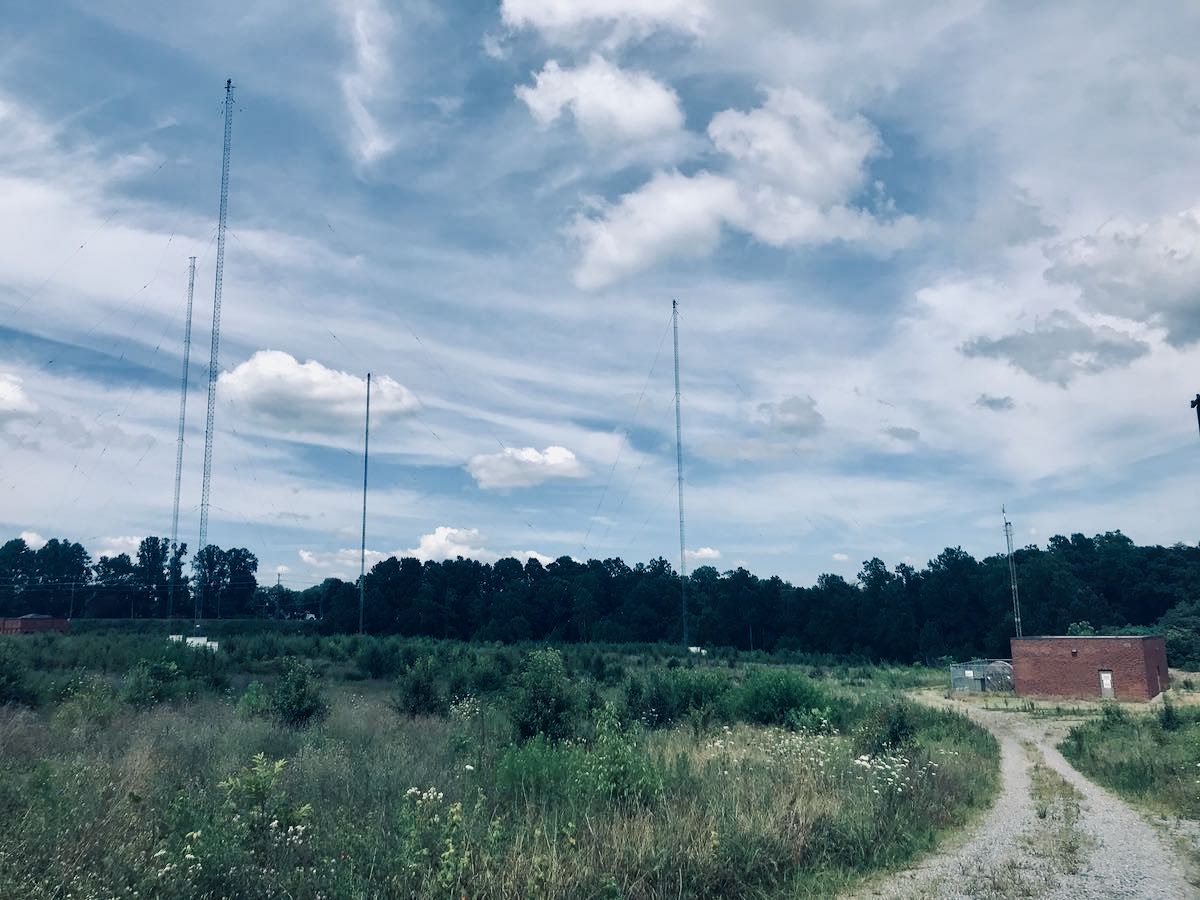
The familiar real estate adage “location, location, location” rings true these days for huge tracts on the outskirts of major cities — sites that for decades housed AM radio towers but that today command top dollar as e-commerce fuels rising demand for new warehouses and logistics centers.

Look no further than the $51 million sale of a five-acre parcel in Queens, N.Y., where an AM radio station will eventually abandon its existing tower and transmitter site, and move it.

New York radio station WFME’s owner, Nashville, Tenn.-based Family Radio, sold its AM transmitter site to Prologis, a San Francisco developer that specializes in building warehouses for companies looking to expand final-mile capability.

This property is situated near the Long Island Expressway, the Brooklyn-Queens Expressway, the Queens-Midtown Tunnel, and La Guardia and JFK airports. The spot’s current value as a logistics hub far outstrips its importance to a broadcast outlet that didn’t register in New York’s most recent radio ratings book.

“Long term, we see this as a strategic move that adds to our growing footprint of high-quality logistics space that offers quick and easy access to consumers.” said Jeremiah Kent, Prologis senior vice president of value added investments. “In one of the most densely populated markets in the world where demand for logistics real estate is high and land is scarce, Prologis is well-positioned to respond to the acceleration of e-commerce and consumers’ expectation for same- and next-day delivery services.”

The rising value of these locations is being driven by changing consumer habits and rapid technological evolution. Sites on the edge of town that in radio’s heyday were cheap and plentiful can now house vital links in a supply chain propelled by technology that was hard to imagine back in AM’s early days.[]

USAGM CEO Names New Leaders for RFE/RL, OCB (VOA)

WASHINGTON – The U.S. Agency for Global Media announced that former VOA journalist Ted Lipien will return to run Radio Free Europe/Radio Liberty and Jeffrey Scott Shapiro, the current acting director at the Office of Cuba Broadcasting, will become director.

The appointments follow USAGM CEO Michael Pack’s December 9 announcement that former Voice of America director Robert Reilly would return to lead that network.

Lipien joined VOA in 1973 and worked as the chief of the Polish language service and later as a senior news and marketing executive until 2006. For 10 years, Lipien worked in Munich and Prague as the Eurasia regional marketing director, helping VOA and RFE/RL place programs on stations across the region. In an announcement sent to staff, he recalled listening to Radio Free Europe while growing up in communist Poland.

“I’m honored, and humbled, to be entrusted with helping this storied organization continue to break the hold of censorship and give voice to the silenced,” he wrote.

Since leaving U.S. broadcasting, Lipien has been a vocal critic of VOA’s and USAGM’s previous leaders. He has also defended Pack’s tenure as CEO, saying Pack has focused on correcting long-running issues of bias and mismanagement at the networks.

Radio Free Europe/Radio Liberty is a nonprofit multimedia broadcasting organization funded by U.S. Congress grants. Based in Prague, it serves as a surrogate media source in 27 languages, mostly in places where a free press remains either banned or not fully established.

Jeffrey Scott Shapiro has been with the Office of Cuba Broadcasting since July 2017. In announcing Shapiro’s new position, Pack cited his deep connections to local communities in South Florida and his track record in producing objective news.

“Transmitting objective news and information to the island plays a critical role in moving toward a free Cuba, and it is a privilege to be a part of such an important mission,” Shapiro wrote in a published statement.

The Office of Cuba Broadcasting oversees Radio and Television Marti, based in Miami, Florida. The network provides news, information and analysis to the people of Cuba via satellite television and shortwave radio, as well as flash drives, DVDs and text messages.

Pack was confirmed by the Senate as CEO in June with a three-year term and fired several news executives upon his arrival. He later declined to testify before a House of Representatives panel examining his decisions at the agency, including his decision to fire the heads of RFE/RL, Radio Free Asia and OCB, and replace their boards. The then-director of VOA, Amanda Bennett, resigned two days before Pack joined the agency.

Last month a federal judge granted a preliminary injunction prohibiting Pack and other USAGM officials from interfering with the editorial independence and First Amendment rights of journalists at VOA and other networks they oversee. The ruling still allows Pack to appoint leaders of those news networks to oversee them.

The November 20 court order prohibits the CEO and other defendants from communicating directly with journalists at the networks without the consent of their directors. The order is part of a lawsuit filed by five USAGM officials whom Pack placed on administrative leave in August. The suit accuses Pack and his political appointees of unlawful actions and of violating the First Amendment and a statutory firewall set up to ensure editorial independence. Pack has said the lawsuit is “without merit” and that all of his and his team’s decisions and actions are “correct and lawful.”

Earlier this month, a federal office set up to protect whistleblowers ordered USAGM to investigate allegations of wrongdoing by its own top officials.[]

All new car radios to have digital terrestrial radio (Southgate ARC)

From today, people purchasing new passenger vehicles across Europe will be able to benefit from the advantages of digital radio – greater choice, clearer audio and enhanced data services.

Article 113, Annex XI in the EECC states that “Any car radio receiver integrated in a new vehicle of category M* which is made available on the market for sale or rent in the Union from 21 December 2020 shall comprise a receiver capable of receiving and reproducing at least radio services provided via digital terrestrial radio broadcasting”.

The regulation applies to all EU member states – regardless of the status of DAB in each country.

Despite the impact of Covid-19, Germany, France, the UK, Italy and Denmark have already introduced laws mandating digital terrestrial radio in cars and other countries are expected to follow shortly.

In the first half of 2020, over 50% of new cars sold in Europe included DAB+ as standard – a number that is expected to reach 100% by the end of 2021 as DAB+ adoption continues to grow across Europe.

More information and regular updates on the EECC directive and its implementation across Europe is available on the WorldDAB EECC factsheet.

*Motor vehicles with at least four wheels designed and constructed for the carriage of passengers

https://www.worlddab.org/news

North Korean fisherman publicly executed for listening to foreign radio (The New Daily)

A North Korean fishing boat captain has been publicly executed for listening to banned foreign radio stations while at sea.

The man, only known by his surname Choi and said to have been in his 40s, was killed by firing squad in front of 100 boat captains and fisheries executives, according to a Radio Free Asia report.

Choi, who owned a fleet of more than 50 ships, is thought to have been turned in by a crew member after they turned against him.

According to the RFA report, Choi ultimately confessed to authorities and was charged with “subversion against the party”.

“In mid-October, a captain of a fishing boat from Chongjin was executed by firing squad, on charges of listening to Radio Free Asia regularly over a long period of time,” a North Korean law enforcement official told RFA.

“They publicly shot him at the base in front of 100 other captains and managers of the facility’s fish processing plants. They also dismissed or discharged party officials, the base’s administration and the security officers who allowed Choi to work at sea.”

The network said the fishing boat captain began his habit of tuning into foreign radio stations, including RFA, while serving as a radio operator in the military. He had listened to RFA – a US-government funded network that broadcasts in Korean – for 15 years.

“The security authorities decided then that the time to re-educate him had long past, so they executed him by firing squad,” the source said.

“It seems that the authorities made an example out of Choi to imprint on the residents that listening to outside radio stations means death.”[]


Do you enjoy the SWLing Post?

Please consider supporting us via Patreon or our Coffee Fund!

Your support makes articles like this one possible. Thank you!

Radio Waves: United Biscuit’s Radio Station, WMAL Towers Demolished, Canada’s First Off-Grid Station, and St. Helena Gets Fiber

Radio Waves:  Stories Making Waves in the World of Radio

Because I keep my ear to the waves, as well as receive many tips from others who do the same, I find myself privy to radio-related stories that might interest SWLing Post readers.  To that end: Welcome to the SWLing Post’s Radio Waves, a collection of links to interesting stories making waves in the world of radio. Enjoy!

Many thanks to SWLing Post contributors Todd R, Skip Arey and Tracy Wood  for the following tips:


Cracker factory records: the surprising story of United Biscuits’ radio station (The Guardian)

Playing Bollywood soundtracks and songs about safety shoes, this shopfloor station made stars out of Dale Winton and Nicky Horne, and paved the way for UK commercial radio

nless you spent your summers packing Jaffa Cakes into boxes in the 70s, you are unlikely to have heard of the United Biscuits Network (UBN). It was a radio station for biscuit-makers, broadcasting around the clock to factories in London, Manchester, Liverpool and Glasgow. One part industrial psychology, another part community radio, UBN was intended to make factory life more bearable, but over its nine-year lifespan, it emerged as one of the most daring, anarchic and pioneering stations to hit the UK airwaves.

Music has long been a point of contention in the workplace. Prof Marek Korczynski, who co-authored Rhythms of Labour (2013), describes the history of British working life as “a battle over soundscapes”. Bosses first wanted silent factories, but during the second world war, Korczynski says, “industrial psychologists – the forerunners to HR departments – started looking at playing cheerful music in factories, at the times of day when productivity would dip”. After the war, as Britain rebuilt itself, this strategy was maintained with muzak: inoffensive background tunes, played to lighten the monotony of factory work.

There was one issue, according to Korczynski: “Workers grew to hate muzak.” As jobs on the production line were deskilled and made ever more monotonous, muzak’s effectiveness weakened and staff turnover soared. For Sir Hector Laing, the chairman of United Biscuits in the 1960s, stemming the flow – and its cost – was desperately necessary. Drawing on the success of commercial pirate stations such as Radio Caroline, Laing put adverts in Melody Maker, bought state-of-the-art broadcasting equipment and set up his very own station from UB’s headquarters in Osterley, west London (where Sky’s HQ sits today).[]

Demolition of Bethesda radio towers takes a piece of history, rare open space (Washington Post)

When the four orange and white steel towers first soared over Bethesda in 1941, they stood in a field surrounded by sparse suburbs emerging just north of where the Capital Beltway didn’t yet exist. Reaching 400 feet, they beamed the voices of WMAL 630 AM talk radio across the nation’s capital for 77 years.[]

Manitoulin boasts Canada’s first off-grid radio stations (Manitoulin Expositor)

LITTLE CURRENT – Great Lakes Country 103 FM and Hits100 FM have opened a new broadcasting studio and office space at the Flat Rock Entertainment Centre, home of Manitoulin Countryfest and Rockin’ the Rock, becoming the first off-grid commercial radio stations in Canada, according to CEO Craig Timmermans.

“It’s super nice to not have an electricity bill anymore,” says Mr. Timmermans as he leads The Expositor on a tour through his company’s new headquarters at 1 Radio Road on the southeastern edge of Little Current.

Through the front doors of the building lies a reception area floating in the centre of a large, open rectangular space. All of the central furniture is moveable so the team can empty the space for special events and small live concerts.

To the right is a small seating area featuring a wood and epoxy tabletop made by Kelly ‘KT’ Timmermans, president of the company. She has also built the live-edge wooden shelving and a table inside the adjacent boardroom.

“This is what I did with my quarantine,” she says with a laugh. “It’s nice to have our own space and to be in charge of our own destiny. We loved being downtown but it didn’t help our business like we had hoped.”[]

Telecom Egypt signs agreement with St Helena Government to provide it with its first subsea solution (Capacity)

02 November 2020: Telecom Egypt and St Helena Government (SHG) have signed an agreement to connect the Island to Telecom Egypt’s subsea system over the Equiano submarine cable system.

Telecom Egypt will be the first to provide St Helena with a fibre optic connection to the rest of the world, which is a crucial step towards the Island’s economic growth. The cable, along with the associated high-speed internet, is planned to be delivered to the Island by early 2022.

The branch that connects Telecom Egypt’s system to St Helena will be 1,140km long. The cable itself will run from the West Coast of Africa and provide St Helena with access to both Lisbon, Portugal and Melkbosstrand, South Africa with scalable connectivity ranging from a few hundred gigabits up to multiple terabits, as demand varies. It, therefore, provides the most cost effective solution to the growth in the Island’s bandwidth needs.

In light of its vast experience in the subsea connectivity business, Telecom Egypt, in conjunction with SHG, will provide a Dynamic Circuit Network functionality, which will ensure that SHG’s communication partners have access to fixed bandwidth.?Telecom Egypt will also support SHG in the design, installation, and configuration of the submarine and network equipment.[]


Do you enjoy the SWLing Post?

Please consider supporting us via Patreon or our Coffee Fund!

Your support makes articles like this one possible. Thank you!
FCC’s AM digital order did not include DRM

This news item expands on our previous post.

(Source: Radio World)

No Luck for DRM in the AM Digital Order

Digital Radio Mondiale was hoping that the Federal Communications Commission would consider allowing its technology as an all-digital option for AM stations in the United States, along with HD Radio. But the FCC disappointed it.

[…]“Many commenters agree that all-digital AM broadcasting should be allowed but object to HD Radio as the sole authorized transmission technology,” it wrote.

“Specifically, commenters urge us to consider the Digital Radio Mondiale all-digital transmission technology on the grounds that it: (1) offers equal or better sound quality to HD Radio at lower bitrates; (2) can transmit metadata as well as emergency alerts, multicast subchannels, and a data channel; (3) is energy- and spectrum-efficient; (4) uses a superior audio codec; (5) is not susceptible to interference; (6) is not owned or controlled by a single company; and (7) has been used successfully in other countries and is the approved technology for shortwave broadcasting in the United States.”

But the FCC said the request was “beyond the scope of this proceeding.”

It said it needed to move expeditiously on this all-digital proposal; and that if parties believe that it should re-evaluate HD Radio and consider alternative technologies, “we would need to evaluate a fully developed proposal including data such as laboratory and field testing, similar to the petition for rulemaking that formed the basis of this proceeding.”[]

Click here to read the full article at Radio World.

FCC Authorizes AM radio stations to operate using all-digital broadcast signals

Many thanks to SWLing Post contributor, Paul Evans, Mike S, and a number of others who have contacted me regarding the FCC’s Authorization of All-Digital AM Radio. Below, you’ll find the FCC press release:


For Immediate Release

FCC AUTHORIZES ALL-DIGITAL AM RADIO

Action Will Improve Listening Experience and Provide Consumers with Enhanced
Services

WASHINGTON, October 27, 2020—The Federal Communications Commission today
adopted a Report and Order that allows AM radio stations to operate using all-digital broadcast
signals. AM broadcasters will be able to voluntarily choose whether and when to convert to
all-digital operation from their current analog or hybrid analog/digital signals.

All-digital broadcasting offers AM listeners significantly improved audio quality and more
reliable coverage over a wider listenable area than analog or hybrid digital broadcasts. It also
allows broadcasters to provide additional services to the public, such as song title and artist
information. These enhancements will enable AM broadcasters to better compete in today’s
media marketplace.

Today’s Order establishes technical rules to protect existing AM broadcast stations from
interference. In addition, stations converting to all-digital operation will be required to notify
the Commission and the public 30 days in advance of their transition. These stations must
provide at least one free over-the-air digital programming stream that is comparable to or better in audio quality than a standard analog broadcast. They also must continue to participate in the Emergency Alert System. The Order envisions that AM broadcasters will decide whether to convert to all-digital operation based on the conditions in their respective markets.

Action by the Commission October 27, 2020 by Report and Order (FCC 20-154). Chairman
Pai, Commissioners O’Rielly, Carr, Rosenworcel, and Starks approving. Chairman Pai, and
Commissioner Rosenworcel issuing separate statements.

MB Docket Nos. 19-311, 13-249

###


Also, check out articles at Radio Insight and Radio World regarding this authorization. 

WNJC DX test starting 04:00 UTC on October 18, 2020

Many thanks to SWLing Post contributor, Bill Hemphill (WD9EQD), who shares the following announcement from Les Rayburn (N1LF):

DX Test This Saturday Night/Sunday Morning– WNJC 1360, Washington Township,
NJ

WNJC 1360 DX TEST– SATURDAY OCTOBER 17 INTO SUNDAY MORNING OCTOBER 18

“04:00 UTC-Midnight Eastern- WNJC will conduct the DX audio test using Morse
Code and sweep tones continuing on our nighttime pattern.

At 0500 UTC- 1 AM Eastern I will be switching to our daytime pattern at 5kw
using 4 towers directional to SSE with the DX audio test concluding at 0600
UTC. From 0600 – 1000 UTC I will be leaving the transmitter in daytime mode
but be playing a mix of 80s – 2010 pop, rock, dance, country and whatever
else I grew up listening to and feel like playing.

Listen for the sweepers between songs of movie & tv show clips along with
our voice-over guy.”

WNJC has tested previously and been heard as far away as the West Coast of
the United States and Canada. Their test signals have also been received in
the UK, Norway, and Spain. Listen for their signal if you get the chance.

Thank you for the tip, Bill!

Using the Icom IC-705 to record a local AM broadcast station

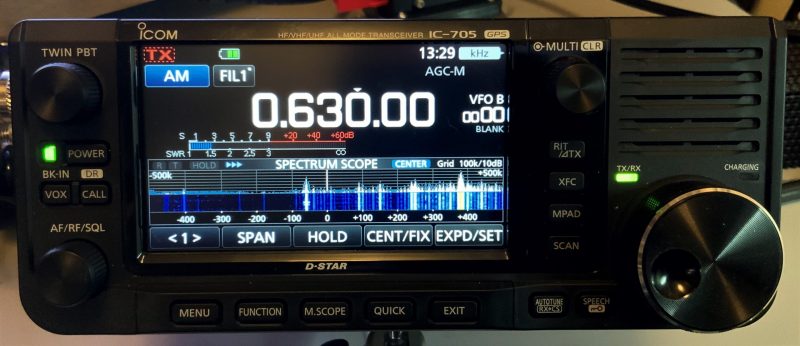
In my previous post, I mentioned how much I enjoy the built-in digital audio recorder in the new Icom IC-705. While I wouldn’t buy a QRP transceiver specifically for built-in audio recording–there are less expensive options out there–it is an incredibly useful feature in my world.

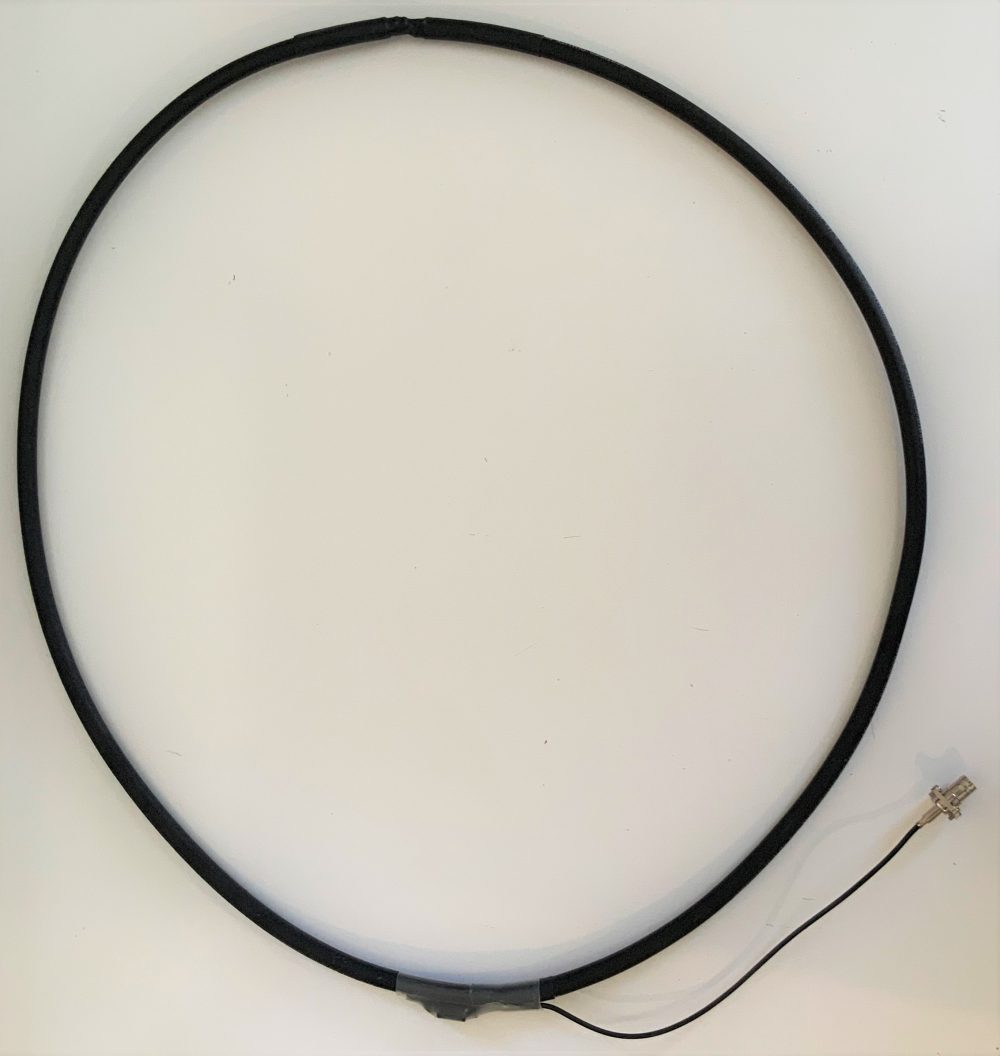
After publishing that post, I was reminded that Monday morning (October 12, 2020) I connected the IC-705 to my homebrew Noise-Cancelling Passive Loop antenna mounted indoors at my parents’ house.

My NCPL antenna

Their house is like so many others in that it is inundated with RFI (radio frequency interference). I find that the NCPL antenna does a fine job mitigating most of that noise on the mediumwave band when I position it so that the bulk of the interference is nulled.

Monday morning, I tuned the IC-705 to my favorite local AM station: WAIZ on 630 kHz.

Weekday mornings, Dave and his “Wacky Wake-Up Crew” always put me in the right mood. They’re incredibly goofy/corny and 100% original.

It’s extraordinarily rare these days to find a local radio station, with local talent, creating a local daily radio show. Almost all of their ads are local, too.

I made the following off-air recording for myself, but decided to upload it for others to enjoy. I’m not sure what the receiver audio EQ or bandwidth filter was set to when I recorded this. It’s not a demo of receiver performance, just a little radio fun.

Enjoy:

NPR listeners shift from over-the-air radio, to streaming content (in a very big way)

Many thanks to SWLing Post contributor, William Lee who shares the following story via Nieman Labs. Note that this is an excerpt from the story and that my comments follow:

Radio listening has plummeted. NPR is reaching a bigger audience than ever. What gives?

This year, for the first time, NPR will make more money from underwriting on podcasts than on its radio shows.

Since the pandemic took hold in the United States, NPR’s radio ratings have taken a nosedive. Half of AM/FM listening in the United States takes place in a car, but between reduced (or eliminated) commutes and social distancing, there’s been a steep decline in the drivers that make up public radio’s traditional broadcast audience.

“People who listened to NPR shows on the radio at home before the pandemic by and large still do,” NPR’s own media correspondent, David Folkenflikreported on July 15. “But many of those who listened on their commute have not rejoined from home. And that threatens to alter the terrain for NPR for years to come.”

Even as its legacy platform’s audience has declined, though, NPR says it is reaching more people than ever. The dip in radio listenership — 22 percent — has coincided with a record number of people turning to NPR on virtually every other platform. More people than ever are reaching NPR through the website, apps, livestreams, and smart speakers (“Alexa, I want to listen to NPR”).

[…]Some of the changes in NPR’s audience mirror what we’ve seen elsewhere in the news industry — traffic to news sites spiked in the early months of the pandemic — but the pandemic’s long-term effects seem poised to have a unique impact on radio listenership.

NPR’s senior director of audience insights, Lori Kaplan, has said public radio’s audience includes a disproportionate percentage of workers who are able to do their jobs remotely during coronavirus shutdowns — and that these professionals are interested in continuing to work from home even after we’ve left coronavirus in the rearview mirror.

“We’re experiencing a sea change,” Kaplan told Folkenflik. “We’re not going back to the same levels of listening that we’ve experienced in the past on broadcast.”

[…]NPR’s leaders have been reading the tea leaves. They’ve seen the studies showing younger generations overwhelmingly use the internet and their phones (not radios) for audio. In other words, they knew this shift was coming. They just didn’t know it would happen all at once.

“It was so clear people’s behaviors were changing,” said Tamar Charney, who leads NPR’s digital strategy. “You’d look at the demographic trends and young people were not listening to radio like older people.”[…]

Continue reading the full story at Nieman Labs.

This is a fascinating report and I’m willing to bet NPR has nothing to lose by being open about listening numbers and platforms compared to some commercial networks.

I’ve spoken with a number of friends in the commercial radio industry and the story is very familiar: since the pandemic especially, less people use over-the-air radio to listen to programming. The majority of over-the-air radio listening is done in the car and with the C-19 pandemic, there’s simply been less driving and commuting.

We radio enthusiasts are unique compared with our neighbors in that we actually have radios in our homes.

There is a trend, though, above and beyond anything pandemic related and it’s hard to ignore: with the proliferation of mobile Internet devices that anyone and everyone carries on their person, consumers prefer and expect on-demand content.  If you have a radio show on an FM station and it’s not offered as a podcast or via one of the streaming networks, you could be missing out on the bulk of your potential audience.

Even though I’m a hard-core radio enthusiast (by pretty much any measure), I appreciate on-demand content. For example, my staple evening news show these days is Marketplace. I prefer listening to the show live at 18:00 local on WCQS (88.1 FM) even though the signal isn’t super strong at my home (fortunately, I’ve got some brilliant radios to pull it in!). At least half of the time, however, family plans intrude on that 18:00-18:30 time slot, so I rely on the Marketplace podcast version of the show which is typically posted thirty minute after the end of their live show. So even though I’m a radio enthusiast, I still rely on streaming content for my favorite news show.

As technology and listener habits shift, I do wonder how local radio stations will adapt.

We’ve a number of SWLing Post community members who work in the radio industry around the world. Feel free to chime in and comment with your thoughts and experience.