Tag Archives: NOAA

Update: Discontinuation of NWS High Seas and Storm Warnings on WWV and WWVH

Many thanks to SWLing Post contributor, Mohamed, who comments with an update about the loss of NWS High Seas and Storm Warnings on WWV and WWVH. Mohamed writes:

The decision to terminate the broadcasts has not been retracted. It has only been delayed to January 31, 2019:

(Source: National Weather Service)

NOUS41 KWBC 151610
PNSWSH

Service Change Notice 18-102
National Weather Service Headquarters Silver Spring MD 1210 PM EST Thu Nov 15 2018

To: Subscribers:
-NOAA Weather Wire Service

-Emergency Managers Weather Information Network -NOAAPORT
Other NWS Partners, Users and Employees

From: Craig Hodan, Chief Dissemination Systems Branch

Subject: Discontinuation of NWS High Seas and Storm Warnings
over NIST Time Frequency Broadcasts Effective January 31, 2019

Effective Thursday, January 31, 2019, at 200 pm Eastern Standard Time (EST) or 1800 Coordinated Universal Time (UTC), the NWS will discontinue dissemination of High Seas and Storm Warnings portion of the National Institutes of Science and Technology (NIST) time frequency broadcasts as issued by WWV and WWVH “shortwave” radio covering the Atlantic, Gulf of Mexico and the Pacific.

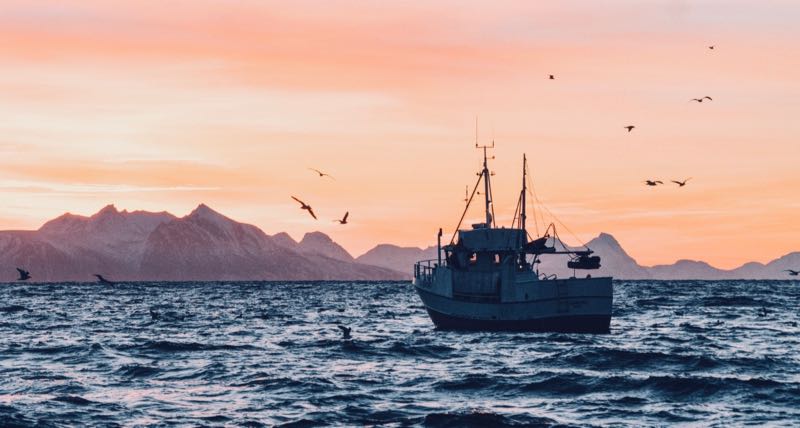
This service is being terminated because weather information in the current broadcast format does not support frequent enough updates for changes in marine weather and cannot provide enough detail in the allotted window required by mariners to avoid hazardous weather. Additionally, alternative technologies and numerous media outlets that provide weather information in various formats have overtaken the need for providing weather information through the NIST frequency signals.

Other sources of marine weather and high seas alerts and detailed forecasts are available over satellite, telephone, the Internet, Marine Fax, Radio Fax and VHF radio. Currently the NWS, U.S. Coast Guard (USCG), and the U.S. Navy (USN) provide multiple dissemination methods for storm positioning, high sea areas, observations, forecasts, outlooks and warnings for both coastal and oceanic marine zones near the United States using Navigational Telex (NAVTEX), Global Maritime Distress and Safety System (GMDSS) and High Seas SImplex Teletype Over Radio (HFSITOR) in compliance with World Meteorological Organization (WMO) policies and the International Safety of Life at Sea (SOLAS) Convention.
Please refer to the following websites for more information on how to use these technologies:

1. http://www.nws.noaa.gov/om/marine/navtex.htm (NAVTEX)

2. http://www.nws.noaa.gov/om/marine/gmdss.htm (GMDSS)

3. http://www.nws.noaa.gov/om/marine/hfsitor.htm HFSITOR)

4. http://www.nws.noaa.gov/om/marine/inmarsat.htm (SAFETYNET)

5. http://www.nws.noaa.gov/os/marine/vhfvoice.htm (USCG VHF)

For additional information, please contact:

Gregory Zwicker
National Weather Service
Dissemination Systems Branch
301-427-9682
[email protected]

National Service Change Notices are online at:

https://www.weather.gov/notification/

NNNN

WWV & WWVH marine storm warning announcements continue

Many thanks to SWLing Post contributor, Richard Langley, who notes that WWV & WWVH marine storm warning announcements continue despite a recent announcement that they would end.

Richard has been monitoring WWV/WWVH broadcasts and shared the following note earlier this month:

The weather broadcasts (storm information) were still there at 8, 9, and 10 minutes past 0:00 UTC on 1 November on WWV as monitored here in NB. Haven’t had a chance to check them since. Are they actually gone? If so, when were the last ones broadcast. The warning at the 4-minute mark hadn’t been heard for days. I’m wondering if the decision to terminate the broadcasts was reversed.

Yesterday, Richard added the following:

[…]And still there on WWV (and presumably WWVH) on 16 November at 03:08 UTC on 10 MHz. So I guess this conclusively means that the proposal to cancel the broadcasts has been rescinded at least for the time being.

Thanks for sharing this, Richard.

Your observation prompted me to check the NOAA Marine Forecast page. I discovered that it has been updated it since the notice to stop marine forecasts was first announced last month.

Before, it stated that the “end of the high seas warnings [is] scheduled for October 31, 2017.” Either NOAA made the decision to end the the forecasts in 2017 and never followed through, else the individual who posted the announcement mistakenly noted 2017 instead of 2018.

NOAA does not note edit dates on this page, so there’s no way of knowing when the page was updated. Regardless, there is no longer a firm termination date mentioned on the page. Now the National Weather Service simply states:

“the NWS is considering a proposal to discontinue this service.”

So I believe, Richard, you are correct: the NWS has at least temporarily rescinded cancellation of the service.

Thanks for following this development, Richard!

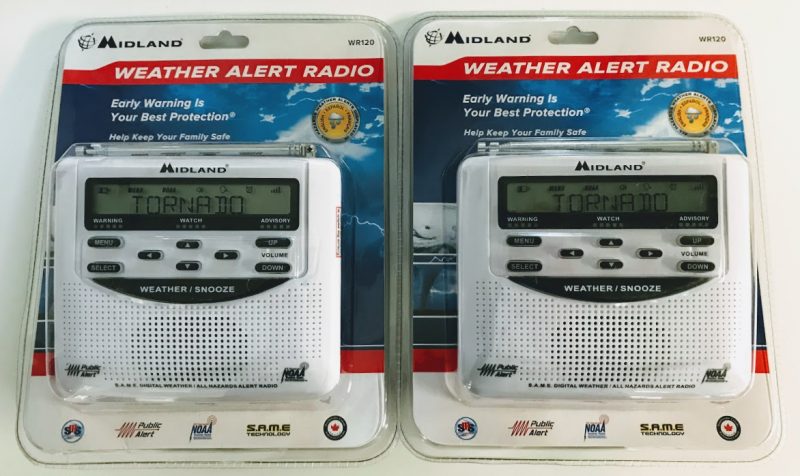
Radio Deal: Midland WR120 weather radios on clearance at Walgreens

Last week, we posted an article about weather radios and Aaron’s assessment of the Midland WR120.

Shortly after publishing Aaron’s post, Nicholas Pospishil commented (on Facebook) that the US pharmacy chain Walgreens has the Midland WR120 on clearance. In fact, his local Walgreens priced the WR120 at $3.50–a phenomenally low price!

I had to investigate this so I stopped by my local Walgreens and searched for the WR120 on the clearance shelf, but there wasn’t one unit to be found. I flagged down the manager at this store–a fantastic guy who’s helped me in the past–and asked if he could check inventory.  He discovered two units tucked away and looked up the clearance price. It was $18.99 in their system. Evidently, store managers have a lot of latitude with clearance pricing and he kindly halved that and set the price to $9.99 each for the two remaining units. I felt like this was a fantastic bargain, so I bought both as Christmas gifts.

If you have a Walgreens near you, I would encourage you to stop by and see if they have any WR120s in stock! These units are only available in Walgreens stores–not on their website. Please report back and comment with pricing!

Click here to find a Walgreens near you.


WWV & WWVH to drop NOAA marine storm warning announcements October 31, 2018

Many thanks to SWLing Post contributor, Dave Zantow (N9EWO), who notes that WWV and WWVH are announcing the end of marine storm warning announcements on October 31, 2018.

This morning, I made the following recording of the announcement via WWV 5 MHz at 4 minutes past the hour:

Last year this time NOAA announced the end of the high seas warnings scheduled for October 31, 2017.

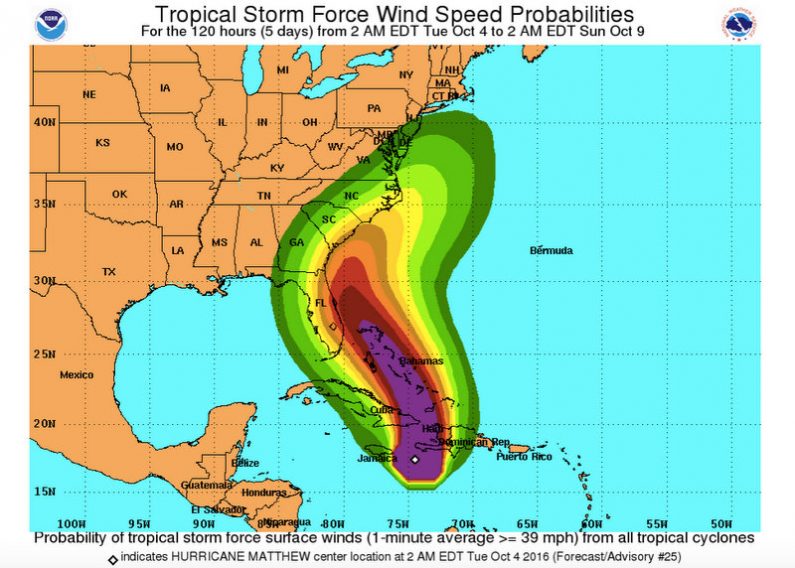
Hurricane Matthew: VOA adds emergency shortwave coverage for Haiti

hurricanematthew

Many thanks to Mauno Ritola who notes the following news via the WRTH Facebook page:

VOA emergency shortwave coverage for Haiti in Creole & English has started as follows via Greenville [North Carolina]:

  • 2200-0200 7305 kHz
  • 0200-1200 7405 kHz
  • 1200-1630 9565 kHz

Last night, I looked at the projected path of Hurricane Matthew. Sadly, Haiti and parts of Cuba will receive the brunt of Matthew’s energy in the Caribbean.

Radio blackout: X-Ray Event exceeds X1

latest_sxi

I’ve heard from several of you this morning that the shortwave bands are dead.

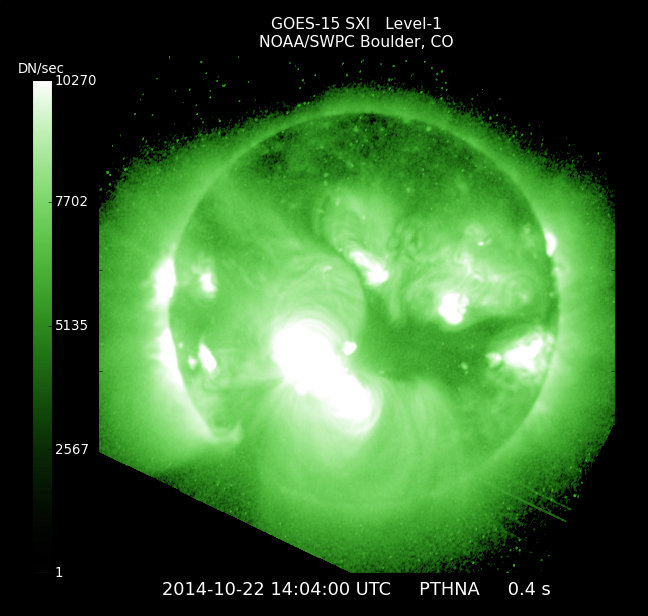
It’s not your radio…it’s our sun. We’re currently experiencing an X-ray event exceeding X1 on the NOAA Space Weather Scale. This equates to wide area blackout of HF radio communication and loss of radio contact for about an hour on sunlit side of Earth.

SWLing Post reader, Richard Langley, shares this space weather alert from NOAA:

Space Weather Message Code: SUMX01
Serial Number: 105
Issue Time: 2014 Oct 22 1454 UTC

SUMMARY: X-ray Event exceeded X1
Begin Time: 2014 Oct 22 1402 UTC
Maximum Time: 2014 Oct 22 1428 UTC
End Time: 2014 Oct 22 1450 UTC
X-ray Class: X1.6
Optical Class: 2b
Location: S14E13
NOAA Scale: R3 – Strong

NOAA Space Weather Scale descriptions can be found at
www.swpc.noaa.gov/NOAAscales

Potential Impacts: Area of impact consists of large portions of the sunlit side of Earth, strongest at the sub-solar point.

Radio – Wide area blackout of HF (high frequency) radio communication for about an hour.

Fear not, this shall eventually pass and SWLing will return to normal. Indeed, you might even catch a few rare band openings between event. I believe you can expect overall unsettled conditions near term, based on recent solar history.

Emergency Preparedness Part 2: All the basics for emergencies

In Emergency Preparedness Part 1: Choosing the right radios, we focused on various types of radios you should consider having on hand in times of disaster. This section focuses on other aspects of emergency preparedness.

Beyond radios

Of course, there’s more to the art of being prepared than simply purchasing a few radios. Being prepared is about having enough supplies, making a plan, and knowing how to get in touch with family/friends, where to meet and what to do should you lose contact. Fortunately, a great percentage of the time, being prepared is about dealing with a few days–not months–of difficult conditions.

What I’m trying to say is, don’t feel like you have to spend a lot of money stock-piling months of food, or buy several bricks of gold to bury at your house (hate to burst your bubble, but gold is, unfortunately, a rotten investment).

Don’t feel like there’s a financial barrier to being prepared, either. It’s easy, and you can gather everything you need in one day.


I find that the Federal Emergency Management Agency (FEMA) has a well thought-through list of items you should have in your preparedness “kit.” I have listed them below (courtesy of FEMA) and included my own comments under some of the suggestions.

FEMA Recommended Items To Include In A Basic Emergency Supply Kit:

    • Distilled water is inexpensive and very easy to store.

      Water, one gallon of water per person per day for at least three days, for drinking and sanitation

      • I suggest purchasing inexpensive gallons of distilled water from your local store. When you bring them home, mark them with the date purchased. Over time, you can use and replace them with new ones.
    • Food, at least a three-day supply of non-perishable food
      • Include a lot of shelf-stable foods ready to be eaten without preparation–trail mix, dehydrated fruits and vegetables, etc.
      • FoodSafety.gov has an excellent guide to preserving, preparing and storing food
    • Battery-powered or hand crank radio and a NOAA Weather Radio with tone alert and extra batteries for both
    • Flashlight and extra batteries
      • Also consider purchasing at least one flashlight that can be hand-cranked
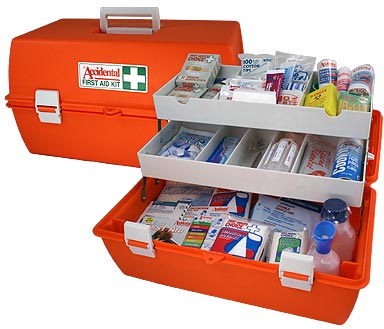
  • A first aid kit is a must–make sure to include any specific medications family members may need

    First aid kit

  • Whistle to signal for help
  • Dust mask, to help filter contaminated air, and plastic sheeting and duct tape to shelter-in-place
  • Moist towelettes, garbage bags and plastic ties for personal sanitation
  • Wrench or pliers to turn off utilities
    • At least have a Gerber or Leatherman tool with a built-in pair of pliers.
  • Can opener for food (if kit contains canned food)
    • Very important–have you ever tried opening a can of food without a can opener? They’re cheap–buy one specifically for your kit
  • Local maps
  • Cell phone with chargers, inverter or solar charger
    • Many of the radios above can charge a USB-based cell phone. If you are looking for a durable solar panel, consider the Goal Zero foldable panel or any roll-up/foldable panel by Power Film Solar.

Additional Items To Consider Adding To An Emergency Supply Kit:

  • Prescription medications and glasses
    • This is extremely important–you should certainly stock up on medical supplies if you’re in the path of a natural disaster like a hurricane. Pharmacies may be closed for several days and you certainly want your prescription heart medication on hand!
  • Infant formula and diapers
  • Pet food and extra water for your pet
    • Don’t forget Rover or Whiskers–!
  • Cash or traveler’s checks and change
  • Important family documents, such as copies of insurance policies, identification and bank account records in a waterproof, portable container. You can use the Emergency Financial First Aid Kit (EFFAK) – PDF, 277Kb) developed by Operation Hope, FEMA and Citizen Corps to help you organize your information.
  • Emergency reference material, such as a first aid book or information from www.ready.gov.
  • Sleeping bag or warm blanket for each person. Consider additional bedding if you live in a cold-weather climate.
  • Complete change of clothing, including a long-sleeved shirt, long pants and sturdy shoes. Consider additional clothing if you live in a cold-weather climate.
  • Household chlorine bleach and medicine dropper – When diluted nine parts water to one part bleach, bleach can be used as a disinfectant. Or in an emergency, you can use it to treat water by using 16 drops of regular household liquid bleach per gallon of water. Please do not use scented or color safe bleach, or bleaches with added cleaners.
  • Fire Extinguisher
  • Matches in a waterproof container
  • Feminine supplies and personal hygiene items
  • Mess kits, paper cups, plates and plastic utensils, paper towels
  • Paper and pencil
  • Books, games, puzzles or other activities for children
    • Often overlooked, but quite important–you may be without power, television and internet for days. You should have a back-up plan for your children. Board games are fun, burn a little time, and require absolutely no batteries!

Other recommendations I would add

  • Fill up your vehicles with fuel.  Indeed, it’s not a bad idea to top-off your fuel on a regular basis.
  • Listen to local radio stations and follow any directions from local officials who are coordinating recovery.
  • Know potential evacuation routes and emergency contact information. This is especially important if you live in an area prone to hurricanes or typhoons

Making a plan and being informed

Being prepared, as I said earlier, is more than just having supplies. It’s about being prepared mentally and having your close family and friends on the same page should disaster strike. Also, you should be well aware of how things are handled locally.
Ready.gov has an excellent guide to making a plan (including downloadable forms) and general information about being informed.
SWLing.com has a lot of guests (almost half of our guests!) who visit us from outside of the USA. The information I have posted above may not be relevant to the place you live (for example, NOAA weather radio).  Still, keep in mind the following:
  • Check to see if your national weather service has specific frequencies with weather or emergency information. If so, make sure you have a radio that can receive these broadcasts.
  • Check with your local emergency management office. If you have any specific needs (medical or otherwise), make sure your local authorities know.

Summary: Preparedness is crucial!

This is, perhaps, one of the longest posts I’ve ever written on the SWLing Post; you can probably tell that I’m an advocate of preparedness.  I hope I’ve shown you that there’s a lot to think about prior to a disaster, whether natural or man-made. It’s not expensive to prepare, but does take a bit of dedicated time and energy.  Once you you do it, though, I promise that you will feel better prepared and more secure than before.  And one more thing:  once you’ve taken care of your own or your family’s needs, please be prepared to help others however you can–sharing and caring is part of any disaster recovery process.