Tag Archives: Radio Waves

Radio Waves: VOA Museum a Historic Marvel, 1BCG Special Event Report, BBC Centenary Celebration, and Czech Radio Turns Off MW and LW

Radio Waves:  Stories Making Waves in the World of Radio

Because I keep my ear to the waves, as well as receive many tips from others who do the same, I find myself privy to radio-related stories that might interest SWLing Post readers.  To that end: Welcome to the SWLing Post’s Radio Waves, a collection of links to interesting stories making waves in the world of radio. Enjoy!

Many thanks to SWLing Post contributors David Iurescia, Mark Erdle, and the Southgate ARC for the following tips:


Voice heard ’round the world: Voice of America museum near Cincinnati a historical marvel (The Columbus Dispatch)

WEST CHESTER, Ohio — Imagine, if you will, a voice so strong that it shakes the very foundations of global tyranny.

In the early days of World War II, a group of Americans, including President Franklin Roosevelt, actor and director John Houseman and Cincinnati entrepreneur Powell Crosley Jr. imagined such a voice, one that could counter Nazi propaganda in Hitler’s own backyard.

They named it The Voice of America.

Today, the National Voice of America Museum of Broadcasting, 8070 Tylersville Road, occupies the site from which the service beamed its message around the world for 50 years beginning in 1944, recounting its history and remembering the people, especially Crosley, who made it possible. [Continue reading…]

100th Anniversary Celebration of the First Trans-Atlantic Radio
Transmission of a Message by Amateur Radio (1BCG.org)

Saturday, December 11, 2021

On a cold winter night on December 11, 1921, members of the Radio Club of America were able to send the first amateur radio message from a small shack in Greenwich, CT to be received by American Paul Godley in Ardrossan, Scotland. This transatlantic test proved the value of shorter wavelengths – long considered worthless to long distance communications and through their success ushered in the age of global shortwave radio communications. The 1921 message was sent one-way. Acknowledgment of Paul Godley’s reception of 1BCG’s massage was sent back to the US via the Marconi high power radio transmitter in Wales.

The Antique Wireless Association, in association with the Vintage Radio and communications Museum of Connecticut (VRCMCT) in Windsor, CT, the Radio Club of America, the American Radio Relay League, and the Radio Society of Great Britain, participated in the 100th Anniversary special events held Saturday, December 11, 2021.

For the 75 th anniversary celebration of the 1BCG accomplishment in 1996, AWA members Bob and Mike Raide constructed a replica of the 1921 transmitter. For this 100th celebration, AWA Museum Staff restored the replica. The VRCMCT in Windsor CT has graciously offered to host AWA operation of the replica transmitter during the evening of December 11th. The 1BCG replica transmitter was placed on public display at the VRCMCT Museum during the day of Saturday December 11, 2021. [Continue reading the full report at the 1BCG website…]

Celebrations to mark the BBC’s Centenary began at midday today (1/1/2022) via shortwave radio (Southgate ARC)

BBC Radio 4 announcer/newsreader, Jim Lee, launched special event amateur radio station GB100BBC, from the BBC’s Broadcasting House, in London, at exactly midday.

Listen to the broadcast:
GB100BBC launches 1st Jan 2022
With thanks to the London BBC Radio Group

Within minutes amateur radio stations around the UK and throughout Europe were clamouring to contact the special BBC station and secure a prized entry in the logbook.

The London BBC Radio Group was granted an extended special event radio licence by the regulator OFCOM, to operate the station throughout 2022.

The amateur radio activity is one of many events organised to celebrate 100 years of the BBC, which began broadcasting from Savoy Hill in 1922 as the British Broadcasting Company, moving to the iconic Broadcasting House in 1932, gaining a Royal Charter as the British Broadcasting Corporation.

The London BBC Radio Group has a growing membership which includes engineers, journalists, producers and on-air talent in both TV and Radio. The group is independent but hosted and supported by the Corporation.

The group was launched in 2017 by a handful of radio enthusiasts to revive a long and rich history of amateur radio at the BBC dating back to the Second World War.

The ‘radio shack’ at the BBC’s headquarters, Broadcasting House in central London, was officially opened by the then Director General, Lord Tony Hall, with an over-the-air message of congratulations. Lord Hall was subsequently bestowed Honorary membership of the club. [Click here to read at the Southgate ARC…]

Czech radio switches off MW and LW as 2022 starts (Mike Terry via the Southgate ARC)

Prague (dpa) – Radio reception on medium wave (MW) and long wave (LW) has been history in many parts of Europe for years.

Now, in the Czech Republic, at least the public broadcaster will stop transmitting on MW and LW as the new year starts on Saturday.

The powerful transmitters on the frequencies 270, 639 and 954 kilohertz could also be received in large parts of Germany.

The reason given for the move was the widespread availability of terrestrial digital radio DAB+ and the high costs of broadcasting.

Those still listening using medium waves were to be persuaded to switch with a campaign. The radio station Cesky Rozhlas set up a telephone hotline to answer questions.

It was not known at first whether the transmitters would be retained or used for other purposes.

The antenna of the medium-wave transmitter Liblice B east of Prague is considered the highest structure in the Czech Republic, with a height of 355 metres.

Impuls, the most-listened to private radio station, wants to remain faithful to medium wave for the time being. It broadcasts its second programme, with pop and country music, on analogue transmission.

Click here to read at DPA-International.com.


Do you enjoy the SWLing Post?

Please consider supporting us via Patreon or our Coffee Fund!

Your support makes articles like this one possible. Thank you!

Radio Waves: Eiffel Tower Radio 100 Years Ago, Raspberry Pi Radio Time Machine, Barrie ARC Thrives in Pandemic, and The Voice of Ganymede via JUNO

Radio Waves:  Stories Making Waves in the World of Radio

Because I keep my ear to the waves, as well as receive many tips from others who do the same, I find myself privy to radio-related stories that might interest SWLing Post readers.  To that end: Welcome to the SWLing Post’s Radio Waves, a collection of links to interesting stories making waves in the world of radio. Enjoy!

Many thanks to SWLing Post contributors Dan Srebnick, the Southgate ARC and Geneva Witherspoon for the following tips:


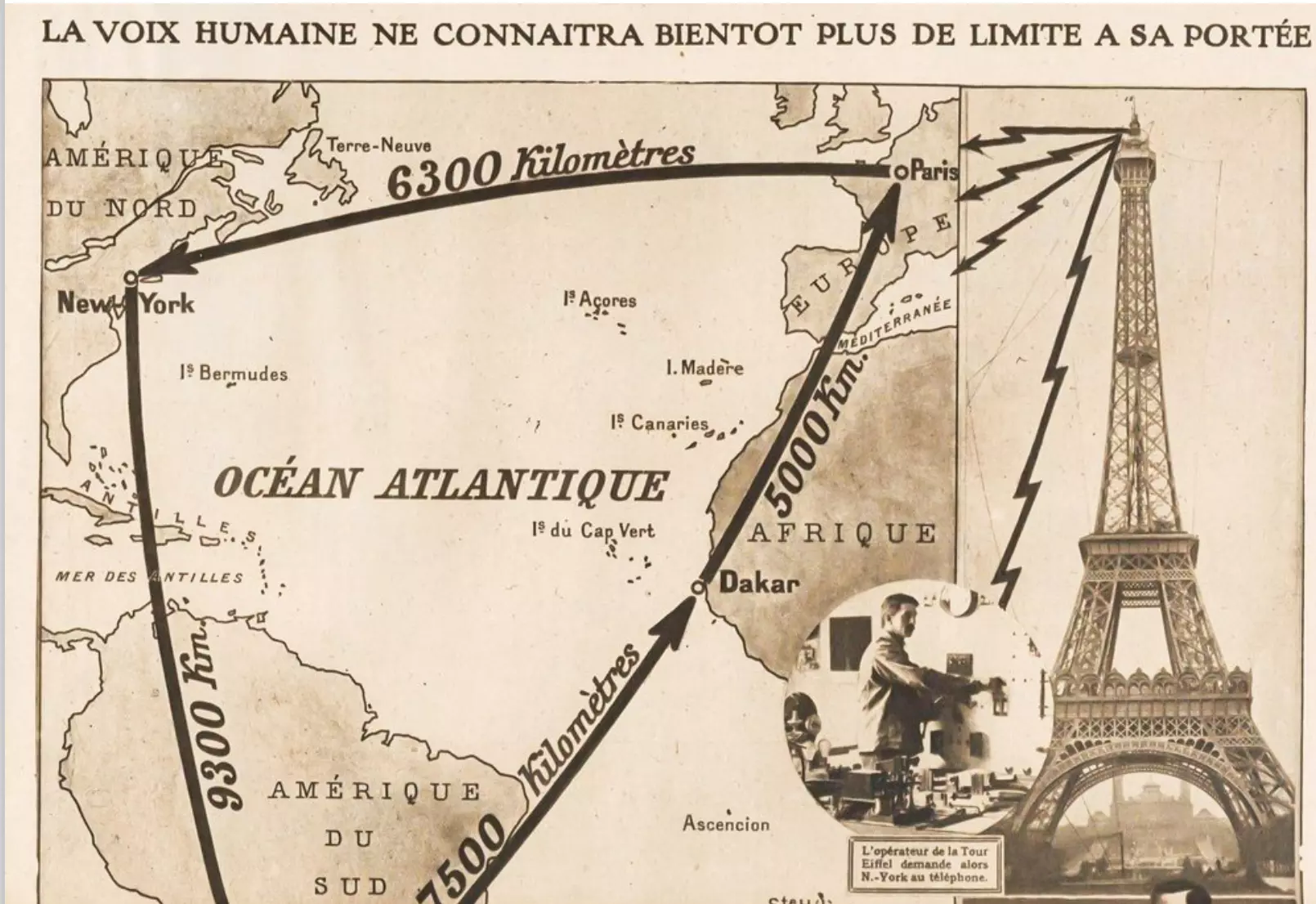
Signal of strength: Eiffel Tower celebrates a centenary of radio broadcast (RFI)

A hundred years ago this week, France’s most famous landmark, the Eiffel Tower, was first used as an antenna for radio programmes. Looming high above the city’s uniform skyline, the tower was an obvious choice to pioneer public radio in France, proving the country’s prowess in broadcast technology.

On 22 December 1921, just three years after the end of WWI, “Radio Tour Eiffel” broadcast its first ever show, a live performance featuring legendary singers.

The trial was the beginning of a long series of broadcasts that continues today, with 45 television stations and 32 FM stations – including RFI – broadcasting from the Eiffel Tower.

According to the Lille-based publication Le Réveil du Nord of 24 December 2021, “a concert by wireless telephony took place at the Lille Theatre”.

Famous artists of that era, the legendary Sacha Guitry, the soprano Jeanne Hatto, the tenor Maurice Dutreix and others sang in a microphone in a room in the Eiffel Tower, from where it was broadcast to a “wireless phone set” in the hall of the Lille theatre.

“A large audience attended this session,” according to the dispatch. [Continue reading…]

Nostalgic Raspberry Pi Radio Tunes to Music From Past Decades (Tom’s Hardware)

The Raspberry Pi makes an excellent gift on its own, but getting one in a custom Time Machine Radio is remarkably fulfilling. This holiday, a maker known as Byte-rider created a custom Raspberry Pi Zero 2 W-powered radio for his father. Continue reading

Radio Waves: First Transatlantic Signal 120 Years Today, 100 Years of German Radio, NASA Laser Communications, and Ham Transmitter on the Moon

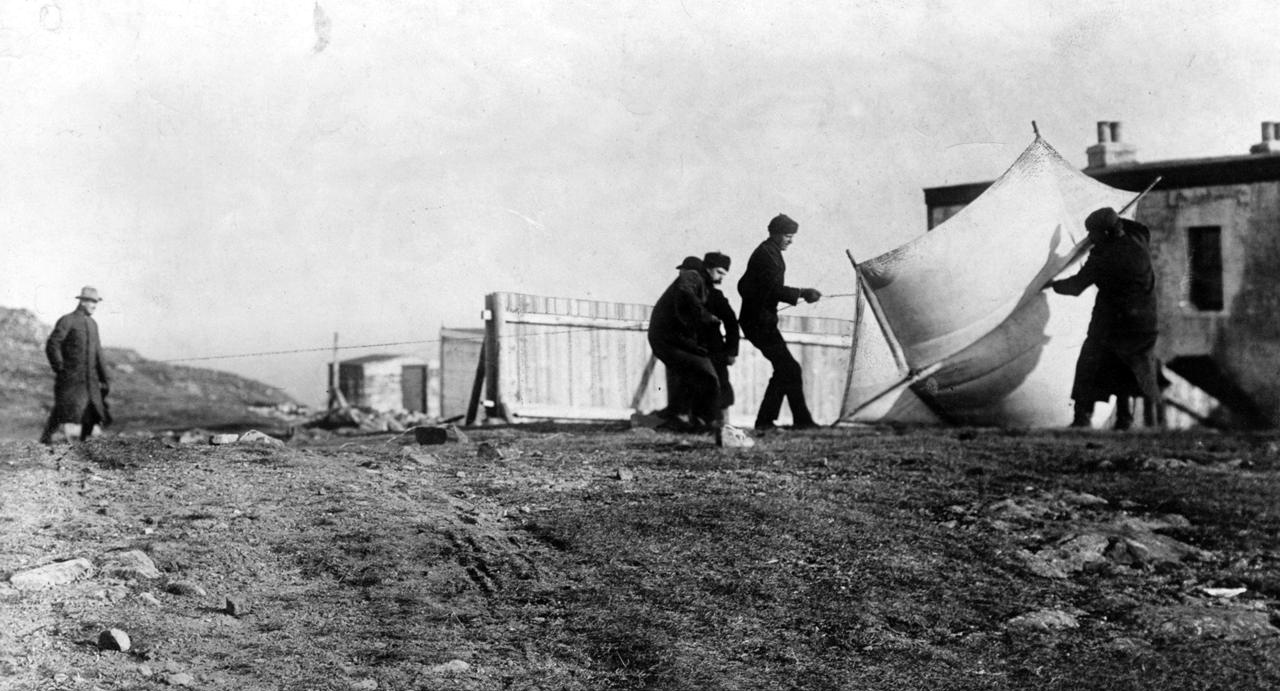
Marconi watching associates raising the kite (a “Levitor” by B.F.S. Baden-Powell[47]) used to lift the antenna at St. John’s, Newfoundland, December 1901 (via Wikipedia)

Radio Waves:  Stories Making Waves in the World of Radio

Because I keep my ear to the waves, as well as receive many tips from others who do the same, I find myself privy to radio-related stories that might interest SWLing Post readers.  To that end: Welcome to the SWLing Post’s Radio Waves, a collection of links to interesting stories making waves in the world of radio. Enjoy!

Many thanks to SWLing Post contributors Trevor R, Andrea Bornino, Wilbur Forcier, and the Southgate ARC for the following tips:


First radio transmission sent across the Atlantic Ocean (History.com)

Italian physicist and radio pioneer Guglielmo Marconi succeeds in sending the first radio transmission across the Atlantic Ocean, disproving detractors who told him that the curvature of the earth would limit transmission to 200 miles or less. The message–simply the Morse-code signal for the letter “s”–traveled more than 2,000 miles from Poldhu in Cornwall, England, to Newfoundland, Canada.

Born in Bologna, Italy, in 1874 to an Italian father and an Irish mother, Marconi studied physics and became interested in the transmission of radio waves after learning of the experiments of the German physicist Heinrich Hertz. He began his own experiments in Bologna beginning in 1894 and soon succeeded in sending a radio signal over a distance of 1.5 miles. Receiving little encouragement for his experiments in Italy, he went to England in 1896. He formed a wireless telegraph company and soon was sending transmissions from distances farther than 10 miles. In 1899, he succeeded in sending a transmission across the English Channel. That year, he also equipped two U.S. ships to report to New York newspapers on the progress of the America’s Cup yacht race. That successful endeavor aroused widespread interest in Marconi and his wireless company. Continue reading

Radio Waves: Life-Changing Song on Radio Australia, NZ Voices in the Air, NIST Test Signal on WWV/WWVH, and 1980s NYC Offshore Pirates

Radio Waves:  Stories Making Waves in the World of Radio

Because I keep my ear to the waves, as well as receive many tips from others who do the same, I find myself privy to radio-related stories that might interest SWLing Post readers.  To that end: Welcome to the SWLing Post’s Radio Waves, a collection of links to interesting stories making waves in the world of radio. Enjoy!

Many thanks to SWLing Post contributors Paul, Dave Zantow, Mark Fahey, Jerome van der Linden, and Phil Brennan for the following tips:


A former Chinese soldier turned artist explains how a song on Radio Australia changed his life (ABC)

It was 1979 and Jian Guo was stationed at a military camp in Yunnan, a province in south-western China bordering Vietnam, when he listened to Radio Australia for the first time.

The then-17-year-old was patrolling the base one night when he saw a group of fellow People’s Liberation Army (PLA) soldiers tuning radio equipment on the back of a truck.

He initially thought they were intercepting enemy signals, but, as he got closer, he realised they were listening to a radio broadcast.

It was the ABC’s international broadcasting service, which was considered an “enemy channel” at the time.

“The so-called ‘enemy channels’ included almost every station outside mainland China,” Guo told the ABC.

“The biggest ones were the VOA [Voice of America] from the US, Voice of Free China from Taiwan, and Radio Australia.”

Guo had joined the PLA in 1979 during the peak of the Sino-Vietnamese War but, thanks to his talent in the arts, he was chosen to be a secretary of his company, so he could avoid fighting on the battlefield.

Apart from painting propaganda materials, he also looked after weapons and communication equipment like the radios, which was an extraordinary privilege.

He was not supposed to use the equipment he maintained, and was fearful of breaking the rules, but after seeing his comrades listening to the Australian broadcast the curiosity grew inside him.

One night, alone in his room, he turned on a radio.

It took a while for him to find the right frequency, because of the interference put out by China, but then suddenly he was listening to Radio Australia and the song that would change his life.

“It was broadcasting The Moon Represents My Heart by Teresa Teng,” Guo said.

“That was the first time I knew such music existed in the world.” [Continue reading…]

Voices in the Air: Sarah Johnston on 100 years of radio (RNZ)

Kia ora koutou k?toa. Thank you to RNZ and National Library for organising this celebration of the start of radio in New Zealand, 100 years ago tonight.

Tonight is something of a game of two halves: first I will talk about the first broadcast of voice and music by radio and the start of radio broadcasting in this country – and then I’m also going speak about a research project I am working on, radio recordings made of New Zealand’s forces overseas during World War II.

I have always been a huge fan of radio, ever since childhood listening to the Weekend children’s request sessions, and then as a teenager, eating my breakfast with Morning Report coming out of the family transistor beside me. As a radio journalist I became one of those voices and worked for RNZ and Deutsche Welle in Germany, where I experienced the power of voices coming out of the air from the other side of the world. And as a sound archivist working with the Radio New Zealand archives, I learnt that that power of the voice doesn’t diminish with time – listening to a voice from 80 years ago can transport you not just through space but also time. Sound to me, has a power that in many ways seems different to that of visual images. Continue reading

Radio Waves: Cassette’s Role in Creation of Internet, AU2JCB Special Event, Joel Hallas (W1ZR) SK, and Shortwave Chatter

Radio Waves:  Stories Making Waves in the World of Radio

Because I keep my ear to the waves, as well as receive many tips from others who do the same, I find myself privy to radio-related stories that might interest SWLing Post readers.  To that end: Welcome to the SWLing Post’s Radio Waves, a collection of links to interesting stories making waves in the world of radio. Enjoy!

Many thanks to SWLing Post contributors Datta (VU2DSI), Kim Elliott, Ron, and the Southgate ARC for the following tips:


How the Cassette Tape Helped Create the Internet (WNYC Studios)

In 1983, Simon Goodwin had a strange thought. Would it be possible to broadcast computer software over the radio? If so, could listeners record it off the air and onto a cassette tape? This experiment, and dozens of others in the early 80s, created a series of cassette fueled, analog internets. Our friend Simon Adler at Radiolab reports.

This is a segment from our November 26th, 2021 program, How Cassette Tapes Changed the World. [Read and listen to this piece at WNYC Studios…]

AU2JCB operation 19 NOV to 14 DEC 2021 (Datta, VU2DSI)

AU2JCB is a special event callsign to commemorate the birth date (30 NOV) & to pay homage & tell about the great INDIAN scientist Aacharya JAGADISH CHANDRA BOSE who is recognized as the “Father of Wireless Communication” by the scientific community of our world.
VU2DSI- Datta Deogaonkar will operate with this AU2JCB special event call sign. Continue reading

Radio Waves: Build a Ham Radio Voice Keyer, Sony TFM1000 Decrustification, Shift at RTHK, and RFE Cold War Thriller “Glória”

Radio Waves:  Stories Making Waves in the World of Radio

Because I keep my ear to the waves, as well as receive many tips from others who do the same, I find myself privy to radio-related stories that might interest SWLing Post readers.  To that end: Welcome to the SWLing Post’s Radio Waves, a collection of links to interesting stories making waves in the world of radio. Enjoy!

Many thanks to SWLing Post contributors Marty, Dennis Dura, Dave Zantow, Al Holt, and Rich Cuff for the following tips:


Build a ham radio voice keyer for the backpack (Nuts and Volts)

I have an MFJ-434 voice keyer that has saved a lot of wear and tear on my vocal cords over the years. It has been a big asset during ham radio contests and when I’ve been calling CQs with reduced power (QRP) transceivers.

One of my new favorite pastimes has been operating QRP radios from remote off-the-grid locations. Most of the time, it’s important to pack only the bare essentials for these mini-DXpeditions. I have never taken the MFJ keyer, primarily due to its size. An “accessory” measuring 6-1/2 x 7 x 2-1/2 inches fills up a lot of backpack. It also weighs a pound and a half. On the other hand, I’m absolutely positive the lack of a keyer has resulted in fewer radio contacts. I always run out of voice before I run out of battery.

Last winter, I was packing a QRP “Go Box” for a trip to Florida. Since that stay was planned to last longer than my normal field trips, I decided to take my MFJ keyer for its first outing. What a difference that keyer made! In less than three months, I worked stations in 31 countries and five continents running a 10 watt transmitter and a dipole antenna!

The enormous number of contacts warranted a closer look at a keyer for shorter field trips. The MFJ-434 has 11 buttons to push, three potentiometers to turn, and two LEDs to show me the keyer is doing what I told it to do. Could I get by with fewer amenities and shrink the size, weight, and power requirements to something more backpack friendly? It was worth an investigation.

The MFJ keyer stores five messages. For field operation, I could live with a single CQ. I found a 20 second record-playback module on eBay for $2.59.

I also found a repeat-cycle timer (variable on and variable off delays) on eBay for $2.38. I could use it to “turn on” the playback message, then turn it “off” for a predetermined period of time before turning it on again.

A relay could be added to key the transmitter’s PTT circuit every time my CQ message was played. The receiver would automatically listen for any replies between messages. (This might actually work!) [Continue reading…]

Sony TFM1000 AM FM SW Vintage Radio Decrustification (YouTube)

Click here to view on YouTube.

Hong Kong Broadcaster’s Swift Turn From Maverick Voice to Official Mouthpiece (NY Times)

RTHK has often set the news agenda with its aggressive coverage of the city. But a Beijing clampdown has changed that, with pro-China coverage filling the void.

HONG KONG — Not long after Patrick Li took over as the government-appointed director of Hong Kong’s public broadcaster, a digital lock pad appeared outside his office entrance.

In the past, the director’s office had been where staffers at the broadcaster, Radio Television Hong Kong, gathered to air grievances with management decisions: programming changes, labor disputes. Now, the lock pad signaled, such complaints were no longer welcome.

For many employees, the closed room was an emblem of the broader transformation sweeping through RTHK, the 93-year-old institution venerated by residents as one of the most trusted news sources in Hong Kong’s once freewheeling media landscape.

RTHK was once compared to the BBC for its fierce editorial independence. But under a sweeping national security law that Beijing imposed last year to silence dissent, many say it now more closely resembles China Central Television, the propagandistic Chinese state broadcaster.[Continue reading…]

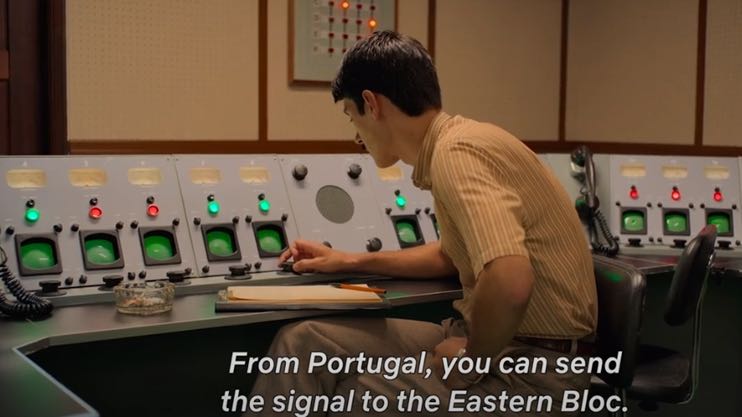
‘Gloria’: Netflix’s First Original Series From Portugal Is A Great Spy Thriller (Forbes)

Netflix has released its first Portuguese original series. Glória is on Netflix since November 5. Produced by the SPi production company of Grupo SP Televisão and co-produced with RTP, Glória is an intense historical spy thriller taking place during the Cold War. It is a high-quality series from Portugal with an intricate storyline.

Set in a small Portuguese village named Glória do Ribatejo in the 1960s, the ten-part series follows João Vidal (played by Miguel Nunes), a young man whose family has connections with the leaders of the Estado Novo, the authoritarian Portuguese Regime. João works as an engineer at RARET, a U.S. re-broadcasting office of Radio Free Europe. The series shows how this small village became “an unlikely Cold War stage where American and Soviet forces fought through dangerous sabotage maneuvers to achieve control of Europe,” the Netflix synopsis explains. João gets recruited by the KGB, and will find himself in the middle of the intricate webs of spy games at play in RARET.

An original series created by Pedro Lopes and directed by Tiago Guedes, Glória is a slow-burning series that is a mixture of historical drama based on real events and espionage thriller. The series paints a dark image of Portugal’s past, its violence toward women and its brutal colonial war. It is the highest budget series in the history of Portuguese production, according to The Portugal News. [Continue reading…]


Do you enjoy the SWLing Post?

Please consider supporting us via Patreon or our Coffee Fund!

Your support makes articles like this one possible. Thank you!
Radio Waves: Radio and Education, Border Blasters, FM Switch Delayed per DCMS, and A Quick Temporary AM Antenna

Radio Waves:  Stories Making Waves in the World of Radio

Because I keep my ear to the waves, as well as receive many tips from others who do the same, I find myself privy to radio-related stories that might interest SWLing Post readers.  To that end: Welcome to the SWLing Post’s Radio Waves, a collection of links to interesting stories making waves in the world of radio. Enjoy!


Can Radio Really Educate? (JSTOR Daily)

In the 1920s, radio was an exciting new mass medium. It was known for providing entertainment, but educators wondered if it could also be used for education.

It was mid-1922 and America was in the midst of the radio craze. Commercial broadcasting had emerged in a handful of cities in 1920, but at that time, few people had a receiving set—except for amateur radio operators, who knew how to build one. It wasn’t even called “radio” back then—newspapers referred to it as “radiophone” or “wireless telephone.” But only two years later, there were several hundred radio stations on the air, and you could purchase a radio in a store—although hobbyists still had fun trying to build their own, with varying degrees of success. Meanwhile, the word “radio” had become the common term for that wonderful new invention that everyone wanted in their home.

Today, we tend to take radio for granted; it is one of many ways to hear music or news or sports. But in 1922, radio was unique: it was the first mass medium to take people to an event in real time, and listeners were amazed by it. Suddenly, they could hear a popular orchestra coming through the radio set. Without leaving their home, they could listen to a baseball game, or an inspirational talk from a preacher; some stations even had the latest news headlines. In an era when traveling from one city to another could take hours (the popular Model T Ford had a top speed of 40-45 mph, and superhighways had not yet come along), listeners could travel by radio, hearing stations from distant cities. Before radio, only the wealthy could attend a concert featuring a famous vocalist, but now, anyone who had a receiving set could hear that singer’s music. And in an America that was still racially segregated, radio gave some musicians of color the opportunity to be heard by thousands of listeners. In magazines and newspapers, radio inspired “utopian hopes and bold predictions.” Writers referred to it as a cure for loneliness—especially for people living in rural areas or on the farm. It was also praised for helping the blind gain greater access to the world around them. More than one writer claimed radio would bring world peace, since everyone would unite around their favorite programs. And of course, as a sign of American progress, it was something no home should be without, not even the White House: President Harding was an enthusiastic radio fan, and had a set installed near his desk, so he could listen whenever he wanted to. [Continue reading…]

Psychics once ruled the airwaves thanks to the Texas-Mexico border and the magic of radio (KUT)

A new book includes details of how powerful radio stations along the border helped former vaudeville actors reach larger audiences.

In the 1920s and ’30s, some of the most popular radio programs in the United States featured radio psychics. The most successful among them made hundreds of thousands of dollars reading the minds and predicting the futures of eager listeners. To do it, they took advantage of a new and mysterious medium: radio. Continue reading