Tag Archives: Voice of America

More 1968 recordings on the Shortwave Radio Audio Archive

IMG_0135I’ve now added a total of five recordings by David Firth, circa 1968, to the SW Radio Audio Archive. Click below for direct links:

Note that you can subscribe to the SW Radio Audio Archive as a podcast via iTunes or by using the following RSS feed: http://shortwavearchive.com/archive?format=rss

BBG tries to improve employee morale

BBG-LogoIn December 2012, we posted a survey from the 2012 edition of The Best Places to Work in the Federal Government by The Partnership for Public Service and Deloitte. The survey indicated that the Broadcasting Board of Governers (BBG) had been ranked in the bottom five places to work in the federal government.

According to the Washington Post, the agency is now working on a plan to boost employee morale. Some of their initiatives include:

“Agency directors and senior staff hold[ing] face-time sessions in the cafeteria for informal talks with employees, a “Civility Campaign” addresses labor-management issues, and a Workplace Engagement Initiative takes a deeper dive into the agency’s low morale ratings.

Some of the morale-boosting events are meant to be fun, such as the raffle during the fitness-center open house, a chocolate bake-off in time for Valentine’s Day, and ?after-work gatherings — a bingo night, happy hour, checkers and chess.

It’s going to take all that and some sustained work to improve the agency’s failing report cards.”

Read the full article on The Washington Post…

Many thanks to Richard Cuff for the tip!

Shortwave Radio Recordings: Voice of America, circa 1968

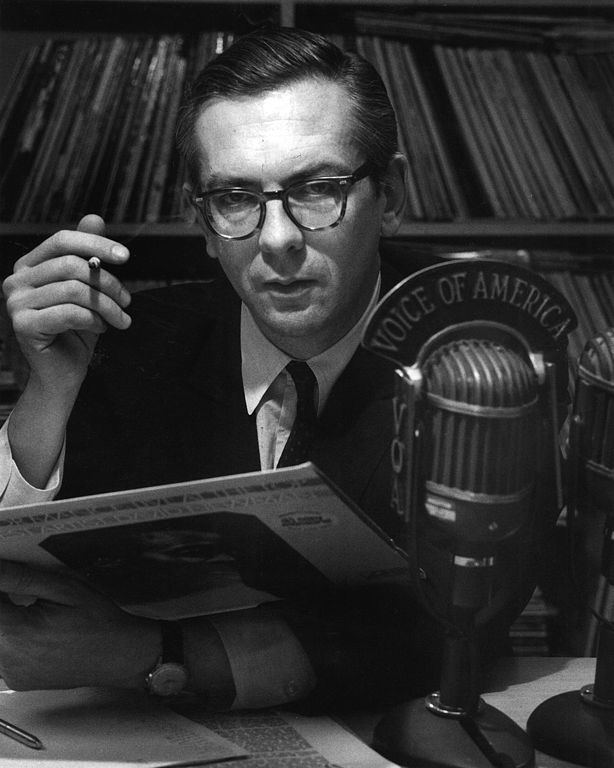
Willis Conover, The Voice of America (Source: Wikimedia Commons)

Many thanks to David Firth, who is kindly sharing shortwave radio recordings he made on reel-to-reel recording equipment in the late 1960s.

Firth is uncovering and digitizing these off air recordings as time allows and, thanks to his generosity, we will be posting these recordings on the Shortwave Radio Audio Archive.

The following is a recording of the Voice of America, which Firth recorded in 1968.

This seven minute recording will surely bring back memories with clips from VOA Jazz Hour (Willis Conover), the VOA Breakfast Show, and VOA Special English.

[Confession: the first time I heard this recording, the Willis Conover clip gave me chill bumps.]

Click here to download the recording as an MP3, or simply listen via the embedded player below:

Check out more recordings on the Shortwave Radio Audio Archive, also check out David Firth’s channel on YouTube.

Want to know more about Willis Conover? Check out David Goren’s podcast for Jazz At Lincoln Center.

BBG changes: US shortwave broadcasts under microscope

voa logoIt appears the Broadcasting Board of Governors (BBG)–the bi-partisan board who oversees all international broadcasts generated by the US government–is making some changes to its structure.

One of those changes will be the formation of a special committee to examine “the efficacy of shortwave radio transmissions.”

See full press release with video of the meeting below:

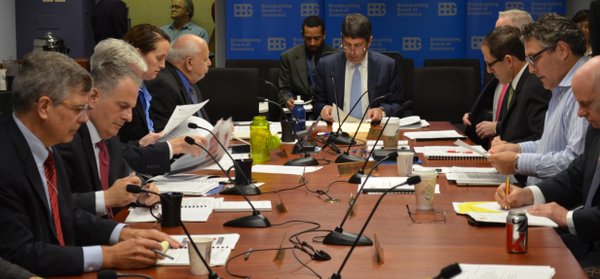
Chairman Jeff Shell chairs the Oct 23 meeting of the Broadcasting Board of Governors (Photo: BBG)

Chairman Jeff Shell chairs the Oct 23 meeting of the Broadcasting Board of Governors (Photo: BBG)

(Source: BBG)

WASHINGTON, DC – As a new member joined its ranks, the Broadcasting Board of Governors today announced a series of restructuring efforts to improve the way the bipartisan board operates.

“The work this agency does is vital, and we must do everything in our power to make sure we as a Board are doing the best we can – not only for our employees, but for the millions of people who depend on the news and information our networks provide,” said the Board’s chair, Jeff Shell.

Shell introduced and welcomed to the Board Kenneth Weinstein, who was confirmed by the Senate in September and sworn in on October 18. He also welcomed Assistant Secretary of State for Public Affairs Douglas Frantz, who was designated by Secretary of State John Kerry – a BBG board member – to represent him at today’s meeting.

Among the changes that the Board adopted is a simplified structure that includes an Advisory Committee and special committees focused on specific strategic issues. Two such special committees were immediately established – one dedicated to defining the responsibilities of and initiating a search for a Chief Executive Officer of U.S. international broadcasting and another to examining the efficacy of shortwave radio transmissions. The Advisory Committee is made up of Governors Shell, Armstrong, Meehan and Weinstein. Governors Shell, Armstrong, McCue, and Weinstein will serve on the Special Committee on the Creation of a CEO, while Governors Armstrong, Crocker, Meehan, and Weinstein now constitute the Special Committee on Shortwave Broadcasting.

With this meeting, the Board began using a consent agenda to adopt items of business that are non-controversial or routine. From now on, Board members will consider and vote on items of business as a group, though any member can request that an agenda item be considered separately. The use of the consent agenda, as well as a revised Board travel policy that was also adopted, were among the recommendations of the Office of Inspector General in its January 2013 inspection report.

The Board also announced the selection of Paul Kollmer-Dorsey as the agency’s General Counsel. Kollmer-Dorsey joined the BBG as Deputy General Counsel and Acting General Counsel in June 2009. Prior to joining BBG, he served as Senior Vice President, General Counsel and Corporate Secretary of Global Relief Technologies and worked for a dozen years in the international satellite communications industry. He earned his law degree from the Stanford School of Law.

And after three years with the BBG and decades of distinguished public and private sector service, International Broadcasting Bureau Director Richard Lobo announced his retirement, effective on November 30. Board members expressed their gratitude for his service and leadership during a period of budgetary challenges.

“The agency and, in fact, the country owes Dick a debt of gratitude for what he did at the IBB,” Shell said. “Dick was instrumental in developing the proposal for establishing a CEO to streamline the agency as well as leadership of the IBB during a challenging period of uncertainty and tightening budgets.”

Lobo thanked Shell and the other Board members and read from the letter he had just sent to President Barack Obama: ”The proposed implementation of the plan, which I helped formulate, to create the position of CEO and to subsequently abolish the IBB Director’s position creates the ideal time for me to step aside. After more than five decades in broadcasting, I intend to retire and return to my native state of Florida.”

Turning to the latest events affecting U.S. international media, Shell acknowledged the hard work and sacrifice required of BBG employees during the partial government shutdown that ended on Oct. 17. Despite the furloughing of approximately 40 percent of the agency’s federal workforce, programs were produced and distributed around the world uninterrupted.

In addition to the administrative challenges of operating during the shutdown, Shell took time to acknowledge how in recent months, journalists across the BBG’s broadcast regions have been harassed, threatened, and wrongly detained as a result of their work.

The simple act of reporting on public demonstrations or events has brought physical attacks on a Radio Free Europe/Radio Liberty (RFE/RL) reporter and a Voice of America (VOA) reporter in Herat province of Afghanistan, the detainment and release of correspondents for RFE/RL in Astana and in Minsk, and the arrest and beating of a VOA correspondent in Angola.

In Iran, officials have continued harassment against VOA and Radio Farda journalists and their families, and in an attempt to intimidate the press and control coverage of elections, Azerbaijan’s ruling political party has targeted RFE/RL and VOA broadcasts with complaints of illegal electioneering.

The Board also called for the immediate release of Alhurra TV reporter Bashar Fahmi as well as other journalists being held incommunicado in Syria. Fahmi has not been seen or heard from since he went missing while reporting in Aleppo, Syria in August 2012.

“The people who make up this agency are some of the most dedicated, courageous and selfless people I have ever known,” Shell concluded. “No hardship, whether it is a partial government shutdown, or unjust incarceration can stop the good work of our workforce. And for that we thank you.”

The Board paused to pay tribute to two distinguished colleagues who recently passed away – Jack Payton, an esteemed and accomplished newsman and senior editor at VOA, and Dave Strawman, recently retired manager of the BBG transmitting station in Tinang, the Philippines.

Video of October 23, 2013 BBG board meeting:

A photo tour of the VOA radio shack, K3VOA

Last week, I visited my friend and fellow radio enthusiast, Dr. Kim Elliott, at the Voice of America headquarters in Washington DC. Kim gave me a tour of K3VOA, the ham radio club station of the Voice of America. K3VOA has a full ham shack, QSL card gallery, an SWLing station, some vintage gear and they even run a repeater site. Kim also took me on the roof to view the K3VOA antenna farm; not only is it impressive, but so, too, is the view of the Capitol Building.

Here is a gallery of the photos I took–click on the image to enlarge:

VOA Radiogram, 7-8 September 2013: Fldigi, Flmsg, Flamp, RSIDs, MFSK

VOARadioGram(Source: VOA Radiogram)

VOA Radiogram for the weekend of 7-8 September 2013 will include more experiments with RSIDs, the brief signals that automatically switch your decoding software to the correct mode.

For best results, please install Fldigi 3.21.75 from w1hkj.com. When you have 3.21.75 installed, go to Configure > ID > RsID, and adjust Errors to 0 (zero). This will prevent Fldigi from flipping to another mode while decoding our MFSK transmissions. For more information about this, seewww.w1hkj.com/FldigiHelp-3.21/ConfigID.html

Please also download the latest versions of Flmsg and Flamp (2.1.00) from w1hkj.com.

This weekend’s VOA Radiogram will include another transmission in MFSK128. This will be done mainly to see if the RSID works. However, to improve the chances for a successful decode of the very fast MFSK128, it will be in Flamp format. A paragraph will be divided into seven blocks of 64 characters each. And it will be transmitted three times, with the second and third passes filling in any blocks with incorrect checksums. Make sure Flamp is running before the MFSK128 transmission begins; it does not turn on automatically like Flmsg.

The foreign language for the weekend will be Spanish, with brief VOA news items in both plain text and Flmsg formatted. Please turn off and restart Fldigi before each of this weekend’s VOA Radiogram broadcasts to ensure the accented Spanish letters display correctly. You will need the UTF-8 character set. The adjustment can be found via Configure > Colors & Fonts.

In the Flmsg-formatted Spanish news story, you will see several html codes such as í for the accented characters. They might look like decoding errors, but the story should look OK when the web page renders.

To make Flmsg work with Fldigi, in Fldigi: Configure > Misc > NBEMS — Under Reception of flmsg files, check both boxes, and under that indicate where your Flmsg.exe file is located.

Here is the lineup for VOA Radiogram, 7-8 September 2013:

3:55  MFSK16: Program preview

2:09  MFSK32: VOA Spanish news re old iPhones

3:41  MFSK32/Flmsg: VOA Spanish news re new iPhone model

2:29  MFSK64: VOA News re Al Jazeera in Egypt

2:48  MFSK32: YouTube screen capture of Al Jazeera

:50  MFSK32: Introduction to MFSK128 item

1:30  MFSK128/Flamp: Brief description of VOA

:45  MFSK32: Introduction to MFSK64

2:55  MFSK64: VOA News re LADEE moon mission

2:56  MFSK32: Artist’s rendition of LADEE spacecraft

1:11  MFSK16: Closing announcements

:41  MFSK32: VOA Radiogram logo

:20  Surprise mode of the week

Please send reception reports to [email protected].

VOA Radiogram transmission schedule

(all days and times UTC)

Sat 1600-1630 17860 kHz

Sun 0230-0300 5745 kHz

Sun 1300-1330 6095 kHz

Sun 1930-2000 15670 kHz

All via the Edward R. Murrow transmitting station in North Carolina.

There will also be a minute of MFSK32 on The Mighty KBC, via Germany, Saturday at approximately 1130 UTC on 6095 kHz, and Sunday at approximately 0130 UTC on 7375 kHz (Saturday evening 9:30 pm EDT).

Also check out their post:  Base64 VOA logo via MFSK128: a few unexpected successes. Fascinating!

The view from the Voice of America

VOA-Roof - DC

Click to enlarge

Today, I visited the Voice of America in Washington, DC and had lunch with my good friend and fellow shortwave radio enthusiast, Dr. Kim Andrew Elliott, creator of the VOA Radiogram. Besides giving me an update on the success of the VOA Radiogram broadcasts, Kim took me to the roof of the VOA building on Independence Avenue, so that I could check out the antenna farm of the VOA Ham Radio Club (K3VOA). I took several photos on my DSLR camera and will post them here upon my return.

While up there, I couldn’t help but note this incredible view of the Capitol Building; I snapped this quick shot–which can’t do it justice–with my iPhone.