Author Archives: Thomas

Guest Post: Pavel’s Raspberry Pi-based homemade multimedia internet radios

Many thanks to SWLing Post contributor, Pavel Kraus, who shares the following guest post:


Raspberry and internet radio


by Pavel Kraus

Raspberry and Volumio

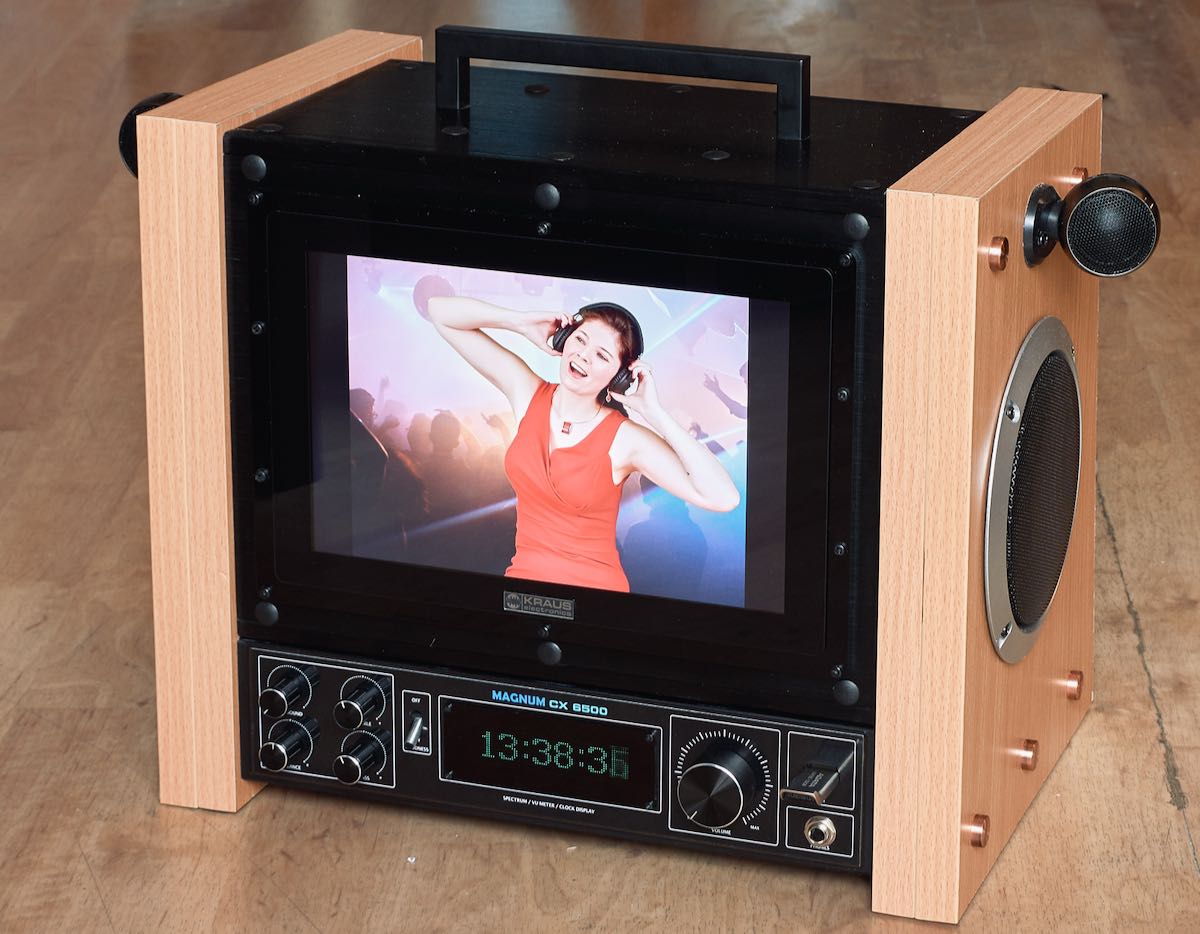
I recently read an article about a Raspberry microcomputer here and I would like to introduce you to an idea that is easy to implement, not too expensive and does not require special computer knowledge due to the number of detailed instructions on the Internet. With Raspberry and the Volumio free software audiophile system, it is possible to design devices that allow you to play music files from connected or network storage or listen to Internet radio, etc. You can also play music from Spotify using the available plugins.

The system can be controlled by touch from the built-in display, from a mobile phone or tablet or by remote control. There are a huge number of internet radios, you can search them by genre or by country. For example, radio stations in the United States are categorized by  state, in each state by city, and we can select individual stations in that city.

Volumio is the name for the project, which is presented at https://volumio.com/en/.

There is also the option to download this software and install it on a microSD card. Detailed documentation is available at https://volumio.github.io/docs/, so I will not describe it in detail here, the installation itself is not complicated. I used the following components to make this device: Continue reading

Guest Post: Mark explores a 1983 Voice of America information pack

Many thanks to SWLing Post contributor, Mark Hirst, who shares the following guest post:


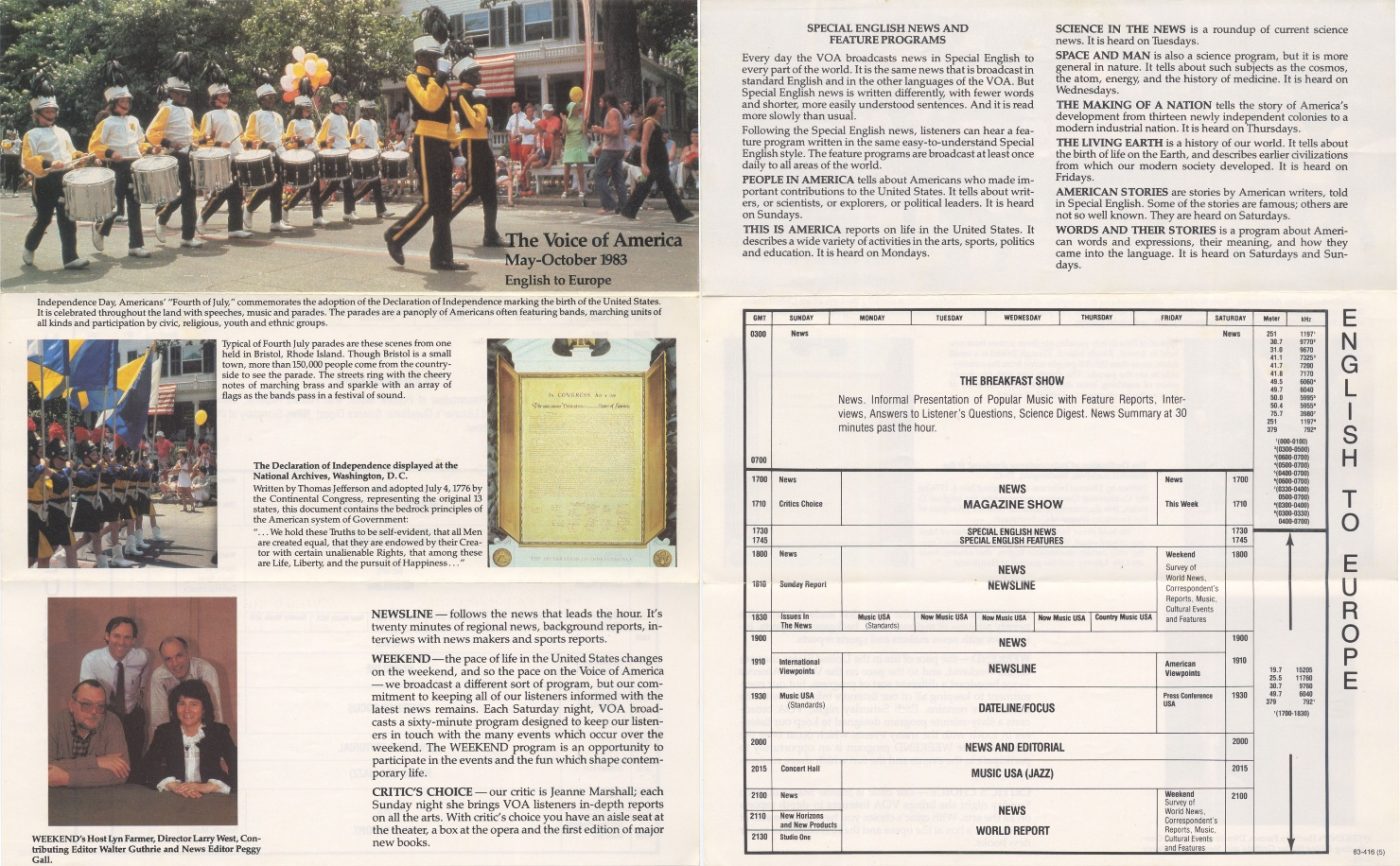
VOA Information Pack 1983

by Mark Hirst

Introduction

A recent guest post on this blog by Jock Elliott asked the question, ‘Why Listen to Shortwave?’

The comment I left at the time was my interest in how nations view themselves, and how they project that view to the world. This might be in the form of cultural exports like music, or teaching us about famous people or revered institutions in their country.

When I first started listening to shortwave in the early eighties, I never got into the habit of asking for QSL cards, being quite thrilled enough to receive programme guides in envelopes stamped with the postmark of other countries.

At the time, the primary stations for me included Radio Netherlands, Radio Sweden, Swiss Radio International, and the Voice of America. While most might send a small leaflet about their country with a frequency schedule, the information pack I received from the Voice of America stands head and shoulders above the others.

I thought readers might be interested in a brief description of this pack and with it a glimpse back into the world of 1983.

Please note that as you read the following sections, you can click on the images to view a larger version.

Package Contents

The package arrived in a manila envelope, with the logo and address of the VOA printed in the top left corner. In the top right corner is the logo of US Mail, with a declaration that postage and fees where paid for by the US Information Agency.

Package contents included:

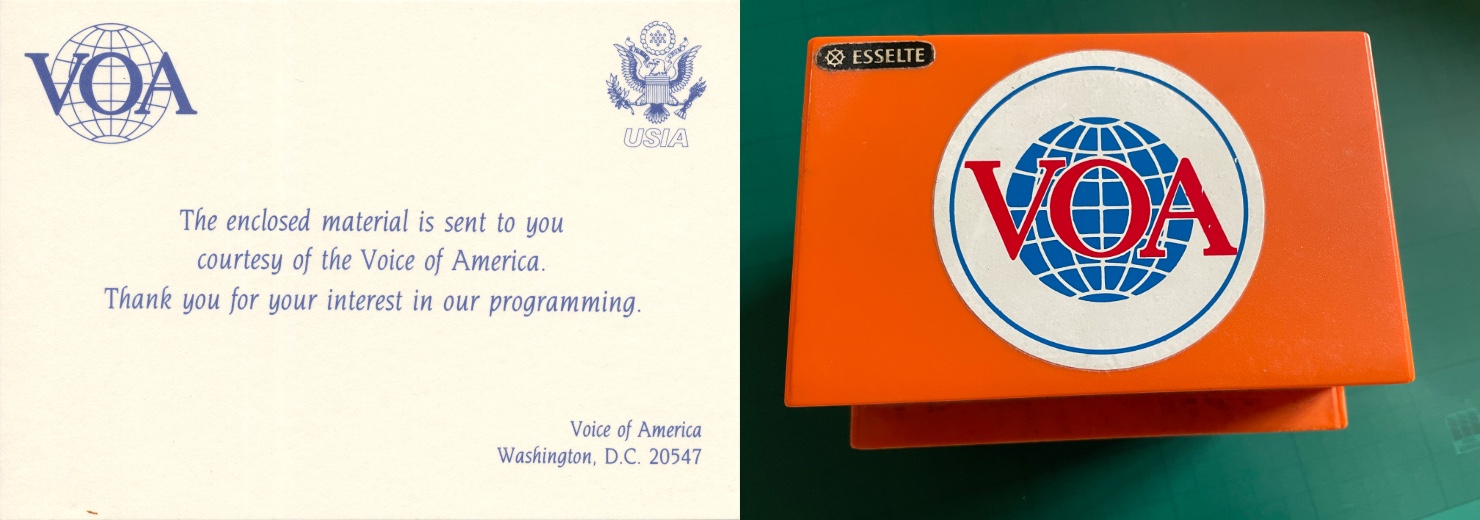
  • Compliments Card
  • VOA Sticker
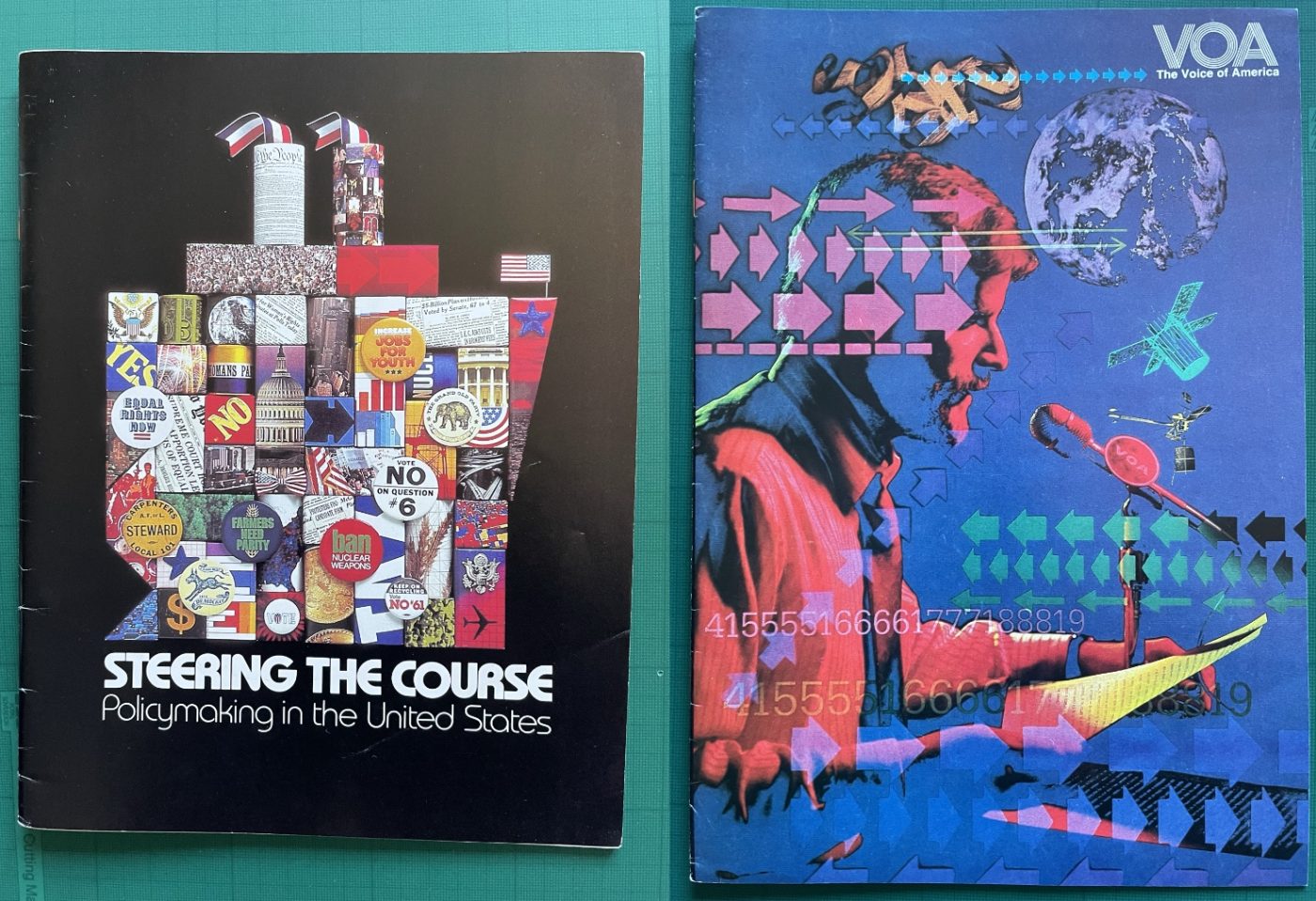
  • Steering the Course Magazine
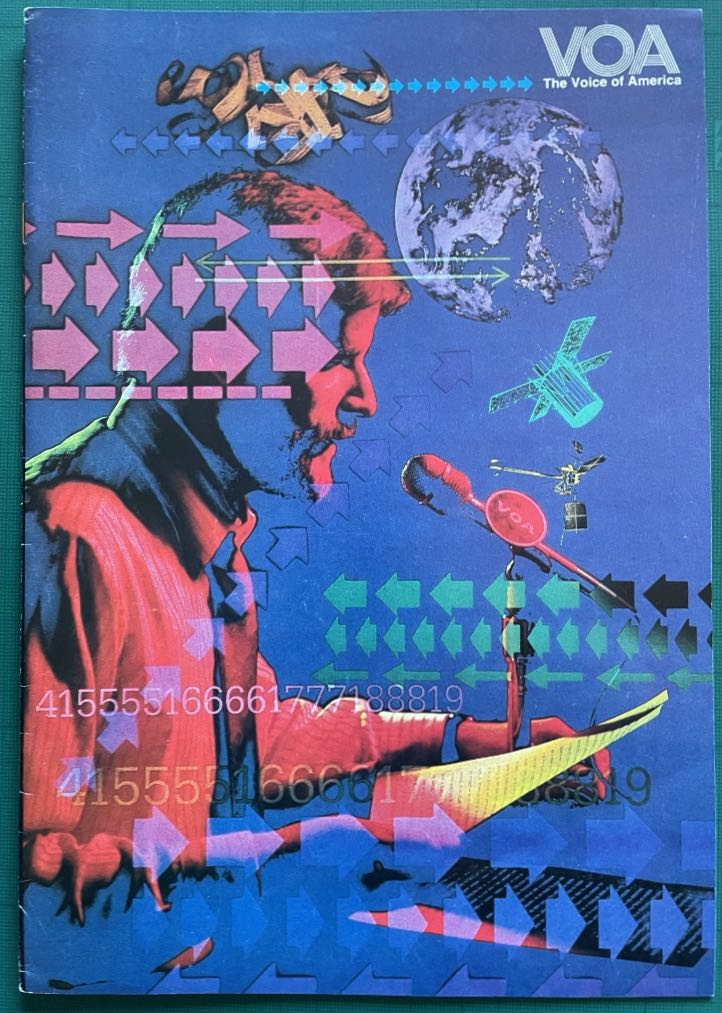
  • VOA Magazine
  • May-October 1983 Programme Schedule

VOA – The Voice of America

This guide begins by outlining the mission of the VOA, emphasising its aim to be an authoritative and reliable source of news. Continue reading

Radio Waves: Data RX via Web SDRs, Mystery Signals from Space, Public Media’s role in Democracy, and Pirates SPAM UVB-76

Radio Waves:  Stories Making Waves in the World of Radio

Because I keep my ear to the waves, as well as receive many tips from others who do the same, I find myself privy to radio-related stories that might interest SWLing Post readers.  To that end: Welcome to the SWLing Post’s Radio Waves, a collection of links to interesting stories making waves in the world of radio. Enjoy!

Many thanks to SWLing Post contributors Marty, Troy Riedel, and Rich Cuff for the following tips:


Receiving data with web based shortwave radios (Nuts and Volts)

Your computer and the Internet give you free access to over 100 web based shortwave receivers that you can use as if they were your own. Unfortunately, employing these radios to decode data transmissions can be very difficult or impossible — unless you know the secret.

[…]A while back, I discussed how to receive data signals with a low cost shortwave radio (N&V May 2015). Now, the concept takes on a new dimension since we are using virtual radios not in our possession.

As astonishing as it seems, many of these Web based shortwave receiver data signals can be processed and decoded using just your PC and some free decoding software. Yes, some signals are encrypted, and can’t be decoded. Fortunately, there are plenty of unencrypted data signals around to keep us busy for a long time.

However, as will be discussed later on, it does require a special trick to allow you to pipe the streaming audio signals from the Web to the decoding software. In this article, I will show you how to use these Web based shortwave receivers to access data transmissions and to get started in this exciting hobby. [Click here to read the full article…]

Unknown objects at the heart of the Milky Way are beaming radio signals, then mysteriously disappearing (Business Insider)

Ziteng Wang found a needle in an astronomical haystack.

Wang, a physics PhD student at the University of Sydney, was combing through data from Australia’s ASKAP radio telescope in late 2020. His research team had detected 2 million objects with the telescope and was classifying each one.

The computer identified most of the stars, and the stage of life or death they were in. It picked out telltale signs of a pulsar (a rapidly rotating dead star), for example, or a supernova explosion. But one object in the center of our galaxy stumped the computer and the researchers.

The object emitted powerful radio waves throughout 2020 — six signals over nine months. Its irregular pattern and polarized radio emissions didn’t look like anything the researchers had seen before.

Even stranger, they couldn’t find the object in X-ray, visible, or infrared light. They lost the radio signal, too, despite listening for months with two different radio telescopes. [Continue reading…]

Do countries with better-funded public media also have healthier democracies? Of course they do (Nieman Lab)

But the direction of causality is tricky. Do a democracy’s flaws lead it to starve public media, or does starving public media lead to a democracy’s flaws?

There’s a new book coming out in the U.K. this week called The BBC: A People’s History, by David Hendy. Its publisher calls it a “monumental work of popular history, making the case that the Beeb is as much of a national treasure as the NHS…a now global institution that defines Britain and created modern broadcasting.”

Cross the pond: While Americans generally like PBS and NPR, I wouldn’t expect them to come up quickly if you asked someone on the street to begin listing national treasures. (I’m even more sure America’s health care system would go unmentioned, too.) Who “created modern broadcasting” in the U.S.? It certainly wasn’t the two public broadcasters that didn’t hit airwaves until 1970. And what TV network is a “global institution” that “defines” the United States abroad? Apologies to PBS Newshour, but that’s CNN.

No one says “Auntie Peebs.”

It’s obvious that the U.S. approached the new broadcasting technologies of the 20th century in ways wildly different from their European peers — and in ways that reflect on the countries themselves. American radio began wild and unregulated, experimental, a bubbling font of creativity — and then quickly became commercialized, optimized for mass audiences and massive profits. The BBC, which turns 100 this year, was more structured, more statist, more controlled — but has remained more central to residents’ lives, more civic-minded, and more beloved. [Continue reading…]

Pirates Spammed an Infamous Soviet Short-wave Radio Station with Memes (Vice)

The UVB-76 numbers station took a break from being a suspected communications tool of Russian intelligence to blast ‘Gangnam Style’

Pirates hijacked an infamous short-wave radio station, which dates from the Soviet era but is still online today, and used it to broadcast everything from Gangnam Style to audio that draws memes when inspected under a spectrum analyzer.

For decades the numbers station known as UVB-76 has emitted an enigmatic series of beeps and a voice reading numbers and names, in what people suspect is a long running communications method for Russian intelligence. Since the broadcast is public, pirates are able to use their software-defined radio (SDR) transmitters to effectively flood the frequencies with noise and memes.

The recent barrage of attacks on the station come as Russia prepares to invade neighbouring Ukraine, where radio enthusiasts speculate at least some of the pirate broadcasts originate. [Continue reading…]


Do you enjoy the SWLing Post?

Please consider supporting us via Patreon or our Coffee Fund!

Your support makes articles like this one possible. Thank you!

Guest Post: Comparing the Reuter Pocket and the Icom IC-705 from an SWL’s perspective

Many thanks to SWLing Post contributor, Uli (DK5ZU), who shares the following guest post:


SWL with a Reuter Pocket and the Icom IC-705

by Uli (DK5ZU)

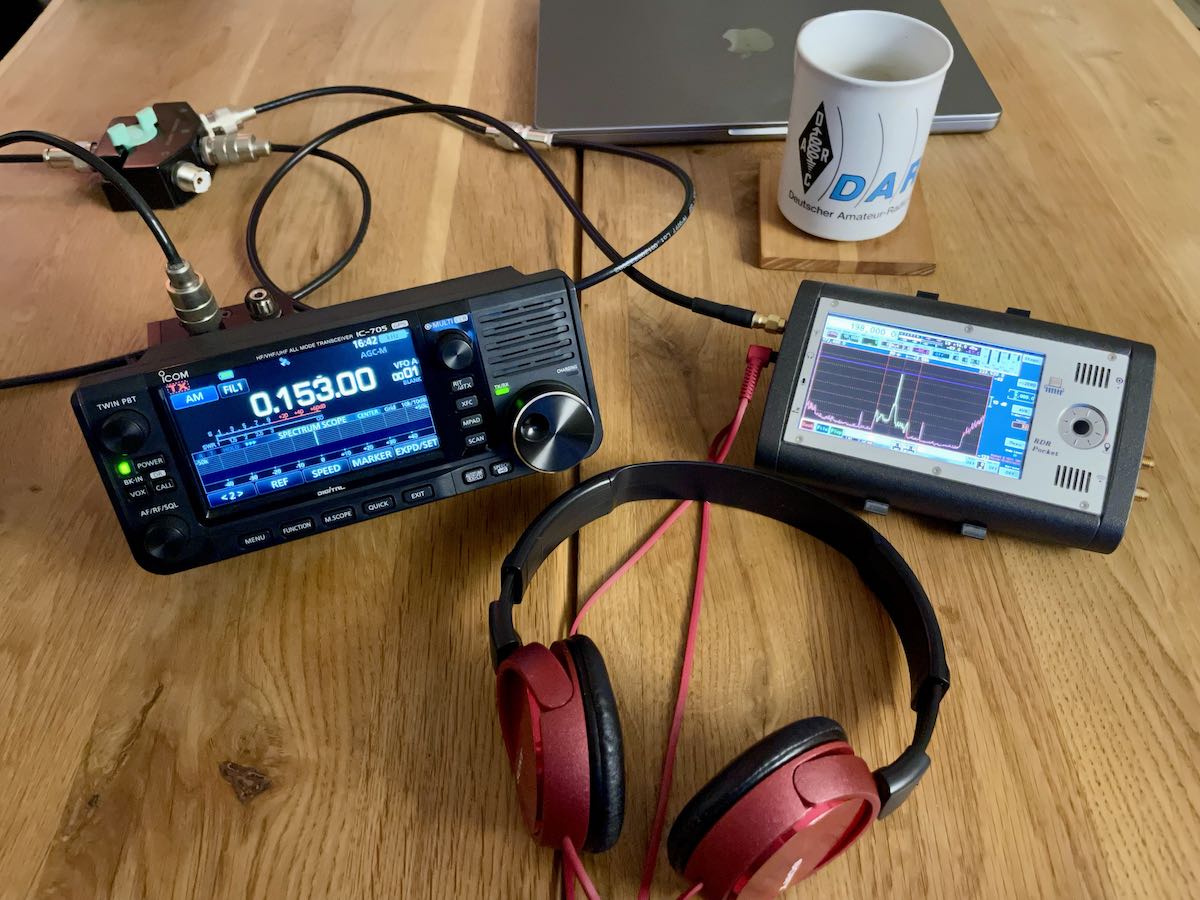
Some time ago I asked how the IC-705 performs on longwave and I got some great feedback. Thanks a lot again. Since the HAM bug bit me again, I wanted to do SWL and HAM Radio portable with one rig. I started with SWL some weeks ago (just before the bug bit). I acquired a second hand Reuter Pocket RDR 51 Version B2. It is a standalone SDR Receiver 0 … 30 MHz / 50 ..71 MHz, and in my B2 version it has also FM (Stereo/RDS) and Digital Audio Broadcasting (DAB). You may find the detailed specs here:
https://www.reuter-elektronik.com/html/pocket.html

The Reuter Pocket could, at one point, be configured as an QRP Transceiver, but it is no longer supported. There is a new RDR 52 small tabletop models, which can be ordered as a transceiver, too. But due to Covid related supply chain problems and price changes for the components, the new model is currently postponed.

The IC-705 is available, though. And for portable HAM operations it is a no brainer; obviously with a high price tag, but comparable with a new Reuter RDR 52 tabletop. And since my budget for the hobby is limited, I thought about funding part of the IC-705 price by selling the Reuter Pocket. But I wanted to do a side-by-side comparison so I ordered the 705 and was able to check them both on one antenna. The goal was to compare their sensitivity and selectivity on the lower bands: BC on AM and HAM bands for SSB. I did not compare CW since I am not a CW operator.

The antenna is a MiniWhip from PA0RDT which works quite well on the lower bands.

This comparison is not at all scientific and reflects just my opinion and what I heard. But anyway, there may be some people out there interested in this. So much for the intro.

Let’s start with my overall findings. Continue reading

Guest Post: Crystal Radios – Construction, Listening, and Contesting

Many thanks to SWLing Post contributor, David Day (N1DAY), for sharing the following guest post:


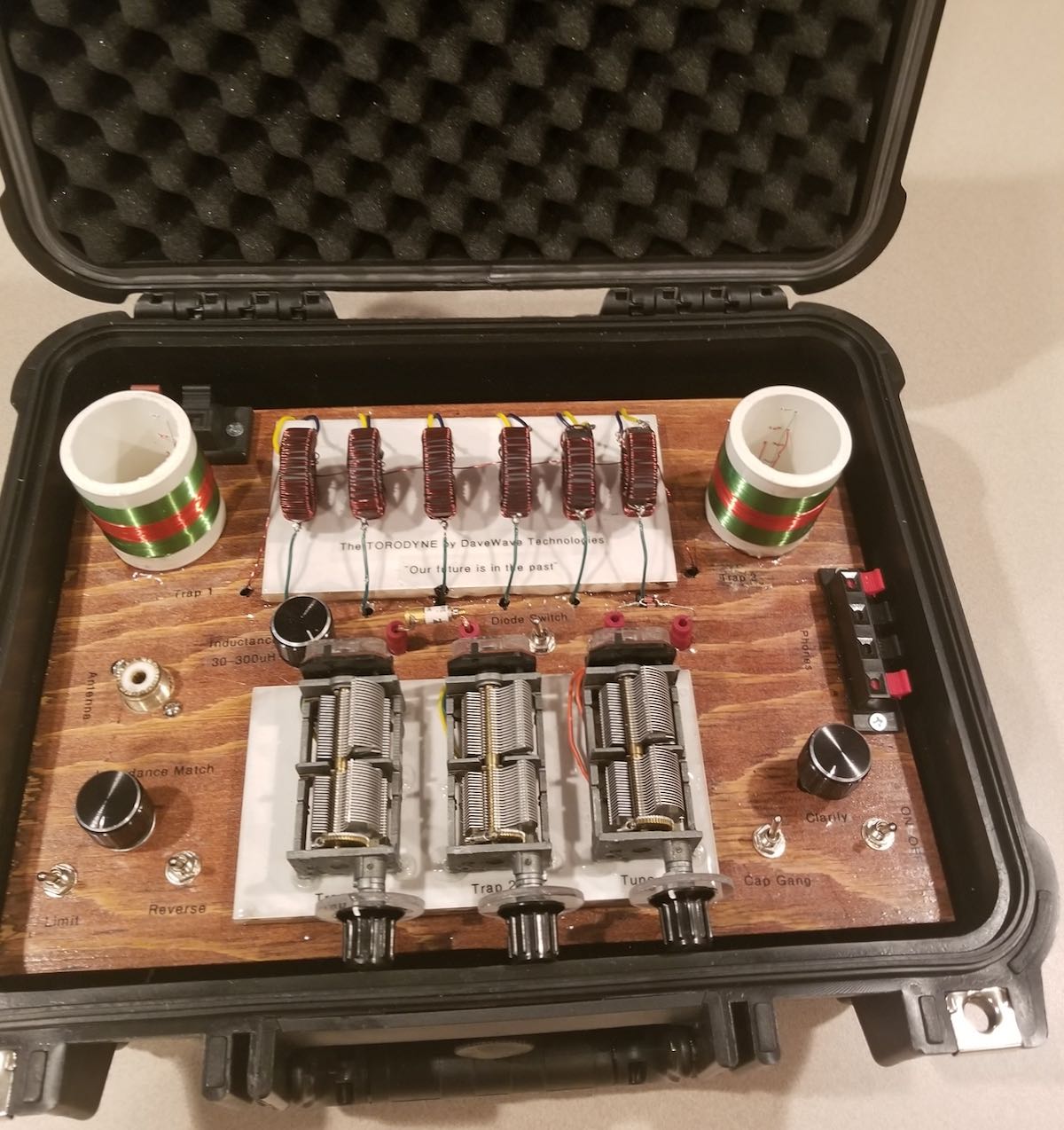
Crystal Radios – Construction, Listening, and Contesting

By David Day – N1DAY

The date was November 2, 1920 and the world was about to change forever when radio station KDKA out of Pittsburgh PA made its first broadcast of election results from the 1920 presidential election.  For the first time in history people knew who won the election before reading about it the next day in the newspaper.  Radio had arrived!

However, hearing the election results was not as easy as powering up an AM radio receiver because radio electron tubes had only been invented a few years earlier and they were still too expensive for most people to afford in a radio set.  After KDKA’s historic broadcast, large 50,000 watt stations began popping up in all major cities around the world.  Even though a tube-driven radio was not yet commonplace, many people listened to these stations on their crystal radios.  The frenzy around radio in the 1920’s was not unlike the excitement around cell phones and the internet today.  If you didn’t have one, you were simply living in the past.

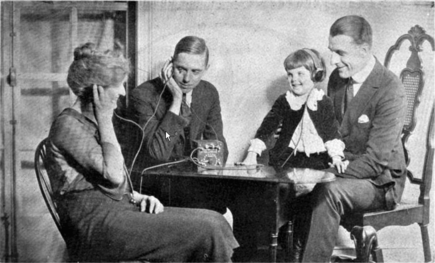
A family listening to a crystal radio in the 1920’s

Fortunately, in the early 1920’s the crystal radio had been around for a while and it was easy to make or purchase a completed set on a limited budget.  The beauty of the radio was that it was a passive device needing no power source other than the radio station’s broadcast that was received by a good antenna about 50 feet long and 15 or so feet above the ground.  Crystal radios derived their name from use of galena crystals as detectors. Continue reading

DX Central’s MW Frequency Challenge: Week 9 Results and Week 10 Announcement

Many thanks to SWLing Post contributor Loyd Van Horn at DX Central who shares the following announcement:

Another great week in the MW Frequency Challenge, and you all continue to pour the logs in!  Our live streams on Saturday nights have been so much fun getting to interact and hear about what you heard in the previous week.  If you haven’t been able to make it to a livestream yet, you are missing out!  Join us Saturdays at 1945 CST / 0145 UTC (Sunday morning, UTC) on our YouTube channel:  youtube.com/c/dxcentral

A total of 29 DXers from three countries (Mexico, Canada and the US) and 17 US States brought in 82 logs for Week 9  of our MW Frequency Challenge.    25 unique stations in 18 states and six countries made it to this week’s log.  The number of logged stations was down, because there are fewer stations on 550 than previous weeks.  But look at that jump in countries…an opportunity here for DXers to get some great international DX!

Most Logged Stations: From runner-up last week to the top spot this week, South Carolina’s Rob Keeney hauled in an impressive 9 stations this week.  Right on his heels, was Mark Connelly (MA) and Stephanie Battaglino (CA) with 7 each.

Most Logged States: Rob Keeney once again took the top spot for heard states this week with 7 logged US states:  FL, GA, MO, NC, NY, OH, TX

Most Logged Countries:  Mark Connelly (MA) brought in the most countries (including US) with 4 total countries:  Colombia, Cuba, US, Venezuela.

Furthest Logging: Brent Taylor of Canada’s Prince Edward Island and his log of YVKE-Radio Mundial in Venezuela was our longest reception of the week at 2,477 miles!  This was only 5 miles more than the #2 spot, Mark Connelly’s 2,472 mile reception of HJHF-Radio Nacional de Colombia in Colombia.  Even tighter, Mark’s log was only ONE MILE more than our third place finish from Marc DeLorenzo for his log of HJHF at 2,471 miles!  Talk about a close one!  Rounding out our top 10 was Jim Renfrew (NY) – 2,358 miles for YVKE, Mark Connelly (MA) – 2,163 for YVKE, Rob Keeney (SC) – 2,034 for HJHF, Brent Taylor (PEI) – 1,962 for WPAB, Mark Connelly (MA) 1,531 for Radio Rebelde, and Stephanie Battaglino (CA) – 1,094 for KTSA.

Loyd/DX Central Numbers:

  • 5 stations logged
  • 3 states logged (GA, MO, TX)
  • 3 countries logged (USA, Cuba, Colombia)
  • 1,926 miles for furthest catch (HJHF in Colombia)

Most Logged Station: WGY in Buffalo, NY brought in 10 logs this week for the top spot. Missouri’s KTRS and Cincinnati’s WKRC at 7 logs each were just behind them.

Most Logged State/Province:  As you might imagine, WGR’s logs brought NY to the top spot here with 10 receptions.  NC (9) and TX, MO (8 each) were just behind.

Most Logged Country (outside of US):  Colombia and Mexico each brought in 4 loggings this week.  Cuba and Venezuela (3 each) were just behind.  In all, 15 stations outside of the US were logged this week.

Busiest Time of Day: Overnight hours (67% of logs) continued to be the busiest period for DX.  Surprisingly, sunrise was in the second spot with 14.6% of all logs.  Sunset (11%) and Daytime (7.3%) rounded out the rest of the day.

Most Used Receiver:  While portable use is still going strong, SDRs once again were the king of DX this week with 56 of 82 logs (69%).  Portables brought in 20 logs (24%) of all loggings.  Among SDRs, we actually had a new brand at the top of the hill as Airspy SDRs brought in a total of 22 loggings (40% of all SDR logs).  SDRPlay’s 18 logs (32% of SDR logs) and Perseus’s 13 receptions (23% of SDR logs) were also very popular this week.  For portables, Tecsun’s came out of nowhere this week to take the top spot with 9 loggings (45% of portable logs).  C. Crane radios (4 loggings, 20% of portable logs) took the #2 spot.

Most Used Antenna: Magnetic Loops were once again the most popular option for DXers this week, with 32 logs (40% of all logs).  The Wellbrook loop’s 21 loggings (65% of all mag loop logs) were the most popular used mag loop, with both the W6LVP and YouLoop (9 logs each, at 28%) also bringing in DX.  Termed loops proved to continue to be a popular option as well, with 17 loggings (21% of all loggings).  This week, other loops (such as the AN-200 or Tecun loops) also brought in 17 loggings this week as a popular option.

See the full export of data at our Google Sheet:  https://docs.google.com/spreadsheets/d/1OGMctuhKyj3lIxqd6tv9oxw2WhZ3F7Q7qM7TGnOxPak/edit?usp=sharing

With week 9 now under wraps, we look ahead to week 10 and for this week, we have a rather unique challenge.  Rather than focus on a single frequency, we are going to explore the ENTIRE expanded band!  1610-1710 kHz – any licensed station (including broadcast and TIS) count as a valid log.  No pirates, no NDBs, etc.  So the NJ TIS station on 1710?  Counts.  1630 Radio Elohim in El Salvador?  Counts.  The “TVS” NDB on 1650?  Does not count.

With 11 frequencies to contend with – even with much fewer stations per frequency – this should be our largest week yet!

Our Google Form for Week 10 can be found here:  https://forms.gle/41FNE9F81bhCr4ts6

RULES:

Logs for Week 10 will only be accepted for stations received between 0300 UTC Sunday, January 23, 2022 and 0300 UTC Sunday, January 30th (will be announcing the closing during our live stream of DX Central Live!).  Logs must be for licensed stations received between 1610 and 1710 kHz.  This includes all standard broadcast stations in the US and internationally, as well as any TIS stations received.  Logs must be from your own equipment using WebSDRs is allowed for reference, but will not be counted towards the challenge (unless it is YOUR WebSDR).  If you do log from a WebSDR, be sure to mark your location as from the location of the WebSDR itself, not your home location.  All loggings must be submitted using our Google Form at https://forms.gle/41FNE9F81bhCr4ts6  Submissions by any other form including social media, email, etc. will not be accepted.

An eCertificate will be sent to the DXer with the most logged stations during the challenge time period.  Additional eCertificates may be presented at the discretion of DX Central.

Have fun, 73 and best of DX!

Loyd – W4LVH