Author Archives: Thomas

Garth Mullins: “The Coming Zombie Apocalypse”

Garth-MullinsGarth Mullins is an SWL and a radio geek–he’s also a Sociologist and radio producer.

Garth’s latest radio doc, “The Coming Zombie Apocalypse” was recently featured on the CBC program Ideas with Paul Kennedy.

While the documentary doesn’t focus on shortwave radio, Garth did give a nod to shortwave at the end (well played).

Listen to “The Coming Zombie Apocalypse” via the embedded player below, or via the CBC website:

Be sure to check out Garth’s website: http://www.garthmullins.com/ and his previous radio documentary “End of the Dial.”

Guest Post: Wellbrook 1530LNPro vs ALA1530S+ Imperium Loop Antennas

Many thanks to SWLing Post contributor and noted DXer, Guy Atkins, for the following guest post:

Two-Wellbrook-Loops-001

Wellbrook 1530LNPro vs ALA1530S+ Imperium Loop Antennas

-Guy Atkins

This past weekend I found some interesting results from medium wave DXing with both models of Wellbrook Imperium loop antennas at the “fabled” Rockworks cliffs near Manzanita, Oregon USA. This location has become popular the last few years with Oregon, Washington, and British Columbia DXers due to the signal enhancement at this narrow strip of land approx. 450 feet above the Pacific ocean. The main benefit seems to be splatter reduction of “pest” stations due to the signal blockage of the rock walls blasted into the cliffs for the coastal highway 101. However, a boost of signals around local sunrise is also beneficial, and is a common occurrence near salt water beaches.

Here is a Google Maps Street View of this beautiful “wide spot in the road” along the cliffs.

Ultralight-Cliff

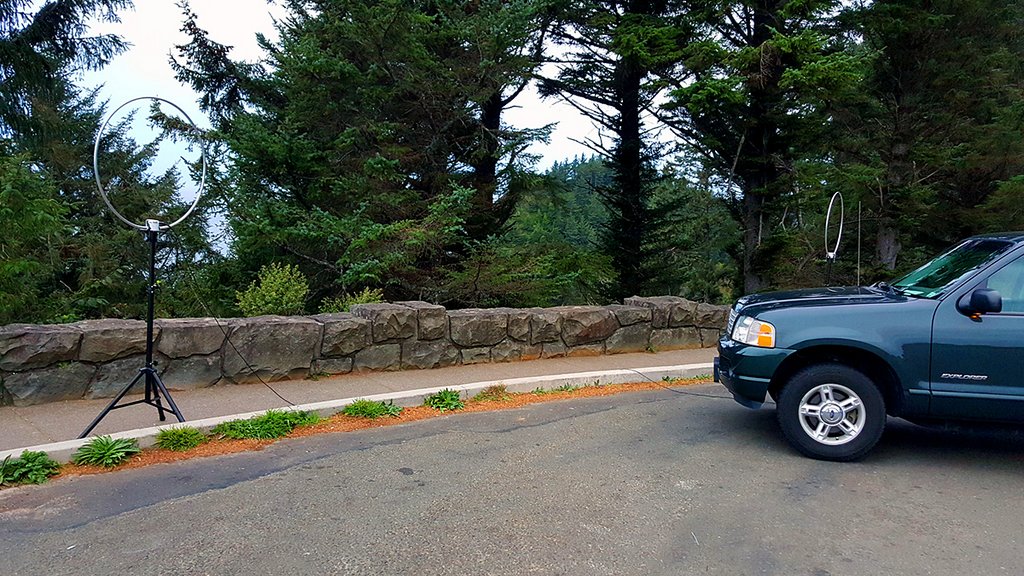
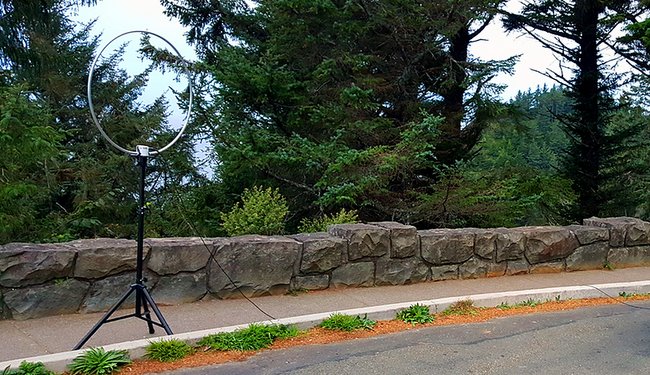
Because of the limited space along this scenic coastal highway, all antennas used for DXing need to be both compact and temporary. Wellbrook loops supported on pro-audio speaker stands are a great way to go, and can easily be set up in the pre-dawn darkness.

Comparison
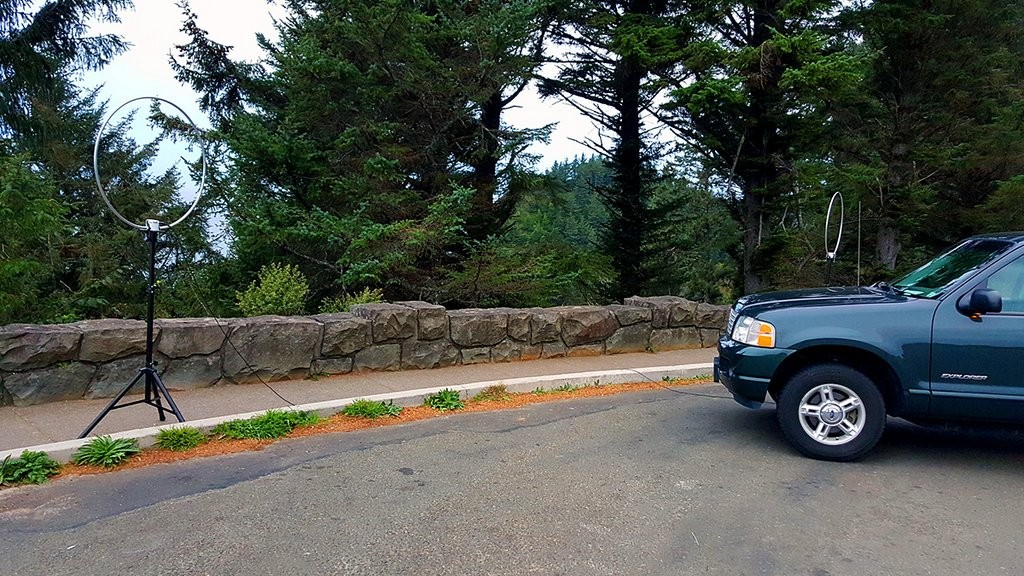
Both Wellbrook loop antennas mounted on "pro-audio" tripod stands right at the cliff edge at Rockworks Cliffs. (Photo: Guy Atkins)

Both Wellbrook loop antennas mounted on “pro-audio” tripod stands right at the cliff edge at Rockworks Cliffs. (Photo: Guy Atkins)

This is a comparison file of weak signal reception with the two models of Wellbrook Communications “Imperium” series loop antennas: the ALA1530LN “Pro” Imperium and the ALA1530S+ Imperium.

Both models of compact, 1-meter dia. active loops are excellent for reception from longwave & medium wave upwards. However, the ALA1530LN “Pro” excels at LW & MW with its low overall noise level and 9dB higher gain, engineered by Wellbrook for improved signal-to-noise ratio (S/N) of up to 10 dB. S/N on the HF bands is reportedly better also.
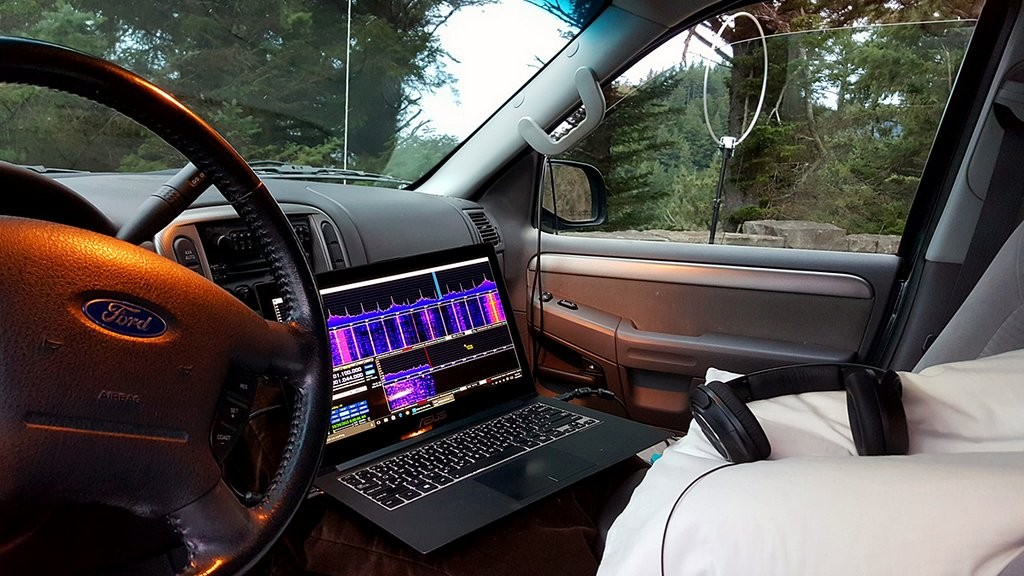
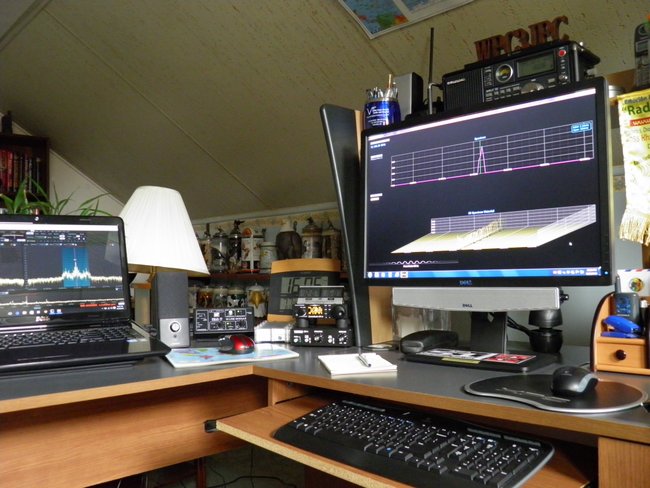
My laptop running HDSDR software in my SUV; the receiver is an Elad FDM-S2. (Photo: Guy Atkins)

My laptop running HDSDR software in my SUV; the receiver is an Elad FDM-S2. (Photo: Guy Atkins)

On the weekend of October 24th, 2015 I was DXing at the “Rockworks” cliffs on the Oregon coast near Manzanita, OR. Both of these Imperium series antennas were in use and I was recording the medium wave band with an Elad FDM-S2 SDR receiver. Both antennas were fed with identical 25 ft. lengths of RG-58 coaxial cable.

The demonstration in this video begins with 10 seconds using the ALA1530LN Pro Imperium loop, alternating with 10 seconds with the ALA1530S+ Imperium loop.

https://www.youtube.com/watch?v=rbX_G0ll_kk

The first signal tuned is aviation voice beacon “SQM” from Level Island, Alaska on 529 kHz (400 watts). The signal is weak, but audible as it rises above the noise floor. The reception improvement with the ALA1530LN Pro is evident.

Half way through the recording the frequency is switched to 1710 kHz, where an unidentified station (possibly a MW pirate) is audible playing the 1967 Zombies tune “Time of the Season”. Again, the clip starts with 10 seconds with the ALA1530LN Pro alternating with 10 seconds of the ALA1530S+ Imperium.

Each antenna is a worthy, compact loop for DXing, but for chasing the weakest signals with the best readability I think the ALA1530LN Pro shows its advantages.


Many thanks, Guy, for sharing your loop research! 

What I love about your portable SDR set-up, is that you can go to the cliff side, set up your antennas and equipment, record the spectrum on your SDR, then go back home to analyze and listen to what you captured.  It takes some of the pressure off while you’re on-site. 

This year at the Dayton Hamvention, I purchased the Pixel Technologies RF PRO-1B mag loop antenna. I used it (for the first time) at the PARI DXpedition. We were all impressed with its performance. I would love to compare it with the ALA1530LN Pro at some point in the future.

Final day: Share a photo of your shack or listening post for a chance to win a Grundig G2

John's shack features the CommRadio CR-1a, RFspace SDR-IQ, Winradio G33DDC Excalibur Pro, and the Grundig Satellite 750.

John’s shack features the CommRadio CR-1a, RFSpace SDR-IQ, Winradio G33DDC Excalibur Pro, and the Grundig Satellite 750.

Today is the deadline for our latest contest!

In exchange for sharing a photo of your favorite listening post or your radio shack with the SWLing Post community, you’ll be entered for a chance to win a Grundig G2 portable radio/recorder and player! The choice will be made by random selection, so everyone has an equal chance of winning.

Click here to read a full description of the contest and how you can participate!

Many thanks to our friends at Universal Radio for sponsoring this contest!

Tony’s homebrew mag loop antenna and amplifier

Fullscreen capture 10312015 115110 AM

Yesterday, Tony (K3DY), shared a video (via Twitter) demonstrating his new home brew loop antenna and amplifier.

This is actually a great demonstration of how even a relatively simple, inexpensive loop antenna can improve reception in locations with heavy radio interference. Tony includes the following notes with his video:

“Testing a new receiving loop antenna that I built today. It uses a pre amplifier based on deferential setup of two 2N5109 transistors. Loop is made out of coaxial cable, only the shield is connected to the circuit.

Quick demo on 31 meters, lots of stations at sunset time. No time for further testing but I observed a pronounced directivity below 7 MHz. 75 meters is so quiet that it makes me forget I live in a townhouse. As a comparison, my noise level on 75 meters is at S8 on an end fed [antenna].

https://www.youtube.com/watch?v=bq_gKNQSVeA

I will use this loop primarily for SWLing purposes but I may use it as a separate receiving antenna with my amateur radio equipment.

A lot of fun, loops are fascinating and efficient!

Indeed, Tony! And perhaps the icing on the cake is that loop antennas are so portable, low-profile and easy to deploy. They’re ideal for those living in restricted areas and with picky home owners’ associations.

Inspired by my buddy Vlado (N3CZ), I’ve actually been collecting the pieces to build my own mag loop antenna this winter. I doubt the parts for my loop will exceed ten dollars as I plan to use the shield of some heavy coax for the primary loop and a little PVC for support (much like Tony’s loop).

Tony’s video is inspiring me to go a step further and also build a simple amplifier. Any suggestions or schematics for doing so are most welcome!

Hackaday: “Secret Radio Stations by the Numbers”

SWLingPost-Spy-Numbers-Station

(Source: Hackaday via Andrea Borgnino)

One thing has stayed with the James Bond movie franchise through the decades: Mr. Bond always has the most wonderful of gadgets. Be it handheld, car-based, or otherwise, there’s always something to thrill that is mostly believable.

The biggest problem with all of those gadgets is that they mark Commander Bond as an obvious spy. “So Mr. Bond, I see you have a book with many random five character groups. Nothing suspicious about that at all!” And we all know that import/export specialists often carry exploding cufflinks or briefcases full of unknown electronics in hidden compartments.

Just as steganography hides data in plain sight, the best spy gadgets are the ones that don’t seem to be a spy gadget. It is no wonder some old weapons are little more than sticks or farm implements. You can tell a peasant he can’t have a sword, but it is hard to ban sticks.

Imagine you were a cold war era spy living in a hostile country with a cover job with Universal Exports. Would you rather get caught with a sophisticated encryption machine or an ordinary consumer radio? I’m guessing you went with the radio. You aren’t the only one. That was one of the presumed purposes to the mysterious shortwave broadcasts known as number stations. These were very common during the cold war, but there are still a few of them operating.

Continue reading at Hackaday…

Tune in: Halloween weekend is a pirate radio playground!

Haloween-Pirate-Radio

Halloween is typically the most active day of the year for shortwave pirates…so, here are three things you’ll want to do this Halloween:

  1. Listen for pirate radio stations this weekend!  Turn on your radio anytime this weekend, but especially around twilight and tune between 6,800 – 6,990 kHz. Pirates broadcast on both AM and SSB; you’re bound to hear a few. For a comprehensive primer on pirate radio listening, check out this post.
  2. Note what pirate stations are being logged–in real time–on the HF Underground pirate radio forum. This is a very active community of pirate radio listeners; I often check the latest loggings to discover frequencies where stations have surfaced. Click here to view the HF Underground pirate radio forum. Posting to the forum requires registration and approval by the moderator (so do this in advance!).
  3. Check out Andrew Yoder’s pirate radio blog with its deceptively simple title, the Hobby Broadcasting blog. Andrew is the author of the Pirate Radio Annual and a guru on shortwave pirate radio. He’s already logged a few mid-week, pre-Halloween pirates. Bookmark his site while you’re at it!

Happy Halloween to all! 

The Spectrum Monitor 2015 Radio Buyer’s Guide

TheSpectrumMonitor

If you’re a subscriber of The Spectrum Monitor (TSM) magazine, you’re in for a treat this month: the November issue is the TSM annual Radio Buyer’s Guide.

Many SWLing Post readers know that I write occasional features and reviews for TSM. Since the November issue will feature my shortwave radio buyer’s guide, I was sent a draft of the November issue. After double-checking my review, I thought I’d glance through some of the other articles–what a rabbit hole that was! Two hours later and I’m still reading. Since I’m primarily a shortwave guy, TSM expands my horizons with articles about parts of the spectrum I seldom explore. That’s a good thing!

TSM Publisher and Managing Editor, Ken Reitz (KS4ZR), has done an amazing job collecting a group of writers who are not only experts in their respective fields, but are effective writers as well. These two qualities do not always go hand-in-hand.

At $3 per issue or (especially) an annual subscription for $24 ($2/issue) I think TSM is a bargain. When the November issue is posted on the TSM website later today, you’ll be able to read through the table of contents online.

It’s hard to believe TSM is almost in its third year of publication–this TSM writer is wishing it many, many more!