Category Archives: AM

Dan’s review of the flagship Tecsun H-501x portable shortwave receiver

Many thanks to SWLing Post contributor, Dan Robinson, for the following guest post and review:


The H-501:  Jewel in the Tecsun Crown, With Some Attractive Features

by Dan Robinson

Since 2020, there has been one Tecsun receiver I have been most looking forward to reviewing, and that is Tecsun’s H-501.

Videos showing the pre-production and mainland China versions of the 501 started appearing online at least a year ago.  There are also numerous videos showing comparisons between the H-501 and PL-990x as well as the PL-330.

What I will do here is provide an assessment of the 501 informed by my use of a H-501 just received, the other two Tecsun receivers, and my decades of experience using a wide range of portable receivers.  This review is based on initial tests of a H-501x, among the first production units.

Video: Unboxing

HOMAGE TO RECEIVERS OF THE PAST

The elephant in the room with the 501 is, of course, its two large left and right speakers.  This reminds one of another Tecsun DSP portable, the PL-398BT with a similar left-right speaker arrangement.

On the left of the H-501, from the top, are the Volume, Treble, and Bass knobs which like the PL-880 and 990x has obvious lineage back to the famous Grundig portables of the 1990’s – the Satellit 500 and 700.  Both of those were limited to two bandwidths.  Only the 700 had anything approaching usable synchronous detection.

Each of the left hand control knobs on the 501 contains a dot to indicate where you are in the Maximum/Minimum range.  At the bottom of the left side is a micro-USB port for when the receiver is used as a computer speaker – quite a nice feature!

On the right side of the 501 you find ports for AM and FM antennas, each with a rubber traction cap, similar to what is found on the PL-990x.  There is also a three position sensitivity sliding switch for Local, Normal, and DX modes – that’s one more than usually found.

Knobs on the right side are the Main tuning and Fine tuning, again similar to the PL-990x.  At the very bottom of the right side is the 5v 1.0 amp micro-USB charging port.

ERGONOMICS

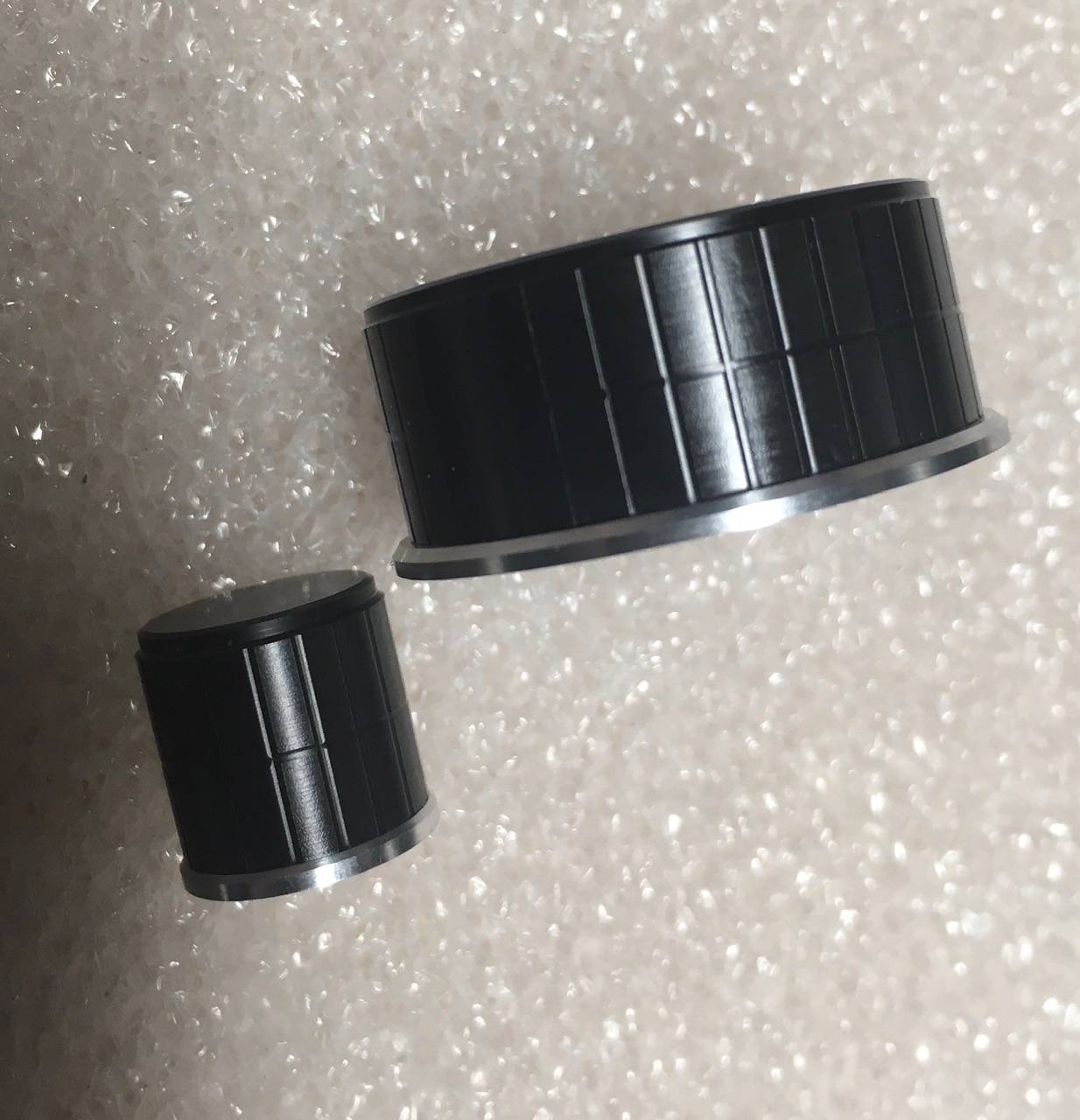
NEGATIVE:  Here I discuss one of two major negatives with the 501.  The tuning knobs are embedded quite far into the radio body.  Each has a round piece of rubber covering on the knob end surface designed obviously to provide traction, possibly also as a protective measure.

The reality is that on the 501, more seriously on the PL-330, embedding of the knobs so far into the cabinet makes it virtually impossible to undertake rapid tuning using those knobs if you are just placing your finger on the top barrel part of the knob itself!

As you will see in photos and video accompanying this review, holding a finger against the rubber on the end of each knob, or closer to the center, to achieve more rapid tuning.  But it’s kind of annoying.  On the PL-990x the knobs are somewhat different – extending a bit farther out of the cabinet, but also with the rubber coverings.

So, this is a design point for Tecsun to consider.  Surely, it should be possible to come up with slightly different knobs for the 501 that make it more comfortable to achieve rapid tuning.  As it is, the knobs on the 501 barely extend beyond the cabinet edge, including the end and rubber cap.

The same goes for the PL-330 – which has knobs that only one half inch in depth, and extending only about 1/16 of an inch beyond the cabinet edge.  Part of the attractiveness of the 330 is its compact size and I doubt Tecsun will be moving to put slightly larger knobs on that radio anytime soon.  But as it is, using the main and fine tuning controls on the 330 gets you maybe 10 kHz in tuning range.

[UPDATE]  I realized after further use of the 501x that Tecsun clearly intended for the rubber knob cap covers to act as traction for tuning.  The problems I see:  after significant use over time, those rubber covers will lose their stickiness and thus their ability to help tuning will be reduced.  Also, the fine tuning knob is smaller — and even using the rubber cover on the knob for more traction, it is somewhat difficult to achieve rapid tuning in 1 kHz mode.  Tecsun could help 501x owners on the issue with the tuning knobs by including spare rubber knob caps.  But it’s uncertain how the existing rubber knob covers are attached to the original knobs and how easy it would be to replace them when they lose their stickiness.

H-501 IMPRESSIVE FRONT PANEL 

At the top of the H-501 radio above the LCD display can be found the Display/Snooze/Lock button.  On an older Tecsun radio, the PL-880, this button doubled as the calibration adjust control.  On the PL-990x this triple function button is located on the top of the radio.

LCD DISPLAY

POSITIVE:   One of the big positives of the 501 is the large LCD display.  The number digits are absolutely huge and make it easy to read frequencies.

Thanks Tecsun!  The display contains numerous bits of information about receiver operation, the signal strength meter, etc.

Below the display is the keypad, with special dual keys for 9/10 kHz mediumwave, Longwave activation, and FM range adjustment.  Backlight activation is on the 5 key.  At the bottom you have the VF/VM key to select between frequency tuning and memories.  To the right are the FM, MW/LW, and SW + and – buttons.  These put the radio into shortwave mode and as is the case with the PL-990 and other receivers, activate ATS/ETM tuning.

At the very bottom of the front panel can be found PLAY/PAUSE, RR, and FF buttons for control of SD card audio when using the microSD card, which like on the 990x is located on the bottom of the receiver.  According to the manual, by the way, the microSD slot accepts cards of up to 128 GB.  Included in the box is a 16 GB SanDisk Ultra card.  A reset hole is also on the bottom of the radio.

Finally, at the bottom of the 501 face are rubber covered input ports for Earphones, Line In, and Line Out.

METAL TILT BAIL

POSITIVE AND NEGATIVE:  On the back of the receiver, you find the metal tilt bail which folds down and locks into two plastic tabs and can be lifted easily with a finger from an indentation in the cabinet.

This was a good design move by Tecsun, with the following observations:  there are no incremental positions on the metal bail as you find on, say, a Microsoft Surface or similar tablet type PC.  The only fully stable position is to have the metal bail fully extended back. That places the 501 in a great position if you’re standing or even sitting to a degree.  But if you try to place the bail in any middle position you’re in danger of having the radio become unstable.  Tecsun should definitely give some thought to a re-design, though the bail is better than the flimsy plastic stands found on the PL-990 and PL-880 and some older portables.

Still on the back of the radio, intelligently, Tecsun marks a screw hole which can be used to remove the telescopic antenna (marked as ANT SCREW).  The other screw holes for removal of the back of the radio are also clearly marked.  Thanks Tecsun!

However, one additional partial negative – there are no rubber pads on the bottom back edge of the 501x which will be contacting whatever surface the radio is sitting on while the metal bail is in use.  So, if you don’t want that bottom back edge to be scratched, place the radio on something to cushion it.

BATTERY CHARGING

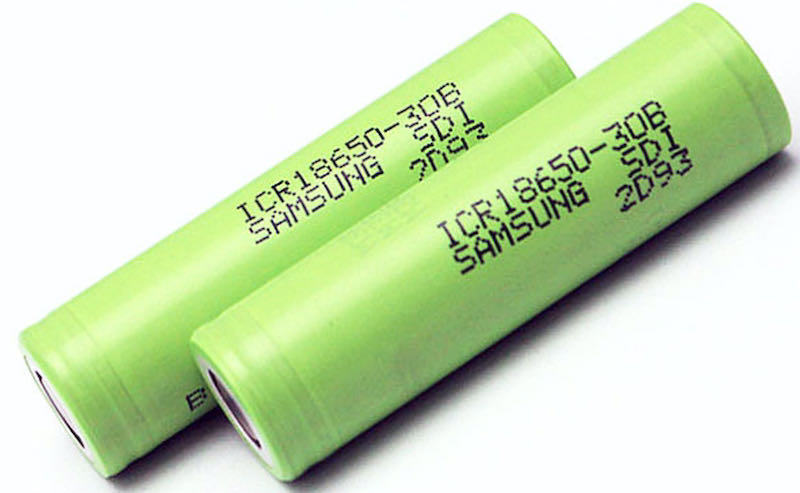
POSITIVE:  Another interesting feature not found on other radios:  Tecsun has created a dual charging system for the 501 which uses two 18650 batteries.

In viewing numerous videos, I have not seen this discussed much.  Basically, this enables you to use the receiver’s internal charging capability to choose which battery you are charging.  The manual states that the battery contains space for a “spare” battery.  The charging indicator on the LCD display will flash while charging is underway – there does not appear to be a separate display for battery A or B.  However, and this is quite a unique capability – while you are using the 501x, the switch changes which battery the radio is using.

It’s not clear to me whether the receiver while powered on is taking energy from one or both batteries simultaneously.  As I note in my reviews, and this is amplified in the manual, do not expect to be able to charge a battery internally and listen to the radio at the same time because there WILL be noise.

HUGE WORLD MAP AND RADIO DIAGRAM INCLUDED

Tecsun includes a huge – and I mean HUGE – World Amateur Radio map in a plastic pouch with the manual.  On the back of this is a large photo of the 501 with clear English guide points to each and every feature of the radio.  In this, Tecsun is really going out of its way to make owning the 501 a special experience.

In the box (see photos) Tecsun includes 2 18650 lithium batteries, a 5 volt double USB A charging cube, a mini to mini cord, a USB charging cable, and to boot, a pair of fairly high quality wired earphones complete with spare ear tips.

PERFORMANCE

Anon-co advises that the H-501x uses a different IC than the PL-990x.  No further details were available as of the time of this writing.

This is clearly a sensitive radio, as is the PL-990X.  In these days of declining use of shortwave, almost any receiver is going to be able to hear “stuff” all over the bands and the 501x and 990x as well as the 330 are all quite capable in this regard.

In the video, I tune some familiar stations, including Voice of Greece and BBC

and move through the excellent bandwidth options.  This is where the 501, with its large dual speakers, excels because if you’re on a strong station – Greece is a great example because of its great music programs – and you have that wider option, it’s really pleasant to listen to.

NEGATIVE:  However, one has to puzzle over the decision to limit bandwidth to 6 kHz when in shortwave mode.  On mediumwave (AM) you have a 9 kHz option which provides some fine listening.  Perhaps Tecsun felt that there are few stations using shortwave these days that would benefit from having a significantly wider option?  I would urge Tecsun to make 9 kHz available in shortwave.

SYNCHRONOUS DETECTION

NEGATIVE:  I really had some hope that Tecsun would go farther toward

solving the problem of unstable/distorted SYNC mode with all of these recent radios.  Unfortunately, it was not to be.

Using SYNC on these radios – though this was not the case with the PL-660 and 680 – involves a delicate dance, requiring using a combination of bandwidth filters and LSB/USB.  SYNC works fairly well with some stations, but it really depends on signal level, and to an extent signal level of any station close to the frequency you are on.

There is a 1 kHz fine tune spread when using SYNC after which lock is lost.  And still, lock is often lost even when you’re on center frequency and not using

fine tune in SYNC – the signal just becomes distorted.  Not fun.  The PL-990x has the same issues.

Now, Tecsun has definitely made progress since the horrendous implementation of SYNC on the PL-880, which wasn’t even an official feature.  But it’s disappointing that given the design features in the 501, especially the wonderful dual speakers, a way has not been found to resolve this issue which obviously involves the DSP chip that is the brain of the receiver.

Video: Detailed testing of Tecsun H-501x

ANTENNA

NEGATIVE: One of the things the folks at SONY, Panasonic and some other manufacturers did so well was design radios with antennas that nested inside the radio and could be pulled up and out of the cabinet, and because of this, there was clearance from the top of the radio so the antenna can achieve vertical position.   Tecsun has not done the same.  Antennas on the H-501x, PL-990x, PL-330 swivel but cannot take up vertical position, and of course they are nested on the top of the radio.  One would have thought that after years of producing portables, and coming to dominate the portable market, someone at Tecsun would have recognized the importance of antenna re-design.  NOTE:  the antenna on the 501x is sufficiently long, but on the PL-330 for example, seems to be not long enough.

BLUETOOTH

POSITIVE:  Hooray for Tecsun in integrating BT capability into the 501x and 990x.  This was such an obvious move and thanks to Tecsun for really hitting it out of the park. Unfortunately, we don’t get the ability to record audio from the radio on to microSD cards – that would truly have been a major step forward

CALIBRATION

The H-501 has the same re-calibration adjustment feature as is seen in the PL-909x and the PL-330.  This involves going into LSB or USB mode, holding down the USB or LSB keys until a flash appears, then using the Fine Tuning knob to achieve zero beat on WWV or strong station that is known to be on frequency, then holding down USB or LSB again to have the radio re-zero itself.  This is a fine feature that we have seen since the PL-880.

When I first received the H-501 it appeared that the receiver was fairly on zero beat from mediumwave up through 25 meters shortwave.  Further testing revealed that re-calibration was necessary, but the degree of error from mediumwave up through 19 meters was not as significant as I have seen on the PL-990x.  Re-calibrating at a mid-point of 25 meters appears to be a good mid-point choice, but inevitably, doing re-calibration on shortwave will throw the receiver off by a bit down on mediumwave.

A cautionary note:  when undertaking this calibration function be sure to give the radio time to confirm it’s in calibration mode with the FLASHing LCD. Sometimes, the readout will jump a full 1 kHz above or below the frequency you’re zeroing on – if that happens use the MAIN TUNING knob to get yourself back (i.e. 9,704 to 9,705.00) and complete the zero beat operation with the FINE TUNING knob, then hold down LSB or USB to complete.

All of this may be overkill for most people – I am just among those who obsess over having receivers as exactly on zero beat as possible.  That’s more difficult or impossible to achieve with older receivers that have no calibration function, such as the ICF-2010 or SW-55 without literally taking those radios apart to access internal points of adjustment.  The fact that Tecsun provides this capability in these portables is something we should all be very grateful for.

CIRCUIT LOCKUP

All of the Tecsun radios have a “reset” hole to be used if the receiver is not functioning properly.  I had one occasion of lockup with this sample of the H-501x.  Rather than using the reset hole, I decided to remove one of the two 18650 batteries, which of course reset the receiver.  I have alerted Anon-co to this issue, but it’s hard to tell whether it’s a major problem without having other H-501 units to compare to.

CARRYING CASE

POSITIVE:  The H-501 that I received for review from Anon-co came with a beautiful faux leather case complete with a convenient carrying handle.  My understanding is that this matches mainland China versions that have been widely seen in videos online.

Anon-co advises that the first batch of 501x to be carried by them will come in a gift box with this PU leather case, possibly to be followed at some later point by a hardcover carrying case.  Indeed, a photo can be found online showing the H-501 in a hardcover carrying case similar to the cases for the PL-880 and PL-990x kits.

As of early April, Anon-co advises that while the price for 501x is not set yet, it’s expected to be somewhere in the $310 – 330 range including shipping to the U.S.

AM/MEDIUMWAVE AND FM PERFORMANCE

Not much to say here – I find FM performance on the 501x to be superb, and mediumwave reception is more than satisfactory.

CONCLUDING THOUGHTS

As I noted earlier, these days amid declining use of shortwave by remaining broadcasters, almost any DSP or older portable receivers are capable of producing excellent results for shortwave listening.

Facebook groups devoted to shortwave (they have become the new gathering place and information exchanges for those of us who still love the hobby) are

full of newcomers inquiring about which Tecsun, Degen, or other portables are best.

Often, my advice is to consider older portables that are still quite competitive, especially considering the reduction in the number of stations still on shortwave.  These would include such classics as the Grundig Satellit 700/500, the SONY

ICF-2010(2001D), SONY ICF-SW77, and ICF-SW55, along with the venerable Panasonic RF-B65 and SONY ICF-SW100S in the smaller category.

What Tecsun has done with what we have to assume may be the final group of DSP receivers it produces is come up with small (PL-330), medium (PL-990x), and large (H-501) radios that combine extremely attractive features and excellent audio.  The H-501x, in effect, is a Grundig Satellit 700 re-born for the 21st century and the path to it was paved by the PL-880.

Though implementation of SYNC in each of these receivers still leaves much to be desired, having this feature is enough to push prospective buyers to choose one or more of these Tecsun units over older portables.

Note that Sangean, which is now producing its ATS-909×2 (though the radio has growing pains and is having its firmware updated by Sangean) seems to have taken note of Tecsun’s dominance of the market and provided multi-bandwith capability, and an improved and enlarged LCD display on the 909×2 along with finer frequency resolution.

In a strange but perhaps understandable decision, Sangean left SYNC mode off of its new flagship receiver.  Whether this had more to do with production costs or a decision that synchronous detection really brings little to the game these days, or both, along with other factors, remains a puzzle.  It does appear, from early reviews, that Sangean may have improved sensitivity on the 909×2, though this too remains unconfirmed.

But again, even with the negatives I noted here about the H-501x, what Tecsun has accomplished is significant.  It has given remaining potential buyers of multi-band portables three superb receiver choices. There are others in the Tecsun line such as the S-8800 and S2000, but of these only the S8800 is something I would recommend.

As I noted in a recent review of the PL-330, had we enjoyed a situation back in the golden days of shortwave in the 1960’s/1970’s/1980’s where a portable provided multiple bandwidths, advanced memory operations, and synchronous detection, DXing would have been even more of an enjoyment than it was.  Certainly those Country Heard/Country Verified totals would have been higher!

The H-501x could easily be considered the crown jewel in the Tecsun group with its killer looks, large speakers, and performance equaling the PL-990x.  Each of these receivers is arguably an easy choice as a “daily driver” for traveling, though where air travel and TSA issues are concerned, the PL-330 would be a better choice.

RECOMMENDATION:  Of the negatives I discuss in this article, only one I would consider fairly huge, and that is the ongoing issue with synchronous detection.  If the 501x, like the 990x and 330, were to have this issue resolved that would make it easy to recommend any of the three radios.  As it is, the attractiveness of the 501x lies with its beautiful two speaker design.  Even with the annoying SYNC  issue, I would recommend the radio to anyone who understands the SYNC issue and doesn’t mind and who wants a nice, larger version of the 909x.

The Sony FX-300 Jackal: A Holy Grail technological marvel of the late 70s

I’m a child of the 1970s and I’m glad I never knew about the Sony FX-300 “Jackal 300.” It would have been the ultimate unobtainable machine of my dreams…this, even despite the lack of shortwave.

I was browsing eBay yesterday when I saw one of these pop up in the search results.

Somehow, this radio made it past my RADAR. How? I’m guessing it’s because this model was primarily sold in Japan–?

The FX-300 sports:

  • A mini CRT television screen (to watch Voyagers!, Space 1999, G-Force, and Ultraman)
  • Precision analog tuning
  • Top-Mounted cassette player/recorder
  • AM/FM reception
  • Built-in speaker
  • Earphone/Mic external ports
  • And let’s face it: a killer design that smacks of the Apollo era 

Other than the Panny RF-2200, I’m not sure if a radio could possibly satisfy more of my design cravings.  Here are a few images I’ve unashamedly swiped from eBay:

What a Holy Grail machine, indeed! I love the tactile mechanical switches, analog dials, speaker grills, selection switches, and even (especially) the metal stand off bar at the top to protect those brilliant cassette controls.

I’m very curious if any SWLing Post readers have ever owned (or still own) a Sony FX-300. (Kei Niigata, I’ll be terribly disappointed if I learn you’ve never owned one!)

Please comment!

Michael pairs the Tecsun PL-990 and the AOR LA400

Many thanks to SWLing Post contributor, Michael Ye (BD4AAQ), for the following guest post:


In the Loop: PL-990 and LA400, a Perfect Match

by Michael Ye (BD4AAQ)

PL-990 and LA400

I have been a happy owner of Tecsun’s PL-880 world band receivers for years. In fact I have two PL-880 radios, one sitting at home and the other staying in my car. So, after Tecsun introduced the new model PL-990 in late 2020, it didn’t take me long to decide to purchase one. In this article I will discuss the Tecsun PL-990 receiver working with loop antennas, while referencing some relevant features of the PL-880.

Overall performance of the PL-990

Merely by its model number, it is easy to regard the PL-990 as an upgraded version of the already highly reputable PL-880. As expected, the PL-990 can very much be regarded as a combination of all the existing fine radio features of the PL-880 AND the music and bluetooth additions, with a number of improvements for instance in shortwave and medium wave performance. The ergonomic design of the PL-990 looks and feels different from that of the PL-880 in a number of ways. Although I may prefer the the more slim and elegant appearance of the PL-880, the PL-990 gives a more rugged and durable feeling, among other improvements over the older PL-880.

Working with loop antennas

The PL-990 and the PL-880 side by side

Living on the twelfth floor of a condominium in the crowded Shanghai, I have often been fascinated with loop antennas. As a licensed amateur operator, I have used the MFJ-1786X and have been impressed with its performance. On reception, I also find loop antennas appealing, as they are able to pull in weak signals while noticeably reducing electro-magnetic interference rampant in the urban environment. I have an unbranded shortwave loop antenna which I believe is based on and performs similarly with the AOR LA320. Despite its excellent performance, it is only good for the 5MHz – 15MHz shortwave range. So a few years ago when AOR launched the new LA400 wideband loop antenna, I bought one, which I often pair up with the PL-880 and other radios for shortwave listening, and get satisfactory results!

Antenna Switch on the PL-990

Now, back to the PL-990. When I first tried the PL-990 with the LA400, the results were generally good but not as good as as compared with using the same LA400 on my PL-880. This puzzled me for a day or so until I realised that the PL-990 actually has an antenna switch which the PL-880 does not have. The switch is used to toggle between an internal antenna (i.e. the built-in ferrite bar/telescopic antenna) and an external one (e.g. the AOR LA400). So a new PL-990 user who has often operated the PL-880 when first using the PL-990 could easily ignore the switch which should be pushed to “Ext” when plugging in an external antenna. This explains why the PL-990 may suddenly appear less sensitive than expected.

“Ext” antenna input for all bands

Contrary to the PL-880 whose external antenna socket is only good for shortwave signal input, the PL-990’s external antenna socket works with all bands, from long wave to FM. I found this to be an important and very useful change, and a pleasant surprise for my LA400, which covers a wide range of frequencies from long wave to medium wave to FM and up to 500MHz.

Once the LA400 is connected, the correct band selected, and last but not least the antenna switch turned to “Ext”, the PL-990 and the LA400 work like a charm in the indoor setting, remarkably better than the built-in telescopic antenna. With the loop connected, while there is not much to expect on the long wave band because of very few long wave stations remaining in the world, reception improves considerably on all other bands including on the medium wave and FM bands, as is also reflected on the upper right hand display of the signal strength and S/N ratio readings. Needless to say, performance on shortwave is as good as on the PL-880, if not better (again, remember to push the antenna switch to “Ext” when using it on the PL-990). Using the AOR loop on the PL-990 for FM reception is somewhat different as there does not seem to be a noticeable tuning point. Simply select the “Others” band, which appears to be broad enough for fair FM reception.

Tecsun AN-200 loop antenna

It is worth mentioning that I have a Tecsun AN-200 tunable medium wave antenna, which I have not used often. As its name suggests, it is for medium wave reception only. I tried it on the PL-990. Works great.

The AN-200 and the PL-990

It is hard to tell which one, the PL-LA400 or the AN-200, fares better, as the signal strength and S/M readings are quite close. They both perform better than the radio’s internal ferrite bar antenna to varying degrees, by improving the signal strength or the S/N ratio or both. The Tecsun loop is a passive antenna, meaning no power is required, making it easy to be used “wirelessly”, by simply placing the loop close to the radio, without having to be connected to the radio via a cable.

Chocolate, our house cat, tries to enhance reception with her tail

It should be noted that in the “wireless” mode of the AN-200 the antenna switch on the PL-990 should remain at “Int” so as for its built-in ferrite bar and the loop to couple with each other.

The “Signal Sweeper”: How to build a portable Wellbrook loop antenna

Many thanks to SWLing Post contributor, Matt Blaze, for the following guest post:


The “Signal Sweeper”, a portable Wellbrook antenna setup

by Matt Blaze

Here’s a very simple construction project that’s really improved my travel shortwave and mediumwave listening experience.

When I go somewhere interesting (whether a day trip on my bike or a longer excursion to an exotic locale), the two things I’m sure to want with me are my camera gear and at least one good receiver. Fortunately, there are plenty of good quality shortwave receivers to choose from these days; the hard part is packing a suitably portable antenna that can do justice to the signals wherever it is I’m going.

I’ve long had a Wellbrook antenna on my roof at home. These wide-band amplified loops famously enjoy a reputation for excellent intermod and noise rejection, as well as an almost magical ability to pull in signals comparable to much larger traditional HF and MF receive antennas. A portable Wellbrook – something I could pack in my luggage that performs as well as the one on my roof, would be just ideal.

Fortunately, Wellbrook sells a “flex” version of their antenna intended for just this application, the model FLX1530LN. It’s essentially just the amplifier of their fixed-mount antennas, equipped with a pair of BNC connectors for you to attach a user-supplied ring of coaxial cable that serves as the antenna loop. This way, you don’t need to travel with the awkwardly large 1 meter diameter ring of aluminum tubing that makes up the normal Wellbrook. You can just bring a compact spool of coaxial cable and configure a loop out of it when you arrive at your destination.

The tricky part is how to actually form a stable loop out of coaxial cable without needing lot of unwieldy supporting hardware. In particularly, I wanted something that could be set up on a camera tripod to be freestanding and easily rotated wherever I happened to find myself wanting to play radio. The key would be finding or making some kind of mostly non-metalic support for the coaxial loop that could be folded down or collapsed to fit in my baggage or backpack for travel.

And then I found it: a humble 3-section telescoping broom handle sold on Amazon for about $15 that’s exactly the right size: the “O-Cedar Easywring Spin Mop Telescopic Replacement Handle“. It collapses to 22 inches (just short enough to fit in my suitcase), and extends to 48 inches (comfortably long enough for a one meter diameter loop).

Normally, a wire loop would need both vertical and horizontal supports in a cross configuration, but by using a reasonably stiff coaxial cable, I figured I could get away with just using the broom handle vertically. I found that LMR400 (the basic kind, not the “Ultraflex” version) holds its shape quite well in a one meter loop supported this way.

At this point, it was just a matter of the details of attaching and mounting everything together into a portable package.

A one meter diameter loop, which is the ideal size for the Wellbrook amp, can be made from 3.14 meters of cable (ask your middle-school math teacher). That’s about 10 feet for Americans like me. High precision is not required here, so I just cut 10 feet of LMR400.

The next step is to attach the middle of the cable to the top of the broom handle. The O-Cedar handle has a loop at the end for hanging it on a hook in your broom closet. It happens to be just the right diameter for LMR400, but not with BNC connectors attached. So you’ll have to thread the cable through before you crimp or solder on the with connectors. (See photo above). I used the Times Microwave crimp-on BNC connectors, which I had some extras of lying around. I also put some shrink wrap on the cable at either side of the broom loop, just to keep it from slipping out and becoming unbalanced, but that was probably unnecessary.

Now I needed a way to to attach the Wellbrook amplifier to the other end of the handle, as well as some way of mounting the whole thing to a camera tripod. My first thought involved a lot of duct tape. But I wanted something more permanent and reusable.

The key is something called an “L-Plate”, which is a piece of hardware intended to allow you to mount a camera to a tripod in either “landscape” or “portrait” mode. It’s basically two tripod dovetail mounts attached at a 90 degree angle. I used one that was in my junk box, but you can buy them new or used on eBay. I also needed a clamp to attach the L-plate to the broom handle. I used the Novoflex MiniClamp 26, which I got from B&H Photo. The clamp attaches to the inside of the L-plate with a captive screw. (See photos)

Next, I attached the amplifier to the other side of the L-plate using an ordinary screw-on hose clamp. Easy enough, and surprisingly sturdy.

And that’s it. To assemble the antenna, just extend the broom handle to about one meter, allowing for a roughly one meter diameter loop that’s as round as you can make it with the amplifier at the bottom. Then clamp the L-plate to the bottom of the handle so that the handle is just above the base of the plate, and attach to the tripod. (See the photos).

The Wellbrook is powered over the feedline with a 12VDC bias-T injector. So you need a clean source of 12 volts. I use a cheap Talent Cell battery pack (available on Amazon in various capacities). These actually deliver 11.1 VDC (3x 3.7V), rather than the 12V the Wellbrook calls for, but it works fine in practice. I can also use the same pack to power the radio and digital audio recorder.

In the photos, you can see the finished antenna setup on my roof, with my permanent base Wellbrook on the rotor in the background. The performance of the two antennas is quite comparable.

(Note that there’s an eBay seller that makes a somewhat similar travel loop. The performance is quite good under normal conditions, but it is a bit more subject to MW overload when near a transmitter site. So I prefer the Wellbrook, which is much less susceptible to overload, I’ve found.)

My usual complete travel setup is either a Reuter RDR Pocket C2 radio or a Sangean ATX-909X (recently upgraded to the X2 model). Both these radios work well with the Wellbrook. I use a Sound Devices Mixpre 3 to record airchecks in the field. In the photos, I’m on a rooftop DXpedition listening to Toronto traffic and weather from CFRX on 6070 kHz on a warm later winter afternoon.

The whole setup breaks down for travel pretty easily, and fits easily in my suitcase, backpack, or bike bag (see photos). I usually bring a larger tripod than this if I’m also taking my camera.

The Wellbrook setup has really made bringing a receiver into the field a lot easier and less uncertain. There’s no worry about finding trees or other supports for wires, and packing and unpacking is quick and easy. Have fun!

Transmitters stuck in time

Sometimes we radio enthusiasts discover odd things on the air.

We’re listeners and we notice things.

A few days ago our friendy, Matt Blaze, tweeted this:

Yep, for eight years a DDOT TIS (Traffic Information System) transmitter has been broadcasting the same repeating message and few have noticed.

You can read Matt’s whole Twitter chain here.

Matt has also kindly shared an audio recording of this transmitter. He notes that the reception “was weak but readable” from his home:

What’s more, Matt’s tweet was picked up by The Drive and turned into a post, thus exposing our radio geekery to the populos at large. Many thanks to the numerous SWLing Post readers who shared a link to the article.

I have to assume someone from the DDOT was paying attention too because Matt posted that as of March 3rd, it appears the transmitter has been taken off the air:

This reminded me of another transmitter stuck in time that I thought David Goren once mentioned. I checked with him and he confirmed:

Yes, there’s a transmitter somewhere on MW in NYC that has been broadcasting: “this is a functional test of the text-to-speech capability of the [VR or BR 2000] software package”. They’ve probably been on at least 10 years.

Many thanks to David for sharing the following recording:

Have you ever heard a forgotten transmitter? Please comment with details!

Radio Waves: Waves of Hope Presentation, More Radio Post-Pandemic, RTÉ to cease radio over DAB network, and Saving VOA Delano Relay DL-8

Radio Waves:  Stories Making Waves in the World of Radio

Because I keep my ear to the waves, as well as receive many tips from others who do the same, I find myself privy to radio-related stories that might interest SWLing Post readers.  To that end: Welcome to the SWLing Post’s Radio Waves, a collection of links to interesting stories making waves in the world of radio. Enjoy!

Many thanks to SWLing Post contributors David Iurescia, William Lee, and Radio Ado for the following tips:


Waves of Hope at Nutley Public Library (Tap Into Nutley)

Saturday, March 27 at 2:00 p.m. via Zoom – Learn the true and inspiring story of centenarian Agnes Joan Negra.  During World War II, using her shortwave radio from her home in Nutley, NJ, Agnes listened to Radio Berlin each night and notated the names of U.S. Prisoners of War as they were announced.  Agnes then went on to send personal letters to each family to inform them that their loved ones were still alive.  Author, Nutley native, and Son of Agnes, Ronald along with his wife Valerie, will discuss the creation of this book and this inspiring story of his mother.  You must register in advance at nutleypubliclibrary.org/waves-of-hope to attend.  When registering you will receive a confirmation and one day before the event you will receive an email with log-in instructions through Zoom.[]

People will be listening to more radio when the pandemic is over: Ciaran Davis (RadioInfo)

“People have learnt that they can listen to radio in new ways and they will be listening to more, not less, when the pandemic is over,” according to HT&E chief executive Ciaran Davis.

Speaking to radioinfo this week, Davis explained that the company had “a very tough second quarter” in 2020, but the rest of the year turned out better than expected.

“There was a huge improvement in quarters 3 and 4, compared with that horrible quarter 2 where radio revenue was back 46%,” said Davis.

With about 30 people losing their jobs at the height of the pandemic, “regular communication and honesty was important in getting the staff through the worst of the pandemic.” It was “a very unsettling time” but the company “kept people involved and focused on the positive,” which kept the company performing well despite the tough economic conditions.

After early pay cuts, salaries have now returned to normal. “The revenue book was empty, so we had to take the decision to cut pay, but radio listenership and advertising has come back strongly and more quickly than we thought it would then… we were looking at some troubling numbers if the pandemic had of kept going.”

Luckily, the worst fears were not realised. HT&E revenue was 22% down on the previous year, but could have been a lot worse. The outlook seems positive for 2021.

“I think there was a perception that radio would suffer the same fate as out of home because people were not listening in the car during lockdowns, but it didn’t.

“We in the industry knew that our content is engaging enough, strong enough, local and live enough to be resilient. The emotional bond between listeners and their favourite stations and personalities meant that they easily switched to new platforms when they were at home. It took some convincing for the ad market to understand that this had happened, but they understood in the end.

“This is an exciting time. I think people have learnt that they can listen to radio in new ways and they will be listening to more not less when the pandemic is over.”[…]

Read more at: https://www.radioinfo.com.au/news/people-will-be-listening-more-radio-when-pandemic-over-ciaran-davis © Radioinfo.com.au


RTÉ to cease radio transmission on DAB network (RTÉ)

RTÉ is to cease transmission of its radio services on the Digital Audio Broadcast (DAB) network on 31 March.

However, its digital radio services, RTÉ Gold, RTÉ 2XM, RTÉ Radio 1 Extra, RTÉ Pulse, and RTÉjr Radio, will remain available on other platforms.

In a statement, the broadcaster said the move to cease DAB transmission was driven by three main factors – the fact that DAB was the least utilised platform in Ireland; that RTÉ is the only Irish broadcaster on the DAB system, and cost avoidance.

A public information campaign will be held to show customers how they can continue to access the digital stations.

In 2019, RTÉ had announced that its digital radio services would cease transmission as part of cost cutting measures.

However, although the DAB service will stop in March, the stations will now still be available on other platforms.

The broadcaster said this is due to the value audiences still derive from them.

The latest JNLR report, Radio in a Digital World, compiled by Ipsos/ MRBI, found that while 8% of the population in Ireland (330,000 people) are accessing radio stations via digital means, the smallest number in this cohort opt for DAB.

According to the report, just under 5% of adults in Ireland listen to radio via a mobile device, 2% listen on a PC, around 1.5% listen on a smart speaker, 0.6% listen on a TV set and 0.5% DAB. 77% of adults in Ireland listen to radio on FM.

For details on how to continue to listen to RTÉ digital radio services visit www.rte.ie/keeplistening 

One Megawatt of Peak AM Power – Saving the Voice of America Delano Relay DL-8 (YouTube)

In 2007, the Voice of America ceased operations at the Delano Relay site in Central California. The site is destined to be bulldozed along with several relics of Collins Radio Company’s Broadcast Communications Division. The Collins Collectors Association, with assistance from the Antique Wireless Association, hatched a plan to retrieve one of the Collins 821A-1 250 KW Shortwave Transmitters from the site and place it on display for all to see. This presentation gives some history of VoA and the Delano site and follows the disassembly and relocation of Delano Relay DL-8.

Dennis Kidder, W6DQ, is a retired Aerospace Engineer, having spent nearly 45 years in System Engineering. His career spanned many fields – from building and operating large scale sound systems, computer systems used to publish newspapers and control communications satellites, 4 years as the Chief Telecom Engineer during the construction of the New Hong Kong International Airport, and finally, air defense radar systems and networked radio communications systems used by the military. First licensed as WN6NIA then WA6NIA over 50 years ago, Dennis was granted the callsign of one of his High School Elmers, Chek Titcomb (SK), W6DQ. Amateur Radio has been a nearly life-long passion.


Do you enjoy the SWLing Post?

Please consider supporting us via Patreon or our Coffee Fund!

Your support makes articles like this one possible. Thank you!

A review of the Icom IC-705 QRP Portable SDR Transceiver

The following review was first published in the February 2021 issue of The Spectrum Monitor magazine:


It sometimes seems that one of the biggest enemies of a radio enthusiast these days is RFI (radio frequency interference), which is to say, human-originated noise that infiltrates––and plagues––vast chunks of our radio spectrum.

Yet I believe RFI has, in a sense, also managed to energize––and even mobilize––many radio enthusiasts. How? By drawing them out of their houses and shacks into the field––to a local park, lake, river, mountain, woodland, or beach––away from switching power supplies, light dimmers, street lights, and other RFI-spewing devices.

Shortwave and mediumwave broadcast listeners have it easy, comparatively speaking. They can simply grab a favorite portable receiver, perhaps an external antenna, then hit the field to enjoy the benefits of a low-noise environment. In that a portable receiver is something of a self-contained listening post, it’s incredibly easy to transport it anywhere you like.

Ham radio operators, on the other hand, need to pack more for field operations. At a minimum, they need a transceiver, an antenna, a power source, not to mention, a mic, key, and/or computing device for digital modes. Thankfully, technology has begun miniaturizing ham radio transceivers, making them more efficient in the use of battery power, and integrating a number of accessories within one unit.

Photo from the 2019 Tokyo Ham Fair

Case in point: in 2019 at Tokyo’s Ham Fair, Icom announced their first QRP (low-power) radio in the better part of two decades: the Icom IC-705.

Introducing the Icom IC-705


It was love at first sight among fans of Icom when the 2019 announcement was made. Why? The instant thrill came courtesy of the IC-705’s resemblance––in miniature––to the IC-7300, one of Icom’s most popular transceivers of all time. Not only that, but the IC-705 sported even more features and a broader frequency range than the IC-7300. What wasn’t to love?

But of course, unlike the IC-7300, which can output 100 watts, the IC-705’s maximum output is just 10 watts with an external 12V power source, or 5 watts with the supplied Icom BP-272 Li-ion battery pack. Nevertheless, enthusiasts who love field radio––this article’s writer being among them––were very pleased to see Icom design a flagship QRP radio that could take some portable operators to the next level. Power was traded for portability, and for field operators, this was a reasonable trade.

And since, again, the IC-705 has even more features, modes, and frequency range than the venerable IC-7300, I felt it important to note them up front. Here are a few of its most notable features, many of which are not available on its bulkier predecessor:

  • VHF and UHF multimode operation
  • D-Star mode
  • Built-in GPS
  • Built-in Wifi connectivity
  • Built-in Bluetooth connectivity
  • Portable size
  • Battery power

The receiver design is similar to the IC-7300 below 25 MHz in that it provides a direct conversion. Above 25 MHz, however, it operates as a superheterodyne receiver. While the user would never know this in operation, it’s a clever way for Icom to keep costs down on such a wideband radio.

At time of publishing, there are no other portable transceivers that sport all of the features of the Icom IC-705. It has, in a sense, carved out its very own market niche…At least for now.

I’ve owned the IC-705 since late September 2020, and I still haven’t fully explored this radio’s remarkable capabilities. It’s really a marvel of ham radio technology, and I’m having fun exploring what it can do.

One conspicuous omission

Let’s go ahead and address this promptly. The IC-705 does have one glaring shortcoming.  It lacks one feature that is standard on the larger 100-watt IC-7300: an internal antenna tuner (ATU).

To be frank, I was a little surprised that the IC-705 didn’t include an internal ATU, since it otherwise sports so many, many features. Not having an internal ATU, like a number of other general coverage QRP transceivers in its class, definitely feels like a missed opportunity. With an ATU, the ‘705 would truly be in a class of its own.

I’m sure Icom either left the internal ATU out of the plan due to space limitations––perhaps wanting to keep the unit as compact as possible?––or possibly to keep the price down? I’m not sure.  At release, the price was $1300 US, which is undoubtedly on the higher side of this market segment; at that price point, it might as well have included an ATU.

With that said, not having an internal ATU is still not a disqualifier for me. Why? Because I have a number of resonant antennas I can add on when in the field, a remote ATU at home, and a couple of portable external ATUs, as well. Yes, it would be helpful to have it built in––as on my Elecraft KX1, KX2, and KX3, or on the ($425) Xiegu G90––but for me it’s not a deal-breaker.

One other minor omission? A simple tilt stand or foot. I do wish Icom had included some sort of foot on the bottom of the IC-705 so that it could be propped up for a better angle of operation. Without a tilt stand or foot, the IC-705 rests flat on a surface, making its screen a bit awkward to view. Of course, a number of third-party tilt stands are available on the market. And if you have a 3D printer or access to one, you can find a wide variety of options to simply print at home. I printed this super simple tilt foot, which works brilliantly.

But why not include one, Icom?

My 3D printed tilt foot

But while the IC-705 lacks a tilt foot, it actually sports a number of connection points on the bottom, including a standard tripod mount. Thank you, Icom, for at least including that (other radio manufactures please take note)!

Initial impressions

Funny: the IC-705 is the first new transceiver I’ve purchased with a color box.

If you’ve ever owned or operated the Icom IC-7300, you already know how to operate many of the functions on the IC-705. The user interfaces on the touch screens are identical. Features that are unique to the IC-705 are easy to find and follow the same standard Icom user-interface workflow.

Having less front faceplate real estate, the IC-705 has less buttons than the IC-7300––about 11 less than its big brother, to be exact. However, the twin passband, gain, multi-function knob and encoder are in the same positions and layout as on the IC-7300.

And if you’ve never used an IC-7300 before, no worries: this is one of the more user-friendly interfaces you’ll find on a ham radio transceiver.

The build of the IC-705 is excellent. It’s not exactly hardened for the elements––there is no waterproof rating or dust rating, for example––but it gives the impression of a solid little radio, likely to withstand a bit of less-than-delicate handling. Yet even though it’s designed to be a portable field radio, I’ll admit that the front panel and especially the color touchscreen feel a little vulnerable. I do worry about damaging that touchscreen while the radio travels in my backpack.

The Icom LC-192

On the topic of backpacks, Icom released a custom backpack (the LC-192) specifically for the IC-705, Icom AH-705 ATU, antennas, and accessories. I did not consider purchasing this backpack, although I’m sure some operators would appreciate it, as it has dedicated compartments for supplies and the radio can be attached to the floor of the backpack’s top compartment. Again, I passed because I’m a bit of a pack fanatic and tend to grab gear that’s more tactical and weatherproof.

IC-705 and Elecraft T1 ATU at Toxaway Game Land

While its in my Red Oxx or GoRuck backpack, I house the IC-705 in a $14 Ape Case Camera insert. Eventually I want to find a better solution, but this does help pad the IC-705 while in my backpack and certainly fits it like a glove––hopefully protecting that touchscreen.

A number of third-party manufacturers have designed protective “cages” and side panels for the IC-705, but I’ve been a bit reluctant to purchase one because I feel they may add too much weight and bulk to the radio.

To the field!

Sandy Mush State Game Land

The day after I received my Icom IC-705, I took it to the field to activate Sandy Mush State Game Land for the Parks On The Air (POTA) program. Typically, when I review a new radio, I spend a few hours with it in the shack before taking it to the field. In this case, however, I felt comfortable enough with the IC-705 user interface, so I decided to skip that step entirely––I was eager to see if this little radio would live up to expectations.

The previous evening, I’d connected the IC-705 to my 13.8V power supply, so the BP-272 battery pack was fully-charged and attached to the IC-705. There was no need for an external battery to be connected.

[Tip: Click here to view my YouTube playlist of field activities with the IC-705.]

Getting on the air that day was very straightforward; indeed, the set-up couldn’t have been more simple: radio plus antenna. I connected the IC-705 to a Vibroplex EFT-MTR end-fed 40, 30, and 20-meter resonant antenna, thus an external antenna tuner was not required.

The Vibroplex/End-Fedz EFT-MTR antenna

Next, I plugged in the included speaker/mic, spotted myself to the POTA network, and started working stations. I asked for audio reports and all were very positive using only the default audio settings. Obviously, the small hand mic works quite well. I did quickly decide to unplug one of the two connectors of the speaker mic (the speaker audio side) so that the received audio wouldn’t be pumped through the hand mic, using the much better IC-705 front-facing speaker.

In the field that day, I had a few objectives in mind:

  • See how well the supplied hand mic works for SSB contacts, thus intended to ask for audio reports
  • Check out full break-in QSK operation in CW mode
  • Measure exactly how long a fully-charged Icom BP-272 Li-ion battery pack would power the IC-705 under intense operation

SSB

SSB at Lake Norman State Park

I was very quickly able to sort out how to record and use the voice memory keying features of the IC-705. There are a total of eight memory positions that can be recorded to the internal microSD card. It’s very simple to use one of the memories in “beacon” mode––simply press and hold one of the memory buttons and the recording is transmitted repeatedly until the user presses the PTT to disengage it. This is incredibly helpful when calling CQ; I typically set mine to play “CQ POTA, CQ POTA, this is K4SWL calling CQ for Parks On The Air.” I’ve also set a five-second gap between playback, allowing for return calls. As I’ve mentioned before, voice-memory keying is incredibly useful and saves one’s voice when calling CQ in the field.

The voice and CW-memory keying features of the IC-705 are robust enough that they could be used in a contest setting to automate workflow. One important note: voice-memory keying saves recordings to the internal MicroSD card. If that card is removed, formatted/erased, or if the file structure is altered, the voice-memory keyer will not recall recordings.

CW

CW at South Mountains State Park

Next, I plugged in my paddles and started calling “CQ POTA” in CW.

As with the voice-memory keyer, CW-memory keying was incredibly easy to set up. Once again, the user once has eight memory positions. As the keyer plays a pre-recording sequence, the IC-705 will display the text being sent.

One of the questions I’m asked most by CW operators about the IC-705 is whether the radio has audible relay clicks during transmit/receive switching. Radios with loud relay clicks can be distracting. My preference these days is to operate in full break-in QSK mode, meaning, there is a transmit/receive change each time I form a character––it allows me space to hear someone break in, but results in much more clicking.

The IC-705 does have relay clicks, but these are very light––equal in volume to those of other Icom transceivers, neither louder nor softer. These clicks, fortunately, are not too distracting to me, and to be fair, I find I don’t even notice them as I operate. With that said, transceivers like my Elecraft KX2 and Mission RGO One use PIN diode switching, which is completely quiet.

Battery Life

Tapping the battery icon will open a larger battery capacity monitor.

My third objective at the first field outing was to test how long the Icom BP-272 Li-ion battery pack would power the IC-705 while calling CQ and working stations in both SSB and CW for an entire activation.

After nearly two hours of constant operation, the BP-272 still had nearly 40% of its capacity.

I didn’t expect this. I assumed it might power the IC-705 for perhaps 90 minutes, max. Fortunately, it seems at 5 watts, one BP-272 could carry you through more than one POTA or SOTA (Summits On The Air) activation. I was pleasantly surprised.

Four months later…

POTA activation at Tuttle Educational State Forest

Since that initial field test, I’ve taken the IC-705 on easily thirty or more individual POTA activations. I’ve also used it at home to chase POTA stations and rag chew with friends.

In short, I’ve found that the IC-705 is a brilliant, robust portable transceiver for SSB and/or CW and a pleasure to operate.

Herein lies the advantage of purchasing a radio from a legacy amateur radio manufacturer: it’s well-vetted right out the door, has no firmware quirks, and is built on iterations of popular radios before it.

I’ve found that IC-705 performance is solid: the receiver has a low noise floor, the audio is well-balanced, the AGC is stable at any setting, and it’s an incredibly sensitive and selective radio.

Digital modes

POTA activation at Lake Jame State Park

One huge advantage of the IC-705 is that it, like the IC-7300, has a built-in sound card for digital modes. This eliminates the need for an external sound card interface. After you’ve read the installation guide, and installed Icom’s USB drivers, simply plug the IC-705 into your computing device via USB cable and you can directly control the ‘705 with popular applications like WSJT-X.

I have not used the IC-705 for digital modes while in the field, but I have done so in the home shack. It was one of the easiest radios I’ve ever set up for FT8 and FT4.

I’m not the biggest digital mode operator, but if you are into it, I expect you’ll be very pleased with the IC-705. It must be one of the most portable, uncomplicated transceivers for digital mode operation currently on the market. I know a number of POTA activators have been using the IC-705 for FT8 and FT4.

D-Star

Being perfectly honest here, I have a chequered history with the D-Star digital voice mode. I purchased an Icom ID-51a and D-Star hotspot several years ago because a local ham pretty much convinced me it was the coolest thing since sliced bread.

And in truth? It is rather amazing.

But at the end of the day I had to admit to myself that I’m an HF guy, and found the user interface and operating procedures just a bit too other-worldly. I kept the ID-51a for perhaps a year, then sold it, along with the hotspot.

Although I knew the IC-705 had D-Star built in, I really hadn’t given it a second thought. But since I’m a reviewer, I simply had to check it out. I still had my D-Star credentials from some years ago, so I set up the IC-705 and connected the transceiver to the Diamond dual band antenna on top of my house.

Fortunately, I was able to hit our only local D-Star repeater and connect on the first go. Note that, like the ID-51a, the IC-705 can use your GPS coordinates, then automatically find the closest D-Star repeater and load the frequency and settings from the default database on the IC-705 MicroSD card.

After reviewing a YouTube video demonstration, I was on the air with D-Star and found the user interface much easier to use than that of the ID-51a. It really helps having a large touch screen.

I’ll admit it: I’m warming back up to D-Star, and I have the IC-705 to thank for that.

Some day, I plan to use D-Star on HF, as well. I acknowledge that it might take some pre-arranging, but perhaps I could even make a D-Star POTA––or better yet, SOTA––contact, if the stars align. It’s certainly worth the experiment.

Let’s talk about broadcast listening

Radio Exterior de España’s interval signal on the IC-705’s waterfall display

Although I’m a pretty active ham radio operator, I’m an SWL and broadcast listener at heart. One of the appealing things about the IC-705 is its excellent receiver range (0.030-470.000 MHz) and multiple operating modes, as well as its adjustable bandwidth.  Broadcast listeners will be happy to know that the AM bandwidth on the IC-705 can be widened to an impressive 10 kHz, which is certainly a stand-out among general coverage transceivers.

After turning on the IC-705 for the very first time, I tuned to the 31-meter band and cruised the dial. I felt like I was using a tabletop receiver: for such a small transceiver, the encoder is on the large side, and the controls are ergonomically designed. The spectrum display and waterfall are amazingly useful.

The front-facing speaker on the IC-705 is well-designed for audio clarity on the ham radio bands. It’s not a high-fidelity speaker, but it’s adequate and has enough “punch” to perform well in the field. Speakers on portable QRP radios are typically an afterthought and are terribly compromised due to space constraints within the chassis. The IC-705’s speaker design feels more deliberate, akin to what you might find on a mobile VHF/UHF rig. Broadcast listeners, in other words, will certainly want to hook the IC-705 up to an external speaker––or, better yet, use headphones––for weak-signal work.

While the received audio isn’t on par with a receiver like the Drake R8B, it’s pretty darn good for a portable general coverage transceiver. The audio is what I would call “flat,” but you are able to adjust the received audio in EQ settings to adjust them to your taste. Audio is well-tailored for the human voice, so I’ve found weak signal IDs are actually easy to grab on the air.

Audio samples

One of the brilliant things about the IC-705 is the fact that it has a built-in digital recorder. Both transmitted and received audio can be recorded in real time and saved to a removable MicroSD card. I made audio recordings of two broadcast stations on the 31-meter band as samples: the Voice of Greece (9420 kHz) and Radio Exterior de España (9690 kHz). The Voice of Greece was moderately strong when I made the recording and Radio Exterior was quite strong. Click on the links to download the .mp3 files for each recording:

Voice of Greece

Radio Exterior de España

I’ve also used the built-in digital recorder to record long sessions of my favorite shortwave, AM, and FM stations. Even with the recorder on, I can typically achieve hours of listening on one battery charge and need no other power supply.

Want more audio samples?
Check out our survey results from an Icom IC-705 blind audio test.

In short? The IC-705 makes for an excellent portable shortwave, mediumwave, and FM broadcast band-recording receiver.

Charging ahead…

The supplied BP-272 battery pack snaps snugly on the back of the IC-705

Power supply is always a concern when taking a transceiver on travels. Most transceivers need a 12-13.8 volt external supply, or an external battery, one that will eventually need to be charged.

This is not the case with the IC-705, because while it can be charged or powered via a 12-13.8V source, it can also be charged via a common 5V USB power supply. Simply insert any USB phone-charging cable into the MicroUSB port on the side of the IC-705, and it will charge the fully-depleted attached BP-272 battery pack in just over four hours.

Indeed, I traveled to visit family one week, and had plotted two park activations both en route and on the way back home. After my first activation, I quickly realized I forgot the supplied IC-705 power cord that I’d normally use to hook the IC-705 up to one of my LiFePo batteries. I was quite disappointed, expecting that I’d missed this opportunity.  Then I remembered USB charging: I simply plugged the IC-705 up to my father’s phone charger, and in four hours, the battery was completely recharged.

To my knowledge, there are no other transceivers that have this capability without modification. A major plus for those of us who love to travel lightly!

Summary

POTA activation at the Zebulon Vance Historic Birthplace

Every radio has its pros and cons. When I begin a review of a radio, I take notes from the very beginning so that I don’t forget my initial impressions. Here’s the list I formed over the time I’ve spent evaluating the Icom IC-705.

Pros:

  • Frequency range
    • TX: 160 – 6 meters, 2M, 70cm
    • RX: 0.030-470.000 MHz
  • Modes include SSB, CW, AM, FM, DV, RTTY
  • 4.3 inch color touchscreen that’s (surprisingly) readable in full sunlight
  • Multiple means to power/charge:
    • Icom BP-272 battery pack (supplied) for 5 watts output
      • Can be charged via 12V power supply or
      • 5V USB phone charger with standard MicroUSB plug (admittedly, I wish they would have adopted now standard USB-C rather than MicroUSB)
    • External battery for 10 watts of output
  • Top-shelf receiver performance (see Rob Sherwood’s assessment)
  • Wireless LAN connectivity that even allows for native remote control (not tested)
  • Built-in Bluetooth
  • Built-in GPS
  • Built-in Digital Recording
  • Full D-Star functionality
  • RTTY can be sent (using macros) and received/decoded natively
  • Multiple standard connection points on base for mounting (see con)
  • Supplied speaker mic is compact and has programmable buttons
  • Frequency stability is less than ± 0.5 ppm (–10°C to +60°C; 14°F to 140°F)
  • The IC-705 ships with an abridged owner’s manual; I recommend downloading the full version via Icom

Cons:

  • No internal ATU option
  • No built-in tilt stand (see pro)
  • Some minor ergonomic issues:
    • Angled speaker/mic connectors can be challenging to insert as they are too close to the recessed area behind front face, especially for those with larger fingers and/or if in chilly conditions in the field
    • MicroSD card also difficult to access––I use needle-nose pliers to remove and insert

Conclusion

POTA activation of Second Creek Game Land

I purchased the Icom IC-705 with the idea that I would review it and then sell it shortly thereafter. Much to the dismay of my (rather limited) radio funds, I find that I now want to keep the IC-705…indefinitely.

I didn’t think the IC-705 would fit into my QRP field radio “arsenal” very well because I tend to gravitate toward more compact radios that I can easily operate on a clipboard on my lap when necessary. My Elecraft KX2 (TSM November 2016), Elecraft KX1, LnR Precision LD-11 (TSM October 2016), and Mountain Topper MTR-3B probably best represent my field radio interests.

But I’m loving the versatility and overall performance of the IC-705. It’s providing an opportunity to do much more than most of my QRP radios allow.

Here are just a few of the things I’ve done with the IC-705 thus far:

  • Activated numerous parks in SSB and CW
  • Connected to a local D-Star repeater and talked with a fellow ‘705 owner in the UK
  • Listened to ATC traffic (and recorded it)
  • Listened to NOAA weather radio
  • Listened to and recorded local FM stations
  • Enjoyed proper FM DXing
  • Recorded GPS coordinates during a POTA/WWFF activation
  • Made numerous digital mode contacts by connecting the IC-705 directly to my Windows tablet
  • Made a 2-meter SSB contact

POTA activation of the Blue Ridge Parkway

Indeed, there are more features on this transceiver than I can fully cover in one review; truly, I consider that a very good thing.

So if you’re looking for a portable transceiver that can truly take you on a deep dive into the world of QRP HF, VHF, UHF, and even satisfy the SWL in you, look no further than the Icom IC-705.

Well played, Icom.

More Icom IC-705 articles, information, and resources:


Do you enjoy the SWLing Post?

Please consider supporting us via Patreon or our Coffee Fund!

Your support makes articles like this one possible. Thank you!