Shortwave listening and everything radio including reviews, broadcasting, ham radio, field operation, DXing, maker kits, travel, emergency gear, events, and more
At first glance, iHeartMedia looks like the model 21st century media conglomerate, truly a colossus with interests across media: owner of 858 radio stations; Clear Channel Outdoor, one of the world’s largest outdoor companies; Premier Networks, the top U.S. radio network; and iHeartRadio, among the nation’s top digital music services.
The radio giant has a dynamic leader, Bob Pittman, the man who created MTV and widely regarded as one of the most charismatic men in media.
And it has glam, lots of glam. Look no further than the iHeartRadio Music Festival and other live events that draw thousands upon thousands of celebrants and endless media excitement.
But for all that glam, iHeart is a deeply troubled company. In fact, iHeartMedia is teetering on collapse. It’s not a question of whether it collapses but when, and it’s likely to come sooner rather than later. It could be within months.
What’s going to sink iHeart is its huge debt, some $21 billion. That’s more than the entire radio industry generates in ad dollars in a given year, and it’s a debt iHeart appears to have zero prospects of paying off.[…]
iHeart’s ills could not come at a worse time for radio.
Cumulus, the No. 2 radio company, is struggling to work through its own debt problems and could itself slide into bankruptcy. And CBS Radio was just put on the block in what’s seen as a major vote of no confidence in radio’s future by CBS Chairman Les Moonves.
One could well imagine a scenario in which all three companies are broken up and their stations all put on the market at one time, in what would prove a major disruption for the industry.[…]
Since I rely on a machine translation of the news page via Google Translate, I’m not totally clear about the details, but it appears Radio Belarus is shutting down their longwave, mediumwave and shortwave broadcasts on April 1, 2016.
UPDATE: SWLing Post contributor, Igor, comments with the following translation which was also confirmed by Ed:
Due to the fact that National Government Broadcasting Company of Belarus Republic refused services of the Belarus Radio and TV Transmitting Center, since April, 01 transmission of radio programs of “1 National Channel of Belarus Radio” and “Radiostation Belarus” on LW, MW and SW bands will stop:
– by transmitting center in Kolodishci: – “1 National Channel of Belarus Radio” on 7255 KHz, 250 KW – “Radiostation Belarus” on 11930 KHz, 250 KW – “Radiostation Belarus” on 11730 KHz, 150 KW – “1 National Channel of Belarus Radio” on 6080 KHz, 150 KW – by Osipovich transmitting center in Sosnovy: – “1 National Channel of Belarus Radio” on 279 KHz, 500 KW – “Radiostation Belarus” on 1170 KHz, 800 KW
Many thanks to SWLing Post contributor, Jerry Popiel, for the following guest post:
A MW DXing Powerhouse Mini FSL Antenna
by Jerry Popiel
In late February 2016 I completed construction of a modified version of Gary DeBock’s excellent 3 inch Mini FSL design (click here to view).
This new antenna is nothing short of a AM DXing powerhouse with unbelievable sensitivity for receiving stations across the entire AM Bandwidth both day and night. The tuning of stations is razor sharp and it has stunning nulling qualities. Consultation assistance was provided from DXing experts Steve Ratzlaff and Gary DeBock on the project.
Construction Details:
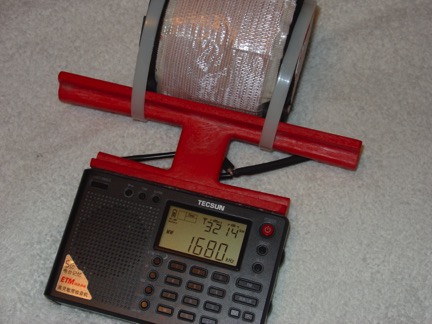
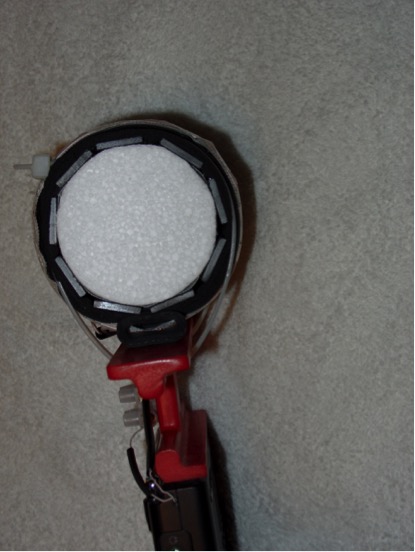
The Antenna was constructed using 9 – 100 mm Ferrite Bars wound on a 2.75 inch diameter x 4 inch styrofoam cake dummy form custom made by in Vancouver, B.C. Canada – ([email protected]) for $3.50 plus shipping.
The Coil wire consisted of 38 turns of high gain 660/46 Litz Wire. (Note: As can be seen 38 turns of the thicker Litz Wire left only 5/8” of room on each side of the Styrofoam Form to wire wrap the coil to the ruler frame. A longer Form ie 5” long would work much better for this build).
The insulation spacer used was 2 layers of 1/8 inch Aerotape self adhesive tape which also helped hold the 100 mm Ferrite Bars onto the Styrofoam Coil Form. Inductance measured 356 uH using a DM 4070 Meter which is well within the requirement of over 300 uH for AM Band Reception.
Side View Of 9-Bar FSL Antenna with 2.75” Diameter Styrofoam Cake Dummy.
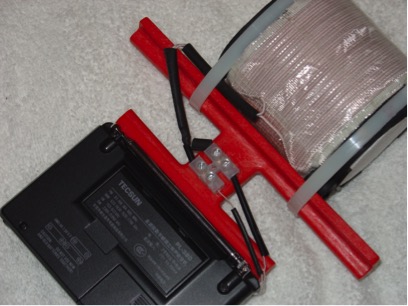
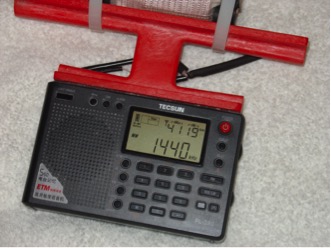
Because of the extra thickness of high gain 660/46 Litz Wire which is a bit too big to solder to the inside terminals of the Tecsun PL-380 Radio, a 2 Position Terminal Block was superglued to the outside of the Ruler Frame to act as an interface connection point.
2 Position Terminal Block Superglued To Back Of Antenna Frame
Testing Results:
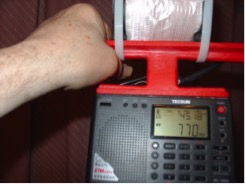
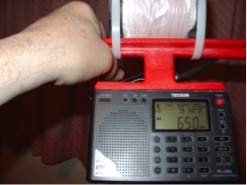
Both daytime and evening AM station captures have been spectacular. Stations as far away as KKOB / 770 kHz Alberquerque, New Mexico 1130 Miles from here in Winnipeg, Manitoba, Canada have been received. Country music station WSM / 650 kHz in Nashville, Tennessee 1082 miles distant is a daily evening pickup.
Station KKOB / 770 kHz Alberquerque, New Mexico 1130 Miles distance.
Station WSM / 650 kHz in Nashville, Tennessee 1082 miles distance.
Two Stations Received At 600 kHz 90 Degrees apart at the same time:
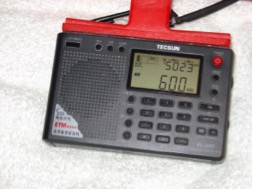
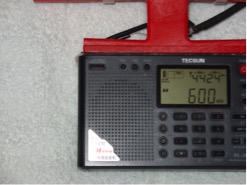
The amazing Nulling and Razor Sharp Tuning quality of this FSL was demonstrated when 2 stations at 600 kHz were received at the same time by rotating the Radio with attached FSL 90 degrees. In the North / South direction Station KSJB / Jamestown, North Dakota (219 miles distant) was received with a strong signal strength of 50 / 23. Then by rotating the Radio 90 degrees to the East / West direction Saskatoon, Saskatchewan station CJWW (442 miles distance) was captured with a similar strong signal strength of 44 / 24.
600 kHz Station KSJB / Jamestown, North Dakota.
600 kHz Station CJWW / Saskatoon, Saskatchewan.
Daytime Reception of 600 Watt Station 137 Miles Distant:
A major daily AM reception capture during the afternoon illustrating the amazing sensitivity of this antenna is 600 Watt station KKXL Sports Radio 1440 kHz (137 miles).
All Indoor Reception – For Now!
Due to winter conditions here in Winnipeg, all of the amazing station reception captures in this report were done inside the House facing towards the South window. Fortunately the red ruler platform sides can he used as handles when pointing the radio in the direction of best reception. Exciting times are ahead to see how well this mini 3” FSL will perform outdoors for likely even better AM DXing.
Summarizing:
The design of this new FSL Antenna attached to the Tecsun PL-380 Ultralite radio by Gary DeBock is a major breakthrough in AM DXing since the Radio is attached to the FSL. This new FSL Antenna needs to be constructed to be really appreciated. The application described here requires a bit more skill to construct and is also heavier than the original construction – but at least it is portable. For beginners Gary’s original 3” FSL Heathkit Design is highly recommended and can be reviewed in his You Tube Video posted at: https://www.youtube.com/watch?v=VY9u8MReGjk
Thanks,
Jerry Popiel
Winnipeg, Manitoba, Canada
Thank you, Jerry! It’s amazing what performance you and Gary DeBock have gotten out of these homebrew FSL antennas! Thank you so much for taking the time to share your construction details and performance notes!
The Society of Broadcast Engineers (SBE) has told the FCC that the regulatory agency needs to take another tack in its efforts to tackle AM revitalization. If the FCC takes the SBE’s advice, the result could be less noise in the MF and HF Amateur Radio bands. In comments the SBE filed in response to an FCC Further Notice of Proposed Rulemaking and Notice of Inquiry (MB 13-249) proposing ways to enhance the viability of the AM broadcast service, the SBE said the Commission must “commit to a regulatory plan which, over time, will reduce the levels of man-made noise in the MF bands, and more broadly in the bands below 30 MHz.” In comments it filed earlier in the proceeding, the SBE pointed out that “AM radio in particular is susceptible to interference from electronic devices of all types,” and that ambient noise on the AM band is only bound to get worse with further proliferation of noise-generating electronic devices, including certain lighting devices regulated under FCC Part 15 and Part 18 rules.[…]
“AM occurs elsewhere in nature. A lightning strike or manmade electrical discharge will produce a burst of electrical noise that varies in amplitude. Since AM radios are designed to detect variations in amplitude, this is why they are prone to interference from such things. AM held sway as the primary method of modulating a radio wave up to WWII, not only for broadcasting, but for all types of radio communications.
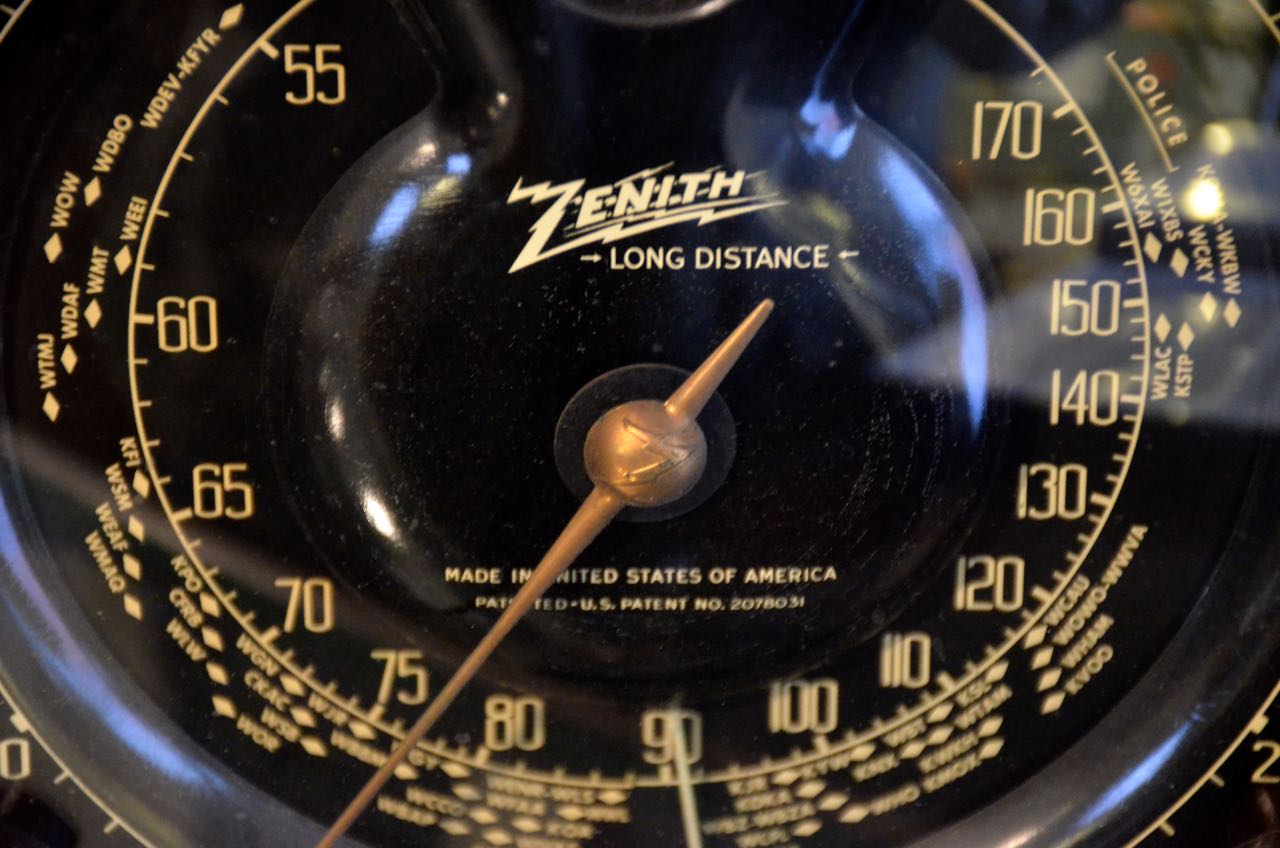
Every vintage consumer radio, be it standard broadcast or shortwave, up to WWII, received amplitude modulated signals. Nowadays, AM broadcast stations are associated with lower quality audio, but such was not always the case. Receiver design really came of age in the 1930s with the superheterodyne circuit and advancements in loudspeaker design. The grand floor consoles of the late 1930s leading up to WWII were capable of producing audio that was very good, even by today’s standards, the only exception being that they were monaural, as stereo technology was still a ways off.”[…]
Litwinovich’s article is a must-read as he gives a concise overview of amplitude modulation, AM vs. FM, and even covers current proposed uses of the broadcast band (something we’ve also recently mentioned).
Many thanks to SWLing Post reader, Vendel Boeree (K2DSI), who writes:
Hi Tom, I just wanted to compliment you on your fine website. As a kid I would listen to Radio Netherlands which made me quite the hit with mom because she was homesick for our native Holland for quite some time. I was heart broken to find out that Radio Netherlands went dark not that long ago.
Back in 1967 my family moved to Australia and went there by freighter. Things didn’t work out as planned and we returned on an old American freighter, the “African Moon”.
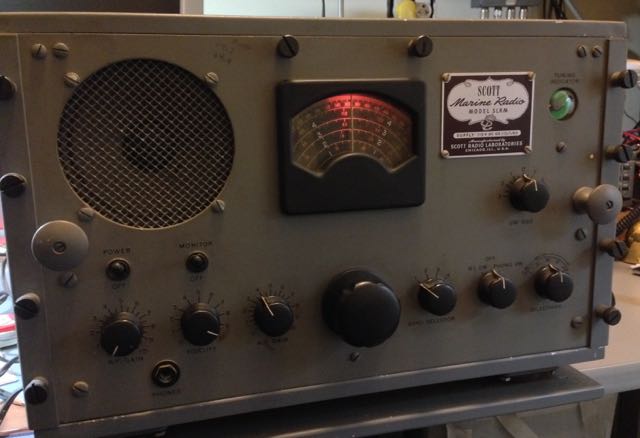
I became friendly with the radio operator on that ship and he let me shortwave listen when he was off watch. The receiver was a “Scott” and appeared to be the same as yours. They also had a “Scott” receiver in the lounge that had a slide rule dial that was used for entertainment purposes. I was hooked. I wanted to be a radio operator.
Needless to say I didn’t follow through on that dream and I suppose that’s just as well seeing as how ROs are a thing of the past.
Take care and keep up the good work.
Vendel Boeree/ K2DSI
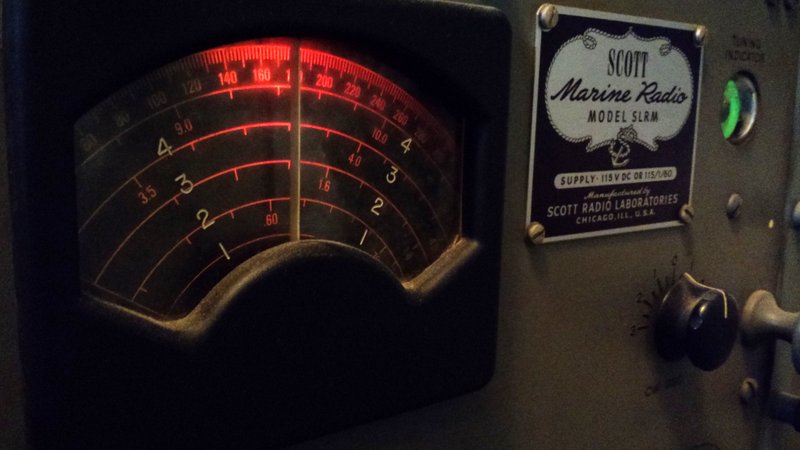
Thanks so much for sharing those memories, Vendel! I bet reception was nothing short of amazing while you were at sea. I’m guessing the slide rule model Scott you listened to in the lounge was the model SLR-F (click here for a photo).
Just the other day, my wife looked around my radio shack and asked what radio I would grab if the house were on fire. My answer was the Scott Marine SLR-M. It represents everything I love in WWII era receivers: built like a tank, great sensitivity, beautiful back-lit dial, built-in speaker, phono in, a magic eye and–since it was intended as a troop morale radio–beautiful room-filling audio.
Many thanks to Mike Terry who shared the following note and video via Facebook:
The great old days when the signal was mellow and radio waves were not blocked by buildings and hills and propagated beyond the horizon especially at night, it all added to the excitement. We would never have heard many of the great records of the 60s and later without this station! So many international stars made their name on the offshore stations around our coast 50 years or so ago. UK radio was changed for ever.
[Note: This video may only be viewable via Facebook or the SWLing Post site.]
Please support this website by adding us to your whitelist in your ad blocker. Ads are what helps us bring you premium content! Thank you!

 (Source: MediaFire)