Category Archives: Mediumwave

Obtaining QSLs from AM broadcast stations?

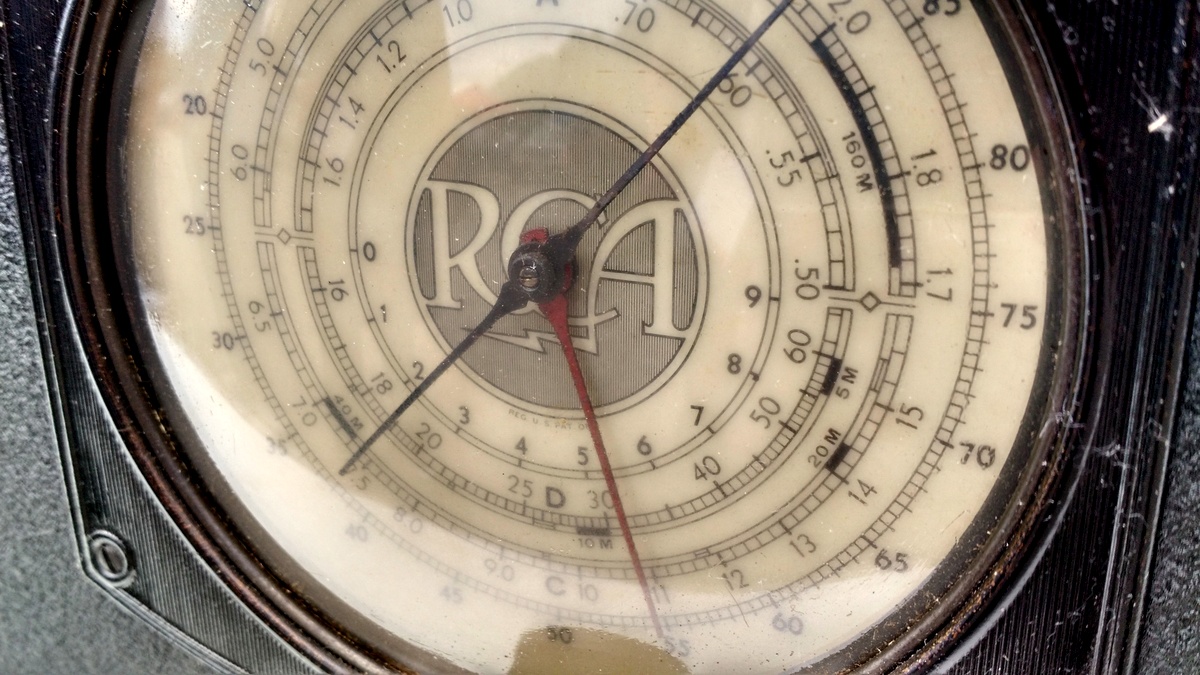
RCA-Dial

SWLing Post reader, Paul Grodkowski, writes:

“Just a quick question to anyone at the SWLing Post:

Is the practice of sending a reception report to a AM broadcast station in return for a QSL card still accepted in the age of the internet ?

So many stations are broadcasting online now that I wonder if they have QSL cards at all?

I just want to keep up with the times and not bother busy people at radio stations and look out of date, yet at the same time would like to confirm report of reception.

Any information would be greatly appreciated.”

Thanks for your question, Paul! I’m no expert on AM broadcast QSLing, but I’m pretty sure many mediumwave stations still respond to listener reports. Indeed, I believe there are even radio enthusiasts who act as QSL managers of larger clear channel stations (CFZM comes to mind).

Of course, one brilliant resource for all things MW DX is the National Radio Club (NRC).

Readers: Can you help answer Paul’s question? Please comment. Also, if you have some AM broadcast QSL cards, please contact me as I would love to post some.

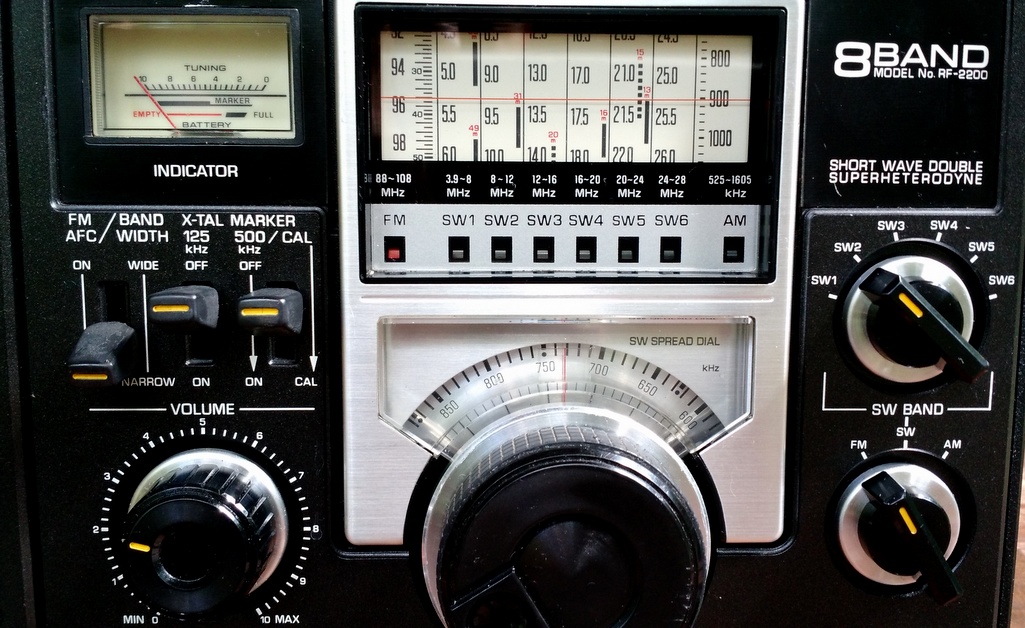
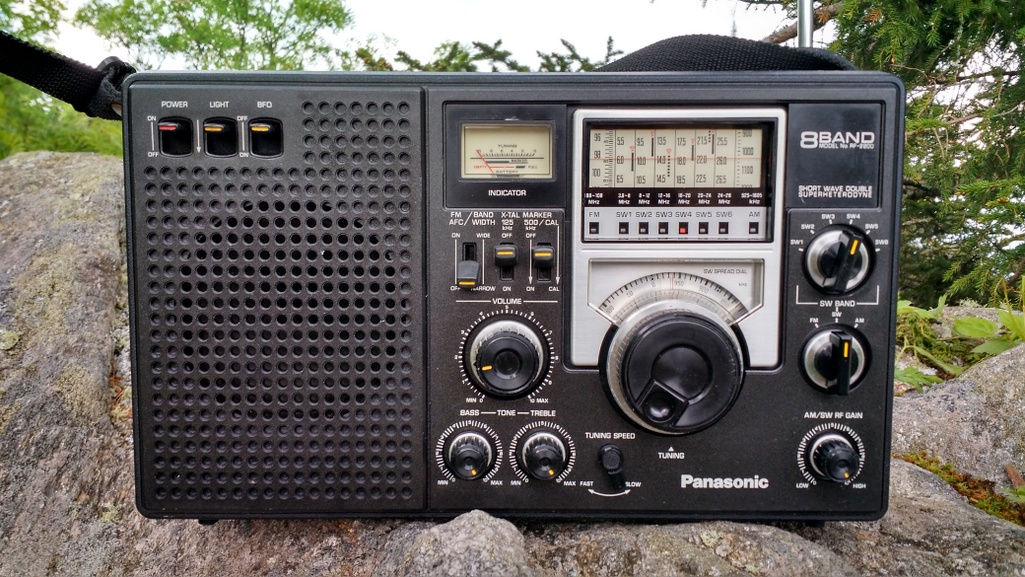
Tuning in to AM broadcast history and the venerable RF-2200

Panasonic-RF-2200-2

Many thanks to SWLing Post contributor, Eric (WD8RIF), for sharing a link to this excellent article in the Illinois Times by James Krohe Jr. Here’s an excerpt:

Tuning in: Making a small world bigger and the big one smaller

So much of happiness, I’ve realized, depends on getting tuned in. When he was a young married, my father used to tune in the console radio in the living room of the Krohe family mansion on Manor Avenue to the live broadcasts of big-band music “from the beautiful Blue Room in the Roosevelt Hotel” in downtown New Orleans. He was able to be in two places at once thanks to WWL-AM, whose 50,000-watt clear channel signal was beamed north. For all I know, while he tapped his toe on the sofa in Springfield, Inuit couples were jitterbugging on the tundra.

For Springfield teens in the 1950s and ’60s, getting a chance to listen to what kids in bigger cities had already decided they liked was important. WCVS-AM was just crawling out of its cocoon, having crawled into it as a country station and emerging as a rock station – although in the late ’50s there wasn’t that much difference. “Rock ’n’ roll” was, in stations like WVCS that catered to mostly white markets, rockabilly and pop-ish country ballads. (Geezers will recall when Brenda Lee was, briefly and laughably, marketed as a rock artist.)

For Top 40 music, as for so many other things, if you wanted to get the really good stuff you had to go to the big city. Around here that meant WLS-AM, WCFL-AM out of Chicago (whose Ron Britain made Soupy Sales look, or rather sound, like Noel Coward), and KXOK-AM out of St. Louis. George Lucas’s American Graffiti brilliantly captured the ways that car radios, transistors, radio stations blaring over PAs in drive-ins, permeated the bubble in which teenagers then lived.

Later I learned I could hear WBZ out of Boston if I acted as the antenna on my transistor. (“Turn on, tune in, drop out” to me meant losing the signal when I lighted a smoke.) WBZ was one of the first stations with the newest 45s from Britain, which allowed us yokels to hear The Yardbirds while the records were still on their way to Midwest stations by stagecoach from Boston harbor.

Continue reading…

Krohe also mentions the virtues of the Panasonic RF-2200 which is, in my opinion, one of the best AM broadcast portable receivers ever.

Click here to read the full article at the Illinois Times website.

Side note: The Panasonic RF-2200 still has a loyal following among mediumwave DXers of the world. The RF-2200 can be found on sites like eBay (click here to search), but make sure you’re purchasing from a reputable seller and not over-paying.

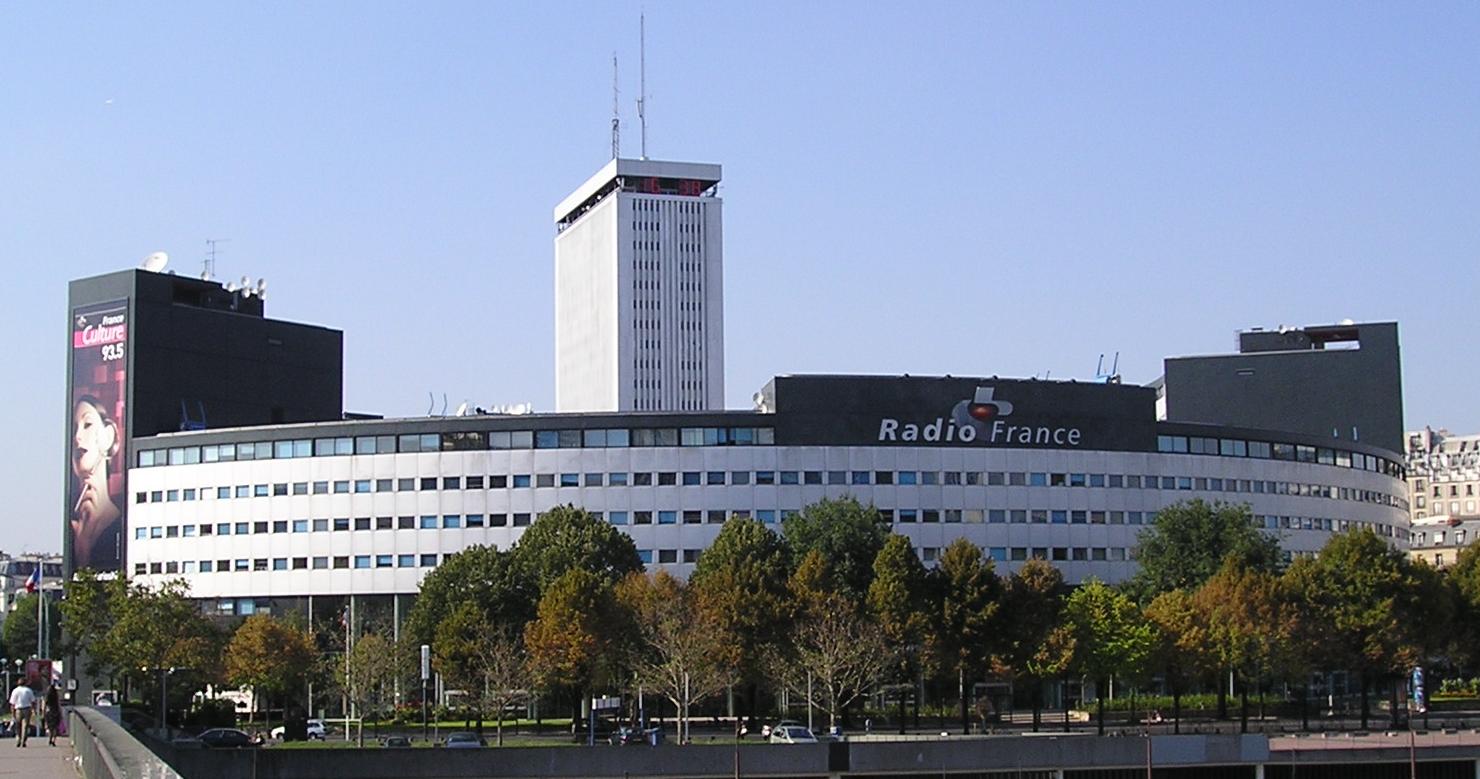
Radio France: mediumwave and longwave broadcasts to end

Maison_de_la_Radio_ParisMany thanks to SWLing Post reader, Marc, who sends this news from France Inter.

The article (in French) states that Radio France, in a cost-cutting measure, will end mediumwave transmissions by the end of this year (2015) and longwave transmissions by the end of 2016. It’s estimated that this will save 13 million Euros annually.

Though I haven’t listened to Radio France on mediumwave since I actually lived in France, I have been attempting to log France Inter on long wave from here in the States. This will certainly motivate me to put them in the books as soon as conditions are favorable.

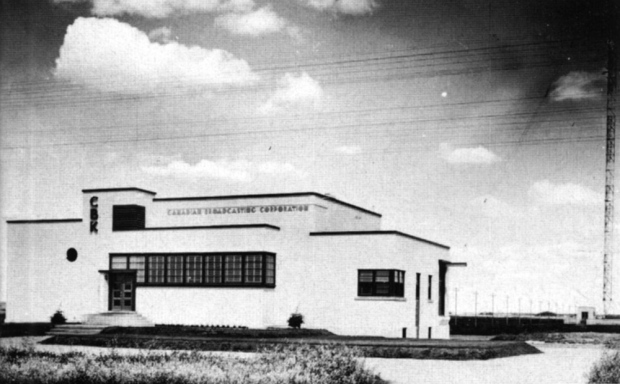
CBK transmitter building to be demolished

cbk

The CBK transmitter building in Watrous 1939 (Source: Dwight Kornelsen/ Watrousheritage.ca via CBC)

Many thanks to SWLing Post reader, Chris, who shares a link to this article from the CBC:

Historic CBK transmitter building in Watrous to be demolished

Most people who have grown up in the prairie provinces will have received their news via the CBC broadcast tower in Watrous.

The massive CBK building was established in 1939 as part of an overall CBC plan to bring programming to all parts of Canada. This was done with several well-placed 50,000 watt transmitters.

CBK was designed to serve all the prairie provinces, which is why Watrous was chosen as the site.

It is located in the centre of the populated portion of the prairies, and as a bonus it is located on a potash vein, making its ground conductivity one of the best on the continent.

In those days the technology for a single transmitter took up two floors of the building.

About 371 square metres was for the transmitter. That amount of equipment required a staff of six to maintain.

There was also a manager and living quarters for the staff.

During the Cold War, nuclear threat was a very real concern.

“The site was deemed important enough for communications that there was an armed guard protecting the transmitter,” said Stephen Tomchuk, transmitter supervisor for Saskatchewan.

“There was a fallout shelter built in the basement of the building that contained full facilities to be able to broadcast in the event of nuclear war,” added Tomchuk.[…]

Continue reading online…

WRTH update to A15 schedule

WRTH2015(Source: Sean Gilbert, WRTH Facebook Page)

WRTH has released a free update for the A15 schedules file. This PDF contains frequency changes, address etc., updates and some new stations. Please visit www.wrth.com and navigate to ‘Latest WRTH Updates’, choose the link under ‘International Radio’ and select the file you wish to download. The file is also available from our webshop:

http://www.wrth.com/_shop/?page_id=444

In the field with the Panasonic RF-2200

Panasonic-RF2200-MtMitchell

I’ve had the Panasonic RF-2200 for just one week, but I’ve thoroughly enjoyed getting to know this classic solid-state portable. Without a doubt I’ve been very pleased with the RF-2200, and I only have good things to say about the eBay seller, volodymyry123 from whom I bought it. Eventually I’ll take the time to calibrate the analog dial, which is about 100 kHz off-frequency.  (I’m obviously in no rush, but if readers with these rigs have suggestions for doing so, feel free to comment.)

The RF-2200 is surely one of the largest, heaviest portables in my collection…still, it begs to be taken outdoors!

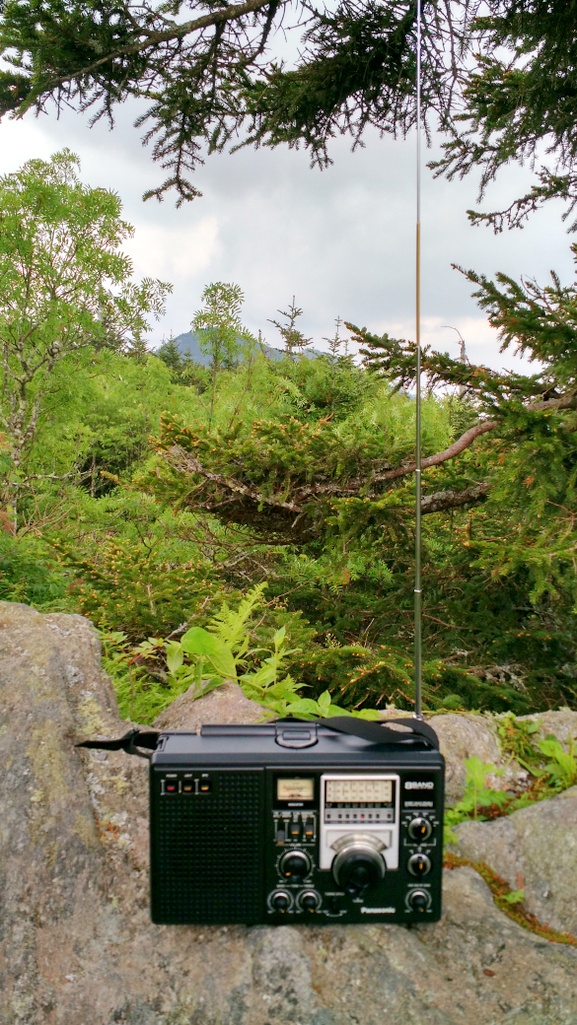
Last week, I drove with some friends to the highest point in eastern North America, Mount Mitchell State Park. As I left for our drive, picnic supplies and backpacks in tow, I took a glance at the RF-2200 in my office–and couldn’t resist taking it along.

During our mountain picnic, I turned the RF-2200 on; immediately I heard Radio Exterior de España‘s interval signal on 17,715 kHz. It was loud and clear, at times pegging S9 on the signal meter.
Panasonic-RF2200-MtMitchell-2

I also tuned to the medium wave band and was instantly amazed by all of the signals it drew in. I was able to hear one of my favorites, WAIZ, on 630 kHz–the signal was very stable and sounded local, although the transmitter was easily 60 miles away.

In general, medium wave performance on the RF-2200 has been nothing short of incredible. But this shouldn’t come as much of a surprise. Indeed, just prior to purchasing the RF-2200, I consulted my buddy, Jeff McMahon (the fellow behind The Herculodge); here’s what he says about the ‘2200:

“I borrowed my friends’ RF-2200 for a month in 2008 and I loved it. It picked up stations effortlessly and had a magisterial quality about it, especially the AM sound. It reminded me of why I fell in love with radios.”
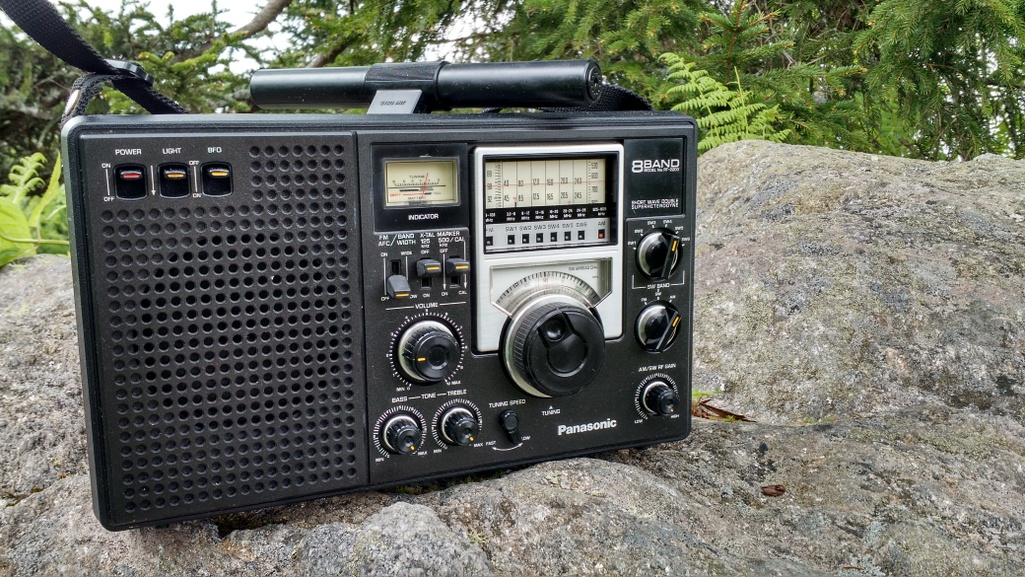
Panasonic-RF2200-MtMitchell-3But why is it that when I look at the RF-2200, I feel like I should be taking it to the field? Perhaps it’s the staunch, beefy look of the chassis, or the controls that could easily be worked even with winter gloves? Or perhaps it’s that woven carry strap?

Or perhaps the RF-2200 offers something I miss in the age of compact portables with digital displays: a radio with presence, one that lends itself to pure listening discovery. The RF-2200 demands your attention, and does so with a clear, deep voice…

Yep, the RF-2200 is a true field companion.  But don’t take my word for it:  find one, take it along, and see–or rather, hear–for yourself.

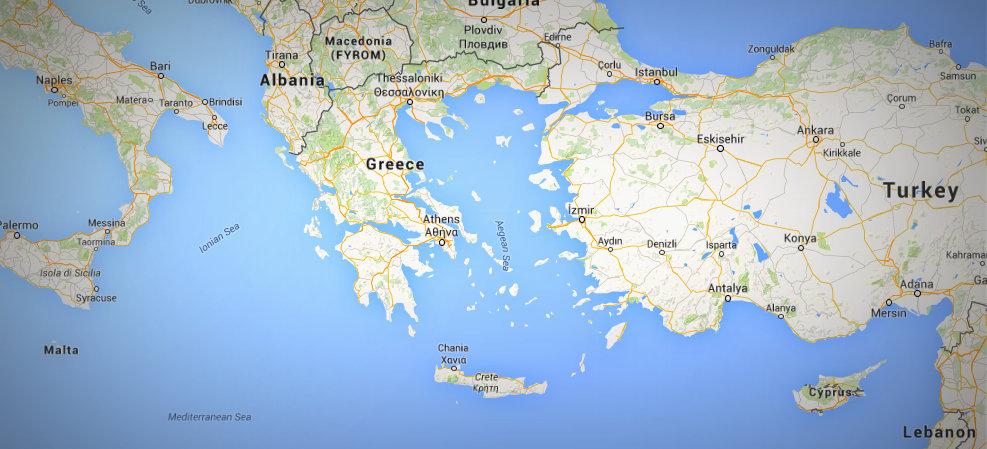
Shortwave listeners hear the Voice of Greece once again

greece

SWLing Post contributor, Moshe, writes with some good news from the Voice of Greece:

I’m listening to VOG at 9420kHz, At 11:27 local time 08:27UTC, 11/06/2015 the station identified itself as “Ezo Athina, I Foni Dis Elladas”: “This Is Athens, The Voice Of Greece”.

Immediately after receiving Moshe’s message, another Post contributor, Merkouris, provided the following details:

It would be of interest to the SWLing Post readers that, as of today June 11, the Greek public broadcaster ERT is back on the air with three TV channels and eight Radio programmes, including the “Voice of Greece”.

TV channels:
ERT1,
ERT2,
ERT3 (Thessaloniki)

Radio programmes:
Proto Programma (1st Programme),
Deftero Programma (2nd Programme),
Trito Programma (3rd Programme),
Kosmos (Musics of the world),
ERA Spor (Sports programme),
RS Makedonia (Thessaloniki),
Foni Tis Elladas (Voice of Greece)

The web site http://www.ert.gr/ is also up with news and streams of all tv and radio channels.

Right now at 10:45 UTC the Voice of Greece is on the air on 9420 kHz.

Many thanks to both Moshe and Merkouris for this information!

A little background…

If you haven’t been following the story, in June 2013, Greek National TV & Radio (ERT) was shut down and so was the Voice of Greece (well…officially, at least).  Only a few hours after VOG went off the air that night, they came back on the air with live protest coverage.

In fact, since that night–exactly two years ago today–Greece has been broadcasting on shortwave intermittently as a relay of ERT Open and/or Elliniki Radiofonia.

I hope that now VOG is officially back on the air, their shortwave broadcasts will be daily once again.  Tonight, I will certainly be tuned to 9,420 kHz!

Update: the BBC News has recently posted this excellent article with photos and videos on their website.