I’ve been listening to Apollo 11 in real-time, as mentioned in a previous post. Today, I’ve been listening to NASA communications as the Eagle landed on the moon (53 years ago).
Of course, any of those Apollo era comms include loads of Quindar Tones, so this reminded me of the following post from the SWLing Post Archives. I thought I might resurrect it for those who might not have caught it when first published. Enjoy:
Quindar Tones: Those iconic NASA PTT confirmation beeps

Apollo 11 (Photo: NASA)
Yesterday, my family watched the successful launch of the NASA Demo-2 SpaceX Dragon via YouTube.
As astronauts Robert Behnken and Douglas Hurley communicated with Mission Control, we heard PTT confirmation beeps after each transmission.
Those beeps, of course, reminded me of past NASA missions and those iconic confirmation tones we heard in audio from the Mercury, Gemini, and Apollo days all the way into Space Shuttle missions.
Quindar Tones
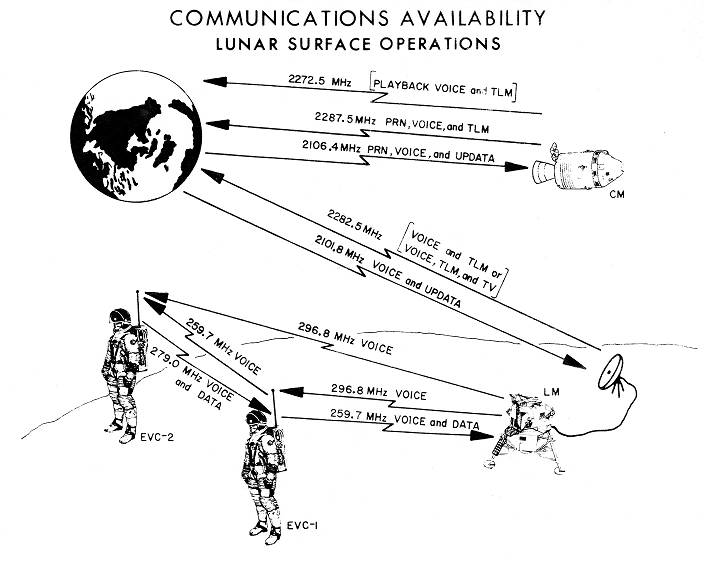
Source: honeysucklecreek.net
Last year, after spending a couple of days at the US Space and Rocket Center (and attending the Huntsville Hamfest), I heard numerous NASA audio clips and that lead me down the path of researching those PTT confirmation tones.
Turns out, they’re called “Quindar Tones.”
I couldn’t find any information about Quindar Tones at the US Space and Rocket Center–although, admittedly, the place is massive and I could have easily overlooked it–so I did a little research when I returned home.
I found this archived post on the NASA’s Apollo Lunar Surface Journal wesbite:
Re: Apollo beeps
Journal Contributor Mark Burckhard writes:
“I’ve always wondered what purpose the ‘beeps’ served that one heard intermittently during the voice communications with the Command and Lunar Modules during the Apollo missions, as well as other space missions.”
Journal Contributor Mike Dinn provides an MP3 clip ( 123k ) from a network audio check that includes numerous Quindar Tones.
Journal Contributor Markus Mehring replies:
“‘Other space missions’ is quite an accurate observation, since the ‘beeps’, in fact, are still in use today on Shuttle flights, at least on the UHF frequencies.”
“These beeps are called ‘Quindar-Tones’. Their purpose is to trigger the ground station transmitters when there is an outgoing transmission from Earth. The CapCom in the Mission Control Center, who is taking care of communications with the crew, uses his communication gear in a PTT mode exclusively. ‘PTT’ is short for Push-To-Talk, which means that the CapCom presses a button every time and as long as he wants to talk. (The crews back during Apollo – and also today – usually communicate via PTT as well, but they also have the so-called ‘VOX mode’ at their disposal, in which their microphones are voice-triggered by a certain adjustable threshold volume levels. VOX is used when they don’t necessarily have their hands free.)
When the CapCom presses his PTT button to start a transmission, an intro tone (2.525KHz sine wave with a length of 250ms) is generated and triggers the ground station transmitters to send. And when he is finished talking and releases the button again, a slightly lower outro tone (2.475KHz, sine, 250ms) is generated to trigger the ground station transmitters to turn off. So in short, these are remote control trigger tones.
CU! Markus”
I then discovered this article via the Internet Archive Wayback Machine, which gave more detail about the Quindar Tones’ name and some of the idiosyncrasies of the system:
The story behind the “Beep”
Steve Schindler, an engineer with voice systems engineering at NASA’s Kennedy Space Center, offers the following history of [Quindar Tones] origins.
“Quindar tones, named after the manufacturer of the tone generation and detection equipment, are actually used to turn on and off, or “key,” the remote transmitters at the various tracking stations (Merritt Island Launch Area–now Kennedy Space Center, Bermuda, Australia, etc.) that were used to communicate with the Mercury through Apollo spacecraft and, in some cases, are still used with the Space Shuttle.”
[…]”Although it usually worked well, there were a couple of peculiarities with this system. If the transmitter was keyed and the telephone line connection broken, the transmitter would never get the tone to turn off. To prevent this there was a “transmitter on” light at each remote site that would come on when the transmitter was keyed. Someone was supposed to monitor the circuit and if the audio dropped, but the “transmitter on” light was still on, they would have to manually unkey the transmitter. Also, just before communications was handed over to a new tracking station, the key-unkey tone pair was sent 10 times to ensure that everything was functioning correctly. This was done before the audio was patched to the tracking station’s line so it wasn’t heard in the control room or on NASA Select audio.
The Quindar system was actually built from a piece of equipment that was used to put multiple teletype circuits on a single phone line by means of frequency domain multiplexing. Because replacement parts are no longer available, an “out-of-band signaling” system was installed in 1998 for the transmitters located in the U.S. This system uses a continuous tone that is below the normal audio frequency range. When the tone is present, the transmitters are keyed. When the tone is not present, the transmitters are unkeyed. It worked fine, but the Astronaut Office complained about the lack of tones which everyone had become accustomed to as an alert that a transmission was about to start. So, the Quindar tone generator, which was still installed in case it was necessary to key the transmitters at an overseas site, was re-enabled.
Even though you won’t hear the same Quindar tones in present-day space missions, you can listen until your heart is content at the website Apollo In Real Time.
The Internet Archive also has a massive collection of Apollo audio free to stream and download.
Quindar Music
If you’re fascinated with the NASA audio soundscape in general, you might check out the electronic music duo Quindar featuring longtime Wilco member Mikael Jorgensen, and art historian-curator James Merle Thomas.
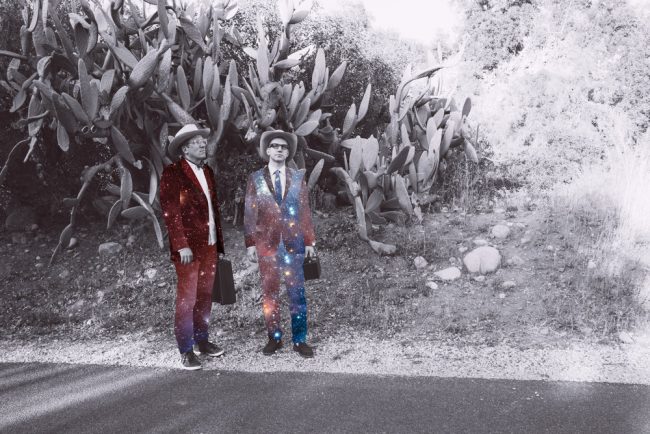
Quindar: Mikael Jorgensen & James Merle Thomas. Photo by Chad Ress, Spacesuits by Cassandra C. Jones
Science Friday featured an extended interview with the group in 2017. If you love electronic music–especially if you’re a fan of Wilco, it’s well worth a listen:
Check out their latest video, Choco Hilton:
Speaking of Mikael Jorgensen and Wilco, I should note here that their album yankee hotel foxtrot has a deep shortwave motif.
Anyone else fascinated with Quindar Tones and NASA audio? Feel free to comment and share any other resources or projects you’ve found.
Do you enjoy the SWLing Post?
Please consider supporting us via Patreon or our Coffee Fund!
Your support makes articles like this one possible. Thank you!