I recently discovered that Bob Padula, long-time shortwave radio enthusiast and publisher of The Australian DX Report, has an online project entitled The History of Shortwave Radio In Australia. It’s a thorough and informative read and is available free of charge.
Category Archives: Radio History
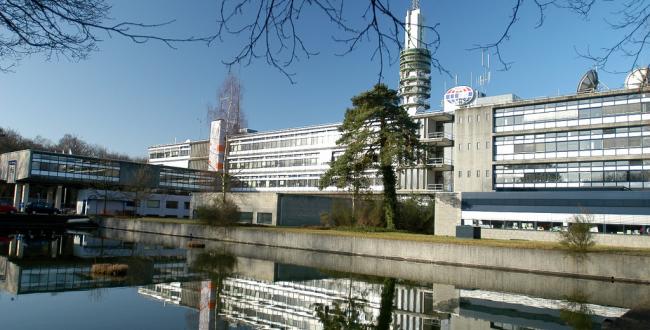
Radio Netherlands says farewell in style
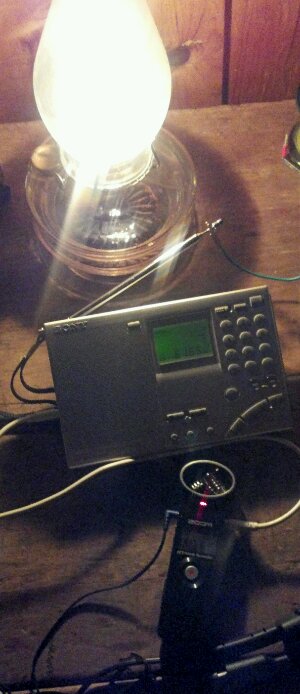
Thursday night, by the light of an oil lamp, I tuned my trusty Sony portable shortwave to 6,165 kHz. At 2:00 UTC, I was rewarded with a rich, full signal from Radio Netherlands Worldwide’s transmission site in Bonaire. Here in this off-grid cabin, on sixty rural acres, I bask in the freedom from electrical noise that might otherwise interfere with my shortwave radio listening—at least in this respect, this is the perfect DXpedition cabin.
The signal coming out of Bonaire, however, would have overcome any interference: Radio Netherlands, my dear friend of some 32 years, had opened a special frequency for those of us in eastern North America…in order to say their good-byes to the airwaves.
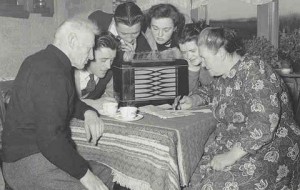
I can only describe the experience of listening as radio bliss…pure radio bliss…marred only by the bittersweet realization that these were RNW’s final days on the air. The experience harkened back to the day when the big broadcasters had booming signals directed toward us.
But, alas. All too brief.
The broadcast was simply entitled Farewell and Thank You. You can hear it just as I heard it—through my recording–here (actual broadcast starts at 1:15):
Then, all day Friday, for nearly 24 hours straight, RNW bid good-bye and farewell to various parts of the world via shortwave, satellite and the internet. I was lucky enough to catch two more broadcasts.
This time of day (19:00 UTC), however, I needed bigger ears than the Sony could provide. I was listening to broadcasts targeting west and east Africa, not North America. Having already charged my laptop battery, I plugged in the Bonito Radiojet (an SDR that I’m currently reviewing) and, just before 1900 UTC, directed her towards 17,605 kHz. Though my Sony found the signal barely audible, the RadioJet produced beautiful fidelity.
This RNW broadcast, entitled The First 50 Years, took listeners through the highlights and history of the Dutch radio service. Here’s the recording I made with the RadioJet:
A final sign-off
At 20:00 UTC, RNW broadcast their very final show—a repeat of Farewell and Thank You (above) appropriately targeting Africa once more. I tuned the dial to 11615 kHz and listened again to the full broadcast. This time, however, as the program drew to its close, the broadcast crew added a personal message.
Jonathan Groubert, the talented host of The State We’re In, broadcasted live from Hilversum’s Studio 4 for a deeply touching adieu. Tears were shed, and I’m not ashamed to confess that I, too, listened through a haze of them as these capable and dedicated journalists, whom I’ve grown to trust, signed off the RNW airwaves for the last time.
But listen for yourself:
Jonathan Marks, RNW’s host of MediaNetwork, also featured in the farewell broadcast, recorded the final sign-off from within Studio 4. You can listen to this and read the description on his excellent website.
RNW–my dear radio friends—I’m going to miss you. Your personalities–and the collective personality of RNW itself–your award-winning content, news, reporting, and your integrity stood out amongst all those Cold War broadcasters I listened to growing up—who, as you so well put it, were merely mouthpieces for their respective governments.
Radio Nederland, I loved your broadcasting because you were fearless: you marched to the beat of your own drummer, were not afraid to turn a critical eye even upon yourself, and as a result–in a world of sham journalism, of compromise and hypocrisy—you earned my trust. You had nothing to hide, and you had so many stories to tell.
RNW: I listened.
I wish you (and your intrepid creators) the very best in all that you do. I trust your new incarnation(s), whatever form they take, will do much good in this world which so sorely needs it, and sincerely believe that your integrity will live on.

Telegraph operations in the Great Auroral Storm of 1859

Sunspots of September 1, 1859, as sketched by Richard Carrington A and B mark the initial positions of an intensely bright event, which moved over the course of 5 minutes to C and D before disappearing. (Source: Wikimedia Commons)
These days, CMEs and solar flares get a great deal of media attention. But it’s mostly speculation–for even with our advanced abilities to measure the potential impact, we can’t be sure what will happen each time this occurs. Might this solar flare be strong enough to damage our satellites and electrical infrastructure? we may wonder. Could it ‘fry’ our electrical grid?
The concerns are merely speculative. But is there actual cause for concern? Surely. A massive solar flare could damage much of our technology in space–such as our satellites–and could also certainly cause headaches for those who manage our electrical grids.
But do we know how powerful solar events can be? History may hold the answer.
In September of 1859, a solar flare was so massive that there were newspaper reports of it across the globe, and many found the strange light it created baffling. Of course, now, there’s no speculation as to what happened then–eyewitness accounts and plenty of written evidence in this pre-internet era paint a clear picture of a massive coronal ejection. This event has been referenced many times as a benchmark–one that, should it happen now, would certainly give us serious pause. Technologically, that is.
I happened upon a fantastic article about the 1859 flare on ARS Technica called: 1859’s “Great Auroral Storm”—the week the Sun touched the earth.
The following is an excerpt:
It hit quickly. Twelve hours after Carrington’s discovery and a continent away, “We were high up on the Rocky Mountains sleeping in the open air,” wrote a correspondent to the Rocky Mountain News. “A little after midnight we were awakened by the auroral light, so bright that one could easily read common print.” As the sky brightened further, some of the party began making breakfast on the mistaken assumption that dawn had arrived.
Across the United States and Europe, telegraph operators struggled to keep service going as the electromagnetic gusts enveloped the globe. In 1859, the US telegraph system was about 20 years old, and Cyrus Field had just built his transatlantic cable from Newfoundland to Ireland, which would not succeed in transmitting messages until after the American Civil War.
“Never in my experience of fifteen years in working telegraph lines have I witnessed anything like the extraordinary effect of the Aurora Borealis between Quebec and Farther Point last night,” wrote one telegraph manager to the Rochester Union & Advertiser on August 30:
The line was in most perfect order, and well skilled operators worked incessantly from 8 o’clock last evening till one this morning to get over in an intelligible form four hundred words of the report per steamer Indian for the Associated Press, and at the latter hour so completely were the wires under the influence of the Aurora Borealis that it was found utterly impossible to communicate between the telegraph stations, and the line had to be closed.
But if the following newspaper transcript of a telegraph operator exchange between Portland and Boston is to be believed, some plucky telegraphers improvised, letting the storm do the work that their disrupted batteries couldn’t:
Boston operator, (to Portland operator) – “Please cut off your battery entirely from the line for fifteen minutes.”
Portland operator: “Will do so. It is now disconnected.”
Boston: “Mine is disconnected, and we are working with the auroral current. How do you receive my writing?”
Portland: “Better than with our batteries on. Current comes and goes gradually.”
Boston: “My current is very strong at times, and we can work better without the batteries, as the Aurora seems to neutralize and augment our batteries alternately, making current too strong at times for our relay magnets.
Suppose we work without batteries while we are affected by this trouble.”
Portland: “Very well. Shall I go ahead with business?”
Boston: “Yes. Go ahead.”
Telegraphers around the US reported similar experiences. “The wire was then worked for about two hours without the usual batteries on the auroral current, working better than with the batteries connected,” said the Washington Daily National Intelligencer. “Who now will dispute the theory that the Aurora Borealis is caused by electricity?” asked the Washington Evening Star.
Read the full and fascinating article, 1859’s “Great Auroral Storm”—the week the Sun touched the earth on arstechnica.
Recording Radio History: The Queen’s Diamond Jubilee via BBC World Service
Ten years ago, my wife–then fiancée–and I lived in the UK, and were fortunate enough to attend The Queen’s Golden Jubilee celebration on the vast lawn at Buckingham Palace. It was without doubt the largest party I’ve ever attended, packed to the gills with the British public–a thoroughly amazing event, featuring a who’s who of past-and-present British musicians and personalities, encouraging attendees to join them in their bit of fun–and, of course, God save the Queen.
Yesterday, I re-lived the energy of that party as I heard (and recorded) the follow-up event these ten years later–The Queen’s Diamond Jubilee, on the BBC World Service–as heard from remote Ascension Island.
When hearing live events like this on shortwave–especially ones like this that celebrate national heritage–I know I’m listening to history in the making. The crowds applauding and cheering in a live broadcast over shortwave reminds me of a former era when British Expats across the globe relied on the BBC World Service to connect them with ol’ Blighty.
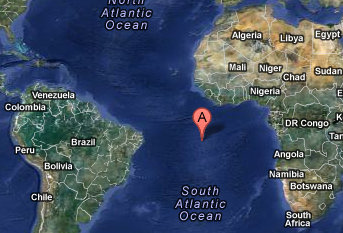

I recorded these broadcasts from my home in the southeastern US, hearing the BBC World Service relay station on the tiny, isolated Ascension Island in the South Atlantic. The broadcast was heard at first on 15,400 kHz, then moved to 9,915 kHz coinciding with their normal broadcast schedule. The broadcast, while completely intelligible, is weak in the beginning, but gains considerable strength by the end. There are summer static crashes heard as storms moved through the southeast US. I divided the broadcast into two parts, coinciding with my shift from one frequency to the other.
I also included a BBC WS news broadcast in Part 2 which followed the end of the show.
Either use the embedded Archive.org audio player below, or simply click here to download the mp3 files for Part 1 and Part 2.
I used the WinRadio Excalibur to record both of these segments. Its synchronous detection helped deal with fading (QSB) present at the beginning of the recording.
Once again, history is made…and archived on shortwave radio. Enjoy!
Andy Sennitt: The Media Network years – the noughties
Media Network, which covered international broadcasting developments at Radio Netherlands, recently ended a 30-year run on RNW. In a series of four articles, Andy Sennitt mentions some of the highlights, and then looks ahead to how international broadcasting might develop in the next ten years.
Part 3 of this series, “The Media Network Years: the noughties” is now available on RNW’s website.
Grandfather of WWV’s atomic clock
I just discovered a film produced by the National Physical Laboratory (NPL) Film Unit in the 1950s explaining the principles behind the first accurate atomic clock. The clock was designed by Louis Essen and built at the National Physical Laboratory in 1955.
This film gives fascinating insight into the physics that run atomic clocks like those behind the WWV and CHU time stations. Better yet, the science is easy to swallow with the traditional “BBC” style voice narration. Enjoy!
Andy Sennitt: The Media Network years the 1990s
Media Network, which covered international broadcasting developments at Radio Netherlands, recently ended a 30-year run on RNW. In a series of four articles, Andy Sennitt mentions some of the highlights, and then looks ahead to how international broadcasting might develop in the next ten years.
Part 2 of this series, “The Media Network Years: the 1990s” is now available on RNW’s website.