Category Archives: Shortwave Radio

Radio Waves: Listening to Jupiter, Radio Emma Toc, Turkish Bans, and RT DE to Sue German Regulator

Radio Waves:  Stories Making Waves in the World of Radio

Because I keep my ear to the waves, as well as receive many tips from others who do the same, I find myself privy to radio-related stories that might interest SWLing Post readers.  To that end: Welcome to the SWLing Post’s Radio Waves, a collection of links to interesting stories making waves in the world of radio. Enjoy!


Under a darkening sky, earthlings tune in to ‘Jupiter Radio’ (KLCC)

Ever eavesdrop on the planet, Jupiter? This past weekend, some radio enthusiasts gathered at Eugene’s Riverfront Field to do just that.

Roughly a dozen members of the Ducks on the Air Amateur Radio Club gathered on the grassy space (making sure to sidestep goose poops) to set up an array of cables and rods called a differential dipole antenna. They managed to assemble it and realign it just before Jupiter appeared on the dusky horizon. [Continue reading and listen to the audio at KLCC…]

Radio Emma Toc – celebrating wireless station 2MT – at 100! (Southgate ARC)

Dear Listener / Viewer

I’m pleased to let you know that I will be broadcasting another video stream this coming Monday, 14th February, with the theme of celebrating wireless station 2MT.

In 1922, after requests & petitions from radio hams in the United Kingdom, a licence was issued for station 2MT to transmit a programme of CW (morse), Telephony (voice) and music, on a weekly basis. Transmissions came from a small wooden hut in Writtle, Essex, where engineers working for the Marconi Company were given the task of putting on air a wireless station for ‘calibration purposes’ aimed at the growing number of radio hams and enthusiasts.

Over a short period, and with the good fortune of this Marconi team having a selection of gifted radio engineers & maverick individuals, 2MT became incredibly popular & – probably without realising it at the time – went on to lay the foundations of entertainment broadcasting that was to follow.

Monday the 14th February will be the centenary of the first transmission from 2MT. From 11am in the morning – 11:00UTC – we will be playing audio documentaries & videos looking at the start of broadcasting here in the UK, & then at around 6.45pm – 18:45UTC – I will present a live programme where hopefully we can all join in to drink a toast to ‘2MT’.

Our broadcast will not be a full history of the station, more a celebration of the people involved & everything that we enjoy about radio today. I hope to link with others celebrating 2MT & also radio hams on the air on this anniversary day.

I invite you to join me for this amateur enthusiast video broadcast!

Further details are available here:
 
Links & information relating to our broadcast stream:

Website – https://www.emmatoc.org/
Website page for this celebration – https://www.emmatoc.org/2mtcelebration
Link for viewing (only linking to us on the day of the broadcast) – https://www.mixcloud.com/live/RadioEmmaToc/
Facebook page – https://www.facebook.com/emmatoc
Twitter page – https://twitter.com/radioemmatoc

You can take part in the programme by emailing me with any comments & radio memories – I’d love to say hello to you – our email address is – [email protected]

Check our Facebook & Twitter pages for updates in case of any problems with transmissions (things can always go wrong!)

Our friends at Essex Ham have produced a short interview video with more detail – https://www.youtube.com/watch?v=uk_XnGvsJ0M

Links & information for other items of interest:

For radio hams, there will be two special event amateur radio stations in operation.
Local Radio Club CARS – Chelmsford Amateur Radio Society – will be operating GB100 2MT from Writtle Village Hall – http://www.g0mwt.org.uk/events/gb1002mt-writtle/index.htm
Radio Club Essex Ham will be operating GB2MTC from the East Essex Hackspace Hut in Hockley – http://sxham.uk/2mt

It is also hoped that items about 2MT will feature in programmes on the 14th on BBC Essex, Chelmsford Community Radio, & Phoenix FM. I will have more detail on this during my live stream, & if possible will link up with our friend Tim Wander at some time during the evening!

I look forward to being with you on the 14th!

Best wishes

Jim

DW, VoA and Euronews facing Turkish ban (Broadband TV News)

Turkey has given three international broadcasters a deadline of 72 hours to apply for local licences or be taken off the air.

“Deutsche Welle, Voice of America and Euronews have been given a deadline of 72 hours by the RTÜK. They must apply for a broadcast licence within that period or face a broadcast ban,” said Okan Konuralp, a member of the Turkish opposition Republican People’s Party (CHP) on Twitter.

At issue are the broadcasters’ websites that have drawn the attention of the authorities because they also feature video news. Such websites have become increasingly popular in Turkey as the government places restrictions on local news outlets.

If the broadcasters don’t apply for a licence the regulator has the right to go to court and get the website closed down. [Continue reading…]

RT DE to sue German regulator after broadcast ban (Broadband TV News)

RT DE says it plans to take legal action against Berlin’s media regulator after the German-language channel was ordered to shut down its streaming service.

The simmering row between Berlin and Russia has resulted in the imposition of restrictions on the German international broadcaster Deutsche Welle’s Russian operations.

“We believe that the regulatory authority acted unlawfully with its decision against RT DE Productions GmbH on February 2. The MABB claims that RT DE Productions GmbH is responsible for broadcasting the RT DE channel, blatantly ignoring the fact that the RT DE programme is managed and distributed by Moscow-based TV Novost,” said RT DE in a statement. [Continue reading…]


Do you enjoy the SWLing Post?

Please consider supporting us via Patreon or our Coffee Fund!

Your support makes articles like this one possible. Thank you!

Carlos’ Shortwave Art and Recording of Okinawa Fishery Radio

Many thanks to SWLing Post contributor and noted political cartoonist, Carlos Latuff, who shares yet another example of his radio log art, this time for Okinawa Fishery Radio. Carlos notes:

Okinawa Fishery Radio Station, Okinawa, #Japan, 8761 kHz (USB), broadcasting weather reports and navigation alerts to Japanese fishing boats.

Heard in Porto Alegre, Brazil, Feb 9, 2022, 08h59 (UTC).

Click here to listen on YouTube.

HF Monitoring in Ukraine?

Many thanks to SWLing Post contributor, Al Hearn, who writes:

Given the emerging situation in the Ukraine, I would appreciate any tips and suggestions that you might offer directly or on your blog as to what we might find interesting in terms of SWL — related broadcast stations, pirate stations, unencrypted government stations, ham nets, or numbers stations that might be monitored for increased activity. KiwiSDR could be an important tool in such monitoring.

Thank you for any information you can provide.

Al Hearn
WA4GKQ

You are not alone in asking this, Al. Indeed, I’ve gotten a numerous inquiries as of late and as tensions continue to rise along the border.

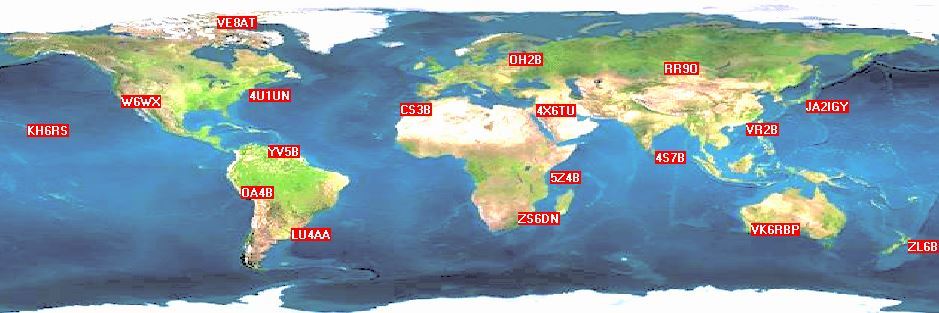
There are numerous KiwiSDRs in the region and throughout Europe that should be positioned well for monitoring pirates, hams, etc. (see map at top of post).

A reminder that the RTL-SDR blog did share a note of caution recently for SDR users in the Ukraine.

Of course, the limiting factor to me is that I don’t speak the language, so I would appreciate any comments from and SWLing Post community members in the region. Have you noticed any new HF activity? What stations are you turning to for information?

Please comment.

I do hope for a peaceful outcome to all of this.

Celebrating World Radio Day 2022!

Today is UNESCO World Radio Day and this year the theme of trust highlights the importance of radio as an accessible form of information.

Below are some of the many projects celebrating World Radio Day:


Cities and Memory: Shortwave Transmissions

As mentioned in a previous post, we at the Shortwave Radio Audio Archive are truly honored to have been a resource for this incredible and diverse sound project organized by Cities and Memory.

We encourage you to explore the creative work from over 120 artists and composers.

A great many of these remarkable dynamic works draw on a wide array of recordings from the SRAA; the resulting compositions and soundscapes are rich with sonic textures, evocative collages of sound and memory, which emerge into further sources of inspiration.

Our profound thanks to Cities and Memory––and all of the participating artists––for this truly brilliant collection which you can check out on the Shortwave Transmissions project page.


BBC World Service Documentary: “World Wide Waves ’22: The sounds of community radio”

As we mention in a previous post, this brilliant radio documentary focusing on community radio is available on the BBC World Service website and BBC Sounds

Here’s the description:

For World Radio Day 2022, we tune in to radio stations around the world that connect communities, spark conversations, keep traditions alive and give a voice to their listeners. From Aboriginal Koori Radio in Australia to a community station in India run by rural women from the lowest Dalit caste, the airwaves carry intimate wisdom, vital knowledge, beats and tunes that keep reminding us who we are.

Note that this piece was produced by our friend David Goren, of Shortwaveology fame. Continue reading

Cities and Memory Shortwave Transmissions released to mark World Radio Day!

We at the Shortwave Radio Audio Archive are truly honored to have been a resource for this incredible and diverse sound project organized by Cities and Memory.

We encourage you to explore the creative work from over 120 artists and composers.

A great many of these remarkable dynamic works draw on a wide array of recordings from the SRAA; the resulting compositions and soundscapes are rich with sonic textures, evocative collages of sound and memory, which emerge into further sources of inspiration.

Our profound thanks to Cities and Memory––and all of the participating artists––for this truly brilliant collection:


13 February 2022

UNIQUE ARCHIVE OF SHORTWAVE RADIO COMPOSITIONS LAUNCHED TO MARK UNESCO WORLD RADIO DAY

To mark UNESCO World Radio Day on 13 February, a unique collection of compositions built from eight decades of shortwave radio recordings is being released.

Shortwave Transmissions, a project by one of the world’s biggest sound projects Cities and Memory in collaboration with the Shortwave Radio Archive, sees more than 120 artists remix and recompose iconic shortwave recordings to create brand new compositions reflecting on and celebrating our relationship with radio.


The project can be explored in full at https://citiesandmemory.com/shortwave and features:

  • Recordings from the mysterious spy radio and “numbers stations” around the world
  • Coverage of world-changing events such as 9/11, the invasion of Kuwait, Kennedy’s assassination, Tiananmen Square protests, the death of Fidel Castro and many more
  • Rare international recordings from North Korea, Saudi Arabia, St. Helena, the Falkland Islands and Antarctica
  • Recordings covering a huge period of time from 1934 through to the present day
  • Space travel documented including the Sputnik, Apollo and Challenger missions
  • Recordings of famous voices such as Winston Churchill and King George V
  • Station IDs, interval signals and final broadcasts from radio stations
  • Stuart Fowkes, founder of Cities and Memory, said:

“Shortwave radio is one of the most fascinating sonic worlds – each recording is a unique time capsule capturing vital moments in world history as well as the thrill of pirate radio, clandestine radio stations, secretive number stations and military and spy radio.

These are sounds to be treasured: all of humanity is truly out there to be listened to at the turn of a dial – and is source material for some extraordinary compositions.”

Taking the world of shortwave radio to an entirely different place, each recording has been reshaped and reimagined as a creative recomposed sound by more than 120 musicians and sound artists, in turn reflecting on current concerns covering everything from climate change to the Covid-19 pandemic.

Shortwave Transmissions is the latest project from Cities and Memory, a global, collaborative network of sound recordists and artists based in Oxford, UK. Previous global sound projects have included #StayHomeSounds (a global mapping of the sounds of the Covid-19 lockdown), Protest and Politics (the biggest ever collection of the sounds of protest) and Sacred Spaces, the first global survey of the sounds of churches, temples, prayer and worship.

It has more than 5,000 sounds on its global sound map covering more than 100 countries and territories, and more than 1,000 worldwide contributing artists since its launch in 2015.

Jock explores “The Essential Listening Post Part II – When the lights go out”

Many thanks to SWLing Post contributor, Jock Elliott, who shares the following guest post:


Photo by Parker Coffman on Unsplash

When the lights go out: The Essential Listening Post – Part II

By Jock Elliott, KB2GOM

What’s the most valuable commodity in an emergency? Information.

Without information, it is very difficult to make decisions of what actions you should – or shouldn’t – take. Fortunately, as swling.com readers know, radio can come to your rescue.

As an example, I offer for your approval this minor incident that happened just a few mornings ago.

At 4:30 am, I awoke. That’s not particularly unusual; I get up early lots of mornings to run the Commuter Assistance Network on ham radio.

What made this morning unusual were the things I couldn’t see: the digital clock across the room, the tiny LED lamp that illuminates the way to the bathroom in the middle of the night. They were both dark. In fact, the only light that I could see was the LED from the uninterruptable power supply for the computer in the next room. It was pulsing, indicating the power from the mains was out.

With the help of a flashlight kept within easy reach of the bed, I made my way downstairs. A peek out the windows revealed the surrounding area was dark; no lights in local houses, no street lights. A house across the ravine behind my house had a single light, but it had the bright white look of an emergency lantern. So this outage was wider spread than just the lane where I live. But how widespread was it? In early February in upstate New York, it’s winter; temperature about 6 degrees Fahrenheit on this particular morning. The thermostat on the wall has already dropped below where the furnace should have kicked on. With no electricity; no furnace.

With no house power, I had no internet, so I couldn’t look things up to find out why there was no house power. Because we use Voice Over Internet Protocol (VOIP), with no internet, no house phone.

Now, I know what you’re thinking: “Well, dummy, fire up your smart phone, and in a few moments you’ll have your answers.”

To that I say: “Not so fast there, pardner.

I consulted with a ham radio friend who makes his living in the commercial radio business. He consults with many companies, including cell phone companies, so he knows what he is talking about.

It turns out there are three things that could render your smart phone useless.

The first is whether your local cell tower(s) have battery back-up. Most do, but how many hours the batteries will run the cell tower can vary widely from just a couple of hours to perhaps eight. Depending upon when the power went out, you may or may not be able to connect.

The second is that many cell phone towers themselves connect to the rest of the network through wire or fiber optic cable. If a vehicle has taken down a pole, or a falling tree has taken down a cable, the network may be disrupted.

Finally, if there is high demand for your local cell phone tower, you may not be able to make a connection. My commercial radio “guru” relates that he went to an event at a local community college. There is a cell tower right on the property, but he had great difficulty connecting simply because so many people were trying to use the tower.

During emergencies, cell phone networks frequently go into gridlock because of high demand, so it’s a good idea to have other means of gathering information. An interesting aside: some years ago, I heard a presentation from one of the hospital administrators who was in New Orleans during Hurricane Katrina. They were unable to make voice phone calls, but apparently they could sometimes send and receive text messages.

Getting back to my small lights-out incident, I was in the actual act of firing up a radio to check out what local broadcasters on the AM (medium wave) band had to say, when the lights came on, the furnace started, and internet and phone service were restored. My greatest inconvenience was having to reset a couple of digital clocks.

But it raised a serious question: what should be your essential listening post if the lights go out, the fertilizer hits the ventilation equipment?

First and foremost, a battery-powered radio capable of receiving your local broadcasters. You need to know – or find out – which ones have back-up power so they can keep transmitting. Knowing that will do two things for you: first, tuning in to a station with back-up power will hopefully get you the information you need, and second, if stations that don’t have back-up power are off the air, that will give you an indication of how widespread the power outage is.

Knowing the extent of the blackout can be important. A couple of decades ago, on an August afternoon, my better half and I took our young son to a local park where there was a water fountain that the kids could run through. When we got home later, the power was out. I saw the neighbor standing in her yard and asked if she had reported the outage. “No point,” she said. “Why?” I asked. “Because the lights are out from Canada to Virginia.” Oh.

In addition to knowing which stations are likely to be on the air, it’s also good to know which local stations have news staff that are likely to collect and broadcast information that is needed during an emergency.

Second, if you live in the United States or Canada, you need a weather radio. Every state in the Union has bad weather of one sort or another . . . and some of them can kill you. NOAA weather radio is an excellent source of information. It’s free, and it does a fine job of delivering weather-related info in a concise and useful format.

Third, it would be very useful to have a scanner or ham radio capable of receiving your local 2 meter repeaters. This could be an additional source of useful information in a crisis.

So, are there any radios that I would recommend for “The Essential Listening Post” when the lights go out?

Yes, there are.

The C.Crane CCRadio 2E

First on my list would be the C.Crane CCRadio 2E (or CCRadio3). It receives AM, FM, NOAA Weather Band with Weather Alert and the 2-Meter Ham Band. It will run on house power or, if the lights are out, over 200 hours on batteries. By all accounts, it offers excellent performance on AM and FM, and it is one of the most sensitive NOAA weather radio receivers I have tested. I bought one and can heartily recommend it.

CC Skywave SSB

The CCrane Skywave SSB receives AM, FM, NOAA Weather band plus Alert, Shortwave (1711-29.999MHz) with SSB, VHF Aviation Band. It doesn’t receive the 2 meter ham band, but it will receive hams on HF frequencies, which might come in handy in an emergency. It is not quite as sensitive as the CCrane 2E on NOAA weather frequencies, but, as I reported last year it was the most sensitive NOAA weather radio receiver I took to Sodus, NY. It is very small and portable and will run for over 50 hours on batteries. I bought one and can heartily recommend it.

The Eton FRX3+

The Eton FRX3+ is an interesting alternative for a “when the lights go out” radio. This battery-powered radio receives AM, FM, and NOAA weather radio with alert. It has a couple of LED lights for navigating in the dark and can be charged by a built-in solar panel, hand-crank, or USB cable, and can even be used to charge your cell phone. Eton Corp. sent me one of these, and I find that it offers worthy performance on AM and FM, and excellent sensitivity on NOAA weather radio. Recommended.

In the future, I hope to offer some additional useful information about NOAA weather radio as well as a comparison of different ways to receive NOAA weather radio, including dedicated weather radio, consumer radio, scanner, and ham handi-talkie.

-Jock Elliott