The following review was first published in the February 2021 issue of The Spectrum Monitor magazine:
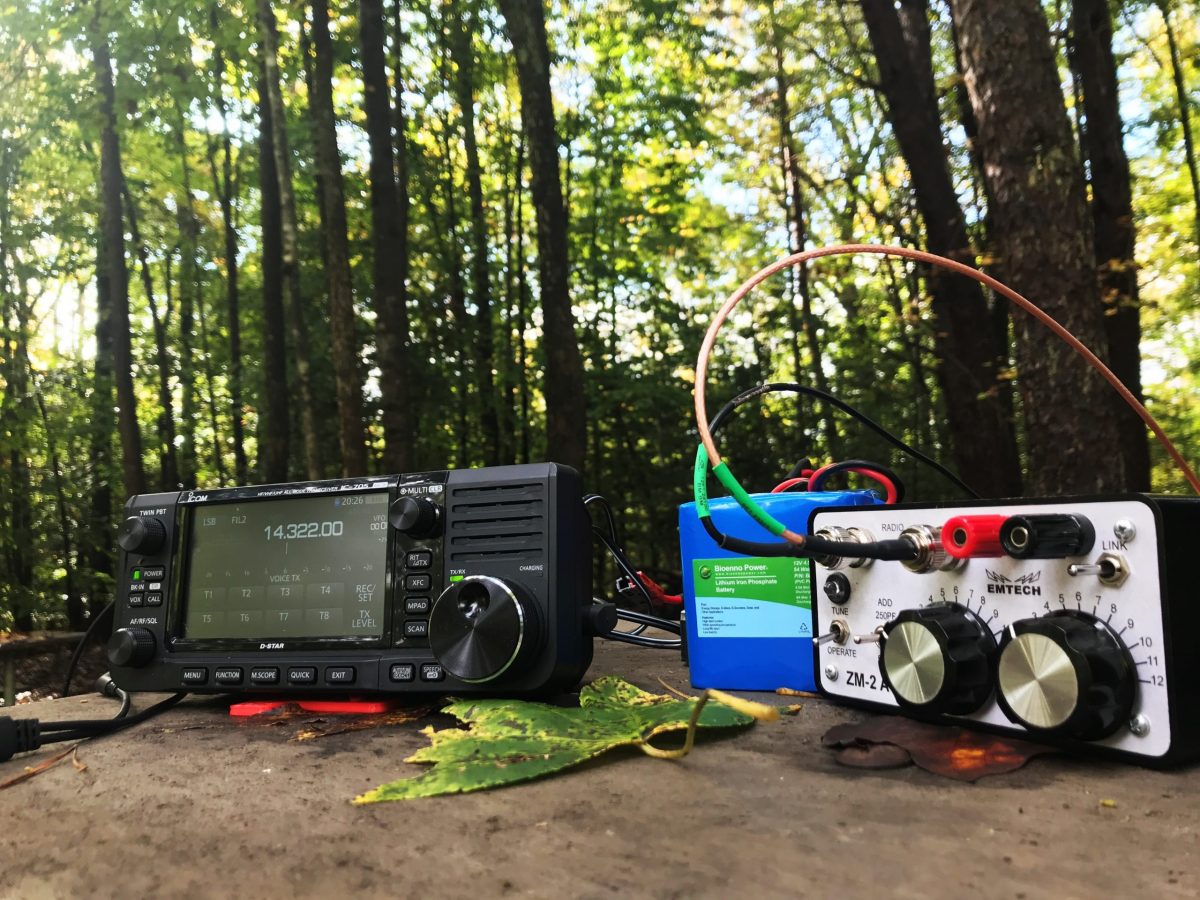
It sometimes seems that one of the biggest enemies of a radio enthusiast these days is RFI (radio frequency interference), which is to say, human-originated noise that infiltrates––and plagues––vast chunks of our radio spectrum.
Yet I believe RFI has, in a sense, also managed to energize––and even mobilize––many radio enthusiasts. How? By drawing them out of their houses and shacks into the field––to a local park, lake, river, mountain, woodland, or beach––away from switching power supplies, light dimmers, street lights, and other RFI-spewing devices.
Shortwave and mediumwave broadcast listeners have it easy, comparatively speaking. They can simply grab a favorite portable receiver, perhaps an external antenna, then hit the field to enjoy the benefits of a low-noise environment. In that a portable receiver is something of a self-contained listening post, it’s incredibly easy to transport it anywhere you like.
Ham radio operators, on the other hand, need to pack more for field operations. At a minimum, they need a transceiver, an antenna, a power source, not to mention, a mic, key, and/or computing device for digital modes. Thankfully, technology has begun miniaturizing ham radio transceivers, making them more efficient in the use of battery power, and integrating a number of accessories within one unit.
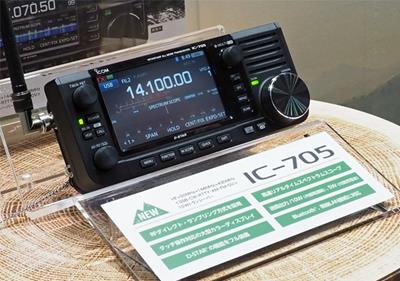
Photo from the 2019 Tokyo Ham Fair
Case in point: in 2019 at Tokyo’s Ham Fair, Icom announced their first QRP (low-power) radio in the better part of two decades: the Icom IC-705.
Introducing the Icom IC-705
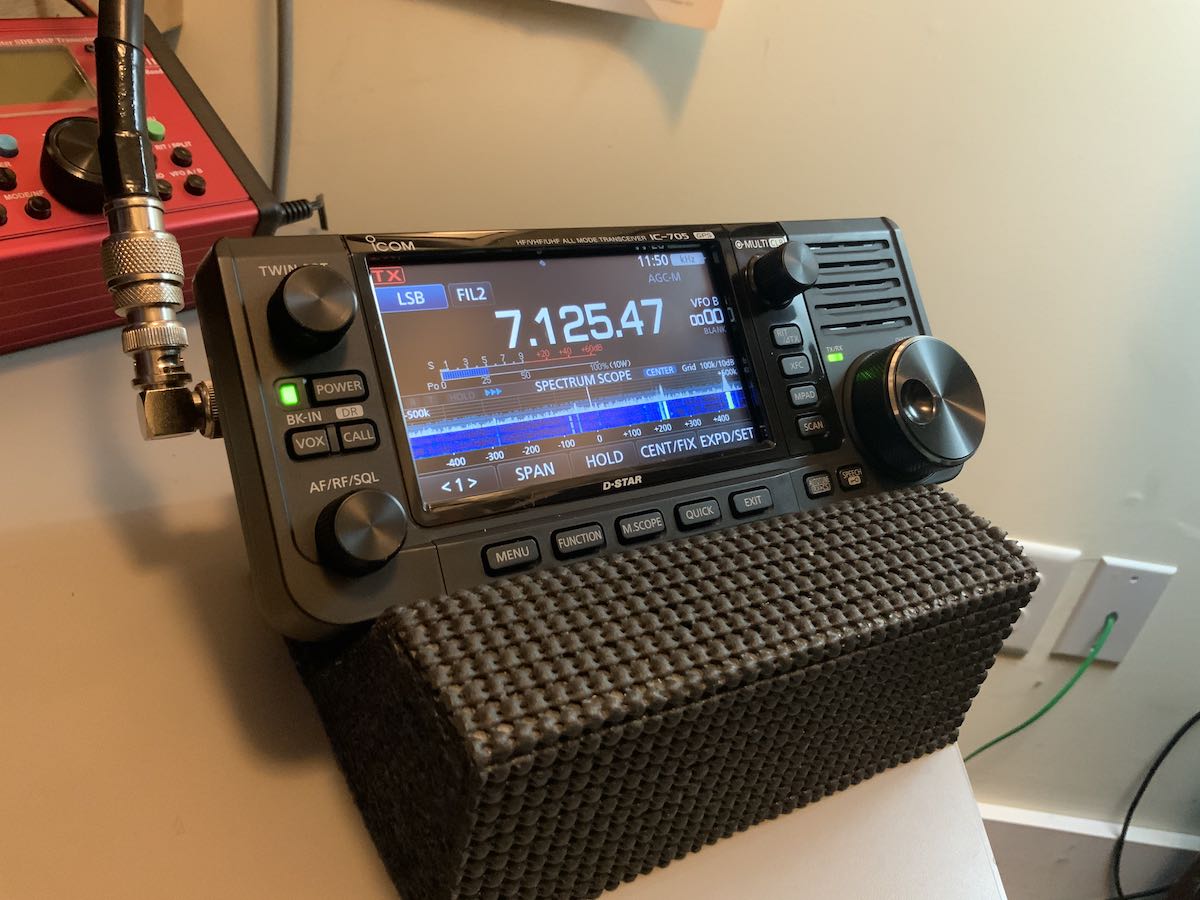
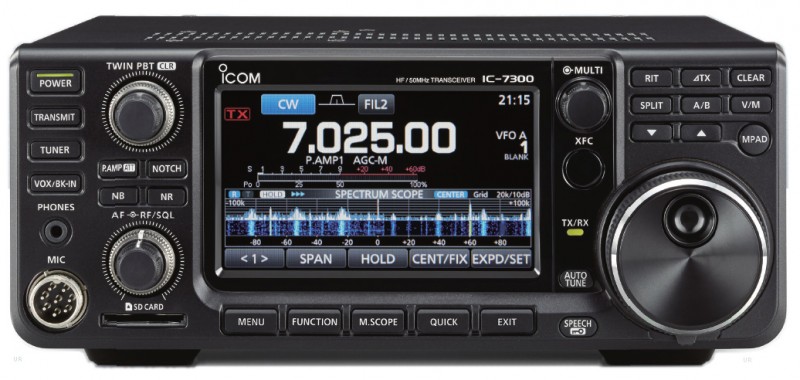
It was love at first sight among fans of Icom when the 2019 announcement was made. Why? The instant thrill came courtesy of the IC-705’s resemblance––in miniature––to the IC-7300, one of Icom’s most popular transceivers of all time. Not only that, but the IC-705 sported even more features and a broader frequency range than the IC-7300. What wasn’t to love?
But of course, unlike the IC-7300, which can output 100 watts, the IC-705’s maximum output is just 10 watts with an external 12V power source, or 5 watts with the supplied Icom BP-272 Li-ion battery pack. Nevertheless, enthusiasts who love field radio––this article’s writer being among them––were very pleased to see Icom design a flagship QRP radio that could take some portable operators to the next level. Power was traded for portability, and for field operators, this was a reasonable trade.
And since, again, the IC-705 has even more features, modes, and frequency range than the venerable IC-7300, I felt it important to note them up front. Here are a few of its most notable features, many of which are not available on its bulkier predecessor:
- VHF and UHF multimode operation
- D-Star mode
- Built-in GPS
- Built-in Wifi connectivity
- Built-in Bluetooth connectivity
- Portable size
- Battery power
The receiver design is similar to the IC-7300 below 25 MHz in that it provides a direct conversion. Above 25 MHz, however, it operates as a superheterodyne receiver. While the user would never know this in operation, it’s a clever way for Icom to keep costs down on such a wideband radio.
At time of publishing, there are no other portable transceivers that sport all of the features of the Icom IC-705. It has, in a sense, carved out its very own market niche…At least for now.
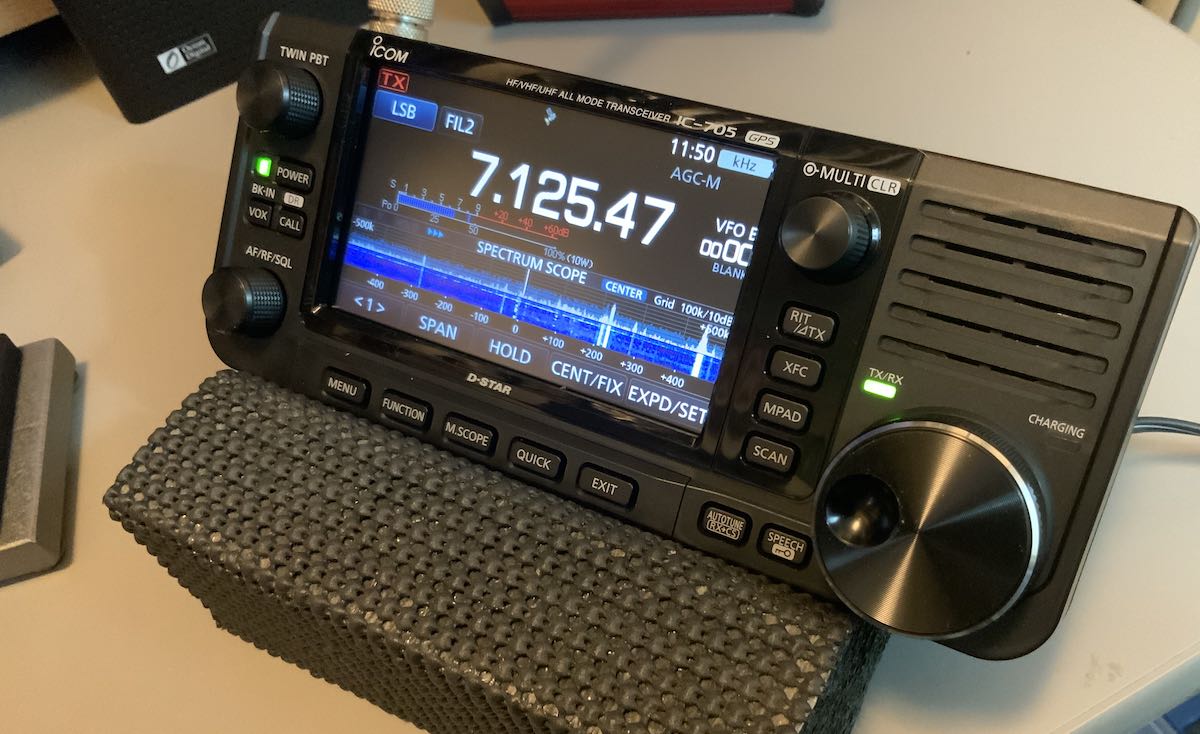
I’ve owned the IC-705 since late September 2020, and I still haven’t fully explored this radio’s remarkable capabilities. It’s really a marvel of ham radio technology, and I’m having fun exploring what it can do.
One conspicuous omission
Let’s go ahead and address this promptly. The IC-705 does have one glaring shortcoming. It lacks one feature that is standard on the larger 100-watt IC-7300: an internal antenna tuner (ATU).
To be frank, I was a little surprised that the IC-705 didn’t include an internal ATU, since it otherwise sports so many, many features. Not having an internal ATU, like a number of other general coverage QRP transceivers in its class, definitely feels like a missed opportunity. With an ATU, the ‘705 would truly be in a class of its own.
I’m sure Icom either left the internal ATU out of the plan due to space limitations––perhaps wanting to keep the unit as compact as possible?––or possibly to keep the price down? I’m not sure. At release, the price was $1300 US, which is undoubtedly on the higher side of this market segment; at that price point, it might as well have included an ATU.
With that said, not having an internal ATU is still not a disqualifier for me. Why? Because I have a number of resonant antennas I can add on when in the field, a remote ATU at home, and a couple of portable external ATUs, as well. Yes, it would be helpful to have it built in––as on my Elecraft KX1, KX2, and KX3, or on the ($425) Xiegu G90––but for me it’s not a deal-breaker.
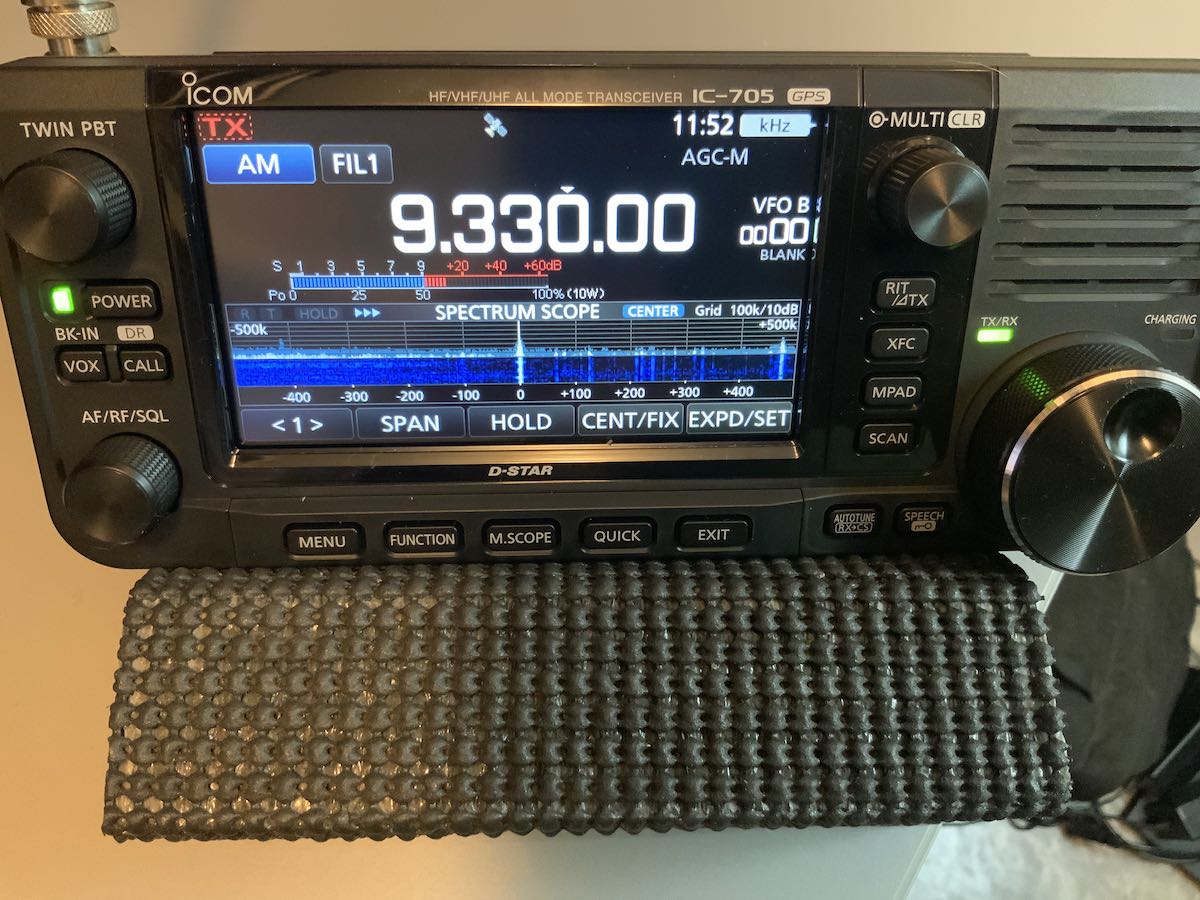
One other minor omission? A simple tilt stand or foot. I do wish Icom had included some sort of foot on the bottom of the IC-705 so that it could be propped up for a better angle of operation. Without a tilt stand or foot, the IC-705 rests flat on a surface, making its screen a bit awkward to view. Of course, a number of third-party tilt stands are available on the market. And if you have a 3D printer or access to one, you can find a wide variety of options to simply print at home. I printed this super simple tilt foot, which works brilliantly.
But why not include one, Icom?
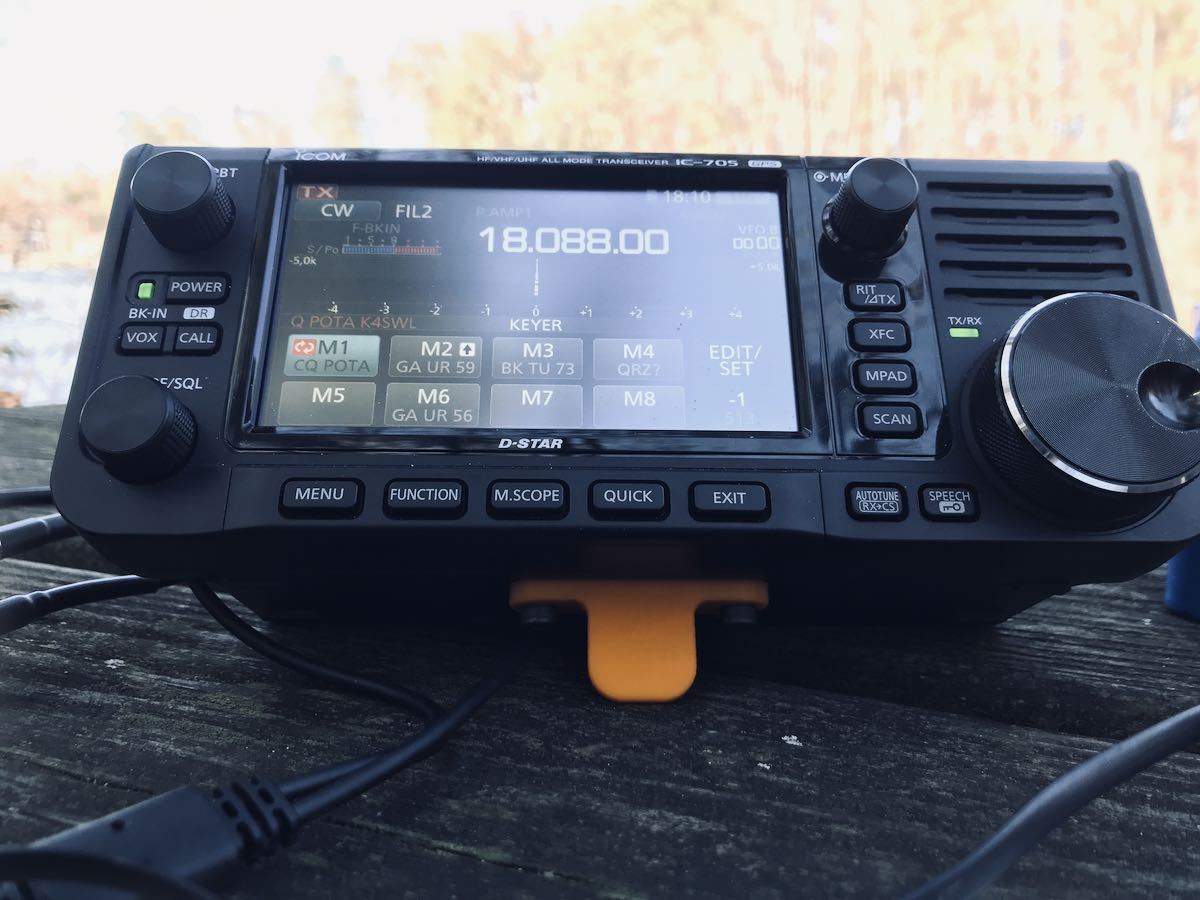
My 3D printed tilt foot
But while the IC-705 lacks a tilt foot, it actually sports a number of connection points on the bottom, including a standard tripod mount. Thank you, Icom, for at least including that (other radio manufactures please take note)!
Initial impressions
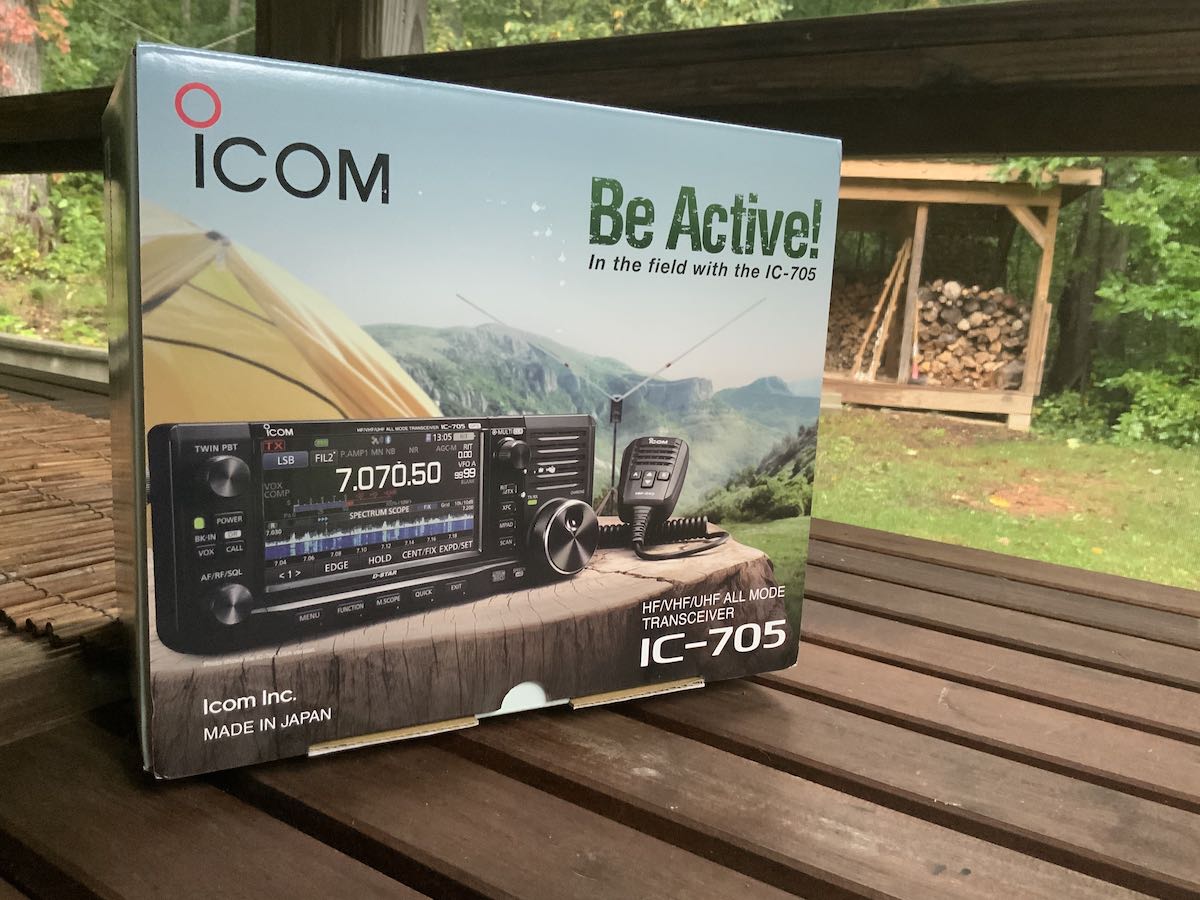
Funny: the IC-705 is the first new transceiver I’ve purchased with a color box.
If you’ve ever owned or operated the Icom IC-7300, you already know how to operate many of the functions on the IC-705. The user interfaces on the touch screens are identical. Features that are unique to the IC-705 are easy to find and follow the same standard Icom user-interface workflow.
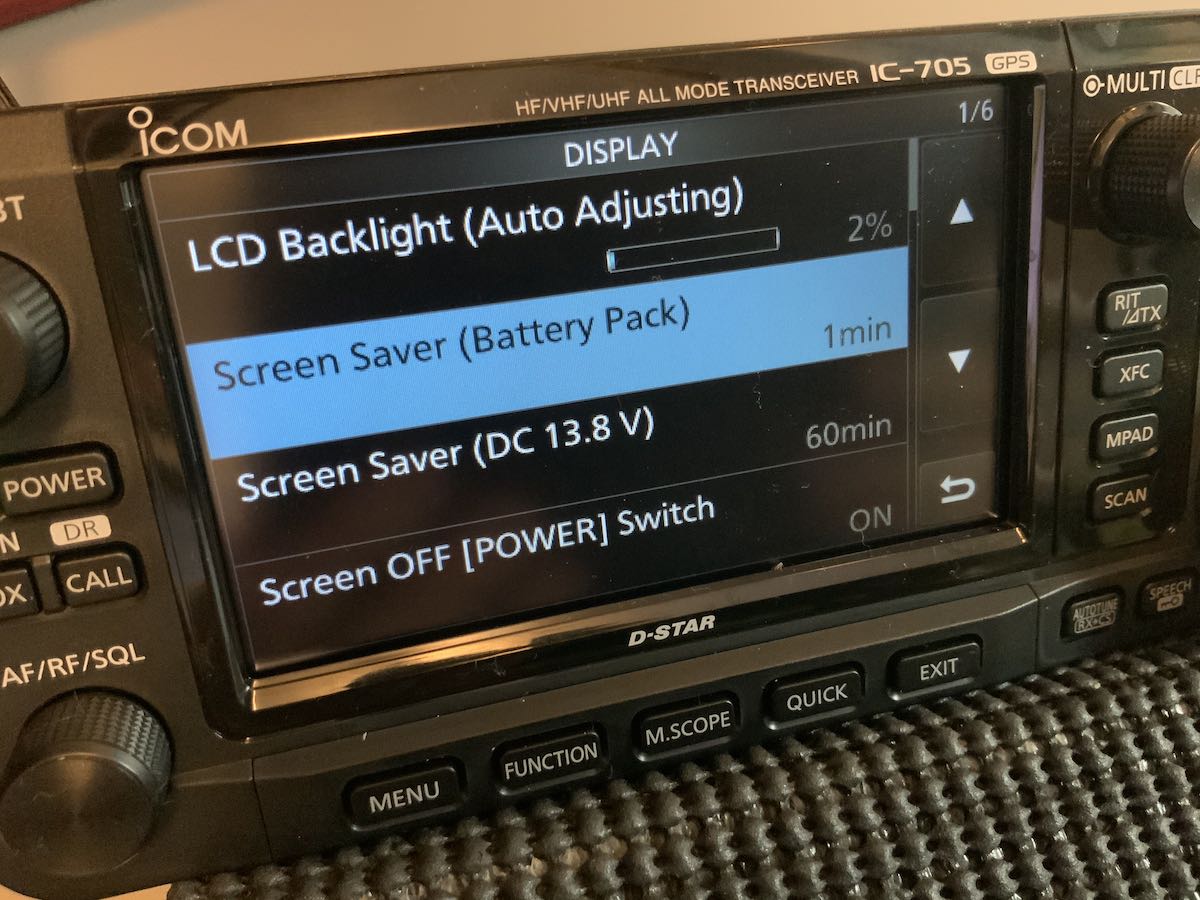
Having less front faceplate real estate, the IC-705 has less buttons than the IC-7300––about 11 less than its big brother, to be exact. However, the twin passband, gain, multi-function knob and encoder are in the same positions and layout as on the IC-7300.
And if you’ve never used an IC-7300 before, no worries: this is one of the more user-friendly interfaces you’ll find on a ham radio transceiver.
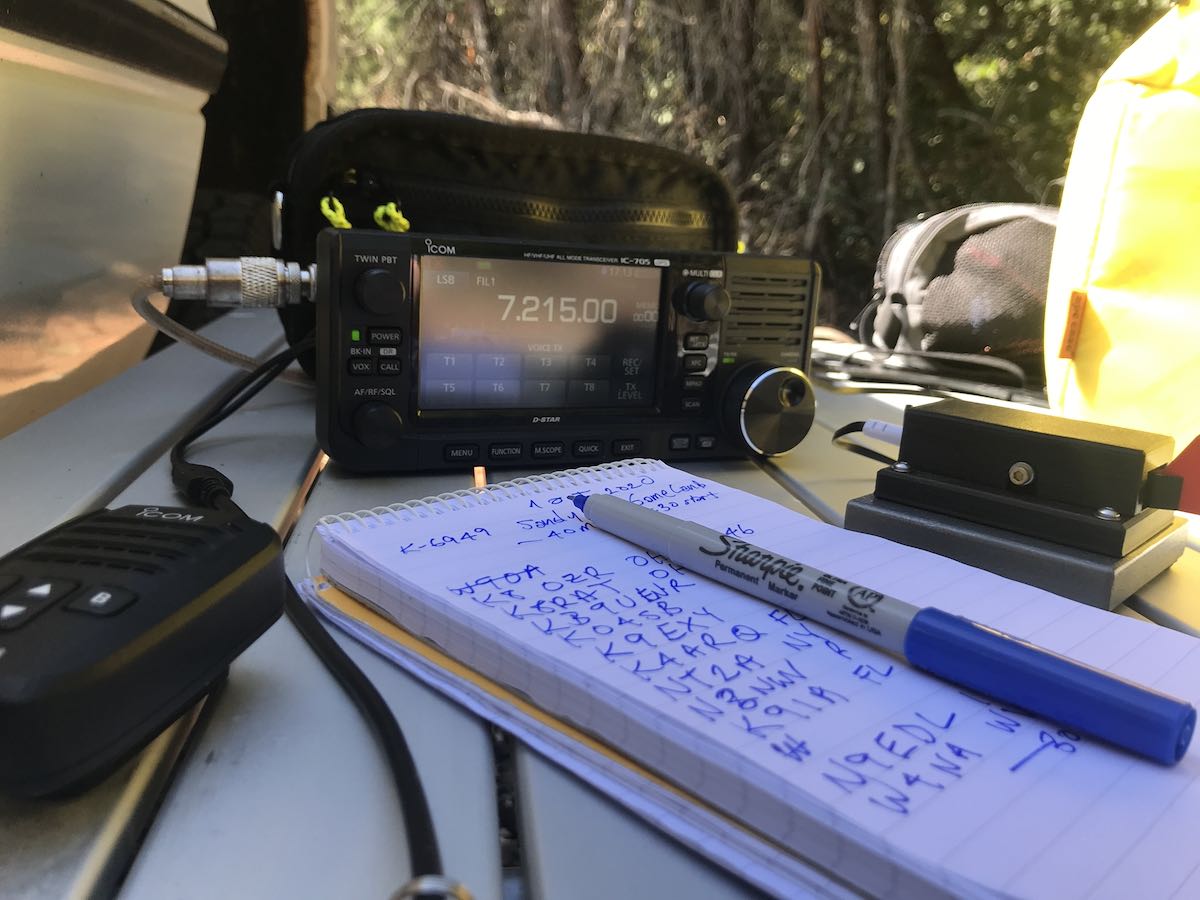
The build of the IC-705 is excellent. It’s not exactly hardened for the elements––there is no waterproof rating or dust rating, for example––but it gives the impression of a solid little radio, likely to withstand a bit of less-than-delicate handling. Yet even though it’s designed to be a portable field radio, I’ll admit that the front panel and especially the color touchscreen feel a little vulnerable. I do worry about damaging that touchscreen while the radio travels in my backpack.
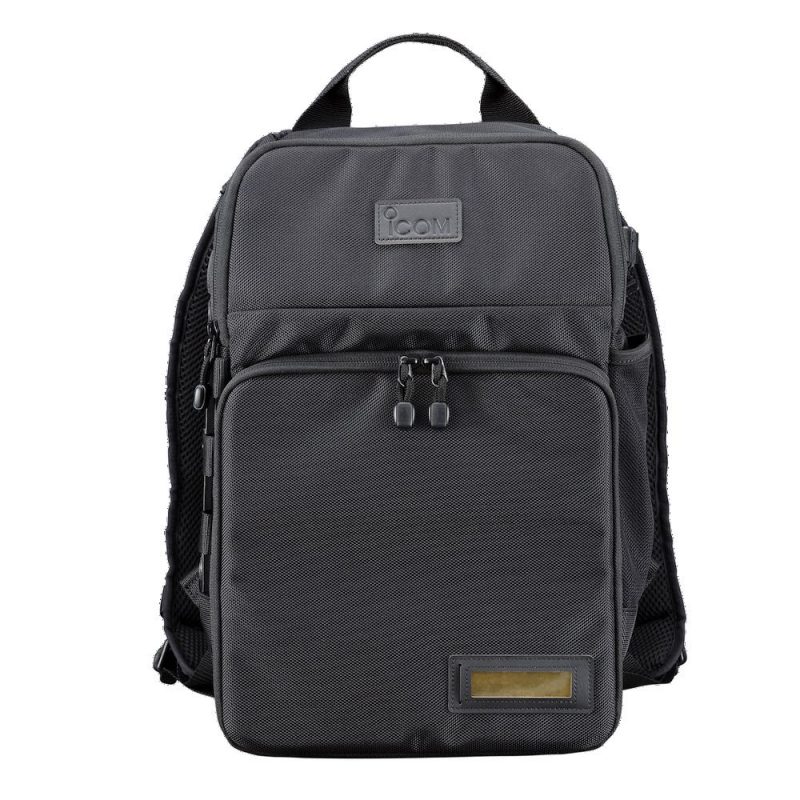
The Icom LC-192
On the topic of backpacks, Icom released a custom backpack (the LC-192) specifically for the IC-705, Icom AH-705 ATU, antennas, and accessories. I did not consider purchasing this backpack, although I’m sure some operators would appreciate it, as it has dedicated compartments for supplies and the radio can be attached to the floor of the backpack’s top compartment. Again, I passed because I’m a bit of a pack fanatic and tend to grab gear that’s more tactical and weatherproof.
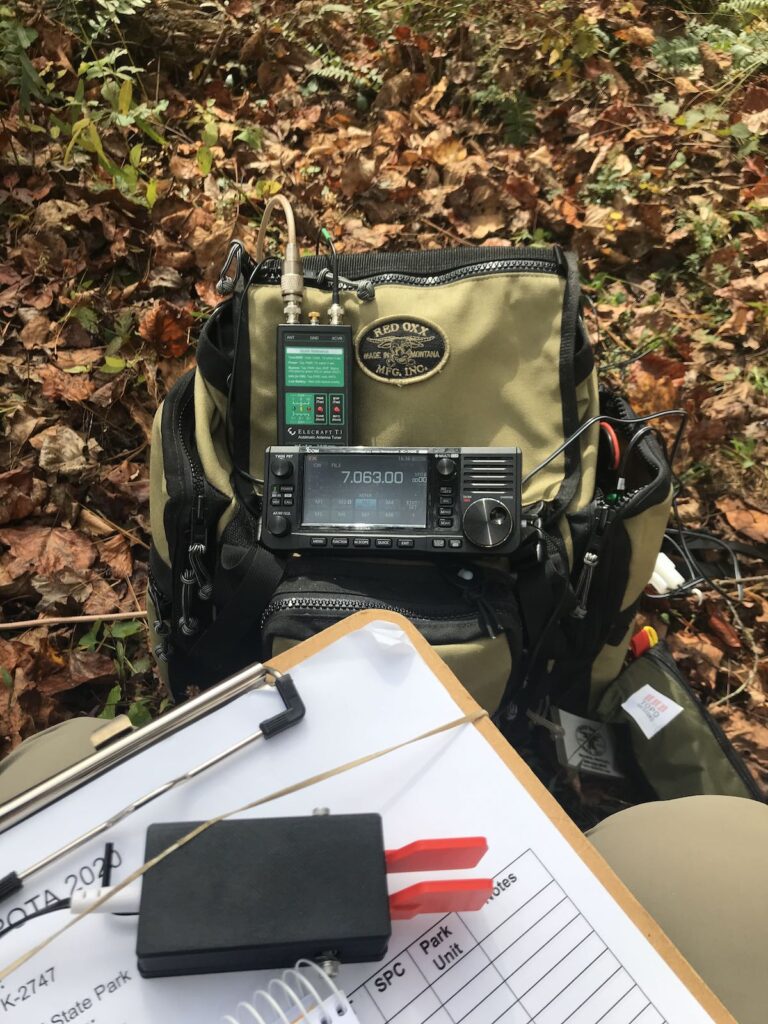
IC-705 and Elecraft T1 ATU at Toxaway Game Land
While its in my Red Oxx or GoRuck backpack, I house the IC-705 in a $14 Ape Case Camera insert. Eventually I want to find a better solution, but this does help pad the IC-705 while in my backpack and certainly fits it like a glove––hopefully protecting that touchscreen.
A number of third-party manufacturers have designed protective “cages” and side panels for the IC-705, but I’ve been a bit reluctant to purchase one because I feel they may add too much weight and bulk to the radio.
To the field!
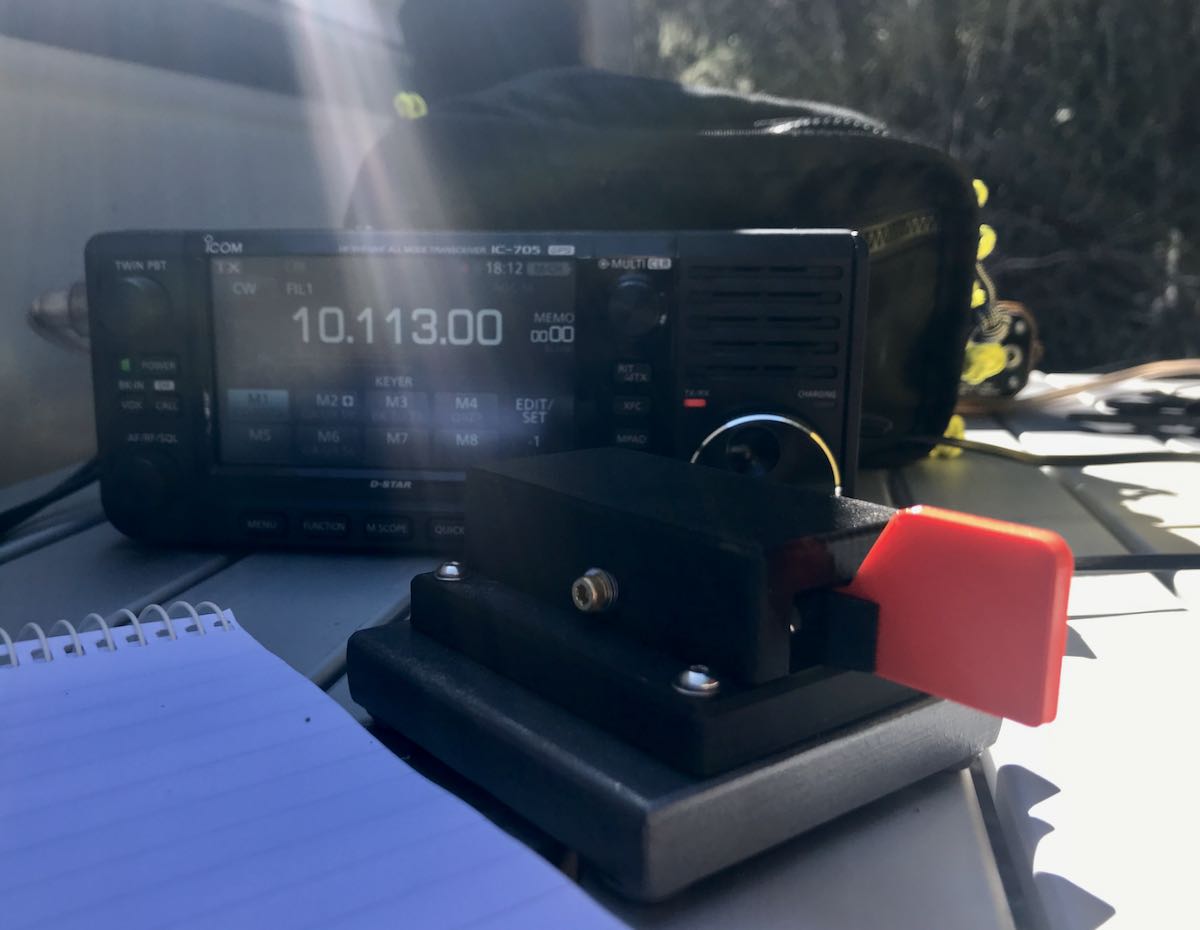
Sandy Mush State Game Land
The day after I received my Icom IC-705, I took it to the field to activate Sandy Mush State Game Land for the Parks On The Air (POTA) program. Typically, when I review a new radio, I spend a few hours with it in the shack before taking it to the field. In this case, however, I felt comfortable enough with the IC-705 user interface, so I decided to skip that step entirely––I was eager to see if this little radio would live up to expectations.
The previous evening, I’d connected the IC-705 to my 13.8V power supply, so the BP-272 battery pack was fully-charged and attached to the IC-705. There was no need for an external battery to be connected.
[Tip: Click here to view my YouTube playlist of field activities with the IC-705.]
Getting on the air that day was very straightforward; indeed, the set-up couldn’t have been more simple: radio plus antenna. I connected the IC-705 to a Vibroplex EFT-MTR end-fed 40, 30, and 20-meter resonant antenna, thus an external antenna tuner was not required.
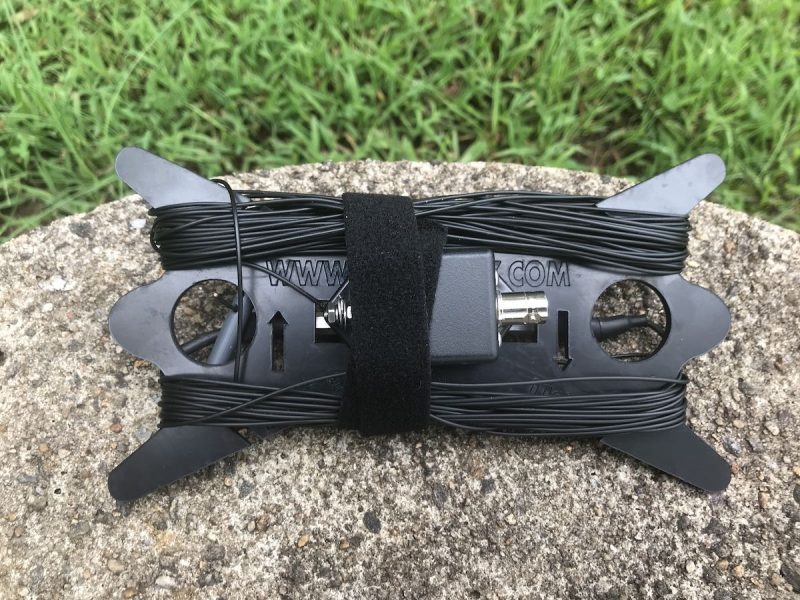
The Vibroplex/End-Fedz EFT-MTR antenna
Next, I plugged in the included speaker/mic, spotted myself to the POTA network, and started working stations. I asked for audio reports and all were very positive using only the default audio settings. Obviously, the small hand mic works quite well. I did quickly decide to unplug one of the two connectors of the speaker mic (the speaker audio side) so that the received audio wouldn’t be pumped through the hand mic, using the much better IC-705 front-facing speaker.
In the field that day, I had a few objectives in mind:
- See how well the supplied hand mic works for SSB contacts, thus intended to ask for audio reports
- Check out full break-in QSK operation in CW mode
- Measure exactly how long a fully-charged Icom BP-272 Li-ion battery pack would power the IC-705 under intense operation
SSB
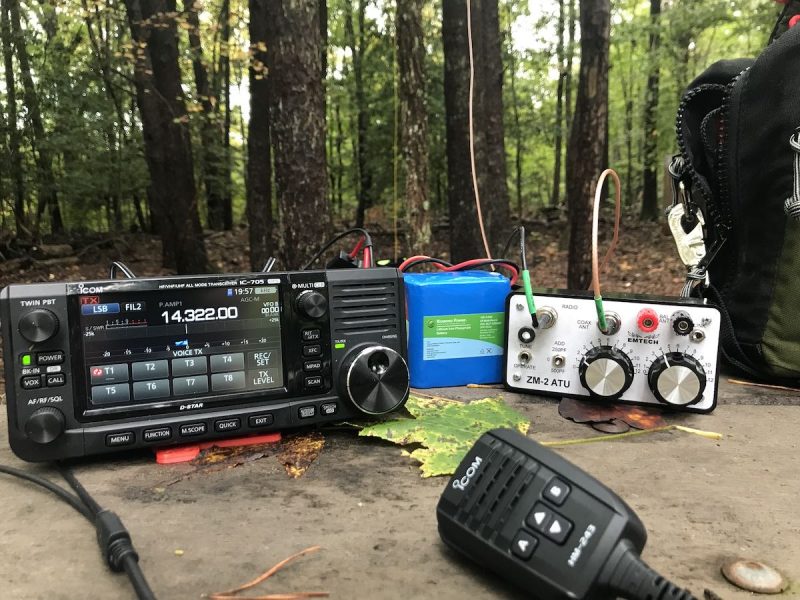
SSB at Lake Norman State Park
I was very quickly able to sort out how to record and use the voice memory keying features of the IC-705. There are a total of eight memory positions that can be recorded to the internal microSD card. It’s very simple to use one of the memories in “beacon” mode––simply press and hold one of the memory buttons and the recording is transmitted repeatedly until the user presses the PTT to disengage it. This is incredibly helpful when calling CQ; I typically set mine to play “CQ POTA, CQ POTA, this is K4SWL calling CQ for Parks On The Air.” I’ve also set a five-second gap between playback, allowing for return calls. As I’ve mentioned before, voice-memory keying is incredibly useful and saves one’s voice when calling CQ in the field.
The voice and CW-memory keying features of the IC-705 are robust enough that they could be used in a contest setting to automate workflow. One important note: voice-memory keying saves recordings to the internal MicroSD card. If that card is removed, formatted/erased, or if the file structure is altered, the voice-memory keyer will not recall recordings.
CW
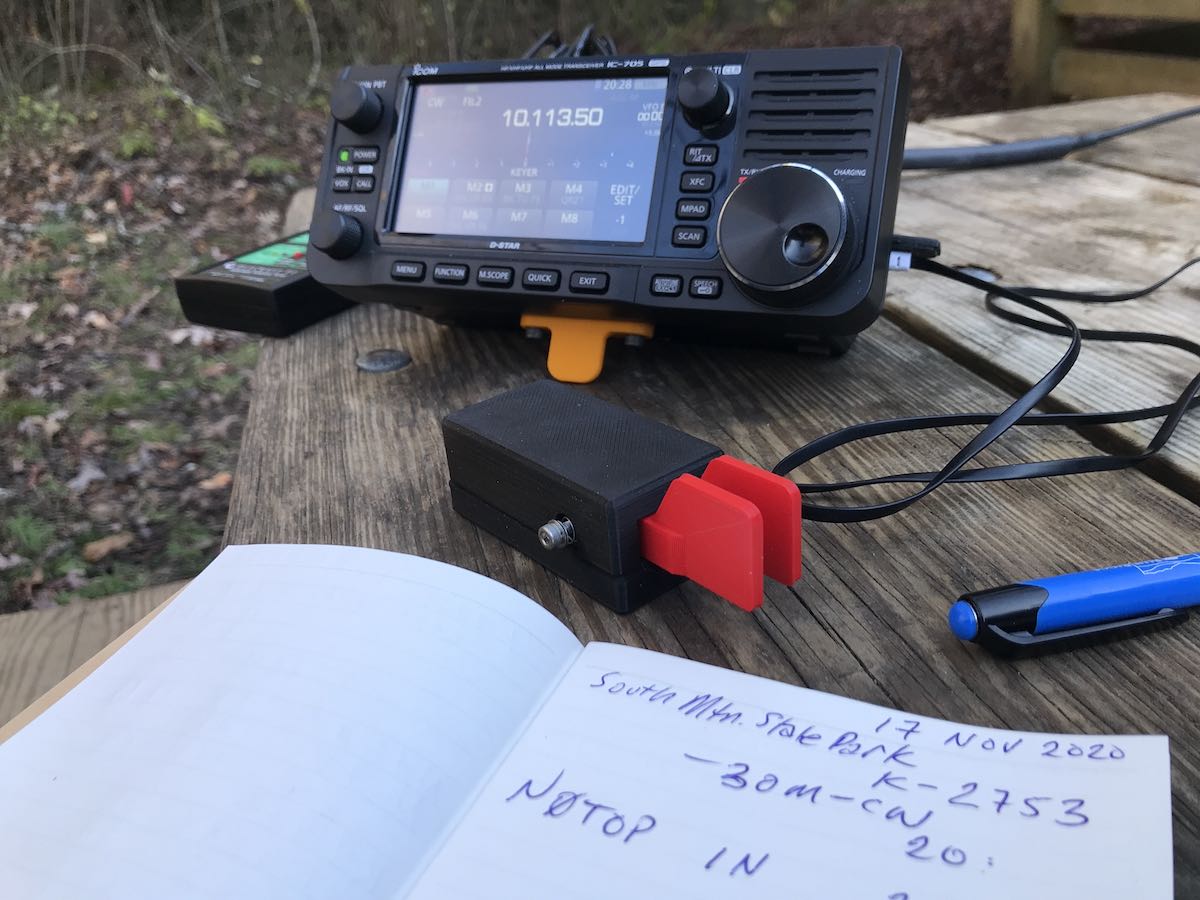
CW at South Mountains State Park
Next, I plugged in my paddles and started calling “CQ POTA” in CW.
As with the voice-memory keyer, CW-memory keying was incredibly easy to set up. Once again, the user once has eight memory positions. As the keyer plays a pre-recording sequence, the IC-705 will display the text being sent.
One of the questions I’m asked most by CW operators about the IC-705 is whether the radio has audible relay clicks during transmit/receive switching. Radios with loud relay clicks can be distracting. My preference these days is to operate in full break-in QSK mode, meaning, there is a transmit/receive change each time I form a character––it allows me space to hear someone break in, but results in much more clicking.
The IC-705 does have relay clicks, but these are very light––equal in volume to those of other Icom transceivers, neither louder nor softer. These clicks, fortunately, are not too distracting to me, and to be fair, I find I don’t even notice them as I operate. With that said, transceivers like my Elecraft KX2 and Mission RGO One use PIN diode switching, which is completely quiet.
Battery Life

Tapping the battery icon will open a larger battery capacity monitor.
My third objective at the first field outing was to test how long the Icom BP-272 Li-ion battery pack would power the IC-705 while calling CQ and working stations in both SSB and CW for an entire activation.
After nearly two hours of constant operation, the BP-272 still had nearly 40% of its capacity.
I didn’t expect this. I assumed it might power the IC-705 for perhaps 90 minutes, max. Fortunately, it seems at 5 watts, one BP-272 could carry you through more than one POTA or SOTA (Summits On The Air) activation. I was pleasantly surprised.
Four months later…
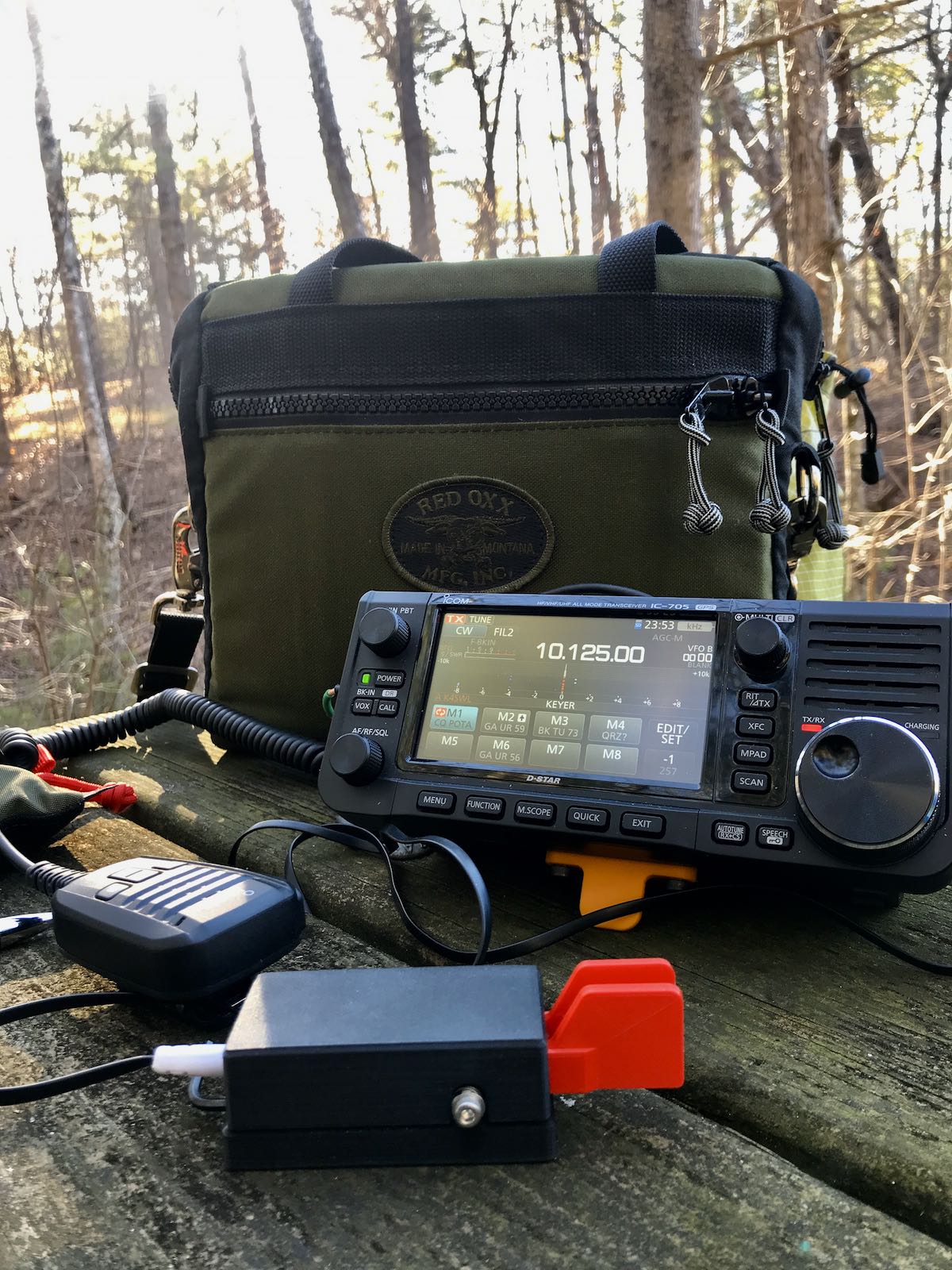
POTA activation at Tuttle Educational State Forest
Since that initial field test, I’ve taken the IC-705 on easily thirty or more individual POTA activations. I’ve also used it at home to chase POTA stations and rag chew with friends.
In short, I’ve found that the IC-705 is a brilliant, robust portable transceiver for SSB and/or CW and a pleasure to operate.
Herein lies the advantage of purchasing a radio from a legacy amateur radio manufacturer: it’s well-vetted right out the door, has no firmware quirks, and is built on iterations of popular radios before it.
I’ve found that IC-705 performance is solid: the receiver has a low noise floor, the audio is well-balanced, the AGC is stable at any setting, and it’s an incredibly sensitive and selective radio.
Digital modes
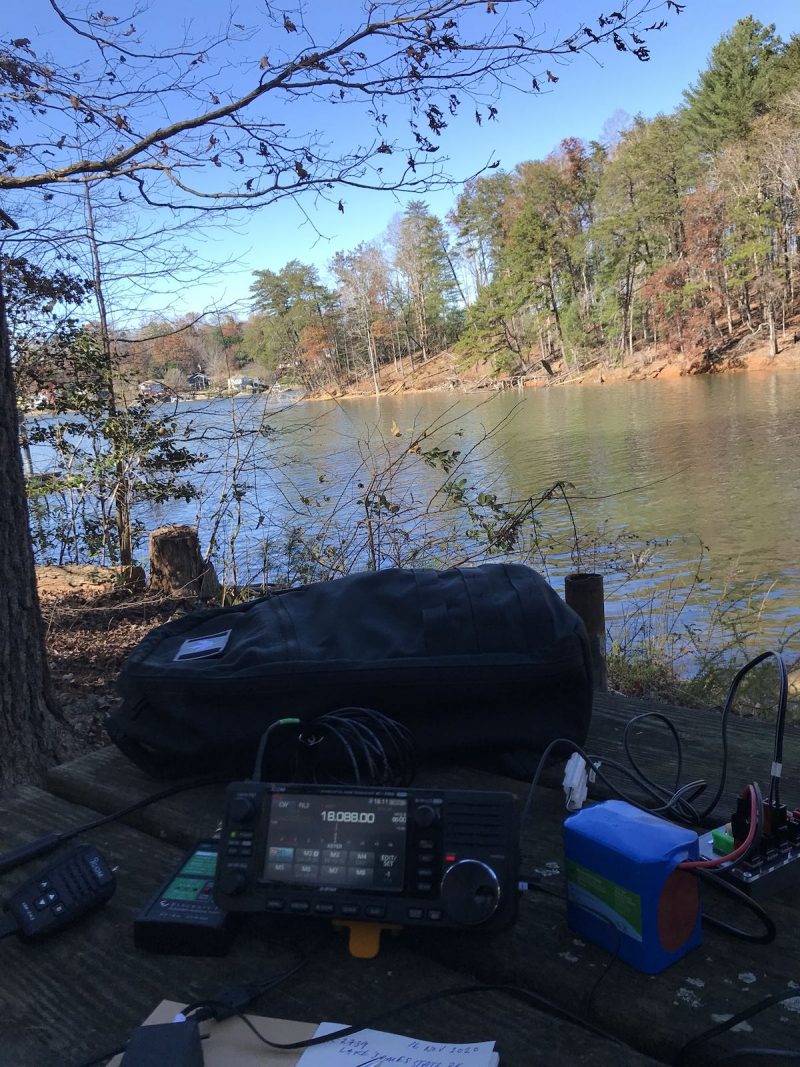
POTA activation at Lake Jame State Park
One huge advantage of the IC-705 is that it, like the IC-7300, has a built-in sound card for digital modes. This eliminates the need for an external sound card interface. After you’ve read the installation guide, and installed Icom’s USB drivers, simply plug the IC-705 into your computing device via USB cable and you can directly control the ‘705 with popular applications like WSJT-X.
I have not used the IC-705 for digital modes while in the field, but I have done so in the home shack. It was one of the easiest radios I’ve ever set up for FT8 and FT4.
I’m not the biggest digital mode operator, but if you are into it, I expect you’ll be very pleased with the IC-705. It must be one of the most portable, uncomplicated transceivers for digital mode operation currently on the market. I know a number of POTA activators have been using the IC-705 for FT8 and FT4.
D-Star
Being perfectly honest here, I have a chequered history with the D-Star digital voice mode. I purchased an Icom ID-51a and D-Star hotspot several years ago because a local ham pretty much convinced me it was the coolest thing since sliced bread.
And in truth? It is rather amazing.
But at the end of the day I had to admit to myself that I’m an HF guy, and found the user interface and operating procedures just a bit too other-worldly. I kept the ID-51a for perhaps a year, then sold it, along with the hotspot.
Although I knew the IC-705 had D-Star built in, I really hadn’t given it a second thought. But since I’m a reviewer, I simply had to check it out. I still had my D-Star credentials from some years ago, so I set up the IC-705 and connected the transceiver to the Diamond dual band antenna on top of my house.
Fortunately, I was able to hit our only local D-Star repeater and connect on the first go. Note that, like the ID-51a, the IC-705 can use your GPS coordinates, then automatically find the closest D-Star repeater and load the frequency and settings from the default database on the IC-705 MicroSD card.
After reviewing a YouTube video demonstration, I was on the air with D-Star and found the user interface much easier to use than that of the ID-51a. It really helps having a large touch screen.
I’ll admit it: I’m warming back up to D-Star, and I have the IC-705 to thank for that.
Some day, I plan to use D-Star on HF, as well. I acknowledge that it might take some pre-arranging, but perhaps I could even make a D-Star POTA––or better yet, SOTA––contact, if the stars align. It’s certainly worth the experiment.
Let’s talk about broadcast listening
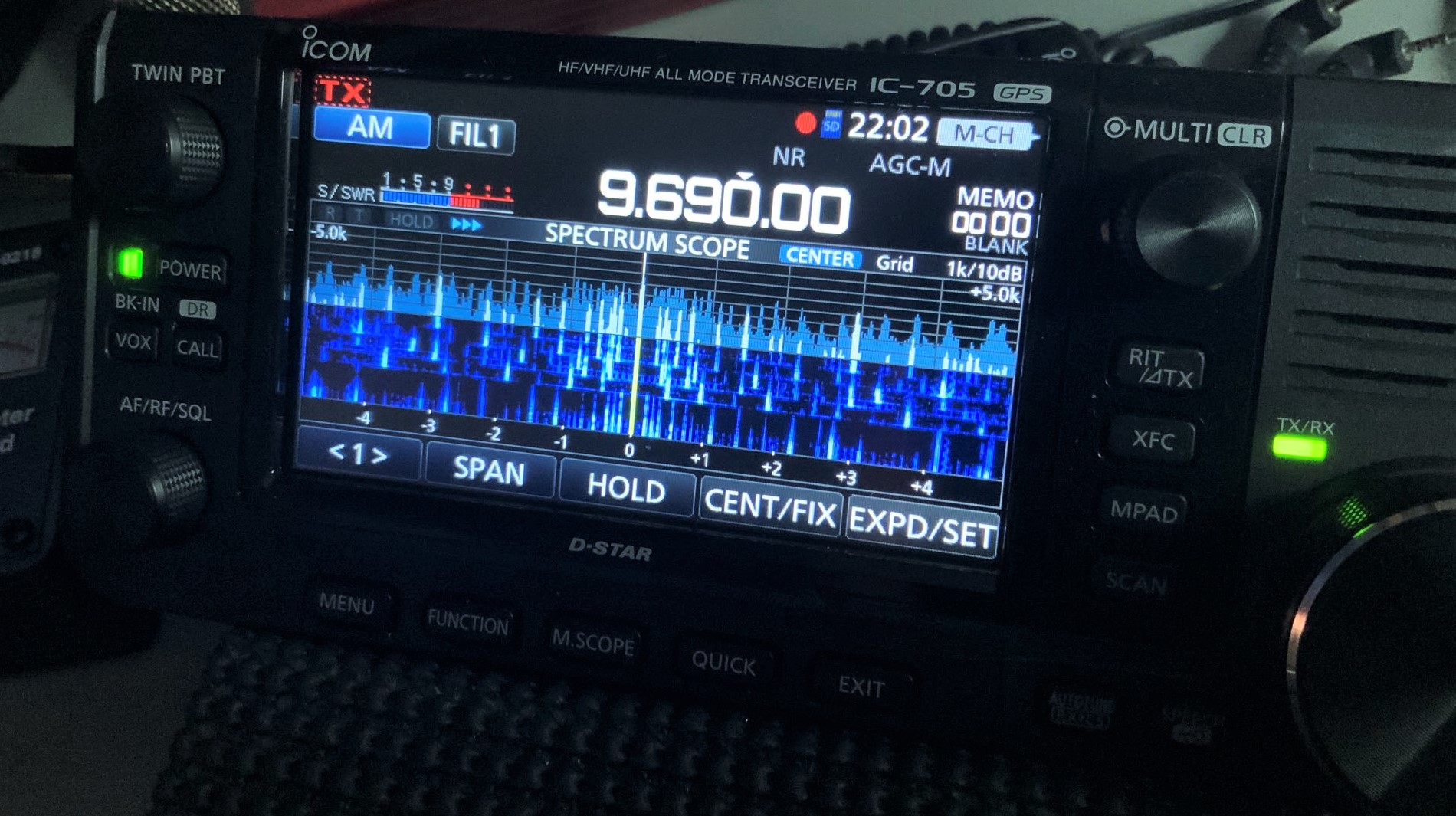
Radio Exterior de España’s interval signal on the IC-705’s waterfall display
Although I’m a pretty active ham radio operator, I’m an SWL and broadcast listener at heart. One of the appealing things about the IC-705 is its excellent receiver range (0.030-470.000 MHz) and multiple operating modes, as well as its adjustable bandwidth. Broadcast listeners will be happy to know that the AM bandwidth on the IC-705 can be widened to an impressive 10 kHz, which is certainly a stand-out among general coverage transceivers.
After turning on the IC-705 for the very first time, I tuned to the 31-meter band and cruised the dial. I felt like I was using a tabletop receiver: for such a small transceiver, the encoder is on the large side, and the controls are ergonomically designed. The spectrum display and waterfall are amazingly useful.
The front-facing speaker on the IC-705 is well-designed for audio clarity on the ham radio bands. It’s not a high-fidelity speaker, but it’s adequate and has enough “punch” to perform well in the field. Speakers on portable QRP radios are typically an afterthought and are terribly compromised due to space constraints within the chassis. The IC-705’s speaker design feels more deliberate, akin to what you might find on a mobile VHF/UHF rig. Broadcast listeners, in other words, will certainly want to hook the IC-705 up to an external speaker––or, better yet, use headphones––for weak-signal work.
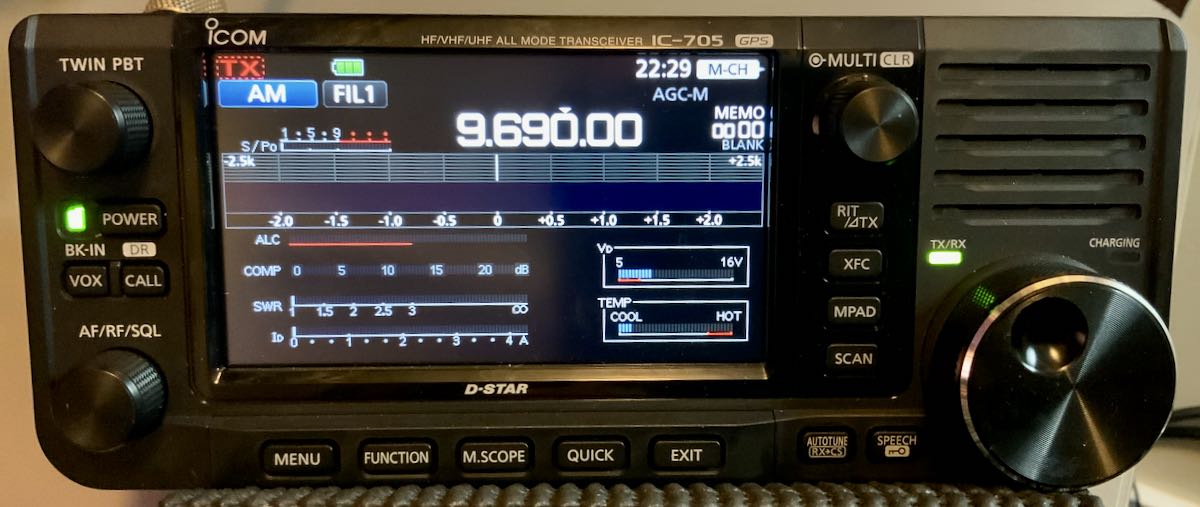
While the received audio isn’t on par with a receiver like the Drake R8B, it’s pretty darn good for a portable general coverage transceiver. The audio is what I would call “flat,” but you are able to adjust the received audio in EQ settings to adjust them to your taste. Audio is well-tailored for the human voice, so I’ve found weak signal IDs are actually easy to grab on the air.
Audio samples
One of the brilliant things about the IC-705 is the fact that it has a built-in digital recorder. Both transmitted and received audio can be recorded in real time and saved to a removable MicroSD card. I made audio recordings of two broadcast stations on the 31-meter band as samples: the Voice of Greece (9420 kHz) and Radio Exterior de España (9690 kHz). The Voice of Greece was moderately strong when I made the recording and Radio Exterior was quite strong. Click on the links to download the .mp3 files for each recording:
Voice of Greece
Radio Exterior de España
I’ve also used the built-in digital recorder to record long sessions of my favorite shortwave, AM, and FM stations. Even with the recorder on, I can typically achieve hours of listening on one battery charge and need no other power supply.
Want more audio samples?
Check out our survey results from an Icom IC-705 blind audio test.
In short? The IC-705 makes for an excellent portable shortwave, mediumwave, and FM broadcast band-recording receiver.
Charging ahead…

The supplied BP-272 battery pack snaps snugly on the back of the IC-705
Power supply is always a concern when taking a transceiver on travels. Most transceivers need a 12-13.8 volt external supply, or an external battery, one that will eventually need to be charged.
This is not the case with the IC-705, because while it can be charged or powered via a 12-13.8V source, it can also be charged via a common 5V USB power supply. Simply insert any USB phone-charging cable into the MicroUSB port on the side of the IC-705, and it will charge the fully-depleted attached BP-272 battery pack in just over four hours.
Indeed, I traveled to visit family one week, and had plotted two park activations both en route and on the way back home. After my first activation, I quickly realized I forgot the supplied IC-705 power cord that I’d normally use to hook the IC-705 up to one of my LiFePo batteries. I was quite disappointed, expecting that I’d missed this opportunity. Then I remembered USB charging: I simply plugged the IC-705 up to my father’s phone charger, and in four hours, the battery was completely recharged.
To my knowledge, there are no other transceivers that have this capability without modification. A major plus for those of us who love to travel lightly!
Summary
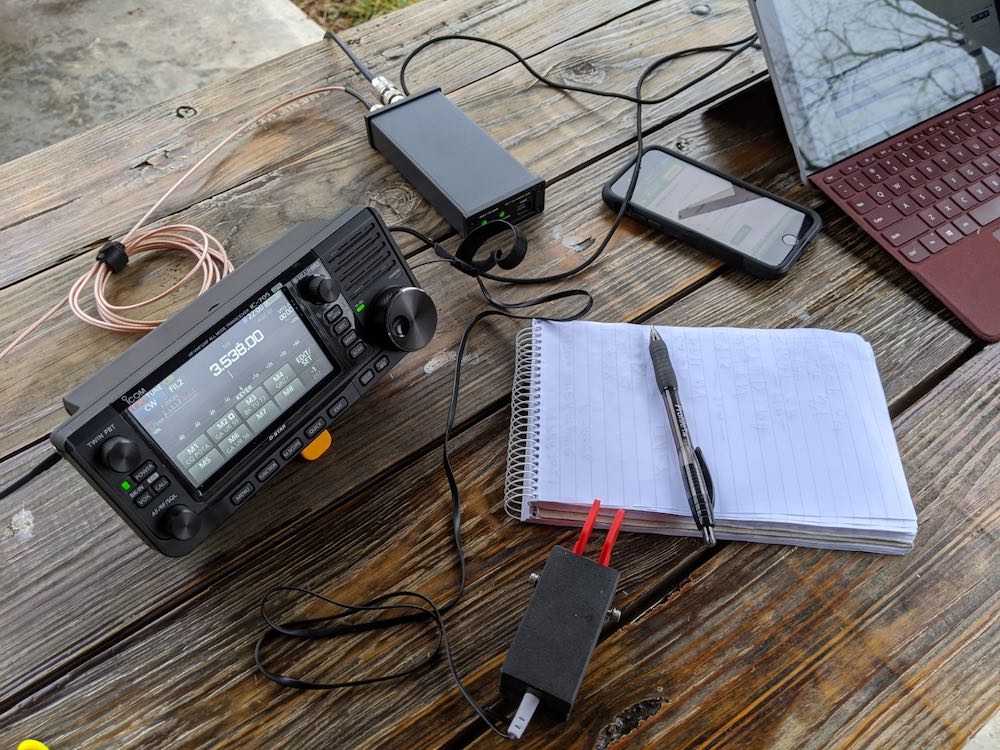
POTA activation at the Zebulon Vance Historic Birthplace
Every radio has its pros and cons. When I begin a review of a radio, I take notes from the very beginning so that I don’t forget my initial impressions. Here’s the list I formed over the time I’ve spent evaluating the Icom IC-705.
Pros:
- Frequency range
- TX: 160 – 6 meters, 2M, 70cm
- RX: 0.030-470.000 MHz
- Modes include SSB, CW, AM, FM, DV, RTTY
- 4.3 inch color touchscreen that’s (surprisingly) readable in full sunlight
- Multiple means to power/charge:
- Icom BP-272 battery pack (supplied) for 5 watts output
- Can be charged via 12V power supply or
- 5V USB phone charger with standard MicroUSB plug (admittedly, I wish they would have adopted now standard USB-C rather than MicroUSB)
- External battery for 10 watts of output
- Icom BP-272 battery pack (supplied) for 5 watts output
- Top-shelf receiver performance (see Rob Sherwood’s assessment)
- Wireless LAN connectivity that even allows for native remote control (not tested)
- Built-in Bluetooth
- Built-in GPS
- Built-in Digital Recording
- Full D-Star functionality
- RTTY can be sent (using macros) and received/decoded natively
- Multiple standard connection points on base for mounting (see con)
- Supplied speaker mic is compact and has programmable buttons
- Frequency stability is less than ± 0.5 ppm (–10°C to +60°C; 14°F to 140°F)
- The IC-705 ships with an abridged owner’s manual; I recommend downloading the full version via Icom
Cons:
- No internal ATU option
- No built-in tilt stand (see pro)
- Some minor ergonomic issues:
- Angled speaker/mic connectors can be challenging to insert as they are too close to the recessed area behind front face, especially for those with larger fingers and/or if in chilly conditions in the field
- MicroSD card also difficult to access––I use needle-nose pliers to remove and insert
Conclusion
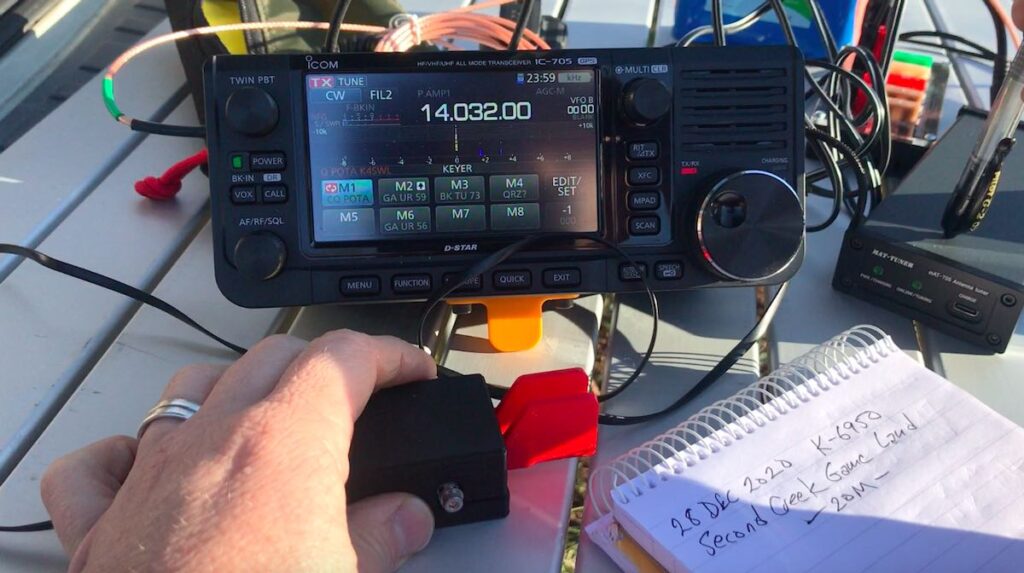
POTA activation of Second Creek Game Land
I purchased the Icom IC-705 with the idea that I would review it and then sell it shortly thereafter. Much to the dismay of my (rather limited) radio funds, I find that I now want to keep the IC-705…indefinitely.
I didn’t think the IC-705 would fit into my QRP field radio “arsenal” very well because I tend to gravitate toward more compact radios that I can easily operate on a clipboard on my lap when necessary. My Elecraft KX2 (TSM November 2016), Elecraft KX1, LnR Precision LD-11 (TSM October 2016), and Mountain Topper MTR-3B probably best represent my field radio interests.
But I’m loving the versatility and overall performance of the IC-705. It’s providing an opportunity to do much more than most of my QRP radios allow.
Here are just a few of the things I’ve done with the IC-705 thus far:
- Activated numerous parks in SSB and CW
- Connected to a local D-Star repeater and talked with a fellow ‘705 owner in the UK
- Listened to ATC traffic (and recorded it)
- Listened to NOAA weather radio
- Listened to and recorded local FM stations
- Enjoyed proper FM DXing
- Recorded GPS coordinates during a POTA/WWFF activation
- Made numerous digital mode contacts by connecting the IC-705 directly to my Windows tablet
- Made a 2-meter SSB contact
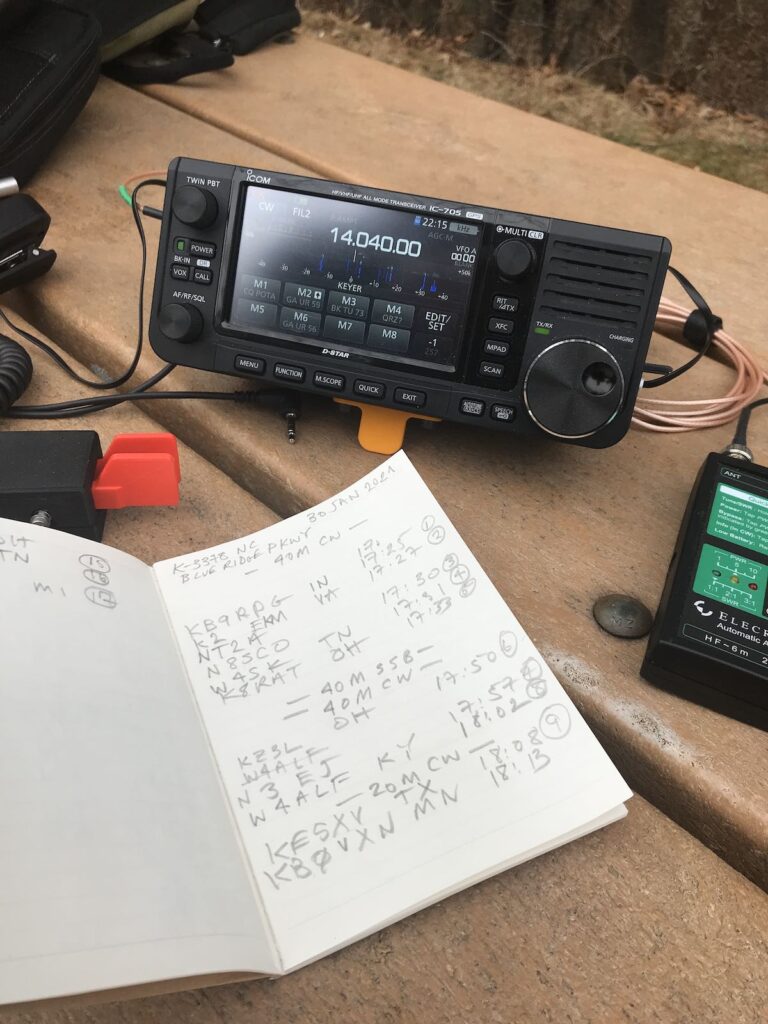
POTA activation of the Blue Ridge Parkway
Indeed, there are more features on this transceiver than I can fully cover in one review; truly, I consider that a very good thing.
So if you’re looking for a portable transceiver that can truly take you on a deep dive into the world of QRP HF, VHF, UHF, and even satisfy the SWL in you, look no further than the Icom IC-705.
Well played, Icom.
More Icom IC-705 articles, information, and resources:
- Click here to view a YouTube playlist of POTA activations where I used the IC-705
- Click here to view numerous field reports with the Icom IC-705 on QRPer.com
- Read Armed with loops, fences, and an Icom IC-705, 13dka battles transatlantic MW DX
- Read The Icom IC-705 is about to achieve ‘Holy Grail’ status
- Read Portable tuner (ATU) options for the new Icom IC-705
- Read Comparing the Icom IC-705 and Icom IC-7300 with the Xiegu GSOC G90 combo
- Read Taking the Icom IC-705 on a shortwave and mediumwave field trip
- Read Icom IC-705 blind audio tests: Let’s take a look at your choices!
Do you enjoy the SWLing Post?
Please consider supporting us via Patreon or our Coffee Fund!
Your support makes articles like this one possible. Thank you!