Category Archives: Shortwave Radio

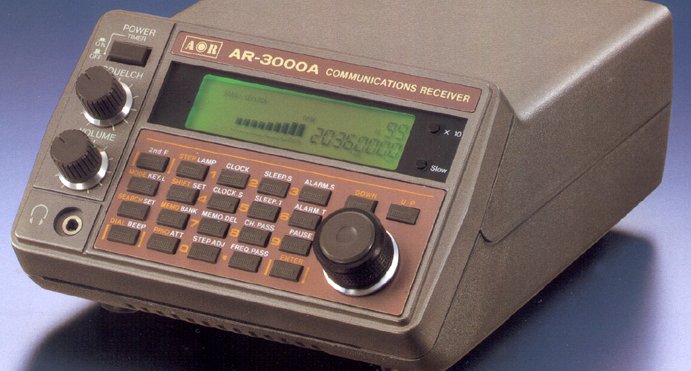
A review of the AOR AR-3000A Wideband Receiver

ar3000Alrg

Many thanks to SWLing Post contributor, Mario Filippi (N2HUN) for the following review:


The AOR AR-3000A Wideband Receiver

by Mario Filippi, N2HUN

(All photos below by author)

The AOR AR-3000A is a wideband communications receiver, made in Japan, covering 100KHz – 2.036 GHz with all popular modes including AM, NFM, WFM, CW, USB and LSB. The AR-3000A was produced in the early ‘90’s at the price of $1063 and came with a telescoping back-of-set antenna, wall-wart power supply, and well written 57 page manual.

AOR is a long time reputable manufacturer of radios and electronic equipment that continues on today producing high quality equipment. While the AR-3000A can be considered a tabletop unit, it is quite small, measuring only 8” x 5” x 3.5”. The AR-3000A has a total of 400 memory channels, with four “Banks” (Banks A- D) each holding up to 100 channels. Each stored channel holds all the necessary parameters such as frequency, mode, attenuator, and step size. An optional mounting bracket for mobile operation was available along with an optional DC cord for those wanting to use it as a scanner for public safety monitoring. It does not run on internal batteries though.

What I like about this radio is it’s wide coverage and it functions as my main longwave/shortwave receiver in addition to a scanner for monitoring local VHF/UHF public safety bands.
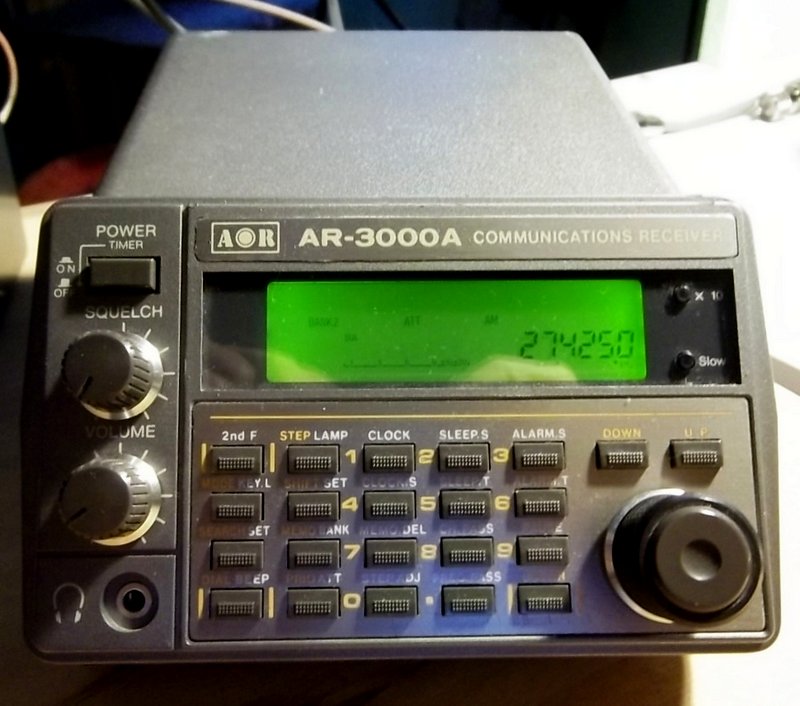
AOR 3000

As desktops go, this one has an unusual shape. While the unit is horizontally shaped for the most part, the front panel is angled slightly upward to make the controls easier to read. However, it took a while to get used to the small print on the panel and LCD so if you wear glasses, definitely don them because you’ll need ‘em. As a matter of fact I’m contemplating purchasing a pair of those magnifying eyeglasses to see (pun intended) if they’ll help (hi hi!).
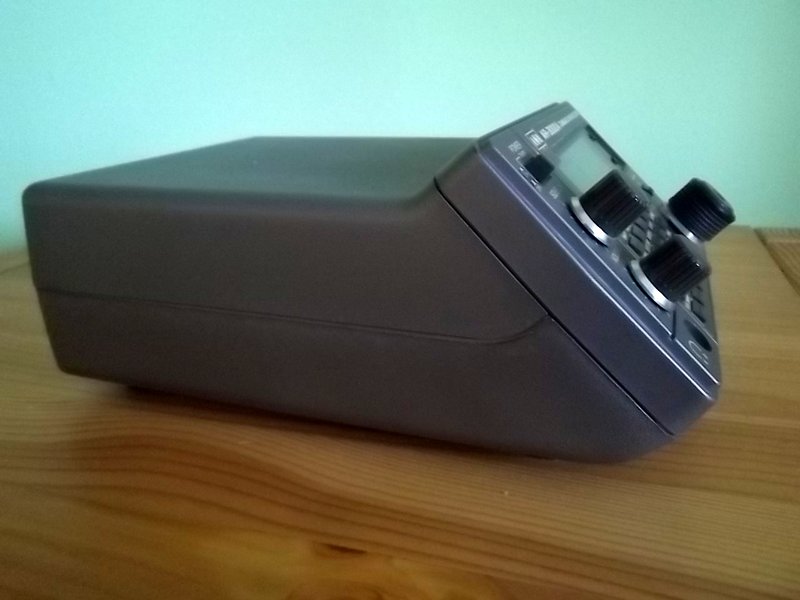
AOR-3000-side view

These units come up for auction on Ebay and on ham classifieds at a much reduced price, most in remarkably good shape for a quarter-century old receiver.

A recent survey of Ebay auctions show they run from about $183 – $350; over several hundred dollars less than the original price. I chose to purchase one from a ham classified website at a higher price but it was well worth it. When it comes to high price tag items I tend to scout out the ham ads first. The seller was a friendly, honest ham who was a great communicator so the deal went smoothly. He included the computer control cable and even replaced the backup memory CR2032 battery, something every buyer should consider when purchasing vintage units.

For advertisements of vintage AOR products check back issues of Monitoring Times at: www.americanradiohistory.com . This site is an excellent resource for old time radio, TV, broadcasting and miscellaneous electronics publications and contains a mind boggling array of books and periodicals from the past.

The front panel is laid out quite well, with soft touch pads in the center allowing easy parameter entry, a tuning knob on lower right, and my favorite, a manual squelch knob. Most of the touch pads have a secondary function which appears in white lettering while primary functions are in yellow.   If you’d rather not spin the VFO dial, which is quite small (0.75” diameter) there are up/down arrow keys to accomplish that function. The knob spins smoothly with no obvious détente.
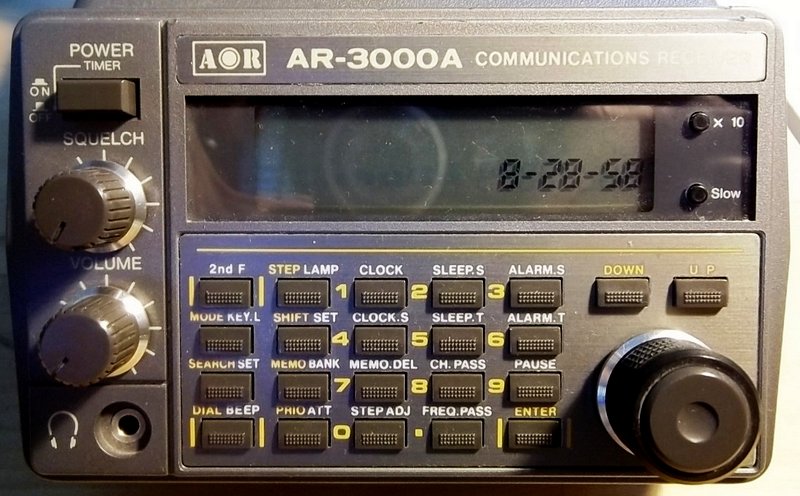
Front panel (sorry about the camera shutter ghost!)

Front panel (sorry about the camera shutter ghost!)

The rear of the unit has several connections: BNC antenna, 12V input, DIN socket for a recorder, external speaker, RS232C for computer remote control, and On/Off switch for computer/manual control. Back in the day you could purchase ScanCat Gold software for about $95.00 that would allow computer control of the unit. I am in the process of finding any existing software that will allow that and it’s not easy to come by, but that is not a priority.

Oh and where is the speaker you might ask? On the underside of the unit.
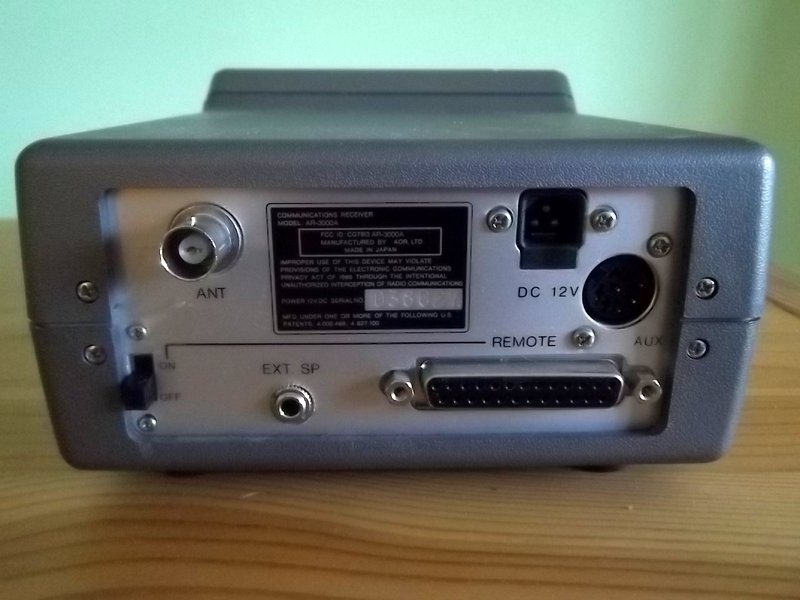
Plenty of rear connections.

Plenty of rear connections.

This unit was purchased to save space at my desk as it’s quite small and serves as my main source of longwave, medium wave, shortwave, and VHF/UHF reception. For HF it’s hooked to an S9 43 foot vertical antenna with many (50+) radials. S9 Antennas unfortunately is no longer in business, but when the company had just started up I purchased the 43 footer for ham use. It’s lightweight, made completely of fiberglass, and has been up several years with no problems.

S9 antennas was eventually sold and the antennas were available from LDG Electronics last time I looked. If you check out their pictures at http://www.ldgelectronics.com/c/252/products/12/62/3 you’ll see my house on the left sporting the S9v43 footer. By the way, when I bought the AR-3000A, the seller stated that ”it’s a great radio as long as you don’t connect too big of an antenna to it”(hi hi!). Yes, I found it tends to suffer from overload with my large antenna, but the 3000A has a useful built-in attenuator

As a wideband receiver the AR-3000A fits my needs perfectly. For LW it receives aeronautical beacons as far away as Quebec and New Brunswick, Canada. NAVTEX transmissions on 518 KHz are easily decoded using a SignaLinkUSB and YAND software.

As for HF, I’m mainly a utility listener and have a bank of memory channels for WWV (2.5, 5, 10, 15,20 MHz), WLO (8.471MHz), CB channels, Volmet stations, USCG facsimile frequencies, W1AW on 3.581 for code practice, a slew of RTTY station frequencies, the 10m FM band repeater frequencies, Radio Habana Cuba, 4XZ (great for code practice), WLO maritime weather broadcasts, and several channels for different ham band frequencies of interest.
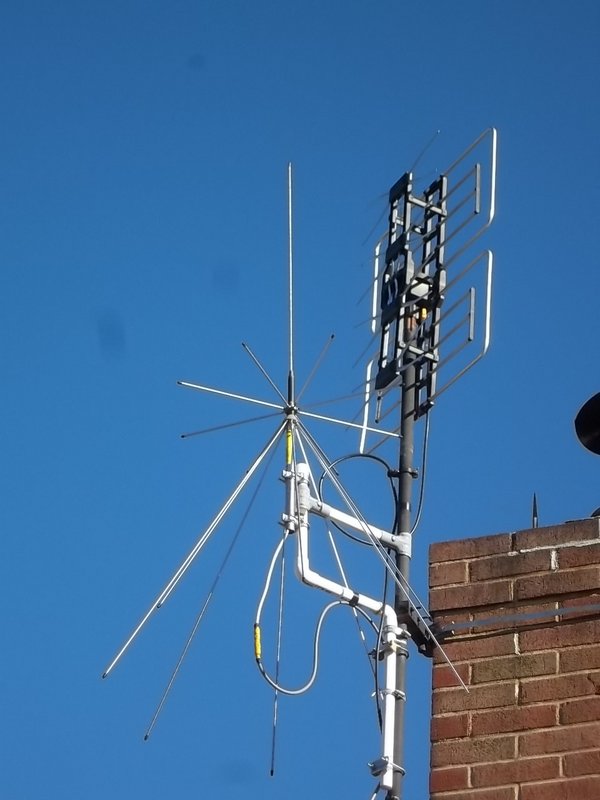
Radio Shack discone offset –mounted on TV antenna mast.

Radio Shack discone offset –mounted on TV antenna mast.

For scanning, obviously the 3000A can’t compete with modern scanners. It was a different era back then. So, no trunking, no CTCSS tones, and the scanning speed slow compared to today’s standards, but it does have the usual features like channel lockout, scan delay, priority channel, step adjustment, search mode and does cover the military aeronautical band.

As a basic scanner for monitoring local state/local first responders, aeronautical (ATIS, ACARS) channels, NOAA satellites, NOAA weather channels, my local repeater, GMRS, FRS, taxis, railroads, etc., it is a very satisfactory performer. I can even hear the NY City Transit police from my location in W. New Jersey which is a pretty good distance, ATIS from LaGuardia and Philadelphia airports, and taxis in the Philly area, all while using a Radio Shack discone on the chimney.

For a more in-depth review of the AR-3000A by Bob Parnass, check the November 2000 issue of Monitoring Times magazine. Universal Radio has a great archive of discontinued radios so check them also at www.universal-radio.com. User reviews can be found on www.eham.net, that’s one of my favorite feedback sites. There’s also an AR-3000A Yahoo users group that’s a great resource. If you want to see videos of the rig in action then search on YouTube as there’s a good number available. In conclusion, I’m very satisfied with the AR-3000A, it’s exactly what I was looking for and is an integral part of radio receiver history.

If any other AR-3000A owners are out there, let’s hear from you. Thanks and 73’s!


Many thanks for this excellent review, Mario. I always thought the AOR AR-3000A was a cool little receiver. When it was being produced, the price was way beyond my means as a college student. At the time, though, it had to be the most compact, best performing, wideband receiver on the market! 

If any Post readers can help Mario find a solution for computer control of the AR-3000A, please comment!

Thanks again, Mario–we look forward to your next contribution!
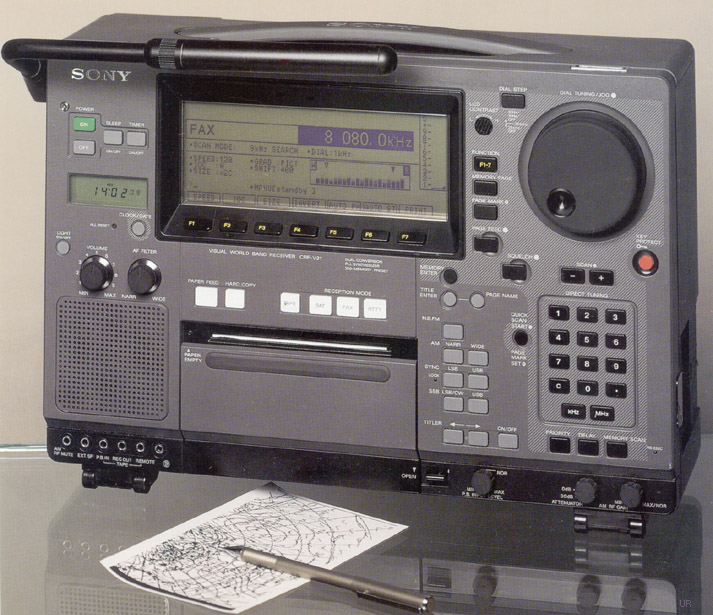
eBay find: the “mythical” Sony CRF-V21

Image source: Universal Radio

Image source: Universal Radio

Many thanks to SWLing Post contributor, Anil, who writes:

Here is a link to an Ebay auction for the mythical Sony CRF-V21. In all my years, I have never seen one for sale before and it might be interesting for some blog readers…

Click here to view on eBay.

Mythical is, indeed, the correct word for the Sony CRF-V21, Anil!

Check out our previous post that mentions the Sony CRF-V21.

Star Wars sound designer is, indeed, a radio enthusiast

StarWars-LogoSWLing Post readers may remember a post I recently published in which I believed I’d identified a familiar shortwave time signal station in the Battle of Hoth scene from The Empire Strikes Back. If you haven’t read this post, feel free to do so and listen to the embedded video/audio clips.

Upon hearing this, I went so far as to muse that the Star Wars sound designer might be a radio listener. I asked our readers if anyone could confirm this–?

Well, we’ve got our answer!  I’m truly indebted to an SWLing Post reader who passed my post along to his friend, Ben, who could provide this definitive response:

“This is Ben Burtt, sound designer of the Star Wars films. A friend sent me a link to this blog thinking I would like to comment.

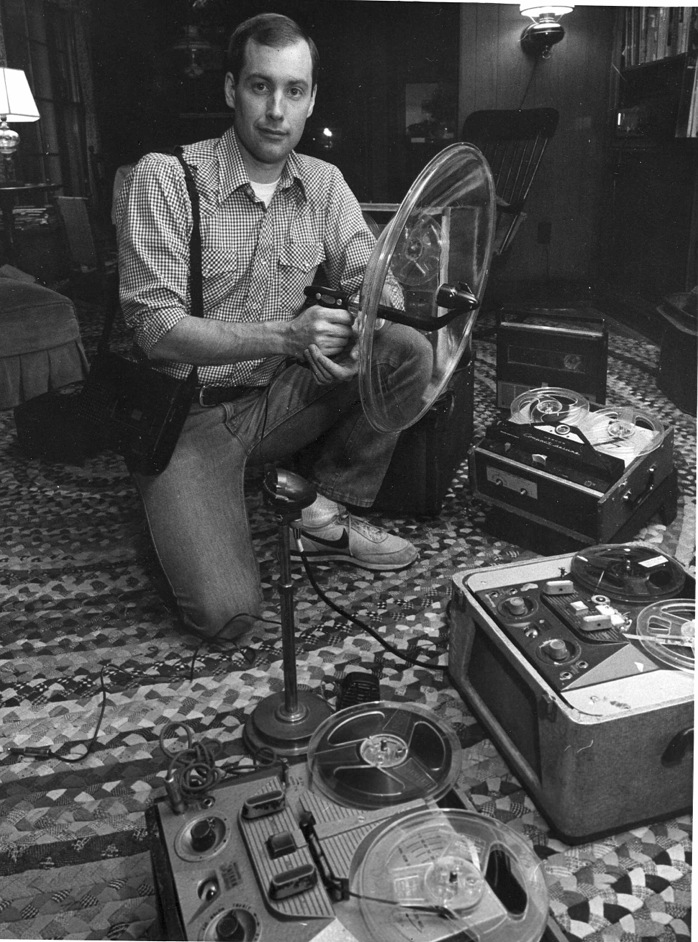
Ben and old recorders

Ben Burtt with his recording gear, circa 1980. The mike on the stand at Ben’s feet is one from his grandfather’s ham radio station in the 1950s, or possibly earlier.

“The answer is yes, I have always been a ham radio enthusiast.”


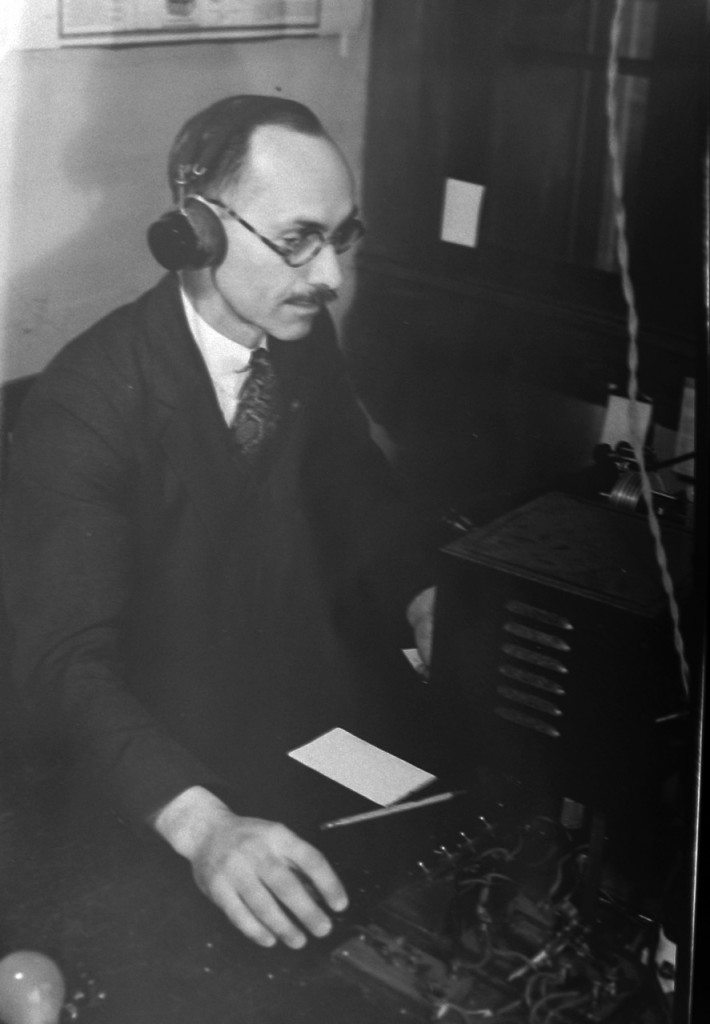
“My grandfather, Harold Burtt, operated W8CD out of his home in Columbus, Ohio 1930s-1960s. I was enthralled as a kid listening to the sounds on his receiver. I heard alien worlds and cosmic ‘voices.’

Harold Burtt, (Chairman of the Psychology Dept Ohio State) with his attic gear approximately 1935

Harold Burtt, W8CD. (Chairman of the Psychology Dept Ohio State) with his attic gear,  approximately 1935

“So not only did I record his radio, but continued to do so on the Star Wars series and Star Trek as well.

My memory of the Hoth transmission was that it was WWV but it could have been CHU since I was recording all that interested me on the dial.”

Terrific! Thank you, Ben, for taking the time to respond. As I said, you’ve certainly started off this radio enthusiast’s year on the right wavelength…no doubt some of our readers will agree.

Indeed, the powerful sonic experience of the Star Wars and Star Trek films has, in my estimation, helped shape many of us into the radio/sound enthusiasts we’ve become–myself certainly included. Thank you, Ben, for this!  You’ve sharpened my ear to a greater appreciation of sound, especially filmic sound, and your work in particular.    

For readers who are less familiar with Ben Burtt’s work, check out his Wikipedia page and IMDB profile–you’ll find he’s been the sound designer on numerous influential films including the recently released Star Wars: The Force Awakens.

A special thanks to Ben Burtt for sharing these wonderful photos and kindly giving me permission to use them here on the SWLing Post.  I must say, considering my love of radio in the thirties, I especially like that photo of Harold Burtt (W8CD) in his shack.

DX Podcast returns

Analog Radio DialColin Newell from DXer.ca has just announced the return of the DX Podcast:
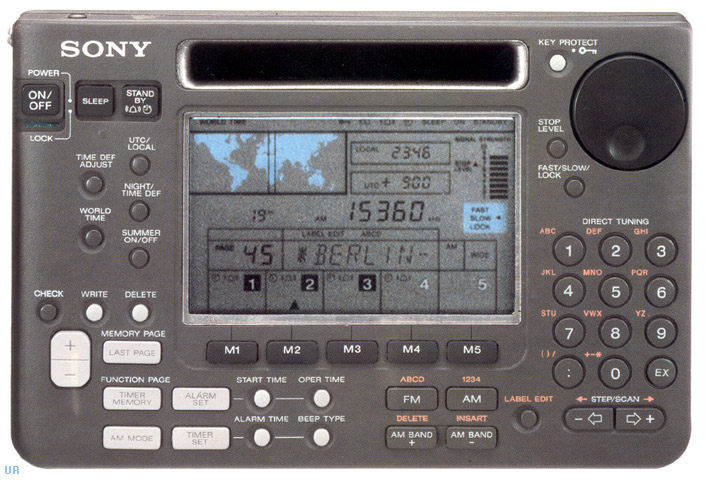
The DXer.ca site has been on the air for over 20 years now! And we are now pleased to announce… the return of the DX Podcast! We ran this little show way back in 2008 and it never got a lot of traction – we are starting small and with our first episode, a conversation with Ian McFarland of Radio Canada International – recorded New Years Eve – December 31st, 2015! Enjoy.

Click here to listen to the podcast on DXer.ca.

I plan to help Colin with the new podcast and wish him the very best producing this new show!

James put his ailing Sony ICF-SW55 on ice. Literally.

sony-icf-sw55c

Many thanks to SWLing Post contributor, James Patterson, who writes:

I have owned the Sony ICF-SW55 for around 15 years or more. I like to change my listening pleasure from radio to radio, giving each one a rest, as they are all different to a degree. So I put the SW55 away and it sat unused for about six moths, as with my radio collection, I had others to listen to.

But when I decided to listen to the SW55 again, it just wouldn’t power up at all. I have read posts from other listeners saying their radios won’t power up either after sitting for extra long periods. I think they are mostly Sonys.

I tried many times but no it wouldn’t power up; I decided I’d just keep it as a memory of a failed Sony radio. I’m aware that the capacitors do blow, and assumed that’s most likely the problem.

But I decided there may be another way to get it going again. I always check for [battery compartment] corrosion, but there was none.

I thought of a crazy idea of actually freezing the radio–just to see what may happen. So it was in the chest freezer for 3 hours. I then took it out frozen like an ice brick!!.

I took it outside to the blazing hot sun and let it fully defrost. I then plugged a DC power pack into it. The operating voltage is 6 volts. I pushed 9 volts into it, through the switchable power pack. I got a plastic clamp and clamped the on/off switch permanently “on”.  I could hear it turning on and off several times as the switch is electrically-activated.

Then all of a sudden it sprang to life–unbelievable! On it came at full volume, so I selected an AM station and it worked as good as it ever did. The sensitivity was always very good, and it still is.

So was it a “Fluke”, “freak of nature” just by chance, or was it the freezing that woke it up?

Well I’m not turning it off. I have new AA batteries in it, as well as the power pack that’s turned back to the correct 6 volts–and yes it’s still going!!

So maybe we should all start freezing our radios when they have given up the “ghost”!?! Don’t forget to defrost before powering up!! Maybe I’ve started a “new trend”. Any comments would be great! Thanks.

Thanks Thomas and have a great and happy New Year from New Zealand.

Wow–James, I’m not sure why this freezing method worked, but I’m glad it did!

I don’t think I could recommend that everyone try this but, James, you did this out of desperation since you essentially had a nice ICF-SW55 paperweight. What did you have to lose? I’m very curious if some engineers or electronics technicians could comment as to why freezing the radio helped.

I do know this: I would be cautious attempting James’ freezing method if you live in a humid environment. It’s possible that the condensation from the radio thawing could actually cause moisture damage. Obviously, in James’ case, it did not.

Thanks again, James–I hope your ICF-SW55 gives you many, many more years of service!

George demonstrates the Tecsun PL-880 tuning bug

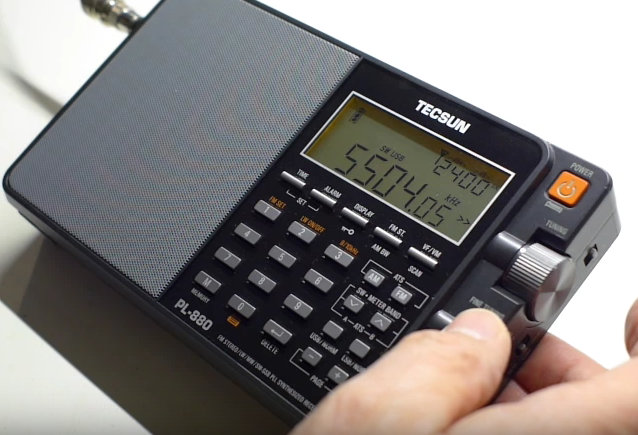
PL-880-Tuning-Bug

[19 January 2016: Please read this updated post.]

In response to Pawel’s post about a tuning bug affecting a recent batch of Tecsun PL-880s, SWLing Post contributor Georges (F6DFZ) comments:

I have posted a new video about this important bug of the PL-880.

I did so because it seems some people don’t understand this very important issue.

This video shows the Tecsun PL-880 tuning bug which is present on SSB when using the Fine Tuning knob.

The PL-880 is tuned to the Shannon Volmet on 5,505 MHz USB.

At the beginning, I use the coarse Tuning knob to shows the effect of tuning 1 kHz down ; the pitch of the voice increases as we are on USB.

Then, I tune down 1 kHz using the Fine Tuning knob, and now the pitch of the voice decreases, indicating the bug with the reverse tuning using the Fine Tuning knob on SSB.
At the end, I use the coarse Tuning knob to hear the voice with a normal pitch, and you can see that the displayed frequency is 5,503.01 MHz, a difference of nearly 2 kHz versus the true frequency.

Best regards, and a Happy New Year

Georges F6DFZ

Thank you, Georges. Since I have an early PL-880 model that doesn’t have this bug, your video and explanation does clarify the situation.

That is frustrating. Until this bug is fixed, I couldn’t recommend purchasing a new Tecsun PL-880. I hope someone can confirm when the bug is fixed and the production run is once again free of this tuning issue.

Many thanks to Pawel and Georges for bringing this to our attention.

The Amateur Astronomer: Tune in to Troy’s Christmas gift

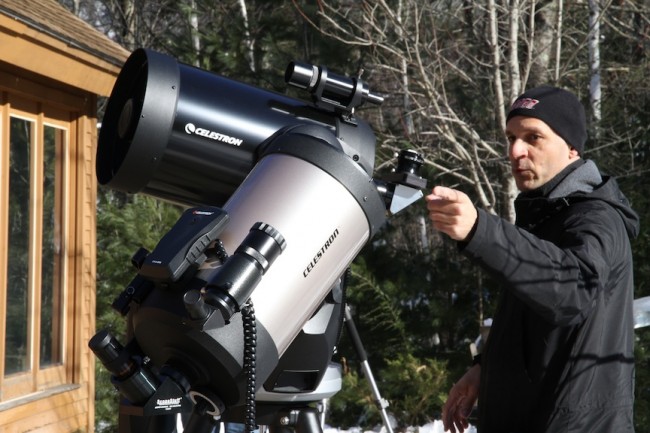
imageSWLing Post reader, Troy Riedel, received a gift like no other from his son this Christmas. No, it wasn’t the fabulous Celestron telescope in the above photo.  On Christmas Eve (December 24) Troy sent the following message:

Merry Christmas, Thomas.

I have to tell you what my son gave me for Christmas a few hours ago.

He purchased 1-hour of radio time for me on WBCQ (5110) for Wednesday, 30 December at 8 P.M. EST.

I will have to pre-record approximately 50-55 minutes over the coming days (not much time to prepare).

After telling my son this is cool – I also added this is the most stressful gift I’ve ever received.

My son suggested I may want to talk about astronomy.

A cool gift, indeed.  Evidently––and even more cool–– Troy is something of a hardcore amateur astronomer. I also encouraged him to do a show on this topic; I can’t think of the last time I heard a show about astronomy on shortwave!

Troy Riedel, host of The Amateur Astronomer

Troy Riedel, host of The Amateur Astronomer

So, despite the challenge of putting a show together in less than a week, Troy confirmed yesterday that he has already completed the show and WBCQ will air it at the following time/frequency:

5,110 kHz on Dec 30, 2015 at 8:00 PM EST (1:00 UTC December 31, 2015)

Troy is looking forward to reception reports and will announce the address during the broadcast.

Oh––and being the good man he is, Troy is also including a PSA for Ears To Our World. Thanks, Troy!

Looking forward to the show!