Category Archives: Shortwave Radio

Listener Post: Chris Freitas

Analog Radio DialChris Freitas’ radio story is the latest in a our series called Listener Posts, where I will place all of your personal radio histories.

If you would like to add your story to the mix, simply send your story by email!

In the meantime, many thanks to Chris for sharing his personal radio history (note that Chris has also posted this story on his new blog):


Chris Freitas

I have an interesting story on how I got into shortwave radio. Let’s hop into the Tardis and go back to 1997. Being 13 years old, a young Chris Freitas was a member of the Boy Scouts.

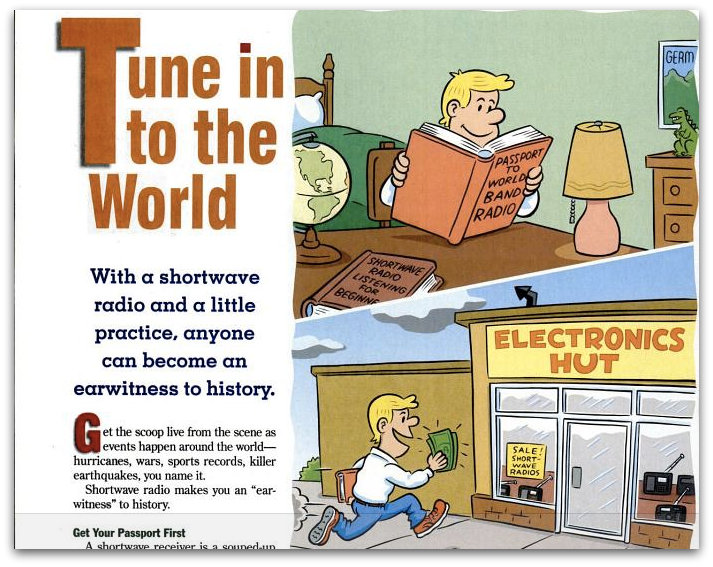
Because I was a part of this organization, Boy’s Life magazine shipped to my mailbox each month. In the December 1997 issue, there was an article titled “Tune In To The World.” This printed piece literally changed my life.
BoysLife-Shortwave

While reading the article, I was amazed that there were radios capable of receiving global signals. There had to be more information. Thus, I went to the Millington Public Library (Millington is a suburb north of Memphis, TN and my hometown).

Using slow dial-up internet and reading Passport to World Band Radio, I learned more about shortwave radio, international stations, and frequencies. Before buying one at Radio Shack, there was an epiphany.

I already owned a shortwave radio and just realized it at that moment. Months before reading the article, my next-door neighbor friend sold me his radio for $25.

BBC-WorldServiceI thought it was neat. It was my first shortwave radio: the Worldstar Multi Band Receiver MG 6100 sold by Sears.

My first two years as an SWL were amazing. I would sit outside on weekends with my radio and listen to the BBC, RTI, RCI, HCJB, VOA, RNW, and many others.

A QSL collection grew and station stickers littered the top of my radio. I wrote to Boy’s Life about it and they paid me some money for the article.

There were great programs like Musical Mailbag, live sports, DX Partyline, and Play of the Week that I would tune into every week. My parents “loved” it, as I annoyed them with loud static.
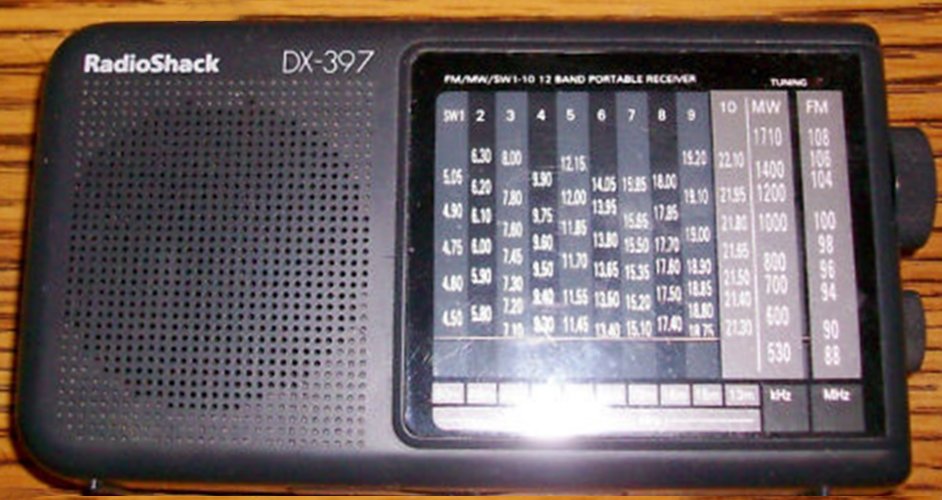
Chris' DX-397

Chris’ DX-397

Unfortunately with all good things, the band knob on my Worldstar radio broke. However, my father conceded to a birthday wish and bought me a Radio Shack DX-397 (my dad told me that he still has it).

I also bought a book from Radio Shack titled Listening To Shortwave. Even for the late ’90s, it was a bit outdated but there were some interesting tips about shortwave.

It also came packaged with a cassette tape (Yes, I still remember them). It was called “Sounds of Shortwave.” If you want to listen, here’s Side A and Side B.

After three years of shortwave radio listening, it was not long before changing my childhood dream of becoming a TV weatherman (I had a crazy fascination with weather and still do). Instead, I wanted to be a radio announcer (or at least work at a station).

In 2000, the Delta Amateur Radio Club was present at a “Scout Base” on Naval Support Activity Mid-South. It was there that I earned my radio merit badge and perhaps my first on-air appearance.

Since then, I’ve been to college and earned my Bachelor’s of Arts in Communications. I am now working part-time at a local radio station. I have yet worked at an international station, but still pursuing that endeavor.
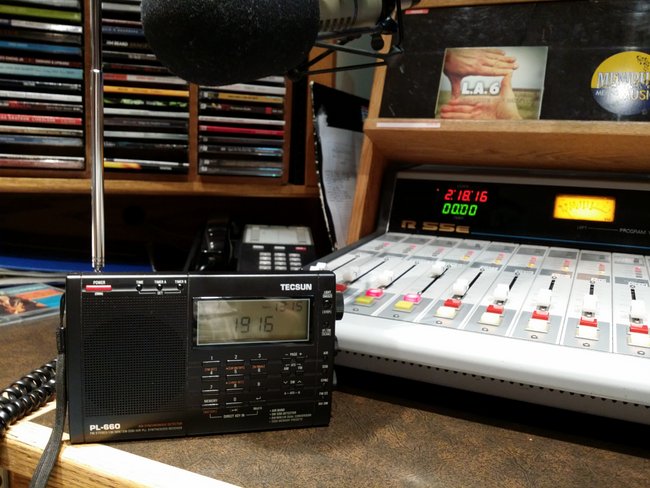
Chris' Tecsun PL-660

Chris’ Tecsun PL-660

Several stations like the BBC, Radio Canada, and Radio Netherlands left shortwave in North America. I have also been through various radios including the Grundig Mini World 300 PE, Eton E5, and Sony ICF-7600GR.

As of now, I am using a Tecsun PL-660 and I love it. Although there are fewer stations on shortwave these days, I still enjoy tuning the bands to catch some exciting sounds halfway around the world.


Many thanks, Chris, for sharing your story.  I think it’s wonderful that you learned about shortwave radio through Boy’s Life magazine. I attend the Dayton Hamvention every year and one of the highlights is that SWLing Post readers stop by my ETOW table to introduce themselves. A number of younger listeners have told me that they learned about shortwave radio through Boy Scouts–no doubt due to the number of Scout Masters who are hams that “propagate” their love of radio.

I encourage you to check out Chris’ new blog and his page on Facebook.

Readers: Please click here to read our growing collection of Listener Posts, and please consider submitting your own story!

The Voice of Korea and an inspirational story

FlagNorthKoreaMany thanks to Frank, a contributor at the Shortwave Radio Audio Archive, for this recording of the Voice of Korea’s English language service.

Frank recorded VOK from his home in Europe on March 27, 2014, on 7,570 kHz, starting at 21:00 UTC, using a Kenwood R-5000 receiver and a Wellbrook ALA 1530+ antenna.

Click here to download the recording as an MP3, or simply listen via the embedded player below:

Of course, the Voice of Korea is all about broadcasting hard-core propaganda–a type of broadcast I find incredibly fascinating. But let there be no mistake, to live in the DPRK is to live under one of the world’s most oppressive regimes. If you want to hear a moving, inspirational story about one North Korean woman’s escape from the DPRK, check out Hyeonseo Lee’s: My escape from North Korea, a TED Talk:

Remember, you can subscribe and download the Shortwave Radio Audio Archive collection (free!) as a podcast via iTunes or the SWAA RSS feed.

VOA Radiogram: Battle of the 100 wpm modes, this weekend!

VOARadioGramIf you like the VOA Radiogram, don’t miss this weekend (March 29-30)–a one year mile marker for the VOA Radiogram service on shortwave radio.

I’ve copied details of the broadcast below, but please bookmark or subscribe to the VOA Radiogram website to see the results of the 100 wpm battle and details of all future broadcasts.

(Source: VOA Radiogram)

This weekend, 29-30 March 2014, will be program 52 of VOA Radiogram. This means that VOA Radiogram has survived one year of shortwave broadcasting.

VOA Radiogram has been successful because of its audience: tuning in, decoding, experimenting, and sending in reports.

We will mark one year of VOA Radiogram with a “battle of the 100-word-per-minute modes.” The same VOA News story will be transmitted using four modes that have a speed of more-or-less 100 words per minute.

Here is the lineup for VOA Radiogram, program 52, 29-30 March 2014:

  •  1:51  MFSK32: Program preview
  •  3:28  PSKR125 (110 wpm): VOA News re Ethiopia
  •  7:42  MT63-1000L (100 wpm): Same VOA New story
  • 12:34  Thor25x4 (100 wpm): Same VOA News story
  • 17:58  MFSK32 (120 wpm): Same VOA News story, with image
  • 23:55  MFSK32: US international broadcasting FY2015 budget
  • 25:58  MFSK32: Closing announcements, with image

Each mode will be preceded by 5 seconds of silence, followed by the RSID, 5 more seconds of silence, and the RSID again.

Please send reception reports to [email protected]

VOA Radiogram transmission schedule

(all days and times UTC)

  • Sat 0930-1000 5745 kHz
  • Sat 1600-1630 17860 kHz
  • Sun 0230-0300 5745 kHz
  • Sun 1930-2000 15670 kHz

All via the Edward R. Murrow transmitting station in North Carolina.

(Many shortwave broadcast frequencies will change on 30 March with the beginning of the A14 season, but the VOA Radiogram frequencies stay the same, for the time being.)

The Mighty KBC, via Germany, will again transmit a minute of MFSK64 Saturday at about 1230 UTC on 6095 kHz and Sunday at about 0130 UTC on 7375 kHz. (KBC’s change from 7375 to 9925 planned for this weekend has been postponed until May.) STF Radio International will also have a minute of digital modes during the same hour (simultaneous MFSK32 streams at 1500 and 2100 Hz).

The Mighty KBC to remain on 7,375 kHz until May ’14

DJ Eric van Willegen, "Uncle Eric" hosts The Giant Jukebox.

DJ Eric van Willegen, “Uncle Eric” hosts The Giant Jukebox.

I’ve just heard from The Mighty KBC that they will not move to their summer frequency of 9,925 kHz until May 2014.

Until then, you will still hear the KBC’s Giant Jukebox show on Sundays (Saturday evening in the Americas) at 00:00 UTC on 7,375 kHz. Note that this only applies to KBC broadcasts to North and South America.

If you’ve never heard The Mighty KBC’s Giant Jukebox, listen to what you’re missing!

1945: Radio Canada International’s first broadcast

RadioListeningMany thanks to Mark for sharing this bit of radio history from the CBC Digital Archives:

“In February 1945, the “Voice of Canada” spoke to the world for the first time. The CBC International Service was founded to broadcast to Canadian Forces overseas in the Second World War. At war’s end the radio service focused on telling the world about Canada in over a dozen languages. Despite budget cuts and critics who accused it of employing communists or operating as a government mouthpiece, the service now called Radio Canada International has persevered. CBC Archives looks back on RCI’s six decades on shortwave.”

Based on this recording, I believe RCI used the same version of O Canada until their very last days as a shortwave broadcaster.

Click here to listen to the clip on the CBC Digital Archives site.

1976 recording of RNW added to the Shotwave Radio Audio Archive

IMG_0135Greg Shoom, a new contributor to the Shortwave Radio Audio Archive, has just submitted a 1976-1977 off air recording which includes:

  • The Happy Station Show hosted by Tom Meijer (Christmas 1976 edition),
  • an unidentified program called “Why Join a DX Club
  • and several longwave radio beacons.

Click here to listen to this recording on the Shortwave Radio Audio Archive.

Remember, you can subscribe and download the Shortwave Radio Audio Archive collection (free!) as a podcast via iTunes or the SWAA RSS feed.

Many thanks to Greg Shoom for sharing this excellent recording!