Category Archives: Vintage Radio

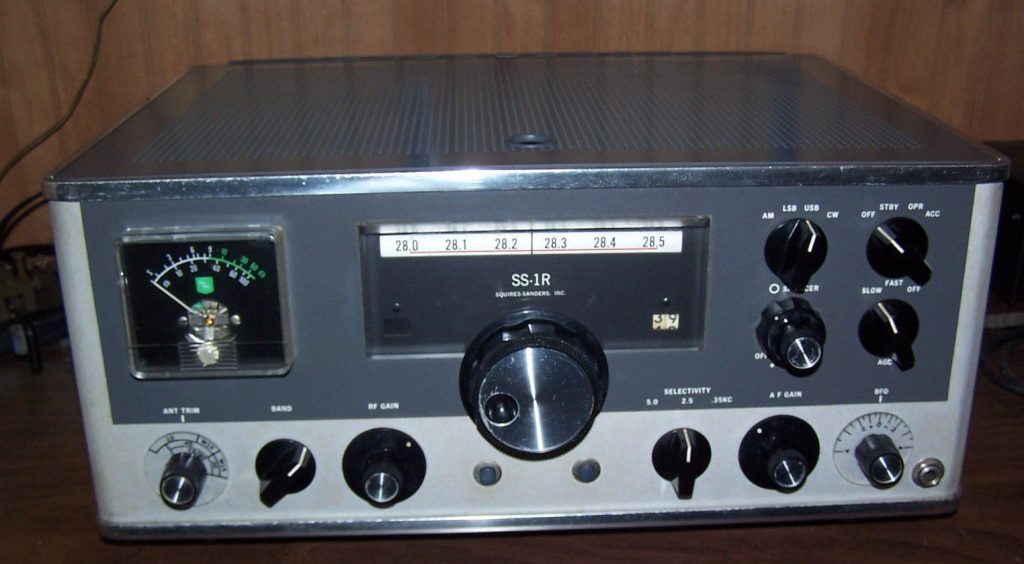
What made the Squires Sanders SS-1R receiver legendary?

ss-1r

Many thanks to SWLing Post contributor, Michael Black, who reminds us why the Squires Sanders SS-1R receiver (Dan recently spotted on eBay) was so innovative at the time:

It’s legendary because it leaped forward in receiver design, at least at the amateur level,  and there was the article in QST  in 1963 by Squires about the design.  So lots of people knew about the design, even if they weren’t owners.

There’s no RF  amplifier, the antenna feeds the mixer trough a tuned circuit.  There’s a q-multiplier on that tuned circuit, to improve selectivity (q-multipliers were mostly seen in 455KHz IFs).  The mixer was a 7360 beam deflection tube, hard to overload, and a balanced mixer, which was likely a first in ham receivers.  After, everyone was using 7360s for receiver mixers, at least until good solid state balanced mixers came along.

I keep forgetting that it is still a dual conversion receiver (except for one band), though presumably to avoid other issues while allowing for a fixed 500KHz tuning range.

But the second IF  is at 1 or 2 MHz, higher than the usual 455KHz, a sign of the future, though there were already some SSB transceivers with IFs in the HF range.

It does seem a relatively simple design now, but wasn’t fifty years ago.

The ham band version was the “big seller”, the shortwave version maybe offered because they could.  It’s not clear if the front end needed changes to cover the SW broadcast bands.  But it would have been an expensive SW receiver, and needing another crystal for each 500KHz tuning segment, a new concept at the time (though a few years later Drake had their SW receivers like that).  But that was the trade-off, most receivers did have a 2:1 tuning range, while some were like the R390 , very complicated mechanically and crystals for every band.  A subset of 3 to 30MHz meant fewer crystals and a simpler bandswitch but you spent a lot of money for a receiver that wasn’t “general coverage”.

Michael

Thank you, Michael, for the insight! At last glance, the bidding was only at $227.50. I suspect it will go much higher, but perhaps this will end up being a deal for someone.

Click here to view on eBay.

What radio would you grab in a fire?

Scott-Marine-SLR-M

Lately, fires have been on my mind. No doubt, this is because there are so many wildfires in the greater southern Appalachian region right now, which is in the midst of a record drought. Brush fires start up almost daily, and no rain is in sight.  In the mountains, the air is hazy with smoke, and it’s become a struggle for fire departments to contain these blazes, even with help from outside the region.

Living, as we do, in a forest, we’ve always had to think through contingency plans if a forest fire should threaten our home:  with only a two hour (or so) warning, what items would we grab and load into our truck?

Of course, we’d likely focus on those things that are irreplaceable and thus essentially invaluable: our few family heirlooms, boxes of photos, documents––you know, stuff you can’t buy.

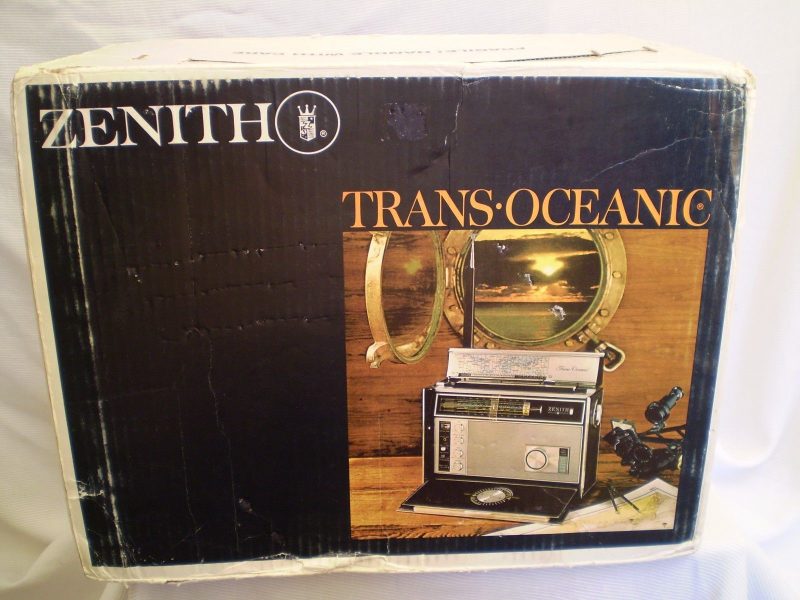
But what about radios?  I hope I’ll never be forced to choose the one thing I should save from my shack, because there are several to which I’m rather sentimentally attached…There’s my Zenith Transoceanic, for example–the first proper shortwave radio I ever owned. There are also a number of vintage radios as well as some SDRs which have become my staple receivers.
Scott-Marine-SLR-M-Dial

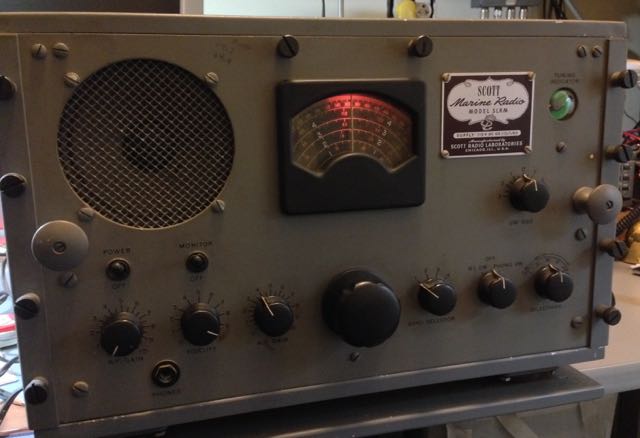
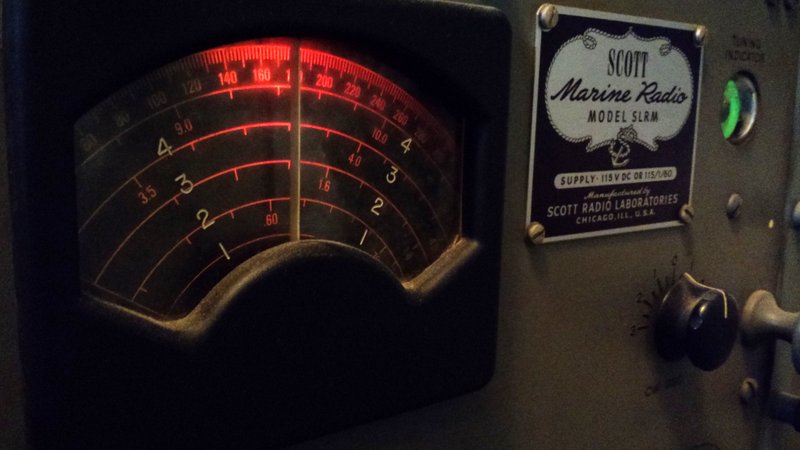
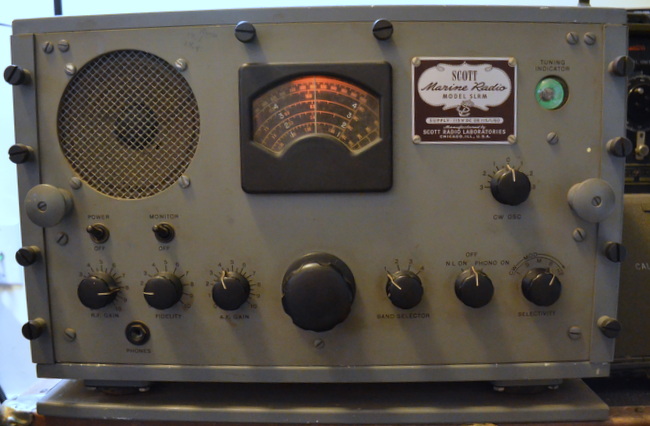
In the end, though, there’s no question which radio I’d grab. It would have to be my Scott Marine Radio Model SLR-M, affectionately nicknamed “Scottie.”. True, she’s not even close to portable at a solid 90 pounds, but I’d strap her to the roof of my vehicle, if I had to.

Why?  Well, it’s the most pristine vintage radio I own, and I use it daily. If it’s not tuned to Radio Australia in the morning, it’s tuned to my AMT3000 AM transmitter on 1570 kHz drawing in any of a number of stations I relay from my WiFi radio.
Scott-Marine-Radio-SLR-M

Scottie simply isn’t replaceable. Even though my Elecraft KX3 probably costs more in terms of monetary value, I could eventually scrape together the money to buy another KX3. But I couldn’t buy Scottie again. Not this one.

So, there you go: after we’ve saved those things important to our family, I’d grab a 1945 receiver and haul it to safety.

Post readers: Now I’m curious–if your home was threatened by fire or other disaster, what radio would you save? Please comment!

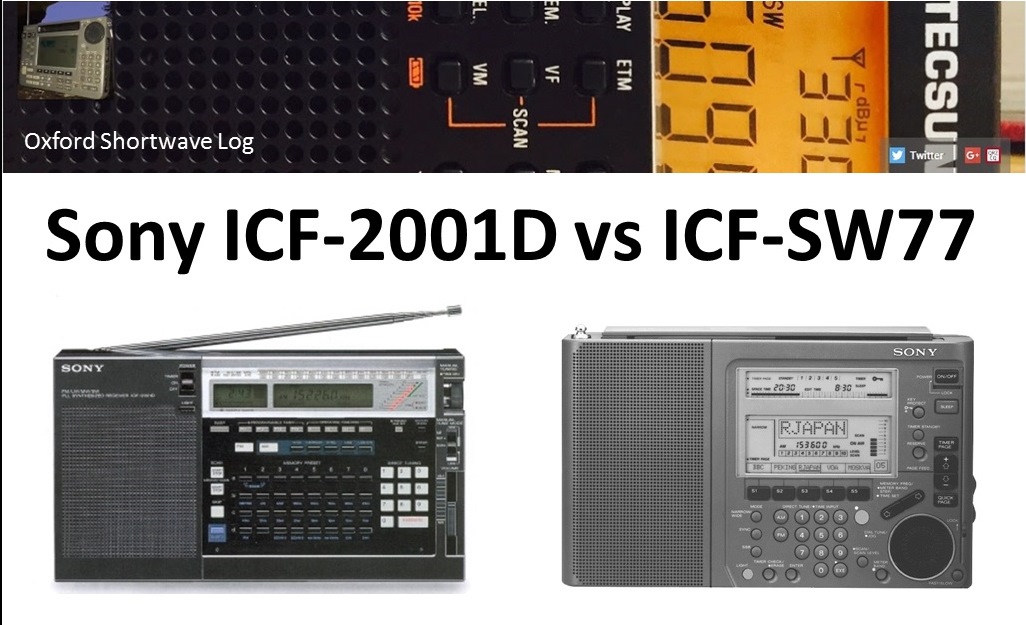
Which is the best? Sony ICF-2001D/2010 or ICF-SW77?

sony-test

Hi there, subscribers to my YouTube channel Oxford Shortwave Log  will be aware that I currently operate both of these wonderful vintage portables. I purchased the ICF-2001D only 18 months ago from eBay, based largely on its reputation as one of the best performing portables ever made. Previously I had been using my excellent ICF-SW55 as the mainstay receiver for my numerous DXpeditions, coupled with irregular appearances from my Sangean ATS-803A and the excellent value-for-money Tecsun PL-360. The ICF-2001D proved to be a revelation in terms of sensitivity, selectivity and contrary to popular belief, with careful planning (to avoid crowded bands), is able to cope pretty well with very large antennas. As regards audio bandwidth filtering, SSB and synchronous detection, in my experience, the ICF-2001D is as good as it gets in a portable – or a vintage portable at least. I have lost count of the number of personal-firsts I’ve achieved using this wonderful receiver and as someone who likes to push the envelope a little, I soon started to wonder whether it’s replacement, the ICF-SW77 might prove to be an even better performer. Subsequent online research  confirmed there was no absolute consensus on this issue, with followers of these two great receivers firmly placed in both camps.

Sometime later, a good friend of mine, fellow radio hobbyist and subscriber to Oxford Shortwave Log very kindly offered to send me his cherished ICF-SW77 on long-term loan. Like me, he was intrigued to know how it compared to it’s venerable predecessor and thus the deal was done! Upon it’s arrival in July, I started planning a back-to-back series of comparison tests at the very quiet wood in Oxfordshire I used for my DX’peditions, using the same antenna for both recievers – the excellent Wellbrook ALA1530 active loop. In total, I made fourteen reception videos comparing the ICF-2001D and ICF-SW77 and posted them to Oxford Shortwave Log. Both receivers performed very well, delivering excellent reception on the Tropical Band and elsewhere on the shortwave spectrum from Bolivia, Brazil, Guatemala, amongst others. At the halfway stage, I generated a video to summarise the results to-date and this will follow in my next post to swling.com.  In the meantime, I hope you enjoy the first half of the reception videos; which follow below:


Clint Gouveia is the author of this post and a regular contributor to the SWLing Post. Clint actively publishes videos of his shortwave radio excursions on his YouTube channel: Oxford Shortwave Log. Clint is based in Oxfordshire, England.

eBay find: Panasonic RF-8000

panasonic-rf8000

Many thanks to SWLing Post reader, Armin Sander, who writes:

Here is a link to a very interesting auction on eBay Germany:

Click here to view on eBay.

Only the price speaks for itself! (And now I need a good whisky!) 😉

No kidding, Armin!  That is a hefty price–8,9999 EUR–even though this particular unit seems to be in excellent shape.

Still, I love looking looking at the photos of this classy receiver.

panasonic-rf8000-front

panasonic-rf-8000-openpanasonic-rf8000-closed

Thanks for sharing, Armin!

Post readers: Anyone own a Panasonic RF-8000?  Please comment!

eBay Find: “exceedingly rare” National HRO-500 Receiver

national-hro-500-receiver

Many thanks to SWLing Post contributor, Dan Robinson, who writes:

The number of times a shortwave classic becomes available in this condition over the course of decades, can be counted on two hands, let alone one in new unopened condition:

Click here to view on eBay.

Thanks for the tip, Dan! I’ve never seen the HRO-500 in person, but it looks like a beautiful rig. I love the simple front panel and the classic HRO tuning knob.

I wonder what this HRO-500 will fetch!?!

Rare Hitachi KW-WSI WorldSpace Receiver on Ebay

This is the first and only “WorldSpace” satellite receiver I’ve seen on Ebay, currently offered at a $175 Buy-It-Now price from a seller in Australia:

http://www.ebay.com/itm/HITACHI-KW-WSI-DIGITAL-RECEIVER-WS-FM-MW-SW1-SW2-/282192383263

The radio is listed as in excellent condition with the original box and literature. Besides the long-gone WorldSpace satellite frequencies, the radio covers medium wave, FM, and most of the shortwave range. A brief PDF data sheet for the radio gives a description of features and operations.

hitachi-kw-wsi

Wikipedia describes this radio’s satellite service as 1worldspace, formerly known as ‘WorldSpace’, is a defunct satellite radio network that in its heyday provided service to over 170,000 subscribers in eastern and southern Africa, the Middle East, and much of Asia with 96% coming from India. It was profitable in India, with 450,000 subscribers.

I wonder if the Hitachi KW-WSI is a reasonable performer for shortwave listening? Does anyone know any technical details of this receiver?

Guy Atkins is a Sr. Graphic Designer for T-Mobile and lives near Seattle, Washington.  He’s a regular contributor to the SWLing Post.

The Sony ICF-SW100: a miniture DX marvel, never likely to be repeated

sw100s

Hi there, I’ve owned my Sony ICF-SW100S for about a year now and in that time it has demonstrated a level of performance way beyond my expectations. Notwithstanding it’s incredibly small size (about the same as a packet of cigarettes, give-or-take), the DX results I have obtained with it are simply incredible. A fully featured ultra-portable receiver, complete with synchronous detection, selectable side bands, SSB, CW and coupled with sensitivity that has my (wonderful) Sony ICF-SW55 beat – and knocks on the door of the legendary ICF2001D. I simply can’t recommend it highly enough. Plug in some headphones or connect an external speaker such as the Bose SoundLink Mini 2 and you effectively have table-top receiver performance and audio in a very compact package.

Originally introduced into the market in 1993 and discontinued in 2005, this little radio covers the broadcast FM band from 76 to 108 MHz and AM from 150 to 29999 kHz, continuously. There are numerous other features that I won’t list here as they’re available on the web, but suffice to say, this (now vintage) ultra-portable DXer’s box of tricks is likely never to be repeated. They are available on eBay and prices remain robust for a radio that will be one to two decades old. Of course there’s also the issue on the first generation models with the ribbon cable connecting the lid of the set with the LCD display etc. to the base, which would fracture after some time, but this was rectified in later models with a notch cut out of the hinge to reduce the stress on the cable – see photo. They are also repairable and in fact I believe Thomas has a posting on here detailing how the ribbon cable on his example was replaced. In my opinion, this receiver is worth the hassle of a repair, because it’s quite simply unique.

Below are selected reception videos from my youtube channel Oxford Shortwave Log using the Sony ICF-SW100, which I believe epitomise the performance of this great little portable. Thanks for watching/ listening.


Direct link to reception video on Oxford Shortwave Log YouTube channel

Direct link to reception video on Oxford Shortwave Log youTube channel

Direct link to reception video on Oxford Shortwave Log Youtube channel

Direct link to reception video on Oxford Shortwave Log YouTube channel

Direct link to reception video on Oxford Shortwave Log YouTube channel

Direct Link to reception video on Oxford Shortwave Log reception video

Direct link to reception video on Oxford Shortwave Log YouTube channel

Direct link to reception video on Oxford Shortwave Log YouTube channel

Clint Gouveia is the author of this post and a regular contributor to the SWLing Post. Clint actively publishes videos of his shortwave radio excursions on his YouTube channel: Oxford Shortwave Log. Clint is based in Oxfordshire, England.