VORW Radio International’s New Schedule

Many thanks to SWLing Post reader, John, who hosts TheReportOfTheWeek channel on YouTube and writes:

Hello Thomas, the broadcasting schedule of VORW Radio International has changed somewhat so I would like to provide an updated schedule for your readers!

The biggest update is that our service to Europe has been fully restored.Listeners in Europe, the Middle East and even South Asia can hear our broadcast clearly on 9400 kHz at 1600 UTC each Sunday!

Each broadcast features a mixture of my commentary and listener requested music. It’s the listeners who choose the playlist in every show, so you are guaranteed to hear a great variety of music! Hope you can tune in!

Thursday 2200 UTC – 9955 kHz – WRMI 100 kW – South America
Friday 0000 UTC (Thu 8 PM Eastern) – 9395 kHz – WRMI 100 kW – North America
Friday 0000 UTC – 9455 kHz – WRMI 100 kW – Central America
Friday 0000 UTC – 7730 kHz – WRMI 100 kW – Western North America
Friday 0000 UTC – 7490 kHz – WBCQ 50 kW – North America
Sunday 1600 UTC – 9400 kHz – Spaceline – 150 kW – Europe / Middle East
Sunday 2000 UTC – 9395 kHz – WRMI 100 kW – North America

Questions, comments, reception reports and music requests may be sent to [email protected]

Reception reports will receive a QSL!

Very cool, John!  Thanks for the update–we’ll be listening!

The GR-227: Gospell introduces a new SDR digital radio car adaptor

Many thanks to SWLing Post contributors Ed and Richard Langley for sharing information about the latest receiver from Gospell: the GR-227 digital radio car adaptor.

According to Radio World:

[…]The compact GR-227 can be added to car stereos, via a USB cable, in order to receive digital radio programs and corresponding data. Based on software-defined radio technology and using the xHE-AAC audio codec, the GR-227 is compatible with both modes of the Digital Radio Mondiale standard as well as the DAB/DAB+ digital radio standards.

According to Gospell, the GR-227 works with car stereos that are fitted with a USB port. Using the firm’s patent-pending technology, the adaptor behaves like a thumb drive when plugged into a USB port, making it compatible with most in-car receivers.

In addition, the GR-227 also features the Gospell Smart Tune App for Android. When partnered with an Android-powered car stereo, this lets users play back the broadcast audio program or benefit from data services.[…]

Read the full article at Radio World.

Richard comments:

“They call it an adaptor but perhaps it’s just an Android-controlled SDR receiver supplying audio output via a USB port, which could be connected to a computer or any other audio device with a USB audio input capability.”

I think he may be correct in that assumption because it may be the only way to get cross-manufacturer compatibility in a device like this.

The product information sheet noted that the receiver is supplied with a “triple band active antenna.” No doubt, the GR-227 will require adding a small external antenna to your car.

Still: an interesting product for sure! Perhaps the price point will be more reasonable that of previous DRM receivers? We’ll post updates from Gospell with the tag: GR-227

Radio exhibit at the Tate Modern

Photo credit: Rebecca Crysdale

Many thanks to SWLing Post contributor, Ed, who writes:

An old friend of mine just emailed me from London after seeing an extraordinary modern art exhibit at Tate Modern. The exhibit, according to my friend Rebecca Crysdale, “is about how we are being overload by communications, particularly digital communications.” She says, “It was a very thought provoking exhibit.”

Photo Credit: Rebecca Crysdale

[H]ere’s a link to Tate Modern’s web page for the exhibit. There appears to be lots of shortwave and other radios in these large sculptures, and SWLing Blog readers might enjoy trying to identify them. http://www.tate.org.uk/art/artworks/meireles-babel-t14041

Many thanks Ed and Rebecca for sharing! I just checked out the Tate Modern site–brilliant installations! I love the Tate Modern, but have never had the fortune of seeing a radio-centric exhibition. Amazing!

Radio World: Preserving Podcasts

(Source: Radio World via Richard Langley)

Radio World supports efforts to save our radio and audio heritage, including the work of the Radio Preservation Task Force,?a project of the Library of Congress.

Here is one in a series of guest commentaries about the topic.

Jeremy Morris is an assistant professor in the Department of Communication Arts at the University of Wisconsin-Madison.

In January 2014, Adam Curry sent a quick tweet out to his 40,000-plus followers with a modest request: “Looking for a full archive of ‘Daily Source Code’ mp3s.” Not just your average media user looking for bootlegged files, Adam Curry was one of podcasting’s first breakout stars in the early 2000s. He was trying to track down one of the first widely popular podcasts, the “Daily Source Code.” But his request was certainly odd; after all Curry was actually the host and producer of the “Daily Source Code,” which ran from 2004 to 2013 (over 860 episodes!).

As Curry lamented on his website: “For a number of [stupid and careless] reasons, I am not in posession of most of these.” [sic]

For those familiar with radio history, this story is probably less surprising. Much of radio’s history has been lost to vagaries of time, be it through the willful ignorance of companies looking to “preserve” only that which could be “monetized,” or the unintentional negligence of hosts, producers and engineers without the foresight, budgets or means to realize that the radio they were making and broadcasting would shape culture for decades to come — culture that media historians, scholars and hobbyists would later want to analyze, research, teach and reference.[…]

Click here to read the full article at Radio World.

Thank you–as Richard knows, podcasting is the distribution method behind our Shortwave Radio Audio Archive. It’s an ideal platform for delivery of recorded broadcasts–listeners subscribe and then maintain their own local copy of the entire archive. Podcasting applications can insure that any new episodes are downloaded automatically.

This year, I will represent the Shortwave Radio Audio Archive at the Radio Preservation Task Force meeting at the Library of Congress. I very much look forward to the event and meeting others in the radio archives world.

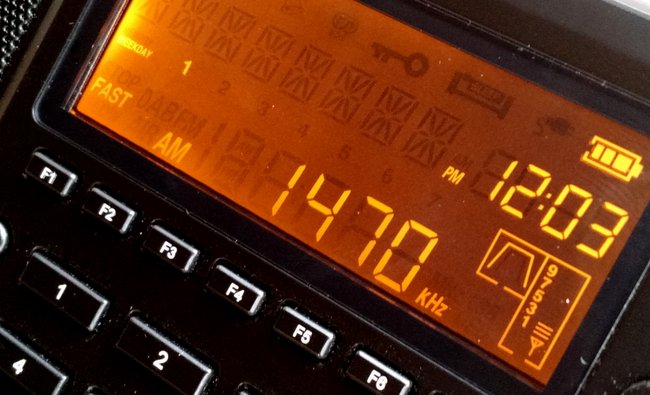
1296 kHz: Help Andy identify this 1970s/80s mediumwave broadcaster

Many thanks to SWLing Post contributor, Andy (G0FTD), who writes:

Back in the 1970’s, there was a rather strange medium wave transmitter on
1296Khz. Originally I think it was in Sussex, and then changed to Orfordness
in Suffolk UK.

It was a weird thing.

I think it was “owned” by the UK’s Diplomatic Wireless Service, not the BBC.

It seemed to be fairly random in its transmissions, and often sent the letter
V in a strange bong-bong-bong-BONG! loops for hours.

Programmes were English by Radio, and a seemingly random mix the BBC World
Service, and BBC Radio 1 (I think).

It slso had a creepy signature tune for the English by Radio programme,
and the modulation had an odd tinge to to it, like it was slightly over modulated.

At some time (the 80’s), I think it’s QTH changed, and the pause between the
letter V being sent was shortened from about 3 seconds to 1 second.

I understand that it had a sharp antenna beam, towards easter Europe, and
was not widely heard in the UK. Those of us that lived in the south east
of the UK could of course hear it off the back of it’s beam.

I’ve never ever seen it mentioned on any radio forums, no archive recordings
seem to exist of these creepy English by Radio them tunes or programmes,
or any off air recordings.

Saying that, I did come across a studio copy of the interval signal, but no
details about it. (But I knew what it was).

Click here to download MP3.

Sometime about 1995 I think it might have been mothballed, and lays ready
for possible future use should there be a need to by the DWS.

If you can help Andy identify, or at least provide more information about this station, please comment! I would love to know about this broadcast service myself.

Relive This Day In Radio History: When WJSV recorded an entire broadcast day

Many thanks to SWLing Post contributor, Bill Patalon, who reminds us that 78 years ago today (September 21, 1939) radio station WSJV made an audio recording of its entire 19 hour broadcast day. Bill points to these details from Wikipedia:

This undertaking was a collaboration between the station and the National Archives, and it was the first time that such a comprehensive recording of a radio broadcast had been made. The station then donated its original set of recording discs to the National Archives, giving it a rare and complete artifact from an era frequently called the Golden Age of Radio. Due to their historical significance, the United States Library of Congress has since added these sound recordings to its National Recording Registry.

https://www.radioarchives.com/WJSV_A_Day_in_Radio_History_p/ra140.htm

Let’s travel back in time…

If you would like to relive September 21, 1939, you can listen to all of the WSJV recording segments courtesy of Archive.org. I’ve embedded the full playlist below–simply press play at the top of the player and each segment will load automatically as long as this page is open. Note that in the very first segment, due to a WSJV equipment glitch, there is a period of silence. Enjoy:

Click here to view or download the full set of recordings on Archive.org.

Many thanks for sharing this bit of radio history, Bill! As a radio archivist, this sort of thing makes my day.

BBC World Service: new shortwave services to Ethiopia and Eritrea

Note that, in terms of press freedoms, Reporters Without Borders ranks Eritrea the second most repressive country in the world, next to North Korea.

(Source: BBC Media Centre)

BBC World Service continues expansion with new services for Ethiopia and Eritrea

Three new language services for Ethiopia, Eritrea, and the diaspora are being launched today by the BBC World Service as part of its biggest expansion since the 1940s.
BBC News in Amharic, Afaan Oromo and Tigrinya will be available online and on Facebook. This will be followed later in the year with shortwave radio services in each language consisting of a 15-minute news and current affairs programme, followed by a 5-minute Learning English programme, from Monday to Friday.

The new BBC services will provide impartial news, current affairs and analysis of Ethiopia and Eritrea as well as regional and international news. Boosting the BBC’s operation in the Horn of Africa will also provide the rest of the BBC’s global audience with a better understanding of Ethiopia and Eritrea.

Programmes will target a younger audience with social media playing a key role. In addition to news and current affairs, there will be extensive coverage of culture, entertainment, entrepreneurship, science & technology, health and sport – including the English Premier League.

These services will benefit from a growing network of journalists across the region and around the world.

Francesca Unsworth, BBC World Service Director, says: “The BBC World Service brings independent, impartial news to audiences around the world, especially in places where media freedom is limited. I’m delighted we’re extending our service to millions of people in Ethiopia, Eritrea and the diaspora worldwide.”

Will Ross, Editorial Lead for Africa, says: “We know that there is a great deal of hunger for audiences in Ethiopia and Eritrea to access a broad range of high quality content in Amharic, Afaan Oromo and Tigrinya. It has been a privilege to work with Ethiopian and Eritrean journalists who are so keen to learn new skills and to ensure the new language services are a success.”