Tag Archives: Radio Waves

Radio Waves: Life-Changing Song on Radio Australia, NZ Voices in the Air, NIST Test Signal on WWV/WWVH, and 1980s NYC Offshore Pirates

Radio Waves:  Stories Making Waves in the World of Radio

Because I keep my ear to the waves, as well as receive many tips from others who do the same, I find myself privy to radio-related stories that might interest SWLing Post readers.  To that end: Welcome to the SWLing Post’s Radio Waves, a collection of links to interesting stories making waves in the world of radio. Enjoy!

Many thanks to SWLing Post contributors Paul, Dave Zantow, Mark Fahey, Jerome van der Linden, and Phil Brennan for the following tips:


A former Chinese soldier turned artist explains how a song on Radio Australia changed his life (ABC)

It was 1979 and Jian Guo was stationed at a military camp in Yunnan, a province in south-western China bordering Vietnam, when he listened to Radio Australia for the first time.

The then-17-year-old was patrolling the base one night when he saw a group of fellow People’s Liberation Army (PLA) soldiers tuning radio equipment on the back of a truck.

He initially thought they were intercepting enemy signals, but, as he got closer, he realised they were listening to a radio broadcast.

It was the ABC’s international broadcasting service, which was considered an “enemy channel” at the time.

“The so-called ‘enemy channels’ included almost every station outside mainland China,” Guo told the ABC.

“The biggest ones were the VOA [Voice of America] from the US, Voice of Free China from Taiwan, and Radio Australia.”

Guo had joined the PLA in 1979 during the peak of the Sino-Vietnamese War but, thanks to his talent in the arts, he was chosen to be a secretary of his company, so he could avoid fighting on the battlefield.

Apart from painting propaganda materials, he also looked after weapons and communication equipment like the radios, which was an extraordinary privilege.

He was not supposed to use the equipment he maintained, and was fearful of breaking the rules, but after seeing his comrades listening to the Australian broadcast the curiosity grew inside him.

One night, alone in his room, he turned on a radio.

It took a while for him to find the right frequency, because of the interference put out by China, but then suddenly he was listening to Radio Australia and the song that would change his life.

“It was broadcasting The Moon Represents My Heart by Teresa Teng,” Guo said.

“That was the first time I knew such music existed in the world.” [Continue reading…]

Voices in the Air: Sarah Johnston on 100 years of radio (RNZ)

Kia ora koutou k?toa. Thank you to RNZ and National Library for organising this celebration of the start of radio in New Zealand, 100 years ago tonight.

Tonight is something of a game of two halves: first I will talk about the first broadcast of voice and music by radio and the start of radio broadcasting in this country – and then I’m also going speak about a research project I am working on, radio recordings made of New Zealand’s forces overseas during World War II.

I have always been a huge fan of radio, ever since childhood listening to the Weekend children’s request sessions, and then as a teenager, eating my breakfast with Morning Report coming out of the family transistor beside me. As a radio journalist I became one of those voices and worked for RNZ and Deutsche Welle in Germany, where I experienced the power of voices coming out of the air from the other side of the world. And as a sound archivist working with the Radio New Zealand archives, I learnt that that power of the voice doesn’t diminish with time – listening to a voice from 80 years ago can transport you not just through space but also time. Sound to me, has a power that in many ways seems different to that of visual images. Continue reading

Radio Waves: Cassette’s Role in Creation of Internet, AU2JCB Special Event, Joel Hallas (W1ZR) SK, and Shortwave Chatter

Radio Waves:  Stories Making Waves in the World of Radio

Because I keep my ear to the waves, as well as receive many tips from others who do the same, I find myself privy to radio-related stories that might interest SWLing Post readers.  To that end: Welcome to the SWLing Post’s Radio Waves, a collection of links to interesting stories making waves in the world of radio. Enjoy!

Many thanks to SWLing Post contributors Datta (VU2DSI), Kim Elliott, Ron, and the Southgate ARC for the following tips:


How the Cassette Tape Helped Create the Internet (WNYC Studios)

In 1983, Simon Goodwin had a strange thought. Would it be possible to broadcast computer software over the radio? If so, could listeners record it off the air and onto a cassette tape? This experiment, and dozens of others in the early 80s, created a series of cassette fueled, analog internets. Our friend Simon Adler at Radiolab reports.

This is a segment from our November 26th, 2021 program, How Cassette Tapes Changed the World. [Read and listen to this piece at WNYC Studios…]

AU2JCB operation 19 NOV to 14 DEC 2021 (Datta, VU2DSI)

AU2JCB is a special event callsign to commemorate the birth date (30 NOV) & to pay homage & tell about the great INDIAN scientist Aacharya JAGADISH CHANDRA BOSE who is recognized as the “Father of Wireless Communication” by the scientific community of our world.
VU2DSI- Datta Deogaonkar will operate with this AU2JCB special event call sign. Continue reading

Radio Waves: Build a Ham Radio Voice Keyer, Sony TFM1000 Decrustification, Shift at RTHK, and RFE Cold War Thriller “Glória”

Radio Waves:  Stories Making Waves in the World of Radio

Because I keep my ear to the waves, as well as receive many tips from others who do the same, I find myself privy to radio-related stories that might interest SWLing Post readers.  To that end: Welcome to the SWLing Post’s Radio Waves, a collection of links to interesting stories making waves in the world of radio. Enjoy!

Many thanks to SWLing Post contributors Marty, Dennis Dura, Dave Zantow, Al Holt, and Rich Cuff for the following tips:


Build a ham radio voice keyer for the backpack (Nuts and Volts)

I have an MFJ-434 voice keyer that has saved a lot of wear and tear on my vocal cords over the years. It has been a big asset during ham radio contests and when I’ve been calling CQs with reduced power (QRP) transceivers.

One of my new favorite pastimes has been operating QRP radios from remote off-the-grid locations. Most of the time, it’s important to pack only the bare essentials for these mini-DXpeditions. I have never taken the MFJ keyer, primarily due to its size. An “accessory” measuring 6-1/2 x 7 x 2-1/2 inches fills up a lot of backpack. It also weighs a pound and a half. On the other hand, I’m absolutely positive the lack of a keyer has resulted in fewer radio contacts. I always run out of voice before I run out of battery.

Last winter, I was packing a QRP “Go Box” for a trip to Florida. Since that stay was planned to last longer than my normal field trips, I decided to take my MFJ keyer for its first outing. What a difference that keyer made! In less than three months, I worked stations in 31 countries and five continents running a 10 watt transmitter and a dipole antenna!

The enormous number of contacts warranted a closer look at a keyer for shorter field trips. The MFJ-434 has 11 buttons to push, three potentiometers to turn, and two LEDs to show me the keyer is doing what I told it to do. Could I get by with fewer amenities and shrink the size, weight, and power requirements to something more backpack friendly? It was worth an investigation.

The MFJ keyer stores five messages. For field operation, I could live with a single CQ. I found a 20 second record-playback module on eBay for $2.59.

I also found a repeat-cycle timer (variable on and variable off delays) on eBay for $2.38. I could use it to “turn on” the playback message, then turn it “off” for a predetermined period of time before turning it on again.

A relay could be added to key the transmitter’s PTT circuit every time my CQ message was played. The receiver would automatically listen for any replies between messages. (This might actually work!) [Continue reading…]

Sony TFM1000 AM FM SW Vintage Radio Decrustification (YouTube)

Click here to view on YouTube.

Hong Kong Broadcaster’s Swift Turn From Maverick Voice to Official Mouthpiece (NY Times)

RTHK has often set the news agenda with its aggressive coverage of the city. But a Beijing clampdown has changed that, with pro-China coverage filling the void.

HONG KONG — Not long after Patrick Li took over as the government-appointed director of Hong Kong’s public broadcaster, a digital lock pad appeared outside his office entrance.

In the past, the director’s office had been where staffers at the broadcaster, Radio Television Hong Kong, gathered to air grievances with management decisions: programming changes, labor disputes. Now, the lock pad signaled, such complaints were no longer welcome.

For many employees, the closed room was an emblem of the broader transformation sweeping through RTHK, the 93-year-old institution venerated by residents as one of the most trusted news sources in Hong Kong’s once freewheeling media landscape.

RTHK was once compared to the BBC for its fierce editorial independence. But under a sweeping national security law that Beijing imposed last year to silence dissent, many say it now more closely resembles China Central Television, the propagandistic Chinese state broadcaster.[Continue reading…]

‘Gloria’: Netflix’s First Original Series From Portugal Is A Great Spy Thriller (Forbes)

Netflix has released its first Portuguese original series. Glória is on Netflix since November 5. Produced by the SPi production company of Grupo SP Televisão and co-produced with RTP, Glória is an intense historical spy thriller taking place during the Cold War. It is a high-quality series from Portugal with an intricate storyline.

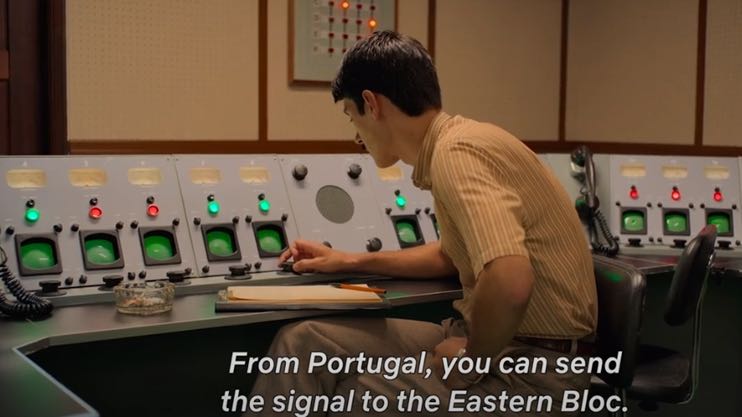
Set in a small Portuguese village named Glória do Ribatejo in the 1960s, the ten-part series follows João Vidal (played by Miguel Nunes), a young man whose family has connections with the leaders of the Estado Novo, the authoritarian Portuguese Regime. João works as an engineer at RARET, a U.S. re-broadcasting office of Radio Free Europe. The series shows how this small village became “an unlikely Cold War stage where American and Soviet forces fought through dangerous sabotage maneuvers to achieve control of Europe,” the Netflix synopsis explains. João gets recruited by the KGB, and will find himself in the middle of the intricate webs of spy games at play in RARET.

An original series created by Pedro Lopes and directed by Tiago Guedes, Glória is a slow-burning series that is a mixture of historical drama based on real events and espionage thriller. The series paints a dark image of Portugal’s past, its violence toward women and its brutal colonial war. It is the highest budget series in the history of Portuguese production, according to The Portugal News. [Continue reading…]


Do you enjoy the SWLing Post?

Please consider supporting us via Patreon or our Coffee Fund!

Your support makes articles like this one possible. Thank you!

Radio Waves: Radio and Education, Border Blasters, FM Switch Delayed per DCMS, and A Quick Temporary AM Antenna

Radio Waves:  Stories Making Waves in the World of Radio

Because I keep my ear to the waves, as well as receive many tips from others who do the same, I find myself privy to radio-related stories that might interest SWLing Post readers.  To that end: Welcome to the SWLing Post’s Radio Waves, a collection of links to interesting stories making waves in the world of radio. Enjoy!


Can Radio Really Educate? (JSTOR Daily)

In the 1920s, radio was an exciting new mass medium. It was known for providing entertainment, but educators wondered if it could also be used for education.

It was mid-1922 and America was in the midst of the radio craze. Commercial broadcasting had emerged in a handful of cities in 1920, but at that time, few people had a receiving set—except for amateur radio operators, who knew how to build one. It wasn’t even called “radio” back then—newspapers referred to it as “radiophone” or “wireless telephone.” But only two years later, there were several hundred radio stations on the air, and you could purchase a radio in a store—although hobbyists still had fun trying to build their own, with varying degrees of success. Meanwhile, the word “radio” had become the common term for that wonderful new invention that everyone wanted in their home.

Today, we tend to take radio for granted; it is one of many ways to hear music or news or sports. But in 1922, radio was unique: it was the first mass medium to take people to an event in real time, and listeners were amazed by it. Suddenly, they could hear a popular orchestra coming through the radio set. Without leaving their home, they could listen to a baseball game, or an inspirational talk from a preacher; some stations even had the latest news headlines. In an era when traveling from one city to another could take hours (the popular Model T Ford had a top speed of 40-45 mph, and superhighways had not yet come along), listeners could travel by radio, hearing stations from distant cities. Before radio, only the wealthy could attend a concert featuring a famous vocalist, but now, anyone who had a receiving set could hear that singer’s music. And in an America that was still racially segregated, radio gave some musicians of color the opportunity to be heard by thousands of listeners. In magazines and newspapers, radio inspired “utopian hopes and bold predictions.” Writers referred to it as a cure for loneliness—especially for people living in rural areas or on the farm. It was also praised for helping the blind gain greater access to the world around them. More than one writer claimed radio would bring world peace, since everyone would unite around their favorite programs. And of course, as a sign of American progress, it was something no home should be without, not even the White House: President Harding was an enthusiastic radio fan, and had a set installed near his desk, so he could listen whenever he wanted to. [Continue reading…]

Psychics once ruled the airwaves thanks to the Texas-Mexico border and the magic of radio (KUT)

A new book includes details of how powerful radio stations along the border helped former vaudeville actors reach larger audiences.

In the 1920s and ’30s, some of the most popular radio programs in the United States featured radio psychics. The most successful among them made hundreds of thousands of dollars reading the minds and predicting the futures of eager listeners. To do it, they took advantage of a new and mysterious medium: radio. Continue reading

Radio Waves: X-Class Flare & Halloween CME, Ham Callsign History, 2/3 UK Listeners Now Digital, AM/FM Until 2030, and Rampisham’s New Plan

Radio Waves:  Stories Making Waves in the World of Radio

Because I keep my ear to the waves, as well as receive many tips from others who do the same, I find myself privy to radio-related stories that might interest SWLing Post readers.  To that end: Welcome to the SWLing Post’s Radio Waves, a collection of links to interesting stories making waves in the world of radio. Enjoy!


Significant X-class solar flare (Southgate ARC)

There was a global eruption on the sun today. It started with a powerful X1-class solar flare from sunspot AR2887.

The blast created a massive tsunami of plasma in the sun’s atmosphere, which rippled across the entire solar disk. A CME is probably heading for Earth, raising the possibility of a geomagnetic storm on Halloween. More information and updates @ Spaceweather.com.

Solar Flare Alerts: Sign up for Space Weather Alerts and get instant text notifications when solar flares are underway.

History of the Ham Radio Callsign (Southgate ARC)

In this video Mike Ritz W7VO looks at the history of amateur radio call signs in the United States

Every legal amateur radio operator in the world has a unique callsign assigned to them by their government, and many of us are better known by our callsign than our given name. But what world event was it that caused these monikers to be? Why are they constructed the way they are? Continue reading

Radio Waves: Radio Facsimile from the 1930s, Public Radio Saving Print, Unlicensed Experimental LW Radio, and RIP Tony Middleton & Milburn Butler

Radio Waves:  Stories Making Waves in the World of Radio

Because I keep my ear to the waves, as well as receive many tips from others who do the same, I find myself privy to radio-related stories that might interest SWLing Post readers.  To that end: Welcome to the SWLing Post’s Radio Waves, a collection of links to interesting stories making waves in the world of radio. Enjoy!


A Look Back at the Radio Newspaper of the Air (Radio World)

Radio facsimile technology never fully caught on, but what if it had?

In the beginning, there were newspapers.

And then radio arrived, challenging the newspapers’ journalistic monopoly.

At first, many newspapers fought the new competitor, refusing to print radio news or program schedules. But some went in the opposite direction, deciding to operate their own radio stations to augment their businesses. And finally, a few brave pioneering publications went even farther: They tried to deliver their newspapers via radio facsimile.

In the early 1930s, radio facsimile looked like the dream application for newspapers. They could use their own local radio stations to deliver newspapers directly to consumers during overnight hours. It would eliminate the cost of printing and distribution and shift those costs onto consumers, who would provide their own printers and paper.

This led several radio stations and newspapers to experiment with facsimile transmission during the late 1930s.

THE FINCH SYSTEM

The person most responsible for this technology was William G. H. Finch. He worked for the International News Service and set up their first teletype circuits between New York, Chicago and Havana. He became interested in facsimile machines and eventually amassed hundreds of patents. [Continue reading the full article…]

How public radio is trying to save print (The Verge)

Why Chicago Public Media and the Chicago Sun-Times are exploring a merger

The Chicago Sun-Times needs help. After being bought and sold several times over the last decade, the 73-year-old paper is looking for a more stable home to continue its award-winning reporting — and it may have finally found it in an unexpected place: a radio station.

Chicago Public Media, which owns the radio station WBEZ, is currently in talks with the Sun-Times to merge. A final deal would combine their newsrooms and audiences in hopes of creating a financially stable enterprise for both teams. Similar mergers and acquisitions have become a common way to bolster the struggling print industry, but if radio were to take on a major newspaper, that would be a first.

“Audio is a growth business,” says Jim Friedlich, chief executive of The Lenfest Institute for Journalism, who advised CPM on the potential merger. “Now Chicago Public Media and other media with audio roots have both the wherewithal and the self-confidence to take a bold step like this.”

Since 2004, US newspapers have shut down at a rate of 100 per year, a pace that’s only accelerated since the start of the pandemic. To stay afloat, some smaller newsrooms have given up independence, being bought by news conglomerates or becoming joint entities with other local outlets — and public radio and TV stations have increasingly offered themselves up as partners. New York Public Radio acquiring the website Gothamist was one of nine similar deals in recent years, triggering researchers to document the trend by creating the Public Media Mergers Project. Public radio has been a particularly strong force, holding its ground amid digitization and the podcasting craze (partially because it’s participated in it), and it might be strong enough to help print do the same thing. [Continue reading…]

The low-down on long-wave: Unlicensed experimental radio (Hackaday via the Southgate ARC)

In the 125 years since Marconi made his first radio transmissions, the spectrum has been divvied up into ranges and bands, most of which are reserved for governments and large telecom companies. Amidst all of the corporate greed, the ‘little guys managed to carve out their own small corner of the spectrum, with the help of organizations like the American Radio Relay League (ARRL).

Since 1914, the ARRL has represented the interests of us amateur radio enthusiasts and helped to protect the bands set aside for amateur use. To actually take advantage of the wonderful opportunity to transmit on these bands, you need a license, issued by the FCC. The licenses really aren’t hard to get, and you should get one, but what if you don’t feel like taking a test? Or if you’re just too impatient?

Well, fear not because there’s some space on the radio spectrum for you, too.

Welcome to the wonderful world of (legal!) unlicensed radio experimentation, where anything goes. Okay, not anything but the possibilities are wide open. There are a few experimental radio bands, known as LowFER, MedFER, and HiFER where anyone is welcome to play around. And of the three, LowFER seems the most promising.

LowFER, as the name would suggest, contains the lowest frequency range of the three, falling between 160 kHz and 190 kHz, with a whopping wavelength of around one mile. Also known as the 1750-meter band, this frequency range is well-suited for long transmission paths through ground wave propagation, a mode in which the radio signals move across the surface of the earth. This can easily carry even low-power signals hundreds of miles, and occasionally through some atmospheric black magic, signals have been known to travel thousands of miles. These ground wave signals also travel well across bodies of water, especially salt water.

Read the full Hackaday item at:
https://hackaday.com/2021/10/19/the-low-down-on-long-wave-unlicensed-experimental-radio/

RAE bids farewell to its historic English voice, Tony Middleton (RAE)

We regret to inform our listeners that our colleague Juan Antonio “Tony” Middleton passed away in Buenos Aires due to health complications, at the age of 82. His distinctive British accent is part of the history of RAE, where he hosted the English-language program for almost three decades. English-speaking listeners around the world remember his warmth and clarity on the air, not to mention his classic opening line: “This is the international service of the Argentine Radio”.

Born in Argentina and son of British immigrants, he ventured into acting in the English language with the group “Suburban Players”, while he was engaged in various commercial activities with his family. In 1981 he had the opportunity to join RAE as a substitute, thanks to his impeccable English and his pleasant voice. In 1983 he joined as a regular and went on to become head of the English-language department at the station, until his retirement in 2008. [Continue reading…]

Milburn Garland Butler Dec 1, 1935 – Oct 10, 2021 (Dignity Memorial)

Mlburn Garland “Gil” Butler was born December 1, 1935 in Bradenton, Florida. He attended local schools, where his mother was a teacher. He grew up in a community where electrification was still being developed, where the Saturday morning movies were an all-day entertainment for kids, and where families would gather in the town square on Sundays for band music and ice cream. After a brief stint in the Army (serving as a quartermaster at a base near Washington, D.C.), Gil Butler went to college in Colorado, returning to Florida where he graduated from the University of Florida with a degree in radio engineering. Along the way, he met and after a whirlwind courtship married Judith Bunten, who would become his lifelong companion. Gil Butler began working as a DJ at a small radio station in Bradenton, Florida in the early 1950s, spinning disks from the very beginning of Rock and Roll. His love of music of all sorts, from Jazz to Rock to Classical, his collection evolved through several formats (LP, cassette, CD, and MPs), and his special chair was always surrounded by the music he would enjoy while reading in the evening. Professionally, Gil moved up to larger stations and more challenging positions in radio and television; working for radio stations around the Tampa Bay area. His first TV gig was as a general reporter for WTVT in Tampa. From there, he moved to WXYZ in Detroit, Michigan, before moving to Silver Spring in the Washington D.C. where he worked as a White House Correspondent for local CBS affiliate, WTOP, covering Washington politics under presidents Nixon and Ford. During this period, Gil appears briefly in Timothy Crouse’s The Boys on the Bus (a recounting of the White House Press Corps during the Nixon Era). He was one of the six “Knights of the Green Ottoman,” named for an item of furniture in the 1972 White House press complex, where the newsmen would gather and share notes. In one passage, he is described: “Gil Butler… the reporter for TV station WTOP, who was chuckling over a volume of Mencken…” This description will surprise no one who knew him, as Gil was a voracious reader. He was always in the middle of a massive nonfiction volume about politics, military history or the Space Race. After WTOP, in 1978, Gil began his ultimate career at the Voice of America, the United States Information Agency’s international radio network. Over a nearly three decade career with Voice of America, he covered 68 countries, working abroad in Cairo, Egypt, Beiruit Lebanon, Beijing, China, London, England, as well as covering the State Department and Pentagon during his time at home between foreign assignments. At the Voice of America’s 40th Anniversary Celebration, Gil received the Meritorious Honor Award for his work in Cairo covering the assassination and funeral of Egyptian President Sadat and its aftermath. Twenty-seven years later, Voice of America News ran a story looking back at that work and the restraint and integrity he exercised in waiting for confirmation before reporting that Sadat had been killed. [Continue reading…]


Do you enjoy the SWLing Post?

Please consider supporting us via Patreon or our Coffee Fund!

Your support makes articles like this one possible. Thank you!

Radio Waves: Radio Bulgaria Online, Small Town Station is Backbone of Community, 1949 Radio Contact, and BBC World Service Performance Review

Photo by Flickt user Shirokazan via Wikimedia Commons.

Radio Waves:  Stories Making Waves in the World of Radio

Because I keep my ear to the waves, as well as receive many tips from others who do the same, I find myself privy to radio-related stories that might interest SWLing Post readers.  To that end: Welcome to the SWLing Post’s Radio Waves, a collection of links to interesting stories making waves in the world of radio. Enjoy!


Hear the voice of Bulgaria – in 9 languages from Radio Bulgaria (Radio Bulgaria)

On the website of the Bulgarian National Radio – www.bnr.bg you can now listen to the new podcast of Radio Bulgaria, “Bulgaria Today” in English, German, French, Spanish, Russian, Serbian, Greek, Albanian and Turkish.

BNR has resumed its programmes in foreign languages after a 5-year pause. The change coincides with the 85th anniversary of the first foreign-language broadcasts for foreign audiences celebrated by Radio Bulgaria in 2021. Continue reading