Tag Archives: Shortwave Radio

Shoot-out results: Top ultra-portable shortwave

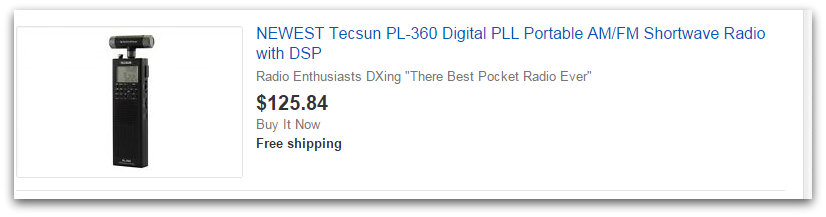
Tecsun-ShootOutThanks to all who participated in our ultra-portable shoot-out! A little over a week ago, I posted recordings of shortwave broadcasts, weak and strong, in an attempt to evaluate which recording–thus which radio–our listeners prefer. I conducted this test on the three radios pictured above: the Tecsun PL-310ET, the CountyComm GP5/DSP (Tecsun PL-360), and the Tecsun PL-380–among the most popular ultra-portables currently on the market. This test was “blind” in the sense that all three radios evaluated were merely labeled “Radio 1,” “Radio 2,” and “Radio 3,” respectively.

The samples

To refresh your memory, I’ve embedded the audio samples below for you to hear; but if you haven’t yet heard them, I encourage you to read our previous post before doing so. (If you’re already heard the recordings, simply skip this section.)


Global 24 – 9395 kHz (Strong)

Radio 1

Radio 2

Radio 3


ERT Open/ Voice of Greece (Relatively strong)

Radio 1

Radio 2

Radio 3


Radio Riyadh (Weak)

Radio 1

Radio 2

Radio 3


Rádio Bandeirantes (Very weak)

Radio 1

Radio 2

Radio 3


And now…the results!

The following chart shows how each radio scored out of a total of 106 (wow!) survey responses:

ShootOutRadios

Let’s start with the radio that scored lowest in this contest…

Radio 3: the CountyComm GP5/DSP (a.k.a., the Tecsun PL-360)CountyCommGP5DSP

Interestingly, the GP5/DSP consistently came in last in every category. I think a few factors outside of receiver performance led to this.

For some reason, the recorded audio of the GP5/DSP sounds out-of-phase.  Several of you noted this. The resulting sound almost mimics a “stereo” effect. No matter how many times I made recordings on the GP5/DSP, this feature predominated, and I eventually assumed it to be characteristic of this radio’s DSP.

But I’m wondering now, however, if there might be oxidation on one of the headphone jack conductors, or if the headphone jack on my unit is somehow faulty–?  Because of this, before conducting the medium wave shoot-out, I’ll try to clean the conductors with a little Deoxit to see if it makes a difference.

Unlike the PL-310ET and PL-380, the GP5/DSP can’t change AM bandwidths. On the strong recordings, I widened the bandwidths of the PL-310ET and PL-380 to 6 kHz; this improved their audio fidelity. On weak signals, I narrowed the bandwidth to 3 or 4 kHz, keeping both at the same level as I did so. While the GP5/DSP’s fixed bandwidth is well chosen, it simply couldn’t compete with the wider filters of the other two radios on strong signals.

Though the GP5/DSP (Tecsun PL-360) came in last, the irony is that most people who made comments on the survey form actually mentioned that the GP5/DSP was also a strong contender. Here are a few responder’s comments:

  • “The bassiness of Radio 1 was pleasing to listen to, but the clarity of radio 3 was also pleasing. All three sounded very good.”
  • “I was divided–Radio 1 seemed to provide the better audio on the stronger stations (not as muddy) yet Radio 3 beat it out on the weak stations and seemed to hold the station steadier (less fading) thereby providing a better audio to hear and understand.”
  • “I think if I were to place these three radios in order of “listening pleasure” based on the provided samples, my order would be 3, 1, 2.”
  • “By a small margin Radio 3 seemed to have the best signal to noise ratio and general audio quality across the range of signal strengths.”

Also notable:  the GP5 has one very distinct advantage over the other two radios, something that wouldn’t have been noticed in this test: its ETM function, which scans the whole band then automatically stores stations to temporary memory, is almost two times faster that that of the other radios. It also seemed to be equally accurate.

So, who would buy the CountyComm GP5/DSP (Tecsun PL-360)? Someone who likes this radio’s form factor, it’s stable AGC, and quick ETM scanning. Keep in mind, we are comparing this model with two of the best radios under $60, in my opinion. Had we compared the GP5 with most other sub-$60 radios, it might have won that shoot-out, and with ease.

Click here to purchase the CountyComm GP5/DSP. [Note that the new CountyComm GP5/SSB should be available soon–I plan to review it shortly thereafter.]

Radio 2: The Tecsun PL-380

Tecsun-PL-380

The Tecsun PL-380 came in a very consistent second place in this shoot-out.

The ‘380 is one of my favorite portables on the market; for many years, it has been my go-to radio for one-bag travel.

Before recording the shoot-out, I guessed that the PL-380 might take first place. But up to this point, I had never actually compared it with either of the two other radios in this shoot-out. Listening to the blind samples, I tend agree with the results.  Still, the PL-380 is a great value and a fun little radio, one I can still easily recommend for travel.

Click here to search for the Tecsun PL-380 on Amazon.com, click here for eBay and click here for Universal Radio.

Radio 1: The Tecsun PL-310ETTecsun PL-310ET

As you can see from the graph, the Tecsun PL-310ET won our shoot-out in every category–and by a fairly wide margin:

UltraPortableShootOut

While comparatively few participants’ comments were specific to the PL-310ET (“Radio 1”), it’s interesting that these most often made note of this radio’s very close resemblance to the PL-380 (“Radio 2”).

The PL-310ET had only a slight advantage over the PL-380 to my ear, but it was enough; so along with most survey respondents, I took note of that advantage.

Now, I know this much: when people ask me whether they should purchase the PL-380 or PL-310ET, I think I’ll suggest the PL-310ET. In the end, it makes for a better travel radio because it also has an external antenna jack, one of the few sub-$60 radios that has this useful feature.

In summary, the Tecsun PL-310ET is truly a fantastic ultra-portable radio, and, at $48 – 52 US, it’s a real bargain, to boot.

Click here to search for the Tecsun PL-310ET on Amazon.com, click here for eBay.

Coming soon…our medium wave shoot-out!

When I find the time in the next month or so, I plan to test the same radios in a medium wave (AM) shoot-out. Weak-signal medium wave will put AGC circuits and internal ferrite antennas center stage. Please be patient, however, as these tests actually take time to put together and evaluate.  Again, your participation will be most welcome!

Global 24’s take on the future of the shortwave radio

Many thanks to the staff of Global 24 for the following response to my post, Does Shortwave Radio Have a Future?:


Global24

To Shortwave Listeners of the World:

Shortwave radio is not dying. In fact, we think the whole story line should just go away.

We wanted to thank Thomas Witherspoon of SWLing.com for his excellent article on this very topic and the team of Global 24 wanted to share our perspective on this question.

First,

The 5,000 of you that have written to Global 24 since November 1, 2014 attest to the fact that shortwave radio is not dying.

The 1,000 of you that have joined our Listeners Club and Insiders Club since November 1, 2014 attest to the fact that shortwave radio is not dying.

The 30,000 unique visitors that visited our website, Global24Radio.com, since November 1, 2014 attest to the fact that shortwave radio is not dying.

You can expect Global 24 to be outspoken whenever and where ever we hear the words that shortwave radio is dying.

Yes, many government broadcast operations have closed up shop. They are totally incorrect in their worldview and so-called “research”. The public diplomacy and foreign policies of governments around the world are in incoherent disarray. It’s not surprising that incoherent foreign policy equates to government shortwave broadcasting being cut back. The fact that the U.S. government thinks shortwave is a medium of the past – should be enough for us all to stand up and cast a doubtful stare.

Whether we are confronting Ebola, dwindling global natural resources,welcoming the Arab spring or dealing with the reality of more and more failed states – states based on borders and beliefs largely imposed by the West – we are living in a world that is more dangerous than ever.

Important World Events Need a Western Perspective on Shortwave

Yes, we live in a world where terrorists groups like ISIS send out thousands of tweets an hour recruiting people to their violent worldview. Yes, we live in a world where ISIS produces an “Annual Report” that visually looks as good as than anything the Voice of America (VoA) produces. Yes, we live in a world where the internet reach of terrorists far eclipses the audience of the VoA. Does shortwave have a place in this world? Of course it does. One kid in Syria – or anywhere in the Middle East – listening to a shortwave radio that gets a different perspective and doesn’t go radical makes it worth it to us. Shortwave is a place where moderate worldviews can be heard easily.

Anyone with TV access or web access has so many other choices for information gathering. Why yield the field in shortwave – the one place where an audience is guaranteed? The governments of many nations, especially the United States need to “go back to the basics” and go back to shortwave radio. VoA, Radio Free Europe, Radio Liberty, Radio Free Asia, Radio Marti and the Middle Eastern Broadcasters need to have their shortwave budgets exponentially increased immediately. It’s not just about hot button issues and unfree governments – it’s about inexpensive access to information for the world and simple “soft power”. Simply look at China Radio International or the Xinhua news agency and you will see a rapidly growing international presence – they are fighting the fights we have already largely walked away from.

The Developing World Still Need Shortwave

We live in a world where access to electricity is still limited to huge swaths of our brothers and sisters around the world. Does shortwave have a place of growing importance in this world? Of course, it does.

Shortwave radio requires no electrical mains, no internet access, no subscriptions – and of course, one radio can be shared and listened to by so many people. How can we live in a world where so many people don’t have clean water, electricity, basic medical care and access to information and think that social media, TV and the internet are the sole communication vehicles of the future? When kids in every country the world over have the water they need, the eyeglasses they need, the medical care they need, the electricity they need and the education they need, then maybe we can talk about engaging them on their smartphones and TVs exclusively and winning over their hearts and minds with 160 character “Tweets”.

Shortwave was, and is, a battle that must be won – not given up on.

The Rest of Us Still Need Shortwave

For the first time in many of our lives, we all should genuinely concerned about press freedom in the United States and in other “First World” nations – yet alone press freedom in countries driving world events like Russia, China, Saudi Arabia and Iran. Across our country more and more people are seeking a simpler lifestyle unburdened by expensive TV, internet and satellite connections. A lifestyle characterized by a lack of dependence – in terms of either information, resources or infrastructure. We are prepping, homesteading and preparing to live off the grid together. We are buying our guns, packing our bug out bags and drawing up emergency plans for our families. .

What We Plan to Do

Here at Global 24 – we are a modest operation but we will be bringing to the world a new view of shortwave radio. Together with our listeners, we can do what governments can not do alone: create a renaissance in shortwave listening in the form of commercial shortwave listening before manufacturers stop making radios and stores stop marketing and selling them. These are the real threats to shortwave radio.

Does Shortwave Radio Have a Future?

This article originally appeared in the October 2014 issue of The Spectrum Monitor Magazine.


nasa_earthlight

There’s a topic I’d like to put on table. One that, in my radio-centric world, stirs up a fair amount of discussion…and, truth be told, apprehension.

The question, simply put, is this: “Does shortwave radio have a future?”

I’m frequently asked this question on my blog, the SWLing Post. Somehow–although I’m not sure how–I’ve become something of a go-to individual when this topic arises, and find myself facing this question frequently.

In my work, I continue to regard shortwave radio as a relevant and contemporary medium that conveys information to all parts of the globe, regardless of where on earth one is born, and, for the most part, regardless of one’s income or status. I love the technology, the content, the variety, the affordability, the relevance, and (let’s face it) the sheer magic of shortwave radio. I love that the medium can help people, teach people, move and inspire people, all around the world, everyday–even in the midst of famines, disasters, crises, wars.

(Source: UC Berkley)

(Source: UC Berkley)

The shortwaves–which is to say, the high-frequency portion of the radio spectrum–will never disappear, even though international broadcasters may eventually fade into history. I often think of the shortwave spectrum as a global resource that will always be here, even if we humans are not. But on a brighter note, I expect the shortwave spectrum will be used for centuries to come, as we implement various technologies that find ways to make use of the medium.

So, in the broadest sense, yes; I sincerely believe shortwave has a future.

But that’s not really what most people are asking. Most want to know if there is anything out there to listen to–and what, if anything, will continue to be out there. Broadcasters have been using the shortwave medium for a long time to spread their message. And many of us (TSM and SWLing Post readers, for example) are still listening. At least, as long as the broadcasting, itself, continues.

The transmitter building of Radio Canada International, Sackville, NB.

The transmitter building of Radio Canada International, Sackville, NB.

Shortwave broadcasting: clearly on the decline

Just to be clear: when I refer to a shortwave broadcaster here, I refer to the large government-supported international broadcaster, unless I specify differently. (There are also many private, non-profit, and clandestine broadcasters; these I will address separately).

If you’re a dedicated shortwave radio listener, radio news just this year has been enough to squelch anyone’s enthusiasm for the future of the hobby. The Voice of America, with very little warning, dropped many of their shortwave services in the final week of June 2014, and now it appears that the Broadcasting Board of Governors’ (BBG), according to their special committee report, regard shortwave radio as a legacy technology with a dwindling listenership. They cite plummeting listener numbers around the world, despite an acknowledgement that there are still communities throughout the world who rely on shortwave.

Moreover, Radio Australia has also been hit hard with budget cuts via their parent Australian Broadcasting Corporation (ABC). While there is no confirmation of a loss of shortwave services at time of writing, no doubt ABC also plans to reduce RA’s shortwave offerings significantly at some point.

And earlier this year after months of speculation, Voice of Russia suddenly dropped all of their shortwave radio services. I, for one, didn’t see that coming; I wouldn’t have guessed that VOR would drop shortwave completely. VOR, and its predecessor, Radio Moscow, have long been dominant voices on the shortwaves. Now they have fallen silent,* just as tensions between Russia and many other countries heat up.

[FOOTNOTE: *However, Voice of Russia may be relayed on the new shortwave broadcaster, Global 24.]

Radio Exterior de España, a broadcaster I’ve also listened to most of my life, has also just announced their closure (October 15, 2014).

Even the small non-profit clandestine station, Shortwave Radio Africa, sadly lost funding in August 2014, closing shop within the course of a few weeks; this was a particularly unfortunate event, as this station provided an alternative voice to government propaganda.

So, let’s face it–shortwave radio broadcasting is on the decline. It simply is. There is no denying this.

Hitting home

Listening to the final broadcast of Radio Netherlands in an off-grid cabin on Prince Edward Island.

Listening to the final broadcast of Radio Netherlands in an off-grid cabin on Prince Edward Island.

Clearly, there are not as many broadcasters on the air as there were in even the late 1990s, let alone as many as there were in the late 1970s and early 1980s, when as a child I began SWLing, and found the bands crowded with voices clamoring to be heard.

Now I’m finding it difficult to imagine a world without, for example, Radio Australia. I have tuned into RA on 9,580 kHz since I was eight years old; if I have a companion on the shortwaves, it’s surely Radio Australia. But I do have to come to terms with the idea that we may lose RA at some point, too–indeed, it’s most likely.

In the past five years I’ve had to say a painful goodbye to some of my favorite broadcasters: Radio Netherlands Worldwide, Radio Canada International, and Radio Bulgaria; at the same time, the BBC, DW, RFI, and the Voice of America have all decreased broadcasting hours, as well.

I find it sad to hear these stations fall silent, one by one. Perhaps because I’m something of an anachronism–a fellow who still uses shortwave radio as a means to understand the world, who still regards radio as a source of news that is…well…from the source.

Perhaps this is why I feel so compelled to archive shortwave radio broadcasts on the Shortwave Radio Audio Archive, why I especially want to hear the voice of each station preserved. And I hope this archive will also serve as a reminder that wireless information has been crossing the planet for the better part of a century, even faster than the Internet can disseminate it now. Shortwave still has this power.

What about private, independent broadcasters?

So far, I’ve been primarily addressing government broadcasting. But what about private shortwave broadcasters, who often rely on revenue from content providers and advertising? While struggling in some respects in this economy, private broadcasters are still prominent on the shortwave landscape.

I asked Jeff White, president of the private shortwave broadcaster WRMI about the current state of private broadcasting:

“There has been some decline in shortwave broadcasting among private broadcasters (primarily religious broadcasters). HCJB in Ecuador and FEBA in the Seychelles come to mind­­–also Christian Vision in Chile. But most of the privately-owned broadcasters seem to be in a status quo situation–not any significant decline, and not any significant growth. Of course you also have to consider the government broadcasters who have privatized their transmitter sites to separate companies, like Babcock, Media Broadcast, MGLOB in Madagascar, Sentech, TDF, etc. In that sense, there has been a great growth in private SW broadcasting, although Media Broadcast has closed a site or two and TDF closed their site in French Guiana (but they both are still very strong shortwave relay sites with lots of clients).”

Most private broadcasting sites were constructed with efficiency and profitability in mind, as compared with many government-funded broadcasting sites, which during the Cold War, built robust and even redundant systems to ensure their radio voice being heard across the planet.

As a case in point, Jeff White’s WRMI is the largest private broadcaster in North America, and one of the largest in the world–but it has much less overhead than, for example, the IBB’s Edward R. Murrow Transmission site in Greenville, North Carolina. According to Jeff White, WRMI sits on 660 acres (one square mile), whereas the IBB site encompasses 2,800 acres (4.4 square miles). While WRMI has more transmitters (fourteen, compared to IBB’s eight) the IBB maintains a larger antenna farm and larger transmitter building, with more employees. In short, the Edward R. Murrow Transmission Site was never designed for efficiency and profitability, whereas WRMI (and its predecessor WYFR) was.

But to be clear, I strongly believe the US should maintain and use the Edward R. Murrow Transmission site; this broadcasting site is simply too valuable a diplomatic resource to abandon. Moreover, in the past 40 years this site has undergone many updates and improvements which allows it to be operated 24/7 by a very small (and efficient) crew of dedicated employees. [Check out my virtual tour of the Edward R. Murrow transmission site to see this remarkable international broadcasting site first hand.] 

Another difficulty inherent in private shortwave broadcasting is finding a way to fund it. Shortwave radio is difficult to monetize through promotional ads. After all, private stations typically broadcast to a vast audience; it’s hard to advertise a regional retailer or service when your footprint covers up to a third of the entire planet. And shortwave listeners are often “disenfranchised”; they have no means to purchase products. But conversely, the disadvantage is also an advantage–save the Internet, what media is so widespread–?

Private broadcasters, however, still maintain their services by brokering air-time to paying clients, many of whom have a religious affiliation, and by relaying language services for big government broadcasters who simply purchase transmitter time.

But then there are the mavericks, such as WBCQ in Monticello, Maine. This station is all about free speech, and maintains its site on a shoestring budget. The number and variety of shows they broadcast is nothing short of amazing. Looking at WRMI and WBCQ, it’s clear that government broadcasters could learn from these examples.

[Update: Check out the new commercial shortwave radio station, Global 24, broadcasting via WRMI.]

But is shortwave radio even relevant in the Internet age?

If you read the Shortwave Committee Report Fact Sheet the BBG recently published, you might be led to believe that shortwave should be replaced by more recent communications media. The report marks shortwave radio as a legacy technology, and claims that it is sunsetting with lesser relevancy each year. The BBG committee claims that listeners use mobile technologies and computers to access broadcasters around the globe.

There is some truth in this usage argument. If you randomly surveyed 1,000 people living in, for example, Seoul, Beijing, Bangkok, and Singapore, you would likely find very few–perhaps less than 1%–who still listen to shortwave radio. And it’s quite true that people gravitate towards the more accessible medium; in populated parts of the world where people live above the poverty line, you will find the market flooded with smartphones. In such cases, mobile Internet is certainly both financially and technologically accessible.

But although Internet penetration is increasing even in the developing world, it’s vital to note that since the birth of the Internet, invariably, poverty and Internet usage inversely correlate. In evidence, percentages of the global population with Internet access are indicated on this Google map:

WorldInternetUsage

Which can be compared with the WorldBank’s interactive poverty map:

MapOfWorldPoverty-WorldBank

Clearly, there is a direct correlation between the two. Hence my charity, Ears To Our World, distributes not smartphones at this point, but radios.

Technological transitions can be difficult to implement. Those who live in the US may remember the recent move from analog terrestrial television to digital television. Once the announcement was made about this transition, consumers had a period of time to either upgrade televisions or buy a subsidized conversion box that helped those televisions receive the new digital signals. Many found this transition, at the very least, awkward.

But now imagine that you live in a developing country on less than one or two US dollars a day, in a village without mains power, and your news source on shortwave has suddenly been removed with only a few days notice. Your alternatives? To listen over the Internet (a service that requires a subscription you can ill afford), or pay-as-you-go access via an Internet café, a half-day’s walk away…Could you save a year’s worth of salary to help pay for an Internet-capable mobile phone that you cannot even charge locally, and then pay a monthly subscription to listen to a broadcast that used to be free over the air? It’s highly doubtful. Suddenly, this “accessible technology” seems much less accessible.

It’s easy to become complacent and assume listeners have access to broadcasting content via the Internet, when decision-makers live in a word where information is not only plentiful and ubiquitous, but even bombards us to the point that we simply tune it out.

But there are other advantages of shortwave radio over Internet–especially in parts of the world where governments tightly control their country’s media:

  • Shortwave radio cannot be easily monitored by a government. In North Korea, for example, this is why shortwave radio remains a vital lifeline of information about the outside world. Censorship of shortwave radio is comparatively unsuccessful, while the Internet is often subject to total blocking.
  • Shortwave radio is the ultimate free speech medium, as it has no regard for national borders, nor for whom is in power (or not in power) at any moment.
  • Shortwave radio is inexpensive to the listener, because:
    • Radios are affordable and plentiful;
    • No apps are required, and
    • No subscription fees are needed.
  • Information races over shortwaves at the speed of light. No buffering is needed, and there is no speed difference between one area to another.
  • Shortwave radio works everywhere on the planet. You don’t have to be within a local broadcast footprint or that of a satellite to receive broadcasts. Even in the most impoverished parts of the world, you’ll find shortwave radios and batteries that run them. Their “market penetration” surpasses even that of the smart phone.
  • Shortwave radio is a basic, simple technology, requiring little to no learning curve for use.

Moreover, only this year we’ve found that shortwave radio may be an excellent means of disaster communications over vast areas, encompassing oceans and continents. Check out this report from the CDAD network.

In addition, Dr. Kim Andrew Elliott of Voice of America has been successfully broadcasting digital messages over a shortwave AM carrier for well over a year, in the form of the VOA Radiogram he produces. These data modes are so efficient, that they can break through even the most robust jamming techniques used by the Chinese government to censor broadcasts.

So, can we stop the decline shortwave radio broadcasting?

Large-scale, government-supported shortwave radio broadcasting experiences an inherent conundrum: those who fund broadcasting do not directly benefit from it. Customers pay for private broadcaster airtime, but taxpayers typically support government broadcasting.

Without the catalyst and fuel of a World War or Cold War, government-supported international broadcasting becomes invisible to those who fund it. Politicians find it easy to cut, as few constituents understand the significance of broadcasting outside their own countries. And why should they? When one lives in a first-world country with an abundance of news sources, it’s hard to relate to those who don’t.

The Canadian taxpayer spent millions of dollars to upgrade the RCI Sackville site so that it could be remotely operated and only require a skeleton crew on site. Sackville was closed the same year (2012) these upgrades were brought online.

The Canadian taxpayer spent millions of dollars to upgrade the RCI Sackville site so that it could be remotely operated; requiring only a skeleton crew on site. Sackville was closed the same year (2012) these upgrades were brought online.

I experienced this disconnect firsthand while petitioning on behalf of Radio Canada International’s Sackville, New Brunswick transmission site in 2012, in an attempt to prevent the significant site’s closure and dismantlement. Though I spoke with a number of Canadians and even members of Canadian Parliament, more often than not, I found most were not aware of Radio Canada International’s mission nor of shortwave’s relevance. Many had never heard of Radio Canada International. Even members of the public broadcasting advocacy group, Friends of the CBC, had no idea the Canadian government broadcasts to the world via shortwave radio…and that the world was listening–even relying upon–this service.

But Canada is not unique in this respect. Similar views are common here in the US, in much of Europe, and in Asia, and no doubt this lack of awareness is impacting Radio Australia at this very moment.

I’d like to think that if taxpayers knew about the real benefits of shortwave radio broadcasting to those in need, about the vital and even life-saving information broadcasters provide to vast reaches of the developing world, they would support it.

Advice to the listener

If you would like to advocate for the continuation of shortwave broadcasting, contact your local government representative and explain the benefits I’ve outlined. Use social media to spread the word. While I acknowledge that it’s something of a Don Quixote endeavor, it’s nonetheless worth making funders aware that first-world countries may one day regret the loss of this powerful form of outreach and diplomacy.

Advice to broadcasters

Considering that Big Brother can’t easily monitor shortwave radio listeners, and that shortwave radio is usually accessible to even the world’s most impoverished listeners, broadcasters can honorably defend their services to their funders. Moreover, they can use this criteria to help determine when–and where–their broadcasts are vitally needed.

If funders are feeling the pinch, broadcasters may buy time–or even a future–with the services of private broadcasters. The free market economy (and good old-fashioned sponsorship) can keep stations afloat.

But regardless, broadcasters should not dismantle their transmission sites as Canada is currently doing. Not only is the current service originating from these sites a more reliable form of emergency communications than the Internet, should a national disaster befall us; not only do they continue to provide a broad-spectrum mode of diplomacy; but should future digital communication modes find a way to take advantage of the HF spectrum as is now under discussion, this would be most unfortunate.

Imagine a wi-fi signal with a footprint as large as several countries, digital devices with tiny fractal antennas that receive this signal containing rich media (e.g., audio and video)–these are not science fiction, but highly plausible uses of these transmission sites, even within the next decade. [Update: One organization is now using shortwave to distribute their smart phone app and KNL Networks is developing shortwave-powered global Internet access.]

Government broadcasting: a quick way of finding your target audience

So, where does shortwave reach? Take a look at NASA’s composite map of the world at night:

City Lights 2012 - Flat map

This map offers a quick view of the parts of our planet still quite literally in the dark; what’s more, it makes energy poverty shockingly apparent. Now compare this nighttime world map with the Population Reference Bureau’s most current map:

PRB-PopulationMap

Upon comparing the two, you will be able to form a vivid picture of populated areas where most people either have no access to power, or simply can’t afford it. East Africa, west Africa, and central Africa are frankly represented. Less noticeable (at least on the NASA map) are impoverished island countries, especially in the Pacific and Caribbean; Haiti, for example, is among these.

So, let’s consider: if basic lighting is too costly for people living in the vast areas these maps indicate, what about paying for–and charging–a smartphone? Obviously, these people still rely upon other means of receiving information, which at this point is radio–primarily FM and shortwave.

Another litmus test for the greater world’s readiness to transition from shortwave radio to phone/Internet technology is as follows. Note which countries lack press freedoms, and free speech, care of the Reporters Without Border’s Press Freedom Index and Map:

PressFreedomsIndexMap-ReportersWithoutBorders

This map indicates countries where those in power tightly control news and information, where the Internet is censored, and where shortwave is the only effective means of hearing the outside world. Again, you might notice the prevalence of many east African, west African, and central African countries.

We already know that shortwave radios are in common usage in these countries. But can broadcasters easily and accurately determine listener numbers in these vast, often war-torn areas? Will listeners openly admit to a survey team that they tune in to broadcasts condemned by their respective governments? Not likely. So actual listener numbers remain undetermined, although population alone provides the most useful indicator.

These listeners, kind readers, are the truly disenfranchised of our world. Still, today.

Students in South Sudan listen to their favorite shortwave radio program, VOA Learning English.

Students in South Sudan listen to their favorite shortwave radio program, VOA Learning English, with a self-powered radio supplied by Ears To Our World.

If we pull the plug on these listeners by removing shortwave radio as an information source, where will they turn? To the Internet?

Let’s assume for a moment that you’re an international broadcaster who has decided to move your content to the Internet. You campaign for and attempt to promote this transition to your listeners, some of whom are living in impoverished areas and/or under repressive regimes (these frequently go hand-in-hand). Do you really think these people can: 1) Afford an Internet service and Internet capable device? 2) Surf anonymously with no chance of their government knowing about the content they research? 3) Ensure that their Internet sources aren’t filtered by their government? 4) Feel confident that their Internet source won’t be turned off at a moment’s notice–?

And none of these points is a stretch. China is the world’s most populous country; it teems with humanity–19% of all of us on this planet live in China. China has excellent Internet penetration…as well as a government that tightly controls and filters this content. I’ve even experienced this firsthand, upon posting an article about China’s Firedrake jamming service which attempts (with only moderate success) to limit shortwave radio in China; within 12 hours, my website received a denial-of-service attack originating in, of course, China. It crippled our website for 24 hours. We had to filter the IP addresses causing the attack, which effectively made it difficult for readers in China to view our site. (China, is regarded as the sixth worst country in terms of press freedoms, according to the Press Freedoms Index). Shortwave can sidestep jamming much more effectively than the Internet can ever hope to overcome such vicious service attacks.

Meanwhile, in Africa…During the last election cycle in Zimbabwe, as some readers may be aware, Robert Mugabe ordered the confiscation of shortwave radios throughout the country. He clearly feared outside news sources like the Voice of America, BBC World Service, and the now-defunct SW Radio Africa. If there was no audience for this information, would Mugabe have gone to such lengths? According to the World Bank, only about 17% of the population of Zimbabwe has access to the Internet (and if you expect this 17% is uniform according to income, you’d be mistaken). The disenfranchised in Zimbabwe, by and large, do not have free and open access to the Internet.

A (modest) positive spin on the decline of shortwave broadcasting

Writing this article has been a cathartic experience for me. In this article, I’ve focused more on the negative implications of shortwave radio’s decline, especially within the humanitarian context. The decline of shortwave radio is a fact I don’t like to face, yet it’s in front of me every day as a humanitarian and as a listener.

But somehow, I’m still an optimist. While others are loudly complaining there’s nothing to listen to on the bands, I’ll be quietly listening to those stations that they don’t realize still exist.

Even as I wrote this column, I was listening to Alcaravan Radio in the wee hours of the morning. Mambo music emanated from Alcaravan’s low-power (1,000 watt) Columbian station. It amazes me that this relatively weak signal punches through the ether during the night and fills my headphones with music. This little signal, and many others like it, play on in the pale glow of shortwave’s apparent “sundowning,” and somehow, this decline is mocked by the cheerful sound.

(Click to enlarge)

Radio Alcaravan WSL from 2013 (Click to enlarge)

There are numerous small stations out there like Alcaravan Radio, more than most uninitiated listeners would ever believe. To be clear, though, I would not be able to hear Alcaravan Radio so well if it wasn’t for the fact that I have a good receiver hooked up to a decent wire antenna, and I live in a rural, RFI-free area. I can understand that those living in urban areas with a lot of local noise may get frustrated with the lack of stations to be heard from a portable radio, just as urban light pollution makes it nearly impossible for amateur astronomers to experience the kind of star-gazing their rural friends enjoy. With low RFI, the world opens up on the shortwave bands.

The truth is, I actually do more SWLing now than I did back when the bands were crowded. Why? The challenge has become less about hearing an elusive station through adjacent signal interference, and more about finding those DX stations buried in the static–or waiting for a propagation opening to snag something truly special. With less stations on the air, there is less interference to obscure weaker stations.

As my buddy Dave Richards (AA7EE) recently wrote:

“[T]he silver lining to the cloud is that the new shortwave landscape encourages solely English-speaking listeners to listen outside their immediate comfort zones by listening to broadcasts in other languages. [T]he absence of some of the previously bigger signals makes it a little easier to spot the weak rarities.”

I also enjoy listening to the thriving free radio (aka, pirate radio) scene. Unlike big government broadcasting, this micro-broadcasting is ever changing, growing, and becoming more innovative. (Check out the pirate radio listening primer published earlier this year.)

Yes, variety is still there. For proof, check out some of the recent recordings posted on the Shortwave Radio Audio Archive. In the past year, I’ve personally recorded hundreds of international broadcasters, pirate radio stations, utility stations, and even numbers stations; this doesn’t even include the many more I’ve logged. And, yes–I’ve thoroughly enjoyed it.

Listening to my CommRadio CR-1 while on vacation in Taos, New Mexico

Listening to my CommRadio CR-1 while on vacation in Taos, New Mexico

Long Live Shortwave

If you feel so compelled, be an advocate for shortwave radio; it’s something you can do for those who don’t have a voice in this matter. Contact your local representative, and ask him/her to maintain vital transmission sites and world broadcasts. Your voice can make a difference here–and across the planet, too.

And in the meanwhile, regarding the much-talked-of coming demise of shortwave, don’t be discouraged by the naysayers and doomsdayers. Join me in contributing to the Shortwave Archive and the SWLing Post. After all, there’s still much to be heard on the shortwaves. How? Simply by listening.

Peter Gabriel: inspired by shortwave radio

Peter Gabriel Photo by By Skoll World Forum (Skoll Awards for Social Entrepreneurship Ceremony) [CC-BY-2.0 (http://creativecommons.org/licenses/by/2.0)], via Wikimedia Commons

Peter Gabriel Photo by By Skoll World Forum (Skoll Awards for Social Entrepreneurship Ceremony) via Wikimedia Commons

SWLing Post reader, Chris, writes:

Your recent post about John Lennon triggered my memory about an interview I heard years ago with Peter Gabriel. He too had a fascination with Shortwave Radio listening and it inspired some of his music. 

Chris then shared a link to the following promotional video for the Real World 25 music collection with Peter Gabriel’s introduction:

“I was listening to shortwave radio in a village about seven miles away from here. As night came, you’d suddenly pick up all sorts of radio stations that you couldn’t in daylight. So that was quite mysterious to me and beguiling…and I would explore all sorts of strange sounds, noises and music.”

Real World Records is Peter Gabriel’s label–and Real World 25, a three-disc collection, is the story of their first 25 Years. I listened to samples of songs and purchased my own copy. At $17 US, it was a no-brainer; I love world music (as well as Peter Gabriel’s music) and appreciate anything that Gabriel would consider for his label. (Note: the CD set is actually less expensive than the MP3 album at time of posting.)

Chris also noted this quote from Peter Gabriel, which describes his “obsession” with shortwave radio and its influence on his hit song, “Here Comes The Flood.” Via the website Planet Jeffro:

“When I wrote this song [Here Comes The Flood] I had an obsession with short-wave radio and I was always amazed at the way in which the radio signals would become stronger as daylight faded. I felt as if psychic energy levels would also increase in the night. I had had an apocalyptic dream in which the psychic barriers which normally prevent us from seeing into each others’ thoughts had been completely eroded producing a mental flood. Those that had been used to having their innermost thoughts exposed would handle this torrent and those inclined to concealment would drown in it. (‘Peter Gabriel’ by Armando Gallo, Omnibus Press, 1986.)”

Fascinating! I particularly like this live version of “Here Comes The Flood:”

Chris, I owe you a debt of gratitude: while I’ve been a fan of Peter Gabriel for well over two decades, I never knew about his connection with shortwave radio. Time to revisit some of his tunes with that in mind…

Capturing spectrum and logging band openings last night

My 31 meter band spectrum display last night. Strong signals across the board.

Waterfall display of the 31 meter band last night.

Last night, band conditions were superb above 7 MHz. Both the 31 and 25 meter bands seemed crowded with stations; for a moment, it felt like a true solar peak.

This morning, solar flares have dampened down the excitement but I imagine conditions could favorably change at times this weekend, so stay tuned!

I recorded the entire 25M band for a couple of hours yesterday evening and a large portion of the 31 meter band throughout the night. Fortunately, I had just invested in another Western Digital Caviar Green 3 TB SATA drive, so there was ample space to make these (very) large recordings. I think this brings my overall spectrum storage up to 12 TB!?!

I love the fact that these SDR band captures will make for good listening sometime this winter when the sun isn’t being so cooperative. I liken it to radio time travel, but I believe David Goren (of shortwaveology.net) said it best in a comment he posted in “Confessions of an SDRaholic: when 4.5 terabytes is not enough“:

“My approach to recording SDR band captures is like assembling a collection of fine wines. I tend to record captures when there are unusual propagational openings…and while recording a whole swath of frequencies for an hour or so you can still tune around and make discoveries and even record them singly.. And then once the capture is done, you have it as long as you want to keep it.. So, on a static-y summers day I can go to the shelf and pull down “Ye Olde Auroral MW Opening 10/15/11? or “Hot Bolivian evening on 60 meters.” and I can make discoveries to my heart’s content. Since I can listen to an hour’s worth of each frequency it will take a long time to exhaust the potential of any particular capture, esp. with the ability to refilter and change. multiple parameters of reception.”

See? (I tell my wife) I’m simply building my collection of fine wines!

Below, you’ll find some of the stations I logged last night (actually, this morning in UTC).

Logs:

31 meter band beginning 00:00 UTC, 25 OCT 2014

  • 9410 BBC English Nakhon Sawan
  • 9420 ERT Open/VOG Greek
  • 9455 China National Radio 1 Chinese
  • 9470 AIR National Channel Hindi/English (vy wk)
  • 9475 WTWW English
  • 9510 China Radio International Russian
  • 9520 PBS Nei Menggu Chinese AND Radio Romania International Romanian
  • 9565 Radio Tupi/Super Radio Deus e Amor Portuguese (QRM from CRI 9570)
  • 9570 China Radio International English
  • 9586 Super Radio Deus e Amor Portuguese
  • 9590 China Radio International Spanish
  • 9630 Radio Aparecida Portuguese
  • 9645 Radio Bandeirantes Portuguese
  • 9660 Radio Taiwan International Chinese
  • 9665 China National Radio 5 Chinese or possibly KCBS Pyongyang Korean
  • 9690 All India Radio English
  • 9700 Radio Romania International English
  • 9705 All India Radio English
  • 9710 China Radio International Portuguese
  • 9730 Adventist World Radio Manumanaw Karen or possibly 9730 Myanmar Radio Burmese
  • 9740 BBC English (vy weak)
  • 9800 China Radio International Spanish
  • 9810 Radio Havana Cuba Spanish
  • 9820 Radio 9 de Julho Portuguese
  • 9855 Voice of America Tibetan
  • 9860 Voice of Islamic Rep. of Iran Spanish
  • 9870 AIR New Delhi Hindi
  • 9880 Voice of America Chinese (vy weak)
  • 9935 ERT Open, VOG Greek
  • 9965 Radio Cairo Arabic
  • 10000 WWV Ft. Collins

25 meter band beginning  0100 UTC, 25 OCT 2014

  • 11520 EWTN (WEWN) English
  • 11580 SOH Xi Wang Zhi Sheng Chinese/Cantonese
  • 11590 Radio Japan Hindi (vy weak)
  • 11620 China National Radio 5 Chinese
  • 11640 Radio Free Asia Uyghur
  • 11650 China Radio International Chinese
  • 11670 Radio Havana Cuba Spanish
  • 11695 Radio Free Asia Tibetan
  • 11710.7 Radio Cairo Spanish (transmitter noise)
  • 11760 Radio Havana Cuba Spanish
  • 11780 Radio Nacional da Brasilia Portuguese
  • 11825 Bro Stair
  • 11840 Radio Havana Cuba Spanish
  • 11855 Radio Aparecida Portuguese
  • 11870 EWTN (WEWN) Spanish
  • 11905 Sri Lanka BC English/Hindi
  • 11955 Radio Romania International French
  • 12020 VoA Deewa Radio Pashto
  • 12025 UNID
  • 12070 Radio Cairo Spanish (jammed or transmitter noise?)
  • 12105 WTWW Spanish

Shortwave Radio Recordings: The Talking Machine Show

EdisonRecordSleeveLivingArtistFor your listening pleasure: 30 minutes of  The Talking Machine Show via WWCR. This broadcast was recorded October 18, 2014 at 2300 UTC, on the shortwave frequency of 9350 kHz.

A big hat tip to SWLing Post reader, Thomas Ally, who first informed me about The Talking Machine Show via WWCR. As many of you may know, I’m a sucker for early recordings and radio nostalgia!

This recording was made with the Elad FDM-S2 SDR and horizontal delta loop antenna. Click here to download the recording as an MP3, or simply listen via the embedded player below:

Transceivers, portables and foldable solar panels: our Virtual Radio Challenge II responses

Laya-Bhutan-Location-Wikipedia

Three weeks ago, I posted a virtual challenge for SWLing Post readers:  your opportunity to piece together the best, innovative $1200 (US) radio kit you might pack for two years in the remote off-grid village of Laya, Bhutan.

You were tasked to track down a radio kit that would keep you in touch with the world, and potentially afford you some very unique DX. [If you haven’t read the full virtual radio challenge, including all of the limitations you might face, I encourage you to check out this post before continuing.]

Your Reader Responses

And, wow, what excellent responses–!  First, I want to thank all who participated in this challenge. Much like the results from our first Reader Challenge, no two responses were identical.  I sincerely hope you enjoyed this exercise as much as I enjoyed reading what you’ve sent to the SWLing Post!  

Below you will find responses from readers, representing remarkable diversity in radio set-ups. Note that my comments follow; they are italicized and in bold.

Now, with no further ado…I welcome you to radio DX in Laya, Bhutan!


 from Frank Holden

Tecsun-PL880-SWLing-Post-0527I would take along two radios:

PowerFilm-Rollable-PV-PanelTo run this for two years off the grid I would buy a PowerFilm R15 foldable Solar panel ($130) and a charging regulator kit for about $18.

These two items would keep me supplied with plenty of power for the job at hand.

I assume that a computer is already owned, mine is a Mac Powerbook…

so I would include in my kit a 12V/18V dc-dc convertor for $60.

This can be adjusted to provide the correct charge voltage for my computer. I would also get the small enclosure for it. Say $70

I would need to source a bare ended power cable for the computer from somewhere, cost unknown. My present one came from my scrap box.

I would also buy a fuse block to help keep all the wiring tidy. ($47)

Also a flush mount USB socket for my radio charging cables about $30.

I would set up all this gear either on a panel or in a small box for the sake of tidiness. This, involving crimping kit, crimps and wire,  could be done before departure. Say $20 for the bits.

Job just about done but not quite…. solar panels only provide power when the sun is out… need a biggish battery to accept the solar charge during the day and give it back at night.

A nice wet cell 12 volt battery will do the job but that won’t be allowed on the ‘plane..what to do??

After flying into Bhutan at Paro and busing to Thimphu I would take time out to buy a 12V automotive battery. At first I considered a couple of 6V motorbike batteries but have been advised that motorbikes are uncommon in Bhutan but cars and trucks aren’t. No probs on-carrying that by truck, horse and porter so thats the 12V storage sorted.

Connect solar panel to charge regulator to my battery to my computer power supply and radio charging cables . Throw my wire antennas over the handy tree, pour single malt, put feet up……

Total cost excluded the 12 volt battery … about $600…  Oh and must not forget to replace the supplied AA’s  in the PL-660 with Sanyo Eneloops and also a few extra sets as spare…. and a copy of WRTH.

I must admit a bit of an advantage with this…. my boat is an off-grid installation and my wife was in Bhutan a few years ago.

Frank, I love how simple you’ve kept this set up. You are very wise to acquire a 12V auto battery locally, when you arrive in Thimpu.  While Bhutan isn’t as commercially “developed” as many other countries, you can find basics like batteries, connectors, fuses and accessories in the capital city of Thimpu. Your experience off-grid on the open sea and with Bhutan, in general, have served you well. Thanks for your entry!


from Tim Rahto

[Note: Tim was so enthusiastic about this challenge that he proposed three different kits: one with a transceiver and two receive-only.]

Your radio challenge inspired me to ignore everything else I have to do today and write you up a response. [You’re welcome, Tim!]

I know your contest refers to shortwave listening and not ham radio, but we are talking about Bhutan here. According to QRZ, there’s only 9 callsigns in the entire country, with three of those belonging to radio clubs, special event stations, or DXpeditions. With that in mind, I put my station together with transmitting as well as receiving in mind.

Option 1: Yaesu FT-857D

FT-857DRADIO

For a radio, I chose the Yaesu FT-857D. I have one in my truck, and it’s survived four years of mobile operation without a hiccup. About the only knock I have on this radio is that the AM bandwidth is pretty wide for shortwave listening, but you can always put it into sideband if needed. It’s small, portable, and puts out 100 watts. Perfect!

Used on eBay for $780.

BATTERY

Since I just blew half of my money on a transceiver, I needed something fairly light and inexpensive for a battery. With that in mind, I was very happy to find a 7 amp hour motorcycle battery for $39 from Batterystuff.com. Sold!

ChargeController-PV-PanelPOWER

Now that I have a battery, I needed some way to keep it charged to keep me on the air. That’s where this 100w solar panel and charge controller combo I found on Amazon comes in. Hard to go wrong for the price too. $164.99 seems like a pretty good deal to me.

ANTENNA

Some would say I cut corners on the antenna, but I don’t think so. Considering the remote nature of the location and the need to keep things light and mobile, I went with a simple dipole. Easy to build, simple to repair, and works pretty well. I went the ‘roll your own’ approach and bought an Alpha-Delta dipole kit and wire for the antenna, and 100′ of coax to feed it all.

Alpha Delta Delta C kit: $29.95 

150′ Copper Antenna Wire: $26.99

100′ RG-8X: $24.95

DentronTUNER

While I have enough wire to make an 80m antenna, I’d like to use it on other bands as well, so a tuner is a must. And since I’d like the ability to trim the antenna for the shortwave as well as amateur bands, I went with an older manual tuning Dentron Super Tuner that I found used on eBay. It’s going for $100 with no bids at the moment, so if it doesn’t go up I should be able to pick it up for the original asking price. It’s not the smallest unit in the world, but they’re not very heavy either.

That leaves me with $12.13 left to buy a log book and some pencils. What about the shipping and handling you ask? Why I went and picked it all up myself of course. 😉

Here’s a quick itemized list of gear:

  • FT-857D – $780
  • Battery   – $39
  • 100′ coax – $39.95
  • 3′ coax jumper – $6.99
  • solar panel/charge controller – $164.99
  • dipole kit – $29.95
  • 150′ antenna wire – $26.99
  • Antenna tuner – $100

Option 2: Icom R71a

r71ARADIO

Icom R71a – $260 on eBay.

ANTENNA

ArraySolutions shared Apex Loop Array SAL-20 – $795

COAX

100 ft RG-6 – $15.04

PanelBATTERIES

Quantity of 2, 12v 7 Amp Hour alarm batteries – $30.58 ($15.29 each)

POWER

30w solar powered battery charger – $88.91

GRAND TOTAL: $1189.53  BOOM!

Option 3: Lowe HF-150

Lowe-HF150RADIO

Lowe HF-150: A lot of radio in a small package. $489.95

ANTENNA

4 unterminated beverages. This will give you all eight points of the compass, all be it two at a time.

alf-delta-4b-n_jy_mlANTENNA SWITCH

4 position Alpha Delta N connector switch from Universal Radio, $94.95

COAX

2 100 ft RG-6 – $60.16 ($15.08 each)

BATTERIES

Quantity 2: 12v 7 Amp Hour alarm batteries – $30.58 ($15.29 each)

POWER

30w solar powered battery charger – $88.91

Tim, no doubt you had a lot of fun piecing together your radio kits! In each case you chose quality components–a smart decision since you want longevity and reliability in the field. I think there would actually be enough financial flexibility in each case to include a small back-up portable like the Tecsun PL-380 or similar. As you must know, the Lowe HF-150 is a surprisingly small tabletop radio with excellent performance; it would be easy to slip in a backpack or suitcase. Thanks for your entries!


from Rex B

KTORFor power I’d get a couple solar panels, maybe the 75-watt ALEKO panels Amazon has for $110. Also a $200 K-Tor pedal power-box as a backup in bad weather, or similar device.

For power storage, I’d go with sufficient numbers of AA size LSD NiMH batteries to be wired up into several 12V battery packs for solar charging… heavier than Li-Ion, but considerably cheaper, more durable, and should easily last through 2-years, where li-ion wouldn’t.

KA1102Probably throw a $100 Kaito KA1102 radio in there. The 1103 is infuriating. A long, long spool of wire for use as antenna once setup. And other bits and pieces.

Amazon says I’m $600, or $800 including the netbook, without really trying to find good deals. Lots and lots of accessories still needed, like 12V cell phone chargers, diodes and/or solar charge controller. I’d also throw-in other comforts, like plenty of different LED flashlights and lanterns, good external speakers and headphones. Plus lots of USB thumb drives just loaded up with movies and TV.

Rex, I like the idea of the KTOR pedal power when solar conditions are not favorable.  in truth, using solar requires a little pre-meditation whereas pedal power could work anytime. Thanks for your entry!


from Timothy Johnson

ECSS-PL-660

Hi! This is a great challenge. I would take my Tecsun PL 660 and buy a solar AA charger. (And maybe $400 worth of AA duracells!) And for my backup……My Grundig FR200!

GrundigFR200TecsunGreen88What? No gazillion dollar receiver with a four mile wire strung up?

Correct! It’s a fun challenge in a great location. I want to use the radio I use now to see what I can pick up. It’s a good location to pick up stations from the otherside of the world that I normally can’t get, but dream about what it would be like. The PL 660 isn’t a slouch when it comes to receiving, and it has SSB and the Airband! This is a fun challenge and it’s a great time to enjoy listening to the shows, not just seeing what I can get. Up in the mountians, I would need to rely on my shortwave for news around the world. I mean, what day is complete without Radio Havana Cuba’s slant on the news? I would hope over there I could get Iran’s Voice of Justice!

The FR-200 would be my back up to use if the solar charger breaks, or it’s cloudy for awhile. It’s a great portable with a built in dynamo. Plus its fun to use. Scanning the dial on an analog dial makes for relaxed listening. Kick back, pour whatever the locals drink, and see what comes in!

As an english/science teacher, I could introduce the students to the world and improve their english skills, while they teach me some of their language.

Anyway, great challenge!
Timothy Johnson

I have had a lot of experience with the Grundig FR200. Unfortunately, it’s no longer available new from Grundig, but the same model is available from sellers on eBay as the Tecsun Green 88. Not only does it work well from the hand crank (2 minutes of cranking yeilds 40+ minutes of listening), but it also runs for 80+ hours on a set of AA batteries. It’s a durable radio as well.  Thanks for your entry!


from Ashok

RTL-SDR

1) Asus EEE-PC $100 from ebay.com
2) Soft66RTL-HF-VHF-SDR including RTL2832u-R820T with upconverter ($52 ebay)
3) 23000 mAh Portable External Battery Solar Power Charger for LAPTOP 12V 16V 19V ($109 ebay) it has multiple pin configuration and also a LED torch.
4) Single core Electrical wire 100 feet for antenna (INR 300 = 5 $ in india)
5) Nylon thread/Rope (INR 50 = 0.9 $ in india)
6) 30 feet Coaxial cable (RG56 ???) INR 80 = 1.3 $

a) Install Linux (Fedora), GNU Radio, and other software for RTL SDR.
b) additionally install fldigi, multimode, HFfax software, NOAA weather decoder
c) make a QFH (Quadri Fillar Helix Antenna) for 137MHz NOAA satellite reception also usefull for VHF 2m reception, upon arrival at the destination. The wooden stick and batten used for it can be available free at the destination.

Total expences = 100+52+109+5+1.3 = 267.3 $
Still one have 1200 – 267.3 = $932.70

That’s an innovative SDR kit and certainly well within budget.  In fact, you would have over $900 to purchase a backup radio, batteries, power generation and antenna accessories! Thanks for your entry! 


from Cap Tux

Cap’s Virtual Radio Challenge Submission
As the challenges main objective is to listen to international broadcasters and DXing you only need a small portable receiver with very little power consumption. There are a lot of very capable receivers on the market now to fit the bill.

Remember, lugging a big receiver to the other side of the world is not going to be fun (and risk it being damaged en-route).

As the village is completely off the power grid I propose to use a small portable receiver & power source with a fairly good storage capacity i.e. at least 5 good charges from a fully charged source should give you a good few weeks of heavy usage.

Tecsun-PL660-SilverReceiver:
Tecsun PL-660 Receiver – A very capable shortwave receiver with MW/LW/FM with SSB and runs from 4 x AA rechargeable 1.2v Ni-Mh batteries.
This receiver is also capable of running/charging from a sustainable USB power source.
The PL-660 also has an auto scan and store that will sweep shortwave and store any stations it finds into memory, saves you tuning about.
You can charge this using a USB Charger for the Tecsun PL-660.

USBFM Reception:
You may be lucky and have FM reception within range (unlikely, but possible), a general coverage receiver in most cases is not equipped with VHF BCB FM reception i.e. NRD-525, IC-R75 are not equipped with VHF FM.

FM in Bhutan: http://www.unesco-ci.org/ipdcprojects/content/expanding-public-service-fm-radio-rural-communities

Broadcast schedules:
In order to know what frequencies you need to tune into, realistically you will only have the first season i.e. A15 shortwave schedules for your target shortwave broadcasters.
You will not know the next seasons frequencies, you will need to listen into your favourite broadcaster nearer the time to get next seasons frequencies. Load the current seasons frequencies onto your laptop, or print them off.

Antenna:
The PL-660 has an external antenna socket by way of a 3.5mm socket, a long wire can be used. Personally, I would take my home-brew passive Mag Loop antenna which can fold up easily, why? in case of thunderstorms that could send static down an external long wire to the receiver, rendering it unusable.

You could always hang the long wire around your room to minimise static from thunderstorms. You get a long wire bundled with the PL-660, no need to buy another,

Li-Po-Pack-BatterySustainable charging power source for the receiver:
23000mAh Li-Po battery pack with solar panel (USB port & various outlets for laptop charging).
Technically you could ditch the 3 x AA internal batteries and power the Tecsun direct from the battery pack via the mini USB cable, however, assume you would want to run it autonomously from the charger or go out and about for a spot of Dxing. I propose purchasing 12 x 2400mAh rechargeable Ni-Mh batteries.

Netbook

MSI-Netbook-LaptopA phone or tablet is going to be a liability if dropped, a small netbook is going to be more robust for travelling and will have a longer running time from each charge.

I would also charge the laptop from my solar charger as it has a 19.5v option for charging. The MSI Wind U180 gives around 7.5 hours on a full charge (Loads of options for a netbook though).
The stock battery is about 7200mAh which the solar charger is more than capable of fully charging.

Shopping list:

Total: £318.28 ($517.06)
As this is well within budget you could buy two of everything for redundancy.

PL-310ETHonourable mention:
If AM BCB is your only concern a Tecsun PL-310ET will fit the bill, very small/light and cheap at around £32. There is also less chance of a small £32 radio being stolen.

In the end, I would probably take both my PL-660 & PL-310 as the PL-310 will give me the flexibility when out hiking or travelling within Bhutan and also acts as a backup radio.

Cap, I’m impressed with how frugal and portable you’ve kept your radio kit. Adding the Tecsun PL-310ET is a great idea. I imagine there would be superb opportunities to do mediumwave DXing with the ‘310. As a bonus, when traveling within the country, the PL-310ET would be easy to carry and use en route.  Thanks for your entry!


 from London Shortwave

My solution is to fuse my two previous submissions to The Post – my response to the shortwave listening challenge for the remote Atlantic island of Tristan Da Cunha and my portable SDR design – and to add solar power.

unCube Dongle Pro+ and Toshiba Encore 8" running SDR# in a London park

FunCube Dongle Pro+ and Toshiba Encore 8″ running SDR# in a London park

To recap, the tablet-based SDR set-up costs $643. My experiments with FunCube Dongle Pro+ and SDR# software have convinced me that this combination makes for one of the best shortwave listening experiences in its price range. Here are a few reasons why:

FunCube Dongle Pro+ is a sensitive SDR.
SDR# has an excellent noise reduction algorithm that often turns laborious DXing into comfortable listening. It also has a robust synchronous detector, which, combined with its passband tuning and noise reduction algorithms can unbury almost any station from the surrounding co-channel interference.

However, given the remoteness of the location and the fact that there is no reliable electricity grid to speak of, we need a few extras:

Solar Power

You may recall that in my portable SDR solution there are two sets of batteries that need to be recharged:

– Toshiba’s built in Lithium Ion battery (via its USB port)
– 4xAA batteries for the Gomadic 5V Power Pack (used for supplying extra power to the SDR)

First, let’s get a compact, foldable solar panel:

1. Powerfilm F16-1200 20W foldable solar panel

1. Powerfilm F16-1200 20W foldable solar panel

I would go with Powerfilm F16-1200 20W foldable solar panel (buy it here for $210.99). Disclaimer: although I’ve never used any of the PowerFilm products or accessories, I have read good reviews of them from other radio enthusiasts. When folded, this solar panel measures merely 27.9cm x 16.5 cm – slightly smaller than an A4 notepad. Once fully opened, however, it can deliver 20W of power (15.4V, 1.2A), enough to charge the Toshiba tablet and 4xAA rechargeable batteries simultaneously.

To charge the AA cells, I would go with the Powerfilm RA-3b – 12V Battery Charger Pack for AA and AAA (buy here for $54.41) and the Powerfilm RA-2 12V Female Power Port Adapter (already included with F16-1200).

2. RA-3b - 12V Battery Charger Pack for AA and AAA

2. RA-3b – 12V Battery Charger Pack for AA and AAA

12vadapter

3. RA-2 12V Female Power Port Adapter

Although we only need 4 AA batteries for the Gomadic USB Power Pack, it’s always nice to have some spare ones, just in case. I would throw in a pack of 12 Panasonic Eneloop AA 2100 Cycle Ni-MH Pre-Charged Rechargeable Batteries for $26.95.

eneloopbatts

4. 12 Panasonic Eneloop Rechargeable Batteries

The spares can be used in the following ways:
– To power the backup portable shortwave radio
– To have another batch ready when the batteries insde the Gomadic USB Power Pack run out.
– Using Gomadic, to charge the tablet outside daylight hours, for more daytime listening.

Now onto charging the tablet itself. For this I would use the Powertraveller Spidermonkey 4-Port USB Charger Hub at $38.76. Again, I haven’t used this product, but according to the specifications it can charge up to 4 USB devices and accepts input power between 5V and 30V. The reviews are largely positive, so it seems like a safe choice.

5. Powertraveller Spidermonkey 4-Port USB Charger Hub

5. Powertraveller Spidermonkey 4-Port USB Charger Hub

To connect the Spidermonkey hub to the solar panel we’ll need the Powerfilm RA-16 – 3ft. Extension Adapter with 4.75mm Barrel cable (available here for $9.98)

6. RA-16 - 3ft. Extension Adapter with 4.75mm Barrel

6. RA-16 – 3ft. Extension Adapter with 4.75mm Barrel

If we want to charge both the tablet and the AA batteries simultaneously, the  Powerfilm PP-7 – Multiple Device Charger Cable accessory will come in handy (here for $24.99)

7. PP-7 - Multiple Device Charger Cable

7. PP-7 – Multiple Device Charger Cable

Antenna Extras

Living off the grid has the advantage of there being minimal man-made radio interference. For this reason we can use a larger antenna than in my original proposal. I suggest buying 40m of POLYS18 Copper-Clad Steel Antenna Wire from Universal Radio (the total comes to $31.44), cutting it halfway, and attaching each half to one of the two antenna terminals on the Wellbrook HF Balun, mentioned in my previous article, thus creating a dipole.

Of course, this makes for a rather powerful shortwave receiving antenna that can easily overload the radio. We can solve this problem by connecting the balun’s feedline output to the antenna terminal on the Global AT-2000 Antenna Tuner, $85 via 25 feet of GadKo BNC Male Copper Stranded Center Conductor Cable , $16.90. We should then connect the radio terminal to the short feedline cable of the FunCube Dongle Pro+ SDR, with the ferrite chokes left in place. We will need 2 x BNC female to PL259 Adapters, $6.49, to connect the BNC cables to Global’s PL259 female sockets.

8. Global AT-2000 Antenna Tuner

8. Global AT-2000 Antenna Tuner

9. 2 x BNC female to PL259 Adapters

9. 2 x BNC female to PL259 Adapters

10. GadKo BNC Male Copper Stranded Center Conductor Cable

10. GadKo BNC Male Copper Stranded Center Conductor Cable

Finally, here’s a simple schematic diagram of how the antenna parts should be wired together:

Connecting all the antenna bits together

Connecting all the antenna bits together

Backup Radio

The challenge article mentions that a back-up radio would be desirable in the event of other equipment failing. I suggest Tecsun PL-310 ET, available for $48.79 from Amazon. It’s a very similar radio to the excellent Tecsun PL-380 (they use the same Silicon Labs chipset), but it has one notable advantage: an external antenna input! It takes a 3.5mm jack plug, so we’ll need a BNC Socket to Composite 3.5mm Male Jack Plug Adapter, $2.01.

Image Source: Anon-Co

11. Tecsun PL-310 ET

12. BNC Socket to Composite 3.5mm Male Jack Plug Adapter

12. BNC Socket to Composite 3.5mm Male Jack Plug Adapter

The subtotal for all of the above comes to $556.71. Adding on $643 for the tablet-based SDR solution brings the total to $1199.71, just 29 cents below the budget limit!

London Shortwave: since you frequently take this same portable SDR kit to the field, I have no doubt that it would perform well in rural Bhutan. Using a PL-310ET as a backup and even thinking to bring a couple antenna accessories shows how thoroughly you thought through this exercise. Knowing the copious amounts of radio noise (QRM) you deal with in London, you might decide to stay in RF quiet Laya after your assignment is over!  Thanks for your entry! Readers: check out London Shortwave’s blog for more portable SDR fun.


from “Broad Wing”

SQUARED_UP_OBLIQUE_VIEW_OF_CR_1A_FULL_SIZE__76883.1405428614.1280.1280

Primary Radio – Comm Radio CR 1A ($614.95)

(Radio is light weight and very durable. It also picks up SSB etc. Even though it used up half the budget I figured it would be the best to have. It has an internal rechargeable battery. I can be charged with Goal Ten Battery Pack or Solar Panels)

kaito-KA600MM

Secondary Radio-Kaito KA-600 Voyager ($60.00)

(This radio is my back up as it has several ways to charge the batteries, solar crank, and electric when I can get to a city that has electricity. it should also be dependable. It also has a built in flashlight. This antenna uses AA rechargeable batteries.)

ANTENNAS

Primary AntennaSuper Sloper all SW Band Antenna ($91.49)

(I have used this antenna and find it to be very durable and a very good DX antenna for shortwave. It is made by a gentleman called Low Bander on e-bay.)

Secondary Antenna – Tinatena All Band Active ($32.90)

(I thought that if in the dead of winter, my primary antenna broke, and there were a couple feet of snow outside, I could use this one for a backup and not have to go out in the snow or storm. This antenna uses 9 Volt batteries.)

ANTENNA SUPPLIES

Antenna wire 12 gauge 50 feet ($27.94)

(Wire would be used to build a long wire antenna if needed or for repairs of the Super Sloper Antenna. Wire will also be used to hook up 2- 12 Volt sealed batteries to primary radio.)

Battery operated solder gun with solder and magnifying glass/helper ($26.26)

BATTERIES/CHARGER

91AMHiWtWZL._SL1500_Goal Zero Solar charger kit with solar panel and Goal 10 charger with 4 AA Batteries. ($99.00)

Additional Solar Panel – Renogy 100W Solar Panel ($132.90)

40 foot solar panel extension cable MC4 converter ($22.99)

(This kit and the extra solar panel should charge up my batteries if the weather permits. The solar panel can be hooked up in tandem to provide quicker charging times or used on separate equipment. The Goal 10 charger will charge my Comm Radio when the power is low, and I can connect the radio to the kit when the sun is out just to recharge. When the sun is not out, or I have a long time without sun, I can use the Secondary Radio to conserve batteries.)

BATTERIES

Set of batteries sold with 24 AA 2000 mAh, NiMH Batteries low discharge ($42.34)

9 Volt batteries, 4 pack ($15.96)

2- 12Volt 7ah sealed lead acid rechargeable batteries ($32.00)

Total Cost: $1198.73 -$ I200.00= $1.27 under budget. Good for a pack of crackers to take on the plane to munch on.

I am not buying any connectors as the primary antenna comes with coax and connector. All prices include shipping and handling charges and can be received in 7-10 days. In two years I will report back to you and tell you how the trip went.

I think choosing the CommRadio CR-1a as the centerpiece of your set up is wise. The CR-1a is very rugged and engineered to last.  Most importantly, you can power and charge it on a wide range of voltages (6-18 VDC). That’s power flexibility! Thanks for your entry!


from Eric McFadden (WD8RIF)

What a fun thought-experiment!

For the shortwave listening station radio, I’d buy a Sony ICF-SW7600GR portable shortwave receiver. It’s stable, sensitive, selective, provides SSB and synchronous-detector, and runs on common AA cells. It’s available for about $132 on Amazon but I’d probably buy from Universal Radio.

Sony7600GR

To fashion the the antenna, I’d take a 100′ spool of 18AWG stranded, insulated (black), wire ($16 at Jameco). I’d string as much as I could between my room and the tree. (I’d think about taking an MFJ-1910 33′ telescoping fiberglass mast (4′ collapsed, $90) in case the tree is too close to the house or not tall but I haven’t flown commercially in many years and don’t know if traveling with the mast would be a problematic.)

Emtech ZM-2

Emtech ZM-2

I’d buy an Emtech ZM-2 “z-match” tuner ($65 in kit form, $90 built, direct from Emtech) to use between the Sony and the random-length wire antenna; I’d adjust the tuner’s two knobs for maximum noise in the receiver. A 3′ RG-8X coax BNC-to-BNC jumper ($6 at Universal Radio) plus a BNC-female to 3.5mm-male adapter (#4546, $3 at Universal Radio) would be used to connect the Sony to the tuner; the wire antenna would connect directly to the tuner’s binding post. A short length of wire could be used as a ground-connection or counterpoise, if desired. I’d also take a pair of solder-less alligator clips (less than $1 each, many sources) and a solder-less 3.5mm plug (I have one of these but haven’t yet found a source for a new one; I might have to make one) in case I would want to (or need to) use the random-wire antenna without the z-match tuner.

PowerFilm-AA-ChargerTo power the Sony receiver, I’d use Eneloop AA cells and two Powerfilm “AA Battery Foldable Solar Panel” (3.6v x 0.6A, $85 at Jameco) to charge them. Fortuitously, the Powerfilm panels come with four Eneloop cells each. I’d buy an additional 8-pack of 2000mAh Eneloop cells ($25 on eBay).

The receiver uses for four cells; one of the panels could (probably) charge a set of four cells each day and the Eneloop chemistry would allow the charged batteries to remain charged while not in use. The second 8-pack of Eneloops and the second Powerfilm solar-charger provide redundancy. It’s unlikely that one evening’s listening on the Sony would discharge a set of cells so it wouldn’t be a problem if the solar panel needs more than one day to fully charge a set of four cells.

To know where and when to listen, I’d take a copy of WRTH 2014 ($30 at Universal Radio).

If I choose the kit version of the z-match tuner and don’t buy an MFJ-1910 mast, the total comes to $449.

I am an amateur radio operator and would want to take along some sort of transceiver. Given my druthers, I’d take my Elecraft KX3 and forget about the ICF-SW-17600GB but that’s against the rules of this Challenge.

YouKits-HB-1B

MK33MiniCWPaddleSince I can’t take my existing KX3, I’d buy a YouKits HB1B Four Band CW QRP Transceiver (80/40/30/20m, $300 from YouKits), a Whiterock MK-33 single-lever CW paddle ($30 from Electronics USA), two pairs of inexpensive over-the-head stereo earphones (~$10/ea), a ten-cell AA holder (#10AAT, $7 at Batteries America), and another set of 2000mAh AA Eneloop cells. I’d use the same random-wire antenna I deployed for the listening post, and the same Emtech ZM-2 z-match tuner to match the transceiver to the random-wire. The 8-pack of Eneloops plus two cells “borrowed” from the extra set purchased for the listening post would be used to make a 10-cell battery-pack for the transceiver. Using both Powerfilm chargers would probably allow me to fully-charge ten cells in a two-day period. I’d have to balance the charging needs of the listening post and the ham station but I think it wouldbe workable.

The cost of the ham station comes to $382.

The rules of the Challenge were unclear about whether the cost of a tablet/smartphone/PC was to come from the $1200. Either way, I’d probably limit myself to a 7″ tablet such as the Nexus 7 I bought myself last year for $150. A Powefilm USB + AA Foldable Solar Panel ($80 from Amazon) could be used to charge such a 7″ tablet. (And the same panel could be used to charge cells 9 and 10 of my 10-cell ham radio battery pack, allowing me to charge the ten-pack in a single day instead of needing two days.)

The grand-total of all of this stuff comes to $1,061, leaving enough to purchase a second ICF-SW7600GR to take as a spare.

I know this is just a mind-experiment but I’d love to hear what the HF bands sound like so many miles from any RFI sources!

Eric, WD8RIF

Eric, I like how you’ve balanced your ham radio and shortwave listening needs in this kit. While there was no restrictions to keep you from using a KX3 (both a superb transceiver and general coverage receiver), your set up allowed for more extras and back-up supplies. Since a basic kit version of the KX3 costs about $930 (shipped) it would have eaten up much of your budget.  Since I own a KX3, my first inclination was to design a kit around the KX3 as well (if the budget would have even been $100 more, I probably would have). With your kit, you have a little money to spare, plenty of antenna-making supplies, a fantastic antenna tuner for both SWLing and QRP, a benchmark portable receiver and a capable four band QRP CW transceiver as well. Great job! (Readers, Eric has an excellent website devoted to ham radio and QRP–his projects are beautifully documented.)


from RS Wood

PL-660

By the sound of it, this is a Peace Corps assignment.  May as well ask a former Peace Corps volunteer!

I’d personally recommend you keep a low profile: traditional peoples like those you find in Bhutan will see your fancy antenna on the roof and assume you’re a spy or something.  I’d go for a portable shortwave – something in the $150-$300 range from Sangean or Tecsun, as well as a $35 indoor, powered antenna (they run on AAA batteries).  Buy a second radio as backup.

For internet use, assume you’re going to be offline for long periods of time.  Get a netbook, not a tablet/smartphone, and one or two USB hard drives for storing your stuff.  Ditch gmail/hotmail and get an account from which you can download email and store locally when you’re in town (fastmail.fm, toast.net) – look for POP3, not IMAP.  Idea is: you go into town, plug in somewhere, download and store your stuff locally, and can use your machine at your house, with no connection to the internet, to write.  You might be able to get a GSM modem if service extends to your post; that’s another reason to have a machine with USB slots into which you can stick a USB modem (yes, dialup) or GSM (cellphone) modem.  Used netbook on ebay should run you $200; add another $200 for external harddrives you bring stocked with stuff (ebooks, etc.).

Lastly, bring as many notebooks, pens, and books as you can.  Speaking from experience, you’ll find yourself doing more reading and writing, and less internet.  And I repeat: keep your radio low-profile.  Whip out the huge radio and antenna and your neighbors will distrust you, seriously.

Good cultural points! This is true. In the past, I have given this same advice to aid workers traveling to impoverished urban areas.  Not only does a conspicuous setup attract attention, but also (sadly) theft–not just of your radio, but anything else in your house. Fortunately, I have only heard positive reports from Bhutan–houses without locks, that sort of thing. Thanks for your entry!


from Ariel Jacala (NY4G)

k2100med

For starters – I would either build from scratch or buy a new Elecraft K2.  Since I would be on assignment for 2 years, I would need to be able to repair my gear.  A K2 is built from through hole components so it is repairable.  All I would need are some spare parts for the components that are known to be failure prone – mostly diodes.  I would consult with W3FPR for his recommended list of spare components from his experience of repairing hundreds of K2s.  If I can find a used one with a SSB module, so much the better.  I would volunteer to build one for someone else just to get the build experience.

Elecraft K2 – from the Elecraft reflector $600

Next I would invest in at least a 20 watt solar panel.  Price per watt is ever changing for the better.  One is available from Amazon for $109 for 27 watt panel weighing 3 pounds.

Next are batteries.

One 30 amp hour SLA for $80 dollars at Batteries Plus.

GeneratorThe next thing is toss up.  Cabelas sells 500 watt generator for $350 dollars or do I get a small amp.  Provided I can get gasoline from the villagers, the generator will make living here at least bearable – for lights, charging batteries and another power source other than the sun.  The amp goes for $300 – a Hardrock50 which I have built.  Is it worth the extra 6 or 7 dB from 10 watts?  You bet.  In an emergency I can use the extra 40 watts or for a long overdue ragchew in English.

There you go
Transceiver, batteries, solar panel with money to spare. – about $350 left.

Ariel NY4G

Ariel: Very smart of you to consult Don Wilhelm (W3FPR) as he is the most knowledgeable source of info about the K2 and any weaknesses it may have. I have a K2 and completely agree–it’s probably the most capable transceiver that can be field serviced. The only weakness of the K2 (for this hypothetical trip) is the fact that it does not have a general coverage transceiver. For any broadcast listening, you’d want to use some of that $350 surplus for a portable receiver–easily accommodated in your budget! I know you Ariel, and am willing to bet that most of your radio time would be in the ham bands! Thanks for your entry!


from Anil Raj

Spend two years in Bhutan, off-grid and with no internet… Wow! That is probably the most extreme scenario one can think of! However, not completely alien to me as I work in the energy business setting up power plants in off-grid areas http://www.omcpower.com/

These are my thoughts:

POWER SOURCE

Click to enlarge.

Click to enlarge.

Clearly, the single largest limitation is going to be the availability of reliable power. A quick look at a solar insolation map for the region makes it clear that solar which would normally be the most convenient source of power cannot be relied upon in this case.

My choice for reliable power would be a combination of a solar charger with a set of Eneloops and the BioLite stove since all it needs to generate useful power are twigs and sticks. It generates about 3 – 4 Watts which can comfortably power a small radio. I’m pretty sure the stove would come in handy in the winter to keep warm as well! The daily ritual of lighting a small wood fire to listen to the radio might eventually become a meditative experience… Price $ 118.00 + $130.00 + $20.00

RADIO RECEIVER

Anil-3

My choice here is the Sony 7600GR. It is time tested having been on the market for over a decade. In my opinion it has by far the most robust build quality in it’s price range. SSB is a must, and the Sony performs well in this department, and the AM sync is a bonus feature. The main reason for my choice however, is the frugal power consumption – about 50 mA. The Sony also happily runs off a 5 V supply like a USB charger which simplifies the power issue significantly. Price $ 130.00 on Ebay

HEADPHONES

SC5GS-MainImage

Headphones are a must to keep power consumption low and my choice here are the “Sleep Phones” http://www.sleepphones.com/ The fantastic thing is that these also keep your ears warm (Himalayan winters) and of course you can use them in bed without the discomfort normal headphones or earbuds usually give. Price $ 40.00

TRANSCEIVER

Anil-1

Being a ham, it is obvious that a transceiver will have to be a part of the plan. Any of the traditional general coverage transceivers available today would immediately break the energy budget and not be viable for more than a couple of weeks. Here my choice is the Mizuho MX-14s handheld. This tiny rugged 20 M transceiver puts out 2 W on SSB and CW, fits in my pocket and hardly draws any power. My plan would be to keep it for emergency use only in case a license is not possible. I have used one of these for several years and know what is possible with 2 Watts and a good antenna. Power is from a set of Energizer AA lithium batteries which can hold a charge for up 20 years.

The MX-14s turns up regularly on Ebay for around $ 300.00 or more depending on the physical condition.  Price $ 350.00

ANTENNA

HyEndCompany-001

My choice would be the HyEndFed antennas EFHW and the most suitable would be the 20 M version which would work fine as a random wire for the Sony receiver as well as  and End Fed Half Wave for the transceiver.  These antennas are built to a very high spec with silver plated wire with teflon insulation etc. Price including feeder and adapters $ 120.00

SUMMARY

Anil-2

So, all the bits and pieces together add up to about $ 1000.00 which is comfortably inside the budget. I would definitely spend the rest on woollen socks!

73s

Anil

Anil, this is brilliant! What I like best is that your kit is based on your experience both with alternative energy and the equipment you’d plan to use. Having built a solar house myself, I also consulted a solar isolation map when first tackling this Bhutanese challenge. You’re right: unless you have a semi-permanent PV system to trickle charge a battery anytime you have solar gain, you could be disappointed if relying on portable solar alone. Though I had heard about the BioLite, I’ve never used one. I’m very tempted to buy one now.  I see where it could provide two important resources at once: heat and power. I also love the idea of the Mizuho MX-14s HT transceiver; though it’s limited to 20 meters, that would be one of the best and most useful bands if you decided to get on the air. I’ve read that the Mizuho is nearly bullet-proof. Still, like Ariel with the K2, I would consult Mizuho MX-14s users in advance of the trip and perhaps stock up on components that commonly fail. Looks like they would be relatively easy to replace in the field (with an inexpensive battery-powered soldering iron). Thanks for your thoughtful entry!


What fun! Thank you all…

I know this sort of challenge may not appeal to everyone, but I really enjoy it. This sort of exercise forces you (though safely) outside the comfort-zone of a home radio set-up. Your responses are truly innovative.

Thanks, again, for your participation! If your response wasn’t included above, or I didn’t respond to you directly, please let me know: it’s possible I skipped over yours by mistake as there were quite a few responses to collate, and my email is managed by a rather discriminating SPAM filter.

Meanwhile, if you think of an alternative set-up–or would like to add your own to this post–please comment below!

I already have more than six future reader challenges waiting in the wings: all based on real inquiries from readers. I hope to post another in the near future.