Tag Archives: Shortwave Radio

Back at the dial again…!

Ship-Throttle

Many of you might have noticed I’ve been absent on Facebook/Twitter , slower to correspond, and not posting quite as often this summer.

Yes, you guessed it: I’ve been on the road again.

Starting in mid-May, we made our annual pilgrimage to Dayton, Ohio, where we hosted an inside exhibit at the Hamvention, made some NPOTA activations, and visited the phenomenal National Museum of the USAF.

The LNR Precision LD-11 and QRP Ranger during a National Parks On The Air (NPOTA) activation in Ohio.

The LNR Precision LD-11 and QRP Ranger during a National Parks On The Air (NPOTA) activation in Ohio.

I then returned to the shack for one week, frantically finished a few projects, then hit the road again.  Headed even farther north this time….Destination: Canada.

The Udvar-Hazy Center houses a number of large aircraft including the Concorde, the SR-71 and even the space shuttle Discovery.

The Smithsonian’s Udvar-Hazy Center houses a number of large aircraft including the Concorde, the SR-71 and even the space shuttle Discovery.

Stopped in the Washington, DC area for a few nights and spent the better part of one day at the Udvar-Hazy Center. The aviation geek in me was in the skies––wow, what an amazing place!

By June 5th, i was just outside Québec City in the town of Beaupré.

My station on Field Day operating as VE2CQ.

My station on Field Day operating as VE2CQ.

While in Québec, I participated in a Field Day event with the incroyable members of the Club Radio Amateur de Québec. I practiced my French, the club members treated me like one of their own––hosting an excellent lunch and dinner––and I even got a few hours on the air as VE2CQ.

Oh, and you might recall a post from June in which I shared photos from an aerial display in Québec City featuring the Snowbirds. It was our first time seeing them, and it was, as you might expect, just spectacular.

DSC_5113

We spent the rest of June and part of July in Québec, then made our way to Prince Edward Island via New Brunswick and Nova Scotia where a rustic off-grid cabin awaited us.

The view from our off-grid cabin on PEI.

The view from our off-grid cabin on PEI.

While the condo in Quebec had all of the radio interference one would expect, the off-grid cabin was blissfully quiet, free of radio interference. As you might imagine, I played a lot of radio…

7BDA6D19-2FC6-4D6D-8C3C-B34E9EF8ADE3

I also sampled a lot of Island craft brews!

We spent several relaxed weeks in Prince Edward Island, then made our way back to the States.

I’ve only been home since last Wednesday, and found quite a pile-up in the work zone, so I’m busily catching up.  However, I’m finally starting to see the light at the end of the tunnel and I should be current with correspondence by next week.  Thanks for your patience, email friends!

And if you’re interested, just for fun, I plan to write a more detailed trip report later this summer or fall. I do have a few pics from side trips I’ll likely share in the meantime.

Yet again, we had a terrific adventure in Canada!  But it’s sure good to be back home…and back at the dial.

Anyone else done a bit of traveling this season? Feel free to share & comment!

Radio World: The evolution of shortwave radio

Panasonic-RF-2200-1

Many thanks to SWLing Post contributor, Richard Langley, who shares the following article by James Careless in Radio World Magazine.

The article includes interviews with Andy Sennitt, Kim Andrew Elliott, Nigel Fry,  and even yours truly. The following is a short excerpt taken from the introduction of the article:

(Source: Radio World)

OTTAWA, Ontario — With the advent of radio in the 20th century, the shortwave band (1710–30,000 kHz) soon became a hotbed of long-distance radio broadcasting. Used primarily by state-run international broadcasters, plus ham radio operators and ship-to-shore radio communications, the shortwave band was prized due to its astoundingly broad reach.

That reach was — and is still — made possible by the tendency of ground-based shortwave radio transmissions to bounce off the ionosphere and back to earth; allowing shortwave broadcasts to “hop” repeatedly, increasing a broadcast’s range while minimizing its decay.

[…]At the height of the Cold War, the shortwave bands were packed with content as the Voice of America and West Germany’s Deutsche Welle (Voice of Germany) traded ideological punches with Radio Moscow and East Germany’s Radio Berlin International. This is because analog shortwave radio broadcasting was the only way for both sides to make their political cases cross international borders: There was no satellite TV, let alone any internet.

Read the full, in-depth article on the Radio World website…

This article is well worth reading and one of the more in-depth pieces I’ve seen in a trade publication or news site recently.

I should add that I completely agree with James Careless’ conclusion:

“[T]he research that went into this article suggests that the shortwave band is sufficiently alive to be still evolving.”

The fact is, the shortwave landscape is not what used to be in the Cold War. Many of those big voices have left the scene and, in the process, left the door open to others.

The shortwaves are a dynamic communications space that continues to evolve.

That’s why I keep listening.

Want to read more about the future of shortwave radio? Click here to read Does Shortwave Radio Have a Future?

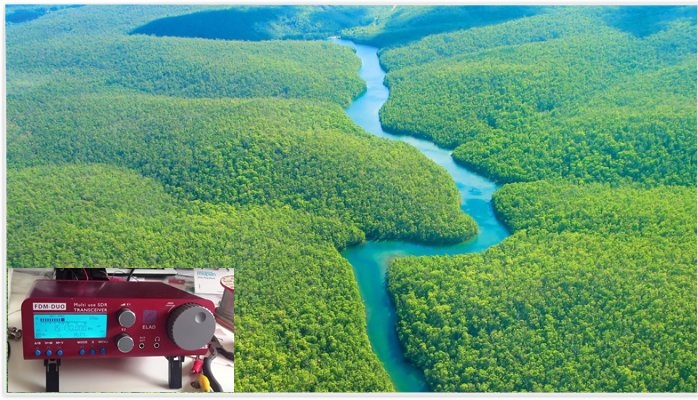
Turn your Elad FDM DUO into a portable receiver, with a 200 metre longwire

As some of the subscribers to Oxford Shortwave Log  will know, I’ve been talking about building a battery pack for my Elad FDM DUO to take it out on a DXpedition. Finally, I found the time to quickly do just that with some parts that cost less than £10 – as the video below demonstrates in more detail. The FDM DUO input voltage is stated as 13.8V and although 12V would probably have been sufficient, a couple of very cheap battery cases later, 9 x 1.5V ‘C’ cells and about 20 minutes of somewhat unpractised soldering did the trick. I have also put together a 200 metre longwire antenna, deployable from a large spool, with a termination connector to add resistor grounding for a Beverage Antenna configuration, should I wish to do so in the future.  I used two spools of 100 metre equipment cable, soldered together and protected with heat-shrink.

Direct link to Oxford Shortwave Log channel

Regular viewers of my youtube channel will know that I spend much of my shortwave listening time out in an Oxfordshire wood where QRM is negligable and Tropical Band stations can be heard with, at times, unprecidented signal-to-noise. This is the first time I’ve used a longwire greater than 100 metres in length, however, to be resonant at two wavelengths for 90 metres and 3 wavelengths for 60 metres was the objective. I hope the already fine Tropical Band listening to be had out in the Oxfordshire countryside will improve further.

Clint Gouveia is the author of this post and a regular contributor to the SWLing Post. Clint actively publishes videos of his shortwave radio excursions on his YouTube channel: Oxford Shortwave Log. Clint is based in Oxfordshire, England.
“Mystery” reel-to-reel tape of shortwave radio broadcasts

Reel-to-reel

Several weeks ago, an SWLing Post reader (sorry–I’m missing your name in my notes!) sent me the following YouTube video. The video is essentially a review of the Pioneer RT-707 reel-to-reel tape deck. The reviewer is using a “mystery” tape of shortwave radio broadcasts in the deck.

You’ll recognize a number of broadcasters in his audio clips:

Click here to view on YouTube.

I’ve actually asked this YouTube reviewer if he would digitize the tape so that I could add it to the shortwave archive. I love lost and found recordings like this.

Some scientists believe sun may be crossing into “magnetic middle age”

 (SILSO data/image, Royal Observatory of Belgium, Brussels)

(SILSO data/image, Royal Observatory of Belgium, Brussels)

I just received the following link to a Forbes article from my buddy Charlie (W4MEC).

If this research turns out to be correct–and time will only tell–it could mean very low solar activity from here on out (let’s hope not!):

(Source: Forbes Magazine via Charlie W4MEC)

The Sun has likely already entered into a new unpredicted long-term phase of its evolution as a hydrogen-burning main sequence star — one characterized by magnetic sputtering indicative of a more quiescent middle-age. Or so say the authors of a new paper submitted to The Astrophysical Journal Letters.

Using observations of other sunlike stars made by NASA ’s Kepler Space Telescope, the team found that the Sun is currently in a special phase of its magnetic evolution.

At time of posting, the Sun has no Sun spots at all. The sun is blank--no sunspots, which means very low solar activity. Credit: SDO/HMI (Click to enlarge)

At time of posting (June 28, 2016) the Sun has no Sun spots at all, which means very low solar activity. Credit: SDO/HMI (Click to enlarge)

Heretofore, the Sun was thought to have been just a more slowly rotating version of a normal yellow dwarf (G-spectral type) star. These results offer the first real confirmation that the Sun is in the process of crossing into its magnetic middle age, where its 11-year Sunspot cycles are likely to slowly disappear entirely. That is, from here on out, the Sun is likely to have fewer sunspots than during the first half of its estimated 10 billion year life as a hydrogen-burning star.

“The Sun’s 11-year sunspot cycle is likely to disappear entirely, not just get less pronounced; [since] other stars with similar rotation rates show no sunspot cycles,” Travis Metcalfe, the paper’s lead author and an astronomer at the Space Science Institute in Boulder, Colo., told me.[…]

Continue reading the full article at Forbes online.

Two hours of rock and roll music on shortwave tonight!

SX-99-Dial-Nar

Another two hour broadcast of rock n roll music–“The Classics Experience”–will happen tonight via the transmitters of Shortwave Service in Kall, Germany.

  • 6005 kHz Friday June 24th 1800-2000
  • 3985 kHz Saturday June 25th 0000-0200

Both broadcasts will have the MFSK32 text and picture as well. However, the picture will NOT decode properly and it isn’t a problem on your end. All it is is a rebroadcast of the WINB/WRMI, complete with WRMI/WINB mentions and no mentions of 3985/6005 kHz.

By the way, you can also expect my show on Laser Hot Hits in the 49 meter and 75 meter band sometime next month, airing on nearly a daily basis for a month or so.

QSL Information:

$2 is appreciated to cover costs

Paul B. Walker, Jr.
PO Box 353
Galena, Alaska 99741 USA

Paul Walker is located in Galena, Alaska and is a regular contributor to the SWLing Post. Be sure to check out Paul’s YouTube channel and SoundCloud channel where everything he logs is recorded and posted. Click here to read his other contributions on the SWLing Post.

A16 version 2.1: Alan Roe’s guide to music on shortwave radio

Alan-Roe-Guide

Many thanks to SWLing Post contributor, Alan Roe, who shares his updated  Music on Shortwave list for the A16 period. This version (2.1) incorporates several suggested additions by SWLing Post readers.

Alan, again, thank you so much for publishing this excellent little guide!

Click here to download Music on Shortwave A-16, Version 2.1 (PDF).