Category Archives: AM

In Pacific Islands, newspapers are a “luxury item”, radio remains the “staple medium”

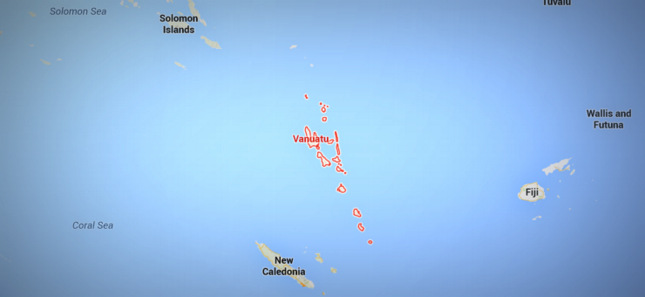
Vanuatu-MapMany thanks to SWLing Post contributor, Richard Cuff, who shares the following article from The Saturday Paper. The article speaks to how important radio
is to Pacific Islanders, and the challenges Radio Australia faces with its budget:

“For many Pacific islanders, newspapers are a luxury item. On average, each newspaper in the Pacific will be read by seven people, which helps explain why the daily paper’s print run is so low. While mobile phones are ubiquitous – top-up booths can be found in the most remote areas of the Pacific – the cost and patchy coverage of internet and TV mean radio is still the most accessible form of media.

“…?radio remains the main staple medium for the Pacific,” says Suva-born Francis Herman, who has worked in the Pacific media industry for more than 30 years as journalist, broadcaster and pre-coup CEO of the Fiji Broadcasting Corporation. “Radio stations across the Pacific are actually opening up.”

I’m speaking to Herman from a conference phone in the Pacific Media Assistance Scheme (PACMAS) office at Port Vila, where Herman works as program manager. PACMAS, a four-person team funded by the Department of Foreign Affairs and Trade (DFAT) and supported by ABC International Development, works with local and Australian media to deliver 74 programs in media training and development throughout the 22 Pacific islands.

[…]The Australian government’s lack of regard for the development of international media was made clear last year by the cancellation of a 10-year $220 million contract to deliver the international broadcasting service, Australia Network, to the Asia-Pacific region. The most worrying effect of this cut for many was the ABC’s decision to compensate for their losses by ravaging Radio Australia.

After axing three correspondents and Pacific-focused programs, Radio Australia content was replaced by translated domestic ABC programming, restricting the interaction of Radio Australia in the region and the news Australians were getting back from it.

“If the story doesn’t fit the paradigm of paradise (swaying palm trees, blue water, sandy beaches) or paradise lost (coups, corruption, climate change), voices from the islands rarely get a run,” wrote past Radio Australia correspondent Nic Maclellan for Inside Story shortly after the cuts were announced.

Shallow international content doesn’t bode well for the development of Pacific media, with a 2013 PACMAS study showing that while Ni-Vanuatu journalists self-censor to avoid retaliation from the government, they will still run investigative pieces from other news outlets.[…]”

Click here to read the full article on The Saturday Paper website…
Radio Cook Islands: Guy’s 1993 recordings

Many thanks to SWLing Post contributor, Guy Atkins, for the following guest post:


Radio Cook Islands

by Guy Atkins

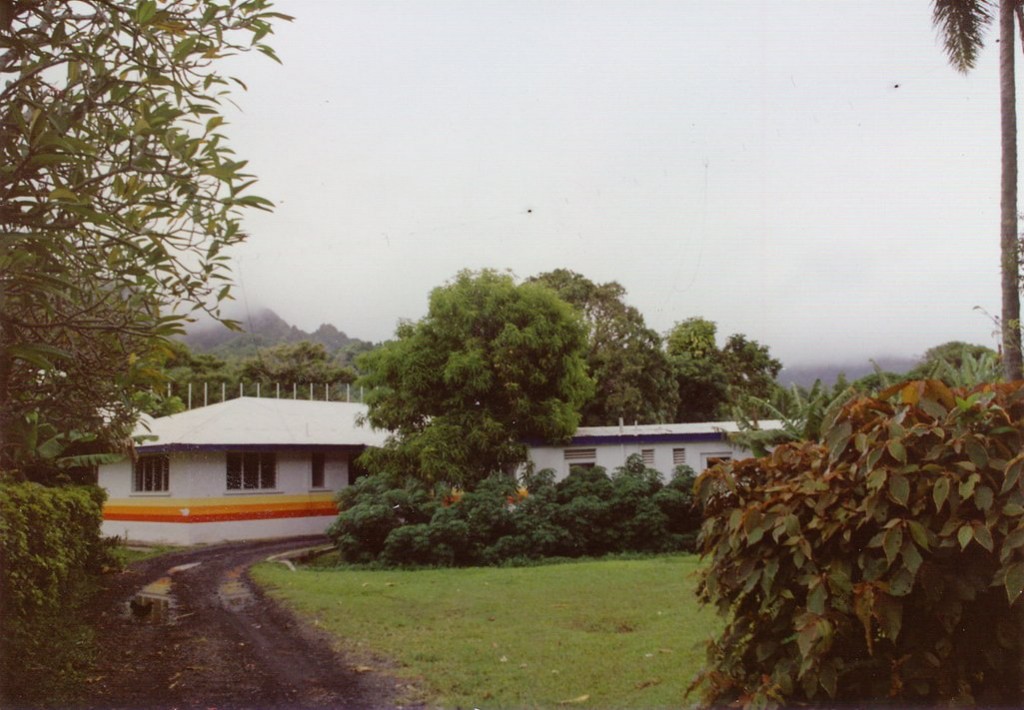
(Photo: Guy Atkins)

A view from the driveway entrance to the Radio Cook Islands studio in 1993. Insulators on an antenna (T2FD or multiband dipole) can be seen as dark spots against the cloudy sky. A feedline is also seen rising above the left side of the building. (Photo: Guy Atkins)

(Photo: Universal Radio)

(Photo: Universal Radio)

In 1993 I was fortunate to have the opportunity to visit Rarotonga with my wife, courtesy of a nice award through my company which afforded me an all-expenses-paid trip anywhere we’d like to go.

I chose the South Pacific island of Rarotonga, partly because I wanted to visit Radio Cook Islands after listening to their “island music” on 11760 and 15170 kHz through my teenage years.

During our visit to the island I recorded 90+ minutes of RCI on 630 kHz with a local quality signal using a Grundig Satellit 500 and a Marantz PMD-221 recorder.

Recordings

The programming of Radio Cook Islands is bilingual, and announcers are fluent in both English and Cook Islands Maori. Music selections on RCI encompass all styles, to appeal to many age groups. These recordings was scheduled to include as much local music as possible.

RCI programming includes all the hallmarks of a small, non-professional station: stuck records & tape carts, dead air, poor modulation, and other miscues.

However, that’s part of the flavor of local radio, and these errors are heard throughout this recording. Particularly noticeable is the bassy, over-modulation of the studio announcer during sign-on announcements.

Recording 1

Notes: National anthem & hymn; sign-on announcements & music.
Music; weather; sign-off announcements & national anthem.
Local & regional news; weather; ads; music.

Recording 2

Notes: “Party Time” music request show; weather; local ads; more music.

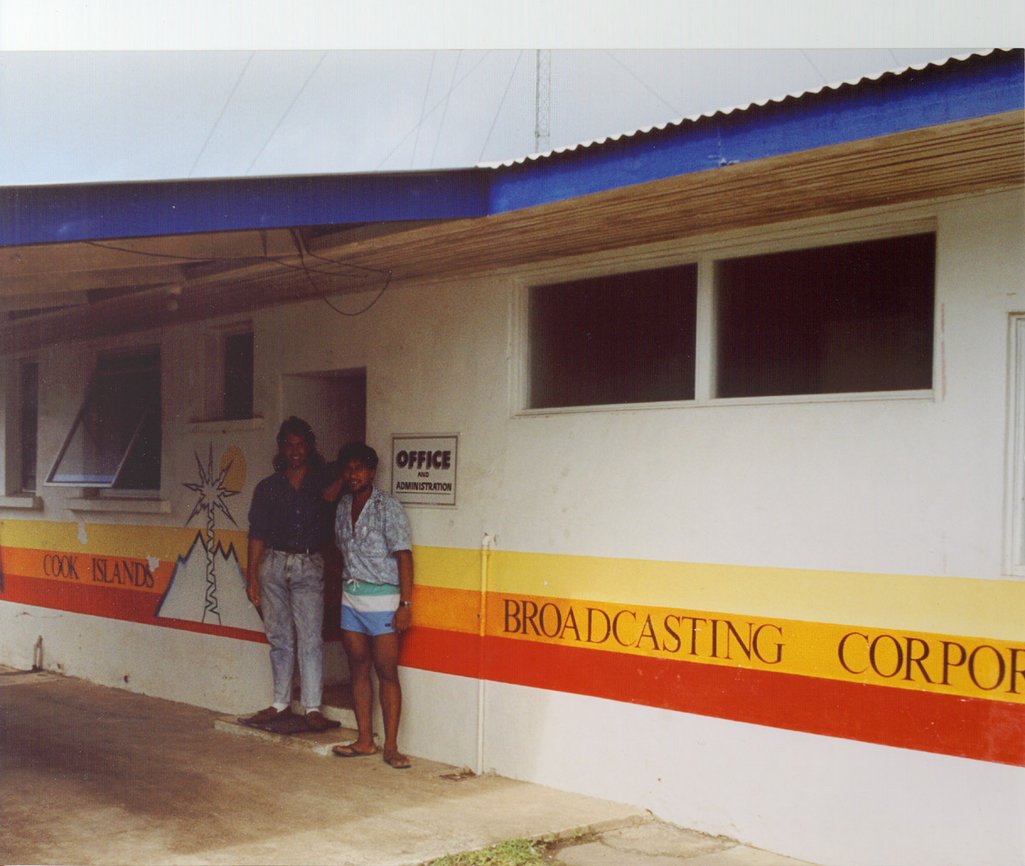
Two engineers from Radio Cook Islands, photographed during my visit in April, 1993. (Photo: Guy Atkins)

Two engineers from Radio Cook Islands, photographed during my visit in April, 1993. (Photo: Guy Atkins)

Sadly, RCI will likely never be on shortwave again; a fire in the local tele-comm building a few months before my 1993 visit destroyed RCI’s transmitter. I had an amusing exchange with the secretary when I visited; she insisted that their station was still on shortwave. Of COURSE we’re on the air she said, because “the frequencies are published right here in the newspaper!” The engineer and announcer confirmed, though, that the silence on their former frequencies was for real. They indicated they were covering the outer islands just fine with FM translators and had no intention of restarting shortwave.

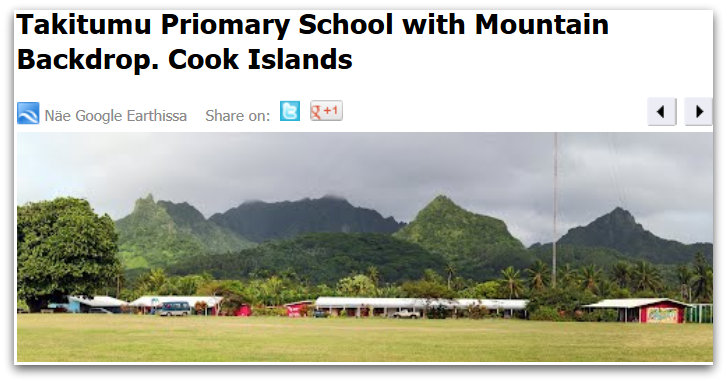
Radio Cook Islands 630 kHz antenna on the school ground of Takitumu Primary School.

Radio Cook Islands 630 kHz antenna on the school ground of Takitumu Primary School.

RCI’s headquarters is in downtown Avarua, and their 5 kw transmitter (reported at half power, 2.5 kw in Dec. 2012) and modern quarter-wavelength vertical antenna is located in the town of Matavera (northeast side of Rarotonga).

Bing.com maps view of Radio Cook Islands antenna, 630 kHz at Takitumu Primary School, Matavera.

Bing.com maps view of Radio Cook Islands antenna, 630 kHz at Takitumu Primary School, Matavera.

The antenna is in the yard of Takitumu primary school; see photos from Bing Maps and Panaromio [above].

It sure brings back a flood of good memories when I listen to these MP3s! I’d love to visit the Cooks again sometime.


Many thanks for this wonderful stroll down memory lane, Guy–radio nostalgia at its best!

I, too, would love to visit the Cook Islands someday–it is on my bucket list. In the meantime, I’ll enjoy your recordings. Again, many thanks for your guest post!

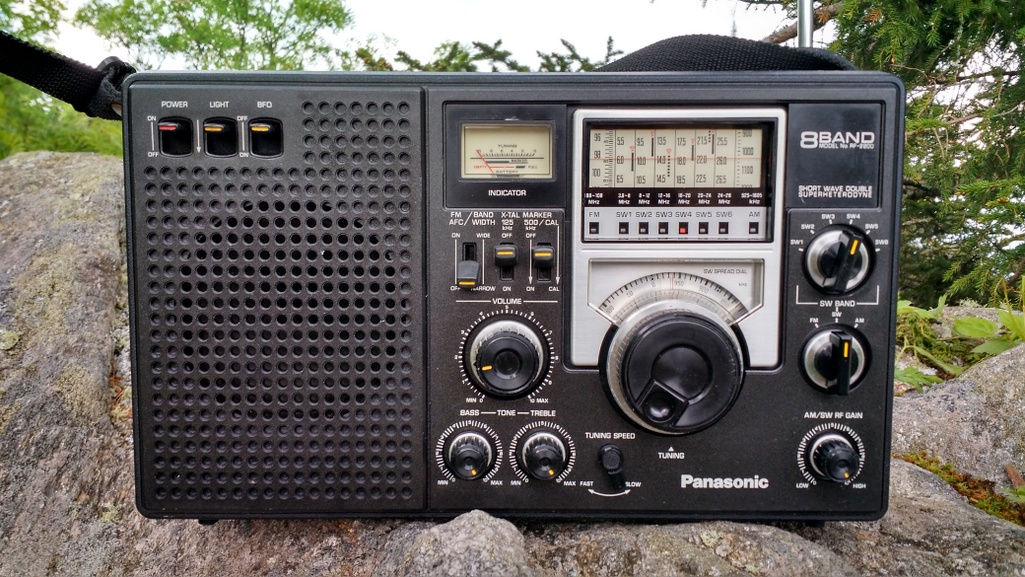
In the field with the Panasonic RF-2200

Panasonic-RF2200-MtMitchell

I’ve had the Panasonic RF-2200 for just one week, but I’ve thoroughly enjoyed getting to know this classic solid-state portable. Without a doubt I’ve been very pleased with the RF-2200, and I only have good things to say about the eBay seller, volodymyry123 from whom I bought it. Eventually I’ll take the time to calibrate the analog dial, which is about 100 kHz off-frequency.  (I’m obviously in no rush, but if readers with these rigs have suggestions for doing so, feel free to comment.)

The RF-2200 is surely one of the largest, heaviest portables in my collection…still, it begs to be taken outdoors!

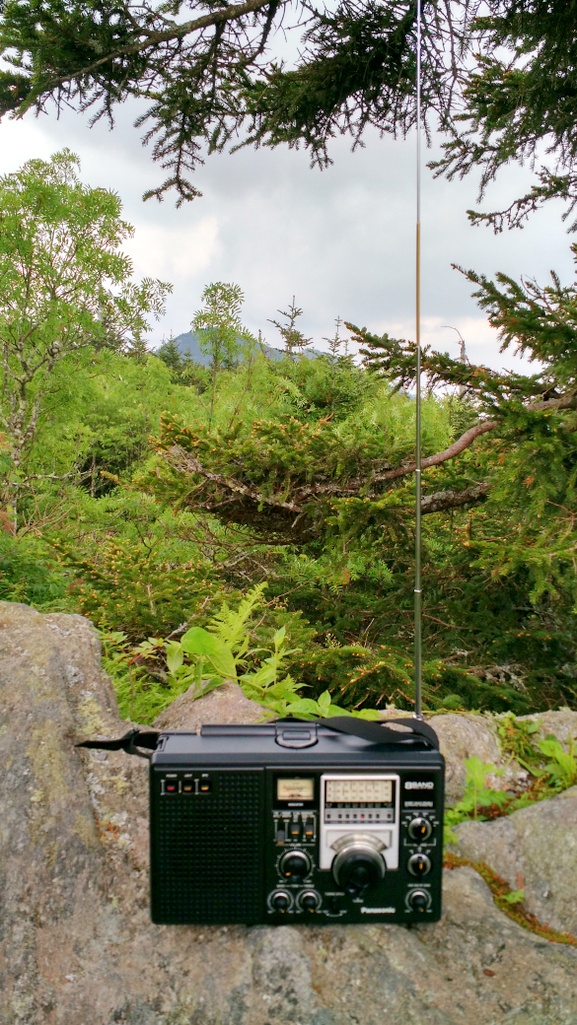
Last week, I drove with some friends to the highest point in eastern North America, Mount Mitchell State Park. As I left for our drive, picnic supplies and backpacks in tow, I took a glance at the RF-2200 in my office–and couldn’t resist taking it along.

During our mountain picnic, I turned the RF-2200 on; immediately I heard Radio Exterior de España‘s interval signal on 17,715 kHz. It was loud and clear, at times pegging S9 on the signal meter.

Panasonic-RF2200-MtMitchell-2

I also tuned to the medium wave band and was instantly amazed by all of the signals it drew in. I was able to hear one of my favorites, WAIZ, on 630 kHz–the signal was very stable and sounded local, although the transmitter was easily 60 miles away.

In general, medium wave performance on the RF-2200 has been nothing short of incredible. But this shouldn’t come as much of a surprise. Indeed, just prior to purchasing the RF-2200, I consulted my buddy, Jeff McMahon (the fellow behind The Herculodge); here’s what he says about the ‘2200:

“I borrowed my friends’ RF-2200 for a month in 2008 and I loved it. It picked up stations effortlessly and had a magisterial quality about it, especially the AM sound. It reminded me of why I fell in love with radios.”

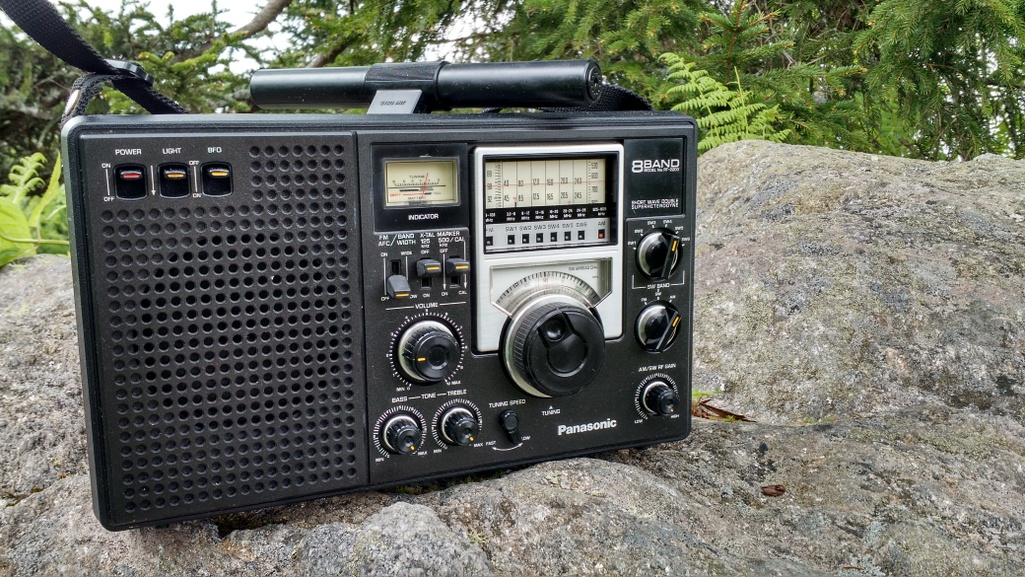
Panasonic-RF2200-MtMitchell-3But why is it that when I look at the RF-2200, I feel like I should be taking it to the field? Perhaps it’s the staunch, beefy look of the chassis, or the controls that could easily be worked even with winter gloves? Or perhaps it’s that woven carry strap?

Or perhaps the RF-2200 offers something I miss in the age of compact portables with digital displays: a radio with presence, one that lends itself to pure listening discovery. The RF-2200 demands your attention, and does so with a clear, deep voice…

Yep, the RF-2200 is a true field companion.  But don’t take my word for it:  find one, take it along, and see–or rather, hear–for yourself.

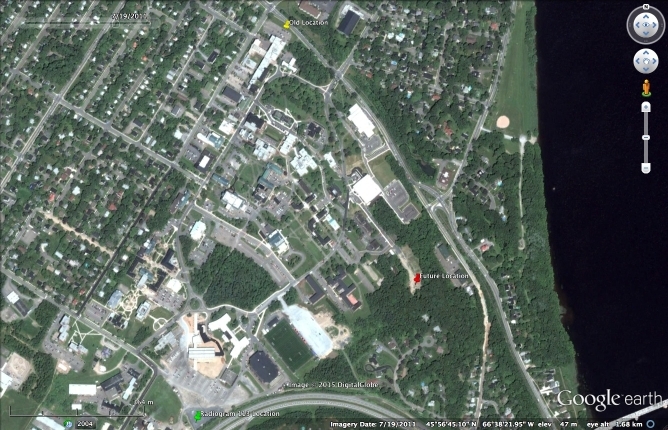
Richard’s search to find the best SWLing spot on campus

Richard-UNB

SWLing Post contributor, Richard Langley, has been seeking the perfect spot on the campus of the University of New Brunswick (UNB) to listen to shortwave. He recently shared the following:

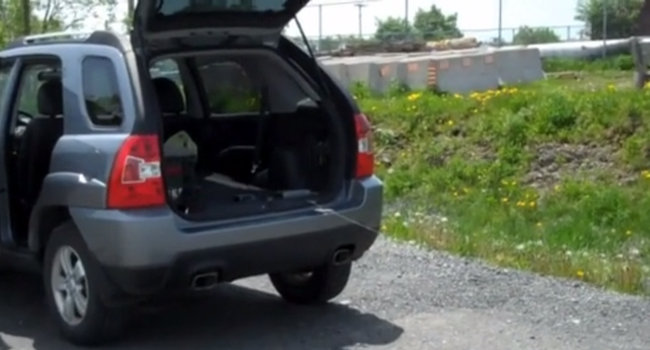
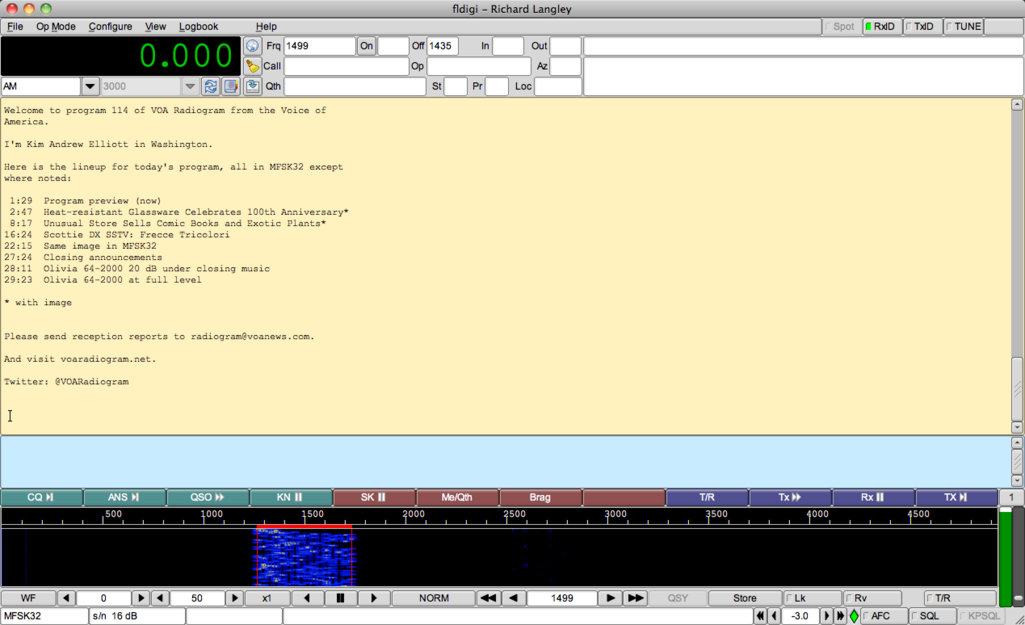
Here’s a link to a brief video of my recording of last weekend’s VOA Radiogram “in the field” (a UNB parking lot):

Richard goes on to say that he’s found an even better location:

receiver_locations_smaller (1)

“That location on campus (green pin on attached image) turned out to not be noise-free on all bands. Found an even better location (red pin). Negligible power-line interference although still within Wi-Fi range of UNB’s system but no significant effects from that discovered yet. Got excellent reception of VOA’s Radiogram this past Saturday afternoon. Extremely clean waterfall in Fldigi. And virtually noise-free images [below]”

voa_radiogram (1)

Richard’s decoded message. (Click to enlarge)

pic_2015-06-06_181519z

VOA Radiogram decoded image

Many thanks for sharing this with us, Richard!

Those of you who live or work in areas with significant radio noise should consider scouting out a listening spot like Richard has. Also, you might be inspired by LondonShortwave who takes his radios to public parks. Regardless, moving your receiver as far away from sources of radio interference as possible will always yield better listening results.

Art Bell’s “Midnight In The Desert” to be broadcast on shortwave via WTWW and WBCQ

MidnightInTHeDesert

Many thanks to SWLing Post reader, Mike, who informs us that Art Bell is returning to the airwaves with a new radio show called Midnight in the Desert. Like Coast to Coast AM, (which Bell retired from several years ago) Midnight in the Desert will also focus on paranormal activity.

Mike also points out that Bell has also announced Midnight in the Desert will be broadcast on WTWW (5,085 kHz).  WTWW will start airing the show July 20, 2015 from 9:00 pm – Midnight Pacific time.

Indeed, after looking at the list of radio stations rebroadcasting Midnight in the Desert, I noted that WBCQ, in Maine, will also carry the show on 7,490 and 9,330 kHz.

For more information and updates, check out Art Bell’s website.