Category Archives: Art

Video: 1940s-era holiday treat from Tommy Dorsey (c/o a vintage rig)

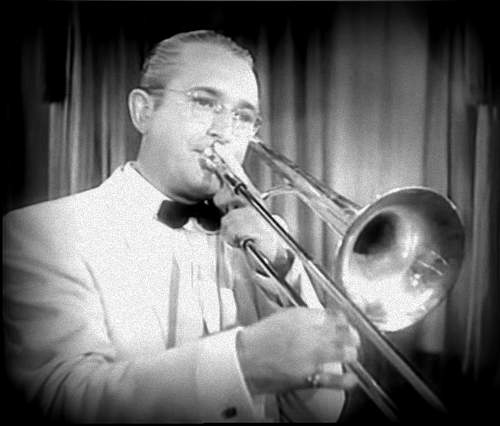
Tommy_dorsey_playing_trombone

Below you’ll find a short video of my 1945 Scott Marine Radio Model SLR-M playing Tommy Dorsey and his Orchestra’s  jazz-infused version of “March of the Toys” from Victor Herbert’s holiday classic “Babes in Toyland.”

It’s a little holiday time-travel I cooked up for you on this great vintage rig. I’m actually playing the song via an SStran Model AMT3000 AM transmitter I built from a kit (more on that in a future post). The transmitter has been set to 1410 kHz, to which the SLR-M is tuned.

Though the microphone on my Flip Video camera makes the sound in this little recording tinny (you’ll have to trust me that, live, it’s remarkably warm and rich), it does feel a bit like radio time-travel to hear a 1940s-era song played on a 1940s era-radio. This is just how WWII servicemen might have heard this music.

For your holiday enjoyment: “March of the Toys” by Tommy Dorsey and his Orchestra:

The Spectrum Monitor: only $24 for a year’s subscription

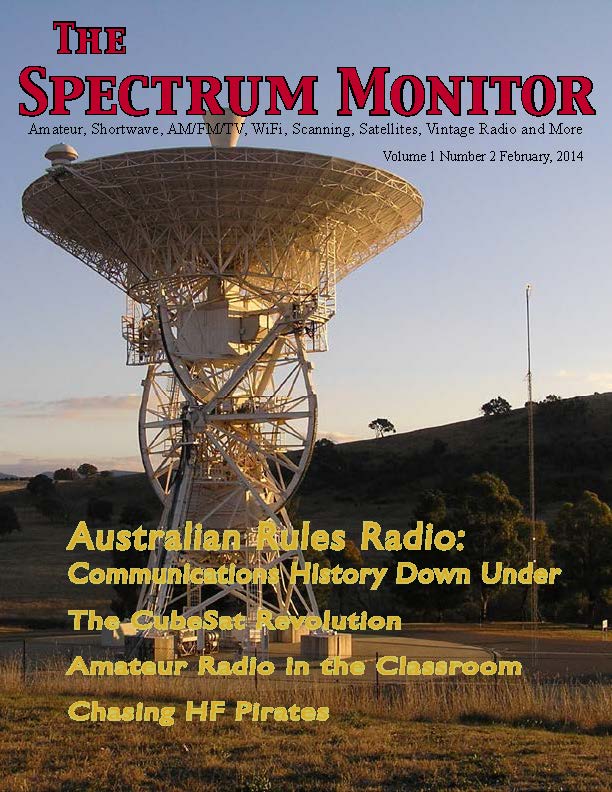
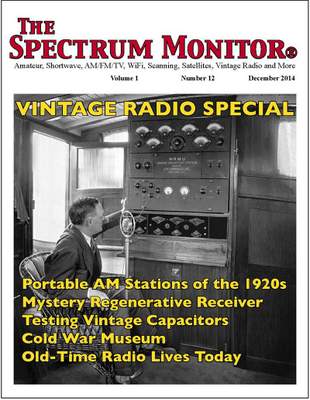
December14Cover.1On occasion, the things you enjoy most, you forget to share with your friends. Not sure why this happens, but this is certainly the case with the Spectrum Monitor magazine (TSM). I’m long overdue to properly pitch TSM to my readers, which I feel is an absolute bargain at just $24 per year.

Why? Many of you may recall that it was only July of last year when we learned about the closure of The Monitoring Times magazine.  I had always loved the magazine–not only were the management and editors a great group, but the magazine content was some of the best in the communications business when I began writing features and reviews for MT. But the owners of MT, Bob and Judy Grove, were ready to retire; ultimately, they decided to close their magazine down rather than sell it off.

Shortly after the announcement, MT‘s managing editor, Ken Reitz (KS4ZR), decided to make a go of a new publication. Albeit wholly digital, this magazine was to cover the same scope and content depth as MT, and would be known as The Spectrum Monitor (TSM).

In January of this year, TSM launched, and like many SWLing Post readers, I was eager to see if the content met the benchmark MT had set for so many years.

I needn’t have worried.  Ken had corralled many excellent contributors, in many cases drawing upon previous writers for MT.  And in the past year, I don’t believe it’s a stretch to say that in many respects, TSM not only met that benchmark, but has actually even exceeded it.  TSM is now–unquestionably–a good, solid, thoroughly enjoyable publication. 

Each issue is packed with topics covering the radio spectrum: shortwave, ham radio, vintage radio, pirate radio, scanning, public service, satellite, AM/medium wave and host of digital/mobile technologies, as well. Really, everything a listener could hope for.

November2014Cover Initially, I had my doubts.  I frankly wasn’t sure whether I’d like reading a “digital-only” radio publication, or whether other readers would. I confess to being a bit “old school;” as a radio listener, I like to hold a radio in my hands, to physically tune it; as a reader, I prefer holding a printed publication in hand, to turn the (paper) pages…How would I feel with an e-reader or laptop, instead? Would reading that way feel like work?

But TSM soon swayed me toward the digital as both reader and as a columnist. As a writer, there was less stress on word count. If it was a bit short, or lengthy– as my October column was–I soon found it mattered less. In a digital publication, page count is comparatively irrelevant as long as content is worthwhile and captivating for the reader.  And as a reader, I appreciated that the columnists that I was reading would have the freedom to write at length, too.

Secondly, a digital publication gave its writers an opportunity to infuse columns with a multi-media element–something I’d become accustomed to as a blogger here on the SWLing Post. When I published a review of a radio, I could include actual audio clips in the article. If I wrote about pirate radio, for example, I could embed actual pirate radio recordings. Brilliant! And, again, more fun for the reader.

Also, including links or references to external websites is a cinch in a digital format, and quite easy for the reader to check out. Instead of copying a long gangly URL from a printed page, you simply click on a link as you would on a website, such as on this one. Second nature, really.
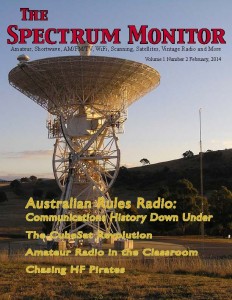
FEB2014CoverFinally, in a digital publication, I found writers could use more full-color images in their articles. I really enjoy the addition of the images; they make articles come to life…

So, I soon learned to relax with the e-reader just as I had with the printed Monitoring Times.  No pages to turn, but then again, not so different from reading…well, a blog like this.  I’ve received excellent feedback from TSM readers, too, many of whom admitted their initial bias against a “digital” magazine had since been withdrawn completely.

I continue to enjoy reading TSM every month.  And although–due to time constraints–I’m no longer TSM‘s primary shortwave radio columnist, I still enjoy writing for TSM when time permits, so you will see my reviews and features pop up in TSM now and again.

But why take my word for it?  Check it out for yourself–it’s one of the best magazines for the radio enthusiast, digital or print…And at only $24 annual cost, it’s a terrific and affordable last minute Christmas gift for a friend, family member, or–let’s be honest–for yourself.

Afraid to commit to a one year subscription? Individual issues of TSM are available online for $3 each. If you like what you’re reading (you will), you can then purchase a one year subscription, and the cost of your issue will be refunded.

If you’re lucky enough to receive a subscription to TSM in your stocking, I can assure you that you’re in for a real treat.  Happy reading!

David Goren’s Cold War mix

ShortwaveologyFeeling nostalgic for the Cold War?  David Goren recently posted the following audio mix and description on his excellent website, Shortwaveology.net:

“This mashup of vintage cold war propaganda (mostly) from Radio Moscow’s North American Service was made for The Schizophonic Archive, a part of The Bureau of Memories: Archives and Ephemera, an exhibition curated by the anthropological collective Ethnographic Terminalia in December 2014. Thanks to Kim Andrew Elliot, Jack Widner, Marie Lamb, David Bodington, Jeff Place and Smithsonian Folkways for the recordings. Special thanks to Tom Miller and Ethnographic Terminalia.”

Readers: There are many more audio goodies at Shortwaveolog.net–go check’em out!

David Goren: The shortwave radio artist

I’ve always thought of my buddy, David Goren, as a shortwave radio artist–then, yesterday, I viewed this latest creation by the infamous Jeff Murray (K1NSS):
JeffMurray-DavidGoren-Shortwaveology
As I’ve said before, I’m completely in tune with Jeff’s sense of humor. If you are, too, be sure to bookmark Dashtoons for more radio fun and whimsy. (Better yet, get Jeff to design your own QSL card!)

As for Dave, follow Shortwaveology.net for the latest in shortwave radio artistry.

(Warning: he paints with a broad filter!)

Wilco’s “Yankee Hotel Foxtrot” and shortwave radio

YankeeHotelFoxtrot

After posting our articles about Joe Strummer and Peter Gabriel, Mike Barraclough writes:

“Wilco’s Yankee Hotel Foxtrot is my favourite shortwave radio related album, I was a fan of the band anyway so when I read about the theme I was really looking forward to the album and was not disappointed.

Reprise rejected it for not being radio-friendly, somewhat ironic given the theme, after streaming it free they released it through Nonesuch to critical acclaim and is to date their best selling one.

“On YHF, Wilco use short-wave radio as a metaphor for communication in a relationship. Short-wave radio allows people to speak who are not in physical proximity, but there’s no guarantee that the coded messages will be received successfully, and atmospheric interference is a given. People involved in a relationship often find their communication imperfect and cryptic, not unlike the experience of those relying on radio. After all, language itself is inherently flawed, inaccurate, and misread—a code often misinterpreted; further complicating matters are external distortions and distractions—a metaphoric radio static. With all of this interference, can we ever succeed in communicating with someone else?”

[Quote taken from this article.]

I later went to see them live at the Hammersmith Apollo.

My favourite track, Poor Places, includes the Irdial recording of the Yankee Hotel Foxtrot numbers stations fading in at the end on top of the music. They hadn’t sought permission to use this so Irdial sued them for copyright breach and won, think it was an out of court settlement. Halfway through the gig they started playing this number, I was waiting with great anticipation for the numbers station recording to fade in during the closing of the song, one I remembered hearing regularly on shortwave from back in the 60s, but was disappointed, just noise came up over the music. Guess the out of court settlement meant a ban on using it live.

Many thanks for sharing this, Mike! I like Wilco too, though haven’t seen them live yet–but I hold out hope as they have been known to venture into my part of the world.

Joe Strummer: influenced by world travel–and shortwave radio

London-Calling

SWLing Post reader, Chris, writes:

“After reading your piece on Peter Gabriel it reminded me of Joe Strummer and the Clash and the Mescaleros… The album and song London Calling was written from a huge influence from the BBC World Service…. Need I say more about the song?

Shortly before his death in 2002, Joe recorded an album called at Global A Go-Go along with a song of that title track. The first line in the song is “World Service Bulletin” and references many cities around the world wanting great rock and roll music…

I know there are also interviews with him stating that growing up his father was a diplomat and he lived in various countries. He would tune in to the BBC World Service to get rock music from home!

The Clash ended up taking on a worldly sound in their later recordings. During Joe Strummer and the Mescaleros, it was all world music!

The latter is still one of my top three albums of all times!

Shortwave radio is the reason why I love world music.”

Same here, Chris–shortwave radio is directly responsible for my interest in any and all forms of music. Growing up, the variety I could hear on shortwave was beyond anything I could hear locally. I think many SWLs share this global connection.

Strummer via the World Service

strummershow_mediumAfter receiving Chris’ message, I did a little more research because I vaguely recalled a program on the BBC World Service that was hosted by Joe Strummer, though I never had the opportunity to hear it live.

Fortunately, I uncovered the original Joe Strummer’s London Calling via PRX. SCORE!

I’ve embedded the first episode below: an introduction to the series where you’ll hear a little about Joe in the first half hour and in the second half, the first episode of  the original Joe Strummer’s London Calling.

This is an amazing collection–actually, that’s an understatement. I’m already on the third episode and will probably listen to the whole series by the end of the week (if not end of day).

Click here for the full list of shows via PRX.

This has all prompted me to order Rock Art & The X-Ray Style by Joe Strummer & The Mescaleros. Thanks, Chris: amazing stuff…

Peter Gabriel: inspired by shortwave radio

Peter Gabriel Photo by By Skoll World Forum (Skoll Awards for Social Entrepreneurship Ceremony) [CC-BY-2.0 (http://creativecommons.org/licenses/by/2.0)], via Wikimedia Commons

Peter Gabriel Photo by By Skoll World Forum (Skoll Awards for Social Entrepreneurship Ceremony) via Wikimedia Commons

SWLing Post reader, Chris, writes:

Your recent post about John Lennon triggered my memory about an interview I heard years ago with Peter Gabriel. He too had a fascination with Shortwave Radio listening and it inspired some of his music. 

Chris then shared a link to the following promotional video for the Real World 25 music collection with Peter Gabriel’s introduction:

“I was listening to shortwave radio in a village about seven miles away from here. As night came, you’d suddenly pick up all sorts of radio stations that you couldn’t in daylight. So that was quite mysterious to me and beguiling…and I would explore all sorts of strange sounds, noises and music.”

Real World Records is Peter Gabriel’s label–and Real World 25, a three-disc collection, is the story of their first 25 Years. I listened to samples of songs and purchased my own copy. At $17 US, it was a no-brainer; I love world music (as well as Peter Gabriel’s music) and appreciate anything that Gabriel would consider for his label. (Note: the CD set is actually less expensive than the MP3 album at time of posting.)

Chris also noted this quote from Peter Gabriel, which describes his “obsession” with shortwave radio and its influence on his hit song, “Here Comes The Flood.” Via the website Planet Jeffro:

“When I wrote this song [Here Comes The Flood] I had an obsession with short-wave radio and I was always amazed at the way in which the radio signals would become stronger as daylight faded. I felt as if psychic energy levels would also increase in the night. I had had an apocalyptic dream in which the psychic barriers which normally prevent us from seeing into each others’ thoughts had been completely eroded producing a mental flood. Those that had been used to having their innermost thoughts exposed would handle this torrent and those inclined to concealment would drown in it. (‘Peter Gabriel’ by Armando Gallo, Omnibus Press, 1986.)”

Fascinating! I particularly like this live version of “Here Comes The Flood:”

Chris, I owe you a debt of gratitude: while I’ve been a fan of Peter Gabriel for well over two decades, I never knew about his connection with shortwave radio. Time to revisit some of his tunes with that in mind…