Category Archives: Art

Forbes: “How To Make Music (And Money) From Shortwave Radio”

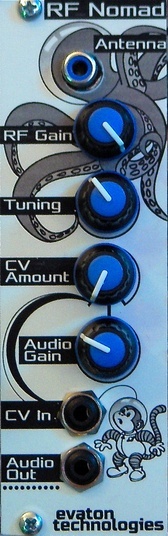
RFNomadModularGridTwo weeks ago, we posted a video of Evaton Technologies RF Nomad: a modular synthesizer that employs shortwave radio to create unique sounds. As someone who has always been fascinating with music and the sonic texture of the shortwaves, of course I find this product fascinating.

Forbes magazine does too. This morning, @UlisK3LU shared an article in Forbes where Russell Hoffman, who runs Evaton Technologies, explains why he believes using shortwave radio in new RF Nomad will be a hit:

“What’s interesting about shortwave radio is that it isn’t necessarily musical by design, but there are interesting sounds to be found when the station tuning is less than perfect,” he said. “You can hear all sorts of sounds on shortwave, from voice, to music, to Morse Code or encoded digital transmissions. In addition to the sounds that are transmitted intentionally, there are sounds that are artifacts of the medium itself like heterodynes, pops, crackles, hiss, static crashes, fading and the like.”

But here’s my favorite bit:

“Shortwave radio has a long and storied history, full of intrigue, espionage, piracy, rebellion, propaganda, and subterfuge,” he added. “It propagates around the world and can be received on inexpensive equipment. It is universal, because it can be heard anywhere; and yet at the same time, in a world of internet, TV, and satellite radio, it is also the underground — a hidden world parallel to that of our daily experiences. It offers an additional perspective.”

I couldn’t have said it better myself. Thank you, Mr. Hoffman.

Click here to read “How To Make Music (And Money) From Shortwave Radio” in Forbes magazine.

Check out Evaton Technologies and RF Nomad announcements by clicking here.
Amanda Dawn Christie shares footage of RCI towers falling

RCI-SpectresOfShortwave

Documentary filmmaker, Amanda Dawn Christie, has been gathering footage to create Spectres of Shortwave: a 90 minute documentary film focusing on the Radio Canada International Sackville transmitting site. Little did Christie know when she started shooting the film several years ago that the site would not only be be shut down but dismantled.

Christie recently shared back-up footage of the towers falling. She describes her videos on Vimeo:

“In the spirit of the founding principles of the CBC and public access to information, i am sharing the back up videos i shot this week of the RCI shortwave towers falling. I retain the copyright to these images, but i do want to share them with anyone who would like to watch them sooner rather than later (given that my film will still be a few month in post production before release). i would also like to thank the CBC for giving me permission to film, and all of the workers on site for being so cooperative and supportive.”

Click here to continue reading and to watch Christie’s footage on Vimeo.

It’s with a heavy heart that I watch these majestic towers fall. After all, I’ve been pretty vocal about how foolish I think Canada is for destroying Sackville. Still, I’m glad someone is documenting it properly. Click here to follow Spectres of Shortwave on Facebook, set to be released later this year (2014). I’ll certainly post updates about the film here.

RF Nomad: Synthesizer meets radio

RFNomadModularGridFor electronic musicians who love the sonic texture of shortwave radio, check out the RF Nomad, under development by Evaton Technologies.

Evaton describes the RF Nomad module:

“RF. Radio Frequency. The stuff that Marconi made famous. Or maybe it made Marconi famous. Either way, it’s not just for listening to hockey games anymore.

The RF Nomad voltage-controlled sideband shortwave receiver Eurorack module is currently in final stages of prototype evaluation.

The RF Nomad adds the squealy, squelchy, noisy, unpredictable vintage sounds of shortwave radio to your modular. But this is no ordinary shortwave; it’s been designed to be extra noisy, extra squealy, extra gritty, and just downright nasty. No built-in output filtering means that a rich spectrum of harmonic content is available on the audio output jack. Audio levels can be driven to distortion. CV control lets you add your own creative spin on sound design.

Hissy interstation audio. Squealy heterodynes. Fading stations. Atmospheric noises. Faint voices in foreign languages from distant broadcast stations. Fire and brimstone. It’s all in there, just like your granddad’s old tabletop shortwave.

But, the RF Nomad adds a twist: The tuning is voltage controlled. Sure, when you were a kid, you discovered you could make spacy noises on Papa’s shortwave by slowly turning the tuning dial. But just how fast could you twist that dial? Faster than an audio-rate LFO? Hardly. Voltage controlled tuning means that the RF Nomad will let you explore sounds you never imagined you could get out of a shortwave receiver.”

Check out this demonstration video:

Many thanks to Mitsuhiko Kagawa for the tip!

BBC Countdown via the Infinite Jukebox

DavidLowe

Referring to my obsession with the BBC Countdown, Jonathan writes:

“You may like to play with the Infinite Juke box at the bottom of this post. You can make the countdown theme go on for hours!”

What an amazing web application! Here’s Jonathan’s version of the BBC News 24 theme on the Infinite Jukebox.

Many thanks, Jonathan! 

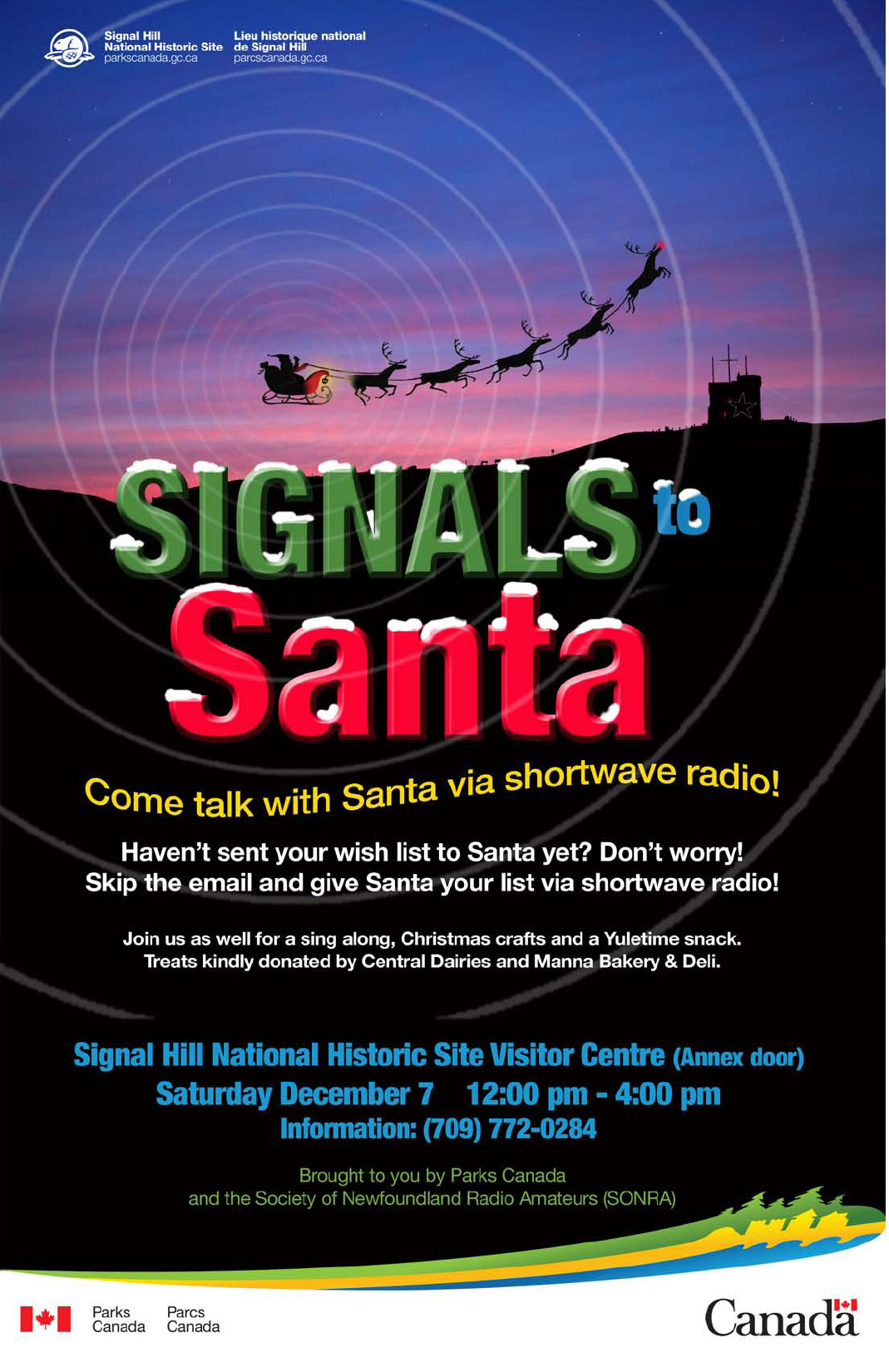
Santa over shortwave?

(Click to enlarge)

(Click to enlarge)

If you live in Newfoundland, Canada, you might want to take part in the Signals To Santa event at the Signal Hill National Historic Site Visitor Centre, which is sponsored by Parks Canada and the Newfoundland Radio Amateurs (SONRA).

Many thanks to SWLing Post reader, Tom Ally, for the tip. Tom did some research to find the HF frequency of the event, so it could be monitored. The response from the event coordinators was 146.520 MHz. Not exactly shortwave (ahem, not even by a long shot!).

Still, I love the idea behind the event and think the Parks Canada poster is brilliant!

I believe an amateur radio club organizes a “talk to Santa” type on-the-air event each year.  If anyone knows the frequency or details, please comment.

Shortwave Radio Recordings: Voice of Korea

SWRAA-Shortwave-Archive-iTunes-LogoLast week, we posted the following recording on the Shortwave Radio Audio Archive; our website and podcast of current and historic shortwave radio recordings.

Indeed, our podcast is absolutely free and by subscribing (via iTunes or RSS feed), you can also help preserve these recordings. Read about the archive by clicking here.

Though I post recordings on the SWLing Post, we post many more on the shortwave archive as many of our recordings are sent in by contributors (like you!).

Pyongyang Metro Station (Original: Wikimedia Commons)

Pyongyang Metro Station (Original: Wikimedia Commons)

Indeed, I owe thanks to SWRAA contributor, Frank, for this recording of the Voice of Korea‘s English language service.

Frank recorded this broadcast from his home in Europe on November 13, 2013, on 11,645 kHz, starting at 16:00 UTC. Frank used a Kenwood R-5000 receiver and a Wellbrook ALA 1530+ antenna.

Click here to download the recording as an MP3, or simply listen via the embedded player below:

David Korchin’s photography captures ETOW radios in the hands of kids

Click here to view David Korchin's photography

Click here to view David Korchin’s photography

A truly rewarding experience I am privileged to enjoy as the director of Ears To Our World is to work directly with kids and teachers in the countries where we extend our mission.

This year, photographer/SWLer/radio amateur–and good friend–David Korchin (KC2WNW) accompanied me on an ETOW distribution trip to inner Belize City. Besides grabbing a few moments to enjoy a little SWLing, we worked with ETOW partner organization, The Belize Council for the Visually Impaired, to place radios with some of the children attending their annual summer camp.  This was the third year we’ve worked with the BCVI, and it’s been a very rewarding journey.

Can you imagine what impact a self-powered shortwave radio might have on a child who is visually-impaired, but whose family can’t readily afford batteries? If you can fill in the answer, you’ll know why I do this.

Today, David posted his photos from the trip, documenting these truly inspirational children.  The photos are nothing short of amazing. Click here to view the photos on his website: davidkorchin.com

You might recognize the radios we’re distributing; they were generously donated by Eton Corporation and are shortwave versions of their clever little wind-up workhorse, the Rover. Eton, incidentally, is celebrating their 27th anniversary today.

And, David–many, many thanks!