Category Archives: News

Radio Preservation Task Force conference in the press

Shepperd-RPTF-LOC-2

Last week, the Radio Preservation Task Force held a conference which focused on saving America’s radio heritage. I had hoped to attend in DC, but sadly had a conflict in my schedule that weekend.

I’m happy to see that the conference got several mentions in the press.

Many thanks to SWLing Post contributor, Bill Patalon, for sharing a link to this article in RadioWorld:

Preservation Conference Highlighted Unique Radio Perspectives

The launch of the first “Save America’s Radio Heritage” conference saw a greater turnout than expected, with a total of roughly 300 attendees over two days in the nation’s capital last week.
The event, held at the Library of Congress and the University of Maryland, focused on the state of radio preservation, but the conference was more than just about the process of preserving historical recordings and other radio documents, but sharing some of America’s unique uses of the medium.
The Radio Preservation Task Force calls itself the first national radio history project of the Library of Congress. It grew out of the Library’s ambitious National Recording Preservation Plan, published in 2012. The task force says radio is “perpetually declared to be a dying medium” but nevertheless attracts dedicated listeners and commercial and public support. The organizers have said radio’s history is a chronicle of culture and a potential trove for historical researchers. The national plan in 2012 specifically called for a symposium to discuss the challenges of preserving American radio broadcasts; last week it was put into action.[…]

Continue reading on RadioWorld’s website…

The conference also caught the attention of APM’s Marketplace:

Task force aims to preserve radio history

A group of librarians, academics, and audio enthusiasts is gathering in Washington Friday for a first-of-its kind conference. The topic: “Saving America’s Radio Heritage.” The meeting is part of a massive effort to preserve recordings going back to the early 20th century.

The effort is not focused on the classic network quiz shows and radio plays of the 1930s through 50s, said Chris Sterling, who chairs the Radio Preservation Task Force at the Library of Congress.

“We’ve pretty much got that stuff,” he said. “What we’re talking about instead is trying to get the local radio voice in America: commercial, educational, college radio, all of that.”

One example is a 1956 interview with Rosa Parks from the Pacifica Radio Archives, recorded after Parks’ arrest for refusing to give up her seat to a white man on an Alabama bus.

Also at PopUp Archive:

http://blog.popuparchive.com/?p=836

And on the CBS Radio Network:

Those of us who work in radio are proud it has such a long and interesting history…

[…]But there’s a problem: Radio, by its very nature, is ephemeral. That makes its history a little hard to document.

A conference going on in Washington, DC is helping to make the airwaves a bit more solid.[…]

Continue reading and listen to the full audio report on the CBS Radio Network.

I hope the RPTF hosts another conference next year as I would like input on archiving AM/MW spectrum recordings–something I suspect few in the field even know exists!

Any SWLing Post readers attend the conference?

Radio Caroline: A video diary of the weekend aboard the MV Ross Revenge

Ross-Revenge-CarolineMany thanks to Mike Terry who shared the following note and video via Facebook:

The great old days when the signal was mellow and radio waves were not blocked by buildings and hills and propagated beyond the horizon especially at night, it all added to the excitement. We would never have heard many of the great records of the 60s and later without this station! So many international stars made their name on the offshore stations around our coast 50 years or so ago. UK radio was changed for ever.

[Note: This video may only be viewable via Facebook or the SWLing Post site.]

B15 update: Alan Roe’s guide to music on shortwave

Music-On-Shortwave-Alan-RoeMany thanks to SWLing Post contributor, Alan Roe, who shares his updated  Music on Shortwave list for the B15 period.

If you love listening to music on the shortwaves, you’ll love Alan’s free guide.

Click here to download Music on Shortwave B-15 (v3.1)

BBC: Raspberry Pi-powered transmitters broadcast Syrian radio

BBC-FM-Transmitter-SyriaMany thanks to SWLing Post contributor, Richard Langley, who shares the following:

Latest item, which provides more information, on this previously mentioned news story:

http://www.bbc.com/news/technology-35690688

Here’s an excerpt:

Raspberry Pi computers are being used to power “micro” radio transmitters in Syria.
The Pocket FMs, as they are called, were designed by a German organisation as a way of providing Syrians with independent radio.

The devices have a range of between 4 to 6km (2.5 to 3.75 miles), which is enough to cover an entire town.

At the heart of each is a Raspberry Pi, the credit card-sized single-board computers.
About two dozen have been built, and the designer says they are intended to be as easy to set up as a piece of flat-pack furniture.

“We lost one device in Kobane”, Philipp Hochleichter told BBC Radio 4’s PM programme.

“But due to the bombing – not due to a malfunction.”[…]

Continue reading on the BBC website…

The Raspberry Pi is an amazing little computer; capable of so much at such a low cost. I just purchased a Raspberry Pi 3 yesterday; hoping I can think of a clever way to use it for a little radio fun..

The Heathkit GR-78: Ed’s “basket case” radio

BasketcaseMany thanks to SWLing Post reader, Edward Ganshirt, who writes:

I picked up this Heathkit GR-78 at a estate/moving sale. It was in a pile of “e-waste” (you know, old vcr’s broken TVs, remote controllers, dead cell phones, etc.).

I found a container and sorted through the stuff to retrieve all what looks like Heathkit parts. The radio was disassembled and scattered about. I was able to collect all the critical components and brought the works to the sales table. The person manning the table said that was stuff they were discarding and I could have it for free but the Easter basket was $0.50.

So far I had put little time into it but was able to mechanically assemble it completely. All the fasteners holding the cabinet were missing. The rest appears to be all there but the primary side of the transformer is open and the NiCads are shorted and stone dead. The manual that I found in their recycle bin is complete and appears to gone through 3 owners by 3 sets of handwriting in the notes and comments through out the manual. If anything this looks like a CSI/forensics troubleshooting process getting into the mind of 3 different owners unsuccessful at making it work.

I will keep you posted on the progress.

WA1-LAI

More power to you, Ed! There are few things as difficult as picking up where someone else left off on a kit build. Your project is exponentially more complicated since there were three people involved and parts are scattered.  Please update us with your progress.

Readers: If you have any experience with the GR-78, I’m sure Ed would welcome your input!

Portable power for active antennas

CPI1000 mit Powerbank

CPI1000 mit Powerbank

Many thanks to Dennis at Bonito for sharing a link to an article he recently published on the Bonito blog:

Autonomous power supply of our active antennas via USB and power bank

It is getting to be more and more difficult to procure reasonably priced analogue external plug-in power supplies because just like old light bulbs they are no longer allowed to be produced due to power consumption restrictions. We are spending a lot of time to find and buy remaining stock so that we can offer our customers noise-free external power supplies. But for years, there has been an alternative.

Our MegaLoop ML200, ML052, the MegActiv MA305 as well as the GigActiv GA3005 can be operated internally with as little as 5V and so can be powered by the supplied CPI1000DP / CPI3000DP bias tee via a USB cable.  In light of the annoying switching power supplies, PowerLAN and heightened mobility of listeners, this is a very practical alternative and offers much more flexibility for the customer.  Unfortunately, this fact is not well known and that is why I would like to shed some light on this subject.[…]

Continue reading at the Bonito website.

Thanks, Dennis!

RaspberryPirate-EtonBlockI should note that there are a multitude of 5 VDC powerblocks on the market. I have two made by Eton Corp (see above) that even have hand-crank power generation. I recently used one to power my Raspberry Pi (Raspberry Pirate!) for several hours.

As Dennis states, using a DC source certainly cuts down on interference from noisy power supplies.

Upcoming shows on the Isle of Music

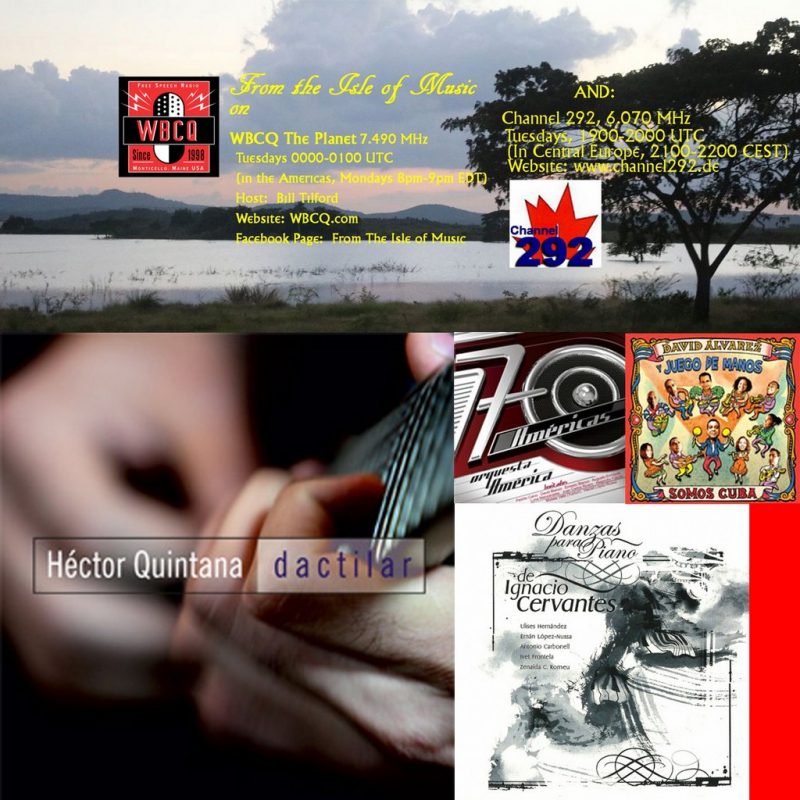
Many thanks to Bill Tilford,who updates us on some of his upcoming Isle of Music broadcasts:FTIOMPROMOFEB29

Greetings. Update for From the Isle of Music on WBCQ, 7490 KHz, 0100-0200 Tuesdays (Monday nights 8-9pm [EST] in the Americas)

The next few weeks of From the Isle of Music will feature, in addition to an eclectic selection of music from Cuba:

Feb 29: Special Guest is Juan Carlos Marín, on of Cuba’s best Jazz saxophonists

March 7: Special Guest is Ethiel Failde, director of Orquesta Miguel Failde, which preserves the Danzon, one of Cuba’s most important popular musical genres (it helped give birth to the Mambo and influenced North American Jazz)

March 14: Special Guest is Leo Garcia, leader of the group Timbalive, which plays Timba, one of Cuba’s best genres of modern dance music. Timbalive is based in Miami but regularly works with musicians on the island in its recordings.
A graphic for our Feb 29 show is attached…..

Thanks for all you do for radio……

And many thanks to you, Bill, for broadcasting the excellent tunes!