Category Archives: News

In the UK, digital radio is not always well-received

DABMany thanks to my buddy, Dan, who shares this article from the Daily Mail:

“It was supposed to be the technology that would transform the way we listen to the radio.

But audiences condemned DAB – or Digital Audio Broadcasting – as a disaster yesterday because of the poor quality of the signal.

They complained that it cuts out in the middle of broadcasts, while others claim the technology is already out of date.

One even joked on Twitter that while we can now receive close-up photos of Pluto taken billions of miles away, he ‘still can’t get a good signal on DAB’.

DAB had been heralded as less prone to interference than AM or FM, but household appliances including microwave ovens, laptops, mobile phones and TVs have all been found to affect reception. Power lines and the weather can knock out digital signals, while signal strength can be reduced in built-up areas, in basements and inside buildings with thick stone or reinforced concrete walls.”

Read more: http://www.dailymail.co.uk/news/article-3168864/Coming-loud-clear-gripes-digital-radio-Audiences-condemn-DAB-poor-quality-signal-cuts-middle-programmes.html

In Pacific Islands, newspapers are a “luxury item”, radio remains the “staple medium”

Vanuatu-MapMany thanks to SWLing Post contributor, Richard Cuff, who shares the following article from The Saturday Paper. The article speaks to how important radio
is to Pacific Islanders, and the challenges Radio Australia faces with its budget:

“For many Pacific islanders, newspapers are a luxury item. On average, each newspaper in the Pacific will be read by seven people, which helps explain why the daily paper’s print run is so low. While mobile phones are ubiquitous – top-up booths can be found in the most remote areas of the Pacific – the cost and patchy coverage of internet and TV mean radio is still the most accessible form of media.

“…?radio remains the main staple medium for the Pacific,” says Suva-born Francis Herman, who has worked in the Pacific media industry for more than 30 years as journalist, broadcaster and pre-coup CEO of the Fiji Broadcasting Corporation. “Radio stations across the Pacific are actually opening up.”

I’m speaking to Herman from a conference phone in the Pacific Media Assistance Scheme (PACMAS) office at Port Vila, where Herman works as program manager. PACMAS, a four-person team funded by the Department of Foreign Affairs and Trade (DFAT) and supported by ABC International Development, works with local and Australian media to deliver 74 programs in media training and development throughout the 22 Pacific islands.

[…]The Australian government’s lack of regard for the development of international media was made clear last year by the cancellation of a 10-year $220 million contract to deliver the international broadcasting service, Australia Network, to the Asia-Pacific region. The most worrying effect of this cut for many was the ABC’s decision to compensate for their losses by ravaging Radio Australia.

After axing three correspondents and Pacific-focused programs, Radio Australia content was replaced by translated domestic ABC programming, restricting the interaction of Radio Australia in the region and the news Australians were getting back from it.

“If the story doesn’t fit the paradigm of paradise (swaying palm trees, blue water, sandy beaches) or paradise lost (coups, corruption, climate change), voices from the islands rarely get a run,” wrote past Radio Australia correspondent Nic Maclellan for Inside Story shortly after the cuts were announced.

Shallow international content doesn’t bode well for the development of Pacific media, with a 2013 PACMAS study showing that while Ni-Vanuatu journalists self-censor to avoid retaliation from the government, they will still run investigative pieces from other news outlets.[…]”

Click here to read the full article on The Saturday Paper website…

Dan’s advice for prospective Sony CRF-320/CRF-330 owners

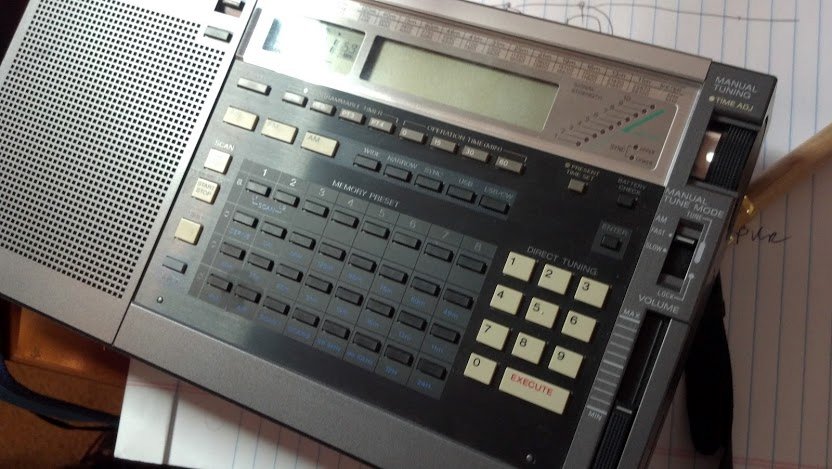
SonyCRF-320In response to our Sony CRF-320 post, SWLing Post contributor, Dan Robinson, comments:

“Thanks for posting this item. I’m the moderator of the Yahoo group for SONY 320 and 330s — they are quite common these days on EBay.

The key, however, is condition and many of them are often suffering from one or more problems common to this receiver including: stuck S-meters, faulty LEDs, gears in the main and AM/FM tuning sections that are dried out and cracked, belts in the recorder (in the 330s) that need replacing, and a variety of cosmetic issues.
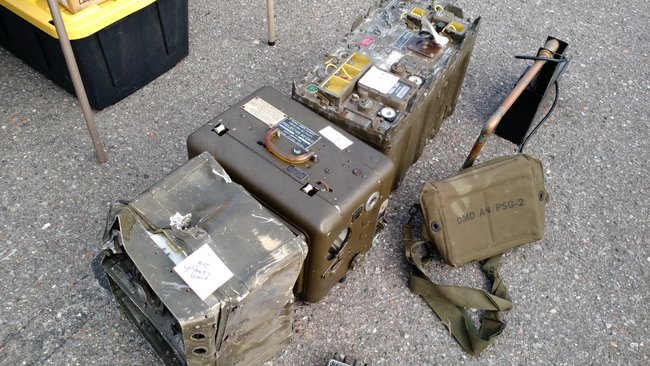
Prices for 320s range from the high hundreds near $1,000 and slightly higher, and for 330s usually well above $1,000 to near $2,000 for units that are in 9.0 or higher condition. Prospective buyers of these wonderful radios need to ask numerous questions of sellers so as to avoid problems down the line.”

[…]I will add a couple of things — the 320 on Ebay right now that Tom identified has the old style rotary clock, while the main photo is one with the LED clock, which is more desirable on the used market. The seller of this particular 320 is well known on Ebay for his extensive write-ups of equipment, quite informative and useful, and he has the advantage of access to a local electronics shop that actually still does repairs of 320s and 330s.
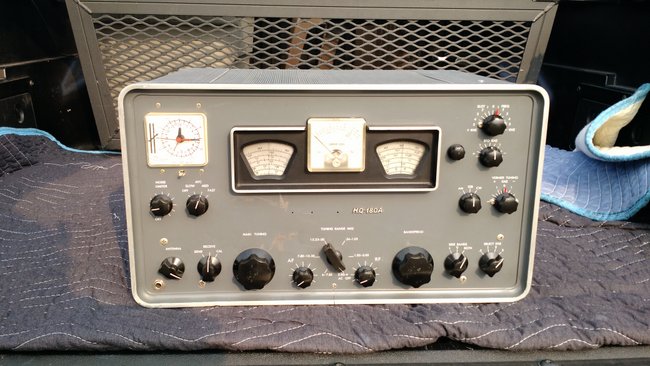
Keep in mind that, generally speaking, prices for 320s as I said and depending on condition generally are in the $1,000 range and top out in the $1200 -1400 range. CRF-330s usually bring more because of the added tape recorder in the bottom of the unit. Of course, the market and demand determine price, and anyone who is really after one of these classic radios might be willing to pay more for a 320.
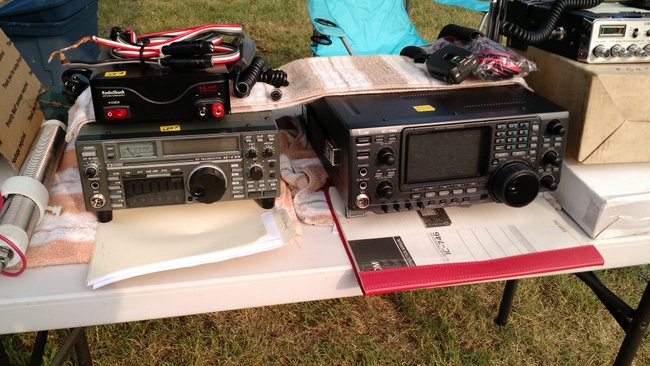
Excellent advice, Dan! Thank you for sharing.

Sony CRF-320 sighting on eBay


SonyThis morning, while scanning eBay, I ran across this serviced and restored Sony CRF-320. It’s listed with a BuyItNow price of $1,795.00 plus $63.30 shipping. Though that price seems steep to me, it appears these trend for $1,880 on eBay.

SonyCRF-320The CRF-320 is certainly a beautiful receiver and, aesthetically, everything I love about radios of the era. I’ve never had the pleasure of operating one, and–though I’m a bit of a radio collector–it’s simply out of my price range. If I ever manage to procure one, it’ll probably be a fixer-upper or a garage sale find. Well…one can dream…

I’ve heard the CRF-320 is a true performer. I’m very curious if any SWLing Post readers have one. If so, please comment with your thoughts or even a review!

Click here to search eBay for the Sony CRF-320.

Radio Cook Islands: Guy’s 1993 recordings

Many thanks to SWLing Post contributor, Guy Atkins, for the following guest post:


Radio Cook Islands

by Guy Atkins

(Photo: Guy Atkins)

A view from the driveway entrance to the Radio Cook Islands studio in 1993. Insulators on an antenna (T2FD or multiband dipole) can be seen as dark spots against the cloudy sky. A feedline is also seen rising above the left side of the building. (Photo: Guy Atkins)

(Photo: Universal Radio)

(Photo: Universal Radio)

In 1993 I was fortunate to have the opportunity to visit Rarotonga with my wife, courtesy of a nice award through my company which afforded me an all-expenses-paid trip anywhere we’d like to go.

I chose the South Pacific island of Rarotonga, partly because I wanted to visit Radio Cook Islands after listening to their “island music” on 11760 and 15170 kHz through my teenage years.

During our visit to the island I recorded 90+ minutes of RCI on 630 kHz with a local quality signal using a Grundig Satellit 500 and a Marantz PMD-221 recorder.

Recordings

The programming of Radio Cook Islands is bilingual, and announcers are fluent in both English and Cook Islands Maori. Music selections on RCI encompass all styles, to appeal to many age groups. These recordings was scheduled to include as much local music as possible.

RCI programming includes all the hallmarks of a small, non-professional station: stuck records & tape carts, dead air, poor modulation, and other miscues.

However, that’s part of the flavor of local radio, and these errors are heard throughout this recording. Particularly noticeable is the bassy, over-modulation of the studio announcer during sign-on announcements.

Recording 1

Notes: National anthem & hymn; sign-on announcements & music.
Music; weather; sign-off announcements & national anthem.
Local & regional news; weather; ads; music.

Recording 2

Notes: “Party Time” music request show; weather; local ads; more music.

Two engineers from Radio Cook Islands, photographed during my visit in April, 1993. (Photo: Guy Atkins)

Two engineers from Radio Cook Islands, photographed during my visit in April, 1993. (Photo: Guy Atkins)

Sadly, RCI will likely never be on shortwave again; a fire in the local tele-comm building a few months before my 1993 visit destroyed RCI’s transmitter. I had an amusing exchange with the secretary when I visited; she insisted that their station was still on shortwave. Of COURSE we’re on the air she said, because “the frequencies are published right here in the newspaper!” The engineer and announcer confirmed, though, that the silence on their former frequencies was for real. They indicated they were covering the outer islands just fine with FM translators and had no intention of restarting shortwave.

Radio Cook Islands 630 kHz antenna on the school ground of Takitumu Primary School.

Radio Cook Islands 630 kHz antenna on the school ground of Takitumu Primary School.

RCI’s headquarters is in downtown Avarua, and their 5 kw transmitter (reported at half power, 2.5 kw in Dec. 2012) and modern quarter-wavelength vertical antenna is located in the town of Matavera (northeast side of Rarotonga).

Bing.com maps view of Radio Cook Islands antenna, 630 kHz at Takitumu Primary School, Matavera.

Bing.com maps view of Radio Cook Islands antenna, 630 kHz at Takitumu Primary School, Matavera.

The antenna is in the yard of Takitumu primary school; see photos from Bing Maps and Panaromio [above].

It sure brings back a flood of good memories when I listen to these MP3s! I’d love to visit the Cooks again sometime.


Many thanks for this wonderful stroll down memory lane, Guy–radio nostalgia at its best!

I, too, would love to visit the Cook Islands someday–it is on my bucket list. In the meantime, I’ll enjoy your recordings. Again, many thanks for your guest post!

Virtual Radio Challenge III: Thru-hiking the Appalachian Trail

AT_-_Franconia_Ridge

The Franconia Ridge, a section of the Appalachian Trail. (Photo source: Paulbalegend at en.wikipedia)

On this blog, I often write about selecting the “right” radio for home, boating, preparednessoff-grid living, or, of course, travel.  As a result, sometimes I like to go through the mental exercise of imagining a scenario that might be, well, a touch extreme.

After all, as I’ve often said, SWLers come from such interesting walks–even hikes–of life, and often pose the most intriguing questions.

Indeed, I occasionally receive rather “extreme” questions from our readers, questions that push the limits of the hobby in the most exhilarating way, demanding highly specific needs in a radio. And (I readily admit) I thoroughly enjoy these questions.  Such queries give me a chance–and good excuse, really–to be imaginative and innovative, to push beyond mere practical or monetary constraints to consider unique environments, weather conditions, durability needs, power requirements, and/or resource availability…all great fun.

If you enjoy this kind of brain game, too, check out our virtual challenge that follows–and, oh, and did I mention…

This time, there’s a prize

GP5SSB-Front

The CountyComm GP5/SSB

Dennis Blanchard (K1YPP), Appalachian Trail thru-hiker and author of Three Hundred Zeroes, which chronicles his adventures on the trail, will select his favorite entry in this reader challenge, and Universal Radio will reward the entrant with a new CountyComm GP5/SSB portable receiver! Woot!

So, should you agree to take it on, you’ll need to complete and submit your entry by August 8, 2015 at 06:00 UTC.

Thru-hiking the Appalachian Trail

[This scenario is based on an actual reader question.]

AppalachianTrail-Map

Virtual Location: The Appalachian Trail

Accommodation? Tents, hammocks, and lean-tos on the trail; occasional hotel or hiker guest houses

Electricity? Other than rest days, you’ll be completely off-the-grid

Internet? You can choose to carry a smart phone with you on this hike. Since most of the trail is in rural, remote areas, Internet access will be sporadic on your journey.

Your budget? $300 US must cover all of your radio requirements (radio, antenna, batteries, battery chargers, and all accessories)

Your radio(s)–??? You’re searching for portable radio gear that can receive shortwave, AM (medium wave), and FM. You’ll also need NOAA weather radio functionality to help you plan each day on the trail and make accommodations for frequent spring and summer thunderstorms (and occasional spring snow or sleet).

Virtual scenario: Imagine you’re a recently-retired stockbroker fulfilling a lifelong dream of thru-hiking the Appalachian Trail. You have cleared out most of the year for uninterrupted hiking, starting in Georgia and ending in Maine. You’re covering all of your logistics, travel, and living expenses while on the trail.

Being an avid shortwave radio listener, you see this hike as an opportunity to spend quality time listening to radio–while hiking and camping–in remote areas that are completely removed from urban radio interference you experience at home.

Although you’re looking forward to “unplugging” from the world of stock trading, you’re still keen on listening to international and local news so you’ll know what’s happening in the world of finance and business.

It goes without saying that you’ll carry all of your supplies–your food, camping supplies, clothing, etc.–and all on your back. Minimizing your backpack weight is clearly of utmost importance.

Limitations

Rather than making this virtual challenge more restrictive, these limitations are designed to make the challenge more fun and set a level playing field for all respondents.

  1. Again, you’re limited to a (virtual) budget of $300 US to procure your supplies; ideally, this includes shipping costs of the purchase
  2. You can select new, used or homebrew/kit gear, but must base your choices on reality (i.e., actually find item(s) online and document the price and time of availability). If you “shop” eBay, make sure you’re using the final purchase price, not the current or opening bid. If you do locate something used on eBayQTH.com, QRZ.com or at Universal Radio, for example, include the link! (Just to add to the fun.) If you enter a homebrew radio, it should be based on something you’ve either built or used and must include a photo. Of course, you can use multiple radios, but keep in mind the amount of space and weight these will take up in your backpack.
  3. Your main objective is to listen to international and local broadcasters and NOAA weather radio. If you’re a ham radio operator, by all means, you’re invited to include a transceiver in your trail kit (indeed, many do have AM/FM/SW reception), but keep in mind that our accomplished A.T. thru-hiker judge will base his decision on the best set up for listening to NOAA weather radio and international, local and broadcasters.
  4. Remember, you’ll be stuck with this radio once you hit the trail! So choose something you’ll love to operate, and don’t forget your vital accessories. Note that there are many points of the Appalachian Trail that are in proximity to towns and cities; you can get additional supplies there as needed.

About the Appalachian Trail…

Appalachian_Trail_at_Newfound_Gap

If you’re not familiar with the Appalachian Trail, you’ll find a wealth of information about it at the Appalachian Trail Conservancy’s (ATC) website. The following is an ATC description of the trail:

The Appalachian Trail is one of the longest continuously marked footpaths in the world, measuring roughly 2,180 miles in length. The Trail goes through fourteen states along the crests and valleys of the Appalachian mountain range from the southern terminus at Springer Mountain, Georgia, to the Trail’s northern terminus at Katahdin, Maine.

Known as the “A.T.,” it has been estimated that 2-3 million people visit the Trail every year and about 1,800–2,000 people attempt to “thru-hike” the Trail. People from across the globe are drawn to the A.T. for a variety of reasons: to reconnect with nature, to escape the stress of city life, to meet new people or deepen old friendships, or to experience a simpler life.[…]

FUN FACTS

    • The Trail is roughly 2,180 miles long, passing through 14 states.
    • Thousands of volunteers contribute roughly 220,000 hours to the A.T. every year.
    • More than 250 three-sided shelters exist along the Trail.
    • Virginia is home to the most miles of the Trail (about 550), while West Virginia is home to the least (about 4).
    • Maryland and West Virginia are the easiest states to hike; New Hampshire and Maine are the hardest.
    • The total elevation gain of hiking the entire A.T. is equivalent to climbing Mt. Everest 16 times.
    • The A.T. is home to an impressive diversity of plants and animals. Some animals you may see include black bears, moose, porcupines, snakes, woodpeckers, and salamanders.
    • Some plants you may encounter include jack-in-the-pulpit, skunk cabbage, and flame azalea.

HIKERS

  • About 2 to 3 million visitors walk a portion of the A.T. each year.
  • The A.T. has hundreds of access points and is within a few hours drive of millions of Americans, making it a popular destination for day-hikers.
  • “Thru-hikers” walk the entire Trail in a continuous journey. “Section-hikers” piece the entire Trail together over years.
  • “Flip-floppers” thru-hike the entire Trail in discontinuous sections to avoid crowds, extremes in weather, or start on easier terrain.
  • 1 in 4 who attempt a thru-hike successfully completes the journey
  • Most thru-hikers walk north, starting in Georgia in spring and finishing in Maine in fall, taking an average of 6 months.
  • Foods high in calories and low in water weight, such as Snickers bars and Ramen Noodles, are popular with backpackers, who can burn up to 6,000 calories a day.

You’ll want to do your research before choosing gear for the Appalachian Trail Virtual Challenge! The more thought you’ve put behind your choices, the more likely your entry will be selected by our judge. Speaking of which…

Our judge

“This photo was taken in NJ. Shortly after I took these photos, and walked down the trail about a 100 feet, a bear came over to check the table to see if I had left anything.” (Photo: K1YPP)

Dennis operating his trail-friendly QRP transceiver on the Appalachian Trail. (Photo: K1YPP)

Dennis Blanchard (K1YPP) is uniquely qualified for this challenge since he thru-hiked (which is to say, hiked in entirety) the Appalachian Trail in 2007, and carried at least one radio with him on much of the trip. He understands the advantages and limitations of operating from the trail. If you have no concept what it would be like to plan for and hike the trail, you might consider checking out his interesting and informative book, Three Hundred Zeroes, which chronicles his adventures on the trail. Dennis has kindly agreed to pick his favorite entry from reader responses.  Click here to read an interview I posted with Dennis on my ham radio blog, QRPer.com.

The selection process

Once our A. T. reader challenge closes on August 8, 2015, I’ll share all the entries with our kind judge. Depending upon the number of responses, of course, Dennis should have a favorite picked within one to two weeks of the challenge’s close.  We’ll announce the winner here on the SWLing Post, and shortly after, Universal Radio will reward the selected entrant with the new CountyComm GP5/SSB!

And note…we’ll also share a number of stand-out entries here with our readers!

If you wish to enter this reader challenge, please use the form below to submit your entry (or click here for the form). Entries must be received by August 8, 2015.

Good luck and have fun!

Feel free to comment on this post if you have any questions.

SSTV from the International Space Station this weekend

ISSThis is a VHF news item, not shortwave, but many SWLing Post readers have wideband SDRs, HT’s and scanners that cover this portion of the VHF band. Unique opportunity:

(Source: AMSAT bb)

40 years ago this week, the historic joint Apollo-Soyuz mission was conducted. Apollo-Soyuz (or Soyuz-Apollo in Russia) represented the first joint USA-Soviet mission and set the stage for follow-on Russia-USA space collaboration on the Space Shuttle, Mir Space Station and the International Space Station. The Soyuz and Apollo vehicles were docked from July 17-19, 1975, during which time joint experiments and activities were accomplished with the 3 USA astronauts and 2 Soviet Cosmonauts on-board. Apollo-Soyuz was the final mission of the Apollo program and the last USA human spaceflight mission until the first space shuttle mission in 1981.

To commemorate the 40th anniversary of this historic international event, the ARISS team has developed a series of 12 Slow Scan Television (SSTV) images that will be sent down for reception by schools, educational organizations and ham radio operators, worldwide. The SSTV images are planned to start sometime Saturday morning, July 18 and run through Sunday July 19. These dates are tentative and are subject to change. The SSTV images can be received on 145.80 MHz and displayed using several different SSTV computer programs that are available on the internet.

We encourage you to submit your best received SSTV images to:
http://spaceflightsoftware.com/ARISS_SSTV/submit.php

The ARISS SSTV image gallery will post the best SSTV images received from this event at:
http://spaceflightsoftware.com/ARISS_SSTV/index.php

Also, as a special treat, on Saturday July 18 the ISS Cosmonauts will take time out to conduct an ARISS contact with students attending the Moon Day/Frontiers of Flight Museum event in Dallas Texas. This Russian Cosmonaut-USA Student contact is planned to start around 16:55 UTC through the W6SRJ ground station located in Santa Rosa, California. ARISS will use the 145.80 MHz voice frequency downlink (same as the SSTV downlink) for the Moon Day contact.

For more information on ARISS, please go to our web site: www.ariss.org

The ARISS international team would like to thank our ARISS-Russia colleague, Sergey Samburov, RV3DR, for his leadership on this historic commemoration.

Frank H. Bauer, KA3HDO

ARISS International Chair