Category Archives: Radio History

Book Review: “The Early Shortwave Stations: A Broadcasting History Through 1945”

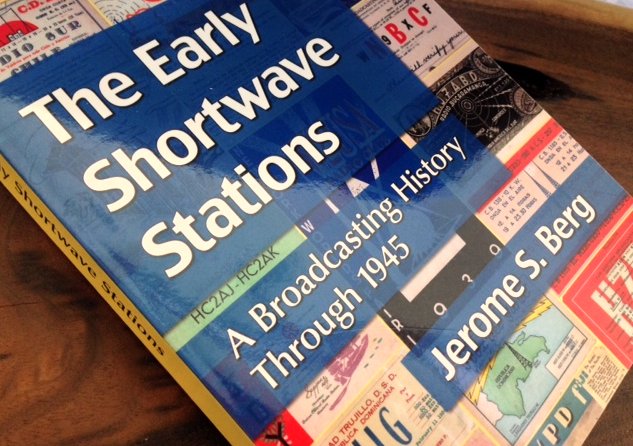
The-Early-Shortwave-StationsAs a life-long student of the history of technology–radio or otherwise–I appreciate well-written, authoritative works of history on the subject. That is exactly what you’ll find in Jerome S. Berg’s The Early Shortwave Stations: A Broadcasting History Through 1945.  In these days during which shortwave is often viewed only as a legacy technology, it’s particularly fascinating to read about the days during which shortwave was new on the scene, exerting a disruptive influence, and threatening the established technology.

If you’re a shortwave radio enthusiast, you may already know of Jerome (Jerry) Berg; he is, without a doubt, one of the foremost historians of shortwave radio broadcasting and listening. His knowledge, moreover, grew out of his passion for the radio medium, and it shows in his writing. Berg has authored a series of history books on the subject on the subject of shortwave broadcast and listening, which this latest work joins:

I’m not sure how Berg manages to convey his vast store of knowledge in such a readable form, but he does so, and very successfully. As with the other works in this series, The Early Shortwave Stations is chock full of details all entirely relevant, and Berg manages to weave this complex and multifaceted history into a very comprehensive, comprehensible, and rich story that the reader will enjoy.

Moreover, I like the manner in which Berg presents the chapters in The Early Shortwave Stations: the first chapter sets the stage, covering radio broadcasting up to the point of the invention of shortwave; the chapters then coincide with a decade-by-decade account of shortwave broadcasting, e.g., chapter 2 covers the 1920s, chapter 3 the 1930s, and chapter 4 covers 1940-1945 (where Berg’s Broadcasting on the Short Waves, 1945 to Today picks up). Furthermore, each decade and chapter is covered year by year. This obviously makes for easy future reference: should you like to know was happening in shortwave broadcasting in 1931, simply turn to chapter 3 (page 82) to find out.

Berg also draws insightful conclusions in his summary and in chapter 5, which only made me want to buy his next volume, Broadcasting on the Short Waves, 1945 to Today.

I can say that I learned an extraordinary amount of radio history from The Early Shortwave Stations, and have enjoyed every minute of it. I’ve had this book for a little while now, and it soon became my bedside reading.  Indeed, it’s been wonderful capping off each day (or even starting it) with early shortwave history. I find that it puts many of the changes that are happening in the industry currently into perspective.

And I would be negligent if I didn’t mention the numerous illustrations and stunning images in The Early Shortwave Stations: there are enough QSL cards, radio ads, and other print nostalgia within its pages to make for good coffee table reading, too. Although its pages are printed in black and white, the photos and illustrations are sharp and of high quality.

The publisher of Berg’s books, McFarland–a leader in publishing academic and non-fiction works–prints in relatively small quantities, hence the price tag per volume is about $45.00. But I assure you that it’s a bargain for a book which so completely encapsulates early shortwave broadcasting history.  It’s a book that you will likely want to reference, and (if you’re like me) not only read, but read again and again.

The real test? I’ve placed The Early Shortwave Stations on the same shelf with my WRTH.

The Early Shortwave Stations: A Broadcasting History Through 1945 can be purchased directly from the publisher, McFarland, by clicking here or by calling their order line (800-253-2187).  I’m pleased to say that The Early Shortwave Stations is also available via the Amazon Kindle format at $16.12 US, possibly the best purchasing option for those living outside North America.  Enjoy!

Jerry Berg also maintains the excellent website, On The Shortwaves.  This one’s been in our list of links for many years, do check it out if you haven’t already.

Shortwave Radio Recordings: BBC to the 2014 British Antarctic Survey

800px-Antarctica.svgAs promised, here are the recordings of the BBC World Service’s thirty minute broadcast to the British Antarctic Survey. The broadcast started at 21:30 UTC on June 21, 2014 and was broadcast on 5,875, 5,985, 7,350 and 9,890 kHz.

British_Antarctic_Survey_Logo

As in previous years, this broadcast was lighthearted, filled with humorous shout-outs from the team’s family and friends. Even a couple of special guests were included. Listen for yourself:

This excellent recording was made by SWLing Post reader, Dominik, in Europe:

Click here to download Dominik’s recording as an MP3.

Post reader Rob Wagner (VK3BVW), in Australia, could receive the broadcast on three frequencies (5,875, 5,985, and 7,350). He’s included clips of each broadcast on his excellent blog, The Mount Evelyn DX Report.

As for me, I was traveling to visit family yesterday afternoon when the broadcast started.  I knew from listening endeavors on previous visits that receiving a broadcast indoors at their home is not feasible; there is some sort of power line noise in that area that overwhelms anything on the short or medium wave bands, unless the station is very strong.

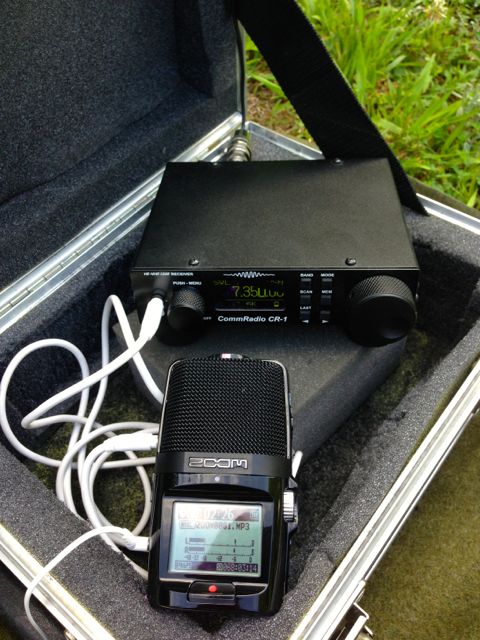
To cope with this noise, I knew I would need to move my operation outdoors, away from the house, and employ an outdoor antenna. So I packed the following, all into my small flight case: the CommRadio CR-1, a NASA PA-30 15 foot passive wide-band wire antenna, and the Zoom H2n Handy Recorder
.

CommRadio-CR-1-Zoom-H2N-BBC-Antarctica

I hung the PA-30 antenna in a nearby tree, spread a wool army blanket on the ground for lounging, and put the mini flight case to use as a stand to hold the radio and recorder. The CR-1 required no external power supply, as its internal battery had been charged in advance (one of the reasons I love this little receiver for travel).

To try out the set-up, I tuned around the bands. Conditions were rough, thunderstorms were in the region, but I was most impressed that I could hear several broadcasters on 31 meters. I knew that the BBC broadcast would be a tough catch; after all, none of their transmissions were targeting my part of the globe–rather, the opposite!

When I tuned to the BBC broadcast on 7,350 kHz, here’s what I heard:

This is (very) rough copy; for five or so minutes, you’ll hear me switching between AM/USB and LSB to find the best mode for the signal. I also check the other BBC frequencies to see if any were more audible.

In the end, using ECSS (zero-beating the signal in USB) seemed to work best.

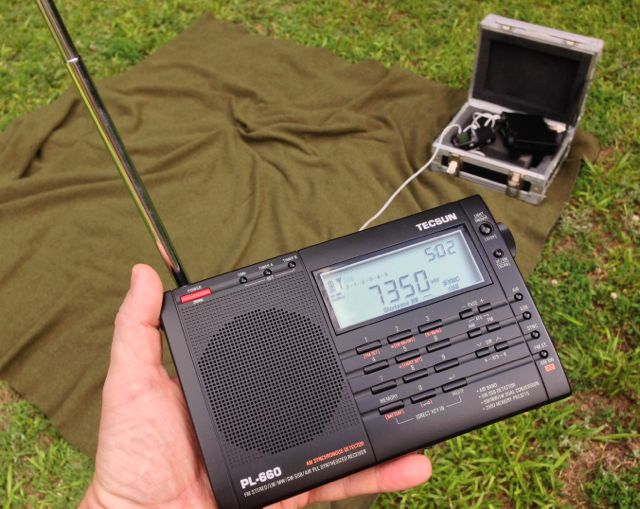
For fun, I had also brought along the Tecsun PL-660–a choice portable radio for weak signal DX. I tuned to 7,350 and could just hear the BBC signal in the noise, but voice and music were unintelligible.

Tecsun-PL-660-BBC-Antarctic

What did I get out of the experience?  Good copy?  Alas, no.

But there’s nothing like the fun of playing radio outdoors! Even though the copy was rough, propagation deplorable, and static crashes abundant, I thoroughly enjoyed the experience.  Moreover, I was amused to note that while I listened (and sweated) outside in the very hot, muggy conditions of the American southeast, a few scientists huddled near the extremely chilly southern pole at that exact moment, were tuning in the exact same broadcast.  It somehow made the heat bearable.

That’s the remarkable camaraderie of radio: truly, a wireless community.

Today: Catch and record the BBC’s broadcast to the British Antarctic Survey Team

Halley VI: The British Antarctic Survey's new base (Source: BBC)

Halley VI: The British Antarctic Survey’s new base (Source: BBC)

Every year, the BBC broadcasts a special program to the 41 scientists and support staff in the British Antarctic Survey Team.

The BBC will play music requests and send special messages to the team who winter over in this isolated post. The broadcast is guaranteed to be quirky, nostalgic and certainly DX worth catching. Click here to listen to the 2013 broadcast.

The winter program will air today, June 21, 2014 at 21:30 UTC on the following frequencies:

  • 7,350 kHz; Ascension; 207°
  • 9,890 kHz; Woofferton; 182°
  • 5,985 kHz; Dhabayya; 203°
  • 5,875 kHz; Wooferton; 184° (updated)

Readers: If you have a chance, try to record the broadcast as I’m uncertain if I’ll have a chance to catch it this year. I would like a good recording for the Shortwave Radio Audio Archive.

Many thanks!

George Stein’s connection to the 1906 Fessenden Christmas Eve broadcast

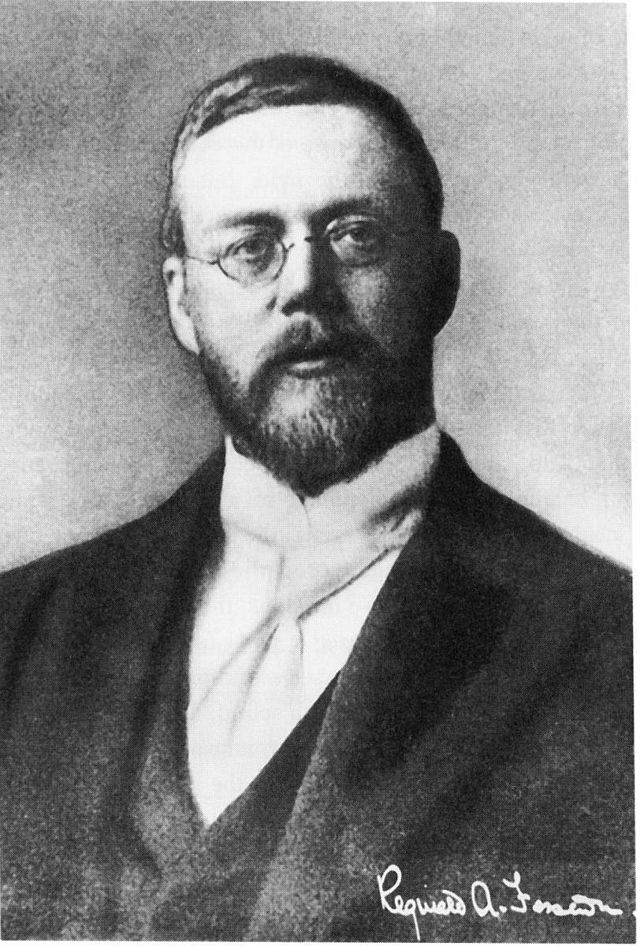
Reginald Aubrey Fessenden (October 6, 1866 – July 22, 1932)

Reginald Aubrey Fessenden (October 6, 1866 – July 22, 1932)

Some of you may recall that last year, I posted an announcement about WG2XFQ; this station annually airs Brian Justin’s longwave broadcast honoring Reginald Fessenden’s famous Christmas Eve’n 1906 AM voice transmission. I had been lucky enough to capture a recording of this commemorative event on WG2XFQ in 2013.

Just yesterday, I was contacted by SWLing Post reader, George Stein (NJ3H), who had just discovered my recording–and, in turn, shared his own recording of the WG2XFQ transmission. In George’s message, he casually mentioned that he has a close family link to the original Fessenden Christmas Eve broadcast, which I find of great interest. George writes:

“My grandfather, Adam Stein, Jr., was Fessenden’s chief engineer and was present for the Christmas Eve broadcast from Brant Rock, Mass in 1906. He is also mentioned in the Fessenden biography by Helen Fessenden, of which I have a copy…

In scientific journals from that time…it was reported that my grandfather’s voice was the first heard across the Atlantic (Machrahanish, Scotland) in Nov/Dec 1906. This occurred during testing at Brant Rock and was picked up by Fessenden’s man in Scotland.”

All I can say is, Wow! This is an amazing bit of history. Of course, I sent a reply to George asking for more information and permission to post this, which he kindly granted. George continues with an excerpt from S. Belrose, Communications Research Centre Canada:

“In November 1906, Fessenden and colleagues were conducting experimental transmissions using his newly-developed HF alternator, between stations at Brant Rock and Plymouth, Massachusetts. The station at Brant Rock was modulated by a carbon microphone connected in series with the antenna lead.

About midnight, on an evening early in November, Mr. Stein was telling the operator at Plymouth how to run the dynamo. His voice was heard by Mr. Armor at the Macrihanish, Scotland station with such clarity that there was no doubt about the speaker, and the station log book confirmed the report.

Fessenden’s greatest triumph was soon to come. On 24 December, 1906, Fessenden and his assistants presented the world’s first radio broadcast. The transmission included a speech by Fessenden and selected music for Christmas. Fessenden played Handel’s Largo on the violin. That first broadcast, from his transmitter at Brant Rock, MA, was heard by radio operators on board US Navy and United Fruit Company ships equipped with Fessenden’s radio receivers at various distances over the South and North Atlantic, as far away as the West Indies. The wireless broadcast was repeated on New Year’s Eve.”

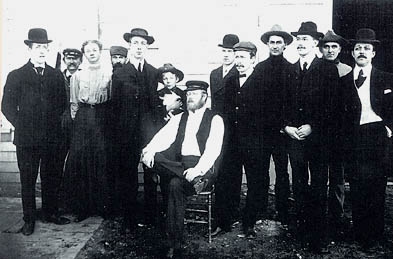
Fessenden Staff Brant Rock

The Brant Rock staff and operators: Fessenden is seated in the middle and to his right is his son (Reginald Kennelly), holding Mikums, his cat. Mr. Pannill is on the far left. Standing next to him is Jessie Bent, the secretary. Mr. Stein is on the far right. (Radioscientist)

[Above] A picture of Fessenden’s team at Brant Rock, Mass in 1906.  Radio pioneer Charles Pannill is shown in the picture.  My grandfather, Adam Stein, Jr., who was Fessenden’s chief engineer, is also shown in the picture.

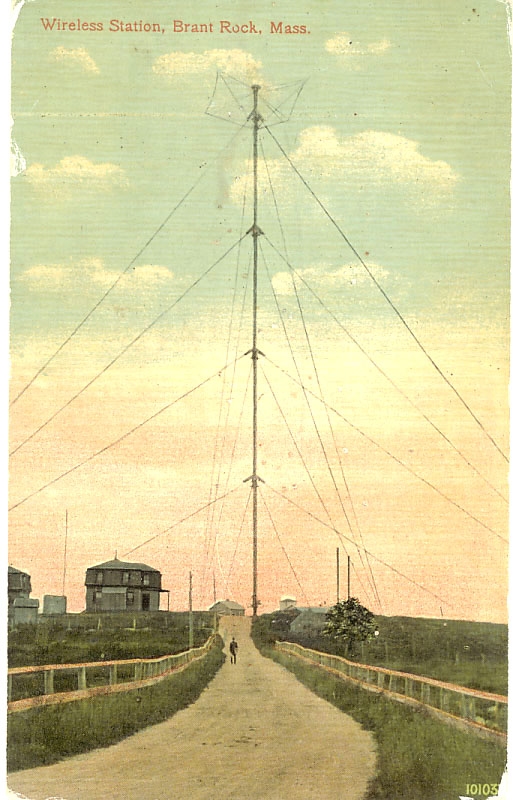
A postcard showing Fessenden’s wireless antenna in 1906 at Brant Rock.

A postcard showing Fessenden’s wireless antenna in 1906 at Brant Rock.

George continues:

In December 2006, a special event amateur radio station, W1F, was on the air from Brant Rock to commemorate 100 years since Fessenden’s Christmas Eve and New Year’s Eve broadcasts. Stephan Barreres, K2CX, put a team together for the special event. I was fortunate to be included with the fine team he had assembled.

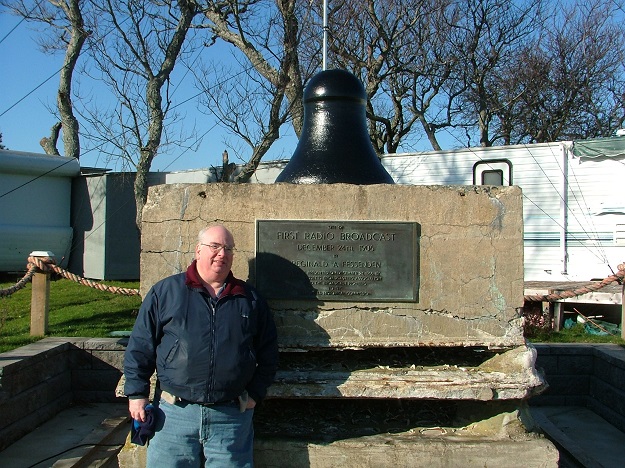
All that remains of the Fessenden antenna is the tower base.

Tower Base

The picture was taken in Dec 2006, with NJ3H standing in front.

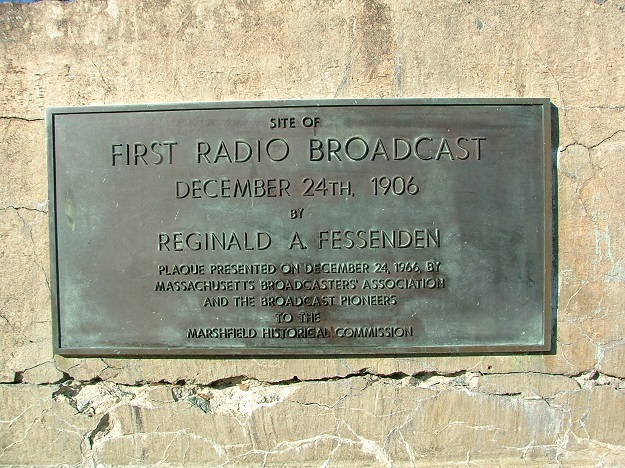
Plaque

The plaque on the base was provided on the 60th anniversary of the 1906 broadcast.

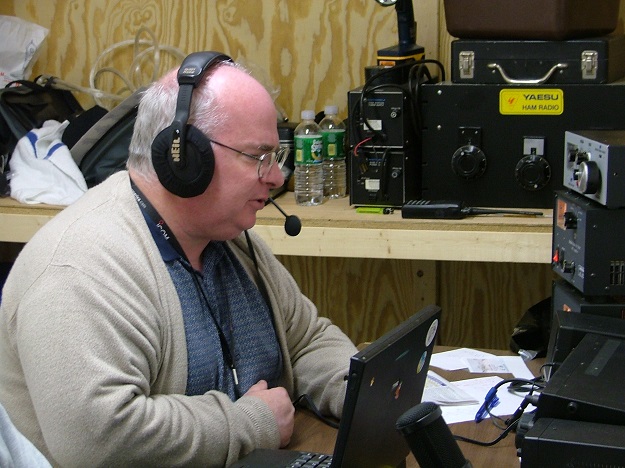
NJ3H at the operating position of W1F, 30 December 2006

NJ3H at the operating position of W1F, 30 December 2006

The following is George’s audio and screen cast while he received the Christmas Eve reenactment broadcast on 25 December 2013; WG2XFQ broadcast from Forest, VA by WA1ZMS, this recording was made by George in Stephens City, VA on a Microtelecom Perseus SDR and a Wellbrook loop.

For those of you not familiar with Reginald Fessenden, I encourage you to read about him;  he was a Canadian inventor who performed pioneering experiments in radio, including the use of continuous waves (CW) and the early—and arguably the first—radio transmissions of voice and music.  Check out some of our archived posts on Fessenden and read more about him at this online Fessenden museum.

George, again, many thanks for sharing a little history about your grandfather and your own way of honoring his work.

Shortwave Radio Recordings: the Voice of Greece, one year on

Last night, while learning the ropes of the new Elad FDM-S2, I noticed some great music on 9,420 kHz, the former Voice of Greece frequency.

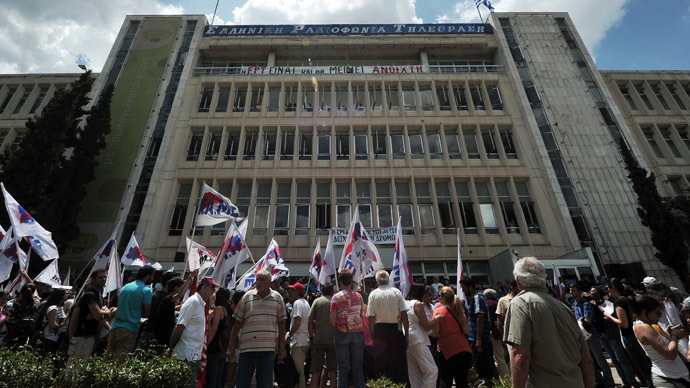
GREECE-ECONOMY-MEDIAIt was then that I realized yesterday (June 11) marked the one year anniversary of the day that the Greek government shut down ERT and the Voice of Greece. If interested, click here for some audio I recorded that very night.
Amazingly, one year later, 9,420 kHz is still active out of the Avlis transmitter site and last night, the Radio Station of Macedonia (a.k.a., ERT 3) was playing an excellent mix of Greek music and jazz.

Click here to listen to the 51 minute recording, made with the Elad FDM-S2 software defined receiver, starting at 00:50 UTC:

You’ll note great audio fidelity and a low noise floor despite the numerous static crashes present from area thunderstorms. (Note that I did not have DSP noise reduction nor the noise blanker engaged.) I started the recording in standard AM mode, then changed it to AM synchronous detection between songs in the first half of the recording.

BBC broadcasts original D-Day news scripts

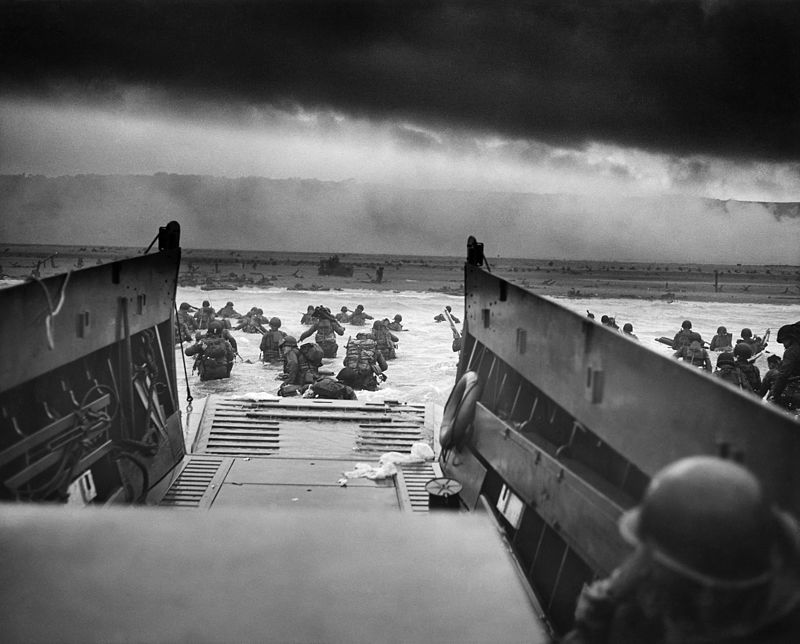
Photo: Chief Photographer's Mate (CPHoM) Robert F. Sargent

Today is the 70th anniversary of D-Day: the WWII Normandy invasion.

In honor, the BBC has been broadcasting the original radio news scripts throughout the day, at the same time of day they would have been originally broadcast. The news scripts are being read by Benedict Cumberbatch, Patrick Stewart and Toby Jones; the complete set of recordings is available online. You can follow along by reading scans of the original scripts.

Click here to view the list of recordings. It appears that they are available to anyone, regardless of geographic location. There doesn’t appear to be a time limit.

Remembering Radio Beijing: 25th anniversary of the Tiananmen Square massacre

A long shot of the iconic "Tank Man" on Tiananmen Square. Photographer: Stuart Franklin

A long shot of the iconic “Tank Man” on Tiananmen Square. Photographer: Stuart Franklin

Today is the 25th anniversary of the horrible events that took place in Beijing’s Tiananmen Square on June 4, 1989, during which Chinese troops opened fire on unarmed student demonstrators.

In this off-air shortwave radio recording of Radio Beijing, made on June 3rd, 1989, you’ll hear the news reader/editor depart from the script and comment on the massacre of protestors in Tiananmen Square:

It’s believed this brave news editor was detained shortly after the broadcast and spent years in a detention (re-training) camp.

Rest assured, you will hear no mention of the Tiananmen Square protests on China Radio International today–even though this year marks the 25th anniversary of the event. China’s state media goes to great lengths to keep this sort of on-air protest from happening again. State media even tries to limit on-line research of the protests; last year, we posted a fascinating article which listed banned search engine terms in China.

I also encourage you to check out Jonathan Marks’ comments (from a broadcaster’s perspective) on this particular Radio Beijing broadcast.