Category Archives: Radios

Include in the CIA’s Survival Kit: the Sony ICF-SW100

CIAEscapeandSurvivalBag

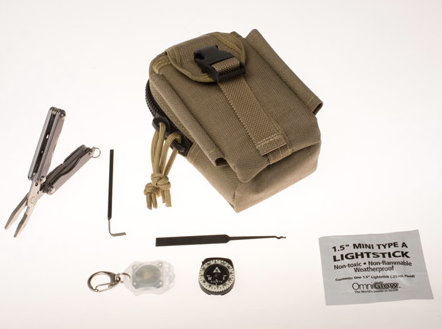
I recently discovered an article on the excellent blog, LifeHacker, which describes the contents of the CIA’s Escape and Evasion Survival Kit.

The kit’s contents currently include:

Lifehacker believes the small bag used is the Maxpedition M-2 Waistpack. I like Maxpedition packs: they’re very durable, typically military grade, and reasonably affordable. But the M-2 is small–quite small.

This led me to thinking about über-portable shortwave radios I would carry in such a small pack for survival purposes. If I were a foreign operative, ideally, I’d want a shortwave radio that has SSB mode, in case my home country’s numbers station broadcast in SSB.

In reality, there are very few good radios that are so compact they could fit in the M-2 Waistpack.

A few that came to mind were the Tecsun PL-310ET or Tecsun PL-380, but the fit would be very tight, if at all; both radios are slightly wider and taller than the M2’s main pocket, which measures 5 x 3 x 1.5 inches. I then remembered the Kaito KA1102 that I owned a few years ago–a very portable radio, but it, too, would be too large at 143 x 88 x 28.50 mm.

But then, it hit me: there is one radio, which, though no longer on the market, would fit the bill (and the pocket)…

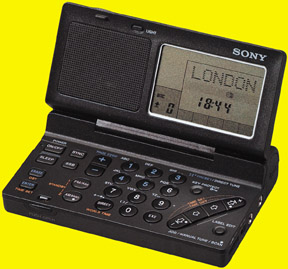
The Holy Grail of über-portable receivers: The Sony ICF-SW100
Sony-ICF-SW100

I have never owned an ICF-SW100, but I’d love to. Occasionally they show up on eBay, but prices range from $300-$800 depending on condition. That’s simply too pricey for my budget. Universal Radio has acquired used units in the past on rare occasions; these have sold between $200-400.

Then there are the lucky few, like my radio-listener buddy, The Professor. Remarkably, he tracked down (and knows I’ll never forgive him for it) an ICF-SW100 on Craig’s List for about $50! That was a steal.

Performance is superb for a radio this size. Not only does it have SSB mode, but selectable sideband sync detection.

One note of caution, should you be lucky enough to acquire one: the ribbon cable that connects the lower portion of the radio with the display (especially in the mark 1 production units) is known to fail. Fortunately, there are a number of videos (like this one) which walk you through replacement.

Click here to search eBay for a used Sony ICF-SW100.

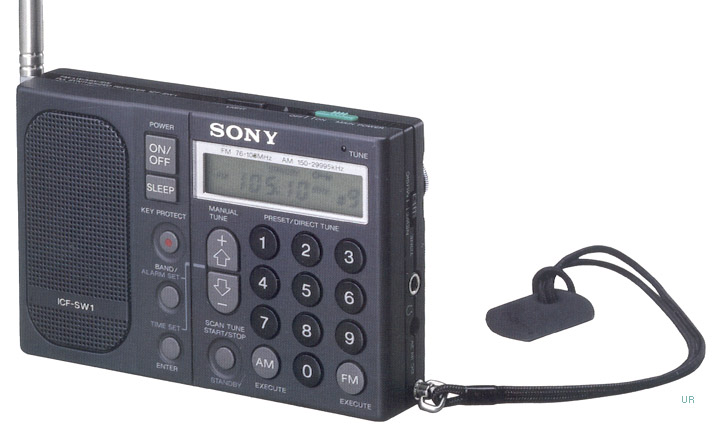
Honorable mention: the Sony ICF-SW1S
icfsw1cs

The ICF-SW100 predecessor, the ICF-SW1S (above), would easily fit in the M-2 Waistpack–it measures a mere 4.75 x 2.785 x 1 inches. Like its younger brother, it is highly sought after on the used radio market, and usually fetches $300+. The ICF-SW1S does not have a sync detector and lacks SSB mode. Still, as a broadcast receiver, it is truly superb for its size.

If you purchase a used ICF-SW1S, do ask the seller if all 6 original electrolytic capacitors have been replaced. If not, you may have to replace them in short order as the originals were known to fail. While not a repair for the faint of heart (as parts are quite small), there are several instructional sites and videos to help you.  Alternatively, you can send your ICF-SW1S to Kiwa to be professionally re-capped.

Click here to search eBay for a used Sony ICF-SW1S.

Any others–?

Do you know of any other high-quality shortwave portables out there compact enough to fit in the M-2 Waistpack?  Let us know!

The hunt is on…!

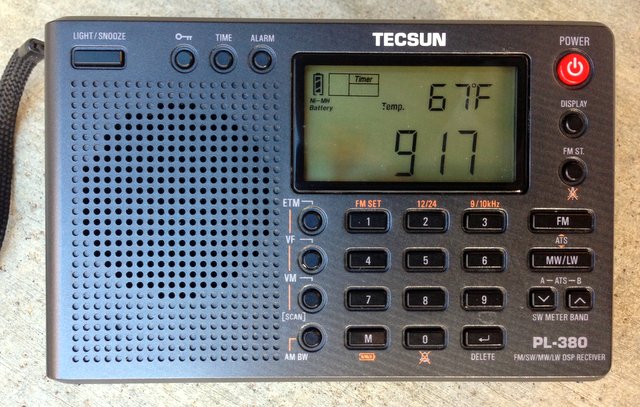
Tecsun PL-380: Displaying temperature in Fahrenheit

Tecsun-PL380-Temperature

I have owned the Tecsun PL-380 for years now. When my buddy Mike (K8RAT) recently asked if the temperature display could be switched from Celsius to Fahrenheit, I gave him a firm “no” as a response.

A few hours later, Mike wrote back:

“Just found out that the PL -380 will toggle between F and C temperature reading. Push and hold the “3” button with radio turned off. Cool!”

I just tried it and, as you can see, it works brilliantly. Thanks, Mike!

(Note to self: Start responding to this sort of inquiry with a softer “no” in the future!)

PortableSDR: The Holy Grail of portable SDR transceivers?

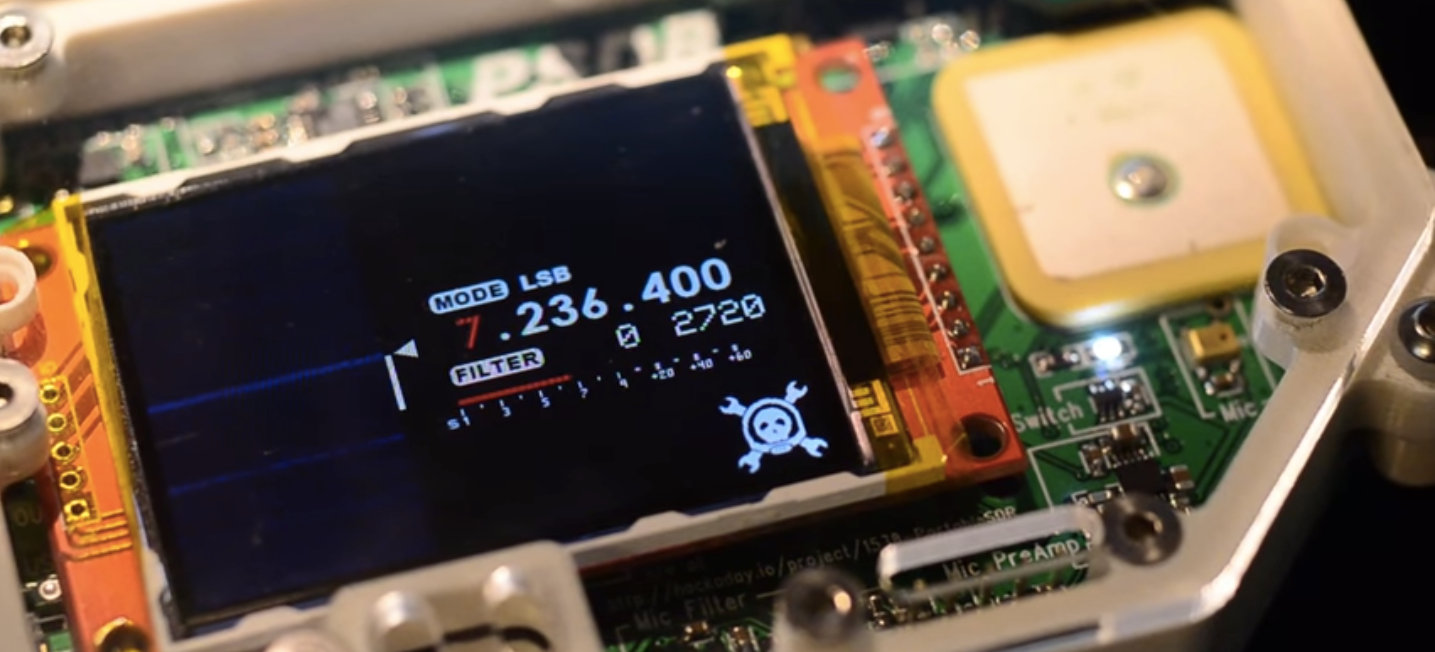
PortableSDRMany thanks to my buddy, Bennett Kobb (AK4AV), who shares information about the PortableSDR, one of five finalists in The Hackaday Prize.

PortableSDR creator, Michael R Colton, describes his project on Hackaday:

“The PSDR is a completely stand-alone (no computer needed), compact, Portable Software Defined Transceiver (hence the name, sorta). Originally designed for backpacking use by Ham Radio operators. It includes complete coverage up to about 30Mhz (plus 144Mhz), it has a 168Mhz ARM processor, color display, and an innovative interface.

Vector Network Analysis (which includes antenna analysis) and GPS functions are included.

The entire design is Open Source. The electronics are designed and laid out to be easy to understand and tinker with. In addition to source code, schematics, board layout and parts lists, articles and videos describing the theory of the design are being created.”

He includes this video of his working prototype:

I will certainly follow this project with interest. I love the fact that PortableSDR has such a small form factor, yet still manages to include room for a battery, display and CW paddles.

Grundig S450DLX $34.19 shipped

GrundigS450DLX

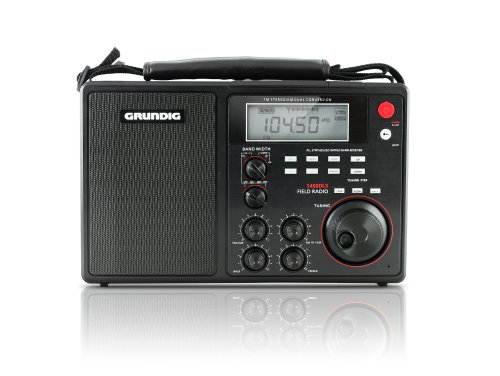
Blinq.com still has the Grundig S450DLX for a mere $34.19 US shipped. That’s a superb price. Blinq.com describes these units as “Used – Very Good – Item fully functional – May show minor wear (scratches, etc) – May come repackaged.”

I’m very tempted to snag one at this price, even though I don’t really need it. Perhaps I’ll purchase one as a gift?

For what it’s worth, Amazon.com has new units for $59.00 shipped.

Close outs: Grundig G2 and RadioShack digital recorder

GrundigG2Front

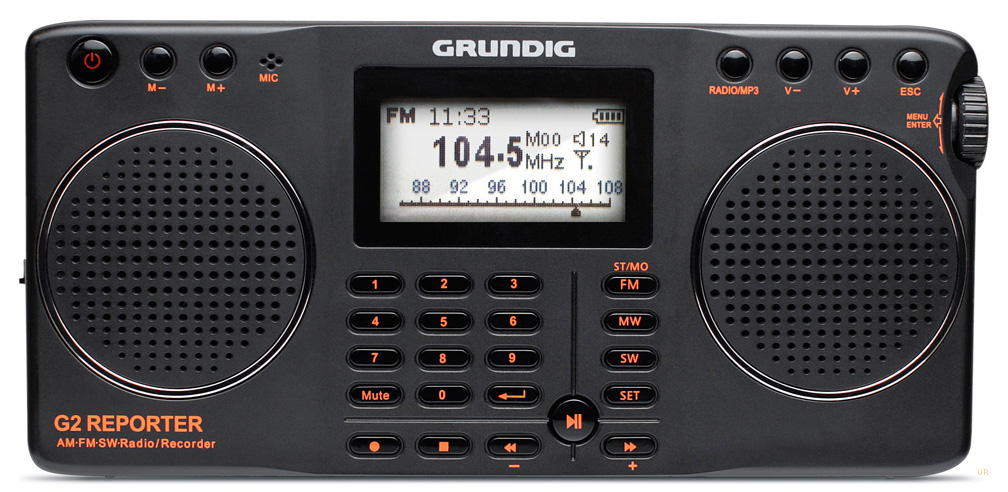
Many thanks to SWLing Post reader, Mike (K8RAT), who notes the Grundig G2 is now being sold at close out pricing.

Universal Radio is currently selling the G2 for $54.98 while Amazon has a price of $52.95.

I’ll be the first to admit that I’m not the biggest fan of the Grundig G2. It packs a lot of features and has good audio for the size, but tuning through the shortwave bands is somewhat cumbersome and the listener is limited to 5 kHz steps. Still, this radio also doubles as a stand-alone MP3 player and even records. FM reception is very good.

RS-MP3-recorder

[Update: See Ron’s comments about this digital recorder below before making a purchase. This recorder has a serious weakness.]

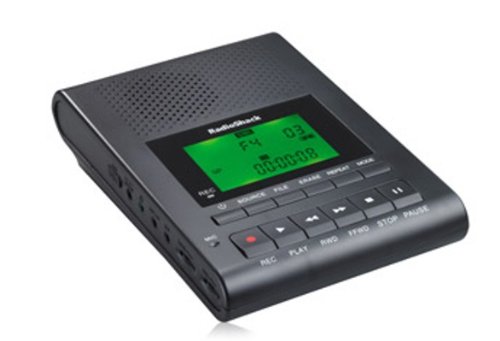
I also noted that Blinq.com and Amazon have a Radio Shack 4GB Desktop Digital Voice Recorder (Model #1400214) on sale. While I’m not at all familiar with this recorder, the price is very attractive. It has a line-in (great for recording directly from a radio’s line out jack), SD card expansion, and very simple controls–reminiscent of old school cassette recorders.

I have no idea how well it performs as there are very few reviews on the ‘net, but with pricing in the $20-25 range, it seems like a bargain. I love the simple controls mounted on the face of the recorder.

Blinq.com is selling the RadioShack recorder for $24.99 shipped, Amazon.com actually has one left (at time of posting) for $19.99.

Has anyone ever used this digital recorder?

SWLing Post reader, Ron, writes:

“Stay away from the Radioshack digital recorder.

It works fine, is set up just like a cassette recorder. And just like a cassette recorder the sound in mono-all on one side!”

Many thanks, Ron.  Yes, I would avoid the recorder knowing this.


Bill solves the CRI echo mystery

Earth

A few days ago, I posted an article about Bill Meara (producer of the SolderSmoke Podcast) who was hearing audio echoes on his home brew regenerative receiver.

Bill has now solved this mystery (hint: it’s all about the receiver):
http://soldersmoke.blogspot.com/2014/09/radio-china-international-echo-mystery.html

1930s refrigerator had built-in radio

Many thanks to Andy Sennitt for sharing this fascinating piece of radio nostalgia:

RefrigeratorRadio

Gizmodo columnist, Matt Novak, writes:

Jesse Walker, author of the book Rebels on the Air: An Alternative History of Radio in America, pointed me to this rather novel invention from 1937 — the refrigerator-radio combination unit. This may seem like an odd marriage of tech, but it makes perfect sense when you realise that it in the 1930s it was becoming harder to sell new radios and much easier to sell new fridges.

Despite the Great Depression, America saw an explosion of mechanical refrigerator ownership during the 1930s. In 1930, just 8 per cent of American households had a fridge. By the end of the decade, nearly half of American homes had one.

But the market for radios was pretty saturated in the late 1930s. Over 80 per cent of American households had a radio by the end of the decade. So radio set manufacturers tried to insert their products into new places that from the vantage point of the future, we can see didn’t pan out (like refrigerators) and others that did (like cars).

Continue reading on Gizmodo…