Category Archives: Shortwave Radio

Dan watches record-setting vintage JRC receiver auction prices

Many thanks to SWLing Post contributor, Dan Robinson, who writes:

The question is, will it go even higher than the two NRD-240s a few months ago?

https://buyee.jp/item/yahoo/auction/j1000312853?conversionType=item_browsing_history

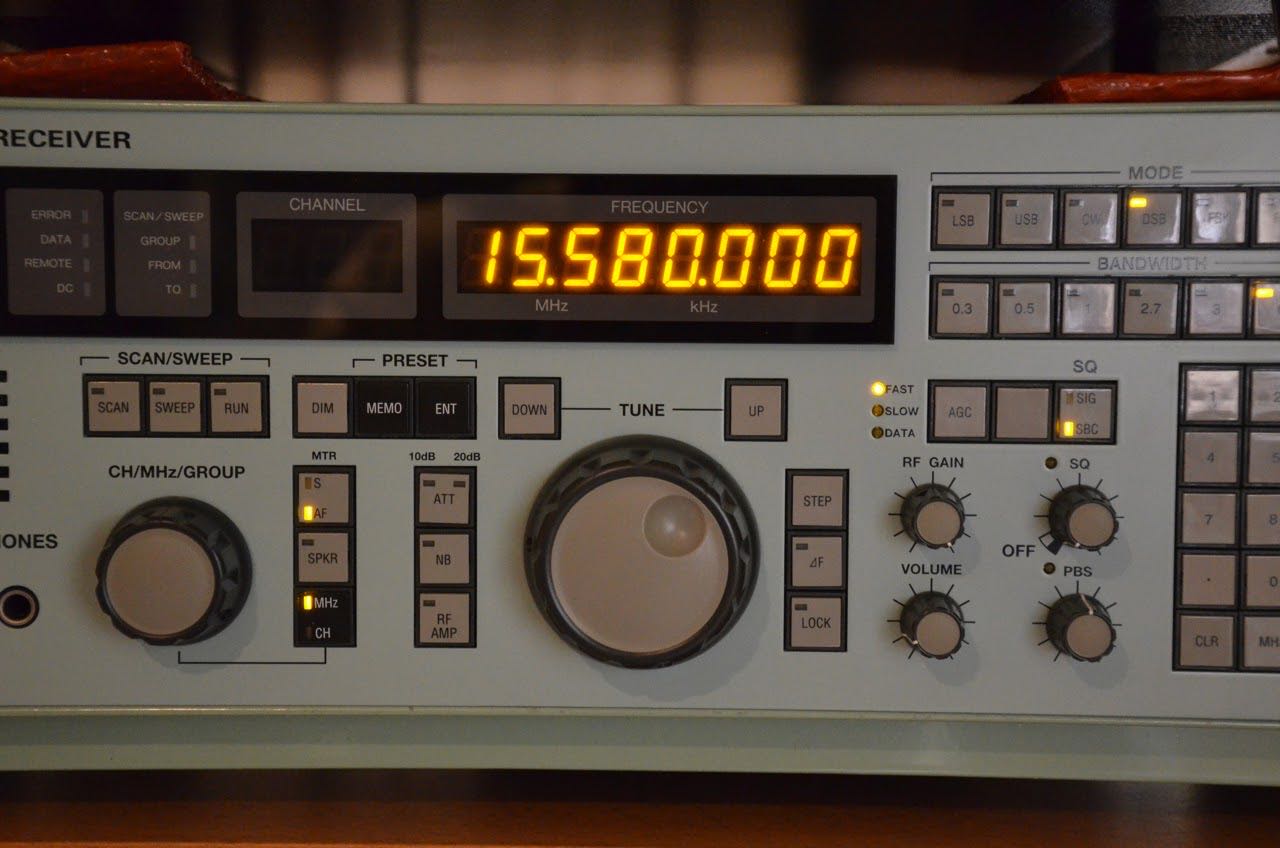
As collectors of premium receivers know, the Japan Radio Corporation (JRC) NRD-630 is among the rarest of radios.

NRD-630s are almost never seen on the used market and when they do appear, they sell usually for over $5,000 U.S.

This NRD-630, with only a few hours to go, appears on the Japan Buyee (Yahoo Auctions) site, and the receiver appears to be in like new condition.

The last JRC receivers to bring over $5,000 were two NRD-240 receivers, both of those also in like new condition.

Click here to see the results of this auction.

Thanks, Dan! It’s so fascinating to see how prices for these vintage JRC receivers change with time!

The Sullivans: Could WWII German broadcasts be easily received in Australia?

Many thanks to SWLing Post contributor, Ray Robinson, who writes:

Hi, Thomas. I have recently been re-watching the Australian soap serial ‘The Sullivans’, which ran on Channel 9 from 1976-1983. I used to watch it on ITV in England, and also for awhile on the Tempo cable & satellite channel here in the States in the late 80’s. It is set in Melbourne during the second World War and after, and begins in September 1939. In the episodes covering the early part of 1940, much is made of one of the character’s abilities to listen to Nazi German broadcasts via shortwave, in both English and German (and they play clips of actual audio in the episodes). My question is, how realistic is this?

Were German broadcasts at that time able to be heard with good quality in Australia? Does anyone have a transmission schedule from that era? I know that German broadcasts were well heard throughout Europe and in North America, but I don’t have any details of broadcasts targeting Australia. Might they have been relayed via some Axis transmitter in the Far East? If any of your SWLing Post readers can shed any light on this, I’d be very grateful. Thank you.

Ray Robinson

Great question, Ray. This is certainly an inquiry for radio enthusiasts and WWII buffs in Australia and New Zealand. I’m sure there are accounts out there that could verify how easily and frequently Axis broadcasts could be heard in Australia and NZ. My guess would be that propaganda would have certainly targeted Australia and New Zealand during WWII.

Please comment if you can provide some insight and/or evidence for Ray!

WRMI will air a second series of Texas Radio Shortwave programs

Many thanks to SWLing Post contributor, Edward, who shares the following announcement:

WRMI to air second series of European free radio and low-power licensed stations

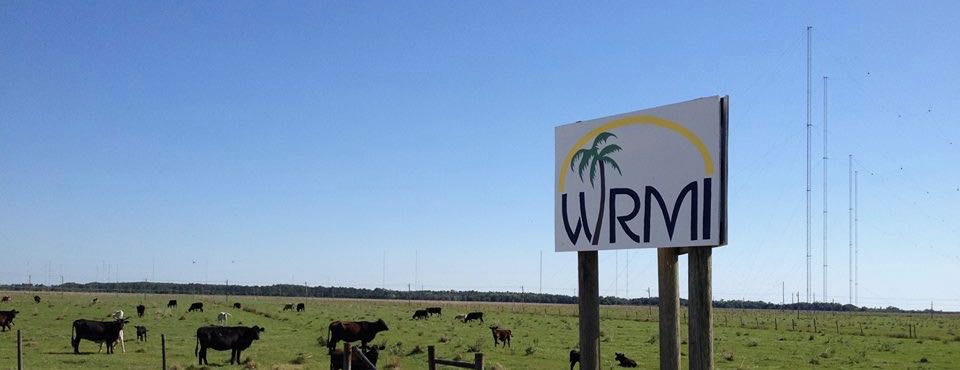
WRMI will air a second series of Texas Radio Shortwave programs featuring European free-radio and low-power licensed stations during September, October, and November.

The one-hour programs will be broadcast every Friday at 9 p.m. ET (Saturday at 0100 UTC) by WRMI, Okeechobee, Florida, on Texas Radio Shortwave’s “regular” frequency of 5950 kHz.

Dates and featured stations in Series 2 are as follows:

September 4-5 = Radio Clash (Somewhere in Europe)

September 11-12 = Radio Merlin (UK) *

September 18-19 = Crusin’ Radio (UK)

September 25-26 = CoolAM Radio (The Netherlands) *

October 2-3 = Radio Monique International (The Netherlands) *

October 9-10 = Radio Blackstone International (The Netherlands)

October 16-17 = Charleston International Radio (Germany) *

October 23-24 = KR1 (The Netherlands)

October 30-31 = To Be Announced

November 6-7 = To Be Announced

November 13-14 = To Be Announced

November 20-21 = To Be Announced

November 27-28 = To Be Announced.

*Series 1 station invited to produce a program for Series 2.

eQSLs will be available from individual stations. TRSW will not issue verifications for these programs.

These popular stations are heard regularly in Europe but seldom in North America because of propagation conditions.

Thank you for the tip, Ed!

Jock discovers the joys of ATS tuning with the C.Crane CC Skywave SSB

Many thanks to SWLing Post contributor, Jock Elliott (KB2GOM), who shares the following guest post:


Really cool trick the CCrane Skywave SSB will do — the “radio butler”?
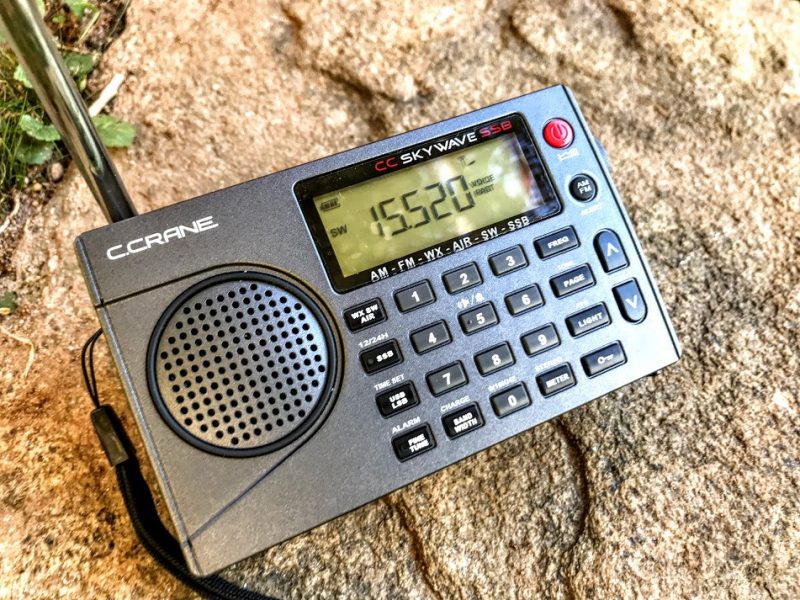
To paraphrase Ratty from Wind in the Willows: ” “Believe me, my young friend, there is nothing–absolutely nothing–half so much worth doing as simply messing about with radios.”

That is precisely what I was doing . . . messing, simply messing about with the CCrane Skywave SSB.

Then I observed something. Just above the LIGHT button is some lettering: “ATS.” Not having taken notice of it before, I looked it up in the manual. It stands of Automatic Tuning System, and the manual says this about it:

“This feature programs all receivable stations in the AM, FM, Air and Shortwave bands to memory buttons. To use ATS, select your desired band: AM, FM, Air or Shortwave, and press and hold the ATS button for two seconds. The CCrane Skywave SSB will scan the entire band and automatically set all available stations in sequence 1-20. If more than stations are available, then the remaining stations will be preset to the next memory page, and so on.”

So I tried it; I punched in a shortwave frequency — 9250 — and pressed and held the ATS button for two seconds. The Skywave then muted itself and went to the bottom of the shortwave bands — 2300 — and started silently scanning through all of the international shortwave bands, hopping from one shortwave band to the next. Occasionally it would stop and silently store a frequency. After a while it stopped, unmuted, and began playing the very first memory that it stored. I checked the other memories that were stored and — sonofagun! — there were stations stored in each memory. Some of them were really faint, and I had to mess with single sideband and bandwidths to make them fully copyable, but they were there, automatically scanned and stored by the CCrane Skywave SSB. Obviously, you might want to repeat the ATS scan as shortwave propagation changes, say, from day to night.

Well, I thought, would it do it also for Air frequencies? Short answer: it certainly will. And it will do the same for AM, FM, and — get this — if you put the Skywave SSB in single sideband mode, it will scan the ham bands, automatically changing sidebands appropriately as it hops from ham band to ham band. Note: when you check the memories stored during an ATS ham band search, you may not find anything there, simply because ham transmissions come and go much more often than international broadcasters.

There is one downside to the ATS function. When the Skywave scans and stores stations, it does so starting at Page 1, Memory 1 of the memory system . . . always. So, if you scan the Shortwave frequencies and store frequencies they will be stored starting at Page 1, Memory 1, wiping out anything that you have already stored there. If you then use ATS on the Air band, it will then write over whatever you stored from the Shortwave frequencies. I wish there were a way for the user to designate at which page in the memory system ATS will begin storing frequencies so that the information stored starting at Page 1, Memory 1 is not constantly overwritten.

However, there is another trick the Skywave will do: if you have used ATS to scan and store Air frequencies in Page 1 of the memory system (which it does automatically), you can then press and hold the UP and DOWN buttons at the same time, the Skywave will then scan through the Air frequencies that are stored there. Further, there is a squelch function on the Skywave that works only on the Air frequencies. So, with a little persuasion (very little), the CCrane Skywave turns itself into a civilian air scanner.

The ATS function on the CCrane Skywave SSB is a bit like having a radio butler: “I say, Jeeves, find me what’s on the air this evening.” A short while later, Jeeves reports back: “Here you are, sir, I found 10 shortwave stations you might like to listen to.”

Frankly, I don’t know if other modern shortwave portable radios offer a similar function, but if you have a CCrane Skywave SSB, give the ATS function a try; it’s pretty slick.

— Jock Elliott, KB2GOM

Bob Colegrove on “The Joys and Challenges of Tuning Analog Radios”

Many thanks to SWLing Post contributor, Bob Colegrove, who recently shared this excellent article and has kindly allowed me to share it here in the the Post. Bob prefaced it by saying, “Being a retired technical writer, I started the attached article some time ago for my own amusement, but it quickly got out of hand.

“Got out of hand” in a very good way, Bob!

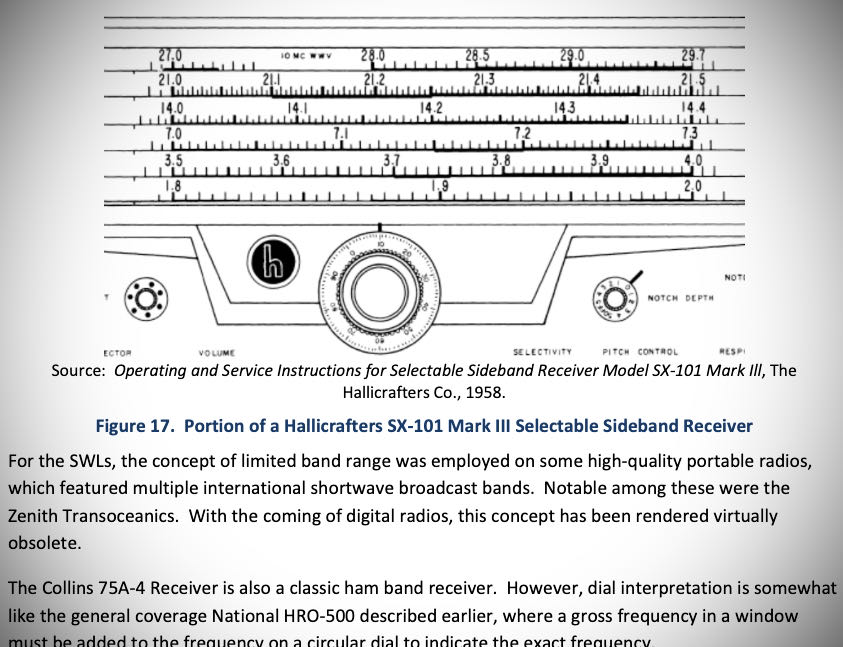
An excerpt from Bob’s article.

I love how this piece takes us through receiver history and explains, in detail, the mechanics and innovations. It’s also a very accessible piece that both the beginner and seasoned radio enthusiast can appreciate.

But don’t take my word for it, download it and enjoy!

Click here to download The Joys and Challenges of Tuning Analog Radios as a PDF.

Thank you again, Bob. This is a most enjoyable and informative read! This was obviously a labor of love. Thanks for sharing it with our radio community!

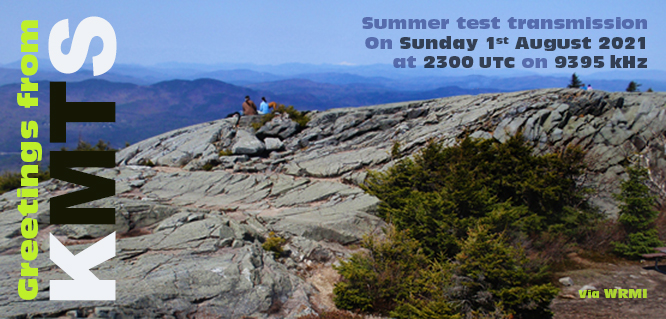
KMTS Summer Test Transmission August 1, 2021

Many thanks to SWLing Post contributor, Fastburstradio23, who shares the following announcement:

Beaming to you from the transmitter’s location, forget summer vacation, it’s time for summer school. Get your pencils sharpened and thinking caps on for the KMTS Summer Test (transmission)! Numbers, poetry, the science of strange tones, music and mountaineering are all part of the curriculum.

And if you are one of those cats who was too hip for school the first time around, we understand. We’ve been there! When you use one of our proprietary quantum radios passing is as easy and pleasant as a breeze blown in from a deserted tropical island. All the answers tp all the questions are right in some reality or timeline!

And after you’ve peaked out with us at the crown of KMTS, you can join us for a Mai Tai at the Tiki bar on top of the mountain as we go over the summer test results.

Thanks for the tip, Fastburstradio23!

As a bonus, I was also sent this video of KMRT’s broadcast from February 2021:

Recommendations for an HF/VHF/UHF station in an apartment or flat

Photo by jay blacks on UnsplashMany thanks to SWLing Post contributor, Jamie, who writes:

Hi,

I would like to ask a few questions about what would be a good set up for my situation.

I am in a 2 storey property, which is not owned by me (renting via community/public housing), located in a large city in Australia. I currently have an SDRPlay RSP2, along with standalone AM/FM tuners – Sony XDR-F1HD and Onkyo T4970. The computer and all radios are upstairs at the back in a room that is not attached.

Given renting would limit what I can do, what would be best for me to get. For MW and SW frequencies, I am trying to decide between the MLA30+ or the AOR LA400. For above 30MHz (6m, 2m, broadcast FM etc) I am deciding between the AOR SA7000 or a Discone.

I have been told that putting antennas in the roof space is not recommended. Would they work fine in the room near a window? I should mention, I do have a 50ft end fed longwire with 9:1 balun, that has been in storage and never used.

I am also looking at upgrading my receiver. Trying to choose between the WinRadio WR-G305e or the Icom IC-R8600 (would also get the RS-R8600 CD software for computer controlling the receiver). How do the specs compare between these two?

Thanks for your time, and hope that wasn’t too many questions.

Regards,

Jamie

Thank you for your inquiry, Jamie, and I hope you don’t mind, but I’m sharing this message as a post as we have readers who are in the same type of living situation and listening environment. In addition, I believe owners of the gear you’ve mentioned might be able to offer some helpful advice!

I can tell you that you’re correct: in general, antennas want to be near windows or, better yet, outdoors. Even placing an antenna on a balcony can make a big difference in terms of lowering the noise floor. This is less an issue with VHF/UHF, but those antennas also benefit from being outside since there’ll be less attenuation from obstructions.

For HF, I would personally suggest you check out the MLA-30 loop first since it’s such a modest investment and is fairly flexible in terms of how you can configure it. I’m sure our regular contributor, Grayhat, will have some helpful advice as he’s a bit of an expert with urban HF antennas.

Also, the IC-R8600 is a brilliant wideband receiver. Depending on what you wish to have for frequency coverage, I would also suggest you check out the Icom IC-705 transceiver (noting that its RX coverage is not as comprehensive as that of the IC-R-8600).

Post readers: Please feel free to comment with some suggestions for Jamie, especially if you have experience with urban radio listening.