Category Archives: Shortwave Radio

A repair story: Vlado’s fix for the classic Sony ICF-SW100

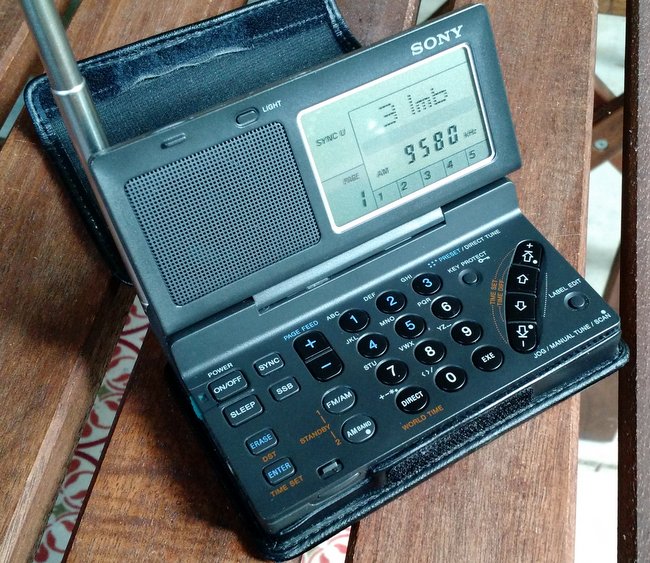
Sony-ICF-SW100In June, I made a small leap of faith and purchased a (dead) Sony ICF-SW100 from Universal Radio (see the listing on right).
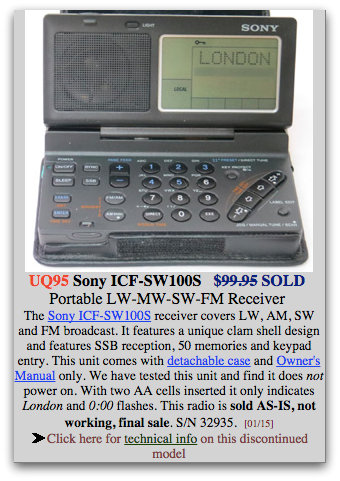
ICF-SW100-Used-NonWorkingYou see, for many years, I’ve dreamed about owning this wee little receiver, now a classic among tiny radios, but used ones are typically too expensive for my modest budget.

This time, seeing the ad at Universal, I spoke with Universal Radio directly to obtain more details about their defunct unit; while they simply didn’t know what was wrong with the Sony, they were able to very accurately describe its cosmetic and functional condition…I took a deep breath, and decided to take a chance on it anyhow.

In full disclosure, I have a secret weapon in my camp:  my talented friend, Vlado (N3CZ), who is not only the most adept electronics engineer/technician I’ve ever known, but one who truly welcomes a challenge.  The thought had occurred to me as I admired the wounded Sony, Wonder if Vlad would like to take this on–?

The answer, of course, was Yes!  So I dropped the DOA Sony off at Vlad’s home last week. He disassembled the radio, only to discover that my ICF-SW100 was a victim of the (dreaded) damaged ribbon cable.

A short history of the Sony ICF-SW100 and SW100S

These radios are indeed brilliant, incredible performers for their miniscule size.  Yet the first generation of ICF-SW100 radios–those produced before the fall of 1997–have a design weakness: the ribbon cables which connect the upper and lower portions of the radio’s clamshell design eventually fail. Multiple openings and closings bend and cut the cables, rendering the otherwise remarkable little radio useless.

SWLing Post contributor, Dan Robinson, recently shared his knowledge about the ICF-SW100 series. Dan notes:

SW-100 Seekers Beware

As shortwave veterans know, the classic SONY miniportables — SW-1, SW-100(S) and  SW-07, represented some amazing technological achievements. SONY managed to  shrink some fantastic technology into these receivers, including (with the last two in the line) — SYNC capability. The SW-07, which was the last of these receivers, still brings some high prices on Ebay.

But if you are searching for the ICF-SW-100S there are some things to consider and beware of. As everyone knows, the SW-100 suffered from the well-known ribbon-cable failure problem. SONY addressed this problem in later serial numbers, and changed the design of the radio case.

Modified SW-100s have a notch where the top cover meets the base.

There are some dishonest sellers out there who are trying to pass off older version SW-100s as modified ones. Usually, the tip-off is that the photograph in the Ebay auction will be dark or out of focus, so it’s hard to tell if the radio is the modified version or not.

It has become quite rare to find an original SONY modification kit, which includes a new top cabinet of the SW-100. And some sellers are trying to get as much as $300 for these, though they rarely sell at this level.
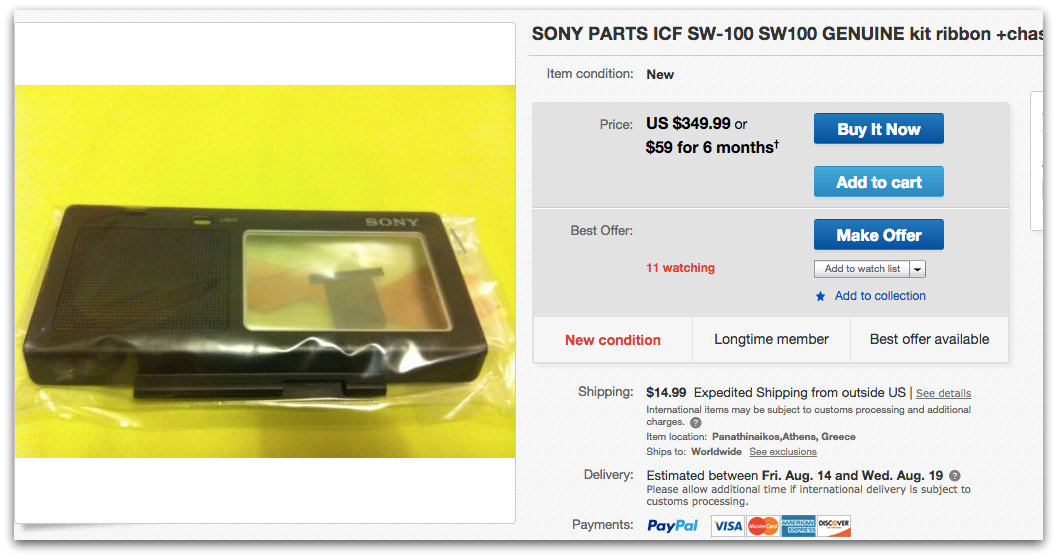
This repair kit was on eBay at time of posting.

ICF-SW100 modification kit found on eBay at time of posting.

It’s also becoming rare to see SW-100S radios new-in-box. I had two of these, sold one and kept the other.

If you’re after one of these marvel radios, do what everyone should do when considering items on Ebay — ask many questions about [the] cosmetic condition, accessories, serial numbers, etc.

Universal Radio, a trustworthy seller I know, had fully disclosed the model number and problems with this radio, so I knew exactly what I was buying. Dan has a very good point, though: unless you know the seller to be honest, do your research and ask questions!

The ailing ICF-SW100
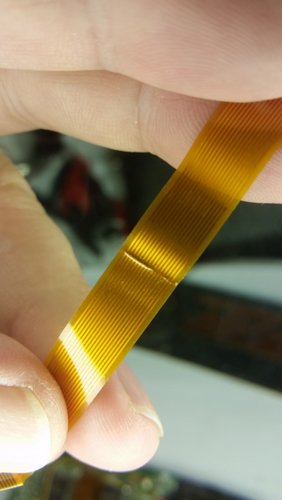
Vlado discovers the faulty ribbon cable.

Vlado discovers the faulty ribbon cable (click to enlarge)

Back to my ailing unit:  Vlado delivered the news about the ribbon cable via text message, and though I was well aware that the chances were high that was the ribbon cable, I was a little bummed, to say the least, to get the formal diagnosis.

Why? As Dan mentions above, you’ll find that the SW-100S upgrade kit Sony produced in the 1990s is no longer available new; sellers typically list these kits at prices in excess of $300 US.  Out of my budget.

But Vlado, ever the intrepid engineer, had no idea I would be disappointed with this news; he was just giving me this FYI via text. Indeed, he seemed entirely unfazed, as in, hey, no serious internal damage here…

Another hour passed. Then came another message from Vlad; this one simply said: “Call me.”

Oh no, I thought. But I called, and Vlado answered cheerfully, “Hello? Tom, is that you? Sorry, I can’t hear you very well because your SW100 is playing too loudly. Hang on–let me turn the volume down!”
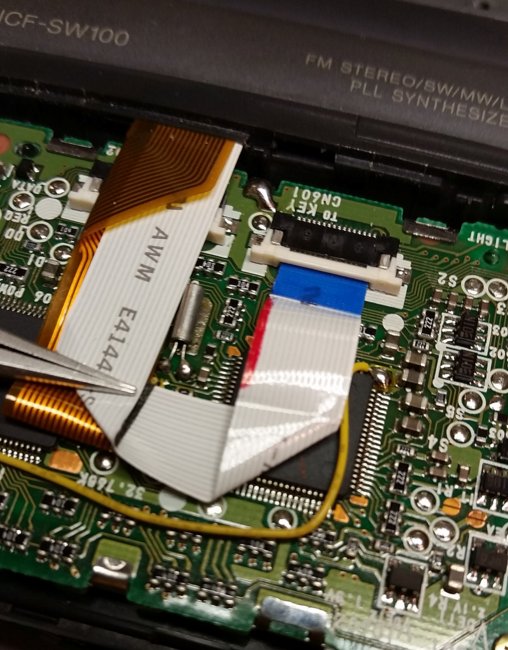
Vlad installs the replacement ribbon cable (click to enlarge)

Vlad installs the replacement ribbon cable (click to enlarge)

“What!?!” I responded, in utter disbelief.

Yes, he’d got it working!  It seems that Vlad had unearthed an old DVD player in his garage that he’d kept merely for parts. He opened it up, identified a ribbon cable with the right pitch, then cut and folded the cable to fit into the SW100.  Ingenious!

That’s Vlado for you!

And should I be interested in replacing this used cable with a new one–or in repairing other Sonys–Vlad directed me to eBay listings for new cables which only total about $20, shipped. Truthfully, I’m in no hurry, as this one is functioning perfectly and changing out the ribbon cable seems to have no effect on stored memories, etc. With a single affordable eBay purchase of multiple cable sets, it occurred to me that Vlad would have enough replacement cables to repair the SW100 many times over…

So I bought the cables.  (This one for the narrow cable and this one for the wider one.)

My “new” Sony ICF-SW100

Needless to say, I’m very pleased with my “new” (to me) SW100. It’s a little masterpiece of receiver engineering in such a tiny package.  And since the ICF-SW100 is unquestionably the smallest portable I own–and is one of the few I own with a proper line-out jack–it may very well become my go-to radio for one bag travel.
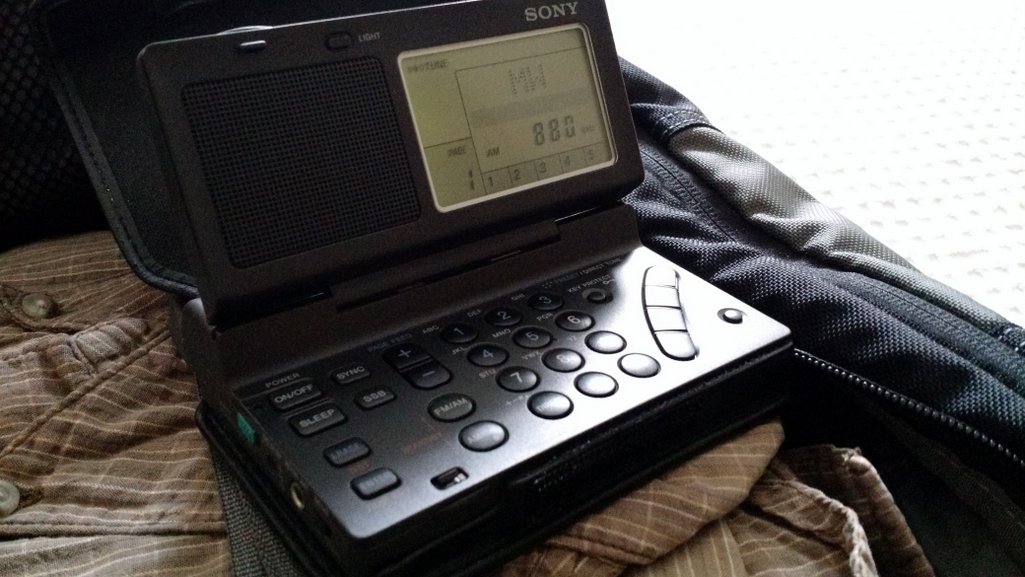
Listening to the 'SW100 before I pack it for my next trip.

It’s in the bag: listening to the ‘SW100 before I pack it for my next trip!

Stay tuned the review…

Vlado’s radio E.R.:  the doctor is in

Sony-ICF-SW100-Open2As I’ve said, Vlad is one of the most adept repair technicians I’ve ever known.  At my prompting, he’s kindly agreed to let me promote his services here on the SWLing Post. Vlad acknowledges that he “likes a challenge,” adding that he enjoys nothing more than making repairs even when”parts are scarce” and radio”surgery” is required.  Moreover, his bench fees will be quite reasonable, especially considering what you receive: new life for a failing radio. So, if you’ve got an ailing rig on your hands, and don’t mind waiting for Vlad to get to it, send it to his radio emergency room, where radios (like my Sony) have life breathed back into them once again.

Long live the Sony ICF-SW100!  And long live Dr. Vlado, who makes this possible with his creative (and nearly miraculous) repairs.

To contact Vlad, simply contact me with a description of your radio and its problem and I’ll put you in touch with Vlado.
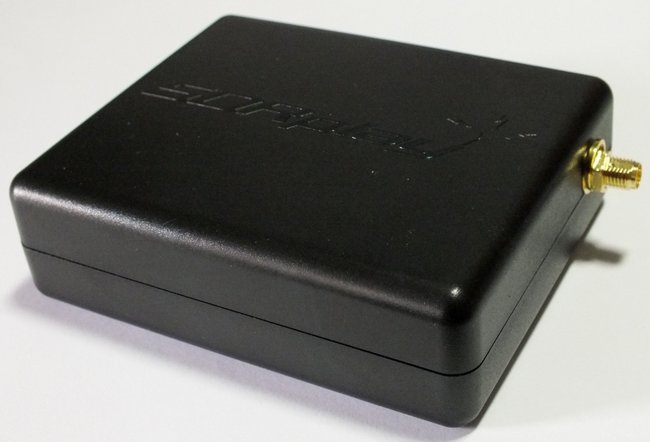
The SDRplay RSP now has gapless coverage

SDRPlay-RSP (1)

Jon Hudson with SDRplay has just informed me that they’ve released the latest version of the SDRplay RSP’s API and EXTIO which, among other things, removes the previous frequency gap between 380 MHz to 420 MHz. This is brilliant news for those of you who need continuous coverage from 100 kHz to 2 GHz.

RSP owners can download the new API and EXTIO on the SDRplay website.

Click here to read about other improvements, included with this API/EXTIO update, on the RTL-SDR blog.

Click here to read our recent review of the SDRplay RSP.

Update: Sangean ATS-405 review

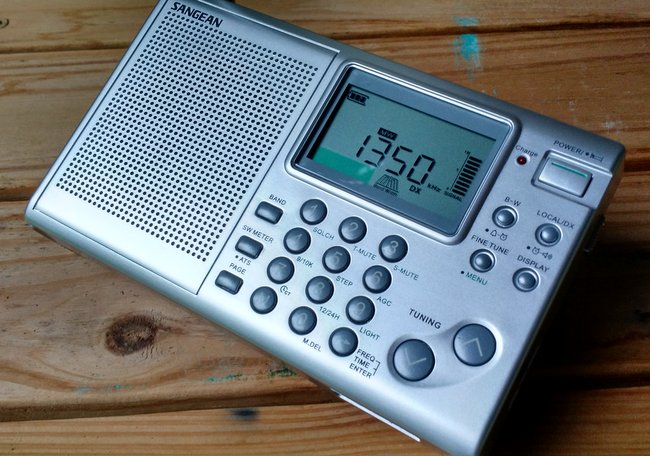
Sangean-ATS-405After publishing my initial review of the Sangean ATS-405 on July 25, I contacted Sangean and requested a sample radio for comparison purposes. Back story:  there were some receiver performance issues that I suspected may have been tied to my particular ATS-405 unit. Sangean kindly dispatched another ATS-405 which I received last week. The following is an update to my initial ATS-405 review.

In truth, there were two main reasons I wanted another unit to compare to my initial review radio:

  1. I wanted to see if the new unit showed improved performance–sensitivity, selectivity, and, specifically, noise floor–in comparison with the first review unit tested
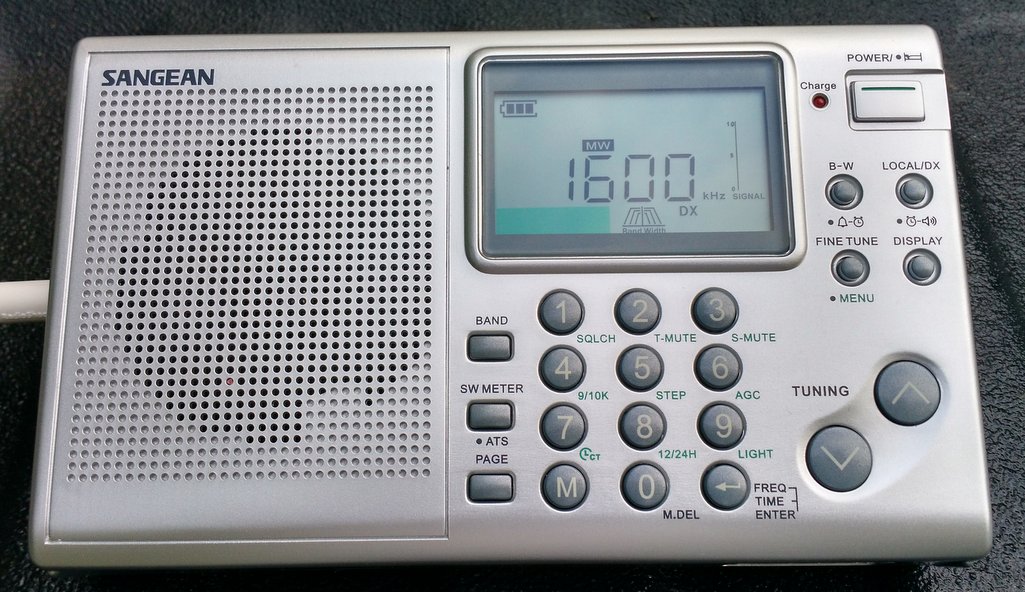
  2. I noted strong DSP “birdies” (noises) on 800 and 1600 kHz on the test model, while several of our readers commented that their ‘405s did not feature birdies

Shortwave sensitivity/selectivity and noise

I noted in my initial review that the initial ATS-405 had an ever-present noise, a sort of low-volume static hiss. The noise floor, while not high, certainly seemed to be higher than other comparable shortwave portables, and was most noticeable when tuned to marginal/weak stations. I suspect many listeners may not notice it unless they compare it with other portables.

ATS-405-9580kHz

Fortunately, my new review unit’s noise floor seems to be slightly lower than that of my initial review unit. [Perhaps this unit’s board is better soldered–?] The noise is still there, but can be better mitigated by judiciously using narrow filters and the three-position audio tone control.

I suspect this is a noise somewhere in the audio amplification chain, because I find it less noticeable with headphones, and more pronounced via the ATS-405’s internal speaker.

In terms of sensitivity and selectivity on the shortwave bands, I believe my new unit is identical to that of the initial review unit. That is to say, the ATS-405 is not an especially  sensitive shortwave receiver, but fairly average, and thus will fit the bill for most but not for the discriminating weak-signal hunter.  Frankly, even my $46 Tecsun PL-310ET does a better job of pulling in weak stations.

I’ve tried tinkering with the AGC settings and soft mute–very cool features!–in an attempt to improve sensitivity, but alas, these only help the quality and stability of the received signal.

Birdies

Immediately after opening the box of the new ATS-405 sample, I popped in a fresh set of AA batteries and tuned the Sangean to 1600 kHz AM. [If you read my initial review, I noted a strong DSP birdie on 1600 and (to a lesser degree) on 800 kHz].

At first listen, I was happy to note that the new unit lacks the wild DSP noise that overwhelmed my favorite local station on 1600 kHz.

As I listened more carefully, though, I did note a metronomic “chick” sound that was also present but partially buried in the noise on my initial ATS-405.

ATS-405-1600kHz

Below, I’ve embedded audio comparing the two receivers:

Initial review unit:

New review unit:

Listening to these samples, I realize I may have had the filter set to the middle position on the first sample and the wide setting on the second (hence, the brighter tone).

To further demonstrate the difference between the two, I made this short video; I start with my initial review unit, then switch to the new review unit provided by Sangean:

Note that this was recorded at least 100 feet from my house on the tailgate of my pickup truck. DSP birdies on 800 kHz sounded very much like the 1600 kHz sample, save the noise level on the latter is slightly lower and there are no broadcast stations in the background.

None of my other portables have digital noises or birdies on 800 and 1600 kHz.

So, the bad news:  I do still hear a noticeable (and slightly annoying) internally-generated noise on the new review unit. The good news: it isn’t as objectionable as that on my initial review unit.

Summary

In short: I stand by my initial review of the Sangean ATS-405.

While the new ‘405 review sample seems to perform better than the initial ‘405 sample, I find the discrepancy somewhat marginal, especially since I spend the bulk of my time on the shortwave and mediumwave bands.

I’m not a fan of production runs where units vary so greatly from one to another, making accurate testing difficult. Therefore it’s quite possible you might receive a unit that performs better than those I tested…but unfortunately, the opposite is also true.

So, if you’re a Sangean fan, if you don’t mind the birdies on mediumwave, and if you mostly listen to strong shortwave stations, you may entertain purchasing an ATS-405. The keypad layout is almost identical to previous Sangean models.

To be clear, of course, this radio’s negatives above have been viewed under a microscope; the ATS-405 is not a “bad” receiver, it’s just not that exceptional. Other than the added mute/AGC/squelch features, when compared to its predecessors, it’s really not a better iteration.

In conclusion?  For the $90 US price, I believe there are better receivers out there–such as the Tecsun PL-600 (which, as a bonus, has USB/LSB reception–and saves you $10, to boot).

Radio Serbia International recording and final farewell

Location of Serbia (green) and the disputed territory of Kosovo (light green)in Europe (dark grey). Source: Wikimedia

Many thanks to SWLing Post reader, “Mutezone,” who writes:

“I want to share a link to a video of Radio Serbia International’s English service recorded on the 4th of July 2015…

[…]I have been monitoring for RSI during the last week of July but got nothing. I have also been monitoring 6100 kHz after the July final date of transmission as according to RSI’s website, there are “Pirates stalking Serbian short wave” due to the termination of the station. However I have not received any odd transmissions on this frequency at the moment.”

Thanks for sharing this recording/video and, especially, for capturing RSI’s interval signal.

I was unable to hear RSI’s final broadcast on July 31, 2015.

If any SWLing Post readers managed to record RSI’s final broadcast–in any language–please contact me so we can add it to the Shortwave Radio Audio Archive.

Regarding the end of Radio Serbia International (or International Radio Serbia), the following final post was published on their website. I’ve included the full note, for archival purposes, in case the RSI website goes offline in the future:


The End of Radio Yugoslavia – International Radio Serbia

RadioSerbiaThanks for sharing the recording and for including a few minutes of the RSI interval signal. RSI was always a difficult broadcaster for me to catch here in North America, though I heard them a number of times via the University Twente Web SDR.

Dear friends, Radio Yugoslavia – International Radio Serbia, ceases to exist on 31 July 2015. For you, our faithful listeners from all over the world, and also for us who have worked on this radio, the only consolation would be the fact that this only state short-wave station in Serbia, which has existed for 79 years, will be remembered as an efficient and reliable promoter of Serbia worldwide. No one has ever presented valid reasons why this media, of rich tradition, range and staff potentials, and with big plans until yesterday, should cease to exist. Unfortunately, the assessments not based on arguments were louder than serious analyses and recommendations of experts, professionals and numerous listeners that the world radio service is necessary for Serbia, that it presents the country worldwide in the best manner possible and that no serious state will renounce such an effective diplomacy.

Our significance has been confirmed by the letters of thousands of listeners from all over the world. Some listened to us because of our information programmes, some because of economic topics, while many got to love our country, Serbia, because of its tradition, beautiful and interesting landmarks and the rich heritage they were acquainted with by listening to International Radio Serbia. Regardless of your affinities, you have all told us that you were listening to us because of our objectivity and the possibility of hearing us at any time and everywhere, for such is the power of short waves.

The Serbian government, however, believes that the closing down of Radio Yugoslavia – International Radio Serbia – is a justified move. Regardless of the fact that the state of Serbia is in an economic crisis, that each saved penny is precious, that many citizens have been rendered jobless, that new work positions should be opened, it has become unclear to the very end why the only state short-wave station has suddenly become too expensive after 80 years. We are, however, certain, that Serbian citizens, taxpayers, who have financed us for all these years, would have decided differently had they been asked to.

What remains, after all, is the pride we feel because of the history of our radio as well as the hope that the voice of Serbia will reach our listeners wherever they are.

Thank you, dear listeners from all over the world, for having trusted us all these years! Radio Yugoslavia – International Radio Serbia now greets you and signs off.

Source: http://voiceofserbia.org/content/end-radio-yugoslavia-%E2%80%93-international-radio-serbia#sthash.rvvWUjgx.dpuf

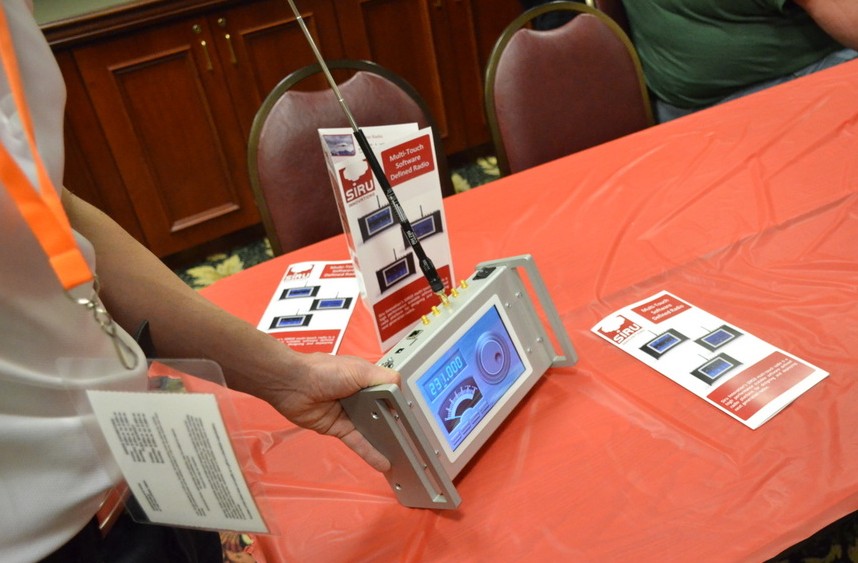
The Siru Innovatios SDR20 adds new features

Siru-Innovations-SDR20-1

Many thanks to Jarkko Mäkivaara with Siru Innovations who writes with the following update:

We have added some new features to our SDR20 portable radio!

Please see the video [below] for a demonstration of the following features:
* Smooth zoom in FFT/waterfall view
* Adaptive menu
* Frequency memory with snapshot pictures of signals
* Sliding effect between views
* Keyboard beep
* FM broadcast receiver
* Example of Ham radio transceiver with Narrow-FM mode
You also might got the email sent out Today where this is in HTML format.

https://vimeo.com/134605242

Shortwave portables that are PC-programmable?

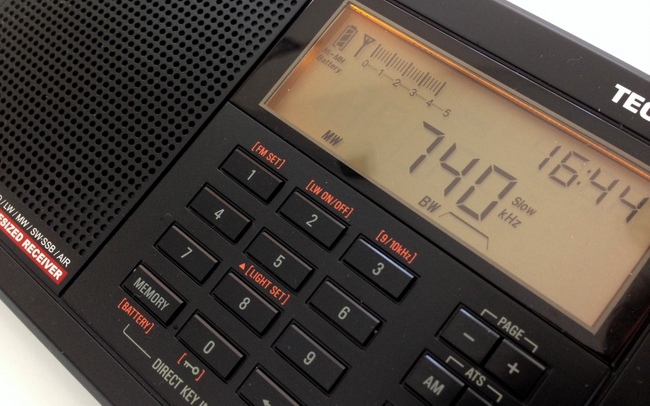
Tecsun-PL-680-MW

SWLing Post reader, Mark, recently contact me with the following question:

“What portable shortwave radios under $300 have an option to have their memories programmed using a computer?”

I replied to Mark that I can’t think of a single shortwave portable that can be programmed via computer–at least, not a “typical” portable radio like a Sony, Sangean, Tecsun, Degen, or Redsun.

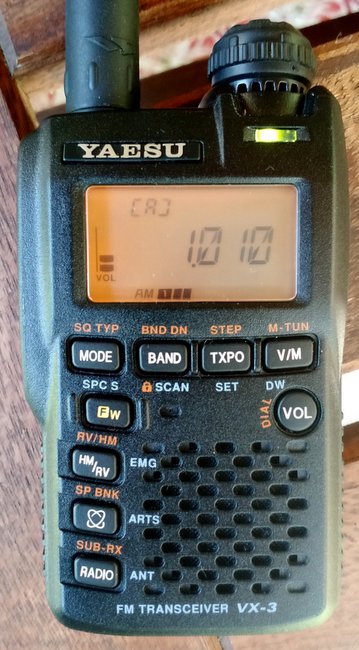
Yaesu-VX-3R

The Yaesu VX-3R HT tuned to the AM broadcast band.

I may be wrong, however, so please comment if you can help Mark identify a model.

I am aware of portable wideband communications receivers/transceivers that cover the shortwave bands: handhelds like the Icom-IC-R6, Icom IC-R20, Yaesu VX-3R, AOR AR8200 Mark III B and Kenwood TH-F6A.

Wideband handhelds are more akin to a scanner, though, and typically shortwave sensitivity is simply not on par with a dedicated shortwave portable. The AOR AR8200 Mark III B  ($700+) and discontinued Icom IC-R20  may be a couple of exceptions.

Please comment if you can help Mark with his quest.

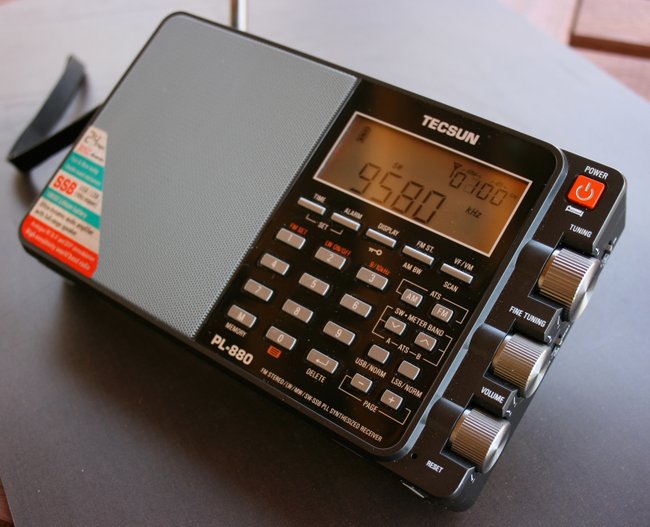
Guest Post: Richard tests the frequency stability of the Tecsun PL-880

PL-880 (1)Many thanks to SWLing Post contributor, Richard Langley, for the following guest post:


Frequency Stability of My Tecsun PL-880

Recently, while recording the audio on a particular SW frequency unattended over night, I decided to set my Tecsun PL-880 in USB mode with the 3.5 kHz RF bandwidth setting as I had previously noticed splatter QRM from a station 10 kHz below my frequency of interest. I adjusted the frequency to the nearest 10 Hz for natural-sounding voice. On playing the recording, I was disappointed to find that the signal had drifted in frequency and although speech was still recognizable, music was distorted.

I decided to try to measure the stability of the receiver by recording the Canadian time signal station CHU on 7850.00 kHz in USB mode (CHU has no LSB component) over night for over nine hours. The receiver was operated with just its telescopic whip antenna indoors and the audio was recorded with a Tecsun ICR-100 radio recorder / digital audio player. I wrote a Python script to compute the audio spectrum of each one-minute segment of the recorded files using a fast Fourier transform (after removing a DC component). The script then looks for the largest peaks in the spectra centred on a specified frequency and prints out the frequency (to the nearest Hz) and amplitude of the peak. In case the signal has dropped below audibility, a threshold is set and if the detected peak is below the threshold (likely just detecting the random noise background), it is skipped. The specific centre frequency I was looking for was 1000 Hz, the frequency of the tone used to mark each second of the CHU broadcast except when the voice announcement and digital signal are transmitted. In AM mode, the spectrum would consistently show a peak at 1000 Hz but in SSB mode, the peak will vary depending on the receiver frequency setting and the actual frequency of the receiver’s oscillator.

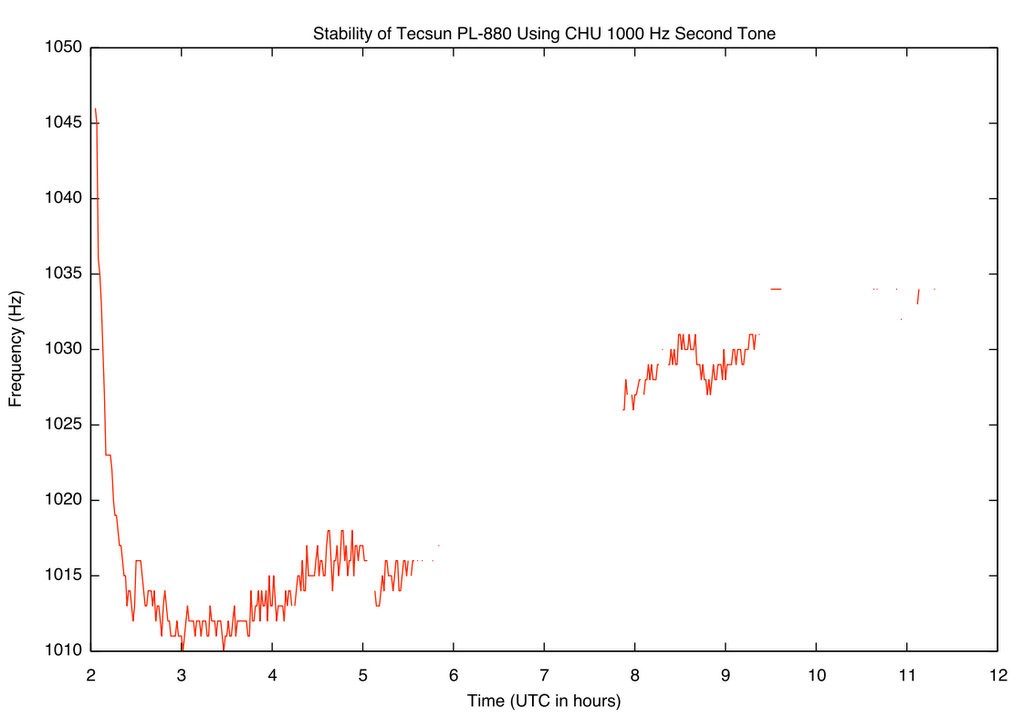
The plot below shows the received CHU one-second tone frequency as a function of time (UTC) from when the receiver was first switched on.

StabilityPlot-CHU1000hz

It shows the tone frequency started out at about 1046 Hz slowly dropping in the first half hour to about 1012 Hz and after about an hour stabilized to 1011 Hz ± 1 Hz for the better part of an hour. (This shows that you may have to allow a receiver to “warm up” for perhaps up to an hour before attempting anything close to accurate frequency reading at the order of 10 Hz.) But then, over the course of the next seven hours when the signal was audible, the frequency slowly rose ending up at about 1034 Hz. The variation might be affected by the ambient air temperature (but this should have been nearly constant), air flow around the receiver, and perhaps the charge level of the receiver’s battery. On several occasions, I have turned the receiver on (after being off for many hours) and seen a CHU frequency offset of only 10 or 20 Hz. So, I intend to repeat this experiment sometime to check on the day-to-day frequency stability. This frequency stability measurement technique could also be used with WWV/WWVH by recording the 440, 500, or 600 Hz tones broadcast at different times during the broadcast hour.

Of course, it’s also possible to check the receiver’s frequency offset in real time by switching between AM and SSB modes while adjusting the receiver frequency in 10 Hz steps until the signal sounds the same in both modes. There is also freely available computer software for various operating systems that can display a real-time spectrum of audio passed to it through a microphone or line input. So, a CHU or WWV/WWVH test using such software could also be performed in real time. And alternatively, by tuning say exactly 1 kHz away from the transmitted carrier frequency in SSB mode, the software can be used to measure the audible heterodyne frequency to better than 10 Hz — even 1 Hz. This frequency can then be added or subtracted as appropriate to the dial reading (assumed accurate or with a noted offset) to get the exact transmitted carrier frequency.

By the way, it is possible to calibrate and reset the PL-880 using the procedure documented on the SWLing Post (click here to view).

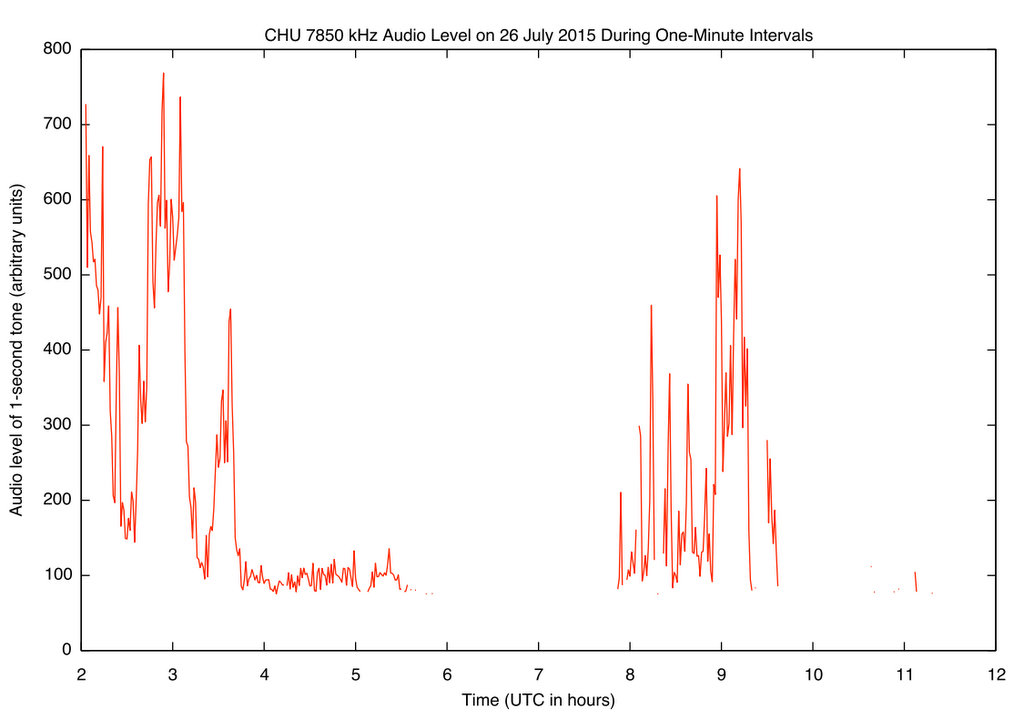
As a side benefit of the analysis I carried out, we can also look at the quality of the received signal over the recorded interval. In this case, it is a measure of the level of a particular audio frequency rather than the RF signal+noise level we usually get from the receiver S-meter or other signal strength display. This is illustrated in the plot below for the CHU recording. As you can see, reception was mostly quite good between about 02:00 and 04:00 UTC and then became fair but above threshold level until about 05:30 UTC.

AudioLevel-CHU7850kHz

The signal was then essentially inaudible up to about 08:00 UTC when with bouts of fading it became audible again for an hour or two with sunrise approaching.

— Richard Langley