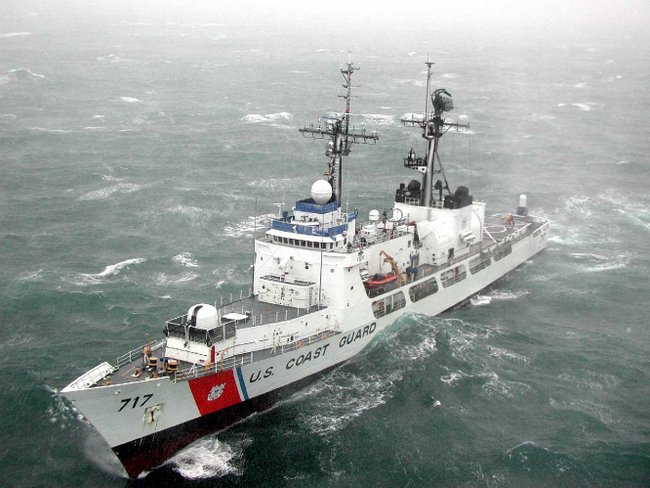
Photo: US Coast Guard
SWLing Post contributor, Brian D. Smith, writes:
“Thought I’d forward you this information on the annual “Night of Nights” event on July 12 (U.S. local time)/July 13 UTC, which provides an opportunity for shortwave QSLs – assuming the listener understands Morse code!
I’m sure you’re familiar with this one-night-a-year happening, in which maritime radio stations rise from the dead and transmit Morse code messages again for a few hours.
As a guy who honed his CW sending skills by listening to these stations’ constantly repeating messages, I have a sense of nostalgia and gratitude toward these stations, which helped me obtain my first Novice license, WN9ICB, at the age of 15 … less than 2 months after I taped the WWV recording that I submitted.”
Many thanks for the notice and sharing your nostalgia! Brian also forwarded an announcement from the Maritime Radio Historical Society of America. The MRHS describe the event:
It’s that time of year again. Time to honor all those ops who came before us by preserving their skills, traditions and culture through on the air operations.
Why 12 July? Long time True Believers know the story. But it may be worth repeating for new arrivals and to remind everyone of the traditions we hope to keep alive.
On 12 July 1999 some very tough looking grizzled old radio pioneers had tears in their eyes as the last commercial Morse code radiogram was sent. It was the end of an era. And as the last beeps faded away into the static they witnessed the end of the career to which they had devoted their lives.
These men – and some women – had stood watch over the airwaves on shore and at sea. Theirs was mostly the business of maritime commerce. But when their ship was in peril they were called upon to send the most electrifying three letters in radio, S O S, knowing that all their fellow radio operators would press their earphones close to get every scrap of information and bring aid to their stricken ship.
Once, our coasts were dotted with great Morse code radio stations, all communicating with ships at sea. They’re all gone now… all except one, the one they called the Wireless Giant of the Pacific, located at Point Reyes.
On that sad day in 1999 another event took place. The Maritime Radio Historical Society (MRHS) was formed. We made it our life’s work to honor the men and women of wireless by restoring that wireless giant. One year and one minute later the giant’s voice once again spanned the oceas as we picked up the thread and kept the faith with our colleagues of the air.
Every year since, in an event that became known as the Night of Nights, Morse code station KPH has returned to the air, joined by KFS and the station of the MRHS, KSM.
This year our friends and colleagues at USCG station NMC have labored mightily to bring that storied call sign back to life on Morse code for the evening along with NMQ in Cambria, CA..
And station NMW in Astoria, OR will be on the air as well.
Stations WLO and KLB will join us again as hey have in years past.
This is a global and local event. Hundreds of listeners around the world will be waiting with their earphones on, waiting for the signals of the great station to once again arc over the dome of the Earth to their receivers.
You can be with us in person!
My buddy, Mike (K8RAT) also notes that this “Night of Nights” event may witness the last ever Morse communications from the US Coast Guard stations. Indeed, this is mentioned in the MHRS newsletter:
This may very well be the last time ever that USCG stations can be heard on the air using A1A (Morse) emission. As new equipment is installed the hardware and wiring for Morse has been progressively removed. And the personnel who knowledgeable in the art retire or are reassigned. So be sure to listen for these stations.
I’ll not only listen to this Night of Nights, but hope to record some of the stations as well.
The frequencies for this event are numerous! I have listed the USCG (NMC) frequencies below, but please check the MHRS newsletter for MRHS and other maritime station frequencies.
Again, Brian, thanks for the heads-up!
Happy listening, everyone!
NMC (Transmit Bolinas, Receive Pt. Reyes)
Frequency Transmitter Antenna
472.0 Nautel ND2500TT/6 173′ monopole tower
500.0 Nautel ND2500TT/6 173′ monopole tower
6383.0 Rockwell-Collins RT-2200 Omni-directional
8574.0 Rockwell-Collins RT-2200 Omni-directional
17220.5 Rockwell-Collins RT-2200 Omni-directional