Category Archives: Guest Posts

Frans experiments with the MFJ-1026 Noise Canceling Signal Enhancer

Many thanks to SWLing Post contributor, Frans Goddijn, who writes:

“Last week I purchased the MFJ-1026 ‘noise canceling signal enhancer’ and I posted two blogs with video about it. Initially the device seemed as useless as it is good looking but then I found a configuration where the device is not only pleasant to have but also useful for radio listening.”

Here are Frans’ reports which he kindly shares from these two posts originally published on his blog, Kostverlorenvaart:

Part 1: MFJ-1026 deluxe noise canceling signal enhancer

Using a GRAHN antenna, (a VENHORST wire antenna for noise reference), the iCOM R8600 radio and optional bhi DSP audio noise canceling, trying to see what’s the best way to cancel noise — on the antenna entry point of the radio or at the speaker output end.

In this case the MFJ-1026 seems ineffective. The DSP at the audio output end works well and easy.

I have also tried two GRAHN antennas on the MFJ-1026, one for MAIN and one for AUX but that was also not noticeably effective yet.

I will also try the little whip antenna that MFJ supplied with the box. Further tweaking may turn out to be helpful on some other frequencies / signals.

Before installing the MFJ i used the little TECSUN H-501x to scan the room for any devices producing radio noise. It turned out that the two Apple Homepods sit in a dense cloud of radio noise, the Macbook Pro also radiates noise, EVE smart plugs controlling lights also produce radio noise, two little label printers s well and the HP printer/scanner too. So I moved those to the other end of the toom or to another room. Continue reading

Guest Post: Everyone should have a “Crisis Radio”

Many thanks to SWLing Post contributor, Jock Elliott, who shares the following guest post:


The Crisis Radio

By Jock Elliott, KB2GOM

Sooner or later, it will happen to you. What’s ‘it’? Short answer: a crisis.

It could be as simple as you wake in the morning to find the power is out; you don’t know how long it has been out, and you don’t know when it is coming back. It might be a weather event: a blizzard, a sandstorm, a tornado, a derecho, a hurricane. It might be a geologic event like a tsunami, earthquake, or even volcanic activity. As recent events have shown, it could even be a war or a revolution.

When normal life is disrupted, and uncertainty is perched on your shoulder like a vulture, you will want to know what’s going on, and your usual means of getting information – telephone, smart phone, internet device – may also be disrupted.

When that happens, radio can come to your rescue. Your local FM or AM (medium wave) station may be on the air, providing vital information to your community, or NOAA Weather Radio may be providing hazard information. In extreme cases, shortwave radio may be beaming information to your area when all else fails.

One of the points that was made when our own Thomas Witherspoon was interviewed recently was that people tend to regard shortwave radio as “crisis” radio.

So I have a couple of very specific recommendations.

First, make sure that your household has a “crisis radio.” By that I mean one that will receive your local AM and FM broadcasters as well as shortwave radio, and, if you live in the US or Canada, NOAA Weather Radio. If you can afford it, I recommend getting a crisis radio that has single sideband capability (SSB) so that you have the ability to intercept ham radio communications, which might be another source of information.

Toward that end, I can heartily recommend the CCrane Skywave SSB radio. (Let’s be clear: I have no commercial connection with CCrane; I get nothing from them for making this recommendation, I purchased my Skywave SSB with my own money.) It has AM, FM, Shortwave, Weather, VHF, Aviation and SSB Bands. It is very small, measuring just 4.8″ W x 3″ H x 1″ D and weighing just 6 ounces without batteries. It will run for over 50 hours on a couple of AA batteries and comes with CC Earbuds, SkyWave SSB Carry Case, and CC SW Reel Antenna which boost sensitivity for shortwave and ham radio listening.

It is a crisis radio that you can stick in your pocket, backpack, purse or briefcase for deployment when the need arises or you simply want to listen to some radio programming. Further, you don’t have to be an expert to operate the CCrane Skywave SSB. Thanks to the Automatic Tuning System, just select the band you want to listen to, press and hold the ATS button for two seconds, and the Skywave SSB will automatically search for stations in that band (AM, FM, Shortwave, etc.) and store those stations in the memory banks for that band. You can later check those memories to hear what programming those stations are broadcasting.

Second, and this is important, if you listen to shortwave radio at all, take the time to let the stations know. Drop them a postcard; shoot them an email, do whatever you can to inform them you are listening, and you value their transmissions.

Why? Because we all want those stations to be there if and when the next crisis happens. And if your local AM or FM station provides special programming to the community a weather event or geologic emergency, for the same reason, be sure to let them know how much you appreciate their efforts.

As a fire captain observed a couple of years after the North Ridge earthquake in California: “You cannot be over-prepared for communications in an emergency.”

You and the ionosphere: Share your propagation stories!

Many thanks to SWLing Post contributor, Jock Elliott, who shares the following guest post:


You and the ionosphere . . . a reader participation post

By Jock Elliott, KB2GOM

Here’s a shocker for you: we live at the bottom of the sky. Above us there are multiple layers of the atmosphere, pressing down on us at 14.7 pounds per square inch.

Of particular relevance to us as shortwave listeners and hams, there is a special layer of the atmosphere, not shown on the chart above called the ionosphere. The ionosphere starts around 30 miles above us and extends up to about 600 miles and includes parts of the layers above.

The Sun’s upper atmosphere, the corona, is very hot and produces a constant stream of Ultra-Violet and X-rays, some of which reach our atmosphere.  When the high energy UV and X-rays strike the atmosphere, electrons are knocked loose from their parent atoms and molecules, creating a layer of electrons.

Now, here’s the cool part: this layer – the ionosphere – is important because radio waves bounce off of it.

The sun, however, is not constant in its action on the ionosphere. The amount of UV and x-ray energy (photon flux) produced by the sun varies at by nearly a factor of ten as the sun goes through an 11 year cycle. The density of the ionosphere changes accordingly, and so does the ability of the ionosphere to bounce radio waves. When the sun is at peak activity, and the ionosphere is “hot,” SWLs and hams are likely to experience excellent long-range propagation. When the sun is quieter, long-range propagation diminishes.

Every 11-year solar cycle is unique, but early indications are that we may on the verge a cycle that favors long-range propagation: https://swling.com/blog/2022/03/termination-event-may-indicate-solar-cycle-strength/

The results can be spectacular. Decades ago, during a particularly hot solar cycle, I once spoke from my station near Albany, NY, to a station in the state of Georgia on a mere 4 watts. On another occasion, I conversed with a ham in Christchurch, New Zealand – a distance of over 9,000 miles – with 100 watts single sideband transmit power. During that same period, I would routinely listen to shortwave stations halfway around the world.

And now, it’s your turn – what’s your favorite long-range propagation story, either as an SWL or ham? Please comment!

“It’s magic, but it’s real”: The joys of listening to the ham bands

Many thanks to SWLing Post contributor, Jock Elliott, who shares the following guest post:


Icom IC-756 Pro Transceiver Dial

The joys of listening to the ham bands

By Jock Elliott, KB2GOM

            “It’s magic, but it’s real.” That statement was uttered recently by an amateur radio operator – a ham – from South Carolina. He was on the 20-meter band (around 14,187 USB), operating in upper sideband (USB), chatting with a British ham from the Isle of Wight off the coast of England, and another US ham located about 60 miles south of Chicago, Illinois.

The South Carolina ham was expressing his delight that a ham from the United Kingdom could deliver a loud signal at such a distance with a mere hundred watts of transmit power, and that they could talk as easily as two people chatting on the telephone. A little later in the conversation (a QSO in ham lingo), the South Carolina ham related how he run a special events ham station from a vintage B17 bomber while in flight! He said it was very noisy, even with headphones.

Listening to the ham bands is just plain fun. You never know what you might encounter. During the same monitoring session, I tuned up the spectrum to the 10 meter band (around 28,400 USB) and heard a ham loud and clear from Santiago, Chile. According to that ham, the climate there is apparently similar to California.

You don’t need a lot of fancy gear or a ham license to listen in on the fun. A shortwave receiver with single-sideband capability will do the trick. If your radio came with an auxiliary wire antenna, deploy it. It will help to boost faint signals. If your radio did not come with an auxiliary wire antenna, it is easy to make one. Get yourself 20 feet of insulated wire (any type will do, but thinner is easier to coil up when not in use), attach an alligator clip (available from most hardware stores) and clip it to the whip antenna on your shortwave portable.

A couple of cautions: do not go nuts with the length of wire. 20 feet is plenty. In addition, do not EVER deploy your antenna where it could fall on a power line or a power line could fall on it. And, finally, if you deploy your wire antenna outdoors, be sure to disconnect it and/or bring it in when foul weather threatens.

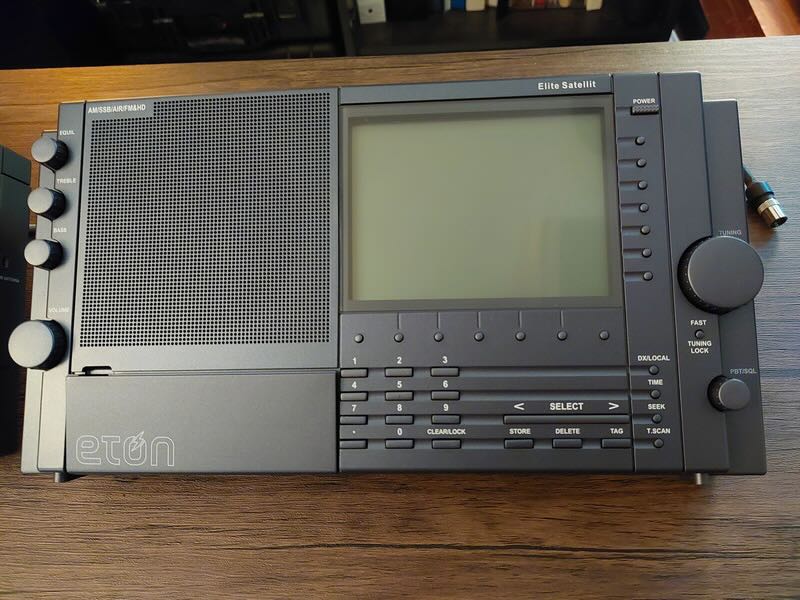
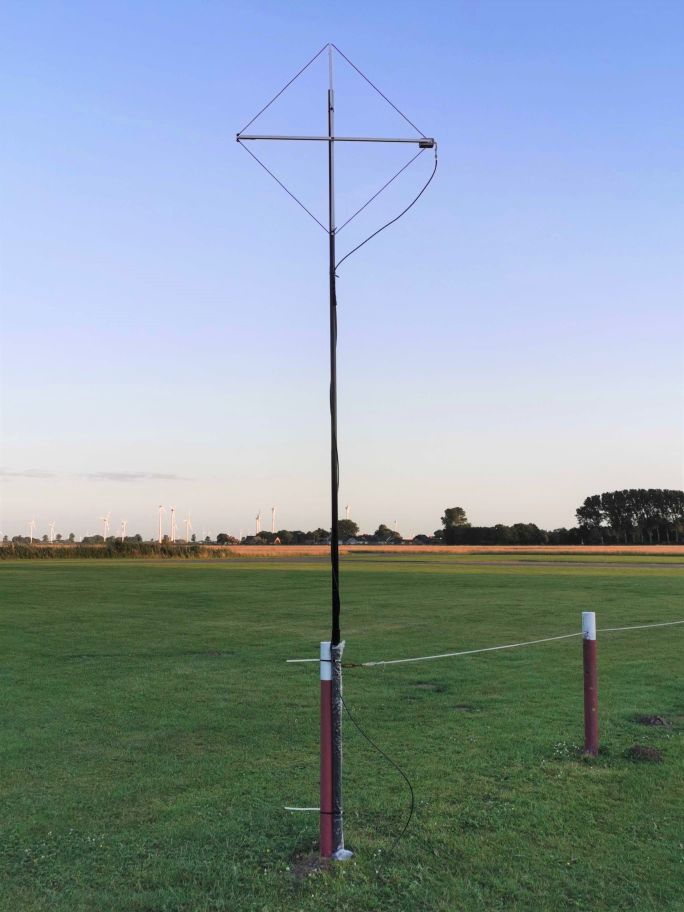
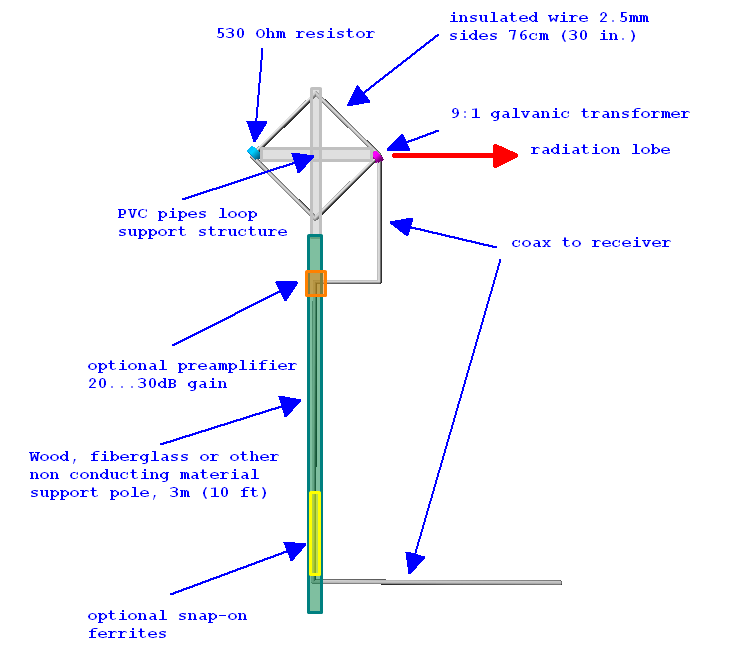
For the record, to intercept the ham communications above I listened with headphones on my Satellit 800 receiver, using my horizontal room loop antenna and the BHI Compact In-Line Noise Eliminating Module.

What can you hear? Lots of times, you will hear hams swapping signal reports and telling each other what kind of ham radio transceivers and antennas they are using. During contests, you’ll hear hams making contact after contact, as quickly as they can. But other times you will hear conversations of all types.

Three decades ago, when I was actively DXing as a ham, I once had a conversation with a UK ham who was a falconer. He had flown the birds for the movie Lady Hawke. No kidding. Another time, I worked a station in Christchurch, New Zealand, from Troy, New York, on just 100 watts. If you were a shortwave listener back then, there’s a chance you could have heard those contacts, and it’s a good bet that interesting contacts are taking place today on the ham bands, if you are willing to accept the challenge of tuning around to find them . . . so join the fun!

With the start of a new solar cycle conditions appear to be changing to favor long-range propagation. It seems like the perfect time to start monitoring the ham bands. You never know what you might find.

You can find a complete downloadable list of the US ham bands by clicking here.


Check out more of Jock Elliott’s guests posts by clicking here!

Guest Post: Keeping an ear on the US Coast Guard

Photo: US Coast Guard

Many thanks to SWLing Post contributor, Jock Elliott, who shares the following guest post:


Keeping an ear on the US Coast Guard

By Jock Elliott KB2GOM

Wandering the vast expanses of YouTube, I encountered an episode of “Coast Guard Alaska” on DangerTV’s Protecting Our Waters/Coast Guard Rescue Series playlist. One episode led to another, and before long, I was binge-watching the series.

Why? Because the courage, dedication and performance of the “Coasties” is just extraordinary. They dangle from hoist cables to pluck survivors from the water, injured sailors from the decks of ships, mariners from sinking vessels, and even incapacitated hikers from mountains. They medevac sick and injured men, women, and children out of remote Alaskan villages; provide medical support while flying them to higher levels of care, and intercept drug smugglers in southern waters. I stand in awe of these men and women. (And – woe is me – it turns out there are similar series for Coast Guard Pacific Northwest and Coast Guard Florida.)

So, I wondered, could I hear the US Coast Guard on the radio? The answer, it turns out is a mixed bag.

The U.S. Coast Guard ceased monitoring all High Frequency (HF) shortwave voice distress frequencies within the contiguous United States and Hawaii on 7 February 2022.  HF voice distress watchkeeping continues unaffected in Alaska and Guam. See below for the Alaska and Guam USB frequencies.

kHz SHIP STATION kHz COAST STATION Station and Schedule (UTC)
NOJ (Kodiak AK)
4125 4125 24 HRS
6215 6215 24 HRS
8291 8291 24 HRS
12290 12290
kHz SHIP STATION kHz COAST STATION Station and Schedule (UTC)
Guam
6215 6215 0900-2100Z
12290 12290 2100-0900Z

Note: 12290 kHz is available under NOJ upon request
Note: 16420 kHz is available at NOJ and Guam upon request

So, if you have a good radio capable of upper sideband (USB) reception, a decent antenna and your location and/or propagation favors you, you might have a shot at hearing USCG Alaska or Guam HF communications.

National Weather Service Marine Products via U.S. Coast Guard HF Voice

You have a much better chance of hearing the U.S. Coast Guard broadcasting National Weather Service high seas forecasts and storm warnings from six high seas communication stations. See table below for station locations and schedules. Transmission range depends on operating frequency, time of day and atmospheric conditions and can vary from only short distances to several thousand miles.

For example, I have heard a weather forecast from the US Coast Guard Communications Command in Chesapeake, including a forecast of tropical weather from the National Hurricane Center, on 4426 USB at my home in upstate New York.

Here are the schedules:

Chesapeake (NMN)
HF Voice Broadcast Schedule

4426, 6501, 8764 kHz (USB) 0330Z1 0515Z2 0930Z1
6501, 8764, 13089 kHz (USB) 1115Z2 1530Z1 2130Z1 2315Z2
8764, 13089, 17314 kHz (USB) 1715Z2
1 Offshore Forecasts, hurricane information

2 High seas Forecast, hurricane information

Broadcast of hurricane and other weather broadcasts from this station may on occasion be preempted, as the frequencies are shared with other USCG stations.

New Orleans (NMG)
HF Voice Broadcast Schedule

4316, 8502, 12788 kHz (USB) 0330Z1 0515Z2 0930Z1 1115Z2 1530Z1 1715Z2 2130Z1 2315Z2
1 Offshore Forecasts, hurricane information

2 Highseas Forecast, hurricane information

Broadcast of hurricane and other weather broadcasts from this station may on occasion be preempted, as the transmitters are shared with the radiofax broadcast.

Pt. Reyes (NMC)
HF Voice Broadcast Schedule

4426, 8764, 13089 kHz (USB) 0430Z 1030Z
8764, 13089, 17314 kHz (USB) 1630Z 2230Z
Broadcast of hurricane and other weather broadcasts from this station may on occasion be preempted, as the frequencies are shared with other USCG stations, and the transmitters are shared with the radiofax broadcast.

Kodiak (NOJ)
HF Voice Broadcast Schedule

6501 kHz (USB) 0203Z 1645Z

Honolulu (NMO)
HF Voice Broadcast Schedule

6501, 8764 kHz (USB) 0600Z 1200Z
8764, 13089 kHz (USB) 0005Z 1800Z

Guam (NRV)
HF Voice Broadcast Schedule

6501 kHz (USB) 0930Z 1530Z
13089 kHz (USB) 0330Z 2130Z

Coastal Maritime Safety Broadcasts on VHF

The other place in the radio spectrum where you might hear voice transmissions from the Coast Guard would be on the maritime VHF channels. Urgent marine navigational and weather information is broadcast over VHF channel 22A (157.1 MHz) from over 200 sites covering the coastal areas of the U.S., including the Great Lakes, major inland waterways, Puerto Rico, Alaska, Hawaii and Guam. Broadcasts are first announced over the distress, safety and calling channel 16 (156.8 MHz) before they are made. All ships in U.S. waters over 20m in length are required to monitor VHF channel 16, and must have radios capable of tuning to the VHF simplex channel 22A.

Although VHF signals are generally short range, here at El Rancho Elliott, I can clearly hear the announcement on channel 16 on a scanner and then I can switch to channel 22A to hear the broadcast, even though my location is at least 140 miles from the nearest large body of water.  In addition, propagation sometimes opens up so that VHF signals can be heard at long distances.

Termination Event May Indicate Solar Cycle Strength

Predictions for Solar Cycle 25. Blue is the “official” prediction of a weak cycle. Red is a new prediction based on the Termination Event.

Feb. 26, 2022: Something big just happened on the sun. Solar physicists Scott McIntosh (NCAR) and Bob Leamon (U. Maryland-Baltimore County) call it “The Termination Event.”

“Old Solar Cycle 24 has finally died–it was terminated!” says McIntosh. “Now the new solar cycle, Solar Cycle 25, can really take off.”

The “Termination Event” is a new idea in solar physics, outlined by McIntosh and Leamon in a December 2020 paper in the journal Solar Physics. Not everyone accepts it–yet. If Solar Cycle 25 unfolds as McIntosh and Leamon predict, the Termination Event will have to be taken seriously.

(Read the full story here at Spaceweather.com)

Robert Gulley, K4PKM (formerly AK3Q), is the author of this post and a regular contributor to the SWLing Post. 

Jock shares: “A bit more about NOAA Weather Radio”

Photo by Raychel Sanner via Unsplash

Many thanks to SWLing Post contributor, Jock Elliott, who shares the following guest post:


A bit more about NOAA Weather Radio

By Jock Elliott, KB2GOM

Okay, I’ll admit it: I’m a fan, an advocate, an evangelist for NOAA Weather Radio (NWR).

Why? Because, quite simply, if you live in the United States, it is one of the very best deals you are ever likely to get. NWR is the voice of the National Weather Service. It is the fastest and most reliable means of receiving alerts when hazardous weather approaches.

NWR includes more than 1000 transmitters, covering some or all of 50 states, adjacent coastal waters, Puerto Rico, the U.S. Virgin Islands, and the U.S. Pacific Territories. Broadcasts are found in the VHF public service band at these seven frequencies (MHz): 162.400, 162.425, 162.450, 162.475, 162.500, 162.525, and 162.550. Radios capable of receiving NWR signals may include consumer radios, ham radios, scanners, and dedicated weather radios.

For more information about coverage, check these:

NOAA Weather Radio is free. There are no commercials, you don’t have to wait for other programming to be completed to hear the weather forecast, and, because it is radio, you can listen and get a concise summary of what’s going on with the weather in your area while you are doing something else. Even better, the folks at the National Weather Service tell me that over 80 percent of the NWR transmitters have some form of backup or emergency power, many of which can continue to operate for 5-10 days while the main power is out. There is a wealth of information about NWR here: https://www.weather.gov/phi/nwrfaq scroll down to see details.

Why do you want a receiver that can hear NOAA Weather Radio? Short answer: because every state in the Union has some form of hazardous weather that could prove lethal. Early warning just might save your life.

In his excellent book Warnings – the true story of how science tamed the weather, Mike Smith points out how successful meteorology has been at saving lives. In the 1950s, with the beginning of the tornado warning system, the death rate from tornados was 1.5 deaths per million people. By 2009, the death rate was down to .068 deaths per million, a decrease or more than 95 percent. The investment weather radar, prediction techniques, and warning systems such as NWR has paid handsome dividends.

So what makes an NWR-capable radio good? First, sensitivity. Greater sensitivity increases the odds that the radio will be able to hear more NWR stations in your local area, which in turn raises the probability that you’ll be able to hear an NWR station with backup power when the lights go out.

Second, alert capability. An alert function – that is, the ability to put the radio in standby mode and have it automatically switch on when NWR transmits an alert tone is a great plus. You can go about your business, and the radio will wake up and alert you when you need to pay attention.

Third, advanced alert capability. Ideally, you would like to be alerted only when a hazard is close to your immediate vicinity. Some dedicated weather radios and advanced scanners offer Specific Area Message Encoding (SAME) that can be programmed by the user to only alarm for weather and other emergency events in specific, desired counties, thereby eliminating unwanted alerts for areas that are not of concern to the listener. In addition, some weather radios have a selectable alert option that can be programmed to alert only when certain hazard codes – ranging from Avalanche to Winter Storm Warning – have been selected by the user and are transmitted by the local NWR station.

With that in mind, here are some NWR-capable radios with which I have had personal experience. With each radio, I did a quick search from the same location to see how many local NWR stations it would receive, as a rough indication of sensitivity. The good news is that every single one of the radios below could receive at least two NWR stations in my local area and had basic alert capabilities.

Consumer radios with AM/FM receive

CC Skywave SSB

CCrane 2E –could hear clearly 3 NWR stations in my area, basic alert function, house mains and battery power (over 200 hours).

CCrane Skywave SSB – could hear 2 NWR stations clearly and one scratchy, basic alert function, battery power (over 50 hours).

Eton FRX3+ — could hear NWR 3 stations clearly, basic alert capability, power options include solar, hand-crank dynamo, and rechargeable battery (can also be recharged off house power with USB capable), internal battery can be used to recharge cell phone battery.

Ham radio hand-talkies

Icom V80 with aftermarket high-performance antenna – could hear 2 NWR stations clearly and one scratchy, basic alert capability.

Yaesu VX-6 with Diamond 77 aftermarket antenna — could hear 2 NWR stations clearly and one scratchy, basic alert capability.

Scanners

Uniden BC125AT with Diamond 77 aftermarket antenna – could hear 3 NWR stations clearly, basic alert function.

Uniden SDS200 with homebrew off-center-fed dipole antenna (see below) – could hear 6 NWR stations clearly, highly sophisticated programmable SAME and specific hazard alert functions, no battery power (the SDS100, handheld version of this scanner provides battery power); would require uninterruptible power supply or something similar if mains power goes off. Author’s note: while the performance is stellar, this is by far the most expensive option. With the stock antenna that comes with the SDS200, I could hear two NWR stations clearly.

Dedicated NOAA Weather Radio Receiver

Midland WR120 Weather Alert Radio – At the time I began this write-up, I did not own a dedicated weather radio receiver, so I reached out to www.midlandusa.com, and they were kind enough to send me this unit, which is built solely to receive National Weather Radio stations. With the built-in whip antenna extended, the receiver was clearly very sensitive. I could hear 4 of my local NWR stations clearly, and 2 more scratchy but copyable. If you are in a fringe area, there is a socket for plugging in an external antenna such as the one I describe below.

There is a little symbol on the box that says “EZ Progamming,” and I was pleasantly surprised that it was true. Between the MENU and SELECT keys, it is easy to walk through the setup. I thought that I would have to look up the SAME code for my location, but the WR120 has a built-in database of all the states and counties, so selecting my county was a snap. In addition to SAME programming, the WR120 has a long list of selectable alert options that you can choose to meet your needs. That list can be downloaded here: https://cdn.shopify.com/s/files/1/0531/2856/0817/files/SAME_List_of_Emergencies_Non-Weather_Emergencies.pdf?v=1636648846

The WR120 is powered by a tiny wall-wart transformer that plugs into house power, and the user installs 3 AA batteries to provide back-up power in case the lights go out. The manual does not say how long it will operate on battery power.

It seems to me that if you do not already own a device that will receive NOAA Weather Radio stations, the WR120 would be an excellent choice.

Boosting Performance

If you want to boost the performance of the radio you are using to listen to NOAA Weather Radio, I can highly recommend this antenna: https://wiki.radioreference.com/index.php/Homebrewed_Off-Center_Fed_Dipole .

I built the wire version, hung it inside in a corner of my radio shack, and with it attached to either Uniden scanner or my Icom V80 ham handi-talkie, I can hear six NWR stations from my location. This antenna offers a large boost in performance for a modest investment of time and money.

In his blog, Smith argues that each of us ought to have redundant means of alerting us to hazardous weather: an app on your smart phone, plus an NWR-capable radio with alert function at home, plus your local TV or radio stations. To which I say: darn good idea!