Category Archives: Guest Posts

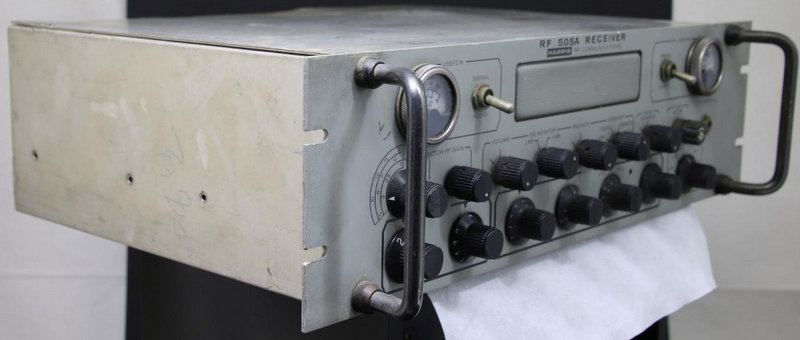
Bob recalls working at Harris and putting the RF-505A on the air

Fullscreen capture 5102016 114119 AM

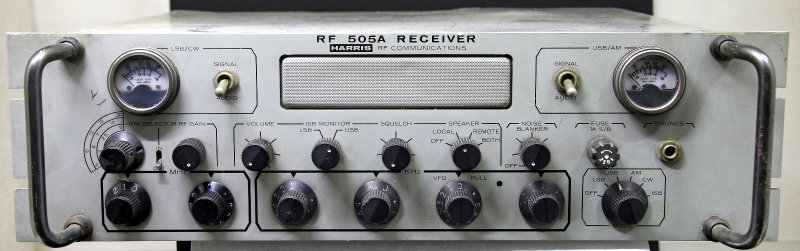
In response to our post mentioning the Harris RF-505ASWLing Post contributor, Bob LaRose (W6ACU), writes:

I know the RF-505A very well. It was introduced in about 1969 while I worked at Harris in Rochester. I started working there as a Co-Op student while at RIT and then after I got my BSEE I joined them full time, initially as a Field Engineer but quickly found my way into Marketing and eventually Sales.

Right after the first version came out, the RF-505, I took one home to my parent’s house for a weekend and did some SWLing with it. It was very neat in one respect – it tuned ISB (Independent Side Band) and in those days there were a number of utility stations using ISB (separate traffic on each sideband). To an SWL some of the most interesting of these were the VOA point-to-point links from the East and West Coast, each carrying two simultaneous program feeds for the overseas relay stations!

Harris-RF-505A

While overall a good receiver my personal results on the sensitivity of the original RF-505 were not very positive. On the bench with exactly a 50 ohm source it looked good but on a real world antenna it was pretty numb. Eventually, after a lot of internal arguments, they came out with the RF-505A that included a tunable active preselector as shown in the photos. Problem solved.

For a ham or SWL the RF-505 was a real pain in the butt to tune. You could dial in any exact frequency but the decade switches didn’t roll over (either mechanically or electrically) so you had to do a lot of knob twiddling to do any kind of band scanning. The detents on the switches connected to the knobs were pretty stiff so you could easily take some finger skin off tuning around!

If I remember correctly Harris built them for about a five year period and then replaced them with the RF-550, which was a monster of a receiver with all kinds of advanced features. It included a keyboard with electronic display.

Great memories!

Thanks so much for this RF-505A insight, Bob! I had a hunch that band-scanning wasn’t the RF-505A’s strong suit–it would be incredibly cumbersome to scan with so much “knob twiddling.”

It must have been pretty amazing to work for the legendary Harris corporation. Thanks for sharing!

Steven is impressed with the CountyComm GP5/SSB and high-gain bar antenna

GP5SSB-Front

Many thanks to SWLing Post contributor, Steven Crawford, who sent the following message to me (several weeks ago) and has kindly allowed me to share it here. Steven writes:

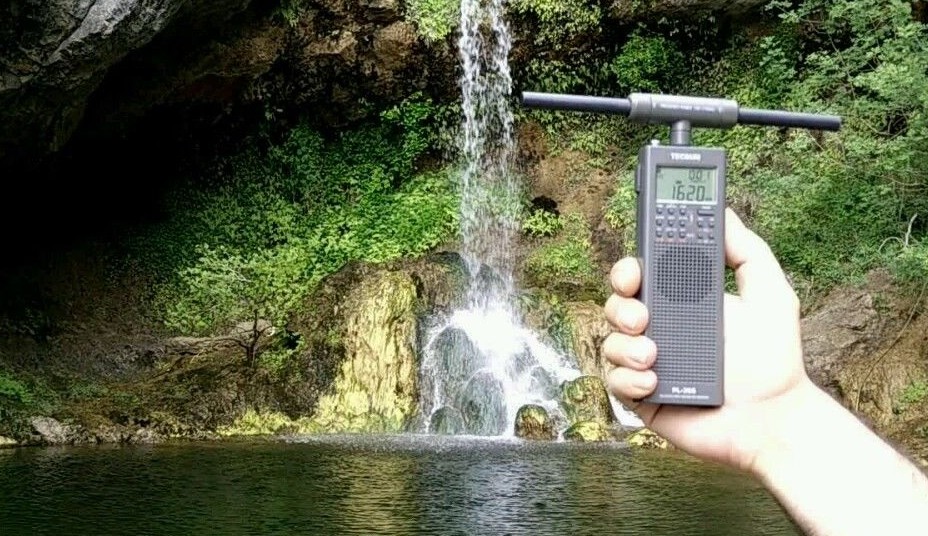
I hope this finds you and yours well. I just wanted to take a few moments and express my sincere thanks to you for your posts of 12/20/2014 and 1/6/2016, and for sharing Larry Thompson’s post of 2/28/2016, and Ron’s post of 1/16/2016. If you are in regular contact with the other individuals please feel free to pass along my thanks as each of you and the respective post convinced me to purchase a CountyComm GP5/SSB and Ebay seller playloudfm’s high-gain ferrite bar antenna. I am so glad I did, so a hearty Thank You to each of you.

The afternoon of March 19th local was the first chance I had to use my GP-5/SSB. After popping in three fresh AA’s on AM using the internal ferrite bar antenna Beaumont, Texas’ own powerhouse 5,000 watt KLVI 560 was there as was 1,000 watt Orange’s KOGT 1600, 23 miles away and my AM daytime benchmark 50 kW KTRH 740 Houston 70 or so miles away on the back side of their pattern. KTRH surprisingly can be a little difficult during the day due to noise. The surprise was 50 kW WWL New Orleans 240 miles away was intelligible above the background noise. Extending the whip a quickie SW test showed WWV Fort Collins time signal was present at 15 MHz.

On the AM side the real money lay after dark once the sun had set in Beaumont and San Antonio. Using only the internal ferrite bar antenna all of the aforementioned AM stations were present. Continuing the internal antenna’s test 50 kW WBAP 820 Dallas 244 miles away and 50kW WOAI 1200 San Antonio 266 miles away were present. I started grinning when 50 kW WLAC 1510 Nashville 598 miles away and 50kW KMOX 1120 St. Louis 632 miles away were just intelligible above the background noise. Keep in mind these stations were received using only the internal antenna.
GP5SSB-MW-Antenna-1

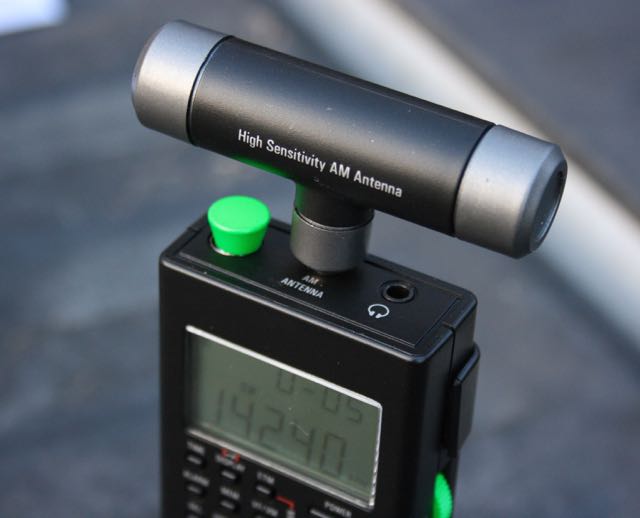
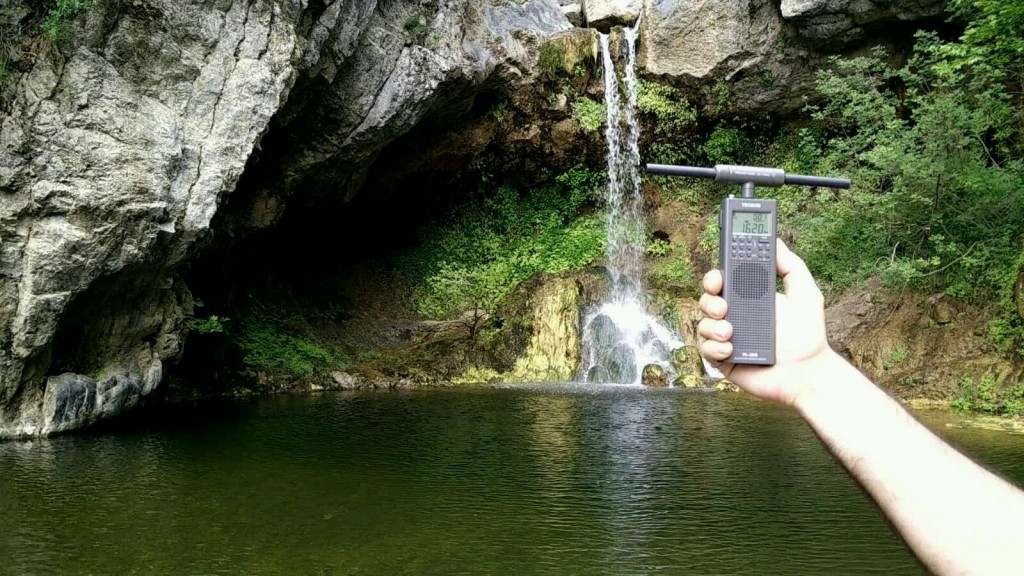
I popped the CountyComm included factory external ferrite bar on and used it 9 -10 PM Saturday local, 0200 – 0300 March 20 UTC. Using the external antenna rotated for best reception WLAC and KMOX improved to the point they were easily listenable. 50 kW WSB 750 Atlanta 625 miles away was listenable above the noise and most surprising 50kW WBBM 780 Chicago 892 miles away(!!!) was just intelligible above the background noise. Another quickie SW test was performed at 10 PM local, 0300 March 20 Sunday UTC by extending the built in whip and the WWV Fort Collins time signals were present at 5 and 10 MHz with 10MHz being particularly well received.
Ferrite-Bar-Antenna-PL-365-GP5SSB

Photo source: eBay

A real treat lay in store after receiving Ebay seller playloudfm’s aftermarket high-gain ferrite bar antenna, the subject of your 1/6/2016 and Ron’s 1/16/2016 post, yesterday. I am not experienced enough to judge what the space weather or propagation conditions were like from 0300 to 0400 March 27th UTC but I was extremely surprised and pleased with the reception results the new antenna afforded.

As I sat relaxing in my easy chair before bed I decided to try the combo out using the included earphones so as to not wake my wife. With the lights off and my iPad open to www.oldradio.com/archives/stations/ccs.htm to help identify clear channel stations I took the handheld combo for a spin. All of the stations found with the factory supplied external ferrite bar antenna were present. There was just so much more signal present using the aftermarket antenna each became easily listenable. For WOAI, WWL, WLAC and KMOX the effect was as if I was located within their local night coverage area. 50 kW WHAS Louisville Kentucky 740 miles away was newly found present. Chicago’s WBBM was there as before and I was surprised to find 50 kW WGN 720 Chicago as well. The reception quality was such that one could enjoy listening to a Cub’s game or breaking local news story should one be so inclined on WBBM or WGN. The listening experience was similar for newly found 50 kW XEROK 800 Ciudad Juarez 738 miles away.

The most surprising and gratifying, to me anyway, find of the night using playloudfm’s antenna was receiving 5,000 watt (nights!) KCMO 710 Kansas City Missouri 624 miles away. The ability to rotate the antenna to take advantage of it’s directional and nulling ability really aided in this reception. It really is a great benefit to be able to rotate the GP-5/SSB’s external AM antennas for peak signal strength while nulling interfering signals and noise. Indeed KCMO was missing in one antenna orientation but rotating the antenna 90 degrees and the station popped in. I really should have jotted signal strength to noise ratios down but I was just enjoying tuning through the spectrum too much. I have not fully tested SSB Exalted Carrier tuning on the GP5/SSB of difficult stations but have tried it 3 or 4 times and it does appear to work as does tuning 1 kHZ either side of the nominal frequency. The later technique did help clean up some signals by further reducing background noise without greatly affecting listenability.

As best I can tell I ordered and received either the last or next to last of playloudfm’s current batch of high-gain ferrite bar antennas as the Ebay add showed two available when I ordered and the ad was almost immediately replaced with an “accepting pre-orders” ad. Currently there are no ads by seller playloudfm.[Note: it appears more inventory has been added to eBay.] My transaction and shipping was quick and smooth. The bulk of the two week wait occurred after the package was received at the Athens airport where tracking stopped. It should be noted by buyers should more antennas become available the tracking number supplied does not work on the USPS tracking service but it will track the package to Athens through Greece’s Hellenic Post tracking service at http://www.elta.gr/en-us/personal/tracktrace.aspx

Note: all distances listed above are “as the crow flies”, straight line city center to city center and are not necessarily correct for the transmission tower location.

This little radio is fast becoming a hand holdable favorite with easy to learn button placement for use in the dark. I am all ready beginning to prefer it to my Sony SW7600GR / AN200 loop combo for MW broadcast AM reception but I really must do more work with SW before calling the CountyComm my favorite of the two.

Steven followed up a week or so later with this addendum to his review:

I finally got the opportunity to test the FM performance of the radio using only the extended whip on the afternoon of April 1st, April 1st 19:30 – 21:00 UTC. Using www.radio-locator.com and my zip code I found 51 FM stations listed as local, distant and possible fringe reception. I was very surprised and pleased when I was able to log all of the most distant fringe stations, KUHF, KKBQ, KTBZ, KKHH, KHMX, KBXX, KODA, KILT, KLOL, KMJQ, KRBE, KOVE, and KGLK, with ERP’s listed as 90 to 100 kW and distances in the given in the 80 to 90 mile range. In short I was able to log all 51 listed stations. The FM broadcast band is crowded indeed with this little rocket radio. It should be noted my little corner of Southeast Texas is dead flat with nothing between me and these stations broadcast towers but Houston skyscrapers, the typical urban / suburban sprawl, timber and marsh. Ground elevations range from 16 ft to 80 ft above sea level between me and many of the broadcast towers.

[…]My Sony SW7600GR / AN200 loop / Sony AN-LP1 loop combination sits in it’s go bag rapidly falling into disfavor, replaced by the easily used in the dark one handed CountyComm GP-5/SSB. Again thank you for your kind response and thanks again to all who motivated me to purchase this rig.

Steven, thank you so much for taking the time to share your experience with the GP5-SSB and the high-gain ferrite bar antenna.

I also have the high-gain ferrite bar antenna and have been meaning to post videos showing how it performs compared with the supplied GP5 antenna. I must say, it does do a pretty amazing job. I’ll get some videos posted in the coming weeks!

Guest Post: Tracking High Seas Pirates on Shortwave Radio

Suspected pirates surrender to crew members of the CGC Boutwell. (U.S. Coast Guard photo)

Suspected pirates surrender to crew members of the CGC Boutwell. (U.S. Coast Guard photo)

Many thanks to SWLing Post contributor, Mario Filippi (N2HUN) for the following guest post:


Tracking High Seas Pirates on Shortwave Radio

by Mario Filippi (N2HUN)

(All photos taken by author–click to enlarge)

Ahoy! After spinning a radio dial for over a half-century, shortwave listening still provides a source of adventure and interesting intercepts. While major broadcasters continue to move to the Internet and dwindle in number, there nonetheless remains plenty of utility intrigue to be had; you just need to know where to look, and be comfortable with other modes of communication such as RTTY (Radioteletype).

RTTY remains on HF (3 – 30 MHz), albeit mostly encrypted, but there are some stalwarts of this mode that transmit important and interesting information for ships at sea. The information can take the form of weather broadcasts, hazards to navigation, information on ships lost at sea, and pirate activity. Yes, pirate activity but not radio pirates; real honest-to-goodness modern day pirates looking to loot, plunder and prey upon commercial ships making an honest living or other leisure watercraft just out having fun.

SignaLink-AOR

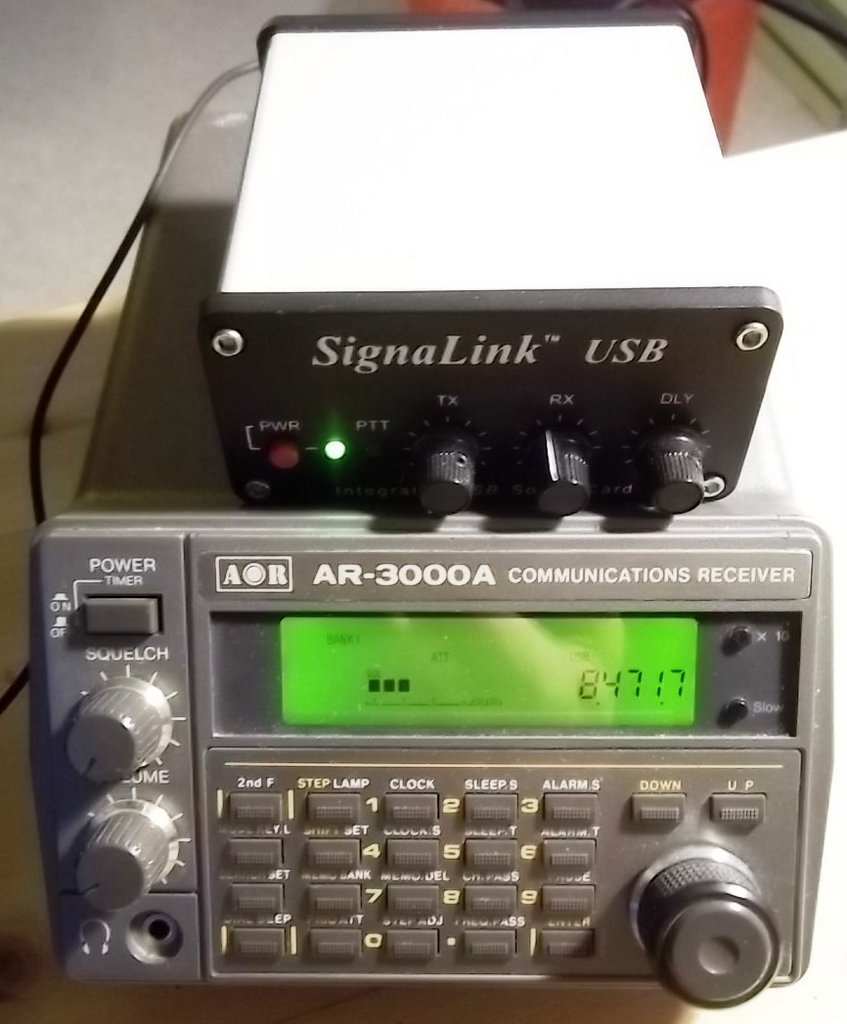
Who knows what dangers lurk behind that dial? Trusty AOR AR-3000 receiver and SignaLink™.

Has your interest been piqued? When avast mateys as I spin ya’ a yarn on how to find out where these sea-faring scoundrels lurk from the Caribbean all the way to the South China sea!

Pirate activity is not something of the past; it exists today and is a threat conducted by ragtag armed ragamuffin groups. To keep abreast of the action you’ll need the following gear: a shortwave radio with single sideband (SSB), a decent antenna, a means of decoding RTTY, and WLO, a station from Mobile, AL that transmits information to ships at sea.

You’ll do well to add WLO’s frequency to your receiver’s memory list as it’s a pretty active station that faithfully serves the sea-faring community and is one of the gems on HF.

First, tune your receiver using USB (Upper Side Band) to around 8.472 MHz and listen for that warbling sound. You will also need a way to pipe the audio from your shortwave receiver to a computer (I use a SignaLink™ USB) and a decoding program for RTTY, such as MMTTY.

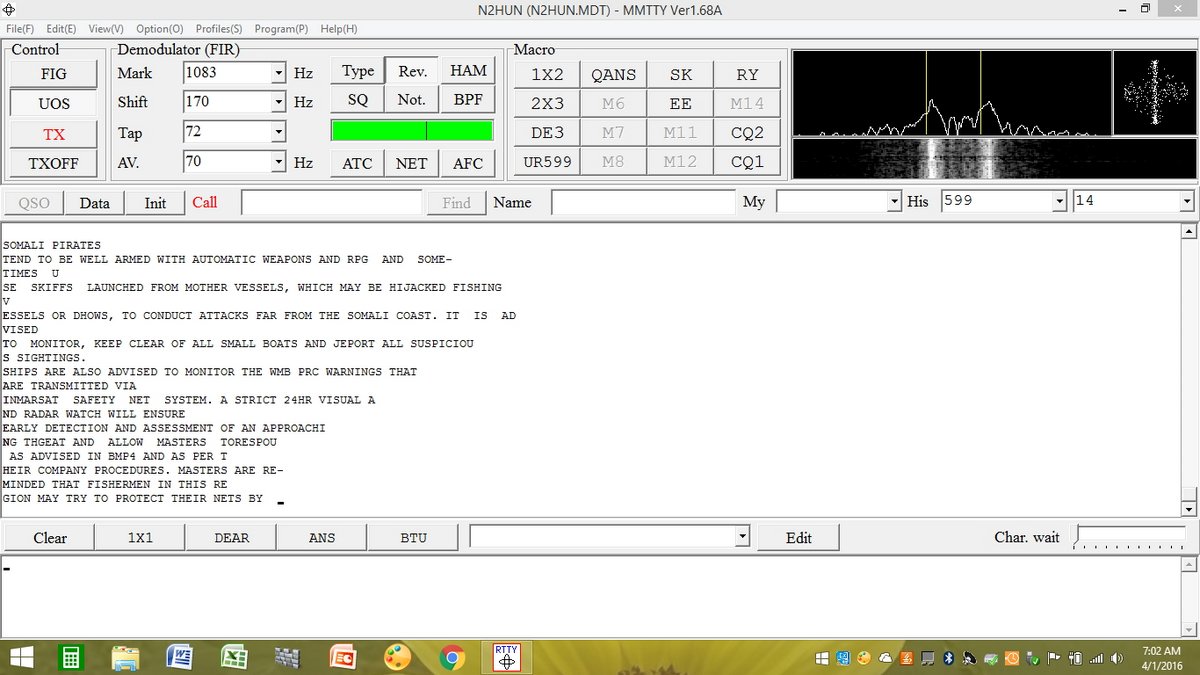
To decode you’ll need to set the baud rate (45.45) and shift (170 Hz) on MTTY (or software program of choice) and tune your radio slightly up and down frequency until the software starts decoding.

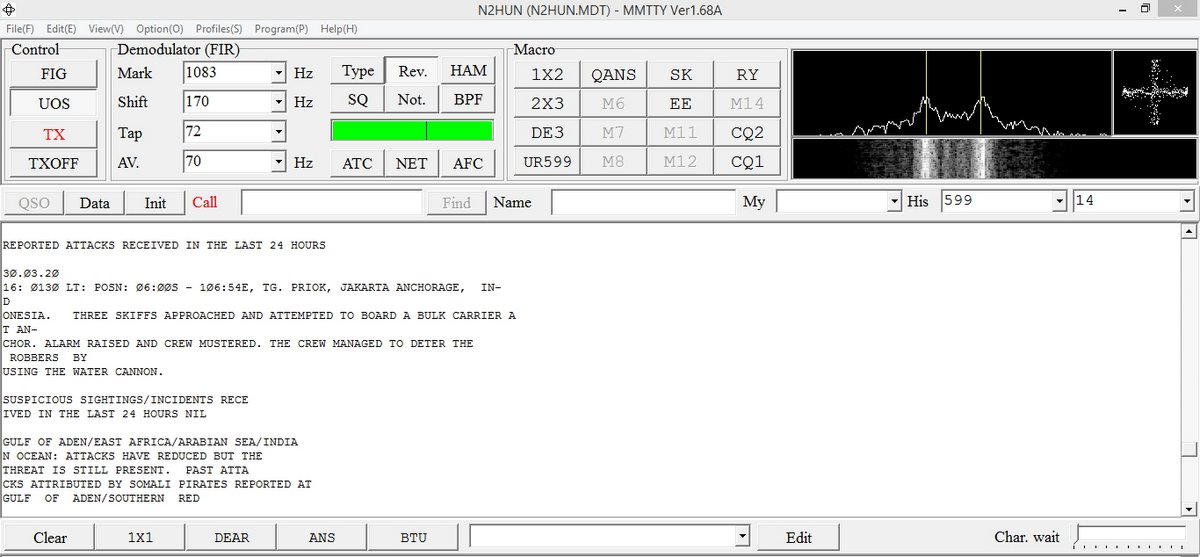
You may have to press the “Reverse” or “Rev” selector at times. MMTTY is my favorite for RTTY decoding, and a picture of it is below.

WLO, Mobile AL, with RYRY idling loop, MMTTY decoder, 45.45 bauds, 170Hz shift, “Rev.”

WLO, Mobile AL, with RYRY idling loop, MMTTY decoder, 45.45 bauds, 170Hz shift, “Rev.”

MMTTY is available as a free download from Makato Mori, JE3HHT. I’ve used his program for over a decade and it performs well.

You can also use MultiPSK or FLdigi to decode RTTY so it’s the user’s choice as to which is a better fit.

Anyway, what are these pirates up to? Well the next few screenshots (click to enlarge) show some interesting activity as per WLO’s RTTY transmissions:

Pirates use element of surprise with guns and knives as armaments.

Pirates use element of surprise with guns and knives as armaments.

Somali pirates reportedly armed with automatic weapons and rocket-propelled grenades. Yikes!

Somali pirates reportedly armed with automatic weapons and rocket-propelled grenades. Yikes!

pic5

Give ‘em hell boys! An alert bulk carrier crew aborted hijacking with teamwork and water cannon.

Ships are encouraged to report pirate activity via FAX or phone.

Ships are encouraged to report pirate activity via FAX or phone.

Well mateys that’s enough high seas adventure for now, so first shove off to the galley for some grub (or grog) and then head to the radio room, turn on that rig and get ready for action on HF, you’ll find plenty to choose from, it’s out there for you.

I would like to thank the operators of WLO for providing such a valuable service to mariners and for providing us radio aficionados with interesting reception! And thanks readers!

P.S. Note that WLO alternates from RTTY to Sitor B so just make sure you are listening to the RTTY broadcast. If the transmission is in Sitor B then you can use a NAVTEX (e.g. YAND) decoder instead.


Thank you so much, Mario, for sharing yet another fascinating aspect of our radio world! FYI: I’m planning on purchasing a SignaLink USB at the Dayton Hamvention this year.

Readers, you can read all of Mario’s posts by clicking or bookmarking this link.

Ken’s E. H. Scott Philharmonic Beam of Light console radio

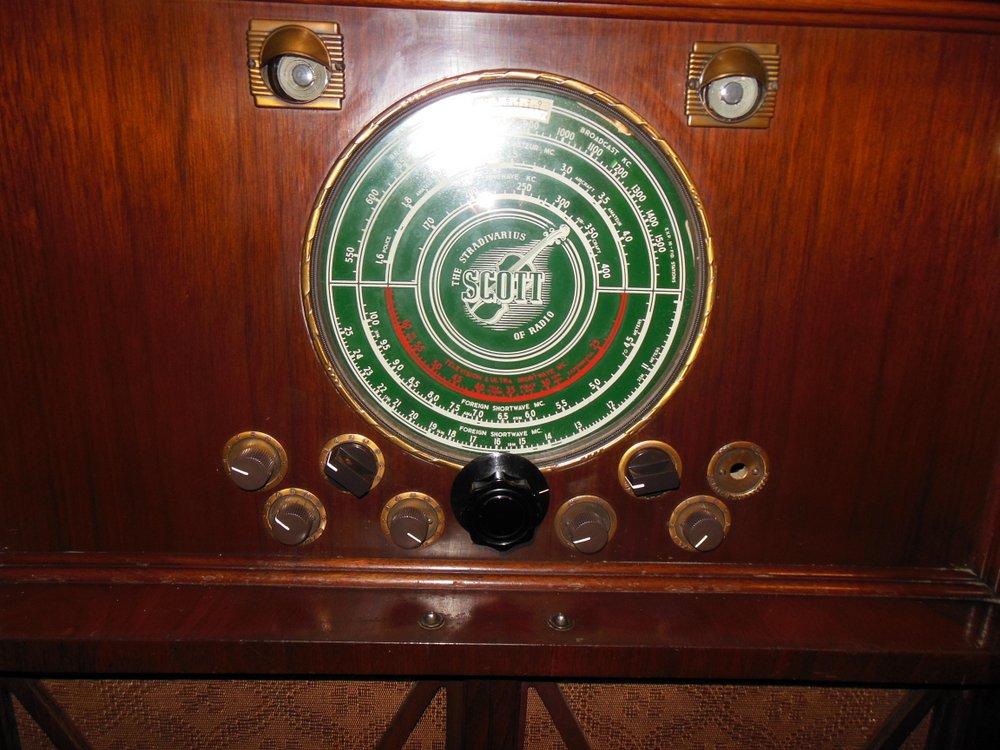
E. H. Scott Philharmonic Beam of Light Open 2

In response to an inquiry in our post about the Crosley WLW Model Super-Power Radio Receiver, SWLing Post contributor, Ken Carr, writes:

I’m not sure if my radio is a ‘benchmark’ but it sure is close to it.
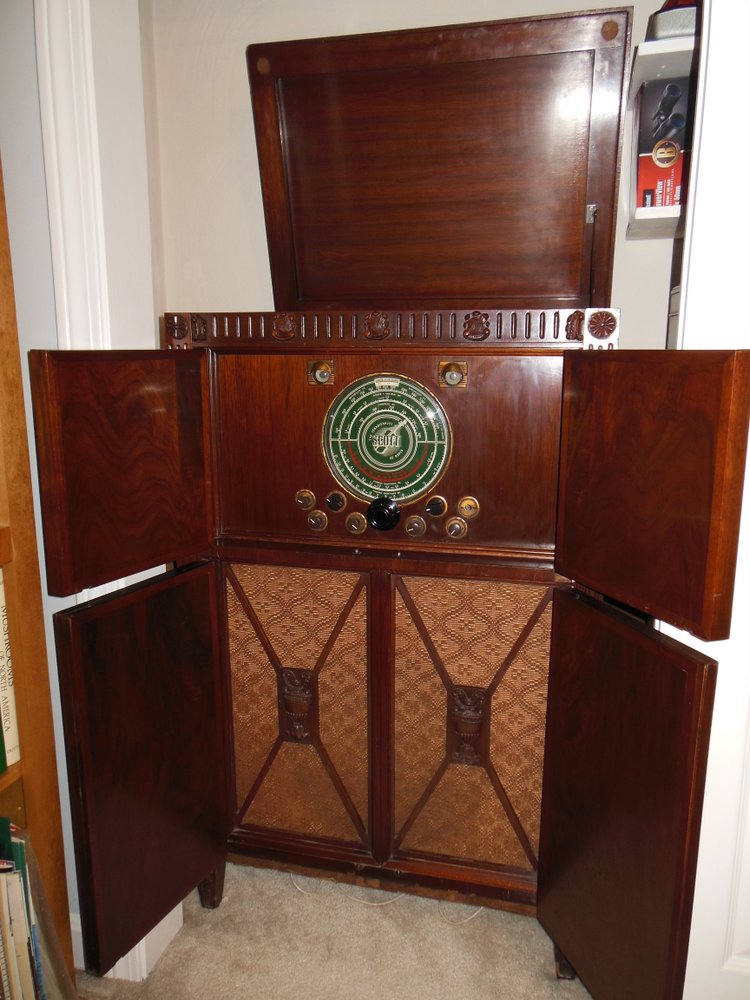
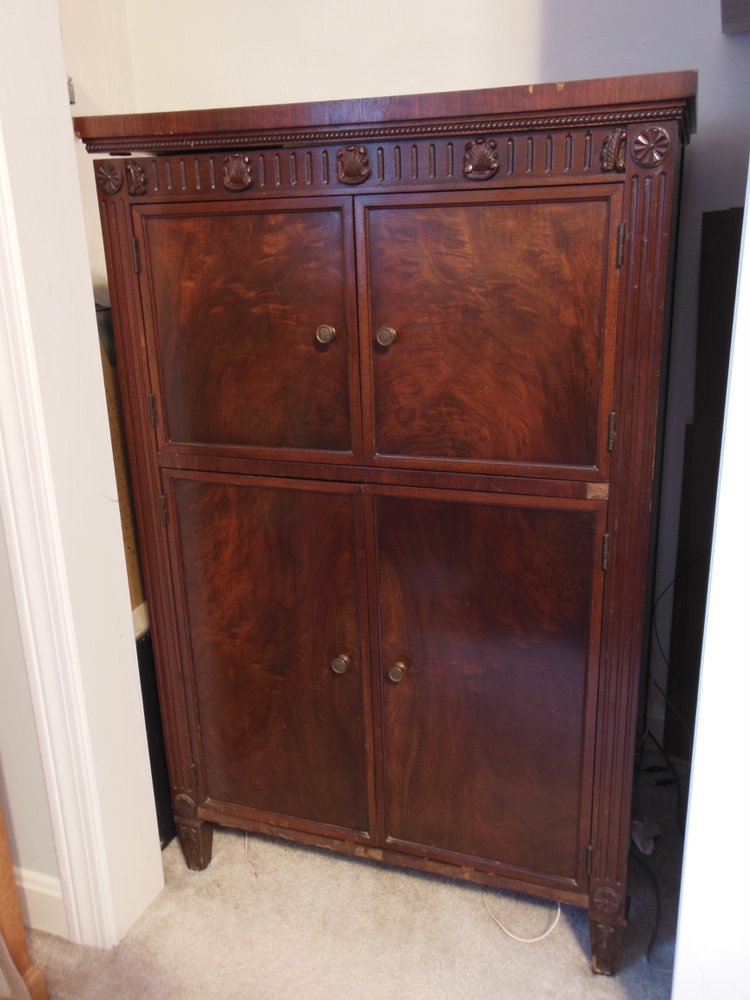
It is the E. H. Scott Philharmonic Beam of Light console radio.

E. H. Scott Philharmonic Beam of Light Outside Closed

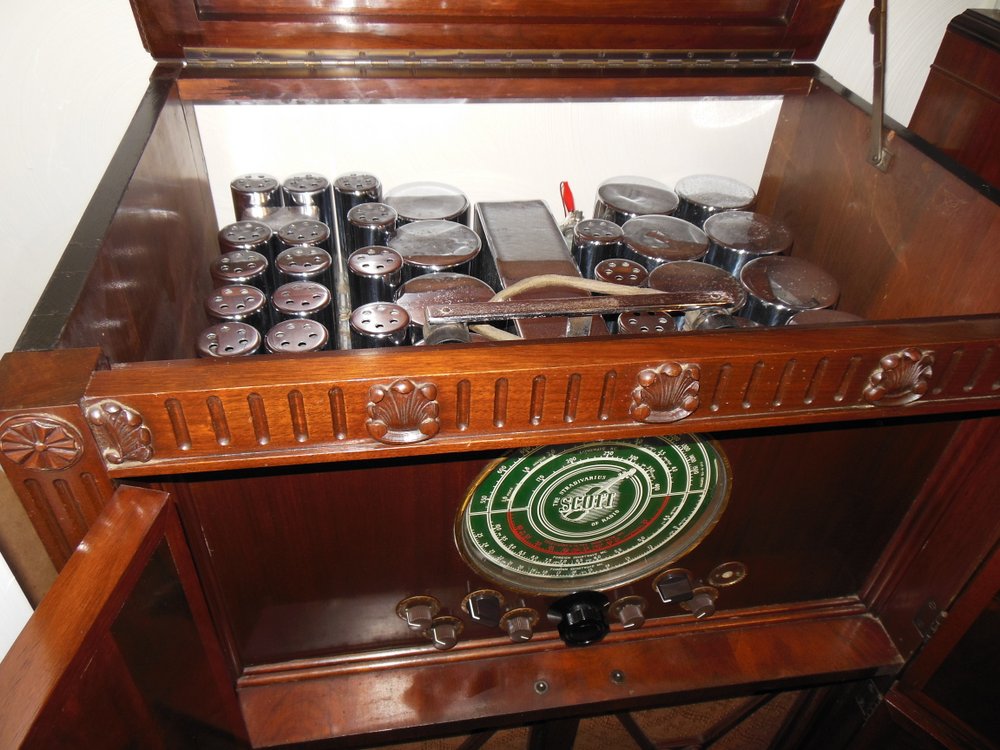
Mine appears to have been built in 1939 or early 1940. It has 30 tubes, most of which are covered by chrome-plated shields. The power supply/amplifier (4 6L6’s in the output stage), receiver, 15″ speaker and cabinet easily weigh over 150 pounds.

E. H. Scott Philharmonic Beam of Light inside

It took me two years of occasional work (I am retired so I don’t rush) to get it going and working reasonably well. I had to replace over 100 capacitors and correct some B+ voltage problems left by a previous repair person. 

None of the knobs are correct (mine came without them … 9 required) and replacements are difficult to come by (and quite expensive when they do appear).

When receiving a strong station the volume is such that it would easily drown out anything within 100 yards (and with no distortion).

E. H. Scott Philharmonic Beam of LightDial

Some day I will post some details and photos on my WordPress site (idlenot.com). I’ll be sure to let you know, Thomas. [Note: Yes, Ken, please do!]

Oh, the first time I powered it up and received a station they were playing Light My Fire (The Doors, I think). Appropriate. I put a video of it on YouTube. The radio is all apart as I was still working on it at the time.

Click here to view on YouTube.

Now that is serendipity, Ken–I mean, the first music you hear after restoring this beauty is Light My Fire? Brilliant!

The E. H. Scott Philharmonic Beam of Light is a benchmark console by any standard. I first learned about this radio through a local classified ad–the owner was selling the internal components (and original knobs) but had no cabinet. I believe he was asking $1200. The chrome plating is such eye candy, I can see why some owner in the past removed it from the cabinet to save space. Still, it was a shame the cabinet had been discarded–as one can see from your photos, the craftsmanship is simply stunning.

Ken, thank you for taking the time to share the Beam of Light console with us!

Post readers: you should check out Ken’s blog, Idlenot.com, where you’ll find more vintage radio and classic cars!

Guest Post: Using the HackRF One for DGPS Beacon Reception

h1-preliminary1-445Many thanks to SWLing Post contributor, Mario Filippi (N2HUN) for the following guest post:


Receiving  with a HackRF One, SDR#, and MultiPSK

by Mario Filippi (N2HUN)

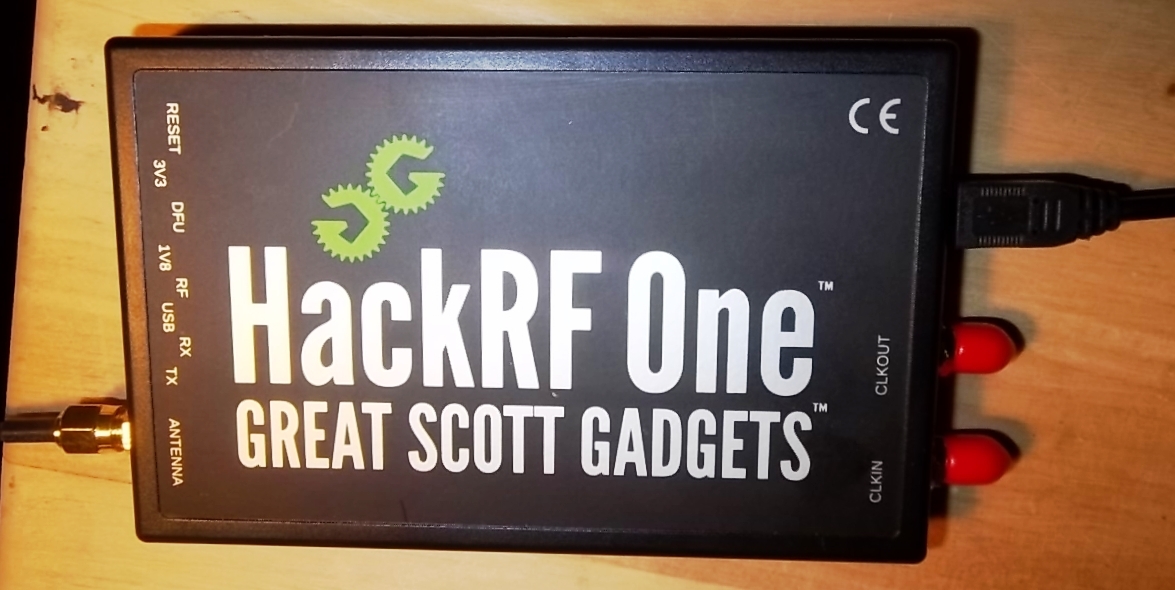
The HackRF One is a Software Defined Radio manufactured by Great Scott Gadgets (www.greatscottgadgets.com) and has been on the market for a few years. Having used an SDR-Dongle for several years I felt it was time to “step up” to this wideband (1 MHz – 6 GHz) receiver to investigate a broader breadth of the radio spectrum, so one was purchased from Sparkfun (www.sparkfun.com).

Recently I performed a rudimentary evaluation of its ability to receive DGPS (Differential Global Positioning System) beacons found in the Longwave band  between 285 – 325 KHz; this frequency range is well below the HackRF One’s stated lower receive limit of 1 MHz.

100_5864

DGPS beacons, when tuned using SSB, emit a distinctive warbling sound, and at this QTH, depending on band conditions and time of year, can be heard as far away as the Midwest. Winter brings the cold weather but also excellent conditions for receiving these beacons, some of which were former marine radiobeacons retrofitted to provide greater DGPS accuracy.

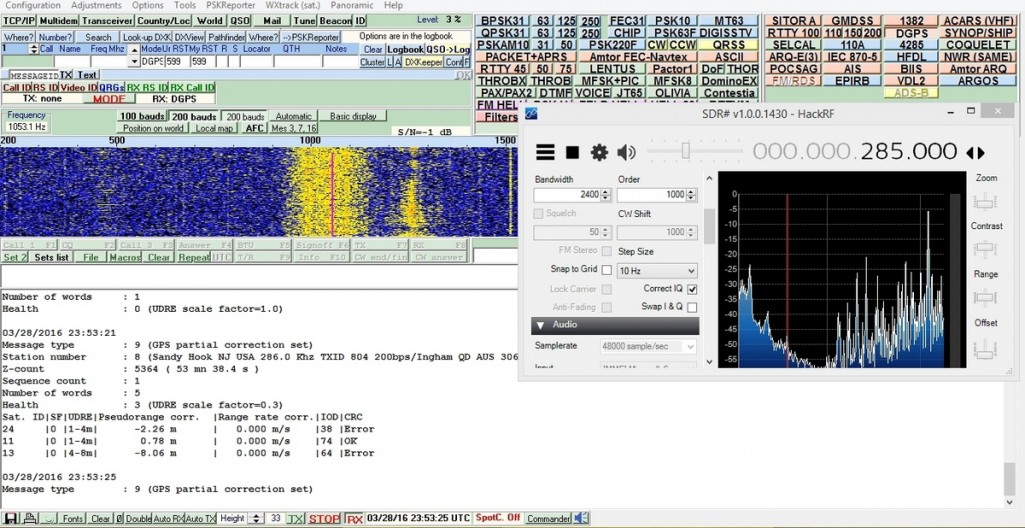
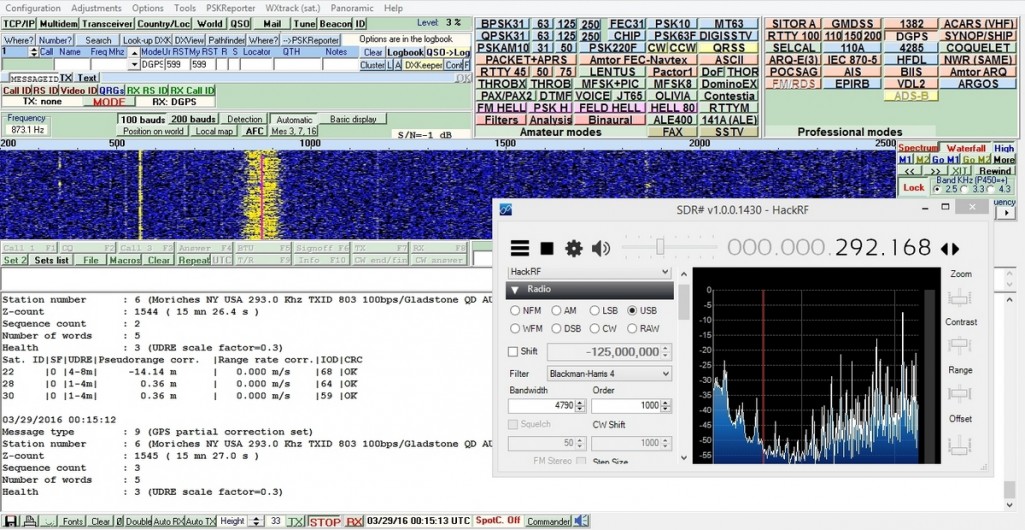
The HackRF One, when used with SDR#, MultiPSK, audio piping software, and a good (43 foot vertical) receiving antenna was able to receive DGPS beacons, and two screen captures are below:

DGPS beacon from Sandy Hook, NJ. SDR# using HackRF One in foreground, MultiPSK software in background with decoded information.

DGPS beacon from Sandy Hook, NJ. SDR# using HackRF One in foreground, MultiPSK software in background with decoded information. Click to enlarge.

DGPS beacon from Moriches, NY. Click to enlarge.

DGPS beacon from Moriches, NY. Click to enlarge.

I was very pleased that the HackRF One was able to receive DGPS stations, though tuning them in seemed a bit trickier than with a standard RTL-SDR dongle.  Since this time of year is not optimal for monitoring DGPS beacons, as well as the Longwave band in general, it’s reassuring to know that come winter I’ll be able to do some DGPS beacon DX’ing with the HackRF One.  However, anyone with a shortwave radio and a good antenna can avail themselves of DGPS beacon hunting, just tune down between 285 – 325 KHz and listen for the distinctive warble.

To decode, look into an excellent program like MultiPSK (http://f6cte.free.fr/index_anglais.htm). 73’s!


Thank you, Mario, for another great post!

When Mario told me he had purchased the $299 HackRF One, I was hoping he would do some guest posts about this SDR–DGPS beacons was use I had never thought of. Looking forward to more of your guest posts, Mario!

Guest Post: Building a magnetic loop antenna & broadband amplifier for your SDR

Many thanks to SWLing Post contributor, Dave Gahimer (K9ZCE) for the following guest post:


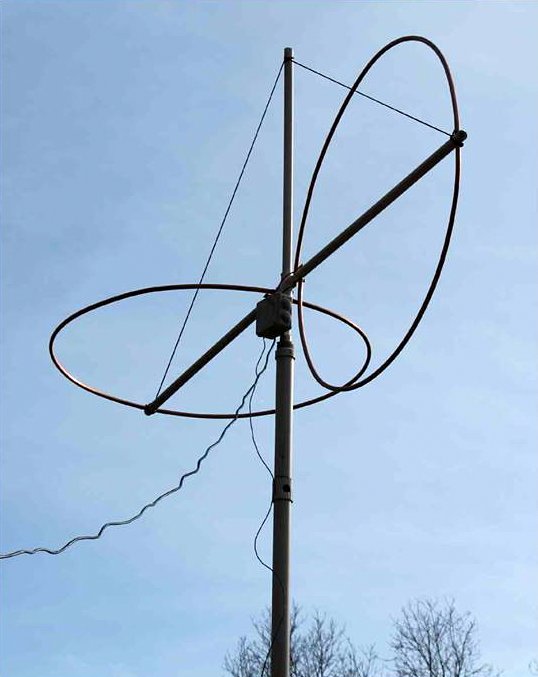
Loop-Antenna

Small Magnetic Loop Antenna with Broadband Amplifier for SDR Reception

by Dave Gahimer (K9ZCE)

Those with limited space, or antenna restrictions, might find a small 1 meter loop antenna a solution.

My son lives in an apartment. One Loop leaning against a wall gives him acceptable reception with the SDRPlay RSP on the ground floor–2nd or 3rd level flats should have very good reception.

Ten meters off the ground outside should give reception equal to any SWL antenna. We all with SDRs fight the image problem. Normal resonate ham band antennas show too strong reception of unwanted bands/stations. Did I mention noise? Loops are well known for –6 db noise reduction.

Then there is the possibility of SDR chip damage from your 1.5 KW station! In researching Loops we came across LZ1AQ. A Brilliant design /engineer (http://www.lz1aq.signacor.com/). Deep reading sometimes, but a great understanding of what makes a good receiving loop antenna.

Those who chase DX know that sometimes fading is caused by the signals’ polarization changing in the Ionosphere. Having both vertical and horizontal loops, and the ability to combine both signals diminishes this fading problem. Being able to filter the powerful, commercial FM transmitters diminishes image problems. Clipping strong signals at the antenna from very near powerful antennas/transmitters could save the SDR receiver from damage.

The LZ1AQ broad band Amp solves all these problems. http://active-antenna.eu/amplifier-kit/.

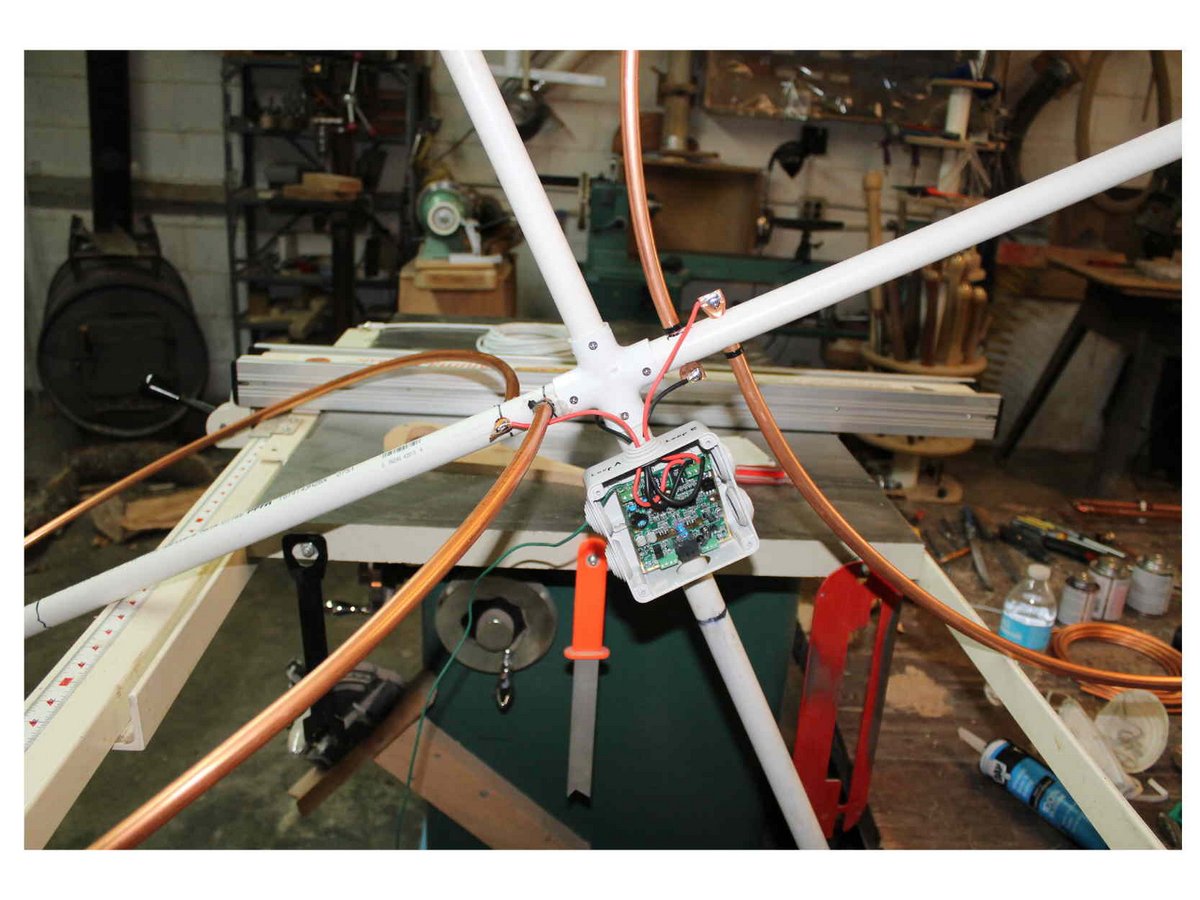
My son Ted and I built three, one meter loops from soft ½ inch copper plumbing tubing. One for his apartment, two for my crossed loops antenna. We weather proofed the Copper from corrosion by coating with outdoor clear spar varnish. We shaped the circle by drawing the tubing around a round glass top patio table.

The soft copper loop in held by white PCV plastic plumbing pipe. 1” or 1.25 inch schedule 40. Be careful to check that the PVC is schedule 40, thick wall. The thin wall pipe is not strong in the wind and will crack when you try to drill it.

Drill up to a 3/8 hole for the ½” copper tube to go through, then file out to fit. Here are some photos (click to enlarge):

crossed loops up 3 crossed loops up 4

Check out these links (all courtesy of LZ1AQ) to acquaint yourself with the loop construction and amplifier installation:

http://active-antenna.eu/tech-docs/2_ActiveAA_Mount_20.pdf

http://active-antenna.eu/tech-docs/1_ActiveAA_DandS_20.pdf

http://active-antenna.eu/tech-docs/3_ActiveAA_Antena_11.pdf

Many SDR receiver owners have seen improved noise and Image reduction by placing the plastic cased SDR unit on a small shielded/ grounded case.

crossed loops up 5

The Amp needs 12VDC from in the shack. The Amp has two relays that you can switch, from in the shack, to select Vertical or Horizontal loops, or a dipole. The loop amp connects back to the shack via a shielded Cat 5 cable, Make sure you get shielded CAT 5 to reduce noise pickup. Make sure you provide an adequate good Ground below the antenna, less noise pickup and lightening protection.

crossed loops up

Have fun!
Dave, K9ZCE
Retired from EE Dept @ Rose-Hulman Institute of Technology
Terre Haute, Indiana


Thank you so much, Dave!

Readers: yesterday I saw Dave’s loop antenna photos on the SDRplay RSP Facebook page. I was fascinated by his horizontally/vertically oriented loops and asked if he would write up a short guest post.  He kindly obliged in a matter of hours!

If you have an antenna project you’d like to share, please contact me. So many SWLs and ham radio operators live in areas with restrictions and pervasive RFI–projects like Dave’s can revive one’s radio life!

Guest Post: Jerry’s Mediumwave DXing Powerhouse Mini FSL Antenna

Many thanks to SWLing Post contributor, Jerry Popiel, for the following guest post:


PowerhouseFSLAntenna-1

A MW DXing Powerhouse Mini FSL Antenna

by Jerry Popiel

In late February 2016 I completed construction of a modified version of Gary DeBock’s excellent 3 inch Mini FSL design (click here to view).

This new antenna is nothing short of a AM DXing powerhouse with unbelievable sensitivity for receiving stations across the entire AM Bandwidth both day and night. The tuning of stations is razor sharp and it has stunning nulling qualities. Consultation assistance was provided from DXing experts Steve Ratzlaff and Gary DeBock on the project.

Construction Details:

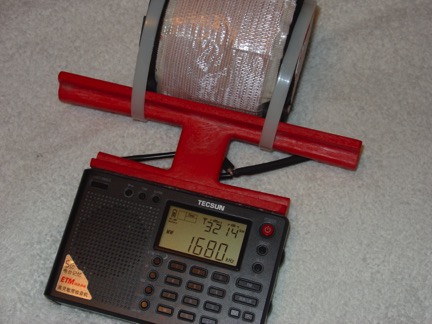
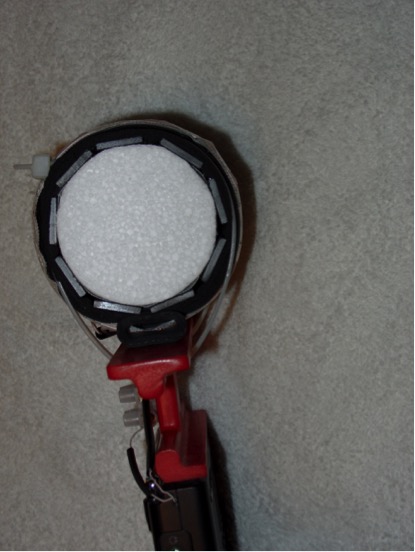
The Antenna was constructed using 9 – 100 mm Ferrite Bars wound on a 2.75 inch diameter x 4 inch styrofoam cake dummy form custom made by in Vancouver, B.C. Canada – ([email protected]) for $3.50 plus shipping.

The Coil wire consisted of 38 turns of high gain 660/46 Litz Wire. (Note: As can be seen 38 turns of the thicker Litz Wire left only 5/8” of room on each side of the Styrofoam Form to wire wrap the coil to the ruler frame. A longer Form ie 5” long would work much better for this build).

The insulation spacer used was 2 layers of 1/8 inch Aerotape self adhesive tape which also helped hold the 100 mm Ferrite Bars onto the Styrofoam Coil Form. Inductance measured 356 uH using a DM 4070 Meter which is well within the requirement of over 300 uH for AM Band Reception.

Side View Of 9-Bar FSL Antenna with 2.75” Diameter Styrofoam Cake Dummy.

Side View Of 9-Bar FSL Antenna with 2.75” Diameter Styrofoam Cake Dummy.

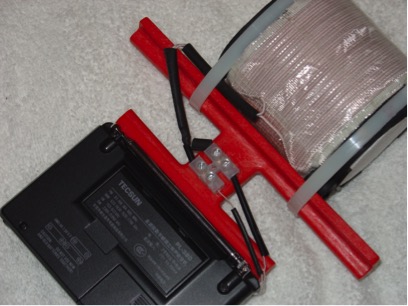
Because of the extra thickness of high gain 660/46 Litz Wire which is a bit too big to solder to the inside terminals of the Tecsun PL-380 Radio, a 2 Position Terminal Block was superglued to the outside of the Ruler Frame to act as an interface connection point.

Position Terminal Block Superglued To Back Of Antenna Frame

2 Position Terminal Block Superglued To Back Of Antenna Frame

Testing Results:

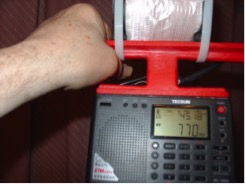
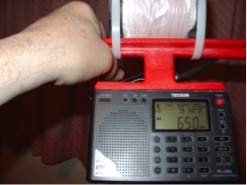
Both daytime and evening AM station captures have been spectacular. Stations as far away as KKOB / 770 kHz Alberquerque, New Mexico 1130 Miles from here in Winnipeg, Manitoba, Canada have been received. Country music station WSM / 650 kHz in Nashville, Tennessee 1082 miles distant is a daily evening pickup.

Station KKOB / 770 kHz Alberquerque, New Mexico 1130 Miles distance.

Station KKOB / 770 kHz Alberquerque, New Mexico 1130 Miles distance.

Station WSM / 650 kHz in Nashville, Tennessee 1082 miles distance.

Station WSM / 650 kHz in Nashville, Tennessee 1082 miles distance.

Two Stations Received At 600 kHz 90 Degrees apart at the same time:

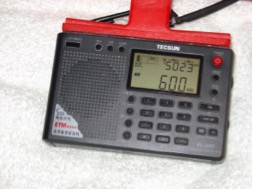
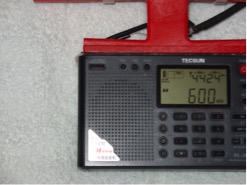
The amazing Nulling and Razor Sharp Tuning quality of this FSL was demonstrated when 2 stations at 600 kHz were received at the same time by rotating the Radio with attached FSL 90 degrees. In the North / South direction Station KSJB / Jamestown, North Dakota (219 miles distant) was received with a strong signal strength of 50 / 23. Then by rotating the Radio 90 degrees to the East / West direction Saskatoon, Saskatchewan station CJWW (442 miles distance) was captured with a similar strong signal strength of 44 / 24.

600 kHz Station KSJB / Jamestown, North Dakota.

600 kHz Station KSJB / Jamestown, North Dakota.

600 kHz Station CJWW / Saskatoon, Saskatchewan.

600 kHz Station CJWW / Saskatoon, Saskatchewan.

Daytime Reception of 600 Watt Station 137 Miles Distant:

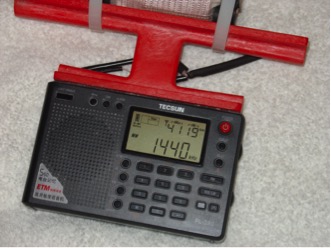
A major daily AM reception capture during the afternoon illustrating the amazing sensitivity of this antenna is 600 Watt station KKXL Sports Radio 1440 kHz (137 miles).

PowerhouseFSLAntenna-8

All Indoor Reception – For Now!

Due to winter conditions here in Winnipeg, all of the amazing station reception captures in this report were done inside the House facing towards the South window. Fortunately the red ruler platform sides can he used as handles when pointing the radio in the direction of best reception. Exciting times are ahead to see how well this mini 3” FSL will perform outdoors for likely even better AM DXing.

Summarizing:

The design of this new FSL Antenna attached to the Tecsun PL-380 Ultralite radio by Gary DeBock is a major breakthrough in AM DXing since the Radio is attached to the FSL. This new FSL Antenna needs to be constructed to be really appreciated. The application described here requires a bit more skill to construct and is also heavier than the original construction – but at least it is portable. For beginners Gary’s original 3” FSL Heathkit Design is highly recommended and can be reviewed in his You Tube Video posted at: https://www.youtube.com/watch?v=VY9u8MReGjk

Thanks,
Jerry Popiel
Winnipeg, Manitoba, Canada


Thank you, Jerry! It’s amazing what performance you and Gary DeBock have gotten out of these homebrew FSL antennas! Thank you so much for taking the time to share your construction details and performance notes!