Category Archives: Ham Radio

SPROUT SSTV and Digitalker Every Sunday

SPROUT SSTV and Digitalker active every Sunday

SPROUT SSTV and Digitalker Active Every Sunday – AMSAT-UK

AMSAT-UK Announces SSTV Activity Every Sunday

Slow Scan TV (SSTV) images in Scottie 1 format will be transmitted from the SPROUT satellite every Sunday (Japanese Standard Time) on 437.600 MHz FM (+/- 9 kHz Doppler shift). The Digitalker will also be active.

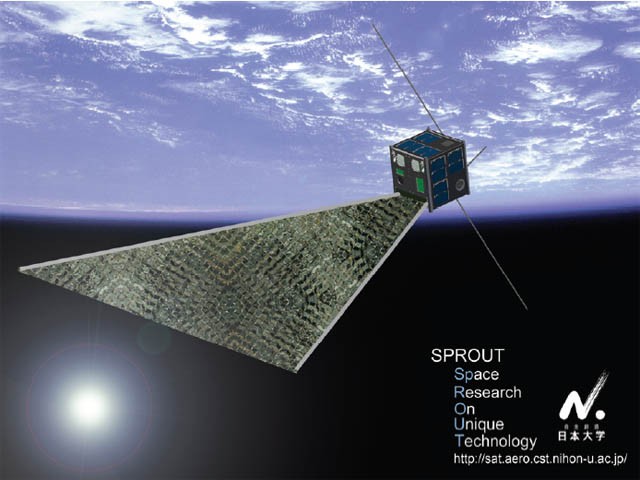
SPROUT, a 20 x 20 x 22 cm amateur radio nano-satellite with a mass of 7.1 kg, launched successfully with the L-band (1236.5 MHz/1257.5 MHz/1278.5 MHz) Synthetic Aperture Radar (SAR) satellite ALOS-2 on May 24, 2014 at 0305 UT. SPROUT is in a 654 km, 97.9 degree inclination Sun Synchronous Orbit (SSO).

SPROUT (Space Research On Unique Technology) was built by students from Nihon University

— A FM Digitalker will enable the satellite to speak to amateurs around the world.

— The Voice Message Box will record transmissions from radio amateurs and play them back.

— Pre-loaded images from the Message Gallery can be transmitted using Slow Scan TV (SSTV).

— Pictures of the Earth can be transmitted by SSTV and radio amateurs can receive it using free software such as MMSSTV. As part of the Earth mapping project the team ask radio amateurs to contribute pictures they have received from the satellite for display on the SPROUT website.

Callsign: JQ1ZJQ

Size: 214x210x220 mm

Weight: 7.1 kg

Mode: 1200bps AFSK, 9600bps GMSK

CW downlink 437.525 MHz

FM packet downlink 437.525 MHz

Digipeater uplink 437.600 MHz

Digitalker downlink 437.600 MHz

SSTV downlink 437.600 MHz

Many FM radios can be switched been wide and narrow deviation FM filters. For best results you should select the wider filter designed for 5 kHz deviation FM.

— SPROUT English website http://sat.aero.cst.nihon-u.ac.jp/sprout-e/

— SPROUT Japanese website http://sat.aero.cst.nihon-u.ac.jp/sprout/

— Nihon-Univ. Miyazaki Laboratory on Facebook

https://www.facebook.com/pages/Nihon-Univ-Miyazaki-Laboratory/406566642818860

— Telemetry Software http://sat.aero.cst.nihon-u.ac.jp/sprout-e/2-Software-e.html

— Telemetry format http://sat.aero.cst.nihon-u.ac.jp/sprout-e/2-Formats%20of%20telemetry-e.html

SPROUT launch data page

http://sat.aero.cst.nihon-u.ac.jp/sprout-e/2-Launch%20data-e.htmlTLE’s from the North American Aerospace Defence Command (NORAD) are also available at http://celestrak.com/NORAD/elements/tle-new.txt

Free Slow Scan TV (SSTV) software MMSSTV http://hamsoft.ca/pages/mmsstv.php

The JE9PEL website has information on other satellites on this launch

http://www.ne.jp/asahi/hamradio/je9pel/jaxalos2.htm

(Full details and links may be found here.)

Robert Gulley, AK3Q, is the author of this post and a regular contributor to the SWLing Post. Robert also blogs at All Things Radio.
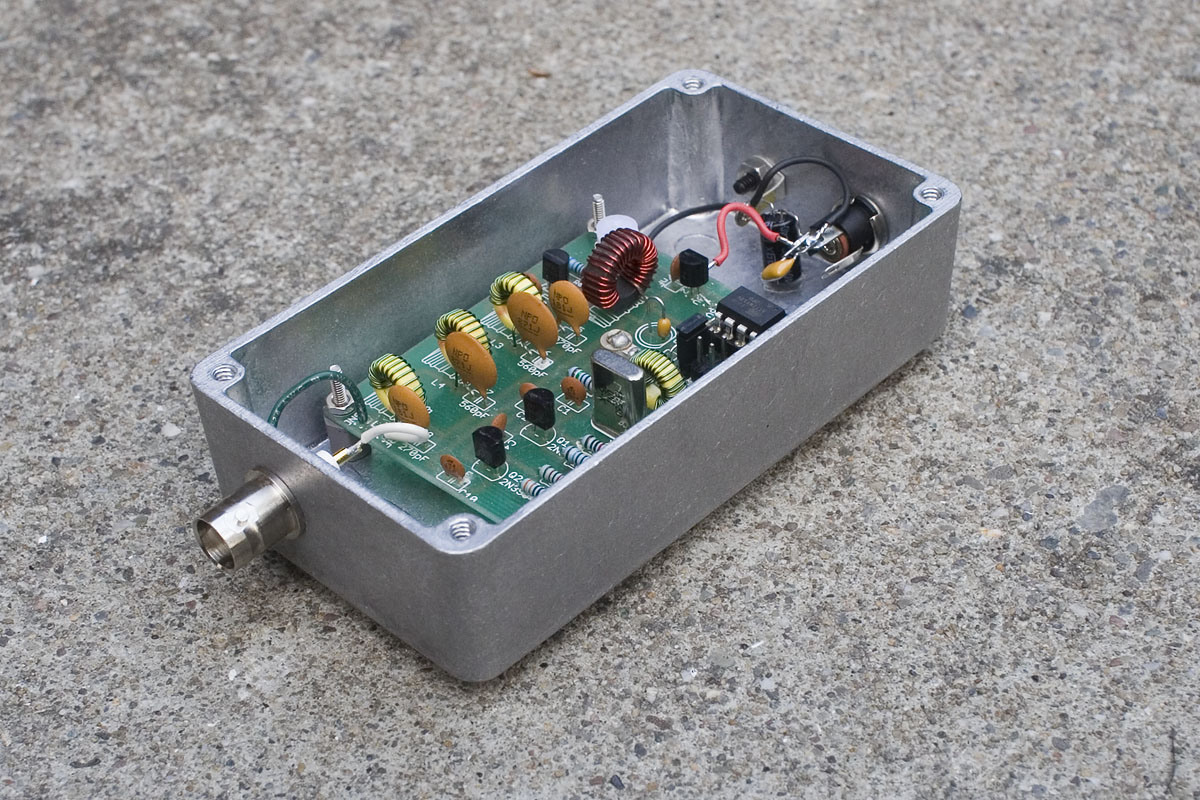
Dave’s Sproutie SPT Beacon

The Sproutie “SPT” Beacon. (Photo source: Dave Richards)

The Sproutie “SPT” Beacon. (Photo source: Dave Richards)

Dave Richards (AA7EE), has just published a brilliant post about his new beacon: the Sproutie SPT Beacon.

Click here to read Dave’s post with detailed instructions for building your own
low power, legal beacon
!

Dave’s beacon is located on 13,558 kHz–he would love your reception reports. Dave notes in his post:

“If you hear the SPT beacon on 13,558 kHz, please send a report – either to the e-mail address listed on my QRZ account [look up call AA7EE], or as a comment underneath this post. Reception reports will be very eagerly received. One gentleman in Seminole County, FL, reported that the area around the SPT frequency was a cacophony of noise in his area, and he stood no chance of hearing it. Those kinds of reports are useful too.  If you put your own HiFER beacon  on the air, do introduce yourself on the LWCA message board, and John can include you on the list of known active HiFER beacons.

Readers: let’s give Dave some reception reports! Though I live on the opposite side of North America, I will certainly be listening!

Dave, thanks again for publishing such an informative and detailed post! You’ve inspired me to build my own beacon.

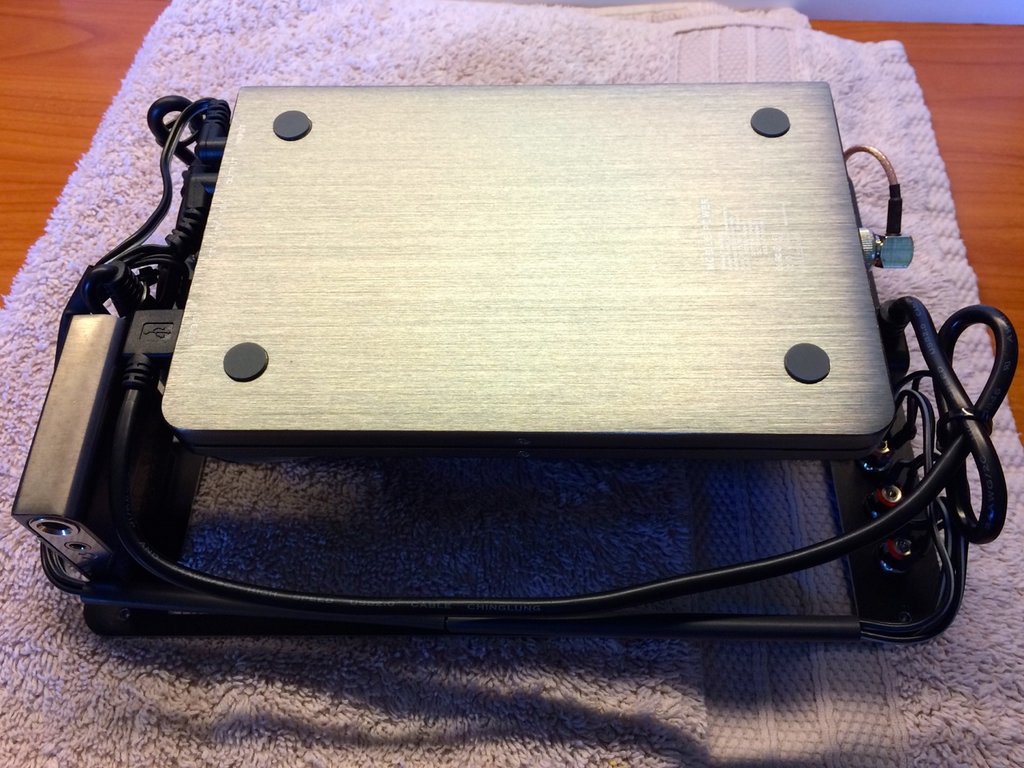
eBay: Mario considers the Time Out Radio Bench

Time-OutRadio-Bench-001

Many thanks to SWLing Post contributor, Mario Filippi (N2HUN), who writes:

Hi Thomas,

For hams and SWLs that have a lot of clutter, a great idea, reminds me of a foot stool that has been re-purposed for radio buffs. Nice idea, good price, free shipping, what’s not to like? My spending finger’s getting itchy hi hi.

Click here to view on eBay.

I’m with you, Mario: this is not a bad price for a useful and portable shelf that is even made here in the USA (Kentucky). I could see using one on Field Day where horizontal space is often limited on club tables.

It appears that the seller (a ham: Ron, KK4RON) purchased a large number of these in a deal. He writes this in the product description:

These benches are great for setting up a compact ham station or use 3 for a surround set up , They also stack nicely if you only have a narrow space available. Go UP rather than out.

These are very sturdy and well made in the USA by a factory in Kentucky , the surface is a very durable and easy clean kitchen cabinet material (Formica) on 3/4″ wood so screwing on mounting brackets and mike holders and such is very easy

These were intended to sell for $49.95 but the company that ordered them went out of business before they had payed the factory so the factory got stuck with literally thousands of these finished and ready for sale.

We were able to acquire there entire inventory including boxes and packaging at a fantastic price but that is also why we are limited to 8 colors and 2 top colors. But these are very well built from a factory (not home made) and just perfect for mounting several radios to and cleaning up your bench.

Again, many thanks, Mario, for sharing this find (and perhaps it’s time to get yourself an early Christmas gift?)!

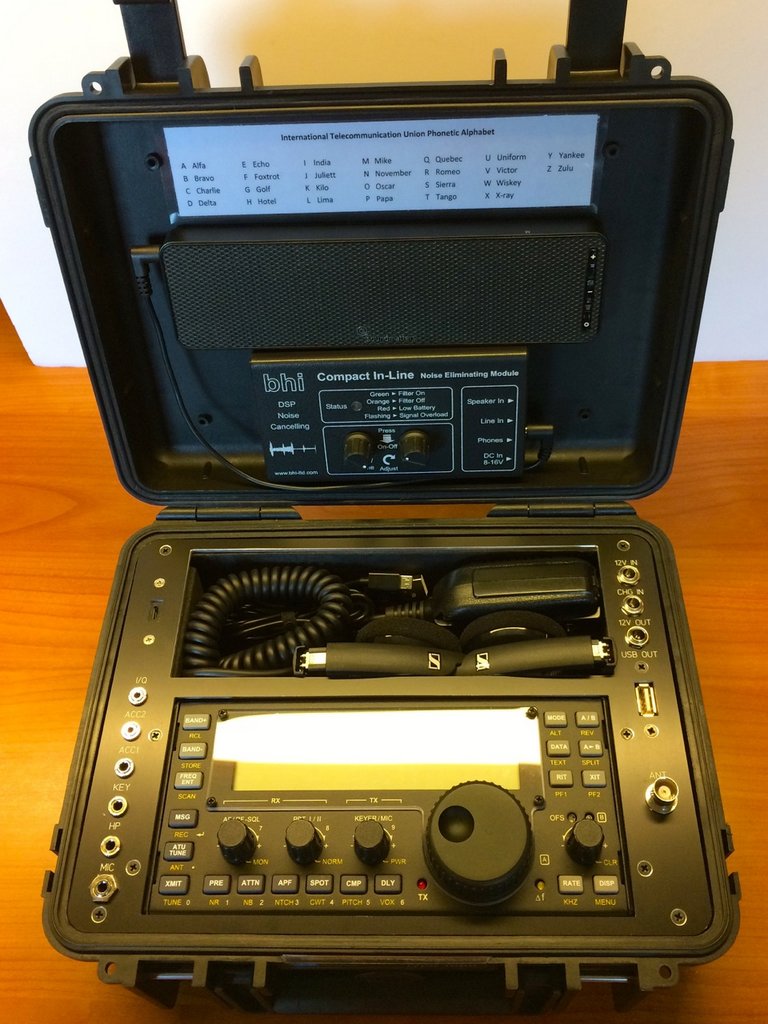
Scott’s Elecraft KX3 Go-Box

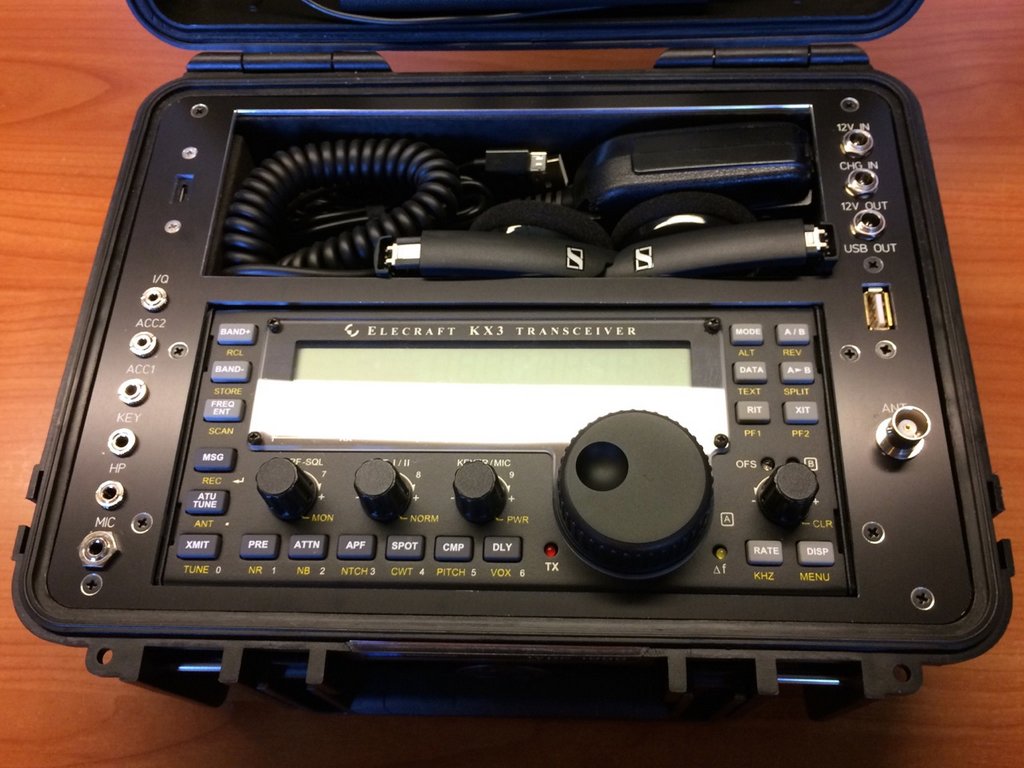
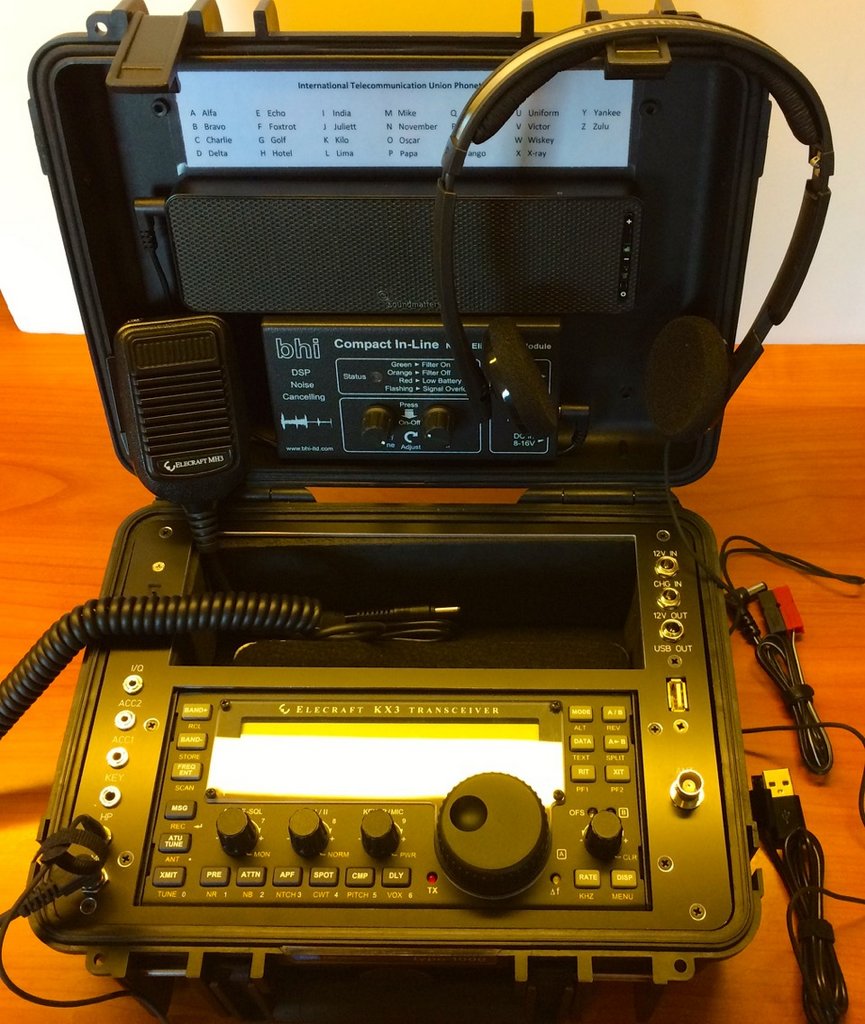
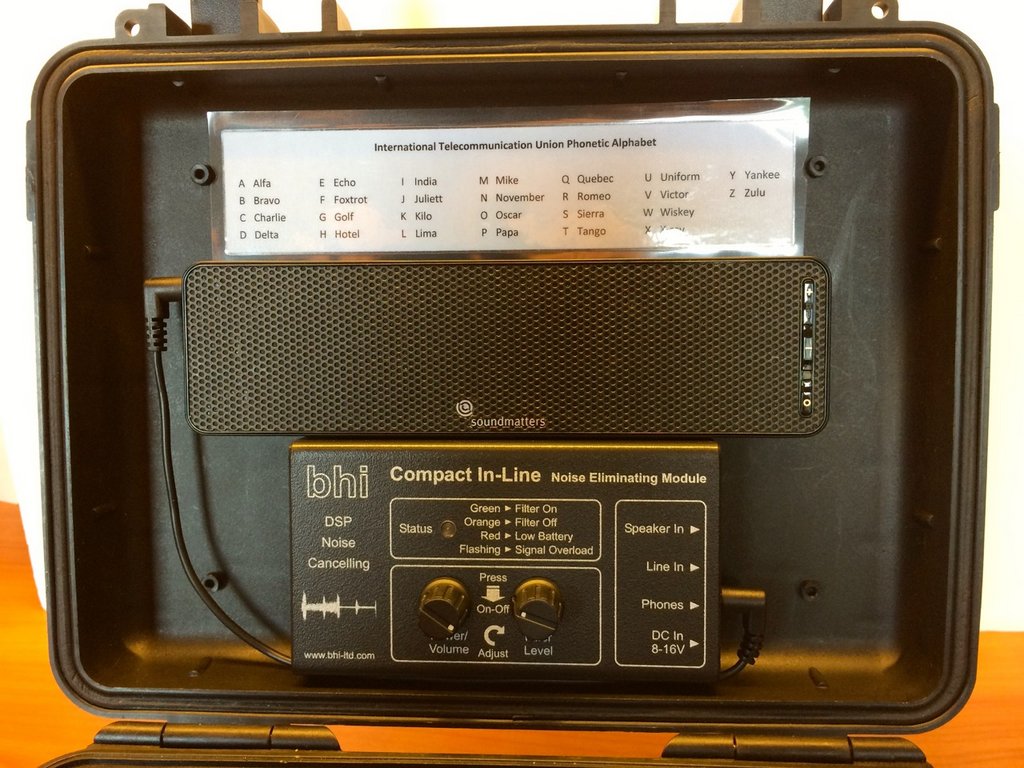
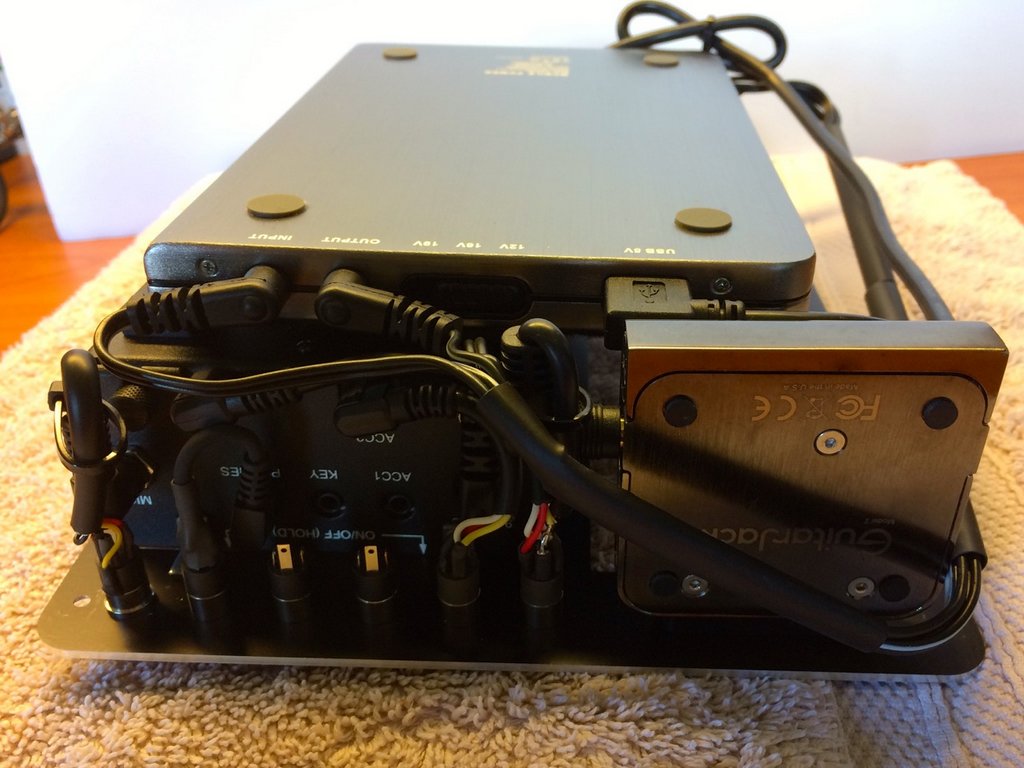
Many thanks to Scott (AK5SD) who shares the following photos and bill of materials for his custom Elecraft KX3 go-box:


IMG_0531 IMG_0534

IMG_0532 IMG_0535 IMG_0537 IMG_0536

Bill of materials

The panel was custom laser cut by Front Panel Express. I have the CAD
file and I’m willing to share it with anyone who wants to reproduce my effort.

Amazon.com
Case B&W Type 1000 Outdoor Case with SI Foam
You won’t use the foam, so you can buy the version without it if you can find it cheaper.

Battery Anker Astro Pro2 20000mAh Multi-Voltage (5V 12V 16V 19V)
Portable Charger External Battery Power Bank
Avoid look alike batteries and the next generation model from Anker. The newer Anker
battery is only capable of delivering 1.5A from the 12V supply. Two look alike batteries
I tried did not have the auto-off feature that the Anker does.

Vetco.net
ACC2 and I/Q Jacks 2 x 2.5mm Stereo Jack Panel Mount (PH-666J-B)
Phone, Key, and ACC1 3 x 3.5mm Stereo Jack Panel Mount (High Quality) (PH-504KB)
Mic Jack 1 x 3.5mm 4 Conductor Jack Panel Mount (PH-70-088B)
12V IN and CHG IN 2 x 2.1mm DC Power Panel Mount Jack (PH-2112)
12V OUT 1 x 2.5mm DC Power Panel Mount Jack (PH-2512)

You also need plugs and wire for interconnects. I bought some 2.5mm (CES-11-5502)
and 3.5mm (PH-44-468 for stereo, PH-44-470 for 4-conductor) audio cables with right
angle plugs and just cut them to use for the signal lines going to the KX3. I did the same
thing for the 2.5mm (PH-TC250) and 2.1mm (PH-TC210) power cables. A couple of
caveats are in order. The Phone, Key, and ACC1 interconnects require low profile
right angle connectors. The cables I listed above won’t work. Vetco part number
VUPN10338 will work. The power cables I’ve listed above use 24 gauge wire. This
is a little light, but the runs are small so I think it is OK. You can use higher gauge
cables if you can find a source.

USBfirewire.com
USB OUT USB 2.0 Right Angle Extension Cable (RR-AAR04P-20G)

Digikey.com
L Brackets 8 x Bracket Rt Ang Mount 4-40 Steel (612K-ND)
These L brackets are used to mount the KX3 to the panel and the panel to the case.
For mounting the KX3, I use a little piece of stick on felt on the bracket to protect the
KX3’s cabinet from damage. Replace the KX3’s screws with #4-40 Thread Size, 1/4”
Length Steel Pan Head Machine Screw, Black Oxide Finish (see below). For the panel
mounting, use #6-32 Thread Size, 3/16” Length self tapping sheet metal screw. You
may need to cut the tip off in order to not puncture the outside of the case.

RG316 BNC Male Angle to BNC Female SM Bulkhead Coaxial RF Pigtail Cable (6”)
This is not the original interconnect I used for connecting the KX3’s antenna output to
the panel. However, I think it is a better option for new designs. The caveat is that you
will need to verify the hole in the panel matches the bulkhead connector on this cable.
There will be a little loop in the cable when you are done, but that is fine.

Micrfasteners.com
Screws for Sound Card 2 x FMSP2510 – M 2.5 x .45 x 10mm
Screws for KX3 Bracket Mount 4 x MSPPK0404 – 4-40 x 1/4
Screws for Countersunk Panel Holes 8 x FMPPK0403 – 4-40 x 3/16
Screws for USB Connector *** 2 x FMPPK0406 – 4-40 x 3/8

I’m pretty sure these are the right length for the USB connector. I am doing it from memory.

Amazon.com or eBay.com
Soundmatters foxL DASH A Wireless Bluetooth Soundbar (OPTIONAL)

Sonoma Wire Works GJ2USB GuitarJack 2 USB Portable Audio Interface (OPTIONAL)
(Make sure you get the USB model, not the 30-pin model.)

This is optional if you want a built-in sound card interface for a waterfall display using iSDR. Make sure to eliminate the holes in the upper left corner of the panel if you are not installing. You will also need 2.5mm x 10mm screws to mount this to the bottom of the panel (see below).

bhi Compact In-Line Noise Eliminating Module (OPTIONAL)

In my opinion, the KX3’s noise reduction is totally ineffective for SSB communications. This external noise reducing DSP is one solution, albeit an expensive one, to that problem. It is only for SSB, not CW or digital modes. It is also available from GAP Antenna Products.

IMG_0530


Scott: you have done a beautiful job here and have spared no expense to make a wonderfully-engineered and rugged go-box. No doubt, you’re ready to take your KX3 to the field and enjoy world-class performance on a moment’s notice. 

Though I’ve never used them personally, I’ve noticed others who have taken advantage of the Front Panel Express engraving service–certainly makes for a polished and professional front panel.

Again, many thanks for not only sharing your photos, but also your bill of materials which will make it much easier for others to draw inspiration from your design!

AK5SD_QSL_Card

Speaking of designs, when I looked up Scott on QRZ.com, I noticed that he also sports a QSL card (above) designed by my good friend, Jeff Murray (K1NSS). Obviously, Scott is a man with good taste!

New kit by NM0S: the 4S-Tuner/Antenna Coupler

4stuner_panelDave Cripe (NM0S) has designed yet another QRP kit for the 4 State QRP Group: the 4S-Tuner/Antenna Coupler.

Description (per Four State QRP Group):

This excellent random wire antenna tuner is the classic T-Match design which is known for wide matching range and smooth operation. Dave has added a nice wrinkle – the SWR indicator employs TWO leds, not the normally seen single red LED. A green one indicates output power with a red one indicating reflected power. The beauty of this arrangement is that the operator sees the output power peaking as the SWR goes down, just like a power meter with dual meters – very intuitive. This makes tuning easier and leaves no doubt that it’s tuned for maximum power output. For a high SWR the red LED is at full brightness and the green LED is off. At 2:1 both are at equal brilliance. At 1:1 the green is full on and the red is off. The small size is perfect for portable operations. Add this dandy little tuner to your portable ops go bag, or use it at home. It’s equally at home on a picnic table, in a tent or camper, as well as on the operating desk in your shack.

Specifications and Design Features

  • Wide tuning range: 80 meters thru 10 meters. Tested on EFHW and 100′ wire.
  • Maximum Power Throughput: tested at 10 Watts.
  • Low loss large toroid
  • Twelve taps for small inductance step selection.
  • Low insertion loss when matched.
  • Enclosure Size: 3″x3″x2″.
  • Pittsburg Construction.

Shipped price is $51.00 (US), $55.00 (Canada), $60.00 (Outside US/Canada).

Dave Cripe designs excellent kits for the ham radio community; they’re easy to build, fun and functional.  If this kit is as popular as his past kits, the first run will most likely sell out in short order.

 Click here to check out the 4S-Tuner/Antenna Coupler at the Four State QRP Group website.

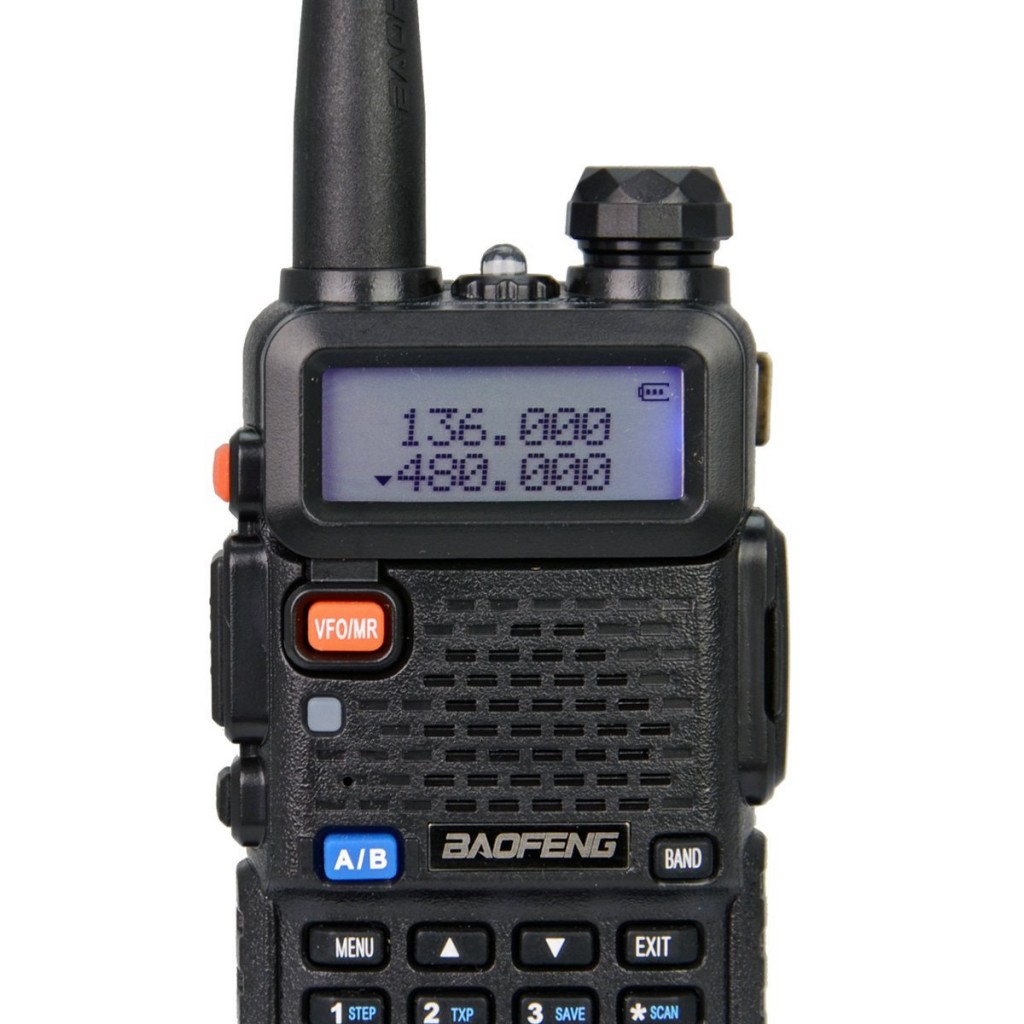
The BaoFeng UV-5R is tougher than the $25 price tag implies

UV-5R

I’ll admit it: I’m a bit of a handheld radio snob.

I don’t own many HT transceivers, but the ones I do own are manufactured by the “big three”–namely, Yaesu, Kenwood and Icom. For ages, these three companies dominated the handheld radio market.

A few years ago, several Chinese radio manufactures (BaofengWouxun, TDXone and TYT to name a few) started flooding the market with inexpensive handheld transceivers–radios that literally cost a fraction of those produced by the “big three.” Where a Yaesu dual band handheld might cost between $150-250 US, a Baefeng model might cost $25-50 US.

As one might imagine, these inexpensive transceivers gained quite a following in the ham radio community and with preparedness/communications enthusiasts.

I’ve read that many of these ultra-cheap transceivers are difficult to program and I’m sure that’s one of the factors that has kept me from purchasing one.

I also assumed that a $25 radio must be very poorly constructed. Seems I’m incorrect at least on this point.

Many thanks to Dave (K4SV) for sharing the following video from Chris (K5CLC), who put the popular Baofeng UV-5R through an “extreme” field test:

https://youtu.be/kZCDBsBuhmg

The Baofeng UV-5R is available at Amazon.com for a mere $25.80 US shipping included.

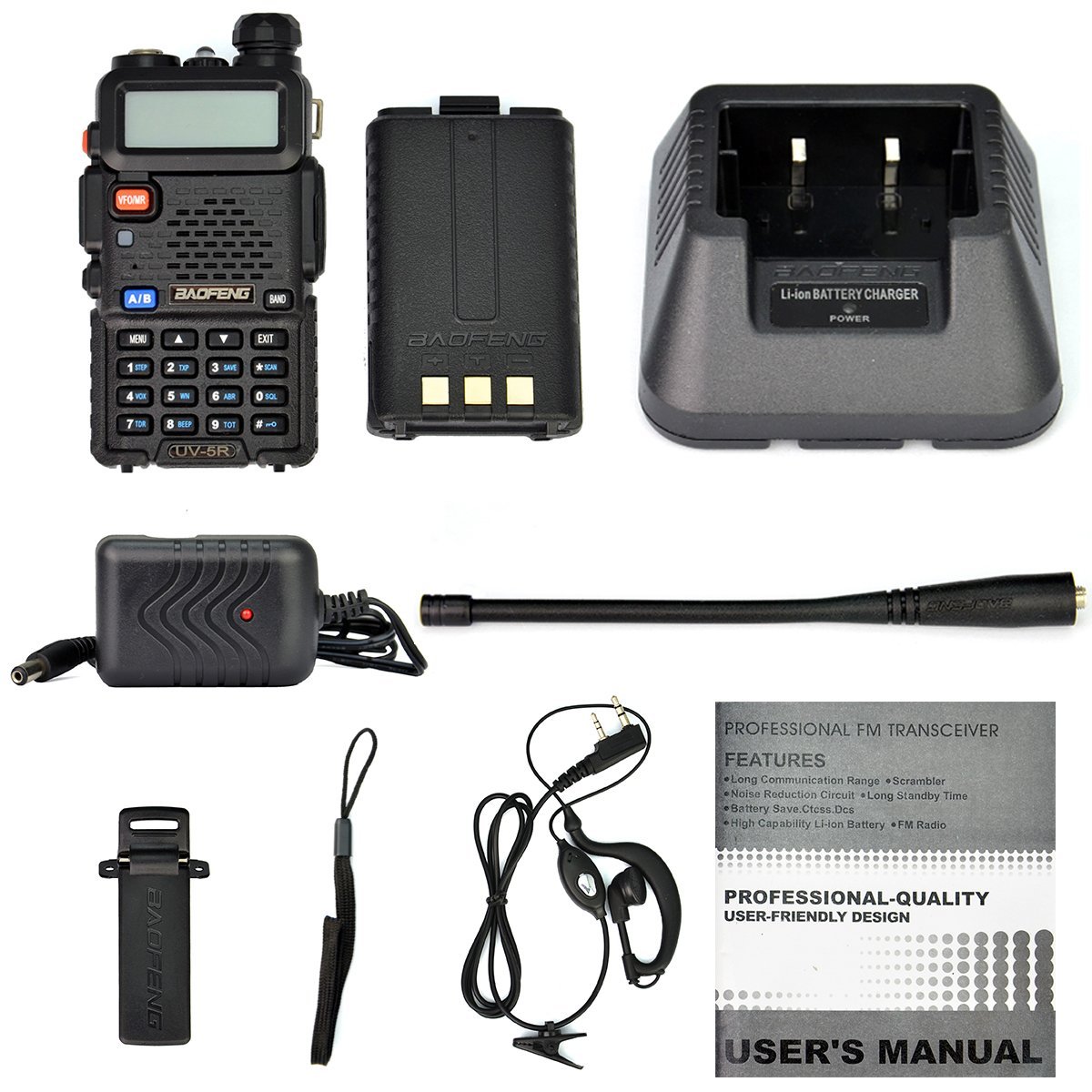
UV-5R accessories. Click to enlarge.

UV-5R accessories. Click to enlarge.

The UV-5R even comes with a number of accessories:

  • a ANT5 SMA-J flexible antenna,
  • BL-5 Li-ion battery (7.4V 1800 mAh),
  • belt clip,
  • wrist strap,
  • AC adapter (8.4V 600ma)
  • and drop-in charger.

Frankly, it’s hard to believe you get so much radio for the price.

Curiosity is getting the best of me and I believe I very well may purchase a UV-5R in the coming days. I’ll probably purchase the USB programming cable as well [UPDATE: several readers suggested this proper FTDI cable as a much better option].

Click here to view the Baofeng UV-5R on Amazon: I encourage you to read the numerous reviews–many of which sing its praises, others do not.

Readers: if you have the UV-5R, please post your comments about this little radio. I’m curious if you find it easy to use and if the battery life has held up over time.  Any tricks for programming it?

Reminder: Share a photo of your shack or listening post for a chance to win a Grundig G2

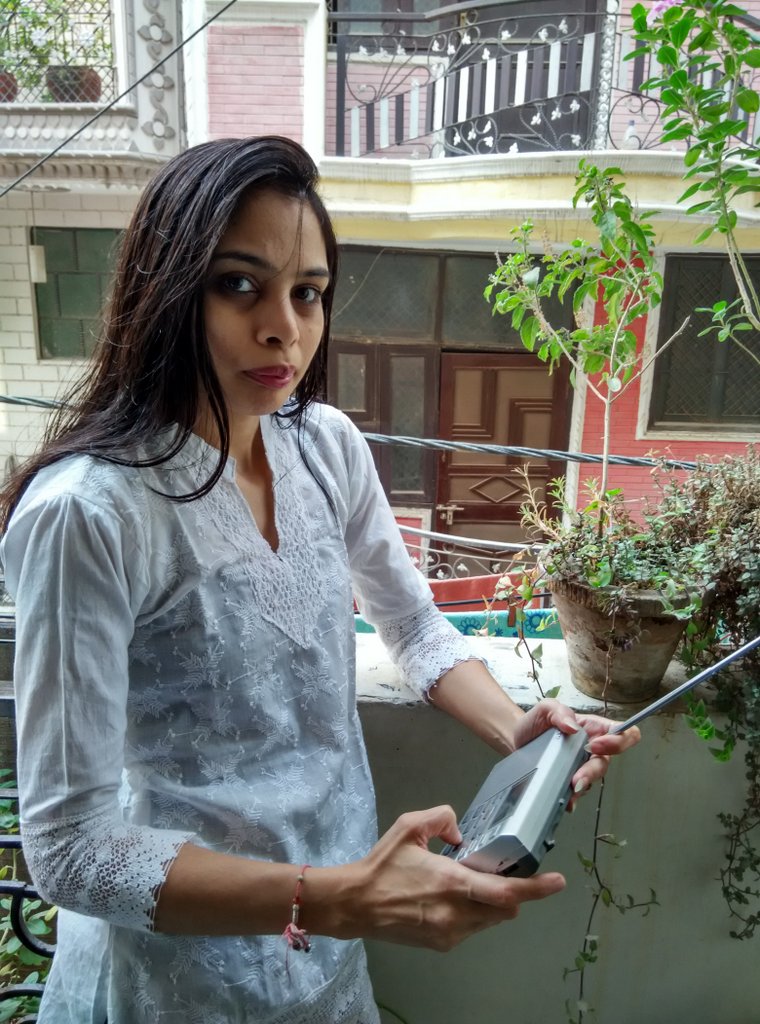
Manisha's favorite listening post is her balcony in New Dehli where she listens with her Sony portable.

Manisha’s favorite listening post is her apartment balcony in New Delhi.

The November 1st deadline for our latest Reader Challenge is approaching!

In exchange for sharing a photo of your favorite listening post or your radio shack with the SWLing Post community, you’ll be entered for a chance to win a Grundig G2 portable radio/recorder and player! The choice will be made by random selection, so everyone has an equal chance of winning.

Click here to read a full description of the contest and how you can participate!

Many thanks to our friends at Universal Radio for sponsoring this contest!