Category Archives: Recordings

Using synchronous detection and notch filter to eliminate het noise

WinRadioExcalibur-VOG-Notch

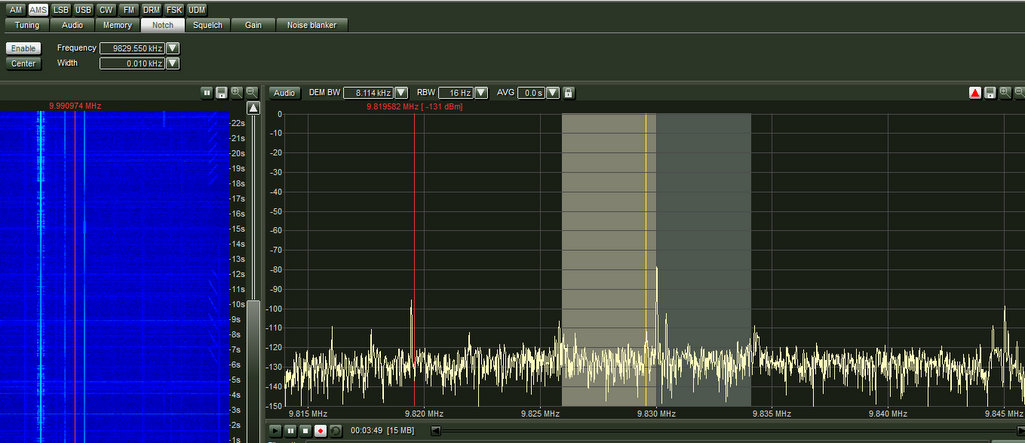
The lighter shaded side of the AM carrier indicates a lower sideband sync lock. (Click to enlarge)

A few days ago, I tuned to 9,420 kHz and found a relatively strong signal from the Avlis transmitter site of the Voice of Greece. The broadcast was quite clear until a heterodyne (het) tone popped up out of nowhere.

I checked the spectrum display of my Excalibur to find two steady carriers located about .5 kHz off each side of VOG’s AM carrier. I assume this may have been a faint digital signal centered on the same frequency as VOG.

The noise was annoying, but SDRs (and many tabletop radios) have tools to help mitigate this type of noise.

The het tone was originating from both sidebands of the VOG AM carrier (see spectrum display above). I had planned to use my notch filter to eliminate the noise, but I had two carriers to notch out and only one notch filter.
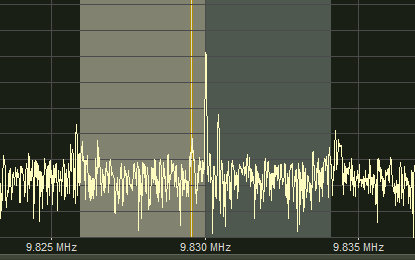
VOG AM carrier

Synchronous detection to the rescue… 

The simple solution was to eliminate one of the carriers using my SDR’s synchronous detector which can lock to either the upper or lower sideband. In this case, it didn’t make any difference which sideband I locked to because both had similar audio fidelity and were otherwise noise free. In the end, I locked to the lower sideband, thus eliminating the het in the upper sideband.

Next, I enabled my notch filter and moved its frequency to cover the annoying het carrier in the lower sideband; I kept the notch filter width as narrow as I could to preserve VOG’s audio fidelity. You can see the notch filter location and width in the spectrum display above (the notch filter is the thin yellow line).

I should note here that the great thing about using an SDR–or tabletop receiver with a spectrum display–is that you can see where the noise is. I was using my WinRadio Excalibur, but pretty much any SDR in my shack could have handled this task.

The results? No het tone and I was able to preserve the great audio fidelity from the Voice of Greece broadcast!

Here’s a 3.5 hour recording I made after cleaning up the signal. I believe at one point in the recording, I switched off the notch filter to demonstrate how loud the het tone was:
Guest Post: Brian’s 1974 mix tape of off-air shortwave radio recordings

HalliDial

Many thanks to SWLing Post and Shortwave Radio Audio Archive contributor, Brian Smith, for the following guest post and vintage recording:


Shortwave Radio 1974: Canada, Argentina, Spain, West Germany, Albania, utility stations

-Brian Smith (W9IND)

Want to know what shortwave radio sounded like in 1974? This 55-minute recording, recovered from a cassette, was never intended to be anything but “audio notes”: I was an 18-year-old shortwave listener who collected QSL cards from international stations, and I was tired of using a pen and a notepad to copy down details of the broadcasts. I wanted an easier way to record what I heard, and my cassette tape recorder seemed like the perfect means to accomplish that goal.

But it wasn’t. I soon discovered that it was simpler to just edit my notes as I was jotting them down — not spend time on endless searches for specific information located all over on the tape. To make a long story shorter, I abandoned my “audio notes” plan after a single shortwave recording: This one.

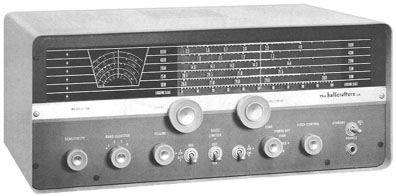
Hallicrafters S-108 (Image: DXing.com)

Hallicrafters S-108 (Image source: DXing.com)

Still, for those who want to experience the feel of sitting at a shortwave radio in the mid-1970s and slowly spinning the dial, this tape delivers. Nothing great in terms of sound quality; I was using a Hallicrafters S-108 that was outdated even at the time. And my recording “technique” involved placing the cassette microphone next to the radio speaker.

Thus, what you’ll hear is a grab bag of randomness: Major shortwave broadcasting stations from Canada, Argentina, Spain, Germany and Albania; maritime CW and other utility stations; and even a one-sided conversation involving a mobile phone, apparently located at sea. There are lengthy (even boring) programs, theme songs and interval signals, and brief IDs, one in Morse code from an Italian Navy station and another from a Department of Energy station used to track shipments of nuclear materials. And I can’t even identify the station behind every recording, including several Spanish broadcasts (I don’t speak the language) and an interview in English with a UFO book author.

The following is a guide, with approximate Windows Media Player starting times, of the signals on this recording. (Incidentally, the CBC recording was from July 11, 1974 — a date I deduced by researching the Major League Baseball scores of the previous day.)

Guide To The Recording

00:00 — CBC (Radio Canada) Northern and Armed Forces Service: News and sports.
07:51 — RAE (Radio Argentina): Sign-off with closing theme
09:14 — Department of Energy station in Belton, Missouri: “This is KRF-265 clear.”
09:17 — Interval signal: Radio Spain.
09:40 — New York Radio, WSY-70 (aviation weather broadcast)
10:22 — Unidentified station (Spanish?): Music.
10:51— Unidentified station (English): Historic drama with mention of Vice President John Adams, plus bell-heavy closing theme.
14:12 — Unidentified station (Spanish?): Male announcer, poor signal strength.
14:20 — Unidentified station (Spanish): Theme music and apparent ID, good signal strength.
15:16 — Unidentified station (foreign-speaking, possibly Spanish): Song, “Chirpy Chirpy Cheep Cheep.”
17:00 — Deutsche Welle (The Voice of West Germany): Announcement of frequencies, theme song.
17:39 — Unidentified station (English): Interview with the Rev. Barry Downing, author of “The Bible and Flying Saucers.”
24:36 — One side of mobile telephone conversation in SSB, possibly from maritime location.
30:37 — Radio Tirana (Albania): Lengthy economic and geopolitical talk (female announcer); bad audio. Theme and ID at 36:23, sign-off at 55:03.
55:11 — Italian Navy, Rome: “VVV IDR3 (and long tone)” in Morse code.

Click here to download the recording as an MP3, or simply listen via the embedded audio player below:


Brian, this is a brilliant recording–regardless of audio quality–and we’re very thankful you took the time to share it. Propagation has left something to be desired as of late, so time traveling back to 1974 has been incredibly fun. 

Post Readers: If, like Brian, you have off-air recordings on tape that you’d like to share, please contact me! Even if you don’t have the means to transfer your tapes to a digital format, I’m a part of a small community of shortwave radio archivists who would be quite willing to help.

Radio Serbia International recording and final farewell

Location of Serbia (green) and the disputed territory of Kosovo (light green)in Europe (dark grey). Source: Wikimedia

Many thanks to SWLing Post reader, “Mutezone,” who writes:

“I want to share a link to a video of Radio Serbia International’s English service recorded on the 4th of July 2015…

[…]I have been monitoring for RSI during the last week of July but got nothing. I have also been monitoring 6100 kHz after the July final date of transmission as according to RSI’s website, there are “Pirates stalking Serbian short wave” due to the termination of the station. However I have not received any odd transmissions on this frequency at the moment.”

Thanks for sharing this recording/video and, especially, for capturing RSI’s interval signal.

I was unable to hear RSI’s final broadcast on July 31, 2015.

If any SWLing Post readers managed to record RSI’s final broadcast–in any language–please contact me so we can add it to the Shortwave Radio Audio Archive.

Regarding the end of Radio Serbia International (or International Radio Serbia), the following final post was published on their website. I’ve included the full note, for archival purposes, in case the RSI website goes offline in the future:


The End of Radio Yugoslavia – International Radio Serbia

RadioSerbiaThanks for sharing the recording and for including a few minutes of the RSI interval signal. RSI was always a difficult broadcaster for me to catch here in North America, though I heard them a number of times via the University Twente Web SDR.

Dear friends, Radio Yugoslavia – International Radio Serbia, ceases to exist on 31 July 2015. For you, our faithful listeners from all over the world, and also for us who have worked on this radio, the only consolation would be the fact that this only state short-wave station in Serbia, which has existed for 79 years, will be remembered as an efficient and reliable promoter of Serbia worldwide. No one has ever presented valid reasons why this media, of rich tradition, range and staff potentials, and with big plans until yesterday, should cease to exist. Unfortunately, the assessments not based on arguments were louder than serious analyses and recommendations of experts, professionals and numerous listeners that the world radio service is necessary for Serbia, that it presents the country worldwide in the best manner possible and that no serious state will renounce such an effective diplomacy.

Our significance has been confirmed by the letters of thousands of listeners from all over the world. Some listened to us because of our information programmes, some because of economic topics, while many got to love our country, Serbia, because of its tradition, beautiful and interesting landmarks and the rich heritage they were acquainted with by listening to International Radio Serbia. Regardless of your affinities, you have all told us that you were listening to us because of our objectivity and the possibility of hearing us at any time and everywhere, for such is the power of short waves.

The Serbian government, however, believes that the closing down of Radio Yugoslavia – International Radio Serbia – is a justified move. Regardless of the fact that the state of Serbia is in an economic crisis, that each saved penny is precious, that many citizens have been rendered jobless, that new work positions should be opened, it has become unclear to the very end why the only state short-wave station has suddenly become too expensive after 80 years. We are, however, certain, that Serbian citizens, taxpayers, who have financed us for all these years, would have decided differently had they been asked to.

What remains, after all, is the pride we feel because of the history of our radio as well as the hope that the voice of Serbia will reach our listeners wherever they are.

Thank you, dear listeners from all over the world, for having trusted us all these years! Radio Yugoslavia – International Radio Serbia now greets you and signs off.

Source: http://voiceofserbia.org/content/end-radio-yugoslavia-%E2%80%93-international-radio-serbia#sthash.rvvWUjgx.dpuf

Peter’s archived recordings include KBC

SX-99-DialSWLing Post reader, Peter (K3KMS) writes:

In a post dated October 25, 2014, you mentioned listening to the ‘Giant Jukebox’ radio program on The Mighty KBC Shortwave.

For the past year or so, I have been a big fan of said program, and I try to listen to it every Saturday evening (0000 UTC, I’m located in Delaware). When I am able to listen, I record the program using my Drake R8B, and I archive the obtained recordings on my website.

The link to the archive web page is provided below (scroll down to the 7375 khz and 9925 khz table rows). I was hoping that you might share said link with your readership so that they, too, can experience this (in my humble opinion) awesome radio program at their leisure!

http://21centimeter.com/Shortwave_Archived_DX.html

Many thanks, Peter, and I’m quite happy to share your recordings. Like you, I’m a big fan of The Mighty KBC–we’re most fortunate to have a broadcaster like KBC on the shortwaves! I look forward to checking out your other recordings as well.

Shortwave Radio Recordings: Radio St. Helena

radiosthelenaMany thanks to Shortwave Radio Audio Archive contributor, Brian Smith, who shares the following recording of Radio St. Helena Day 2006 and notes:

“Beginning in 1990, Radio St. Helena was known for transmitting an international shortwave radio broadcast only once a year — and sometimes not even that — on a frequency of 11092.5 kHz USB. I managed to hear its 2006 broadcast to North America for about an hour on Nov. 4 and 5 UTC (straddling the 0000 hour).

Because of its relatively low power, it was never an easy catch in the American Midwest. That’s why this recording, which lasts just over an hour — I spliced together both sides of a cassette — captures a signal quality that is merely fair at best. But that was typical of Radio St. Helena, whose 1 kw signal in 2006 (it was 1.5 kw in the 1990s) seldom packed much of a punch.

I was listening on the borrowed rig of a now-deceased friend, Mike Koss, W9SU, and have long since forgotten the type of radio (probably a ham rig) he let me use. However, if memory serves, it was attached to a Beverage antenna that stretched across his 10-acre property in the heart of Indianapolis.

Mike deserves the lion’s share of the credit for the creation of this recording.”

In all of the years I tried to hear Radio St. Helena’s annual broadcast, timing never worked on my end; either I was travelling, the station had transmitter problems, or conditions were simply too poor. Many thanks for sharing this recording with us, Brian!

Click here to download the recording as an MP3, or simply listen via the embedded player below:

LondonShortwave: “Scanning the skies”

Fullscreen capture 7302015 124403 PMMany thanks to SWLing Post contributor, LondonShortwave, who shared (via Twitter) this video with recordings made with his portable SDR in a London park:

Brilliant recordings, LS, and amazingly QRM-free!

You can follow LondonShortwave on his blog and via Twitter.

Jim’s shortwave listening post is a Navy ship

USNS Button - 02

USNS Sgt William R Button (Photo: NavySite.de)

SWLing Post contributor, Jim Clary (ND9M/VQ9JC) contacted me in June to obtain details about the BBC’s Midwinter broadcast to the British Antarctic Survey Team. Jim has been working on board the USNS Sgt William R Button since mid-June. While on board Jim has no web access, but he can send and receive emails and some files. I kept Jim informed about the time and frequencies of the BAS broadcast.

Jim had hoped to make a recording of the Midwinter broadcast at sea, but timing and some technical problems got in the way and he missed the bulk of the 30 minute program.

That’s okay, though, because Jim is an avid SWL and ham radio operator. During time off, he has logged a number of stations, so I asked if he would consider making a recording for us.  I mean, SWLing from a Navy ship?!  How cool is that?!

Within a week, Jim sent me a recording of the Voice of Korea. Here are some of his notes:

I’d heard [the Voice of Korea] many times before when Stateside (and they were Radio Pyongyang at the time), but their signals were always weak and had major polar flutter. Out here, the signal was in-my-face loud, so even though the station is not much of a rare DX catch, I wanted to get them on tape.[…]

[M]y location is the east southern Atlantic Ocean, not far from St. Helena.

[…]My ship is named USNS Sgt William R Button. The ship has been active since the mid 80s and was a “motor vessel” (M/V) until we became a Navy asset in 2009.

USNS Button - 04

[…]My receiver that I’m currently using is my QRP rig, a Yaesu FT-817ND. I changed over to a Navy antenna that I’m feeding with about 70 feet of 75-ohm RG-6 cable. There’s obviously some signal loss from both the length and impedance mismatch of the coax, but at these freqs it’s fairly negligible.

The antenna itself is an AS-2815/SSR-1 that’s mounted above the wheelhouse (bridge) of the ship. I can’t really describe the make up of the antenna simply because I don’t see why it works so well but it really does a good job. If I’d figured out where its feed point is a couple weeks ago, I would’ve had no problem logging the BBC’s Antarctic service!

.Click here to download Jim’s recording of the Voice of Korea or simply listen via the embedded player below. This broadcast was recorded on July 1, 2015 at 1900 UTC on 11910 kHz:

Many thanks, Jim! We look forward to any other recordings you wish to share!