Shortwave listening and everything radio including reviews, broadcasting, ham radio, field operation, DXing, maker kits, travel, emergency gear, events, and more
Many thanks to SWLing Post and SRAA contributor, Tom Laskowski, who shares this recording of the Voice of America; recorded on July 20, 1979 at 0500 UTC on the 31 meter band. Tom notes:
“The first 4:30 is from a VOA newscast that aired before the main part of the program. The main recording was presented on the 10th anniversary of the Apollo 11 moon landing. I enjoy listening to this every year on the landing anniversary.”
Note that Tom has been sharing a number of shortwave recordings from the late 1970s. All of his recordings are being published on the Shortwave Radio Audio Archive. Tom: thanks so much for being a part of the shortwave archive community.
If you have recordings you would like to share with the world as well, please contact me.
Last week, I received a tip from SWLing Post contributor, Dan Robinson: Radio Biafra, a new clandestine station, was audible on 15,560 kHz via the Universite Twente Web SDR.
Despite miserable propagation conditions, I tuned my receiver to 15,560 kHz and was surprised to hear a weak signal from Radio Biafra, here in North Carolina. I recorded a few minutes before conditions changed and Biafra’s signal began to fade.
This was the first time I had logged Radio Biafra, so I was amazed to have copy clear enough to understand.
Radio Biafra also known as Voice of Biafra, is a radio station that was originally founded by the government of the Republic of Biafra but is currently operated by Mazi Nnamdi Kanu. Believed to have had its first transmission before the Nigeria-Biafra war, the radio station was instrumental in the broadcast of speeches and propaganda by Chukwuemeka Odumegwu Ojukwu to the people of the Republic of Biafra.
[…]Radio Biafra currently transmits via the internet and shortwave broadcast targeted majorly around Eastern Nigeria. Radio Biafra claims to be broadcasting the ideology of Biafra –”Freedom of the Biafra people”.
[…]Radio Biafra has been met with mixed reactions. While some critics have criticized the station for “inciting war” through its programmes and “preaching hate messages” against Nigeria which it refers to as a “zoo”, an editor for Sahara Reporters wrote in defence of the radio station after he compared Radio Biafra with the British Broadcasting Corporation Hausa service.
On 14 July 2015, it was reported in the media that the radio station had been jammed because it did not have a broadcast license from the Nigerian Broadcasting Commission. However, the radio station in a swift reaction labelled such claims as “lies” and went on to release its new frequency details to the public.
After a 2005-13 hiatus, I have rediscovered a childhood hobby and your reviews have helped me find my way to the post-Sony portable shortwave radio markets.
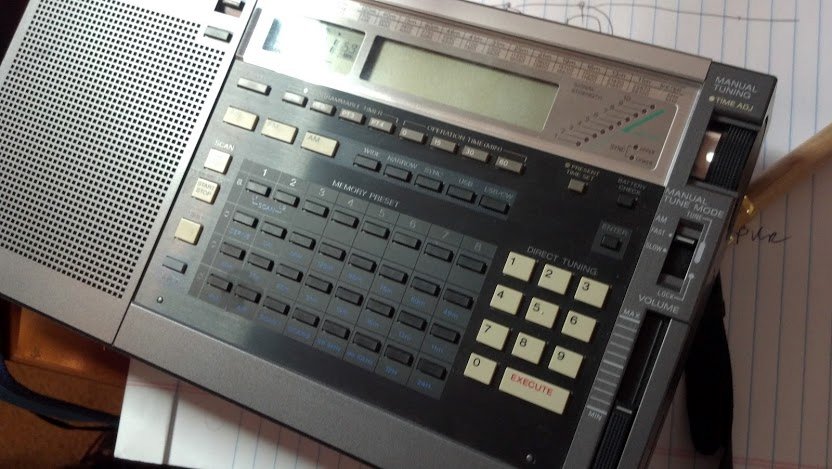
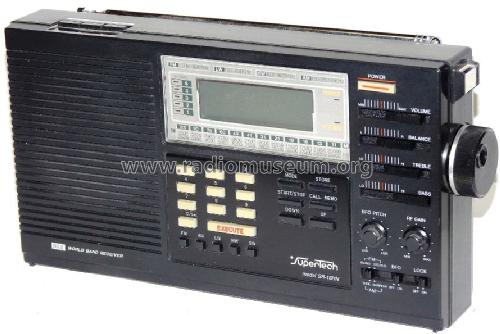
First, I obtained my “childhood dream” radio (Sony ICF 2001D), because at the time I made these recordings I was still in school and 1300 DM would have equaled over 1 year of pocket money, so a Supertech SR16HN had to do. I thought I got some fine results with this Sangean-Siemens re-branded receiver then, using a CB half-length antenna, a random wire, and much endurance.
The Supertech SR16HN (photo: Radiomuseum.com)
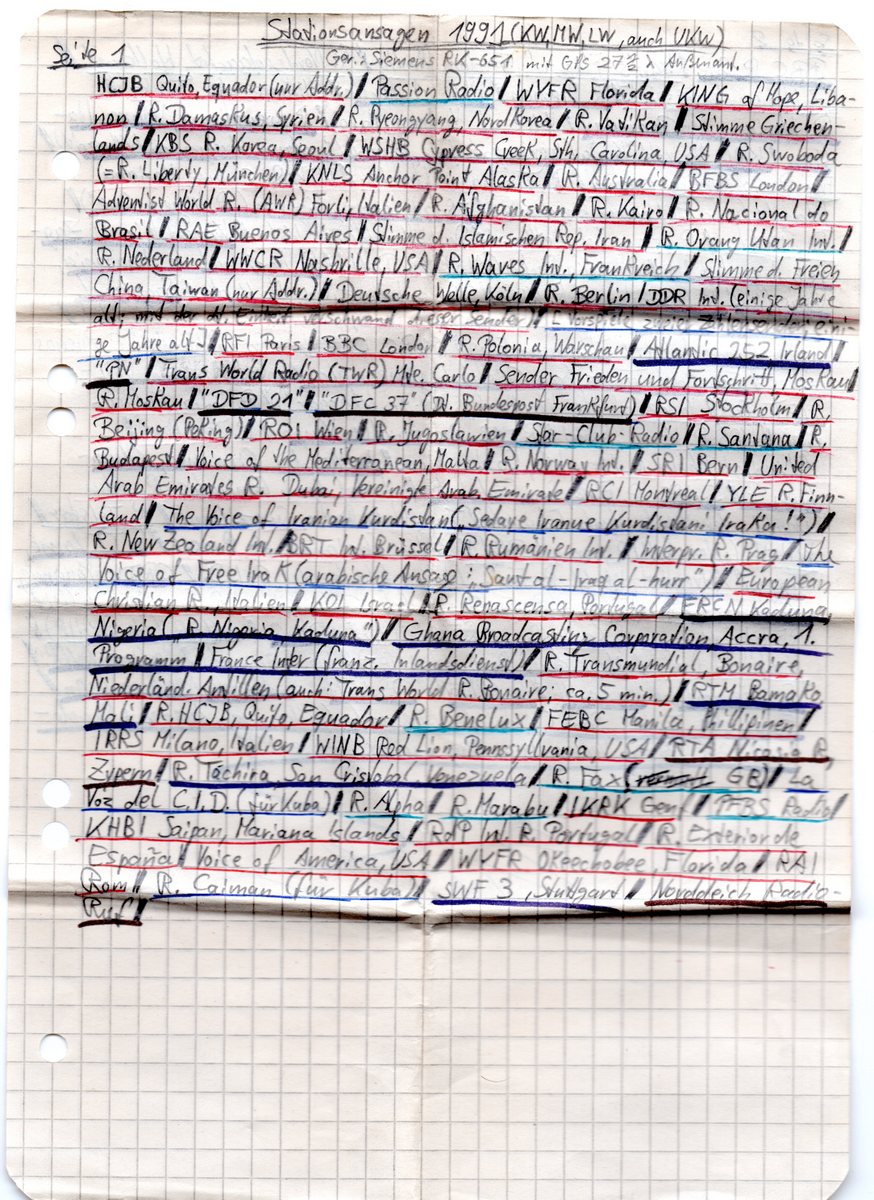
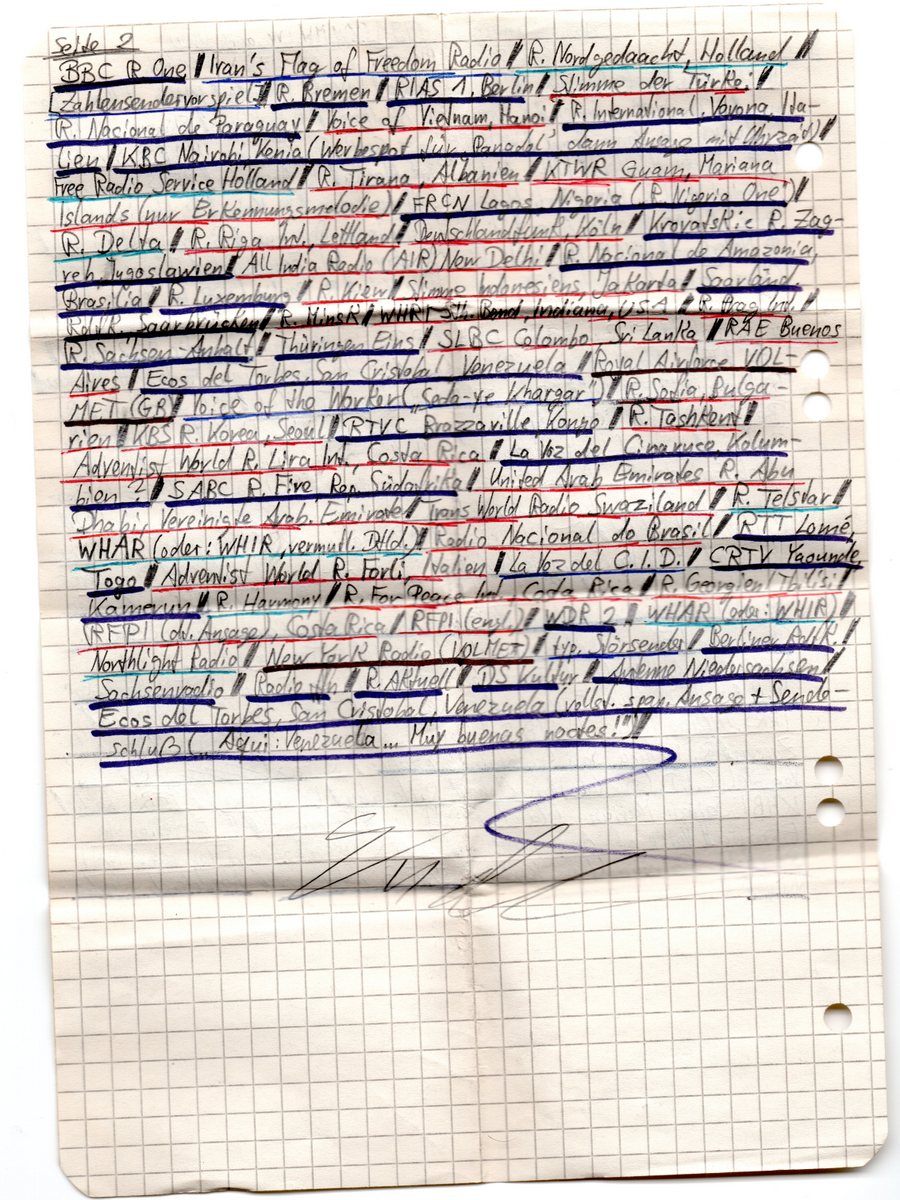
I kept regular logs throughout the years, wrote to 50 international and pirate stations for QSL and compiled this cassette.
A few years before I got that trusty SR16HN, however, I recorded a few number stations (such as G3, Four Note Rising Scale etc) with an ordinary radio cassette recorder, and in 1991 I put them onto this tape as well. The other recordings are done with the same radio placed right in front of the SR 16HN.
Feel free to make use of these recordings. Most of it are the well-known international state-owned shortwave stations of the past; plus European pirates; plus number stations; and at the end, a few (off-topic) local Am and FM stations interval signals.
As I said, this collection I made shortly after the Wende/reunification period, when all former-GDR state broadcasters changed their names, sometimes more than once.
Please continue your good work on the blogs! Weather permitting I am often outside cycling and always have the tiny Sony ICF 100 with me (which I call my then-student’s dream radio of the later 90ies).
Cassette Side 1
Frank’s original hand-written notes. Click to enlarge.
Wow! Frank, what a treat to listen to all these station IDs!
I had forgotten how many interval signals have changed over time and how many, of course, have disappeared. This tape represents a flood of nostalgia for me.
I should add, too, that I’ve enjoyed hearing so many IDs in German. It’s funny, but we all get hooked on listening to language programming from our native or second languages. It makes me realize just how many broadcasters used to have German language services.
Again, many thanks, Frank, for taking the time to digitize these recordings and scan your original hand-written notes. This stuff is invaluable, in my book!
Despite dismal propagation, I was quite happy to receive a relatively strong signal earlier this week (31 August 2015) from Channel Africa, starting around 16:40 UTC on 15,235 kHz.
This recording begins with the French language service (already in progress), followed by the English language service. Receiver used was a WinRadio Excalibur connected to a large horizontal delta loop antenna.
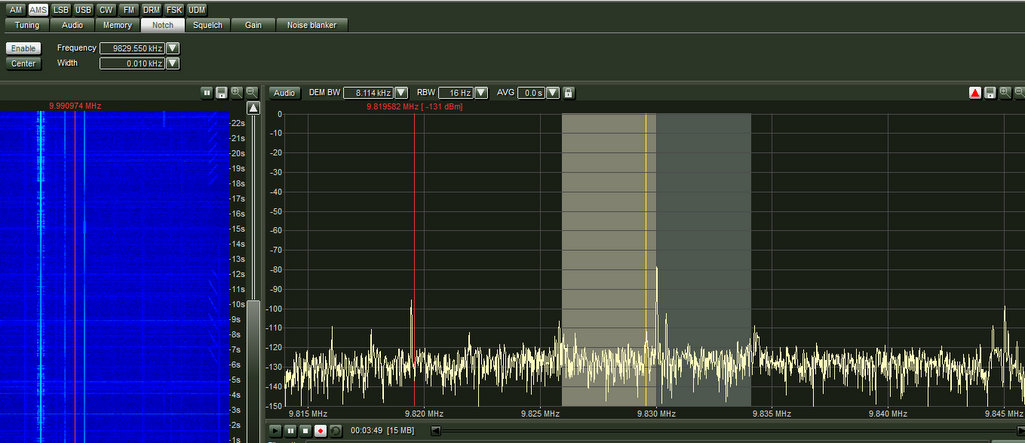
The lighter shaded side of the AM carrier indicates a lower sideband sync lock. (Click to enlarge)
A few days ago, I tuned to 9,420 kHz and found a relatively strong signal from the Avlis transmitter site of the Voice of Greece. The broadcast was quite clear until a heterodyne (het) tone popped up out of nowhere.
I checked the spectrum display of my Excalibur to find two steady carriers located about .5 kHz off each side of VOG’s AM carrier. I assume this may have been a faint digital signal centered on the same frequency as VOG.
The noise was annoying, but SDRs (and many tabletop radios) have tools to help mitigate this type of noise.
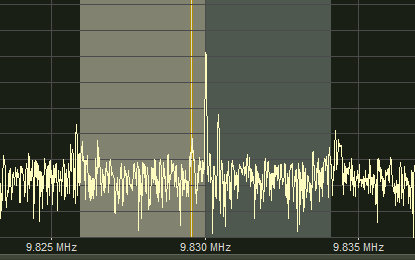
The het tone was originating from both sidebands of the VOG AM carrier (see spectrum display above). I had planned to use my notch filter to eliminate the noise, but I had two carriers to notch out and only one notch filter.
Synchronous detection to the rescue…
The simple solution was to eliminate one of the carriers using my SDR’s synchronous detector which can lock to either the upper or lower sideband. In this case, it didn’t make any difference which sideband I locked to because both had similar audio fidelity and were otherwise noise free. In the end, I locked to the lower sideband, thus eliminating the het in the upper sideband.
Next, I enabled my notch filter and moved its frequency to cover the annoying het carrier in the lower sideband; I kept the notch filter width as narrow as I could to preserve VOG’s audio fidelity. You can see the notch filter location and width in the spectrum display above (the notch filter is the thin yellow line).
I should note here that the great thing about using an SDR–or tabletop receiver with a spectrum display–is that you can see where the noise is. I was using my WinRadio Excalibur, but pretty much any SDR in my shack could have handled this task.
The results? No het tone and I was able to preserve the great audio fidelity from the Voice of Greece broadcast!
Here’s a 3.5 hour recording I made after cleaning up the signal. I believe at one point in the recording, I switched off the notch filter to demonstrate how loud the het tone was:
Many thanks to SWLing Post and Shortwave Radio Audio Archive contributor, Brian Smith, for the following guest post and vintage recording:
Shortwave Radio 1974: Canada, Argentina, Spain, West Germany, Albania, utility stations
-Brian Smith (W9IND)
Want to know what shortwave radio sounded like in 1974? This 55-minute recording, recovered from a cassette, was never intended to be anything but “audio notes”: I was an 18-year-old shortwave listener who collected QSL cards from international stations, and I was tired of using a pen and a notepad to copy down details of the broadcasts. I wanted an easier way to record what I heard, and my cassette tape recorder seemed like the perfect means to accomplish that goal.
But it wasn’t. I soon discovered that it was simpler to just edit my notes as I was jotting them down — not spend time on endless searches for specific information located all over on the tape. To make a long story shorter, I abandoned my “audio notes” plan after a single shortwave recording: This one.
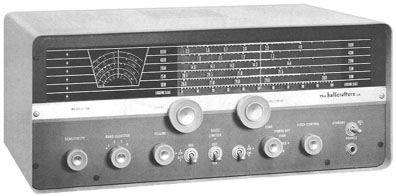
Hallicrafters S-108 (Image source: DXing.com)
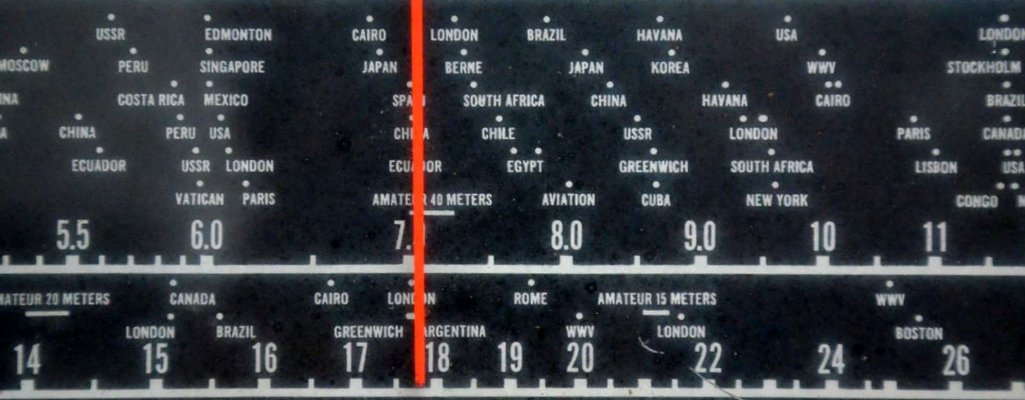
Still, for those who want to experience the feel of sitting at a shortwave radio in the mid-1970s and slowly spinning the dial, this tape delivers. Nothing great in terms of sound quality; I was using a Hallicrafters S-108 that was outdated even at the time. And my recording “technique” involved placing the cassette microphone next to the radio speaker.
Thus, what you’ll hear is a grab bag of randomness: Major shortwave broadcasting stations from Canada, Argentina, Spain, Germany and Albania; maritime CW and other utility stations; and even a one-sided conversation involving a mobile phone, apparently located at sea. There are lengthy (even boring) programs, theme songs and interval signals, and brief IDs, one in Morse code from an Italian Navy station and another from a Department of Energy station used to track shipments of nuclear materials. And I can’t even identify the station behind every recording, including several Spanish broadcasts (I don’t speak the language) and an interview in English with a UFO book author.
The following is a guide, with approximate Windows Media Player starting times, of the signals on this recording. (Incidentally, the CBC recording was from July 11, 1974 — a date I deduced by researching the Major League Baseball scores of the previous day.)
Guide To The Recording
00:00 — CBC (Radio Canada) Northern and Armed Forces Service: News and sports. 07:51 — RAE (Radio Argentina): Sign-off with closing theme 09:14 — Department of Energy station in Belton, Missouri: “This is KRF-265 clear.” 09:17 — Interval signal: Radio Spain. 09:40 — New York Radio, WSY-70 (aviation weather broadcast) 10:22 — Unidentified station (Spanish?): Music. 10:51— Unidentified station (English): Historic drama with mention of Vice President John Adams, plus bell-heavy closing theme. 14:12 — Unidentified station (Spanish?): Male announcer, poor signal strength. 14:20 — Unidentified station (Spanish): Theme music and apparent ID, good signal strength. 15:16 — Unidentified station (foreign-speaking, possibly Spanish): Song, “Chirpy Chirpy Cheep Cheep.” 17:00 — Deutsche Welle (The Voice of West Germany): Announcement of frequencies, theme song. 17:39 — Unidentified station (English): Interview with the Rev. Barry Downing, author of “The Bible and Flying Saucers.” 24:36 — One side of mobile telephone conversation in SSB, possibly from maritime location. 30:37 — Radio Tirana (Albania): Lengthy economic and geopolitical talk (female announcer); bad audio. Theme and ID at 36:23, sign-off at 55:03. 55:11 — Italian Navy, Rome: “VVV IDR3 (and long tone)” in Morse code.
Brian, this is a brilliant recording–regardless of audio quality–and we’re very thankful you took the time to share it. Propagation has left something to be desired as of late, so time traveling back to 1974 has been incredibly fun.
Post Readers: If, like Brian, you have off-air recordings on tape that you’d like to share, please contact me! Even if you don’t have the means to transfer your tapes to a digital format, I’m a part of a small community of shortwave radio archivists who would be quite willing to help.
Many thanks to SWLing Post reader, “Mutezone,” who writes:
“I want to share a link to a video of Radio Serbia International’s English service recorded on the 4th of July 2015…
[…]I have been monitoring for RSI during the last week of July but got nothing. I have also been monitoring 6100 kHz after the July final date of transmission as according to RSI’s website, there are “Pirates stalking Serbian short wave” due to the termination of the station. However I have not received any odd transmissions on this frequency at the moment.”
Thanks for sharing this recording/video and, especially, for capturing RSI’s interval signal.
I was unable to hear RSI’s final broadcast on July 31, 2015.
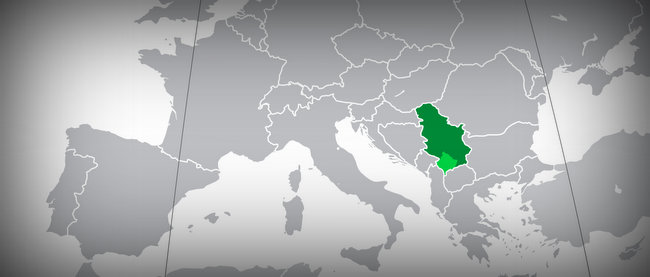
Regarding the end of Radio Serbia International (or International Radio Serbia), the following final post was published on their website. I’ve included the full note, for archival purposes, in case the RSI website goes offline in the future:
The End of Radio Yugoslavia – International Radio Serbia
Thanks for sharing the recording and for including a few minutes of the RSI interval signal. RSI was always a difficult broadcaster for me to catch here in North America, though I heard them a number of times via the University Twente Web SDR.
Dear friends, Radio Yugoslavia – International Radio Serbia, ceases to exist on 31 July 2015. For you, our faithful listeners from all over the world, and also for us who have worked on this radio, the only consolation would be the fact that this only state short-wave station in Serbia, which has existed for 79 years, will be remembered as an efficient and reliable promoter of Serbia worldwide. No one has ever presented valid reasons why this media, of rich tradition, range and staff potentials, and with big plans until yesterday, should cease to exist. Unfortunately, the assessments not based on arguments were louder than serious analyses and recommendations of experts, professionals and numerous listeners that the world radio service is necessary for Serbia, that it presents the country worldwide in the best manner possible and that no serious state will renounce such an effective diplomacy.
Our significance has been confirmed by the letters of thousands of listeners from all over the world. Some listened to us because of our information programmes, some because of economic topics, while many got to love our country, Serbia, because of its tradition, beautiful and interesting landmarks and the rich heritage they were acquainted with by listening to International Radio Serbia. Regardless of your affinities, you have all told us that you were listening to us because of our objectivity and the possibility of hearing us at any time and everywhere, for such is the power of short waves.
The Serbian government, however, believes that the closing down of Radio Yugoslavia – International Radio Serbia – is a justified move. Regardless of the fact that the state of Serbia is in an economic crisis, that each saved penny is precious, that many citizens have been rendered jobless, that new work positions should be opened, it has become unclear to the very end why the only state short-wave station has suddenly become too expensive after 80 years. We are, however, certain, that Serbian citizens, taxpayers, who have financed us for all these years, would have decided differently had they been asked to.
What remains, after all, is the pride we feel because of the history of our radio as well as the hope that the voice of Serbia will reach our listeners wherever they are.
Thank you, dear listeners from all over the world, for having trusted us all these years! Radio Yugoslavia – International Radio Serbia now greets you and signs off.