Category Archives: Shortwave Radio

Results of the Shortwave Portable weak signal shoot-out

RadiosShootOut-SonyTecsunSangean

Thanks to all who participated in our shoot-out!  Last week, I posted three recordings of a weak shortwave broadcast in an attempt to evaluate which recording–thus which radio–our listeners prefer. The test was “blind” in that, though four radios were evaluated, only three recordings were posted, merely labeled, “Sample #1,” “Sample #2,” and “Sample #3,” respectively.

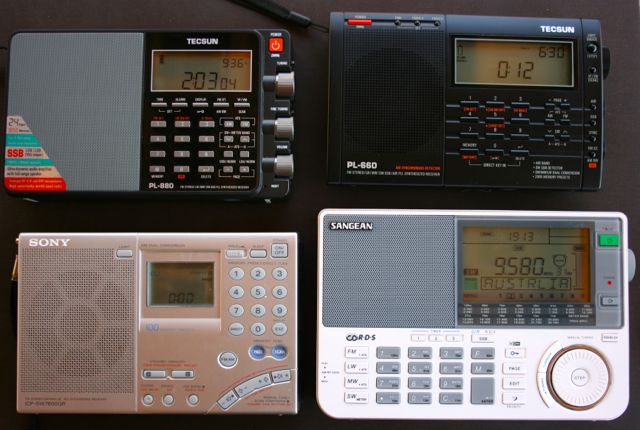
The radios tested were not just average radios. Rather, they represent the best of the truly portable radios currently on the market, namely: the Sangean ATS-909X, the Tecsun PL-880, the Tecsun-PL660 and the Sony ICF-SW7600GR.

Indeed, the most popular question I receive from SWLing Post readers is about two or more of these models, asking,”which is best?”

The samples

To refresh your memory, I’ve embedded the audio samples below–but if you haven’t yet, I would encourage you to read our previous post (and the great reader comments following!) before proceeding.

The recordings in our samples are of Radio Romania International on 11,975 kHz. Normally, the signal would have been stronger, but propagation was rough, and QSB (fading) was pronounced at times. Note that I recorded all of these samples with my Zoom H2N digital recorder via a line-in connection, using the radio’s headphone jack. Since not all of the radios have a line-out jack, I used the headphone jack each time and simply set the volume and line-in gain to the same level.

Sample 1:

Sample 2:

Sample 3:

And now, here is the sample I intentionally left out in my previous post…Sample #4. I didn’t include it in the evaluation because, frankly, it was such a weak performer compared with the other three; I knew it would take last place:

Sample 4:

With that in mind, we’ll start with the radio behind Sample 4:
Sangean-ATS-909X

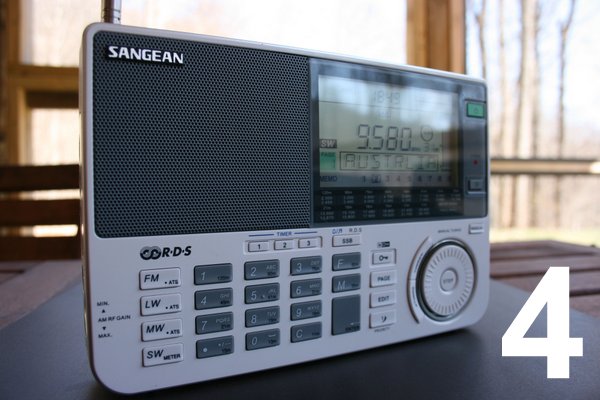
Sangean ATS-909X ($200-250 US)


Many readers guessed rightly that the Sangean ATS-909X was the radio omitted. Evidently, it is known for its lack of sensitivity when only employing its telescoping whip antenna. You’ll notice that, most of the time, the RRI broadcast is lost in the static.

Frankly, I was somewhat surprised that the ATS-909X didn’t perform better. It has a loyal following amongst SWLing Post readers and has been a popular radio on the market for the past three years or so. While I’ve used the ATS-909X in the past, I have never owned one, and had never done a side-by-side comparison.

To perform this test, I borrowed the 909X from a friend who usually has it hooked up to an external antenna. In fact, this is when I learned that the 909X performs admirably when hooked up to an external antenna.

In my tests, however, I didn’t want to hook up external antennas.  I believe that for a radio to be evaluated as a portable, it must be judged on its ability to receive signals from its telescopic whip antenna as a base line.

But let’s move on to the radios you did hear in our weak signal evaluation…

Let’s take a look at the radio behind Sample #3, the radio our readers voted to take last place in terms of weak-signal listening:
Tecsun-PL-880

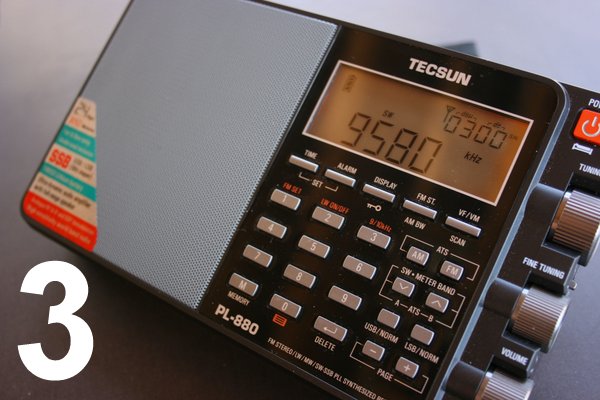
Tecsun PL-880: Sample 3 ($150-160 US)


With the exception of three votes (out of more than seventy), Sample #3–the Tecsun PL-880–was overwhelmingly voted worst in this weak-signal shoot-out.

The bulk of your criticisms focused on the fact that the PL-880 did not handle fading as well as the other radios. When the signal was at a peak, it sounded great, but in QSB troughs, the signal became unintelligible and you could hear DSP artifacts and distortion.

But is the PL-880 a “bad” radio? Absolutely not. Indeed, I gave it pretty high marks when I reviewed it last year. It’s just not the best choice for weak-signal listening–at least in its current firmware version.  Note to Tecsun:  I do believe it may be possible to tweak this portable’s AGC circuit so that it handles fading better…

But let’s move on to the other contestants. Here’s our second-place portable:
Tecsun-PL660

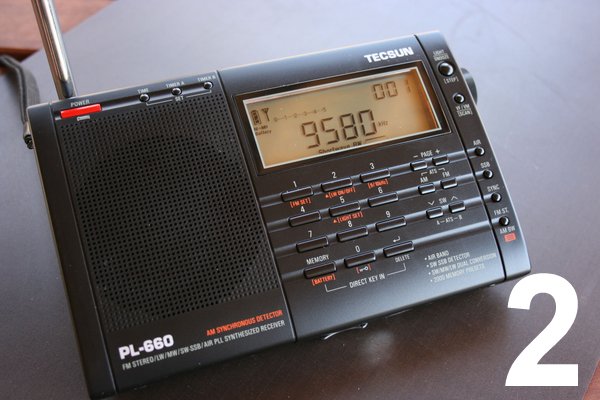
Tecsun PL-660: Sample 2 ($110-130 US)


During the first day of voting, the Tecsun PL-660 actually had a noticeable lead on the other radios. I’m not surprised. The sensitivity was better than the rest of the contestants, in my opinion. The received audio was clear and seemed to pop out of the static better than the others.

Overwhelmingly, those who didn’t vote the PL-660 as best, voted it as second. Their main criticism was that the PL-660’s AGC was a little too active and less stable than the radio which actually took first place.

And with no further ado, here’s our winner:
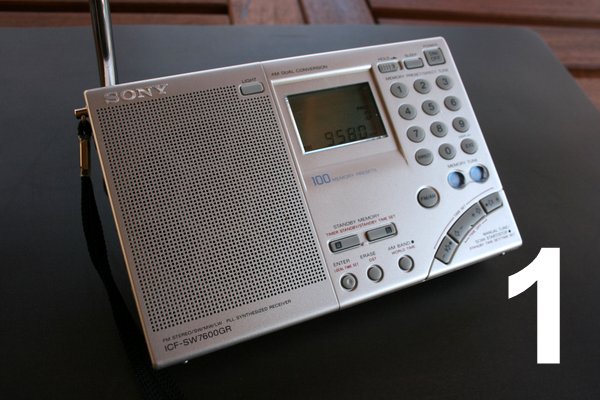
Son-ICF-SW7600GR

Sony ICF-SW7600GR: Sample 1 ($130-150 US)


Surprised?  I was!

After I evaluated the blind test myself, I was certain the PL-660 would be the winner with its stronger sensitivity. But the result–and reader comments–proved me wrong. More of you placed a value on the Sony’s rock-solid AGC circuit which handles the peaks and troughs of fading better than the other contenders.

Commenters noted that the Sony’s audio and stability lent itself to easier, less fatiguing, listening. Keep in mind, though, that many of these same commenters mentioned that the PL-660 (Sample #2) would be their preference for identifying a station in under weak signal conditions.

Now let’s look at the raw data, and then discuss what it all means.

The data

The Sony ICF-SW7600GR was voted:

  • first place 41 times,
  • second place 2o times, and
  • third place once

The Tecsun PL-660 was voted:

  • first place 23 times,
  • second place 33 times, and
  • third place twice

The Tecsun PL-880 was voted:

  • first place never,
  • second place three times, and
  • third place 53 times

I’ve attempted to place this data into a bar graph to make it a little easier to visualize: RadioShootOut-ResultsIf you noticed that these numbers don’t completely add up, it’s because responses were inconsistent.
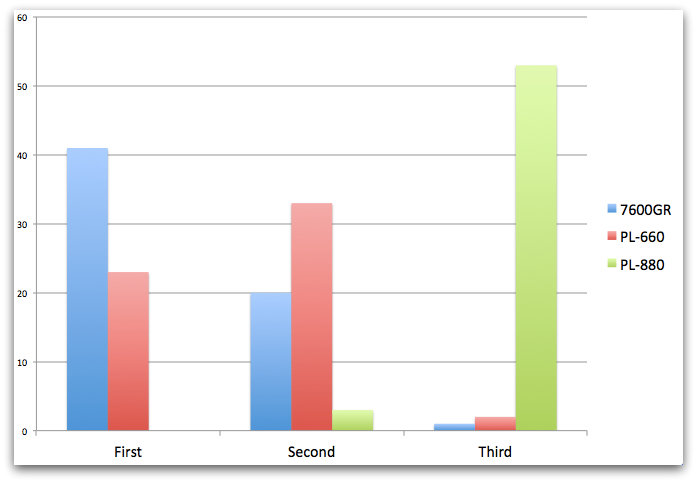
Most survey participants listed their preferences in order (i.e., first, second, and third place). Some respondents only listed their favorite of the three, while others only listed the one they didn’t like. No one responded with a tie between the radios, all had an opinion.

Another way of reading the results

SWLing Post reader “Radio Flynn” helped me with some additional data interpretation this morning. He put together this analysis (download as a PDF), and commented:

“[A]lthough a majority of people choose sample #1, nearly everyone ranked either sample #1 or sample #2 as preferred, and the average ranks are very close, closer than the raw percentages would indicate. I have not done a statistical analysis so I don’t know if the difference in mean rank between #1 and #2 is significant (in other words, I don’t know if there is a significant preference for #1), but you can say that either sample 1 or sample 2 would be acceptable to almost everyone, and sample 3 clearly last choice.”

Radio Flynn also pointed out that next time I do this sort of test (and I will be doing another!) that I should keep votes consistent by asking everyone to rank their preference. Excellent suggestion; I’ll be sure to do so.

So the Sony ICF-SW7600GR is the best radio…right?

Not exactly.

Herein lies the difficulty of suggesting the “best” radio for any particular listener.

This test only evaluated weak signal sensitivity under rather rough conditions. The Sony was “the winner” in this respect.
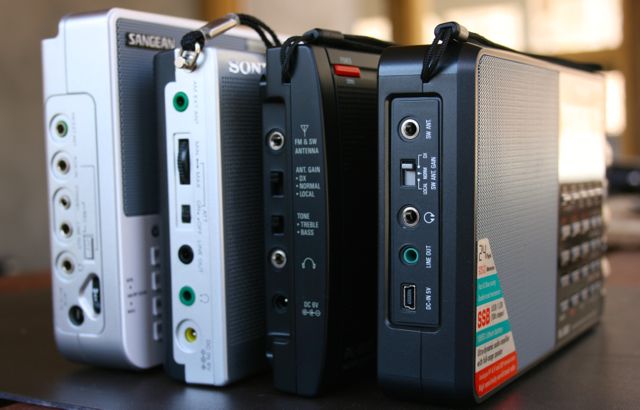
SideBySide-FourRadiosBut this doesn’t tell the whole story.

I’ve had my Sony ‘7600GR longer than any of the other portables in this contest and it is invariably the radio I reach for when I want to make a field recording. I prefer the Sony because it has good sensitivity, a stable AGC, excellent single-sideband selectable sync detection and it can handle being connected to a long external antenna. Indeed, it was the Sony I packed when I spent the summer of 2012 in an off-grid cabin in the Canadian maritimes. In short: my Sony ICF-SW7600GR is my “old faithful.”

But frankly, when I travel, I reach for the PL-660 more often than not. Why?  Yes, the Sony has great receiver characteristics, but its ergonomics leave a lot to be desired. I use my Sony when I plan to key in a frequency and leave it there. The PL-660 is a joy to operate, has simple direct-frequency entry, an excellent auto-tune feature, not to mention, a stable sync detector.

If I want to identify a signal buried in the static, I reach for the PL-660.

If I want to do casual listening and am less concerned with DXing, I reach for the PL-880. It’s a solid radio and has a quality feel to it (running neck-and-neck with the ATS-909X in this respect). Of this bunch, it has by far, the best audio from its internal speaker. If I want armchair listening, I reach for the PL-880. It’s also an excellent SSB receiver–one of the best in this group–and offers more filter selections.

In summary, it’s not always easy to suggest which radio is best…I must ask in response, “Best for what?” The data from this test proves this, as our readers who ranked their favorites backed up their choices with consistent and valid comments.

What do you think?

Before long, I plan to pit these radios (and perhaps another?) against each other in terms of their synchronous detectors in another blind test.  It may take a while to work this up. Your enthusiastic responses, however, completely justify it.

Stay tuned!

Resources:

The Mighty KBC: surfing the shortwaves

Many thanks to Peter Quinn at The Mighty KBC for sharing the following announcement for his new summer radio show:BigBeachRadio-KBC

“Great news if you love surf music and like exploring shortwave radio. The Big Beach Radio Show is coming to The Mighty KBC Europe on 6095 kHz for the summer of 2014. The show’s presenter Peter Quinn describes the venture as “a mirage of the perfect day on the beach.”

Peter has been heard on a range of radio stations over the years including Radio Caroline, The Voice of Peace, Island Sound Malta and numerous UK and European radio stations. He says he’s delighted to be appearing on The Mighty KBC and cordially invites you to catch some surf on shortwave every week at 11.00 UTC .

The show starts Saturday 19th April and goes to air whatever the weather. The Big Beach Radio Show Station – The Mighty KBC Freq – 6095 kHz ( 49 meter band shortwave) Day – Saturday Time – 11.00 UTC

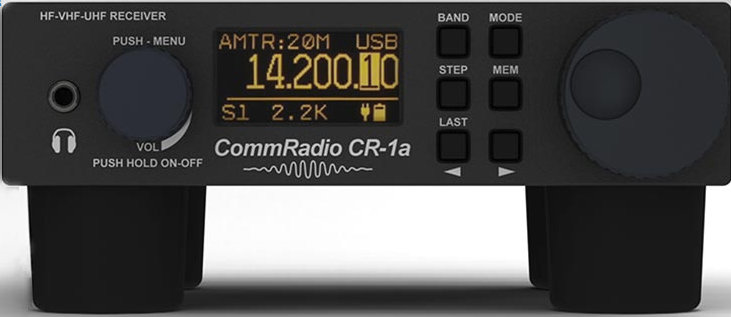
CommRadio introduces the CR-1a

CommRadioCR1a

Many thanks to Dave Zantow (N9EWO) for apprising me of an update to the CommRadio line: the new CommRadio CR-1a.

Based on information published by CommRadio, it appears that the main difference is a change to the USB hardware which has been improved to provide:

  • Digital I-Q (for third-party SDR developers), and
  • One-step user programming (versus two-step with the CR-1).

Other differences are minor, and primarily cosmetic: for example, the CR-1a OLED display is now amber instead of green. Also, the CR-1a lacks the 1/8” HF antenna jack found on the CR-1 (CommRadio notes that the HF-BNC jack is superior).

Software updates and RF-analog DSP architecture are identical to the original CommRadio CR-1.

To me, the USB update is significant in that it results in the CR-1a’s ability to export IQ data via a USB cable.

This could make the CR-1a a very versatile and portable stand-alone or computer-linked SDR. Better yet, it can even be battery powered: the only SDR I know of with this feature.

For more details, check out CommRadio’s website.

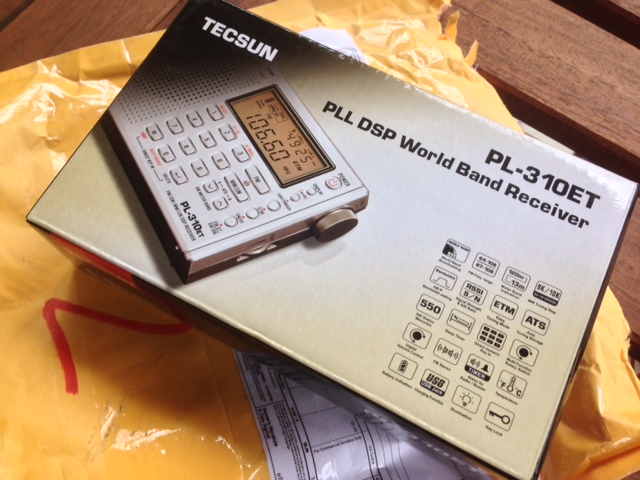
Just arrived: the Tecsun PL-310ET

The Tecsun PL-310 as it arrived in the post.

I confess, I have well over twenty portable shortwave radios at the moment…So why am I still so enthusiastic when a new one arrives in the mailbox?

My Tecun PL-310ET just arrived, purchased from my favorite eBay seller, Anon-Co. And I just can’t wait to compare the PL-310ET with my PL-380.

Perhaps this will become another opportunity for a blind radio comparison by you, our community of listener-readers.  Dare I say, a community equally enthusiastic?

By the way, I plan to publish the results of our recent weak-signal comparison on Tuesday of next week. I’m still impressed by your responses. But there’s still time to submit your vote.  Stay tuned…!

Numbers Stations in the news

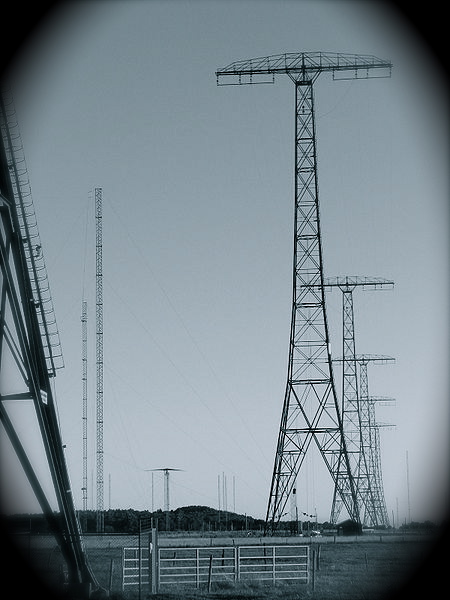
towersThere have been a lot of numbers in the news lately.

Earlier this week, David Goren’s numbers station radio documentary was featured on the ABC Radio National show, Sounds Like Radio.

Click here to listen.

This morning, I also noticed this excellent BBC News Magazine piece on numbers stations, which includes an interview with Akin Fernandez, the creator of the Conet Project.

Here’s an excerpt from The spooky world of the ‘numbers stations’:

“This is the era of hyper-tech espionage, encrypted emails and mindboggling cryptography. But you can hear a very old-fashioned form of espionage on shortwave radio.

It is 13:03 on a Tuesday in a little crammed room of the BBC Monitoring building in Caversham and what is suddenly heard on a shortwave receiving station is a 10-minute message in Morse code.

There is a small community of aficionados who believe messages like this are a throwback to the era of Cold War espionage. They are the mysterious “numbers stations”.

At the apex of the Cold War, radio lovers across the globe started to notice bizarre broadcasts on the airwaves. Starting with a weird melody or the sound of several beeps, these transmissions might be followed by the unnerving sound of a strange woman’s voice counting in German or the creepy voice of a child reciting letters in English.

[…]Times have changed and technology has evolved, but there’s evidence that this old-fashioned seeming method of communication might still be used. Shortwave numbers stations might seem low-tech but they probably remain the best option for transmitting information to agents in the field, some espionage experts suggest.

“Nobody has found a more convenient and expedient way of communicating with an agent,” says Rupert Allason, an author specialising in espionage issues and writing under the pen name Nigel West.

“Their sole purpose is for intelligence agencies to communicate with their agents in denied areas – a territory where it is difficult to use a consensual form of communications,” Allason says.

A former GCHQ officer, who does not wish to be named, whose duty was to intercept signals towards the UK and search for these numbers stations in the 1980s is also adamant that these were broadcasts to agents in the field or in residencies or directed to embassies.

It was “one-way traffic” – the transmitters broadcast numbers to the recipient. The recipient did not reply.”

[…]”This system is completely secure because the messages can’t be tracked, the recipient could be anywhere,” says Akin Fernandez, the creator of the Conet Project – a comprehensive archive of the phenomenon of numbers stations. “It is easy. You just send the spies to a country and get them to buy a radio. They know where to tune and when,” he says.

Continue reading on the BBC Magazine website…

If you would like to know more about numbers stations, click here to read other numbers posts.

Click here to go to David’s website, Shortwaveology.net.

STF Radio: 1 Hour Million Watt Special, April 20

STF Radio sent the following announcement for their “1-hour Million-Watt Special”:

    ___________ ____  ____  __   ___  _  ___    
   / ___/_   __| ___||    \|  \ |   \(_)/ _ \   
   \___ \ | | | __|  | |) /| \ \| |) | | (_) |  
   \____/ |_| |_|    |_|\_\|_|\_\___/|_|\___/   
 
            I N T E R N A T I O N A L
 
               ***ANNOUNCEMENT***
 
            STF Radio International
                       
          1-hour Million-Watt Special 
                       
            April 20, 2014 0400 UTC
 
               –Frequency List–
                   
  5050 (The Americas)         Saturday Night
  5110 (N+C. America)                “
  7490 (N+C. America)                “
  7570 (N. America)                  “
  7730 (Mex/C. America)              “
  9925 (N. America)                  “
  9955 (Caribbean)                   “
  6025 (EU)                   Sunday Morning
 17630* DRM (EU, alternate program)  “
 17760 (Asia)                Sunday Afternoon
 21490 (Pacific Aus/NZ)              “
   
                   Music
                   Voice
          Digital Mode Text+Images
            Internet Hyperlinks
                   ….and more!

Shortwave.am: a new online frequency guide

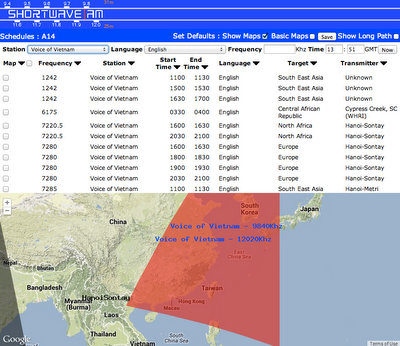
ShortwaveAMA few SWLing Post readers have recently recommended that I check out a new shortwave radio schedule site: shortwave.am.

Shortwave.am has a unique layout that lists broadcast schedules along with a map that displays broadcast footprints (both short and long path).

Fortunately, I was able to get in touch with the site developer, Stephen Cooper, who frequently comments on the SWLing Post.

Stephen kindly answered a couple of questions I posed.

My first question was why, with the number of shortwave schedule sites on the Internet, he felt motivated to create a new site.  Evidently, inspiration came from Stephen’s Android app, Shortwave Radio Schedules. He responds:

I first created the [Shortwave Radio Schedules] app to give me searchable listings on my phone which I found interfered much less with my radio than on my PC so I could turn my PC off and look at frequencies and schedules on a phone/tablet.

Since then I have just added extra features that I find useful, such as the ability to save logs including the station name, time, SINPO, a comment and a recording of the audio. I’ve used the app to then share my logs to Facebook groups, DXLD Yahoo Group etc. including the audio recordings made on the app.

The maps option I added because I had been using AOKI listings with the beam direction to try and work out favourable beam directions of broadcasts for me in the UK even if they were not targeted to Europe. I realised that it would be much easier to visualise this on a map and started looking at the Google Maps API to work out this would be possible on the app.

Once I added to the app I had noticed screenshots of the maps being posted on groups such as the Rally DX 2012 Facebook group’s and a few people who didn’t have Android asking if there was a web version. I looked into it and it wasn’t too hard to create shortwave.am after converting the Java code to PHP:and Javascript then the site was complete.”

When I asked Stephen what made his site differ from others, he responded:

“[I]t uses data from a combination of Eibi and AOKI to display the listings with maps showing the beam direction. It can also show estimate long paths of each broadcast and uses AJAX web technologies to show search results and maps without having to reload the page for each search or change of parameters.

[…]If you choose a station or language or both and click “Save” (next to the “Set Defaults” part of the site) it will set these as the default that will open each time you go to the site.

Also if you click on a transmitter it now shows all broadcasts coming from that transmitter.

[…]I am going to add some more of the features from the [Shortwave Radio Schedules] app such as the ability to add logging reports, view others reception reports from each station and the options to add recordings of a station and listen to others recordings.”

I think shortwave.am is fantastic, and I’m glad Stephen has put the time behind developing it in his spare time.

Stephen is eager to hear your comments, as he wishes to further develop the shortwave.am. Either post them here, or email Stephen directly.