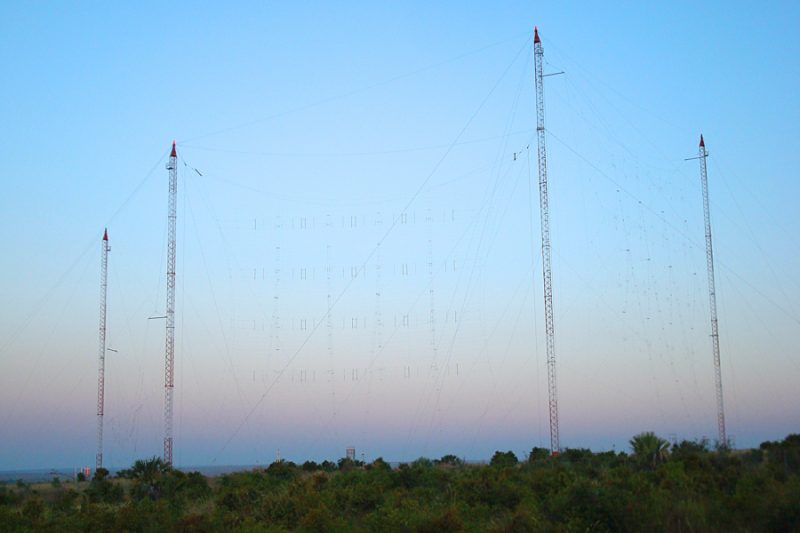
Radio World: Schenectady Shortwave Transmitters, 1941

philco38-4_dial_1Many thanks to SWLing Post contributor, Dan Robinson, for sharing a link to the following article in Radio World:

The General Electric Co. was truly among America’s premier broadcasting companies.

In addition to developing much of early broadcast technology and building a trio of high-power AM stations in the early 1920s — WGY Schenectady, N.Y.; KOA Denver; and KGO Oakland, Calif. — GE was also the country’s pioneer shortwave broadcaster.

GE’s initial shortwave station, 2XI, first broadcast in 1923, and in 1924 it was used to relay WGY’s programs for to KOA and KGO for rebroadcast in the western U.S.

By 1925, there were two experimentally licensed shortwave stations in Schenectady: W2XAD and W2XAF. A third GE station in San Francisco, W6XBE, was added in 1939.

That was the year that the Federal Communications Commission allowed the country’s experimental shortwave stations to relicense as commercial operations, and these three GE stations received the call signs WGEA, WGEO and KGEI, respectively.

Continue reading the full article at Radio World.

Mark’s Icom IC-7100 go kit

Click to enlarge

Click to enlarge

Many thanks to SWLing Post reader, Mark Hirst, who writes:

Thomas,

I have been very impressed by the shacks featured on SWLing !

I don’t really have the room to accommodate such large collections, or to dedicate a special area to just radio.

I tend to perch a radio on a spare surface in the front bedroom, and then cycle through my small collection on a weekly or bi-weekly basis, returning the previous radio to storage to await its turn in a month’s time.

Since newer houses and gardens are typically quite small in the UK, I’ve always been thinking in terms of radio on safari, so with the weather starting to improve, I present to you my ‘shack’ consisting of a recently acquired IC-7100 inside a fortuitously sized toolbox. The radio runs in the bedroom like this too, usually connected to a Wellbrook loop when not transmitting.

20160312_121757332_iOS (1)

The picture [above is of the] head unit in stowed configuration, as the lid of the box doesn’t quite clear the unit when sitting on the base. The space on top of the radio is then filled by the SOTA Beams antenna bag and other sundries. The battery travels separately in the backpack.

My plan was to never have to connect/disconnect the ethernet style cable between the two halves, looks like the plan worked !

You can see it in action here:

This is a brilliant kit, Mark–a great way to escape urban radio interference! The Icom IC-7100 is uniquely qualified for the deep case, too, since the control head can sit on top of the body while in use. The angle of operation is also ideal. Very cool–thanks for sharing!

WRMI test transmissions for Radio Taiwan International

WRMI Logo(Source: WRMI on Facebook)

Friends, we’re doing another round of tests for Radio Taiwan International the nights of March 13, 14 and 15 (Sunday, Monday and Tuesday) in a new frequency of 11530 Khz.

The transmissions will be at 0000-0100 and 0200-0300 UTC (UTC Monday, Tuesday and Wednesday). Very grateful any observation on the quality of the reception in your area, and especially a comparison between the two hours. Thank you in advance.

Please send your reception reports to WRMI using the following email address: [email protected]

Stuart Sizer: Heathkit designer, dad, and “bon vivant”

Heathkit-Drawings-2Two weeks ago, through a radio preservation group, I met the son of Heathkit product designer of the 1950s-70s, Stu Sizer––”stylist, artist, maker of models, bon vivant.” His son described the discovery of a few vintage Heathkit brochures, photos, and illustrations his father kept in his family’s basement shop, many of which had been scanned at some point.

Stu Sizer––”stylist, artist, maker of models, bon vivant”––was tasked with crafting Heathkit’s user-friendly and attractive exterior designs. For many years Sizer was Heathkit’s only product designer, and was therefore often busy. “He was a great dad,” his son told me, “but he spent a lot of time in the basement proof-building kits.”  He adds wryly, “Let that be a lesson to the hams of this world.”

Sizer’s son kindly shared with us the following scans and photos of his dad’s work, many of which are original drawings; the series concludes with some clippings featuring Sizer.

PC241116 PC241108 PC241107 PC241106 PC241099 Heathkit-Drawings-16 Heathkit-Drawings-15 Heathkit-Drawings-13 Heathkit-Drawings-12 Heathkit-Drawings-11 Heathkit-Drawings-10 Heathkit-Drawings-9 Heathkit-Drawings-8 Heathkit-Drawings-7 Heathkit-Drawings-6 Heathkit-Drawings-5 Heathkit-Drawings-4 Heathkit-Drawings-3 Heathkit-Drawings Heathkit-Advertisement

On Stuart Sizer

Heathkit-Stu Walter SizerHeathkit-Stu Walter Sizer-3Heathkit-Stu Walter Sizer-2

Car Shortwave Radio

sw_car_audioTonight on Allan Weiner Worldwide (WBCQ  7490 kHz coming in beautifully on my FRG-7) Allan mentioned a shortwave radio converter for car radios. The package uses a small box which plugs into the cigarette lighter socket and can either use an antenna made for the converter or an antenna supplied by the user. The unit can display frequencies through the FM RDS display, and has a key-fob controller for scanning and saving stations into memory.

Here are some of the features listed by the manufacturer:

FEATURES OF THE BST-1
Excellent sensitivity – 0.5 microvolt at the antenna connector will stop the preset scan and provide a very listenable signal.
Automatic Gain Control – Keeps audio levels constant for weak and strong stations.
Full Shortwave band coverage – tune to any 5 kHz spaced AM channel from 2.3 to 26.1 MHz.   The frequency coverage is actually from 150 KHz to 30 MHz but with reduced sensitivity when operating outside of the shortwave bands, especially below 1.8 MHz.  This extended frequency range lets you listen to the 10 and 160 meter ham radio bands as well as CB channels.  If you are close to the transmitting antenna, you can even hear airport beacons in the 200 to 400 KHz radio-location band.
DSP (digital signal processor) selectivity – Sharp 3 kHz for speech or wider bandwidth for Hi-Fi music.
Noise Blanker – A digital noise blanker greatly eliminates any spark plug noise from car engine that can disrupt reception.Built-in crystal controlled FM transmitter –  Has RDS to display 5 digit tuned shortwave frequency and preset channel number/ “S” meter on the vehicle’s FM radio.
Four BST-1 broadcast FM frequencies can be selected by the Key Fob Controller so you always have a clear FM channel to use.  Programmed with 88.3, 88.5, 88.7, and 88.9 MHz – one of these channels will always be clear to listen for the BST-1’s FM transmitter.
If you know Morse code for the numbers 0-9 (very easy to learn), you can use the Key-Fob to activate a Morse code annunciation of tuned frequency.   This aids in operation if your FM receiver doesn’t have RDS display or if you can’t look at the display on the FM radio while driving.

Key-Fob command for instant selection of WWV channels – 5,10,15, and 20 MHz for accurate time and signal propagation checks.

High or Low sensitivity selection by the Key Fob – Optimum performance can always be obtained during conditions of very strong signals.
Rugged construction – Designed for automotive use.
Memory storage of up to 100 preset channels-  After changing channels, the preset channel is shown on the RDS display for 3 seconds and then the display switches to show the “S” meter.
The BST-1 can be manually tuned to any 5 KHz channel in the turning range and if desired, that new frequency stored in preset memory (up to 100 presets).  Note that the BST-1 radio is AM reception only so 5 KHz tuning intervals are optimum since all International Shortwave stations are on 5 KHz channels. A digital AFC (Automatic frequency control) circuit in the BST-1 is used to automatically compensate for stations that are slightly off (+/- 150 ppm) the exact 5 KHz channel.
Pre-programmed- The BST-1 is ready to start listening right away.  Comes with 50 popular U.S. and International shortwave stations as well as WWV at 5,10,15 and 20 MHz.
Easily add or delete preset channels using the Key Fob controller.

For a starting price of $179.50 (as of this writing) plus shipping, this is an intriguing possibility for having shortwave radio in the car. 73, Robert

Robert Gulley, AK3Q, is the author of this post and a regular contributor to the SWLing Post. Robert also blogs at All Things Radio.

Part 2: SWLing Post shack photos

image1 (1)

Arie van Bezooijen’s (PE1AJ) shack photo

Several months ago, we conducted a shack photo contest sponsored by Universal Radio. I’m posting all of your excellent photos as time allows and putting them under the tag, shack photos.

The following is the second set of ten photos along with any notes that were included.

Click on images to enlarge and enjoy:


Rajesh Chandwani, VU2OEC

IMG_9013

Notes:

?My radio shack has radio from two generations, that is, my father’s tube radio, viz., Murphy TAO 776 MARK II. My father, Mr. P. R. Chandwani, also a Shortwave Listener, purchased Murphy Radio in Summer of 1971.

MURPHY RADIOI used to see him install wire antenna between to bamboo poles or mesh antenna in our room for shorwave signals. I love this old murphy radio. I carried on further the legacy of radio listening till 2005 and then got my Ham ticket. My radio shack also have state-of-the-art technology radios, like, Kenwood TS-590s and Grundig Satellit 800 Millennium. Overall, it is the love for radio, experience of years & years of listening works out. Even after becoming ham, I still indulge in Shortwave Listening, AM Bands and FM Dxing. It is a lot of fun. My 14 year old son, viz., Chittaranjan too some time takes interest in radio technology.

?73?
Rajesh Chandwani, VU2OEC
Gurgaon (Haryana)
INDIA


Moshe Ze’ev Zaharia

Notes:

I actually have two favorite listening posts, as seen in the following pictures:

20151004_173027

In the first you can see the Ben-Gal Duet Stereo, Tube radio with record player. The Ben-Gal covers Shortwave in 3 overlap bands continues from about 2MHz up to about 23MHz, it has an RF stage and it is very sensitive. Above are (from left to right): the Sangean ATS909, Tecsun S2000, and Philips 90AL765.

IMG_0452In the second picture is the Ben-Gal Verdi. In contrast to the Duet Stereo, it lacks the RF stage, but 15 meters of wire as an antenna compensate for that. I like to lay down on the sofa, in the dark, spin the dial on this radio while gazing the green light of the EM84 tuning tube.

Best Regards,
Moshe Ze’ev Zaharia
Be’er Sheva
Israel


Elwood Downey, WB0OEW

IMG_0410Notes:

Main rig at this time is Elecraft KX3, both on-air and SWL. I also still have my Knight Kit Star Roamer I built in 1970 to which I added a BFO but it is not in the photo. Ham interests include antennas, building and digital modes. SWL interests include WX FAX, utility and military.

Thanks for a great website.

73, Elwood

Tucson Arizona


Gregory

IMG_20150816_182501_2

Notes:

Here is my Tecsun PL-600. My other toys include UHF-walkie and RTL-SDR, and that’s it for now. I was laying in my mother-in-law’s garden, in evening twilight, and this very friendly stray cat came and jumped on me to listen 20m hams too.

Best regards,
Greg,

Yekaterinburg Russia


Dan Robinson

DSCF0023

Dan Robinson sits in front of his “main stack” of  receivers in his basement shack in Potomac, MD.

The former VOA correspondent currently runs, from top to bottom, a RFT EKD-515, McKay Dymek DR33-C6, JRC NRD-301A, Drake R7A/RV75, Eddystone 6200, JRC NRD-515. Just behind Dan, you find a Drake R8, SONY ICF-6800W, and a Kenwood R-2000, while not seen behind this veteran DX’er is a NRD-545. Dan notes that the receivers shown constitute only about half of his collection.

DSCF0029In his “back room” he has everything from a Panasonic RF-9000 and Grundig Sat 650, to an R-390A and JRC NRD-93.


David Self, K8SSN

Shack 2014Primary radio is a Flex 3000 and a secondary FT900. Location is Hamilton, Ohio.


Satyan, VU3MES

shack rearranged.Notes:

Top is my ham radio equipment and bottom shelf is for my JRC NRD92 – 35 years young.


Art van Esch, VK4GO

PC-Table2

Notes:

I am a ham since 1963 was born in The Netherlands, moving to Australia in 1980. I am active on the short wave bands.

FTdx1200-artRegards de Art VK4GO

Queensland, Australia


Anthony Bueron

kk1012Notes: Hello, my name is Anthony Bueron from the Philippines. Here is a photo of my shortwave radio. Thanks!


Francisc Grünberg, YO4PX

YO4PX Callsign Lookup by QRZ.COM

Notes:

My name is Francisc Grünberg, a radio ham with the call sign YO4PX. I live in Constanta, Romania. More about me and my ham radio activities and publications may be found on my QRZ.com page at https://www.qrz.com/db/yo4px

From there you may see that I was a short-wave listener for 17 years because of the discrimination of the former communist authorities, before obtaining my transmitter license in 1980.

I am a writer, a journalist and a professional certified and sworn translator for 4 languages. I am also my own webmaster at http://yo4px.blogspot.ro where more than 850 articles (translations and own writings) were published in the last 6 years.
A picture of me in my shack is attached.

The gear I am using is presented on my QRZ.com page.
My postal address is also there, but I repeat it:

Grünberg Francisc
Constanta, Romania


Again, many thanks to all who sent in their listening post photos. I absolutely love the variety! 

Follow the tag Shack Photos for more!

Video: TX Factor Episode 10

TXfactorAs I catch up with reader correspondence and the many projects I’ve been working on, I’m happy to take a moment to watch the latest episode of the superb ham radio show, TX Factor.

If you’ve never watched TX Factor, you’re in for a treat. Each episode is brilliantly produced and edited. Here’s the description for Episode 10:

In this episode the sky’s the limit as Mike Marsh discovers when he returns to his old school! We visit Goonhilly Earth Station in Cornwall and return to the site of Marconi’s early test transmissions. Bob McCreadie checks out the FT-991 all-band transceiver from Yaesu.

Click here to watch TX Factor Episode 10 on YouTube, or simply view via the embedded player below:

Click here to visit TX Factor’s website.