Shortwave listening and everything radio including reviews, broadcasting, ham radio, field operation, DXing, maker kits, travel, emergency gear, events, and more
Hi there, you might remember my post from last month focussing on the Bonito MegActive MA305 E-field antenna, kindly supplied to me for testing, by Bonito themselves. That post was essentially a report on my experiences travelling to Crete with the MA305, navigating through security at London Gatwick and Heraklion airports (mostly with relative ease), but more importantly, how well it worked with the equally excellent Eton Satellit portable receiver. Whilst in Crete I managed to copy a number of personal firsts, including CRI on 7295 kHz, via their relay in Bamako, Mali, The Voice of Beibu Radio on 5050 kHz, Nanning, XSL ‘Slot Machine’ on 6251 kHz USB, Ichihara, Japan, S32 ‘The Squeaky Wheel’ on 3828 kHz and NHK World Radio Japan, 11910 kHz. I also copied RTM Wai/Limbang FM on 11665 kHz from Kajang, Myanmar Radio on 5985 kHz and AIR Bhopal on 4810 kHz, amongst others – all of which I would certainly consider to be difficult catches in Europe.
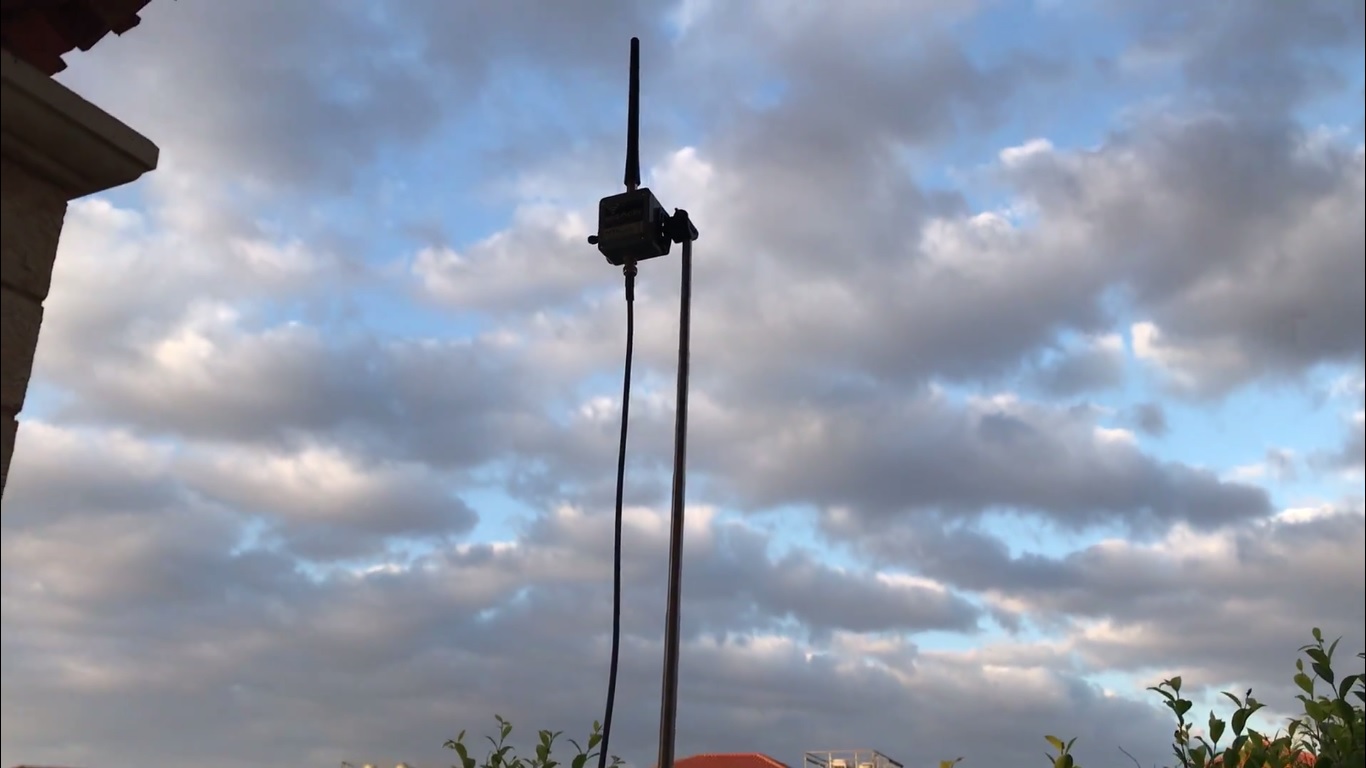
The USB-powered MegActive MA305 is perfect for DXing on the move…
Despite excellent all-round results from the ultra-portable USB powered MA305, there was one signal I copied, which more than any other, demonstrated the DXing credentials of this antenna; Radio Tarma from Peru on 4775 kHz. With a TX power of 1 kW, this is a very difficult station to hear in Western Europe, even with a longwire. To catch this station in Crete, with a 22 cm antenna was incredible and it was at that point during my trip that I realised E-field antennas really can work superbly well for hard-core DXers on the move.
Upon my return to Oxford, I immediately started thinking about a DXpedition to the local woods I use for what I consider serious DXing. For obvious reasons, E-field antennas require an electrically quiet environment to ensure maximum SNR performance. In noisy environments, these types of antennas amplify the signal of interest and the background ‘electro-smog’, thus increasing signal levels but critically, not signal-to-noise. Fortunately, the Oxfordshire wood I have been using for a couple of years is only a 10 minute drive from my QTH as I sort of live in the countryside anyway and the QRM levels there are just about zero. Now, given that this was essentially an experiment to determine the best possible performance from the MA305, I decided to use my best portable radio. It was quite tempting to pack up the Elad FDM DUO which running on a home-brew battery pack has proven itself to be my best (pseudo) portable radio. However, this is supposed to be a real-world test and in this type of scenario, DXpeditions with the Bonito antenna are much more likely to be undertaken with a portable radio. For these reasons I decided to conduct the test with the venerable Sony ICF-2001D. Having proven to be a superb receiver over many, many dxpeditions (check out the evidence on my YouTube Channel Oxford Shortwave Log) and still regarded by DXers as one of the best ever portable radios – possibly the best – it was the obvious choice.
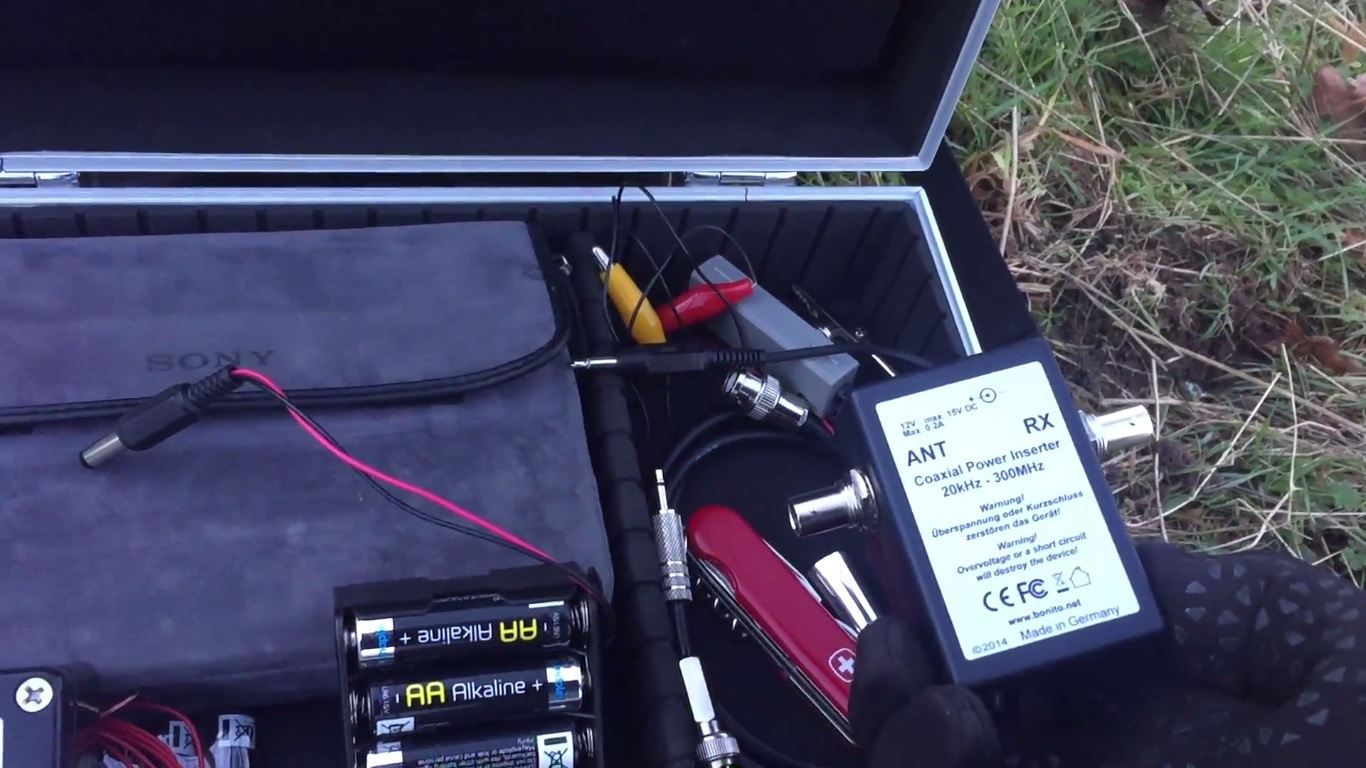
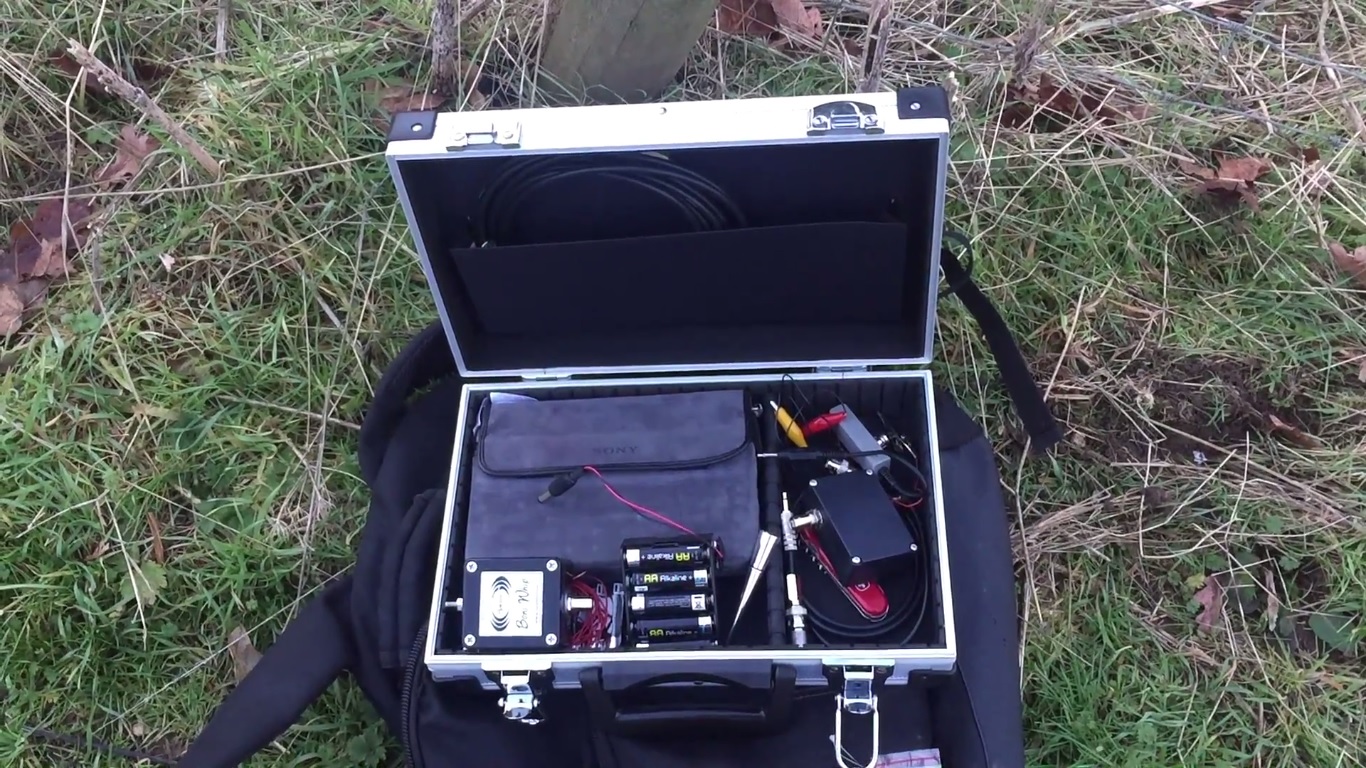
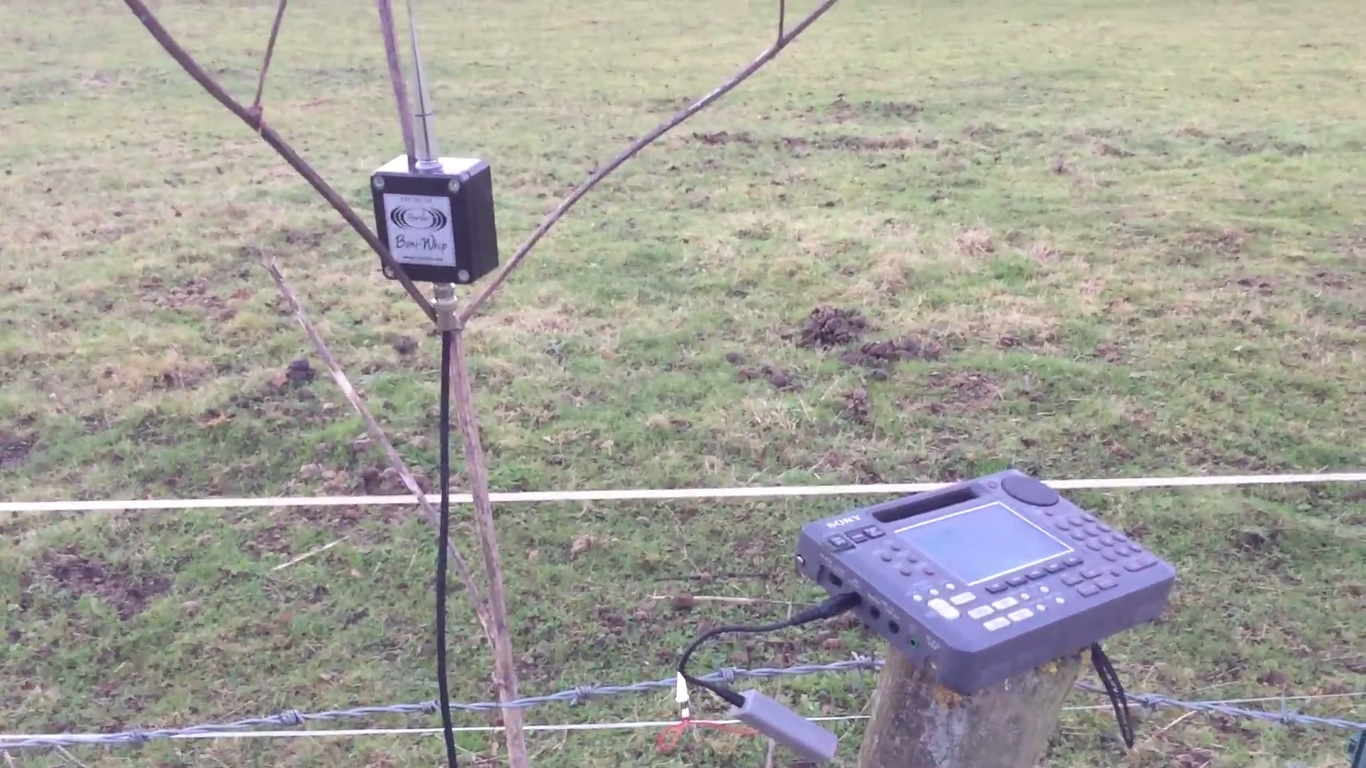
My portable DXing kit comprising the Bonito MegActive MA305 antenna and the Sony ICF-2001D…a bit of a legend in DXing circles…
I ventured out in early June around 23:00 hrs BST (22:00 hrs UTC), parked the car on the edge of the wood and proceeded to set up my cheap camera tripod, slightly modified to accept a 2 metre-long stainless steel tube, into which a slightly thinner 1 metre tube was mounted, topped off with my partially disassembled ‘Selfie Stick’ – which made it back from Crete lol. The antenna was set up in less than 5 minutes and approximately 4 metres above the ground – much quicker and easier than de-spooling 100 metres of wire! With fresh batteries in the Sony and the MA305 powered up using the USB power brick supplied by Bonito, I was ready to start listening. Almost immediately I heard and recorded a personal first; Lao National Radio, Laos, signing on 6130 kHz, with an excellent signal. Hearing them in the UK was only made possible by the annual two week shut down of the PBS Xizang transmitter in Lhasa, Tibet, but hey, I’ll take it. A brilliant start to my listening session.
Over the next two hours I was amazed at what could be heard using this 22 cm amplified antenna. Bearing in mind I have spent many hours at the woods previously, listening via various 100 metre longwires and a 200 metre Beverage, my expectations were, I thought, realistic in that the MA305 coupled to the Sony would catch some very good DX. However, I did believe there might be an absence of at least some of the more exotic low power stations on the Tropical Band – afterall the MA305 is a very short antenna. Clearly I was wrong, because what transpired during the session surpassed anything I thought possible with this set-up. A list of reception videos follows below and further below, a selection of embedded videos. Some of the entries on this list simply stunned me at the time. Rádio Educação Rural for starters is such an incredibly difficult signal to hear in Europe, even with a very large antenna. Thus, to hear them on an ultra-compact set-up felt very special. Radio Mali is another station that is very difficult to catch with any modulation, except on a large antenna and yet there they were – at the first time of trying. Similarly, Rádio Nacional de Angola and Alcaravan Radio are exotics that at best deliver very weak audio – and most of the time no audio. Furthermore, the signals from Emisoras Pio XII, Myanmar Radio and Rádio Clube do Pará were verging on what I would call superb…I’d never heard anything like it previously except via 100 (or more) metres of wire.
The ICF-2001D and MegActive MA305 Rádio Educação Rural transmitter site in Tefé, Brazil
So what’s next? Well it would certainly be an interesting experiment to compare the performance of the MegActive antenna with the Wellbrook ALA1530 active loop in a similar environment. I have used the Wellbrook on DXpeditions several times, with often excellent results, however, it’s not designed to be portable and if SNR performance could be demonstrated as similar between these two products, given a very favourable price delta, the Bonito antenna would add up to be a very compelling purchase decision. More on that to come. In the meantime, thank you very much for reading/watching/listening and I wish you all excellent DX.
Please click on the links below for the reception videos on the Oxford Shortwave Log YouTube channel.
Selected embedded reception videos from the list above:
Clint Gouveia is the author of this post and a regular contributor to the SWLing Post. Clint actively publishes videos of his shortwave radio excursions on his YouTube channel: Oxford Shortwave Log. Clint is based in Oxfordshire, England.
Ok, so officially it wasn’t a DXpedition; it was a well needed vacation in the sun after several hectic months of work, some of which involved travel to slightly more exotic locations. However, these days, I view any travel, whether it be for business or pleasure as a ‘DXpedition’ opportunity! Some of you might remember that I purchased a Bonito Boni Whip at the beginning of 2017 because (a) I needed another antenna and (b) a second Wellbrook loop felt like too much of an extravagance. They’re excellent antennas for sure, but at around £300, I couldn’t justify buying another. Thus, for about a third of the price I bought the Boni Whip. It proved to be an excellent choice – very compact and so perfect for my regular DXpeditions, quick to set up and capable of really excellent DX. There are many videos on the Oxford Shortwave Log YouTube channel that are testament to this. I wrote a couple of articles, published here on the SWLing Post which were seen by Dennis Walter of Bonito, who subsequently contacted me and offered to send over their MegActive MA305 E-field antenna for testing. Dennis made it crystal-clear that I was to ‘do my own thing’…test the antenna in any way I saw fit and publish my findings so DXers/radio enthusiasts could learn more about the capabilities of the antenna – from another DXer. I was happy to agree to this arrangement and the MegActive MA305 duly arrived, complete with two lengths of (bayonet BNC terminated) high quality H-155 coaxial cable.
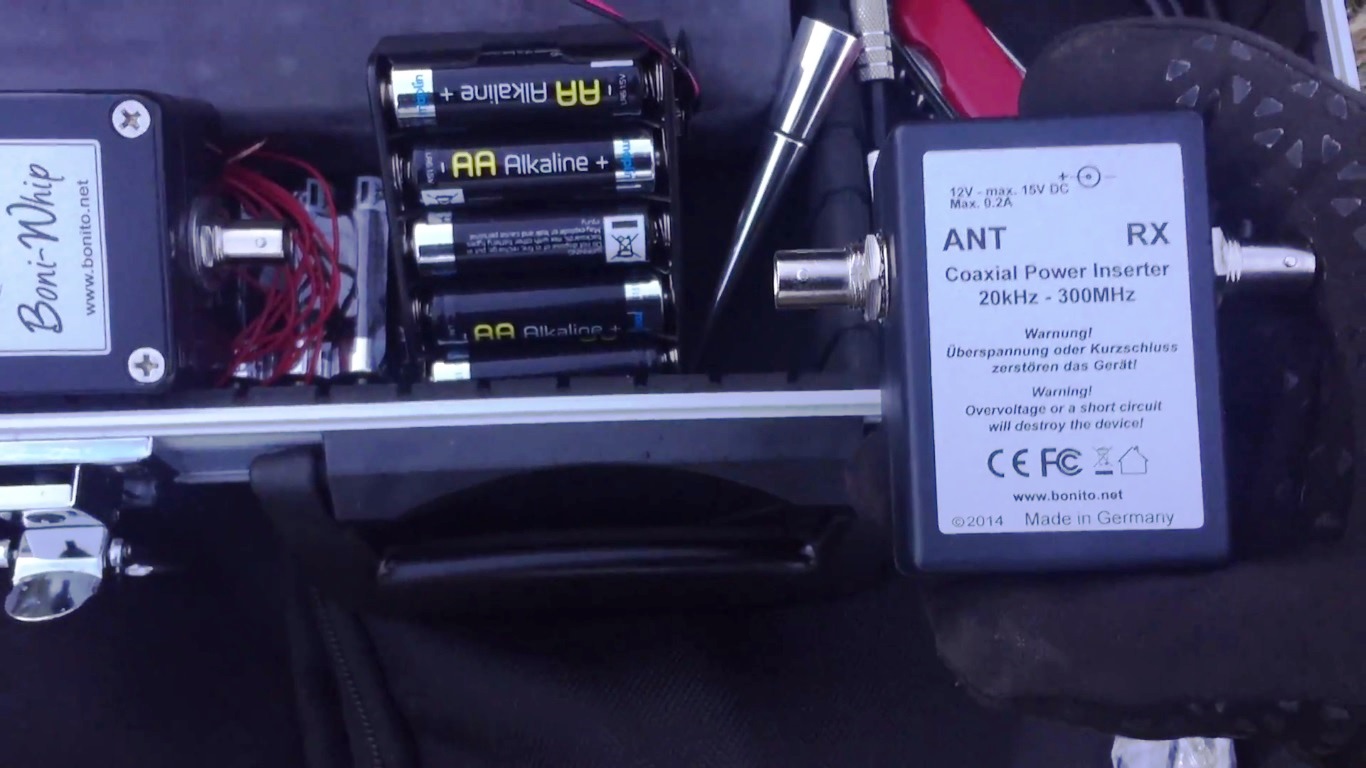
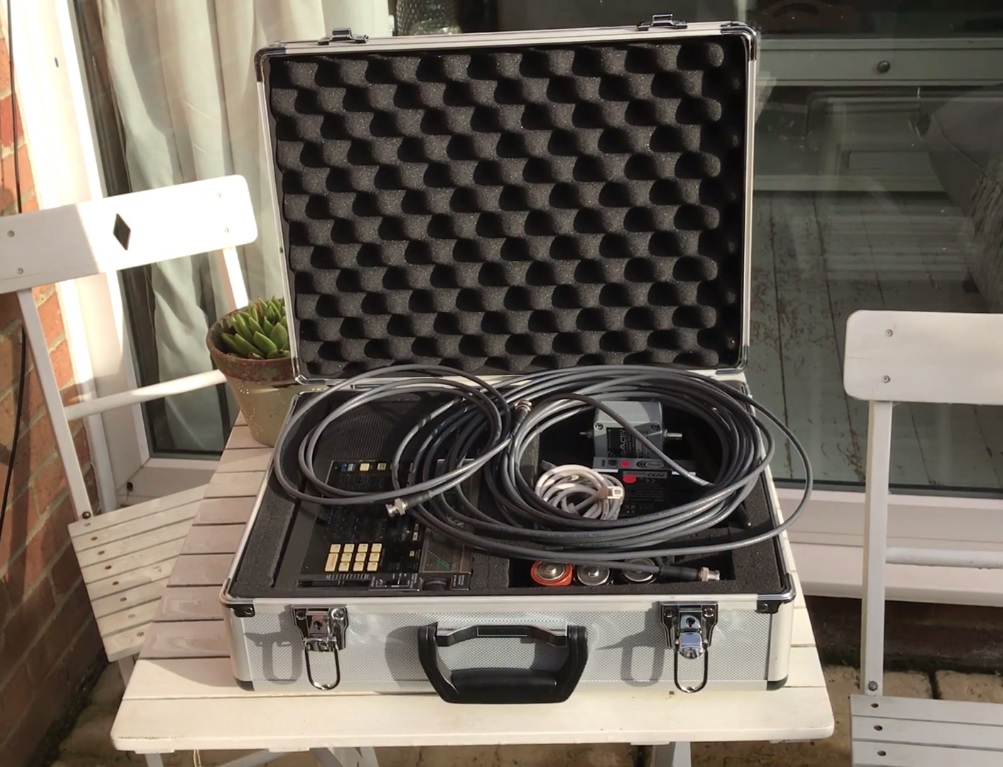
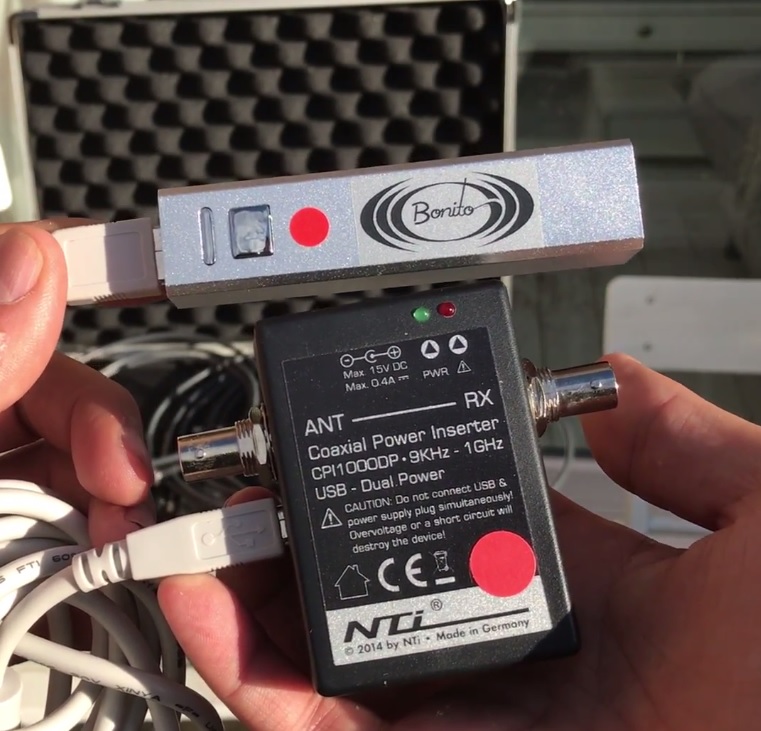
My portable Dxing kit with MA305 antenna The MA305 power inserter and USB power ‘brick’
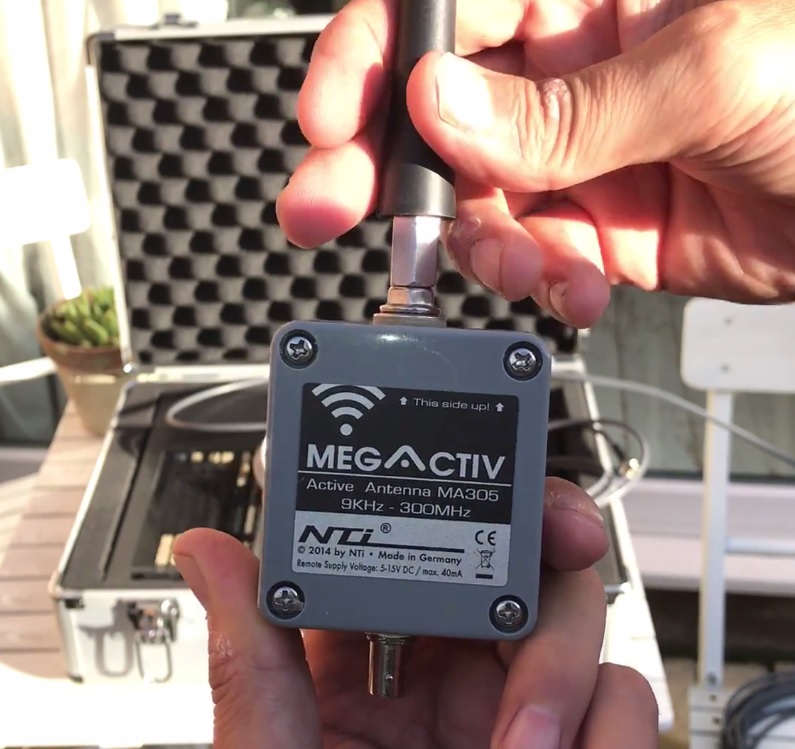
The specifications of the MegActive MA305 are very similar to the Boni Whip; they both offer a Gain of +3 dBs, second and third order intercept points of greater than +30 and +50 dB respectively and both tune to 300 MHz. The MA305 is supplied with a longer radiating element and tunes down to 9 KHz (versus the 20 kHz lower limit for the Boni Whip). Obviously this isn’t a specification that is going to concern most radio enthusiasts; both offer fantastically wide operating bandwidths. The way in which these antennas do differ quite significantly however, is in how they are powered. The Boni Whip operates from 12 to 15 V, whilst the MA305 operates from 5 to 15 V. Bonito’s design philosophy regarding this feature is based on the increasing difficulty in procuring reasonably priced analogue external plug-in power supplies (they are no longer allowed to be produced due to power consumption restrictions).
Interestingly, when the power supply for my Wellbrook ALA1530 packed up, I called them to purchase a replacement and was told they only have limited stocks remaining. Thus, a solution for powering active antennas with a suitable low-noise supply is an issue that needs resolving. The guys at Bonito figured a USB power source was suitably quiet and with USB ‘power bricks’ almost ubiquitous these days for charging mobile phones and other portable electronic devices on-the-go, the idea could be applied to their active antennas. The result is the MegActive MA305, designed to operate at 5 Volts with no loss of performance. As a DXer who probably spends more time listening on DXpeditions than I do in my shack at home, the USB power solution was perfect. I myself often carry a cheap Chromebook laptop to use as an additional power source for my camera phone when I’m DXing, so Bonito’s design approach resonated with me completely.
Travelling with the MegActive MA305
Ok, so the MA305 is very compact and very light indeed – perfect for a trip to Crete! However, I know from many conversations with my YouTube friends and followers that some of us feel a slight sense of trepidation carrying shortwave radios and antenna systems on board flights, be they national or international. I myself wasn’t really concerned other than if my bag got pulled from the X-ray machine, there’s often quite a long wait whilst the security staff work through the queue of luggage requiring er…human intervention! Predictably, my rucksack did get pulled and I waited patiently until it was my turn to explain the contents! Looking back on this retrospectively, it’s hardly surprising. Other than the usual holiday paraphernalia, my rucksack contained:
A 10.0 metre length of H-155 coaxial cable
A 1.0 metre length of H-155 coaxial cable
Eton Satellit receiver
MA305 Coaxial Power Inserter
MA305 Antenna Amplifier
Bonito USB ‘Power Brick’
Bonito USB Power Cable
NooElec RTL-SDR dongle
NooElect ‘Ham It Up’ upconverter
Various screened cables and connectors
10 metres of equipment wire
I explained to the (friendly) security chap that I was a shortwave radio hobbyist and identified the various pieces of equipment for him, as he removed them from my rucksack. He confirmed my X-ray had ‘lit up’ (in blue as it happens) with metallic/electronic items and was even kind enough to swivel his monitor to show me the mess of items strewn across the screen – just as I had thrown them all into my rucksack! However, after quickly swabbing some of the items, he said all was fine and hoped that I enjoyed my holiday and listening. Service with a smile at Gatwick Airport – and I was on my way. My outbound experience got me thinking whether it would be possible to pack my DXing kit in such a way that it wouldn’t alarm airport security. Thus, for the trip home, I packed all of my cables into my (checked-in) suitcase. I figured it would be obvious there was no security risk associated with cables alone. I then packed my RTL-SDR, upconverter and all of the MS305 components very neatly into a single box and put that in my carry-on rucksack. Now, some might argue that security measures at Heraklion International Airport in Crete differ a little from London Gatwick, but I observed staff at the X-ray machine very carefully monitoring every piece of luggage passing through it – including my own and I passed straight through without a problem. All I did was take my laptop out as usual, and put it in a separate tray. Job done.
DXing with the MegActive MA305
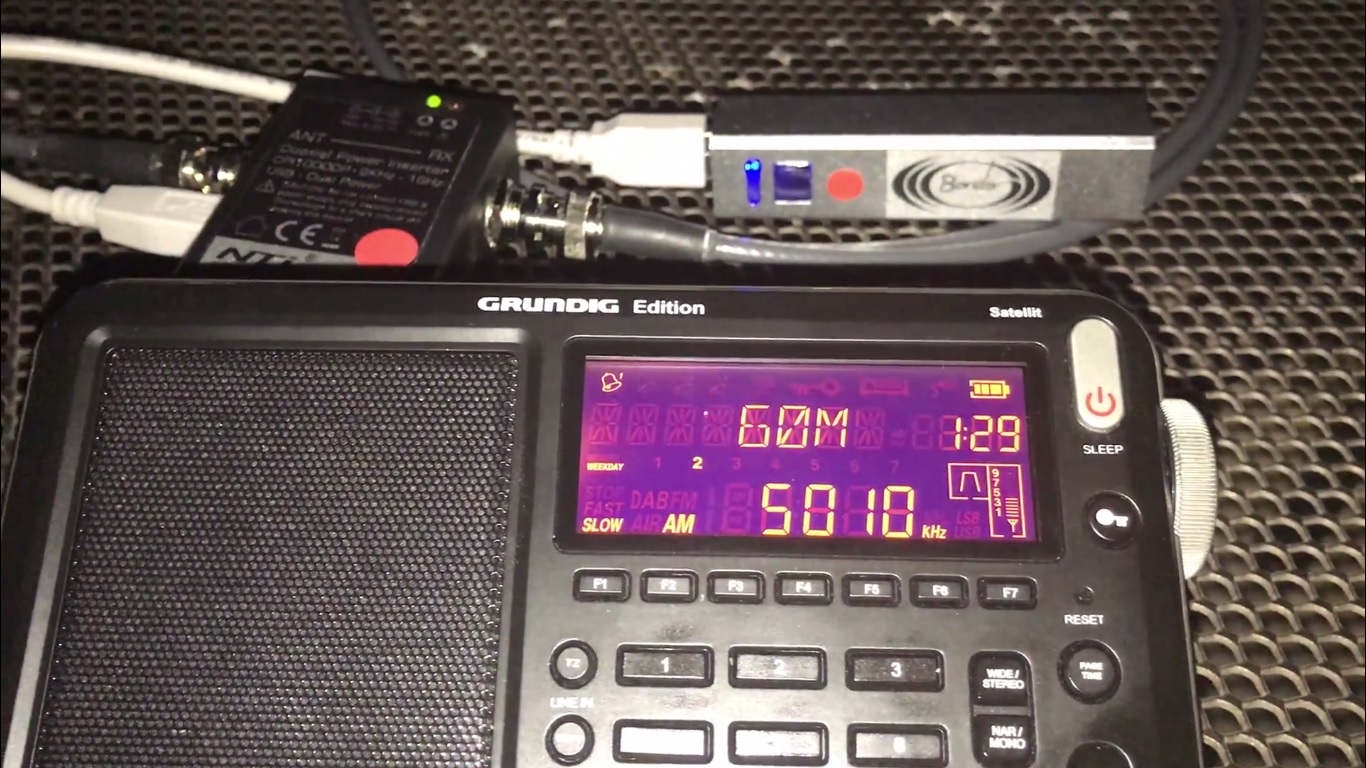
My listening post in Crete, with the brilliant Eton Satellit receiver
My apartment in Crete was on the second floor and a large balcony provided a decent outdoor location for DXing. As regards electrical noise, the location was much quieter than my shack at home, but it certainly wasn’t perfect, thus a good test of the MA305 in a real-world pseudo-urban environment. in an attempt to improve SNR, I bought a cheap ‘Selfie Stick’ and some tape and managed to construct a mount for the amplifier, increasing the overall height above ground by about 1.5 metres and displacing the radiating element an additional 2 metres thereabouts from the building. I’m not sure whether it made much difference, but it seemed like the sensible thing to do for less than 10 Euros.
During my week-long stay, I managed to fit in several listening sessions and copied some really excellent DX from this ultra-compact, USB-powered set up. In fact, the MA305 coupled to the Eton Satellit performed so well, I managed to copy a number of personal firsts, including CRI on 7295 kHz, via their relay in Bamako, Mali, The Voice of Beibu Radio on 5050 kHz, Nanning, XSL ‘Slot Machine’ on 6251 kHz USB, Ichihara, Japan, S32 ‘The Squeaky Wheel’ on 3828 kHz and NHK World Radio Japan, 11910 kHz. I also copied RTM Wai/Limbang FM on 11665 kHz from Kajang, Myanmar Radio on 5985 kHz and AIR Bhopal on 4810 kHz, amongst others – all of which I would certainly consider to be difficult catches in Europe. To hear them with an 18 cm antenna felt pretty special. African shortwave stations were also very well represented and I managed to copy a number of them including Radio Hargeysa on 7120 kHz, Voice of Tigray Revolution on 59150 kHz, Radio Oromiya on 6030 kHz, Radio Fana on 6110 kHz, Radio Ethiopia on 7235 kHz, Radio Sonder Grense on 3320 kHz and Radio Guinée on 9650 kHz. I expected to hear all of these stations, except for Radio Guinée, which is farther away from Crete than the UK. So, all-in-all an excellent result.
Despite hearing a lot of excellent DX whilst in Crete, there is one signal I copied, which more than any other, demonstrates the DXing credentials of the MA305 – and Eton Satellit for that matter. In the early hours of the morning (00:59 hrs UTC) I copied and recorded Radio Tarma from Peru on 4775 kHz. With a TX power of 1 kW, this is a very difficult station to hear in Western Europe, even with a longwire. To catch this station in Crete, at all, was incredible on an ultra-compact set-up. It was at this point during the trip that I realised E-field antennas really do work superbly well for hard-core DXers on the move. It inspired me to conduct further tests back home in the Oxfordshire countryside, where electrical noise is absent. This I did a few days ago, with some quite amazing results on the Tropical Band. More on that to come in my next post. In the meantime, please find text links and embedded videos for selected reception recordings, below. Many more recordings are available on the Oxford Shortwave Log YouTube channel and please don’t hesitate to contact me if you require further information on the MA305 or the Eton Satellit. Thanks for reading/watching/listening and I wish you all excellent DX.
Clint Gouveia is the author of this post and a regular contributor to the SWLing Post. Clint actively publishes videos of his shortwave radio excursions on his YouTube channel: Oxford Shortwave Log. Clint is based in Oxfordshire, England.
It is high time to register to this year’s EDXC Conference which will be held in Tampere, Finland on 18-20 August organized by the Finnish DX Association.
…
We have already received about 30 registrations from abroad and registration of the Finnish participants will also activate these days. Altogether we expect to have a participation of 120-150. This meeting will most probably be the last big DX and shortwave meeting in Europe, so don’t miss it!
We are working hard to have a comprehensive conference program. A new version has just been updated to the conference website http://www.sdxl.fi/edxc2017. More details will be added later, when some still tentative sessions have been confirmed.
A tour to the beautiful Finnish Lapland will follow after the conference for those interested. We do have already a good list for tentative participants of the tour, but the possibility to join the tour will still be open for 10 days, so if you want to join it, act quickly. After 26 of May we will make a final decision on how the tour will be done and what the costs will be.
Conference registrations, tour inquiries and all questions are welcome to rv at sdxl dot com.
Many thanks to SWLing Post contributor, Gary DeBock, who shares the following notes and recordings from an Ultralight DXpedition in Kona, Hawaii:
April 2017 Kona, Hawaii Ultralight DXpedition
The first long-range test of a “Frequent Flyer” FSL Antenna
By Gary DeBock, Puyallup, WA, USA April 2017
Introduction
Ever since the U.K.’s Graham Maynard published his innovative article about the “Ferrite Sleeve” antenna in early 2011 an enthusiastic group of DXers and tinkerers has continually refined and upgraded the design, with most of them going in the pursuit of maximum possible gain. Monster FSL models were designed with weights of up to 38 pounds (17 kg), and considering the size, weight and subversive appearance of the typical model, the general assumption was that this new type of antenna was highly unsuitable for air travel, since it would send airport security personnel into a serious panic.
This situation continued for a full 6 years, during which the FSL antenna became a star performer in the related new niche of ocean cliff transoceanic DXing. But was there another possible application for the antenna’s compact performance advantage? What if a very lightweight, high-performing model could be designed which would not only provide a huge boost in DXing gain, but fit inside a hand-carry suitcase, and routinely pass airport security screening inspections around the world? This was a tough design challenge, but well worth the effort if successful!
Since the new antenna would need the maximum possible performance for its small, lightweight size, the use of the Russian surplus 100mm x 20mm x 3mm ferrite bars was mandatory. Every possible effort would be used to make the antenna as compact and lightweight as possible, although the choice of the highest-sensitivity 1162/46 Litz wire was critical for best performance. The PVC frame would be shrunk down to the smallest practical size. Finally, in a major experimental effort here over the winter season, the first of the new 5 inch (127mm) “Frequent Flyer” FSL’s became a reality. The finished antenna had a very non-subversive appearance, and could fit inside a custom-sized plastic tote within a hand-carry suitcase. Most importantly, it could still deliver a serious amount of inductive coupling gain– roughly similar to that provided by a 4 foot (1.22m) air core box loop, but with the advantage of somewhat lower noise reception.
Because the Russian surplus 100mm x 20mm x 3mm ferrite bars are extremely scarce (without any current supply source) only five of these original “Frequent Flyer” models would be made, although alternative models using the commonly available 140mm x 8mm ferrite rods were also designed. These antennas would be somewhat heavier and larger, but these “Baby FSL” ferrite rod models could be easily assembled from parts available on eBay, fit inside the hand-carry suitcases, and still deliver a lot of DXing performance (while routinely passing airport security screening). Finally, an economic model using the commonly available 62mm x 12mm x 4mm Russian surplus ferrite bars was also designed. This lightweight FSL can be constructed for around $65 US, and can still provide a serious DXing gain boost to a stock Ultralight radio. For want of better terms, these three classes of “Frequent Flyer” FSL antennas are called the “first class,” the “business class” and “coach class” models, with FSL sensitivity scores (ferrite length x coil diameter) of 585, 490 and 300 respectively.
From April 9-12 a Mini-DXpedition was conducted on a 6th floor oceanfront room at the Royal Kona Resort Motel in Kona, Hawaii. This was the first of many long-range DXing trips based upon the performance boost provided by the compact new antenna– which was specifically designed to easily pass through airport TSA security checkpoints. A 5 inch (127mm) “Frequent Flyer” FSL antenna was packed inside a matched-size plastic tote within a hand-carry suitcase, and breezed through TSA security screening in both the Seattle and Kona airports (without even a single question ever being asked). This was one of the “first class” Frequent Flyer models described previously, and was used to boost DX station gain on a 7.5″ loopstick C.Crane “Skywave” Ultralight radio. This combination was effective enough to track down many exotic Pacific Island stations (540, 621, 1440, etc.) at S9 levels during transmitter-site sunset skip propagation into Kona, as well as Asian TP-DX of varying strength around local sunrise.
This Kona trip was primarily designed as an anniversary celebration with my wife, so before we took off I had (somewhat reluctantly) agreed that DXing would have a secondary priority to sightseeing over the four days. Because of this there were many frequencies that could not be investigated in Kona, but I knew very well which Pacific island stations were tough challenges in both North America and Japan, and I was determined to go after them with a vengeance. 540, 621 and 1440 would all receive serious attention in Kona– not because they were great challenges in Hawaii, but because most DXers in both North America and Japan needed all possible information about them if they were to have any chance of reception at all. Besides this I was eager to try my long-range luck chasing exotic Asians around local sunrise with the innovative FSL antenna, but I knew that east-west propagation was almost totally dependent upon solar activity– and as it turned out both the A and K indexes shot up after our arrival.
Overall the Kona MW propagation to the Pacific islands was exceptional around local midnight (as expected), but the sunrise propagation was somewhat challenging for long range Asians. Perhaps the biggest success of this entire trip was the interest and excitement that the “Frequent Flyer” FSL antenna series (the major experimental project here this past winter) has inspired among DXers who routinely travel to foreign countries and other faraway venues. As I write this Craig Barnes of Wheat Ridge, Colorado is conducting his own 5 inch “Frequent Flyer” FSL- based DXpedition to Hawaii. Good luck, Craig!
Recordings
[Note: a selection of audio files have been embedded in the post below, but all audio is available to download and stream via the links provided.]
531 6DL? Dalwallinu, Australia Presumably the one with the same-sounding announcer and program as the one on 630-4QN at the time (at 1547 on 4-9; see MP3 for 630-4QN), but it didn’t seem to be exactly parallel (maybe a time zone delay?)
https://app.box.com/s/7bg1hruxrufccuys5axc4yzumexr3q36
540 2AP Apia, Western Samoa This station features a lot of Samoan music (with both male and female announcers), and dominates the frequency in Kona at night as long as it transmits. Unfortunately it doesn’t follow the listed PAL sign off time of 1000, but runs past this time routinely, which made it tough to track down an exact sign off time during my limited sessions. My guess is that it signs off sometime between 1030 and 1100. The following MP3 is of S9+ level Samoan Christian worship music at 0931 on 4-9. This overwhelming signal was one of the most awesome recorded during the entire DXpedition:
558 Radio Fiji One Suva, Fiji Somewhat of an underperformer considering its South Pacific location and (nominal) 10 kW power level. My guess is that the station has some transmitter and/ or antenna issues. Here is some fair level male speech with island music at 1001 on 4-9, which was the strongest signal it managed during the entire trip
558 UnID-TP Once again, this weak signal sounded a lot like the 630-4QN program at the time (1548 on 4-11), so my guess is that 6WA in Wagin, Australia is the most likely possibility
603 HLSA Namyang, S. Korea One of the common Asians which ran the gauntlet of dicey solar activity. It was fairly good at 1521 on 4-12, but was MIA during a couple of days
621 3RN Melbourne, Australia This LR network station would start to fade in just when Radio Tuvalu was about to sign off (around 1000), although it never provided any serious competition for the exotic station. This MP3 was made just after Tuvalu’s sign off at 1006 on 4-9
621 Radio Tuvalu Funafuti, Tuvalu A very tough station to track down on the mainland, but certainly a “piece of cake” in Kona. Routinely has sign off at 1003 UTC, preceded by island choral music and the national anthem (sung by the same choral group). Around 0950 a female announcer begins the routine by giving a monolog news broadcast about 5 minutes long, typically followed by an island music song right before the fixed 5-minute sign off routine. The latter two features are included in the following 8 minute recording (at near S9 strength) made at 0955 on April 10
The usual female announcer with her 5 minute news broadcast at near S9 strength at 0955 prior to the sign off routine on April 11. The lady giving the correct pronunciation for “Tuvalu” is at the 11 second point
630 4QN Townsville, Australia This 50 kW station was far and away the strongest Australian signal heard throughout the trip. Unfortunately it wasn’t in the same time zone as fellow LR network stations on 531 and 558 in Western Australia, making parallel checks seem dubious. Here is a typical signal at 1543 on 4-9
657 Pyongyang BS Pyongyang, N. Korea This bizarre station was far and away the strongest Asian heard during the trip– almost like it was a South Pacific semi-local. When solar activity cooled off it could blast in with serious power, such as at 1555 on 4-9
693 UnID-TP This mystery signal showed up at 1604 on 4-9, after NHK2 (JOAB) sign off. Obviously there is male speech and some kind of backup music at various times, but I’m totally unfamiliar with stations on this frequency (except for JOAB). Any hints or suggestions? This station only showed up on 4-9; rising solar activity brought in only 690-Honolulu splatter on the other three days
1035 Newstalk ZB Wellington, NZ Received late in sunrise enhancement at 1611 on 4-12, this was a rather modest signal from the Kiwi big gun, which never seemed to get anywhere close to its Oregon cliff strength during the entire trip
1098 V7AB Radio Marshalls Majuro, Marshall Islands One of the regular Pacific island stations received in Kona, and one of the best bets for Mainland reception. The frequency has very little QRM, although Newstalk ZB could be weakly received in between the island music songs after around 0900.
Strong island music at 0955 on 4-9 (its best performance during the trip)
1098 Newstalk ZB Christchurch, NZ Heard only once in between island songs on V7AB (at 0957 on 4-9); and never really strong enough to compete for the frequency with Radio Marshalls
1440 Radio Kiribati Bairiki, Kiribati Because of its domestic frequency this obscure station is another of the toughest Pacific island stations (and countries) to receive on the Mainland, but some very helpful identity clues were discovered in Kona (where the station is a breeze to hear). The station routinely signs off at 0936 UTC each evening, with a very loud 1000 Hz audio tone right before it cuts power. The sign off routine includes station ID’s in both the local language and English around 0932 prior to the choral music national anthem, although because of her heavy accent the fact that the female announcer is talking in English might well go unnoticed. The full sign off routine is included in the following MP3, preceded by an Island music number (during which a 1440 Spanish pest attempts a run on the frequency, only to be immediately drowned out)
The American country music format can be heard prior to the 4-bong time signal.
Prior to the sign off routine this station also uses its female announcer to give a final news update (like 621-Tuvalu). This recording is of such a news update at 0925 on 4-11, with several mentions made of the American president
1566 HLAZ Jeju, S. Korea Fairly regular with its Chinese Christian service around 1530 each morning in Kona, but never at very great strength (possibly due to unfavorable solar activity). Here at 1609 on 4-9 it is the music station playing the Chinese version of “I Would Rather Have Jesus,” in a mix with the (presumed) Mainland Chinese Yanbian Jammer
1566 Yanbian, China (Presumed location, Jammer) Because of Chinese inflection this is the apparent co-channel of HLAZ in the same recording at 1609 on 4-9; it was also received at 1600 on 4-10 with Chinese 5+1 time pips (thanks to Chris Kadlec for his assessment)
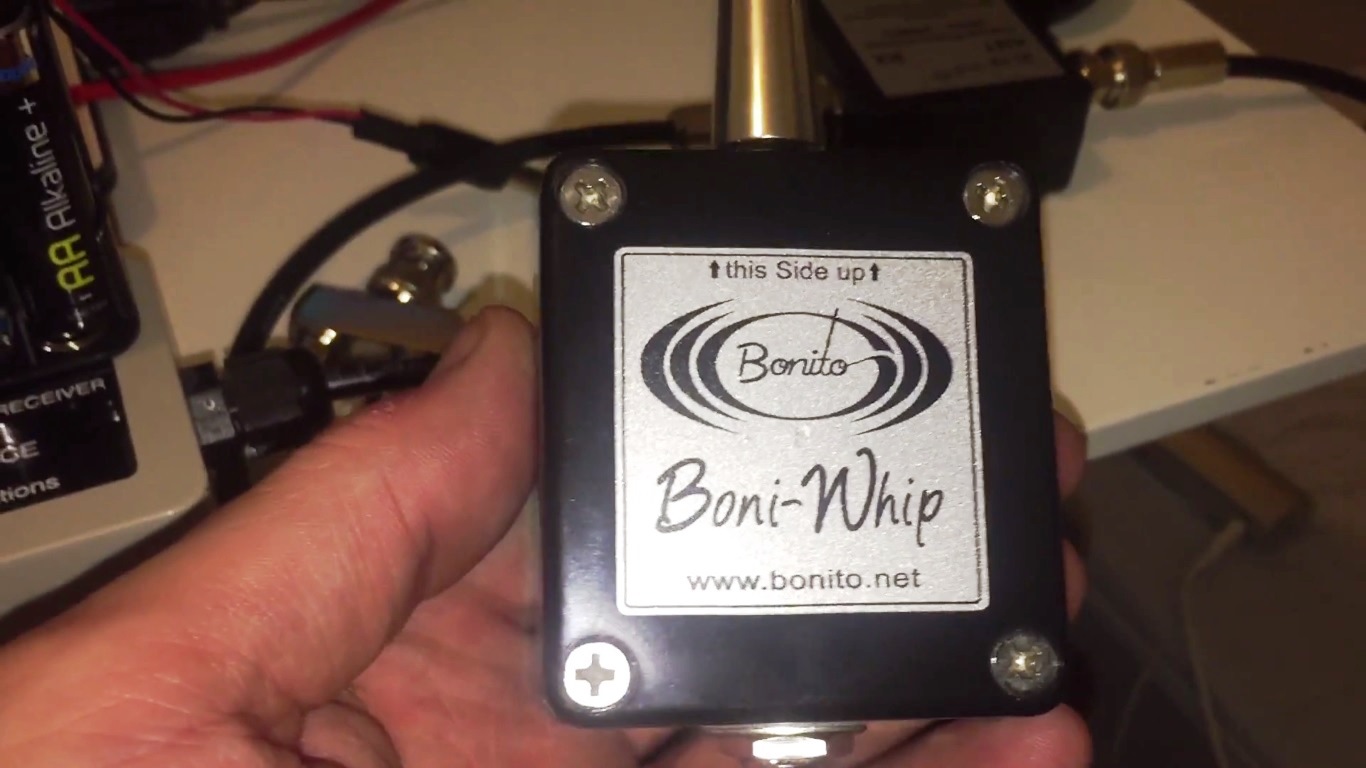
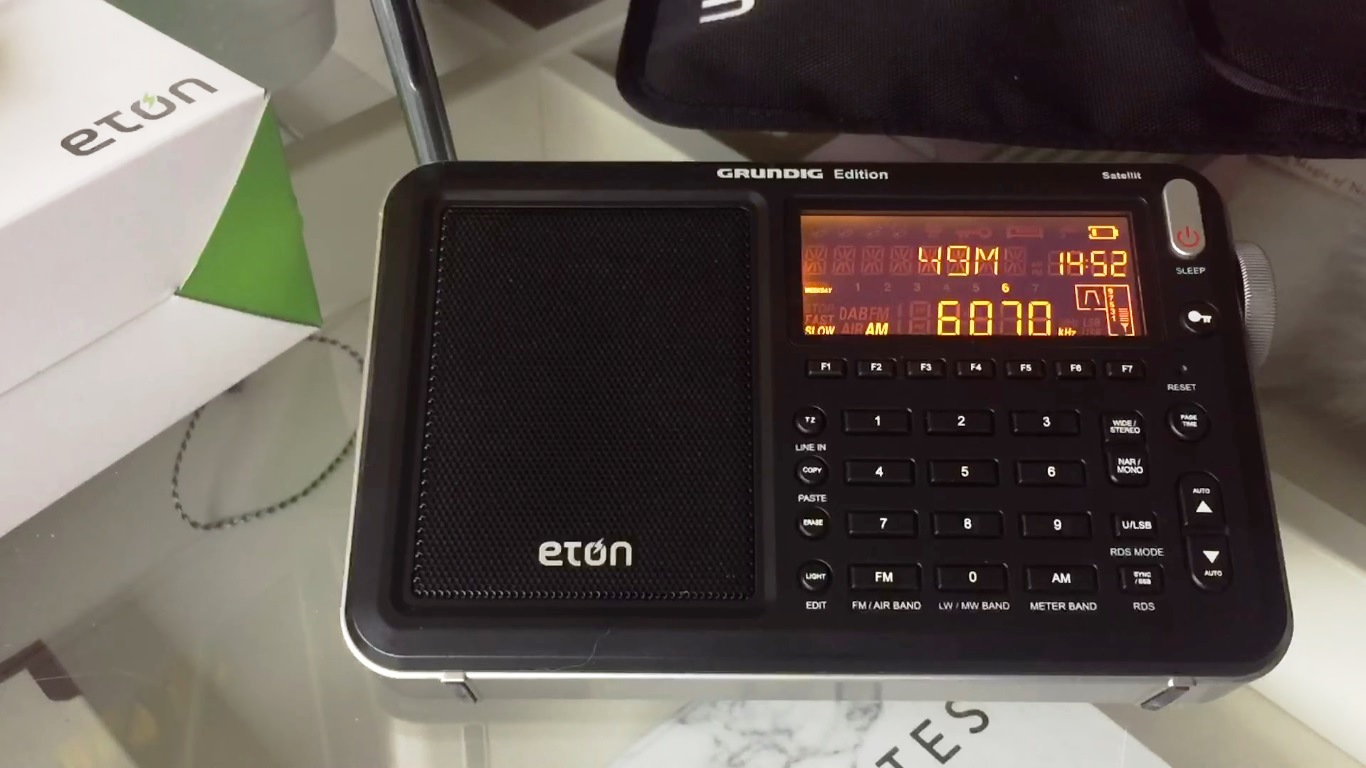
Hi there, subscribers to the Oxford Shortwave Log YouTube channel and regular readers of this excellent website will be aware that I have been using a Bonito Boni whip E-field wideband antenna for a couple of months now. You may have seen my previous post here, detailing some excellent initial DX results achieved with the Boni Whip. What makes this antenna so compelling for a DXer such as myself is simply that it’s so light and compact; I can literally take it anywhere. Currently it lives in a small flight case (see above & below) on the back seat of my car, with either my Sony ICF-SW55 or Eton Satellit, a home-brew battery pack (that literally cost pence) and some peripheral bits and pieces; spare batteries, cables etc. I think it’s probably already clear that if you consider the Boni Whip’s performance as a function of portability and price, it’s out there on its own – I’m not aware of another antenna that can match it. Of course, there are H-field antennas, such as the excellent Wellbrook active loops that will effectively reject QRM, if that’s an issue for the user, but at a significant cost delta.
Since my last posting, I have continued to use the Boni Whip regularly on my DXpeditions and upload the reception videos to my YouTube channel. I have been nothing but totally impressed with this antenna, to the point that I’ve actually been surprised by the signals I’ve caught and recorded with it. Recent catches include a number of low-power stations from Brazil, including Radio Bandeirantes – Sao Paolo, Radio Voz Missionaria – Camboriu (on the 49 and 31 metre broadcast bands) and Radio Aparecida. Some of these signals are incredibly difficult to hear in Europe at all, let alone well and yet the ultra-compact Boni-Whip running off AA batteries, coupled to the (equally brilliant) Eton Satellit managed it with aplomb. Other catches include Zambia NBC Radio 1 – Lusaka and a signal from Bangladesh Betar that sounded as if the transmitter was 5 miles down the road!
All-in-all, I’m extremely satisfied with the performance of the Bonito Boni Whip and highly recommend it to those DXers requiring a high-performance, compact antenna, for use at home in electrically quiet environments or on any DXpedition. You certainly won’t be disappointed.
Please find embedded reception videos below and text links that will take you to the Oxford Shortwave Log YouTube channel. Thanks for reading/watching/listening and I wish you all great DX.
Clint Gouveia is the author of this post and a regular contributor to the SWLing Post. Clint actively publishes videos of his shortwave radio excursions on his YouTube channel: Oxford Shortwave Log. Clint is based in Oxfordshire, England.
Many thanks to Adrian Korol, at RAE, for sharing the following update from Actualidad DX:
ACTUALIDAD DX.COM.AR brings you the latest news of the radio world, the short waves, the media, the telecommunications, the DX, the ham radio and the digital context every week. A production of RAE Argentina to the world, edited by Arnaldo Slaen
This week
ACTUALIDAD DX.COM.AR No. 3
Greetings dear friends of Actualidad DX.com.ar, the DXing program about DXing, broadcasting media and new technologies that airs every week through RAE-Argentina to the World, the International Short Wave Station of the Argentine Republic.
We remind you that you can send your reception reports, suggestions, criticisms and comments to our email: [email protected]
We also invite you to contact us via traditional mail, to RAE Argentina to the World, PO Box 555, Post Code 1000, BA, Argentina.
RAE Argentina al Mundo keeps on incorporating new technologies and has now a new channel: AUDIONOW, that allows our listeners to follow our programs via their phones, at the cost of an local phone call.
AUDIONOW is a system to connect stations with their audiences in far-off places, as an alternative to SW and internet. In the specific case of the US, online listening is made only where there’s Wi Fi networks near, since 4G and 3G services don’t have flat-price data plans, but they do have flat-price plans for phone calls.
This radio-over-phone instrument is already used by other international broadcasters such as BBC, VOA, Radio Francia Internacional, Deutsche Welle, and the UN radio station.
On this first stage, RAE Argentina to the World will work with Audionow in English and Spanish for listeners in the US who will be able to tune in on our full hour-long programs or on our news bulletins.
Arrangements are being made to bring this option to Mexico and Canada in North America and Brazil in South America.
There’s the intention also of including football broadcasts.
And we kick off with SW hearings.
La Oesterreichischer Rundfunk, was picked up by transmitters in Moosbrun, Austria
0500-0620 en 6155 khz con 300 kW in German for the west of Europe, from Mondays to Fridays.
0500-0615 en 6155 khz also in German for western Europe, on Saturdays and Sundays.
From the same transmitting site, religious broadcaster FEBA goes on the air, between 0800-0830 on 15260 KHZ with 100KW in Arabic.
Also from Moosbrun, Austria, Radio DARC, broadcasts only on Sundays, between 0900-1000 UTC on 6070 khz con 100 kW in German.
Only the first Sunday of every month and always from Moosbrun, Radio JOystick can be picked up between 1000 and 1100 on 7330 khz, with 100 kW for Europe in German.
Now we share some news for the A17 broadcasting period by WCB-Madagascar World Voice.
Between 0200 and 0400, on its new frequency of 6190KHZ with 100KW, aimed at SOuth America in Spanish, with a program called “The Happy Voice”.
Between 0300-0400 on 15515 KHZ with 100KW for Southeast Asia with English-language program “African Pathways Radio”.
Between 1900 and 2000 on 9820 KHZ with 100KW in Russian for Eastern Europe, with a program generated by its sister station “KNLS New Life Station”.
Now we have more news from Argentina.
The Culture Secretary of La Rioja province, Víctor Robledo, together with other officials of the provincial administration met Cristian Arrieta, the delegate from the ENACOM, Communications Board.
The provincial secretariat had requested the federal authorities for an FM broadcasting license, to set up a public radio that broadcasts culture-related news.
We move on now to an international SW broadcaster, China International Radio proposed Sputnik China to create a joint brand, according to what was informed by Dmitri Kiseliov, director general of the Rossiya Segodnya, .media group
In addition, a project called “Russia and China on the Silk Road”, organized by both groups began last October.
25 journalists from both nations will visit the main stages of the New Silk Road between the cities of Xi’an and Urumchi.
And back to Latin America to visit Ecuador.
The Ecuadorian House of Culture reported that the Telecom Watchdog Agency, Arcotel, assigned an FM broadcasting licence to them.
Arcotel granted the entity the 100.9 frequency, with enough range to cover the province of Pichincha. The new station will be called Culture FM.
Pérez underlined the importance of getting the licence, something the House of Culture had been working for years. They already run an AM station, House of Culture Radio, that’s been on the air for almost 70 years, and is one of the forerunners in the field of cultural broadcasting in the country.
According to Pérez Torres, Culture FM will aim at contributing to the cultural enhancemente of Ecuadorians, bringing them closer to Latin America and the world.
Proaño, expects the station becomes a reference in culture for the country.
Let’s continue with the Americas. Now, Panamá.
The Panamanian National Authority of Public Services held two public hearings that seek to establish the reach and benefit for the population of granting Radio Licences Class B (non-proffit broadcasting) to the State-Ran SERTV broadcasting service and the Catholic Faith Radio Promotion Foundation.
During the hearings, which are part of the process the entity carries out every two years to assign FM licences, legal representatives of both organizations presented their arguments to obtain concession of the broadcasting rights, underlining they wanted them exclusively for divulging issues that strengthen national culture, democracy and transparency in public administration.
Moving on now to Venezuela, where various stations have closed down in the region of Yaracuy, because they were allegedly in violation of the law, and hadn’t met legal requirements to remain on the air.
The CONATEL telecom watchdog agency establishes that broadcasting is suspended until they meet the legal requirements.
These are the stations that were removed from the airwaves by the Venezuelan authorities: Yara 104.3, K-ndela 90.3, Más Network 98.9, Shaddai 101.9, Mix 98.3 y Criollísima 104.9, all of them FM stations.
Rumbera Network 106.5 was mentioned as one of the potential broadcasters in problems, but the station’s management dismissed this rumour, and explained they were off the air due to a broken transmitter that was fixed already.
When CONATEL inspectors visited the area of Nirgua, they closed down La Reina 96.7 FM, Agua Viva 90.3 FM y Tentación 90.9 FM. and also Divertida 104.7 FM, Sabor 89.9 FM, Auténtica 97.1 FM y Urbana 102.9 FM.
And the final part of our program is dedicated to cinema and radio.
Radio didn’t only revolutionize the telecommunications sector. It also enabled journalism and entertainment to explore new fields.
Therefore, the world of waves and transistors has generated a world of its own that has been depicted on various films. On the occasion of marking the World Radio Day, Non Stop People has prepared a clip reviewing the main radio-related films.
A highlight of the list is Good Morning Vietnam, of 1987, starring Robin Williams. The movie is a criticism of political correctness. The role of the radio presenter is key in other features such as Talking To Death of Lonely in the Night. Then, there’s also Radio Stories and Radio Days, that shows the effect the medium had on people’s day-to-day lives.
Not close to a radio receiver or internet? Now those who live in the US can listen to RAE-Argentina to the World live calling 641.552.8099 from any telephone, with no additional cost per call.
Call 641.552.8099 and listen to news and content by RAE – Argentina to the World. Save the number on your phone.
If you have friends and family in the US who enjoy being in touch with Argentine current affairs, tell them they can call 641.552.8099 and listen to RAE – Argentina to the World from any mobile phone.
The best part is that there’s no additional cost for the call when one calls from the US.
Hi there, if you’re a subscriber to the Oxford Shortwave Log YouTube channel, you will be aware that I have been using a Wellbrook ALA1530 H field antenna, for 15 months or so, with (at times) excellent results. A while back I was on the lookout for a second antenna, however at more than £250, I couldn’t justify purchasing a second Wellbrook. Ultimately I splashed out on the Bonito Boni whip E-field wideband active antenna (20 kHz to 300 MHz) and with a very compact form-factor suitable for DXpeditions/portable operation in general, the Boni whip definitely ticked all the boxes. Furthermore, with reasonable second and third order intercept points of +55 and +32.5 dBm respectively, the Boni whip, on paper at least, looked like a pretty good buy at around £100.
Initial testing at home confirmed, perhaps not surprisingly that the Boni whip could not match the SNR provided by the Wellbrook ALA1530 in a noisy, urban environment. However, less predictably, the Boni whip has proven to be a truly excellent antenna away from the ubiquitous blanket of ‘electrosmog’ at my QTH. Furthermore, it really is so compact, I simply leave it in the car in a small flight case, with a portable and connectors etc. for ad-hoc listening sessions. Since returning from my most recent trip to Brazil, I have had a chance to review my most recent catches with the Boni whip, some of which are realy pleasing and most definitely underline the excellent performance of this diminutive antenna. In particular, signals from Radio RB2 on 11935 kHz and Radio Aparecida on 11855 kHz, both low power Brazilian stations, are testament to how sensitive the Boni whip is in an electrically quiet environment. Check out also the quality of longwave signals from Poland and the Czech Republic – simply amazing for such a physically short antenna. Finally, there’s a personal first from Lusaka, Zambia, Voice of Hope Africa on 13680 kHz. All the more rewarding that this was actually copied in my work office!
I hope you found this article interesting. There are embedded reception videos below and text links for all, which will take you directly to the relevant video on the Oxford Shortwave Log YouTube channel. Thank you for reading/watching/listening and I wish you all excellent DX!
Clint Gouveia is the author of this post and a regular contributor to the SWLing Post. Clint actively publishes videos of his shortwave radio excursions on his YouTube channel: Oxford Shortwave Log. Clint is based in Oxfordshire, England.

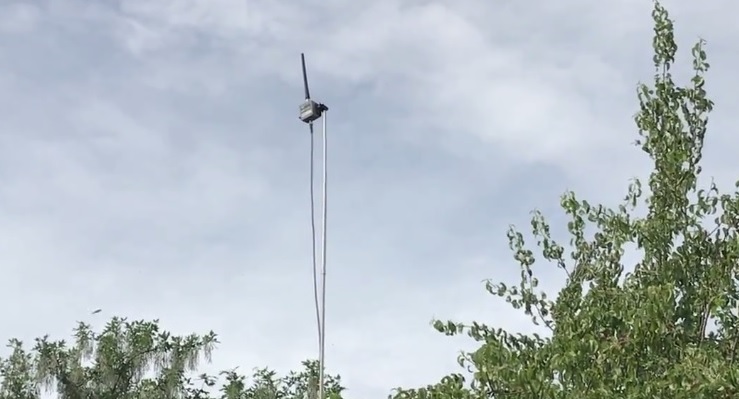
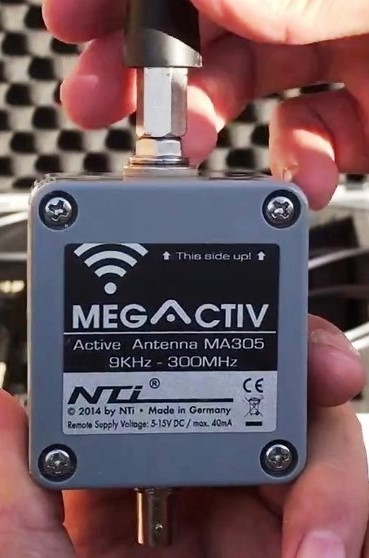

 The USB-powered MegActive MA305 is perfect for DXing on the move…
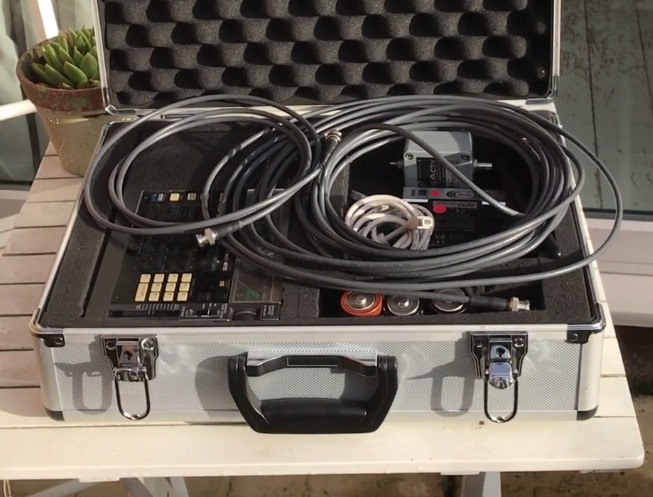
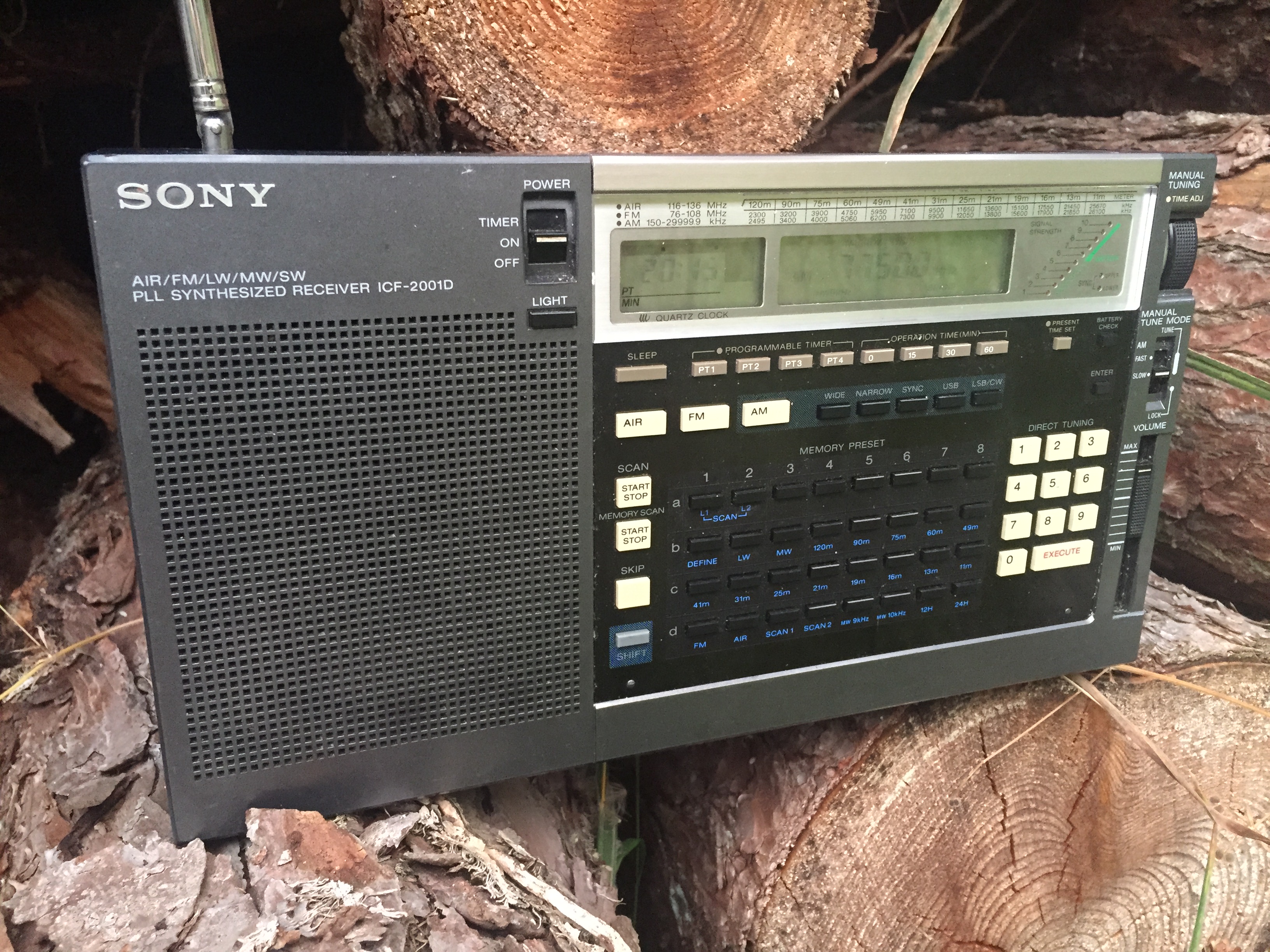 My portable DXing kit comprising the Bonito MegActive MA305 antenna and the Sony ICF-2001D…a bit of a legend in DXing circles…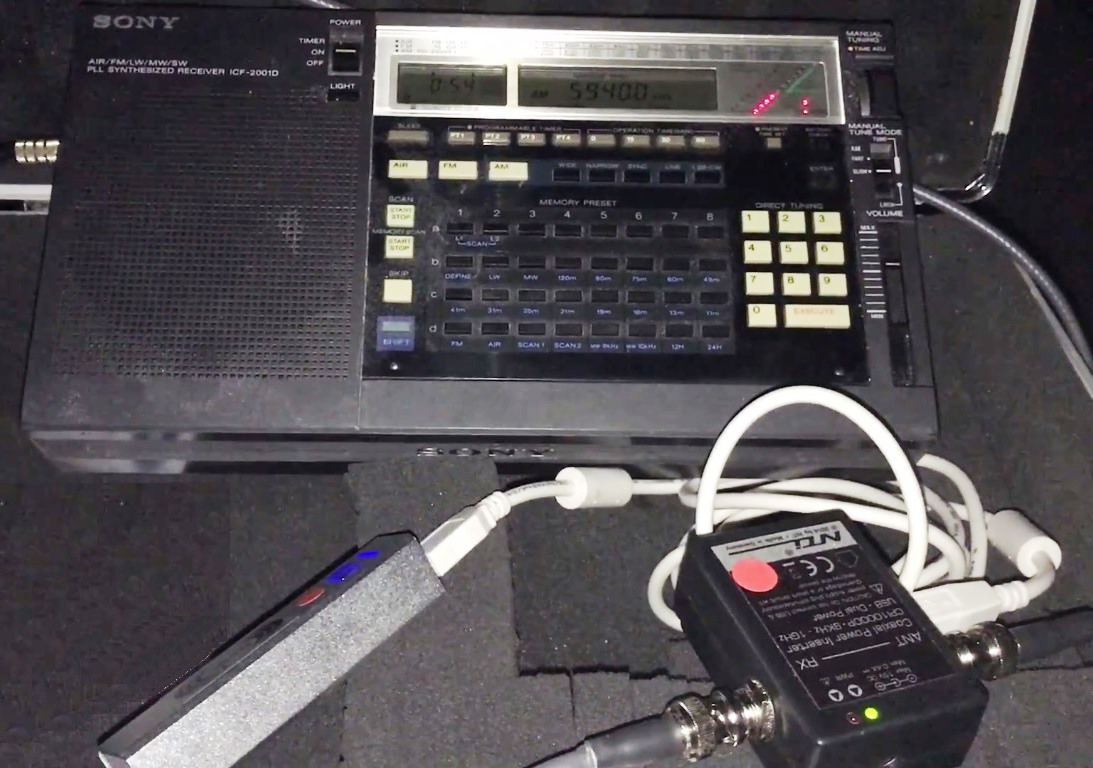
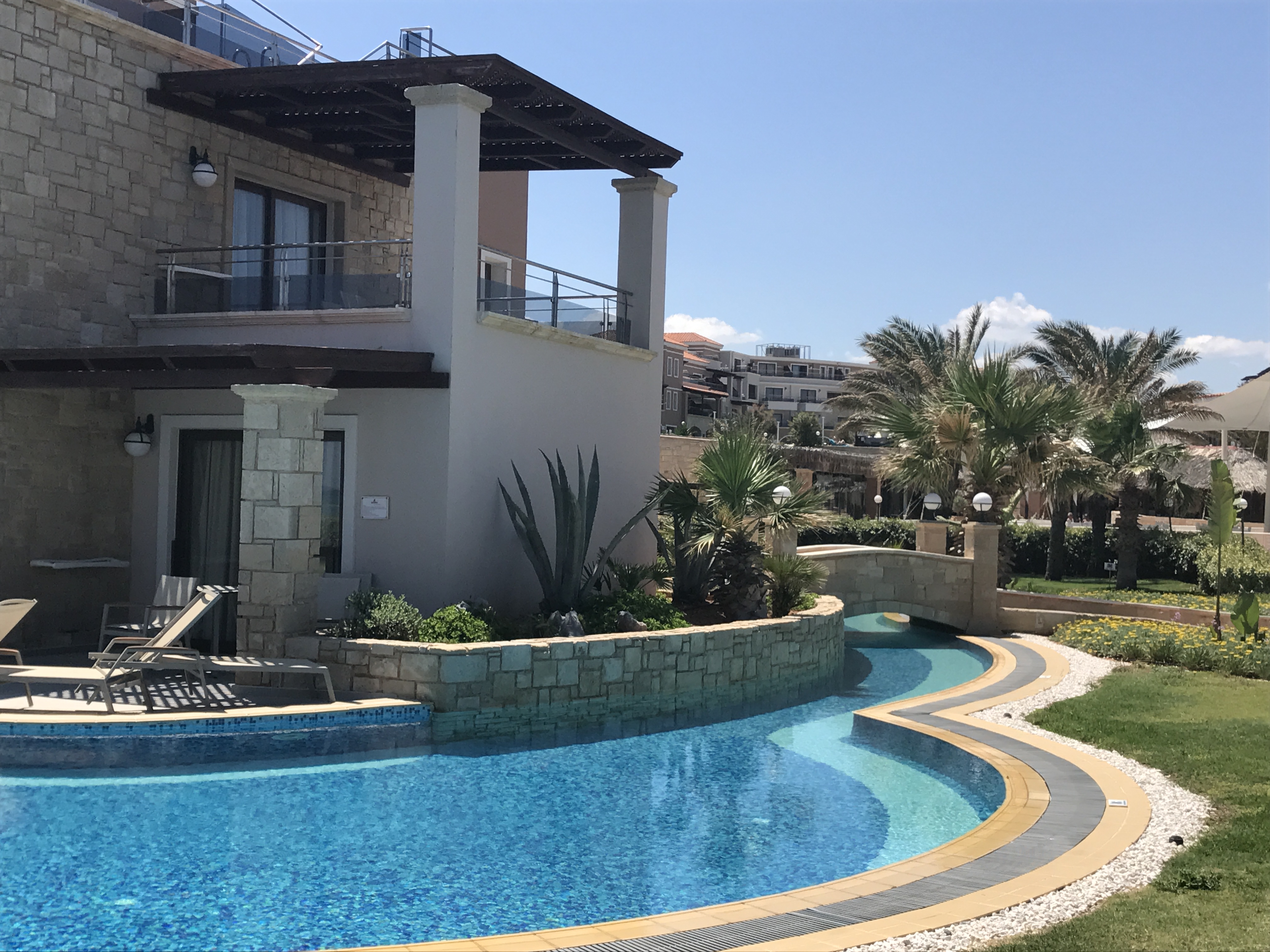
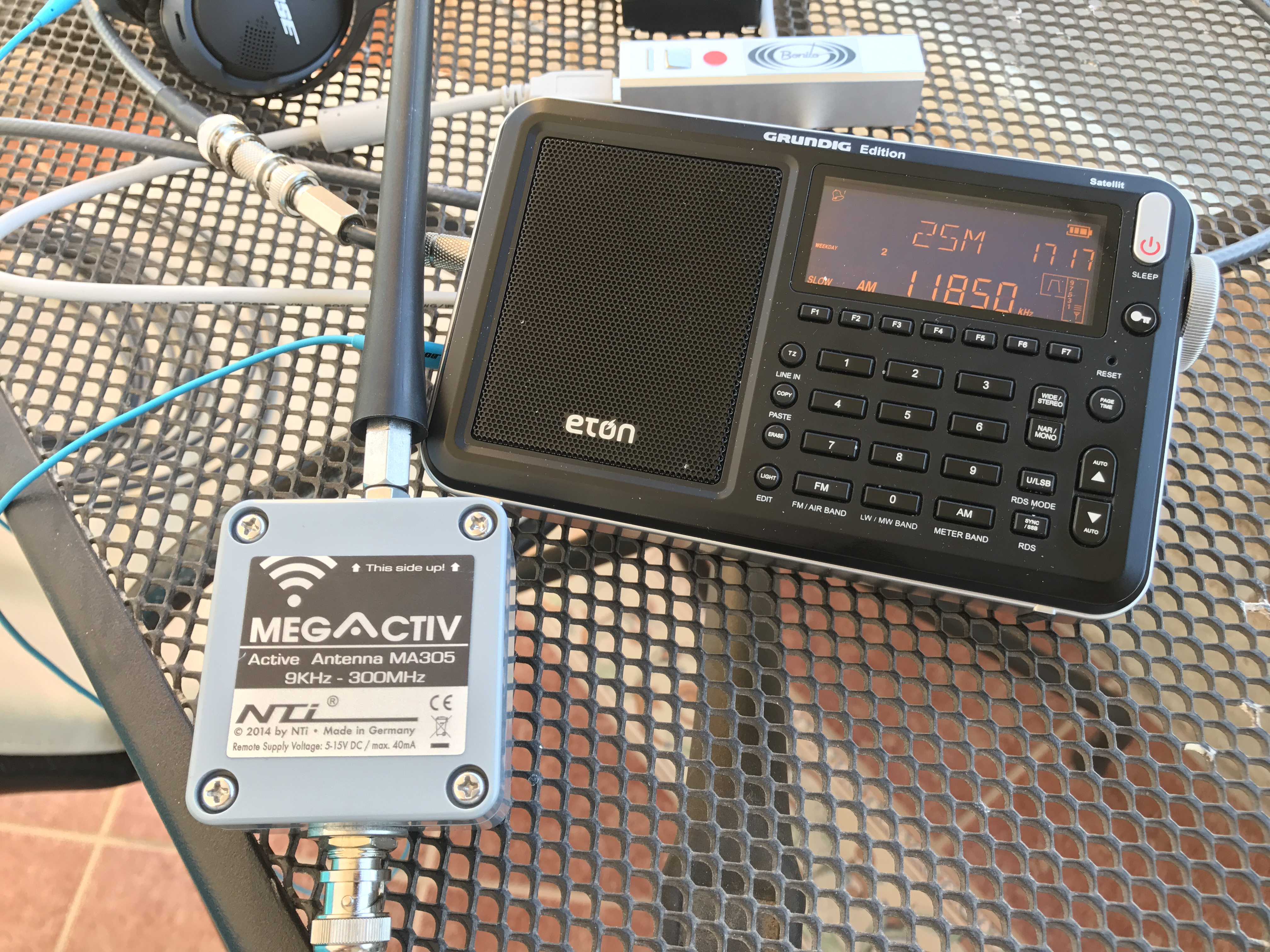
 My listening post in Crete, with the brilliant Eton Satellit receiver