Category Archives: Radio History

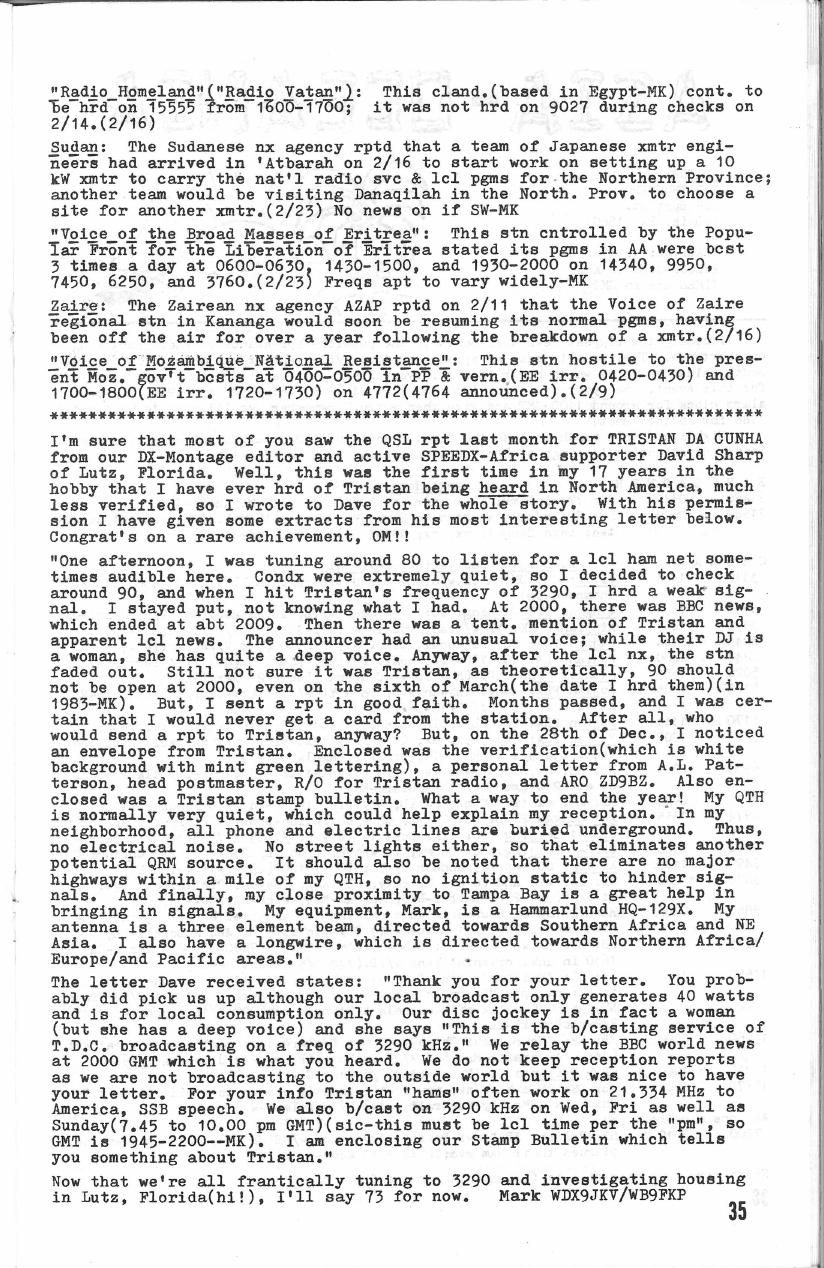
Website highlights the history of YLE Radio Finland

Many thanks to SWLing Post contributor, Mark (VA3MK), who writes:

I found a great website written by the former head of broadcasting in Finland.

I hope this brings back memories of YLE Radio Finland.

I used to listen regularly on 15.400 MHz when they were on the air. Enjoy:

http://www.ulkomaanmedia.net/RFTIMELINE.html

What a fabulous deep dive into YLE Radio Finland history! Thanks for sharing, Mark.

Radio Waves: Brazil Proposes End of all Ham Radio Exams, Radio Engineer Files Objection to WIPE, Radio in the Malvinas War, and List of 48 Weatheradio Sites in Proposed Closure

Icom IC-756 Pro Transceiver DialRadio Waves:  Stories Making Waves in the World of Radio

Because I keep my ear to the waves, as well as receive many tips from others who do the same, I find myself privy to radio-related stories that might interest SWLing Post readers.  To that end: Welcome to the SWLing Post’s Radio Waves, a collection of links to interesting stories making waves in the world of radio. Enjoy!

Many thanks to SWLing Post contributors Rob (PE9PE), Bennett Kobb, Harald
(DL1AX), and Dennis Dura for the following tips:


Brazil proposes end of all amateur radio exams (Southgate ARC)

ANATEL, the Brazilian National Telecommunications Agency, recently published a public consultation, CP65, which is available at this link:

In their website, LABRE, the Brazilian Amateur Radio League, was surprised by the CP65 proposal that proposes, among other topics, the extinction of the COER (amateur radio certificate) exam for all classes and replacement by free access to initial class C, as is done today with the Citizen’s Band, as well as access to subsequent classes B and A upon presentation of the Certificate of Technical Course and Graduation in Telecommunications, respectively, or minimum stay of 3 years in each class.

In addition, the aforementioned proposal suggests ending the rules of different prefixes for each of the States of the Federation, remaining only the prefix per class and there would no longer be any special callsigns.

The proposal, in addition to going against what is consensus in the international regulation related to the Amateur Radio Service, is absolutely contrary to the LABRE’s thinking with regard to the minimum requirements to be a radio amateur and also does not match ANATEL’s request for support from LABRE in the revision of amateur radio regulations in Brazil.

For further clarification on the subject, LABRE has already requested a meeting with ANATEL, which will be scheduled soon.

PR7GA

Radio Engineer Files Objection to WIPE (DRMNA.info)

Story by Bennett Kobb:
On September 3, radio engineer Alex Pilosov of Shortwave Solutions filed with the FCC an objection to WIPE, the DRM-based HF station of Turms Tech of New York, presumed to be ready to broadcast from the Armstrong Tower in Alpine, NJ.

WIPE is suspected to be intended mainly for secret, non-broadcast message transmission for private trading clients while broadcasting financial and economic news for the public.

WIPE is not yet operational. The station is waiting on its FCC license, but Pilosov took aim at possible glitches in its license application. He also raises the issue of whether U.S. shortwave stations can legally conduct non-public telecommunications in the broadcast bands in a service limited to broadcasting.

Pilosov is a consultant to HF stations in the Experimental Radio Service, which are not constrained by the broadcast rules; thus he or his clients are prospective competitors to WIPE. This is Pilosov’s second FCC objection. He also filed against the application of Parable Broadcasting for WPBC, a DRM HF station proposed for Batavia, IL.[]

Radio in the Malvinas War (RAE)

In 2020 we celebrate the centenary of radio in Argentina. Such an event can be approached in various ways, since there are several milestones along this century of radio in our country. There are some events that are marked by fire in collective memory.

It is our intention to approach the celebration focusing on an event in which radio was in the spotlight: the 1982 Malvinas War, a conflict waged on various fields: military, economic, diplomatic and, of course, communications, mainly as a means of propaganda.

Most countries over time have recognised the great potential of radio as an effective instrument both in times of war and peace. Historically, Germany was the first country to use this for purely political purposes.

During WWII the broadcasts of Radio Tokyo, Radio Germany, the BBC in London and other stations were used for propaganda and military purposes by combatant nations.

The post-war period and the subsequent Cold War brought along a “war of the airwaves”. During these years, countless stations emerged with their own propaganda styles, looking to advance their social, political and economic systems.

An example of this are the broadcasts of Radio Moscow, Voice of America or Radio Beijing. Along with these stations, others of a clearly political nature emerged, such as Radio Free Europe and Radio Liberty, that targeted countries in Eastern Europe, as well as nations that became independent after the collapse of the Soviet Union. This group also includes the so-called clandestine stations, which generally broadcast secretly from conflict zones or from nearby regions or using rented transmission sites.

Before April 2, 1982, the Malvinas Islands had one radio station: the Falkland Islands Radio Service (FIBS) – with broadcasts in English. Content aired included locally-produced programs as well as news services of BBC London. It broadcast on 536 khz and 2370 khz.

The AM frequency was intended to cover the Port Stanley area, reaching a little further with SW transmissions.[]

List of 48 Weatheradio Canada transmitting site proposed for decommissioning (Weatheradio Newsletter)

As mentioned in a previous post, Weatheradio Canada is considering shutting down 48 network transmitters across the country. SWLing Post contributor, Dennis Dura, recommends checking out the Weatheradio Canada Newsletter for updates.

He also forwards the following list of sites that are proposed for decommissioning. Click here to download the list as a PDF.


Do you enjoy the SWLing Post?

Please consider supporting us via Patreon or our Coffee Fund!

Your support makes articles like this one possible. Thank you!

Radio Waves: Possible Radio & TV Closures in Canada, Bauer closes stations in England and Wales, WWJ at 100 years, VOA staff fear political agenda by Pack, and latest issue of The Communicator

Radio Waves:  Stories Making Waves in the World of Radio

Because I keep my ear to the waves, as well as receive many tips from others who do the same, I find myself privy to radio-related stories that might interest SWLing Post readers.  To that end: Welcome to the SWLing Post’s Radio Waves, a collection of links to interesting stories making waves in the world of radio. Enjoy!

Many thanks to SWLing Post contributors Adid, Joel, Michael Bird, and Mike Terry, for the following tips:


Canadian radio stations and TV outlets risk closure (Southgate ARC)

As many as 40 local television outlets and 200 Canadian radio stations could be forced to close in the next three years as the financial pressures faced by media companies intensify under the COVID-19 pandemic, suggests a new study from an industry advocacy group.

The Canadian Association of Broadcasters issued a report on Wednesday warning of potential closures and widespread job cuts as private TV and radio broadcasters face a cumulative projected revenue shortfall of up to $1.06 billion by the end of 2022.

Most vulnerable are the country’s AM radio stations, the report said, as well as other independent private radio and TV operations in smaller markets across the country.

The study, titled “The Crisis in Canadian Media and the Future of Local Broadcasting,” was commissioned by the CAB, which represents the majority of private broadcasters in Canada, and conducted through Winnipeg-based independent media economics consultancy Communications Management Inc.

More here:
https://www.boundary
creektimes.com/business/media-study-says-hundreds-of-canadian-radio-stations-tv-outlets-risk-closure/

Bauer closes dozens of regional radio stations in England and Wales (The Guardian)

Replacement of stations with single national outlet described as act of ‘breathtaking cultural vandalism’

Dozens of regional radio stations have been replaced by a single national outlet, in the latest blow to an industry that has seen deep cuts in recent decades.

Outlets across England and Wales owned by Bauer Media – ranging from Wolverhampton’s Signal 107 to York’s Minster FM and Salisbury’s Spire FM – will now broadcast under the single brand Greatest Hits Radio.

Critics said the move was the death knell for traditional mid-sized commercial radio stations, with only a handful of truly independent local radio outlets remaining.

Most of the outlets affected had their own locally employed presenters and management and their own studios in the towns and cities they served. Now, most of the stations on the new network will carry national programming for 20 hours a day.[]

Born at The News: WWJ radio celebrates 100 years since launch as nation’s first commercial broadcaster (Detroit News)

For a behemoth that now dominates the local AM radio dial, its beginnings were surprisingly humble.

One hundred years ago Thursday, WWJ radio — Detroit’s very first station — was born when Detroit News publisher and radio enthusiast William E. Scripps had a 200-watt transmitter set up in a corner of the sports department. (Today? It’s 50,000 watts.) WWJ will air a special show, “WWJ at 100, a Century of News,” at 7 p.m. Thursday to celebrate.

WWJ wasn’t just first in Detroit. Depending on how you slice things, it was the first commercial broadcaster in the U.S., though when it went on the air that Aug. 20 a century back, it was probably picked up by only a few dozen households in possession of what was, at the time, shockingly high-tech radio equipment.

Asked where he’d locate WWJ in American broadcasting history, Specs Howard, founder of the School of Media Arts in Southfield that bears his name, said without hesitation, “Oh, right near the top.”

One-time WRIF program director Fred Jacobs, now head of Jacobs Media Strategies in Bingham Farms, agreed, saying, “It’s really been a remarkable run, especially in a world where brands come and go.”[]

At Voice of America, Trump Appointee Sought Political Influence Over Coverage (KPCW)

At the Voice of America, staffers say the Trump appointee leading their parent agency is threatening to wash away legal protections intended to insulate their news reports from political meddling.

“What we’re seeing now is the step-by-step and wholescale dismantling of the institutions that protect the independence and the integrity of our journalism,” says Shawn Powers, until recently the chief strategy officer for the U.S. Agency for Global Media, which oversees VOA.

Voice of America’s mission is a form of soft diplomacy: to embody democratic principles through fair reporting and to replace a free press in countries where there is none. VOA and its four sister networks together reach more than 350 million people abroad each week.

Since taking office in June, Pack has upended the agency. In a podcast interview last week with the pro-Trump website The Federalist, Pack said he had to take action because many executives and journalists were disregarding the agency’s ethical standards.

“My job really is to drain the swamp, to root out corruption and to deal with these issues of bias, not to tell journalists what to report,” Pack told host Chris Bedford. Pack has declined NPR’s repeated and detailed requests for comment.

But it appears that Pack is, in fact, interested in influencing which stories get told, and how. The senior news editor who oversaw VOA’s standards and practices was reassigned to a corporate position earlier this summer and has since played no role in guiding coverage or scrutinizing stories flagged as problematic.[]

The Communicator – September-October 2020 now on-line (Southgate ARC)

This issue over 100 Pages Of Projects, News, Views and Reviews…

Amateur Radio News from the SW corner of Canada and elsewhere.
You will find articles, profiles, news, tips and how-to’s.

https://ve7sar.blogspot.com/2020/08/the-communicator-magazine-september.html

Clicl here to download the issue (PDF).


Do you enjoy the SWLing Post?

Please consider supporting us via Patreon or our Coffee Fund!

Your support makes articles like this one possible. Thank you!

Rush’s new “Spirit of Radio” video pays homage to our rich radio history

Many thanks to SWLing Post contributor, Mark Hirst, who shares a music video recently released by Rush in honor of the 40th anniversary of their album, Permanent Waves.

The animated video takes us on a journey through radio and broadcasting history. No doubt, you’ll recognize many names and stations. It’s a wonderful radio nostalgia trip. Rush produced this video in memory of their epic drummer, Neil Peart, who passed away earlier this year.

Enjoy:

Radio Waves: GatesAir Invests in Equatorial Guinea, Community Radio Champion Lorenzo Wilson Milam SK, and GQRP Online Convention

Radio Waves:  Stories Making Waves in the World of Radio

Because I keep my ear to the waves, as well as receive many tips from others who do the same, I find myself privy to radio-related stories that might interest SWLing Post readers.  To that end: Welcome to the SWLing Post’s Radio Waves, a collection of links to interesting stories making waves in the world of radio. Enjoy!

Many thanks to SWLing Post contributors Tracy Wood, John Figliozzi, Heath Hall and Gérard Koopal for the following tips:


Investment project by North American company GatesAir in digitalisation of Equatorial Guinea (Equatorial Guinea Press and Information Office)

The company GatesAir could invest in a digitalisation project for audiovisual media in Equatorial Guinea in the near future. The information was revealed at the audience that the Vice-President of the Republic, H. E. Teodoro Nguema Obiang Mangue, granted on Friday 7th August, at the People’s palace in Malabo, to the accredited North American Ambassador to Equatorial Guinea, Susan Stevenson.

The willingness of the United States Government was expressed at a bilateral meeting that the Vice-President held with the Ambassador, Susan Stevenson, who came to report to H. E. Teodoro Nguema Obiang Mangue about the interest of the North American company GatesAir in investing in a digitalisation project in the country.

The initiative was well received by Nguema Obiang Mangue, who declared to his interlocutor that Equatorial Guinea has its doors open to any foreign investment.

The Coronavirus pandemic which is currently affecting the whole world also occupied a page on the menu of discussions between Nguema Obiang Mangue and Susan Stevenson.

In addition to this project, Equatorial Guinea and the United States continue to form closer ties in other sectors such as Defence, Education, the Economy and Culture, among others.[]

Lorenzo Wilson Milam, Guru of Community Radio, Is Dead at 86 (NY times)

He helped start noncommercial stations in the 1960s and ’70s, offering an eclectic mix of music and talk. His goal: to change the world.

Lorenzo Wilson Milam, who devoted much of his life to building noncommercial radio stations with eclectic fusions of music, talk and public affairs, died on July 19 at his home in Puerto Escondido, Mexico. He was 86.

[…]Mr. Milam loathed commercial radio stations, which he saw as purveyors of mindless junk. With KRAB and about a dozen other stations that he helped start in the 1960s and ’70s, he created a freewheeling, esoteric vision of commercial-free community radio as the voice of the people it served.

He wanted his stations to have inexperienced contributors, both on and off the air. He encouraged locals to help him program the stations and contribute a few dollars to keep these shoestring operations open.[]

RAE 100 year anniversary specials (Gérard Koopal)

I heard on RAE German that Argentina celebrates 100 years radio in Argentina on august 27th of this year.

This was announced by Rayén Braun the 4th of august on her broadcast show in German.

German listeners are asked to send in a personal message as video or mp3 to this event which will be incorporated in the special broadcast show on this matter.

She points out that more information will be found on the website of RAE. (www.rae.com.ar)

GQRP Club releases agenda for its Online Convention 2020 (Southgate ARC)

The GQRP Club has released a detailed agenda for its Online Convention 2020, taking place on Saturday 5th and Sunday 6th September.

The online event, which replaces the club’s annual GQRP convention at Telford due to current Covid-19 restrictions, is open to existing members. There is a special rate for non-members which will include GQRP Club membership until January 2022.

The two-day event comprises a series of online presentations and knowledge-sharing meetings where people can share ideas.

The packed presentation list includes:

• “Building QRP transceivers” with Hans Summers G0UPL, designer and manufacturer of the QCX QRP transceiver.

• “HF propagation and QRP” with Steve Nichols G0KYA, author and chairman of the RSGB’s Propagation Studies Committee

• “Homebrew SSB Transceivers” with Pete Juliano N6QW, co-presenter of the Soldersmoke podcast and a prolific home brewer.

• “Vector Network analysers explained and the NanoVNA” with Alan Wolke W2AEW, a professional electrical engineer who works for Tektronix.

• “Antennas for QRP” with Callum McCormick M0MCX, YouTube star and inventor and manufacturer of the DX Commander vertical antenna.

• “FT8/FT4 for the QRPer” with Anthony Luscre K8ZT, who will take a detailed look at this the fastest-growing mode in amateur radio.

There will also be range of knowledge-sharing sessions, including “Using Antenna analysers” with Heather M0HMO, “Running a QRP DxPedition” with Dom M1KTA, “Battery technology for QRP portable” with Bill G4ERV, “Omni Directional antennas” with John G8SEQ and many more.

The event costs £4 for GQRP club members. Non-members can also sign up for the event and join the GQRP club for just £10 (or £17 for international participants).

To sign up for the event just go to the Eventbrite sign-up page at: https://www.eventbrite.co.uk/e/gqrp-club-2020-online-convention-tickets-115417887007

For more information and to view the full event schedule see http://www.gqrp.com/convention.htm


Do you enjoy the SWLing Post?

Please consider supporting us via Patreon or our Coffee Fund!

Your support makes articles like this one possible. Thank you!

Video: When “Tomorrow’s World” demonstrated digital radio

Many thanks to SWLing Post contributor, Jason W, who writes:

You might be interested in this episode of the BBC series tomorrow’s world from 17th Feb 1993 on YouTube:

10:23 to 14:50 has a introduction and demonstration of digital radio in the UK and concluding with “the experts say we will be fully digital by 2020 it’s a long wait” (referring to the switch from fm to digital radio in the UK which is yet to happen).

I thought it might be interesting to highlight this on the blog in 2020.

We can forgive the bit where she suggests digital radio will operate alongside analogue FM in the same frequency band. This Wikipedia on the history of digital broadcasting in the UK shows the UK adopted the DAB Eureka 147 standard in a SFN (single frequency network) from the start of test transmissions in 1990.
https://en.m.wikipedia.org/wiki/Digital_radio_in_the_United_Kingdom

The same episode has a later piece on wide-screen digital television. (20:18 to 23:41) ending with the line “like digital radio, it is a few years away” 🙂

This is fantastic! I love watching vintage Tomorrow’s World episodes. It’s great to see how well they predicted the future and what they considered to be meaningful future innovations at the time. Thank you for sharing, Jason!

The book that took David down the path of SWLing and ham radio

Many thanks to SWLing Post contributor, David (G4EDR), who writes:

I enjoyed reading about the vintage shortwave radio book memories from Bob W6ACU and it prompted me dig out the book which got me started in SWLing back in 1970. It was in a series of illustrated teach yourself books and the title was ‘Radio’ written by David Gibson G3JDG [see cover above].

I borrowed it from the school library and renewed the loan so many times the librarian suggested I should buy my own copy so that someone else could have the chance to borrow it! I still have my own copy of the book bought with my saved pocket money for the sum of 15 shillings. That was before the UK changed to decimal currency (15 shillings is 75p in decimal).

The book covered basic radio theory and several construction projects including a crystal set and an atu which I made and I also learned all about amateur radio and QSL cards.

That was the start of my life long obsession with radio. How things have changed over 50 years! Thank you for allowing me to rekindle those happy early days of this fantastic hobby of ours.

73, David – G4EDR.

Thank you, David, for sharing your memories with us. It’s amazing, isn’t it, the impact one book or one radio can have on one’s life!