Shortwave listening and everything radio including reviews, broadcasting, ham radio, field operation, DXing, maker kits, travel, emergency gear, events, and more
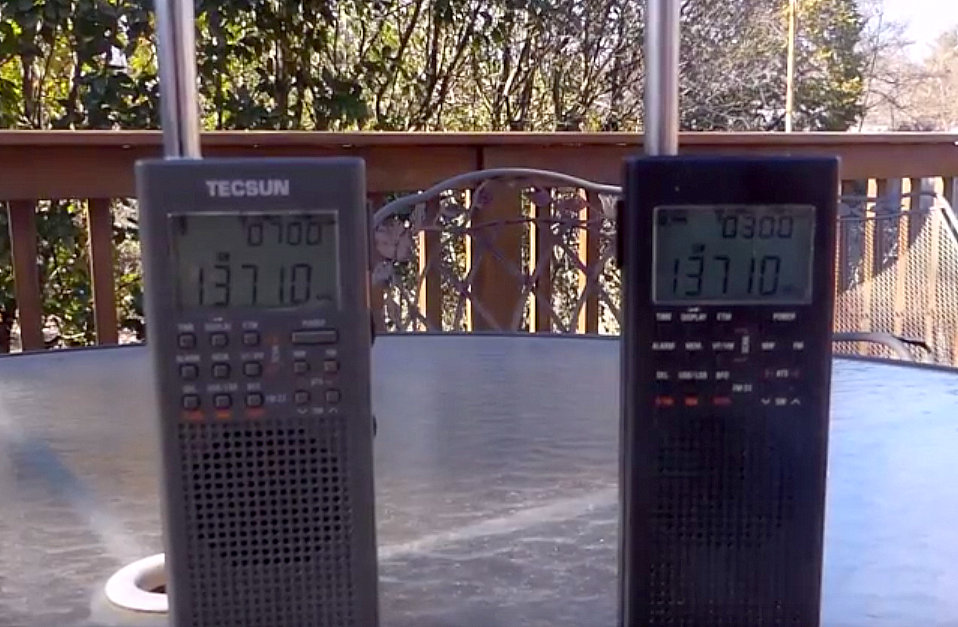
Hi there, a good friend of mine Mr Thomas Brogan mentioned to me recently that his little Tecsun PL-310ET was proving to be an excellent receiver and that it would suit my DXpedition activities. Now, as someone who likes to push the envelope of performance with sophisticated portables, usually coupled to very large antennas, a cheap little Tecsun might not have been an abvious choice for my next purchase. However, Mr Brogan (who has an excellent Youtube channel by the same name – check out his wonderful collection of vintage and modern receivers) previously suggested I buy, for similar reasons, the Sony ICF-SW100. That little masterpiece of electronics turned out to be one of the best receivers I’ve ever owned. I felt compelled to take notice because Tom never gets this stuff wrong! A few days later I found myself in Maplins – again – and there it was on the shelf at just under £40, so I bought one.
I got back into shortwave listening about 18 months ago, after many years of inactivity whilst my poor Sangean ATS-803A rotted away in the garden shed and Sony ICF-7600G long-gone via eBay. To start all over again, I bought a Tecsun PL-360. What a great little portable that turned out to be – there are over 100 reception videos on my YouTube channel demonstrating how it continually performed above and beyond the very modest price tag. I even managed to hear ABC Northern Territories 4835 kHz on it once – simply amazing for a receiver under £30. Given my extensive experience with the PL-360 and having learned the PL-310ET shared the same DSP chip, I was expecting the same, or at least very similar performance and the only real benefit to upgrading to the PL-310ET was the direct frequency access. However, I was wrong about that!
The brilliant Tecsun PL-360 got me back into shortwave radio for less than £30
About a week after buying the PL-310ET, I managed to get out on a DXpedition and with 30 metres of wire attached to it via the external antenna socket, I started tuning around the SW bands. Quite simply, I was amazed at the sensitivity and selectivity of this diminutive little portable. With the proven DSP receiver chip and a number of audio bandwidth filter options from 1 to 6 kHz, coupled with direct frequency access via the keypad, it was a joy to use and listen to. In just over an hour I had copied signals from North Korea, including their internal service KCBS Pyongyang, Zanzibar BC, ABC Northern Territories (at the first attempt!), Zambia NBC Radio 1, Radio Oromiya and Radio Amhara from Ethiopia, amongst others. Brilliant stuff and clearly demonstrating that the overall hardware/software package with the PL-310ET is a step up in performance over the PL-360 and capable of proper DX for a very modest outlay. Interestingly, in a conversation with Thomas Witherspoon regarding the PL-310ET, he reminded me that it was one of his go-to radios for travelling and confirmed it’s excellent performance. I would definitely recommend this radio to novices and experts alike.
Reception videos follow below, with more to come in part 2; I hope you enjoy them. Thanks for watching/listening and I wish you all excellent DX!
Clint Gouveia is the author of this post and a regular contributor to the SWLing Post. Clint actively publishes videos of his shortwave radio excursions on his YouTube channel: Oxford Shortwave Log. Clint is based in Oxfordshire, England.
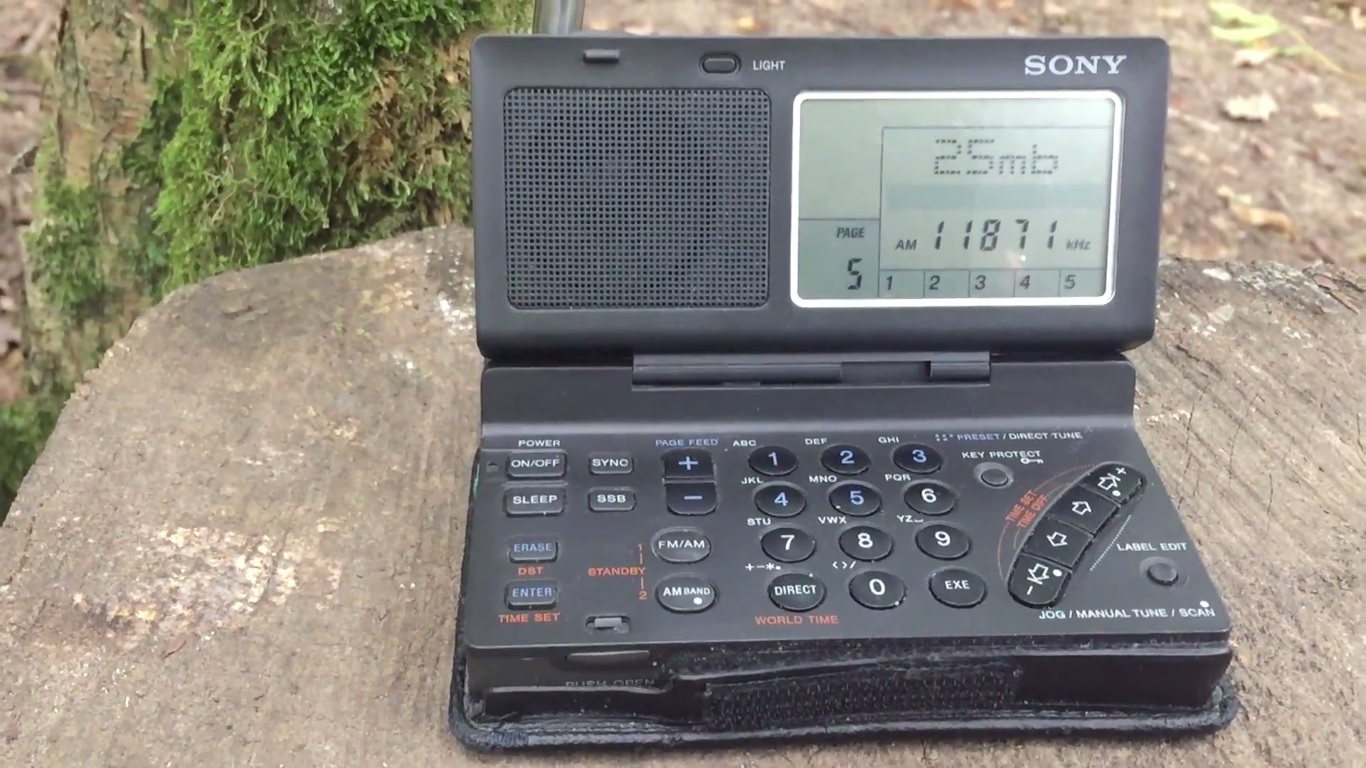
Hi there, after conducting a total of 14 reception tests comparing these two vintage – but excellent portable shortwave radios, there was a clear winner – the ICF-2001D. Interestingly, the second half of the testing identified yet another example of synchronous detection lock dropping out on the ICF-SW77 (during reception of Radio CANDIP, Democratic Republic of the Congo on 5066.4 kHz). Generally, however, and despite a fairly narrow performance margin, the ICF-2001D managed to deliver clearer audio across 5 of the remaining 6 reception tests, giving a final score of 9 to 3 in it’s favour. However, despite the clear win, there is no doubt in my mind at all that the ICF-SW77 is still a great portable receiver and in my humble opinion, remains one of the best ever made.
I believe this comparison test reveals the only likely remaining contender to the top-spot in portable shortwave receivers to be the Eton E1/E1XM. Originally to be marketed as the ‘Satellit 900’ (that never happened) and following a decade of development, involving RL Drake, it was finally introduced in 1995 – and then out of production within a few years. Fortunately, a couple of months ago, I managed to snag one in excellent condition on eBay, for a reasonable price. Now, these radios are not without issues, including, but not limited to; sticky rubber exterior casing, malfunctioning display, failing function keys and general all-round fragility. Not exactly what I would be looking for in a rugged, well-performing portable for my DXpeditions. However, as someone who is always exploring ways to ‘push the performance envelope’ and the obvious potential benefits of passband tuning, an allegedly superior synchronous detection circuit, 4 audio bandwidth filters and tuning resolution down to 10 Hz, the E1 was impossible for me to ignore. Thus, at some point in the near future, I will perform a similar comparison test with the Sony ICF-2001D and the Eton E1. Whichever camp you might be in, I hope you’ll enjoy the reception videos and find the results/conclusions informative.
For now, wishing you all excellent DX.
The Eton E1; possibly the best portable shortwave receiver of all time?
Clint Gouveia is the author of this post and a regular contributor to the SWLing Post. Clint actively publishes videos of his shortwave radio excursions on his YouTube channel: Oxford Shortwave Log. Clint is based in Oxfordshire, England.
Many thanks to SWLing Post contributor, Troy Riedel, who shares the following guest post:
Review: DoxyTronics Portable HF Magnetic Loop 8020CA
-by Troy Riedel
Before I purchased the DoxyTronics 8020CA antenna, I emailed the owner/manufacturer and asked if he felt this antenna would be a good choice with the radios that I own. He promptly and courteously answered my question and I purchased the antenna on September 30th. I received the antenna approximately 6-days after I ordered it.
The DoxyTronics 8020CA magnetic loop antenna
I have been evaluating the antenna for 5-6 weeks mostly on my Grundig Satellit 750 and my Grundig G3. I have used other portables but the two aforementioned Grundigs were the radios I used most.
The antenna control box has a ¼-20 hole on the bottom so it can be mounted to a video camera tripod. The assembled antenna weighs 3 lbs. I tried using a light duty DSLR tripod that I own, however that was nowhere near sturdy enough. I had to use a heavier duty tripod (Ravelli AVT) that I use for astronomical purposes. This Ravelli has a weight capacity of 16 lbs and it easily supported the antenna. I’m confident a much smaller and lighter duty tripod than the Ravelli could be used, I simply don’t own anything in-between as my astronomical binoculars and binocular telescopes weigh 5 – 14 lbs.
The 8020CA Antenna consists of a large tuning knob and control box. The control box has switch settings of 3-5 Mhz and 5-15 Mhz. In testing, I found that I could “tune” up to 17.840 MHz. No batteries are needed to operate.
The antenna worked equally well with all of the “portable” radios that I tested (I am a SWL’er, not a ham).
I can summarize the antenna’s performance as this: it is not a magic elixir that will allow you to capture signals too faint to recognize without the antenna attached, but it definitely enhances the signal and “stabilizes” it to the point where the level of the signal remains relatively constant (less peaks & troughs in signal strength).
Hopefully you can hear what I have summarized and concluded. I have included a two and one-half minute recording of the following:
Radio: Grundig Satellit 750 Recorder: RadioShack 140-214 Freq: 7.310 MHz BW: Wide Broadcaster: Radio Romania International Date of Recording: 15NOV2016 Time: 2309 – 2313 UTC
00:00 – 00:30: 8020CA Antenna Attached 00:30 – 01:00: Radio’s Whip Antenna 01:00 – 01:30: 8020CA Antenna Attached 01:30 – 02:00: Radio’s Whip Antenna 02:00 – 02:30: This last 30-second segment is with the 8020CA attached, however I am panning the Ravelli tripod 360-degrees in the horizontal. You will hopefully notice that there is a “sweet spot” where the signal and reception is the best of the entire 2:30 recording. I had set-up the antenna and I completed a quick, test recording of Radio Romania. But conditions changed slightly and the best signal during the recoding was approximately 50-60-degrees away from where the best reception was earlier. This is a positive for the antenna: you can pan the tripod head where the antenna sits to null and/or find the best signal.
Note: this is my first shortwave and radio-related review I have ever done. I have done many astronomical reviews – where I have much more experience – so please be kind towards this first attempt.
No worries, Troy! We’re kind and appreciative here–especially since guest posts are all about sharing our experiences and experimentation!
I must say, the DoxyTronics loop is doing a fine job mitigating the local QRM/interference that is easily heard when only the telescopic whip is being used. I’m also impressed that a passive loop this modest in size has so much gain without amplification.
Hi there, here is a summary of the first half of tests comparing the Sony ICF-2001D against it’s replacement the ICF-SW77. Both receivers are widely acknowledged as being amongst the best shortwave portables ever made, but how close are they in performance? Is there a clear winner after the first 8 reception tests? I hope you enjoy the summary video. Links to the first half of reception tests follow again, below, whilst the second half will follow in a separate post. Thanks and good DX to all.
Clint Gouveia is the author of this post and a regular contributor to the SWLing Post. Clint actively publishes videos of his shortwave radio excursions on his YouTube channel: Oxford Shortwave Log. Clint is based in Oxfordshire, England.
In a previous guest post, SWLing Post contributor TomL, shared his “Evolving, Morphing, SW Listening Station” where he detailed the many ways he’s trying to fight heavy radio interference at his listening post. The following post is TomL’s update:
More Anti-Noise Ideas
(Continuing the hunt for better reception in a foul RFI environment)
by TomL
I have made the following changes:
Created a prototype mini-loop based on a crossed-parallel idea from VE1ZAC (Jeff).
Added 2 preselectors, an old Grove TUN-3 connected to the main loop feed and an MFJ-1046 connected to the ground connection of the balun. Both feeds go into the MFJ-1026.
Added a medium wave noise canceling unit that I have not figured out how to use yet. (Quantum Phaser). The MFJ unit does not work on medium wave without modification.
Purchased from eBay a used Grundig Satellit 800, a somewhat more robust fixed-station receiver to replace my aging Sony ICF-2010.
Other non-related (not shown): Whistler digital scanner + UHF over-the-air TV + FM broadcasts + an AM/FM HD digital radio + high pass filters from MiniCircuits.com – (audio from all these sources is passed to an existing high fidelity stereo power amp and NHT Super One speakers on the computer desk for near-field monitoring). Associated antennas are also hidden on the outside deck (shhhhh!).
Large charge card balance!!
So, here are some pics for the crossed-parallel loop. VE1ZAC web site has all the references if you want to explore further or google him. Mine is purely a prototype and not finished. And should eventually be placed on a rotor (but how to keep my Nazi-like condo association from finding out?!?!?!?).
It is three 14 inch quilters hoops from Joann Stores plus some 1-inch copper strips cut from a small 2 meter roll of thin copper from eBay. Then, it is wired in parallel with silver-plated aviation wire on each side with a feed in the middle. Not an optimal placement of the feed, (should go straight down along the pipe). Will fix things up whenever I get some more time.
Seems to be an efficient way to prototype small loops. It is now mounted on a short ¾” inside diameter PVC pipe into a cheap plastic sand-filled deck-umbrella stand. Loops are light and somewhat flimsy, so I mounted the three loops on a plastic triangle ruler and dowel sticks glued to the sides for some extra strength. Good enough for now.
The EF-SWL balun is also in an experimental configuration. Since I read somewhere that loop antennas have a very low impedance at the feed point (like, 10 ohms or lower), I thought I might try a balun that is meant to lower the impedance and mount it backwards. I don’t have a picture of it but the SO-239 output is facing the loop and the screw terminals are facing the direction of the radio. My feeble brain thinks since it is a passive device of coils on ferrite, it should work bidirectionally for receive only applications like this. It seems to work but I have the excuse that I really don’t know what I am doing! 🙂
BHI unit in action.
The BHI DSP filter is useful in some circumstances but I find it fatiguing to listen to. The audio from the Sattelit 800 is so nice, I mostly like it without the DSP. The DSP narrows the bandwidth significantly, somewhere around 4 kHz or less from my hearing. I like that the Grundig has two tone controls. And it also has a stable SSB and on very strong signals with clear audio, I like to listen with SSB lower or upper sideband. But the DSP is useful at times for hash-like noisy signals; it is not quite as good on buzzing noise and I wish the Satellit 800 had a noise blanker, but that would have been a more costly purchase, like a Drake R8A.
So, in a nutshell, I have a discovery about noise here: it is all around me and ubiquitous, like the air I breathe!
I find it hard to null and also worry about peaking a station signal at the same time. However, I do have a lower noise floor with the experimental loop sitting outdoors, especially on medium wave (the Wellbrook amp + loop works great on the lower frequencies – am able to get eight different medium wave stations carrying Major League Baseball games at night – it would be nine to get WFAN for the New York Mets but the local Chicago Cubs station covers the adjacent frequency with horrible digital hash! ***Bleeping*** digital junk!).
Also, the signal level is noticeably lower using the loop. Then, add in the effect of the MFJ Noise Canceling unit, the usable signal gets even weaker.
The bottom line is, I can now finally enjoy listening to many SW broadcasts, BUT only the strongest signals. Anything else is still hopelessly lost in the noise. So, gains are limited.
On the other hand, and something else I learned by doing is that, any 1 or 2 dB signal/noise ratio improvement will help with the final audio output in the end product. Using low-noise amps, loops, noise canceler, preselectors, grounded connections, ground isolators at the input of every receiver, high quality stereo amplifier and speakers, tone controls, SSB vs. AM Sync, weird antenna configurations, etc, etc. It all helps in the end to some degree.
Tinkering is an art that involves a lot of thinking/doing iterations! And high quality parts must be used all along the chain or it could degrade the signal.
Below are some audio samples, not very well recorded, but can give some idea of the incremental improvement with each enhancement (turn up the volume). NOTE: other people may get better or worse results depending upon individual situations, type of antennas used, etc, etc.
Recording 1: R. Marti. First 10 seconds an indoor antenna with no noise reduction, second 10 seconds the outdoor loop without the MFJ-1026, the third 10 seconds with the MFJ-1026, then switched off and on to hear the difference.
Recording 2: R. Marti. MFJ -1026 is ON. Last 15 seconds is SSB, very thin sounding. Really only good for strongest signals. I liked the AM Sync better (Satellit 800 is really a Drake SW8 in disguise with a quality AM Sync). But, SSB can sound excellent with very clear voices with a steady and strong signal (The Satellit 800 does NOT have IF-shift or a BFO to fine tune an SSB reception, so the station must be exactly transmitting on the kHz mark, which most are nowadays).
Recording 3: R. Marti. MFJ-1026 is ON. Last 20 seconds you hear me switch in the two audio switches and the BHI DSP is on its lowest setting. Narrower and clearer with some reduction of background noise. I find I only like going up to about 4 on the DSP dial, after that the audio fidelity starts getting more choppy with digital artifacts that sound like dripping water. I tend to like higher fidelity. One nice thing about the BHI DSP is a faux-stereo that helps a little with voice intelligibility by helping the brain naturally filter the noise. Faux-stereo is ON even when the noise reduction circuit is manually turned off (power must be on and bandwidth still sounds narrowed).
Recording 4: R. Nacional Brazilia. First without MFJ-1026, then ON, then OFF, then ON, then with the BHI kicked for the last 20 seconds.
Recording 5: Greece. Switching the MFJ-1026 on and off every 5 seconds. In this particular case, the signal was weak and fading a lot. The MFJ OFF was also weaker than with it turned ON. That is interesting behavior, usually it is opposite. It pays to play with the settings a little. At other times, and less frequently, the MFJ unit turned OFF sometimes sounds better than with it ON and tuned for less noise. Go figure!
After all the tweaking is done, and I cannot get any more performance out of this, I will probably have to move to a nice, quiet neighborhood and setup a nice antenna farm!!
In the meantime, I do enjoy listening to the stronger stations from North America, Cuba, Brazil, Europe, and Australia with less noise than before.
73’s
TomL from NOIZEY Illinoiz
Once again, Tom, thanks for sharing your RFI elimination journey!
I love how you take on this noisy problem by experimenting and seeing it more as a challenge than an obstacle to enjoying your hobby. Great job!
Many thanks to SWLing Post contributor, Troy Riedel, who writes:
I don’t have a “shack”, but I wanted to take the time to share with you my “listening post”. But first, let me start from the beginning.
I’d call myself an amateur astronomer first – and a Shortwave Listener (SWL’er) second (I have never been a Ham Operator).
I started my astronomy hobby as a young kid who was enthralled by the Apollo Missions. I was also fascinated by weather & I learned how to make short-term 12-36 hour forecasts by making cloud observations, following the barometric pressure trend & noting changes in wind direction. I am still an amateur astronomer (a very expensive endeavor). I was able to pursue my childhood interest in weather and I became an Aviation Weather Forecaster in the military (I also instructed synoptic meteorology in the military at the schoolhouse). I promoted myself out of meteorological jobs in my Service but I was able to transition to a deployable job that allowed me to visit 50 countries. I retired with slightly over 30-years served.
When I was a kid, a buddy had a shortwave radio but we could never hear anything (we had no clue). I had an Electro-Brand EB2100 5-band radio that had AM/FM, Police, Fire, Aviation & NOAA (if I recall). We heard transmissions on that EB2100! I didn’t truly discover shortwave until the early 1990s. My first shortwave radio was a Panda 2006 (I challenge readers to look-up that model in the 1994 Passport to World Band Radio). I liked shortwave so much, I sold the Panda to help finance my next radio. I pre-ordered & subsequently received one of the first Gru?ndig Yacht Boy 400s released in the U.S. (I still have the radio & the receipt).
I think, for a SWL’er, I have a decent collection of shortwave radios & antennae:
Grundig Yacht Boy 400
Grundig G6 Aviator Buzz Aldrin Ed.
Grundig G3 Globe Traveler
Tecsun PL-390
Sony ICF-7600GR
Tecsun PL-365
Grundig Satellit 750
Grundig G2000A Porsche
RadioShack 140-214 Digital Recorder
AMECO TPA Active Antenna
Crane Twin-Coil Ferrite Antenna
DoxyTronics 8020A Passive Antenna
Kaito KA35 Active Loop Proximate Antenna
NASA PA30 Wideband Passive Antenna
A Helical/Slinky Antenna
RadioShack 20-280 Active Antenna
Sony AN-LP1 Active Magnetic Loop Antenna
Tecsun AN-200 AM Passive Antenna
Terk Advantage AM-1000 Passive Antenna
TG34 Active Magnetic LoopAntenna
Yo-Yo Antennas & various Longwires
Extended AM Ferrite Rod for PL-365/360
Slinky, ST3 Scanner Antenna (EB2100 on top of the wall unit library)
Okay, so what is my “listening post”? It’s a sitting room attached to my master bedroom. I have a roll-top desk. A slinky antenna stretched across one side of the room above the window. And an ST3 “Sputnik” Scanner Antenna hung in front of the window (for my RadioShack Pro-651). I use an old-school iPad 1st Gen next to my radios because I found that it emits virtually no RF compared to my iMac, MacBook Air, and MacBook Pros. Besides using the iPad Gen 1 as an Internet reference, it’s also loaded with every one of my radio & antennae manuals, nearly every copy of Passport to World Band Radio, and many Spectrum Monitor issues. If I cannot find a pdf version of a manual, I use my document scanner to create my own pdf’s.
Typical set-up (the metal basket bin is completely filled with radios, antennae, adapters, etc., all in their own cases)
Having my listening post essentially in the master bedroom causes conflict because my wife must get up early & drive 60-miles to work thus I am kicked-out and banished downstairs fairly early each night … while carrying a radio or two with me if I wish to continue listening. Nearly all of my shortwave listening occurs before 8:30 P.M.
I have all of my radios and antennae neatly organized in padded bags & cases within an arms reach of my roll-top. Since everything is organized in its own case, I can easily grab whatever combination I want if I were to travel (or go outside, or go downstairs when my wife kicks-me-out of my listening post).
My radios in their padded cases (remember my GPS & Tablet case recommendations many months ago?)
What are my favorites? I typically use the Grundig Satellit 750 the most – mainly because of its size & large intuitive buttons. The direct BNC connections make it quick & easy to transition from one antenna to another. My favorite SW radio feature is Tecsun’s ETM (I wish every radio had it) thus I find myself using the PL-390 & PL-365 especially when out of my listening post. My favorite antenna is the TG34. I find that it greatly enhances the signal with a minimal increase in noise. The Slinky is great in that I can add it to another antenna that I’m using to make a more effective combination (e.g., AMECO TPA with the Slinky & the NASA PA30 with the Slinky on the radio whip work well for me).
The bins and black cases with my gear (those are two Plano Gun Cases … a 2-gun case and a 4-gun case; I have 8 more filled with my astronomy gear but that’s another story).
I think shortwave listening is a great hobby that compliments my amateur astronomy. Why? No matter the clouds, extreme temperatures, etc., I always have something interesting to do. But I do miss the days when the wave bands were crowded with international broadcasters. At least I know that Jupiter, Saturn & the thousands of deep sky objects within grasp of my many telescopes & binoculars will NOT be leaving the sky until long after I leave this planet!
You’ve set up an excellent listening post, Troy! As you well know, I’m a bit of a pack junkie, so I love the fact you have so many padded cases and protective gear for your equipment–no doubt, this is championed by your amateur astronomer half!
SWLing Post readers might recall that, last year, Troy actually put together a shortwave broadcast dedicated to amateur astronomy. We published a full recording of the show on the Shortwave Radio Audio Archive.
Thanks, again, for sharing a tour of your listening post, Troy!
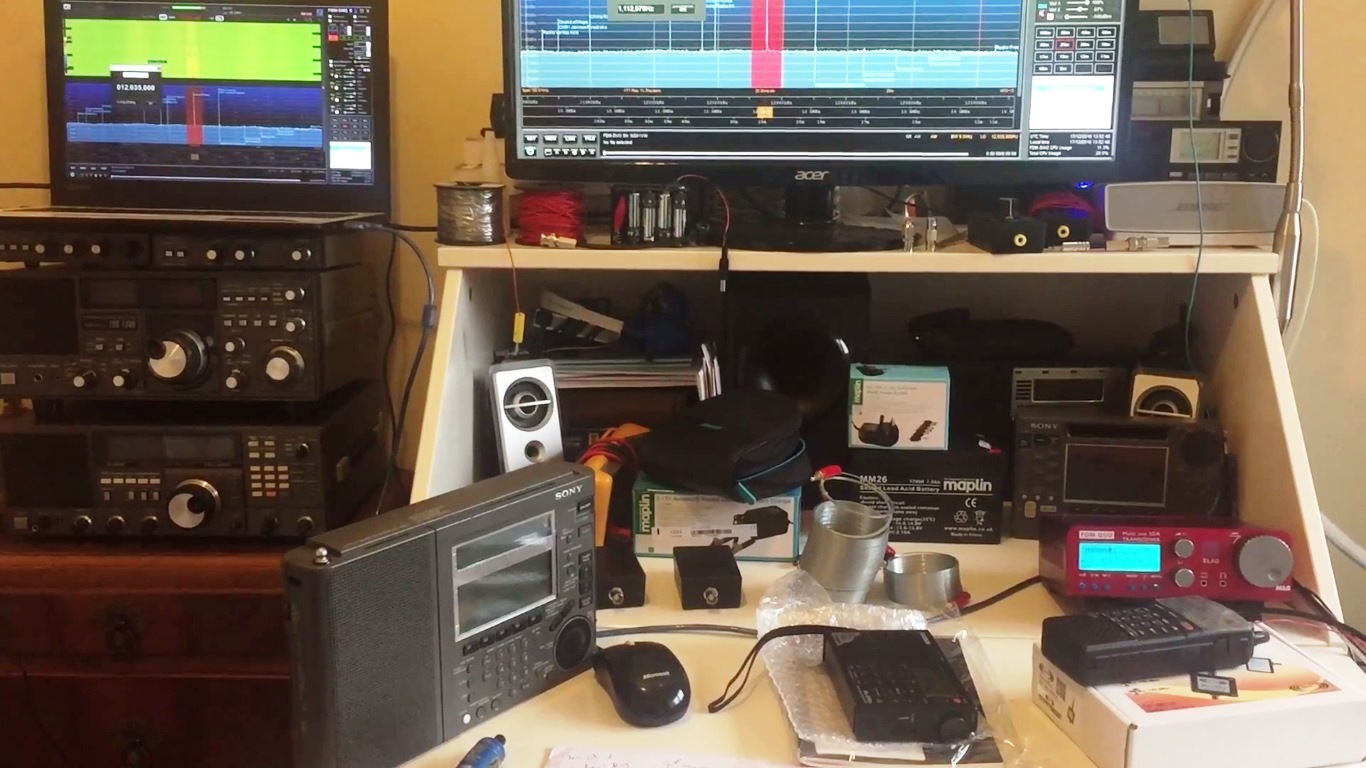
Hi there, I thought I would share a few recent medium wave DX catches from South America. In the past month or so, I’ve managed to record signals from Colombia, Peru, Venezuela and one that I’m particularly happy about – Ecuador, which is rarely reported in Europe. All catches were obtained with my usual indoor home set-up – the brilliant little Elad FDM DUO coupled to the equally brilliant Wellbrook ALA1530 active loop antenna. I have started to take the Elad on DXpeditions now, having constructed a battery pack for it, but the results I’m yielding outdoors are so far mainly with shortwave reception, where the improvement in SNR is quite obvious in the size of the carriers I’m observing and much improved modulation/ audio clarity on the Tropical Band. Hopefully in time, similar results will yield on medium wave. In the meantime, Im very happy with the indoor performance and these catches demonstrate that. There are many more reception videos on my YouTube channel Oxford Shortwave Log, including a large number of signals recorded from North America on medium wave. Direct links follow below and further down, embedded reception videos. Thanks very much for watching, listening and I will you all excellent DX.
Clint Gouveia is the author of this post and a regular contributor to the SWLing Post. Clint actively publishes videos of his shortwave radio excursions on his YouTube channel: Oxford Shortwave Log. Clint is based in Oxfordshire, England.
Please support this website by adding us to your whitelist in your ad blocker. Ads are what helps us bring you premium content! Thank you!