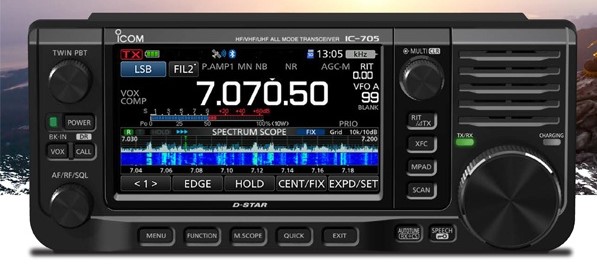
Icom Inc. will begin to ship the IC-705, a new all mode portable transceiver covering HF, VHF and UHF, for the Japan domestic market from the middle of June 2020.
Shipments of the IC-705 for international markets will follow the release of the Japan domestic model.
Timing of availability depends on the schedule of type approvals in each region.
For the latest information about the availability in your country, please contact to your authorized dealer in your country.
Icom Inc. is continuing to effect delivery of the IC-705 in the soonest time possible under the current circumstances caused by COVID-19.
We thank you for your patience.
Category Archives: Ham Radio
Missing Hamvention? Yeah, me too.
If we weren’t all in the midst of a global pandemic, today I would be at the first day of the 2020 Hamvenion in Xenia, OH.
Since I would not be hosting a table for ETOW this year, I was going to Hamvention for the first time on Press credentials. While I absolutely loved hosting the ETOW table with my friends and fellow volunteers, I was certainly looking forward to being a bit of a free agent this year and visiting vendors and friends with no time pressures. This would have also given me much more time to do live postings.
For me, Hamvention is first and foremost an excuse to hang with good friends I only typically see once a year. Between Hamvention and several other associated events like the QRPARCI’s Four Days In May, I connect with hundreds of people. It can be a bit daunting–even draining to this “socially adept” introvert–but I still love it and look forward to it every year.
One of my favorite things to do at Hamvention is to see what new innovations individuals and companies have introduced. As I’ve mentioned before, I love the “mom-and-pop” innovators in our radio community and Hamvention is certainly one of those places where they showcase their goods.
Of course, I love the Hamvention flea market–easily one of the largest outdoor hamfest flea markets in the world. Although I have found some outstanding deals at the Hamvention flea market in the past–like my BC-348-Q ($40) and Panasonic RF-2200 ($70)–I’m more likely to find that obscure rig or accessory I’ve been looking for rather than a proper bargain.
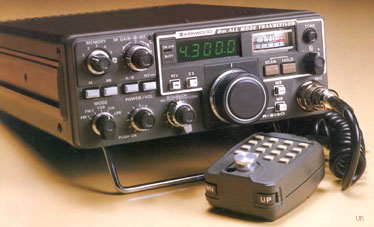
This year, I would have kept my eye out for a Kenwood TR-9000 or TR-9130 VHF transceiver.
I’ve seen the TR-9000 and TR-9130 at past Hamvention flea markets–a near ideal place to locate vintage transceivers like these. (On that note, contact me if you have one you’d like to sell!) 🙂
I would have also been on the lookout for classic shortwave portables, of course, and accessories like enclosures, antennas, Powerpole connectors, coax, ladder line, and wire. Many of these I would only buy new.
2020 might not have been a great flea market year anyway. The weather forecast calls for quite a bit of rain and possibly thunder storms over the weekend. Likely, the flea market grounds would have been a bit wet and muddy thus less vendors would have shown up.
See you next year!
Calling off Hamvention made sense this year. Even if state restrictions would have allowed for a gathering of 30,000 people, I imagine turnout would have been anemic at best. The typical Hamvention attendee also happens to be the target demographic of the Coronavirus. Many would have not wanted to take the risk. I doubt there would have much of any international attendees or vendors there either.
You can bet I’ll be at Hamvention next year and you can bet I’ve already started my shopping list! If the pandemic is no longer an issue, I willing to bet Hamvention might have a record year in 2021. I look forward to finding out in person!
Post readers: Had anyone else planned to attend Hamvention this year?
Radio Waves: Radio Listeners Key to Economy, DXcamp Updates, Coronavirus Hospital Radio, and Hamvention QSO Party
Radio Waves: Stories Making Waves in the World of Radio
Because I keep my ear to the waves, as well as receive many tips from others who do the same, I find myself privy to radio-related stories that might interest SWLing Post readers. To that end: Welcome to the SWLing Post’s Radio Waves, a collection of links to interesting stories making waves in the world of radio. Enjoy!
Many thanks to SWLing Post contributors Dennis Dura, Martin Butera, and Dan Van Hoy for the following tips:
Nielsen: Heavy Radio Listeners Are Key To Restarting U.S. Economy. (Inside Radio)
With 39 states beginning to relax restrictions imposed to diminish the spread of the coronavirus, many Americans are ready to pick up the pieces and get back to their previous lifestyles. An online survey of 1,000 persons aged 18+, conducted from April 30-May 2, found nearly two thirds (63%) say they plan to resume normal activities next month. Conducted by Nielsen, the survey also shows heavy radio listeners are key to driving commerce and supporting the economy since they’re more likely to go out and shop once COVID-19 eases in their market.
Presenting the findings during a client webinar Friday afternoon, Tony Hereau, Nielsen VP of Cross-Platform Insights, summed up the top takeaway succinctly: “AM/FM radio is the soundtrack of America’s re-opening and reemergence.”[…]
Marajo Dxcamp updates
Ivan Dias and Martin Butera inform us about their most recent update on the receptions of the last DXcamp on the Amazonian Island of Marajo, in the north of Brazil.
Interesting medium wave receptions from the following link
https://dxcamp-marajo2019.blogspot.com/p/only-log.htmlBe sure to visit the official website of the Dxcamp, where you will find a lot of material about this important event
https://dxcamp-marajo2019.blogspot.com/
The Tiny Radio Stations That Lift Spirits in Hospitals (NY Times)
LONDON — Last Wednesday, Steve Coulby, a D.J. for Nottingham Hospitals Radio in England, read out a request from a patient battling Covid-19.
“Brian, you’ve given me an awesome responsibly, as you’ve asked for ‘any jazz,’” Mr. Coulby said. “I have to admit,” he added, “what I know about jazz is limited.”
Mr. Coulby then told his listeners he’d spent much of the day searching jazz tracks online, looking for one that might aid Brian’s recovery, or at least lift his mood. He decided on “Let Me Into Your Heart” by the British singer Isaac Waddington.
“I hope it’s good enough, Brian,” Mr. Coulby said, with a nervous laugh. “To be honest, it’s all you’re getting.”
Britain’s hospital radio stations are one of the less well-known features of its health system: tiny operations, staffed by volunteers, that you would never know existed unless you’d been a patient here.
Patients can normally listen to the shows, which are heavy on chart music and old hits, using headphones connected to an entertainment unit beside their beds. In some cases, the shows are even played out of speakers on the wards or in the emergency room waiting area.
The end of hospital radio has been declared many times over in Britain. Some hospital stations have struggled to raise funds, while the rise of smartphones filled with music and radio apps has meant patients have less need for them. But there are still over 200 such stations, according to the Hospital Broadcasting Association, and some claim they have found themselves more useful than ever during the pandemic, providing a human connections to patients who would otherwise be alone.[…]
Hamvention QSO Party Saturday May 16! (Hamvention.org)
Let’s celebrate the many years we have all had at the Great Gathering we call Hamvention. We also want to remember Ron Moorefield W8ILC who never missed a Hamvention and contributed to our club until his recent death.Let’s light up the airwaves with our remembrances of Hamventions of the past! See you on the air! K3LR, Tim Duffy and W8CI, Michael Kalter.
Here is the deal: 12 hour event, 8 a.m. to 8 p.m. EDST on Saturday of Hamvention May 16, 2020. Operate CW or SSB on 160, 80, 40, 20, 15 and 10 meters. The exchange is a signal report and first year you attended Hamvention. If you have never attended Hamvention you send 2020.
Send your score (number of QSOs) to 3830scores.com within 5 days of the event. You can print a certificate on line via www.HVQP.org. More details will appear on the Hamvention QSO Party web site being set up now.
Special bonus: W8BI, the club call of the Dayton Amateur Radio Association (DARA is the host of Hamvention) will be activated by designated DARA members from their home stations. You can add 10 points for each band/mode QSO with W8BI (12 available). So you can earn 120 bonus points (like having 120 additional QSOs).
Do you enjoy the SWLing Post?
Please consider supporting us via Patreon or our Coffee Fund!
Your support makes articles like this one possible. Thank you!
ARRL seeks clarification: Amended Amateur Service RF Safety Rules
Many thanks to SWLing Post contributor, Paul Evans (W4/VP9KF), who has been following the progress of new FCC RF exposure rules and writes:
“The ARRL has finally read the new RF Exposure rules and agrees with my thoughts that they are going to make quite a difference in the way the FCC sees amateur radio levels.”
(Source: ARRL News)
ARRL Seeks Clarification of Amended Amateur Service RF Safety Rules
ARRL has filed a Petition for Clarification addressing two issues arising from amended FCC RF safety rules that go into effect on June 1 for the Amateur Service and other FCC-regulated services. Licensees will have 2 years to determine if an RF safety evaluation is now required under the new rules and to perform an evaluation and implement any needed mitigation measures. Current rules already require amateur stations to meet RF exposure limits, but more radio amateurs will have to evaluate their stations under the new rules. The revised final rules, adopted last November, appeared in the April 1 edition of The Federal Register.
“For applicants and licensees in the Amateur Radio Service, we substitute our general exemption criteria for the specific exemption from routine evaluation based on power alone in §97.13(c)(1) and specify the use of occupational/controlled limits for amateurs where appropriate,” the FCC said. While radio amateurs have always had to comply with RF exposure limits, certain stations have been exempted from having to conduct evaluations based upon power and frequency.
On May 8, ARRL asked the FCC to clarify that using maximum permissible exposure (MPE) limits be permitted in the Amateur Service for required RF safety evaluations of 2200-meter operations, just as they are elsewhere in the amateur spectrum. Removal of the exemption for amateurs resulted in a requirement to use specific absorption rate (SAR) limits for amateur frequencies between 100 and 300 kHz.
“SAR evaluations are very complex to directly measure and, we believe, generally exceed the capability of most individual amateur operators,” ARRL argued in its petition, asserting that MPE limits correspond to conservative estimates of SAR.[…]
Continue reading the full article here.
Paul adds:
“You’ll note that they too were clearly caught out by there being no comment period as stated in December 2019, but the FINAL ruling appeared out of the blue in the Federal Register on April 1, 2020, which took me by surprise (having checked every day for over 90 days!).”
Thank you for following and sharing this development, Paul!
Lockdown Lunacy: QRP EME has now been added to the Social DX bucket list
When my buddy, Pete dives into a project that would have otherwise been placed on the backburner, had it not been for sheltering at home during the Covd-19 pandemic, he calls it an episode of “Lockdown Lunacy.”
Lockdown Lunancy
I don’t think there could be a better name for the bug that has bitten me.
Since my earliest days of reading ham radio magazines–well before I was licensed–I found the concept of EME (Earth-Moon-Earth) communications absolutely fascinating. I mean, communicating with someone across vast distances by bouncing signals off the freaking moon?!?
What’s not to love?
After becoming a ham, the reality set in about how much equipment and financial resources it would take to set up an EME station in 1997. I would need big X/Y/Z steerable antennas, big amplifiers, and very pricey transceivers. Even if I built half the system, I couldn’t imagine piecing it together for less than $3,000 US.
Plus, HF/shortwave signal work was what really pushed me into the world of ham radio. Once I set up my first dipole and started making DX contacts with my Icom IC-735, I never really looked back…that is, until, I met Bill.
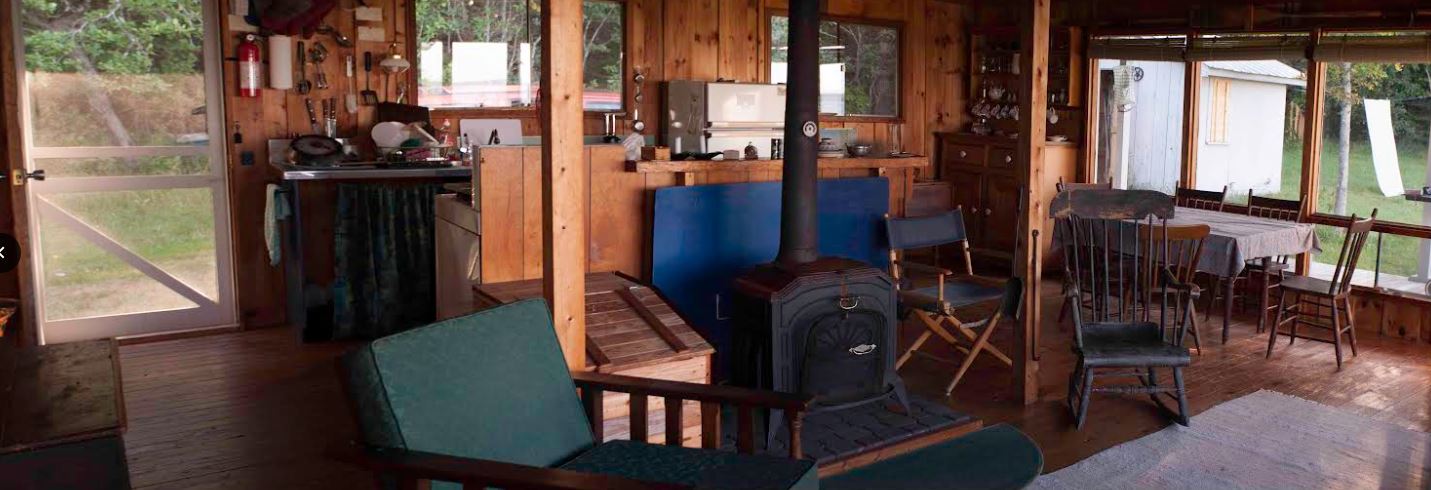
In 2016, my family spent yet another summer on the east coast of Prince Edward Island, Canada, in an off-grid cottage.
I brought along my Elecraft KX3, of course, with a LiFePo external battery and PV panel for charging One day, I hopped on the 17 meter band to work a little DX with a large dipole I’d set up in the trees behind the house. After turning on the rig, I heard a PEI amateur radio operator working another strong station in Europe. As he sent his 73s to the other station, I quickly interrupted and asked where he was located. Turns out, he was only 5 km way as the crow flies! After a quick chat, he invited me over for coffee the next morning and to talk radio.
That next morning I discovered two things about Bill (VY2WM / VY2EME):
Firstly, he’s a coffee snob…just like me. Best coffee I’d ever had on the island.
Secondly, the man had been bitten by the EME bug. Indeed, the mission to build a station to do moon bounce communications is really what energized him to play radio. We spoke at length about EME and it was then I realized that QRP EME was an actual “thing.”
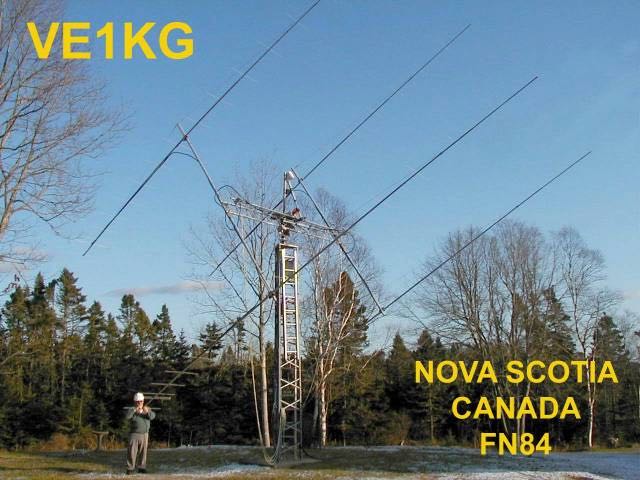
Bill informed me that, with the advent of weak-signal digital modes like JT-65, QRP EME contacts were possible for almost anyone and the investment in equipment, much more modest than in the past. I was truly impressed with how, over the course of a few years, Bill slowly and methodically built his station and started making contacts. Bill gave a lot of credit to his EME Elmer, Serge (VE1KG)–just check out Serge’s big gun station on his QSL card below:
Though Bill didn’t know it at the time, our little talk re-ignited my interest in EME.
Bill and I have kept in touch over the years and only last week, after talking EME a bit more via email, I realized it was time I start my own little QRP EME station.
One thing that pushed me to commit to EME is the fact that both of my daughters are studying for their Technician licenses at present. Both are into all things astronomy and space, so I thought it might be rather fun to give them a chance to play radio off the moon with their Tech licenses!
Like Bill, I plan to take time assembling my QRP EME station. I would like to have all of the components together by December and perhaps start building things like a long yagi and some sort of antenna support by next spring.
I’m facing a big learning curve here. Other than what I learned on my ham radio license prep, I know little to nothing about signals north of 30 MHz!
But that’s the thing about radio in general: I love learning new skills and exploring the world just a little outside my comfort zone!
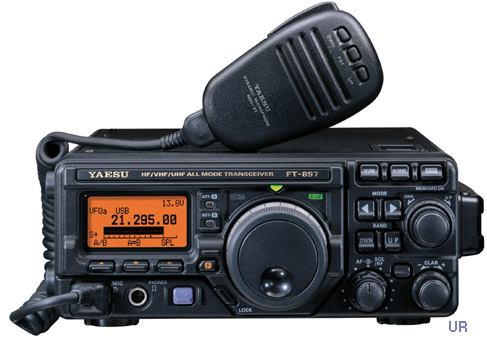
I’m already putting out feelers for a good transceiver (thinking a used Yaesu FT-897 or FT-100D).
How committed am I? A QRP EME station has been officially added to my Social DX bucket list. That’s pretty darn serious!
Post readers: Any EME enthusiasts in our community? If so, please comment with any suggestions you may have as I dive deeper into the world of moon bounce!
Radio Waves: FCC Wipes Out Engineering Division, Last Nazi Message Decoded, Remembering Ronan O’Rahilly, and French Radio Society Free Publications
Radio Waves: Stories Making Waves in the World of Radio
Because I keep my ear to the waves, as well as receive many tips from others who do the same, I find myself privy to radio-related stories that might interest SWLing Post readers. To that end: Welcome to the SWLing Post’s Radio Waves, a collection of links to interesting stories making waves in the world of radio. Enjoy!
Many thanks to SWLing Post contributors Mike, Eric McFadden, and Paul Evans, and for the following tips:
FCC Eliminates Its Own Engineering Division (Radio World)
The Federal Communications Commission has elected to eliminate the Engineering Division at the organization in an effort to, as it says, “streamline the organization of the Media Bureau” as part of the public interest.
The commission plans to fold the work of the Engineering Division into the Media Bureau’s Industry Analysis Division (IAD) due to changes in the duties of the Engineering Division.
“By incorporating the work and staff of the Engineering Division into IAD, we can better ensure that the bureau’s technical expertise is integrated more fully into the bureau’s adjudicatory matters and policy proceedings,” the commission announced on April 29.
Back in 2002, the Engineering Division was established to conduct technical reviews of media-related matters, including overseeing technical compliance of TV and radio broadcast licenses, as well as things like cable regulatory filings and license transfers. But as the industry transitioned from analog to digital and from paper to electronic filing, the Engineering Division’s tasks have diminished.[…]
Last Nazi message intercepted by Bletchley Park revealed (BBC News)
The last German military communications decoded at Bletchley Park in World War Two have been revealed to mark the 75th anniversary of VE Day.
They were broadcast on 7 May 1945 by a military radio network making its final stand in Cuxhaven on Germany’s North Sea coast.
The message reports the arrival of British troops and ends: “Closing down for ever – all the best – goodbye.”
After Germany surrendered, VE Day was declared the next day.
In 1944, this German military radio network, codenamed BROWN, had extended across Europe sending reports about the development of experimental weapons.
But a year later, as the Allies entered the town and closed in on his position, a radio operator at his post signed off to any colleagues who might still be listening.[…]
Remembering ‘Radio Caroline’ Founder Ronan O’Rahilly, A Pioneer Of Pirate Radio (NPR)
NPR’s Scott Simon talks to U.K. broadcaster Johnnie Walker about Ronan O’Rahilly, the founder of the pirate Radio Caroline, who died on April 20 at the age of 79.[…]
French Society makes Radio REF free for April and May
Paul Evans notes that two REF-Radio publications are now free to download via the REF website. If you know French, you’ll enjoy these quality radio publications:
Click here to download REF-Radio (PDFs) for:
Do you enjoy the SWLing Post?
Please consider supporting us via Patreon or our Coffee Fund!
Your support makes articles like this one possible. Thank you!
Build an SDR station and balcony antenna farm for less than 150 Euros
UPDATE 11 May 2020: We recently learned that the MSI.SDR software defined radio dongle in the following post and tutorial is a clone of the SDRplay RSP1 SDR. We did not realize this when the post was published. Grayhat had done research prior to purchase and believed it not to be a clone, but only using the same chipset as the RSP1 (hence the compatibility with SDRuno). We have confirmed that it is indeed a clone now via SDRplay (clear here to read more via the excellent RTL-SDR blog). What follows isn’t an SDR review. Indeed, Grahat’s post has little to do with the receiver and much, much more to do with building proper antennas! We’ve removed links to the MSI.SDR and would encourage you to invest in the excellent SDRplay RSP1a instead (click here to read our RSP1a review). Thank you for understanding!
Many thanks to SWLing Post contributor, Grayhat, who shares the following guest post. He lives in Italy and has been in lock-down since the beginning of the pandemic. He pitched the idea of building an entire SDR setup from scratch–receiver and antennas–for less than 150 Euros (roughly $163 USD). I thought it was a brilliant idea and I believe he thoroughly enjoyed the challenge of sourcing the components and building a mini antenna farm on his balcony while in quarantine:
From Zero to SDR
by Grayhat
What follows doesn’t pretend to be some kind of “definitive guide” or “last word”, on the contrary, it’s aimed at people who have little or no experience with SDR but want to try putting together a decent station without paying an arm and a leg.
The idea of writing this came to me after reading a number of messages and discussions on various online groups/forums, in a lot of cases, someone bought an SDR (usually the ones coming with a telescopic whip antenna), and after connecting it was expecting it “just to work” or, better said, pretending that the SDR connected to that whip (usually placed on a table right near the computer) could receive ANY POSSIBLE signal, including transmissions coming from the “dark side of the moon.” 🙂 Those folks got scared by the fact that the SDR “didn’t work” and decided to give up; now, this short “guide” should allow anyone to setup what’s needed to have a working SDR
My self-imposed limitations for this project/experiment were the following:
- The whole setup shouldn’t cost more than 150 Euros so that, if after trying the SDR one doesn’t like it, (s)he won’t have paid $$$, otherwise, if (s)he decides to keep it, the resulting station will allow for further expansion/improvement
- The available space was considered to be that of an apartment, that is, no large field to put up huge wire antennas or to raise towers, the limit was the one of a balcony (in my home) that is 8 meters (max antenna length) by 3 meters (available height) by 2 meters (balcony width)
- The whole setup should be simple and straightforward, no need to solder components or to build special types of antennas
- Given the current Covid-19 sheltering, most components should be available online, while for others one may arrange with whatever is locally available (e.g. duct tape)
With the above limitations in mind, I took pencil, paper and rubber eraser (high-tech instruments, indeed) and started writing down a list of the needed stuff, after some writing, wiping and second thought, I came out with the following list, available on Amazon:
Bill of materials
- Insulated wire (100mt x 2.5mm)
- Paracord (100mt x 3mm)
- Nylon cable tiers (100 pcs x 2.5mm x 100 mm)
- Waterproof electrical junction box
- NooElec Balun 1:9 V2
- iChoose Ltd RG58+BNC coax, 15mts
- BNC female to SMA male adapter (2 pcs)
- Snap-on ferrite chokes for 9mm cables (10 pcs)
- MSI.SDR 12 bit ADC was used for this experiment before realizing it is a clone of the SDRplay RSP1. We recommend the RSP1a as an upgrade.
The above includes all the needed stuff to put together a number of wire antennas (random wire, random dipole, loop…) the coax to connect the SDR, a balun to match the coax to the antenna and the accessory parts needed to put up the antenna. The selected SDR isn’t the common “RTL SDR” type, not that they don’t work, but their 8 bit ADC is far from being a good performer, so I decided to pick a different SDR which offers a 12 bits ADC and which also “presents itself” to the system as an SDRplay RSP1.
[Please note: we’ve since learned from SDRplay that the MSI.SDR is indeed a clone of the SDRplay RSP1. Here’s a post from the RTL-SDR blog confirming this. We recommend purchasing the RSP1a as a better alternative.]
Anyhow; all I can say is that after some tests, the MSI.SDR is a quite good unit and offers quite a lot of bangs for the buck, so I believe it may be a good unit for people willing to get their feet wet with SDRs
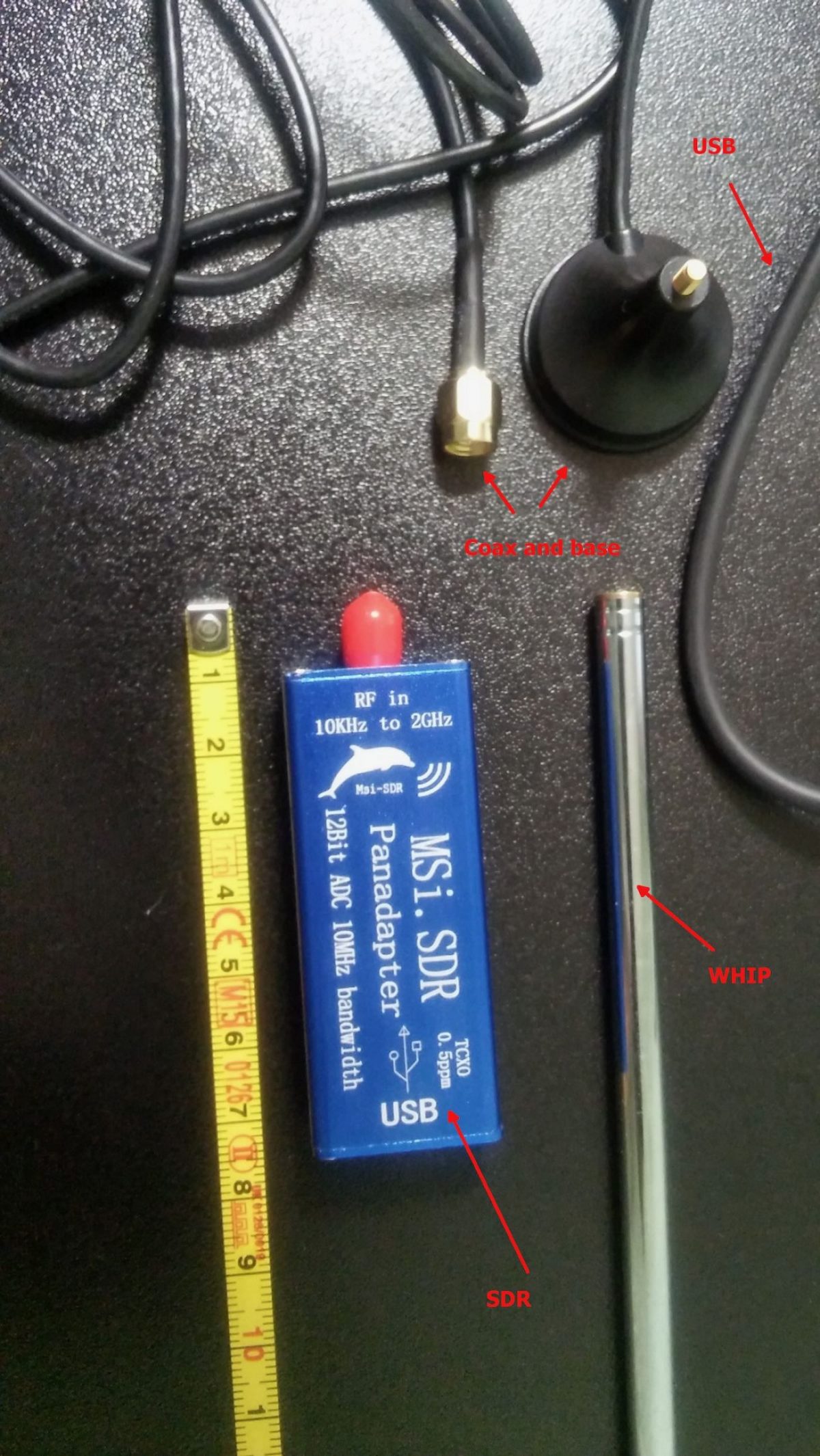
The above being said, here’s a pic of the MSI.SDR unit with the included stuff:
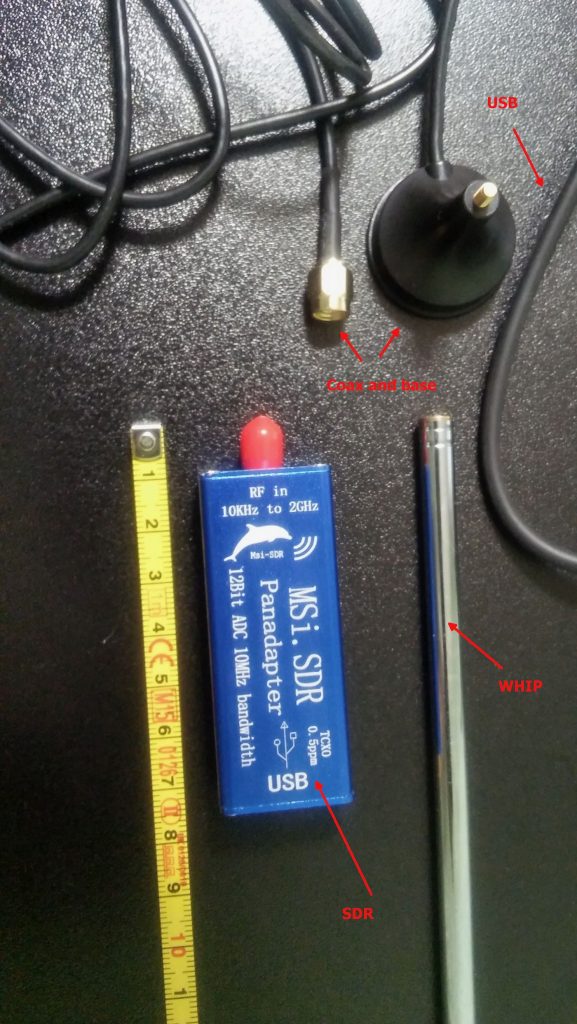
The unit is very small and the box has two connectors, an SMA for the antenna and a micro-USB (like the ones used in cellphones) for the USB cable which is used to both power and control it; the other bits are the telescopic whip antenna (around 98cm fully extended) with a magnetic base and a short run of coax, and the USB cable.
Once I got the SDR I decided to give the included whip antenna a try… well, to be clear, while it will allow you to pick up some strong local FM stations and maybe a bit else, it will only be useful to test if the SDR unit is working (before putting together our antenna), so don’t expect to receive much with that whip, yet… don’t throw it away, it may become useful (more later).
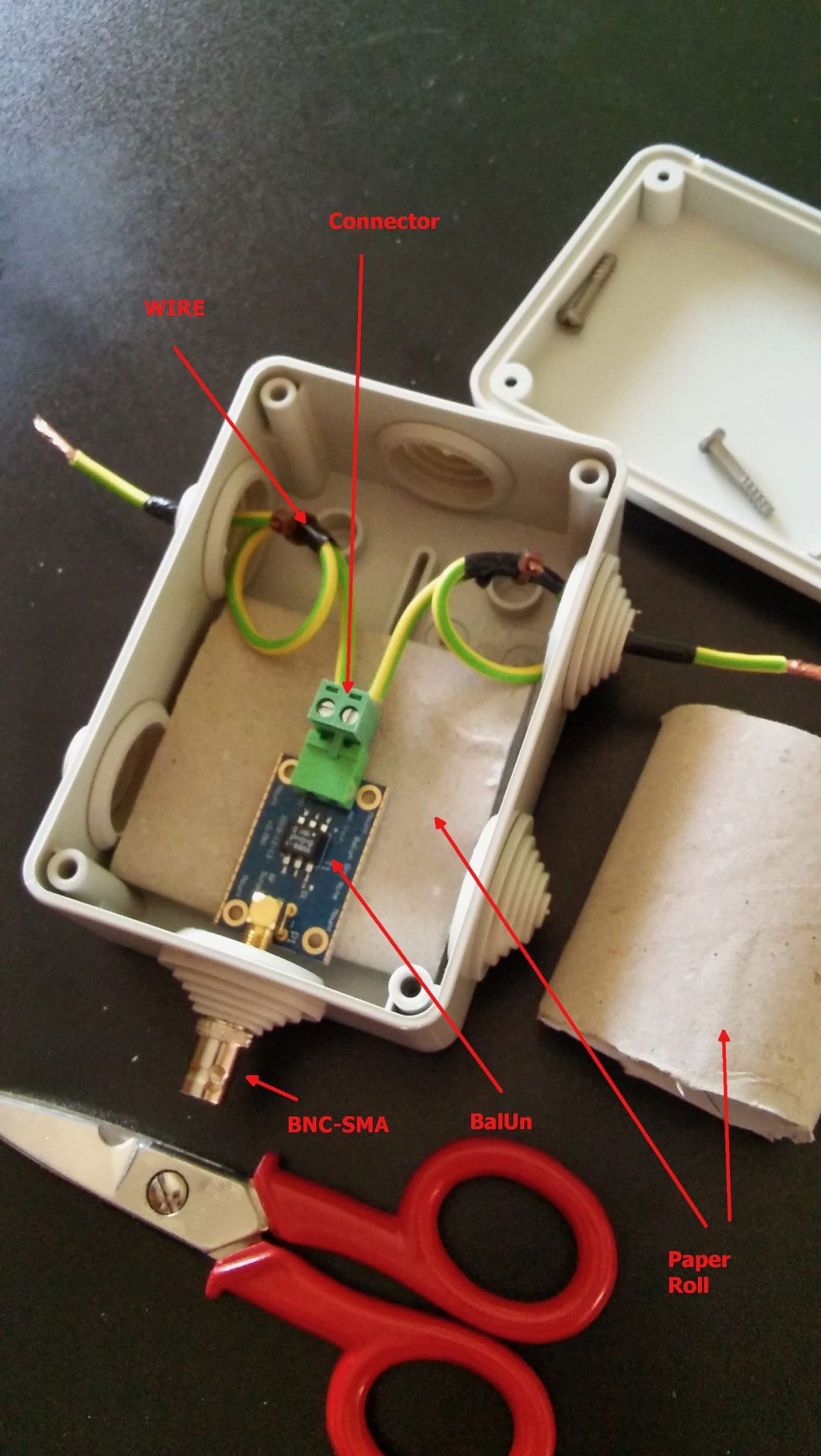
The other important piece is the BalUn. I picked a NooElec “Nine to One” v2, since I’ve used their v1 model and I’ve found it to work well, I decided to pick the newest model which has a better antenna wire connector. The BalUn, which is in effect a so-called “transformer balun” is really small and the junction box I bought is much bigger, but it isn’t a problem. All in all, the box may host a preamplifier in the future, but for the moment it’s fine for the balun. The following pic shows the balun “installed” inside the junction box:
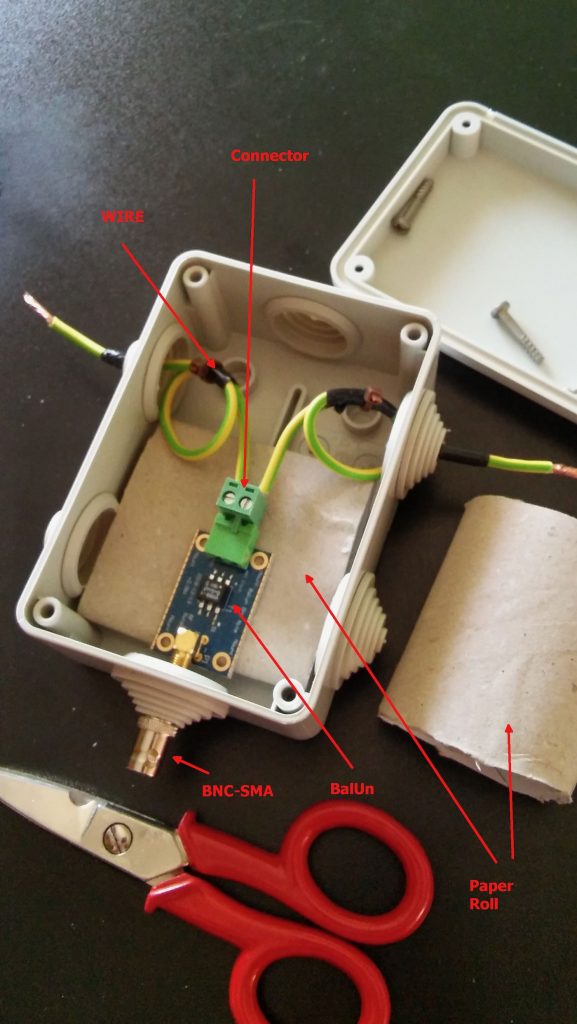
The scissors are there to give you an idea of the sizes; to put together the whole thing, I started by preparing two pieces of wire (the 2.5mm one), made a turn with each wire and locked them with a nylon cable tier. Those turns will prevent the wire from sliding out and putting a strain on the balun connector. I did that since I didn’t have plastic washers at hand, otherwise you may just slide two plastic washers (or proper diameter) over the wires and use two nylon tiers to lock them. In either case, the idea is that the “loops” or the washers won’t slide through the box holes and will support that (little bit of) strain caused by the wire connection.
Next, I stripped some of the insulation from the ends and connected the wires to one of the balun connectors (I chose the one in the pic since I believe it’s the most suitable for this setup), at that point I continued cutting the smaller “ring” of the box insulation caps (the two at top and the bottom one). Then I placed a piece of carboard roll (from a kitchen-paper roll) at the bottom to serve as a support (you can see it below the balun). At that point, I slid the balun SMA connector through the bottom hole and used the SMA to BNC adapter to hold it, done so I slid the two wires (connected to the green wire connector) through the side hole and then inserted the connector into the balun. I then placed the other piece of paper roll above the balun and closed the box with its cap. As a note, to properly close it, start by inserting the screw into the cap holes till end, so that they’ll extrude from the bottom, then place the cap over the box and tighten the screws–you may need to use some force to properly tighten it.
Notice that the wire shown in the pic are SHORT, later on I replaced them with longer wires (outside the box) to be able to better connect the balun box to the antenna, but the remainder of the build is the same.
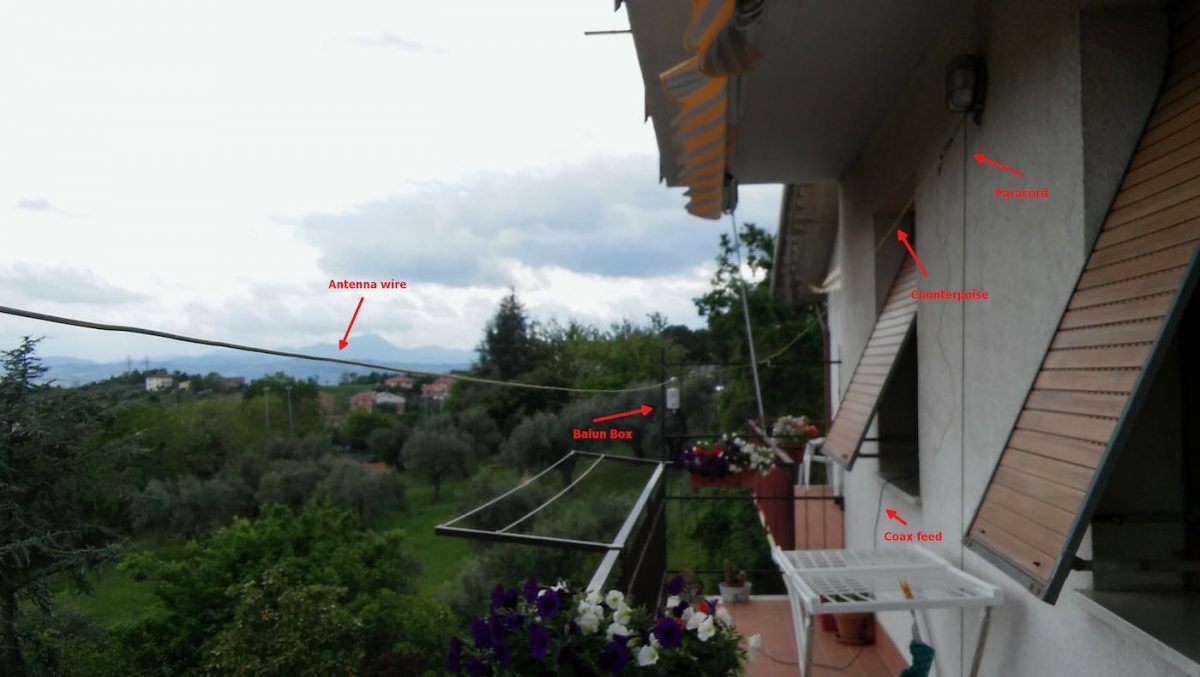
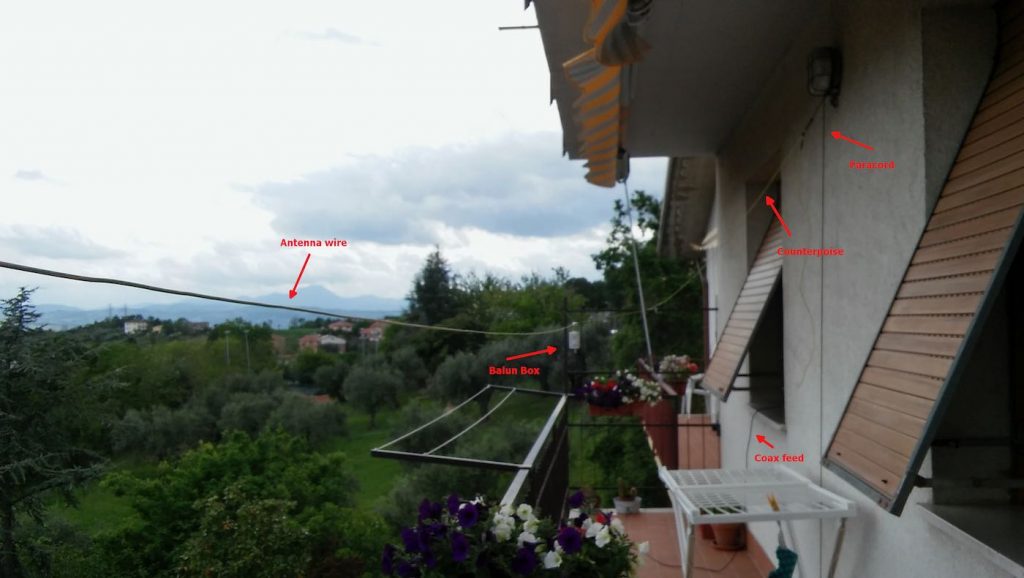
Now that I had my “balun box” ready, I measured the antenna wire and, using the paracord and some nylon tiers, I installed it. I also installed the “counterpoise” wire. For the latter, at first I tried just connecting the remainder of wire to the “gnd” of the balun, leaving the spool laying on the floor, but later on I decided to hang up the counterpoise and the final result was the following:
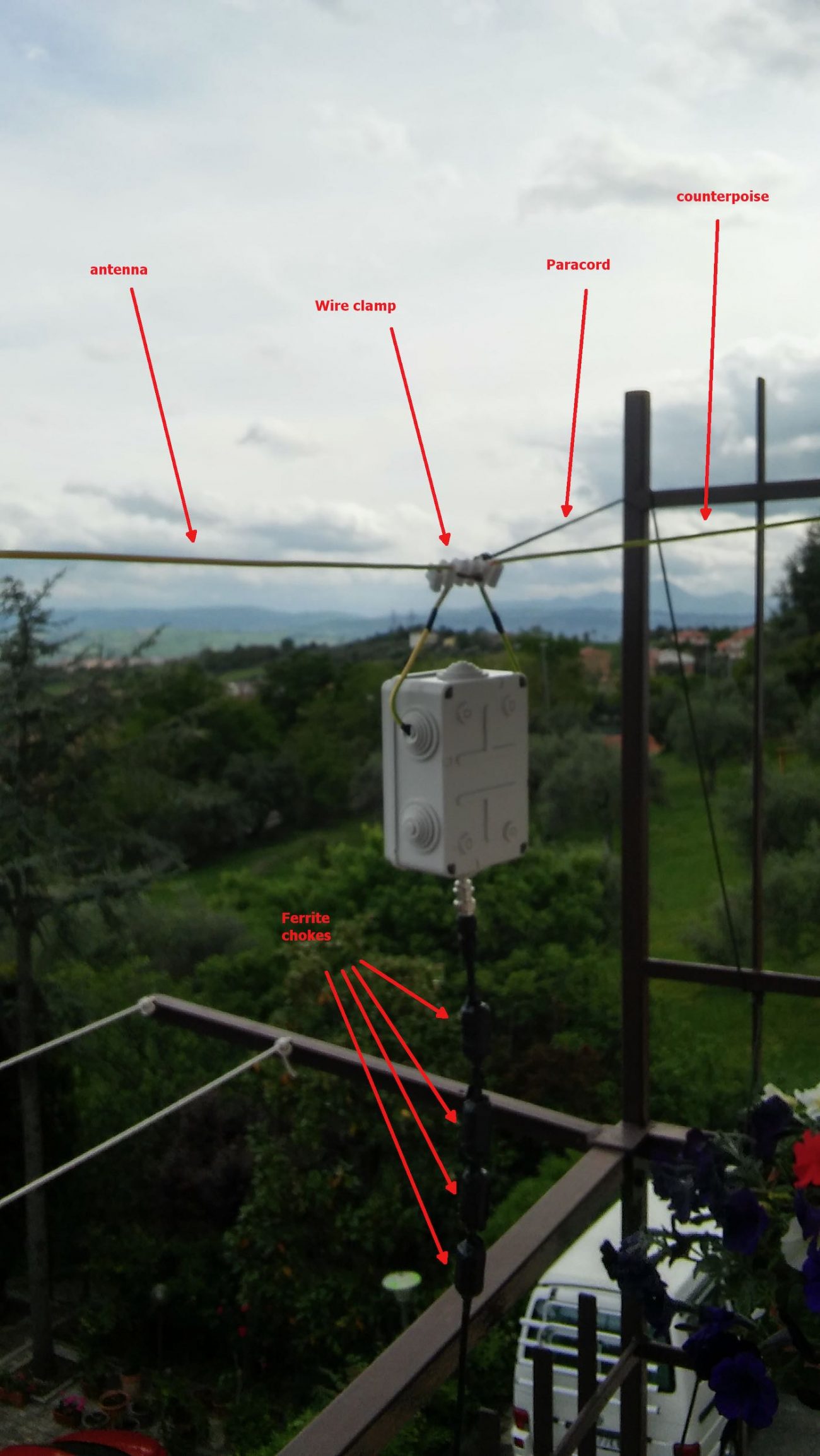
Not a work of art, but then since I was experimenting, I decided not to add PTFE and tape to allow me to quickly rearrange the antenna to run other configurations, yet, the whole setup worked quite well and stood fine to some wind and rain, the picture below shows the balun box with the antenna/counterpoise wires and the coax with the snap-on ferrite chokes.
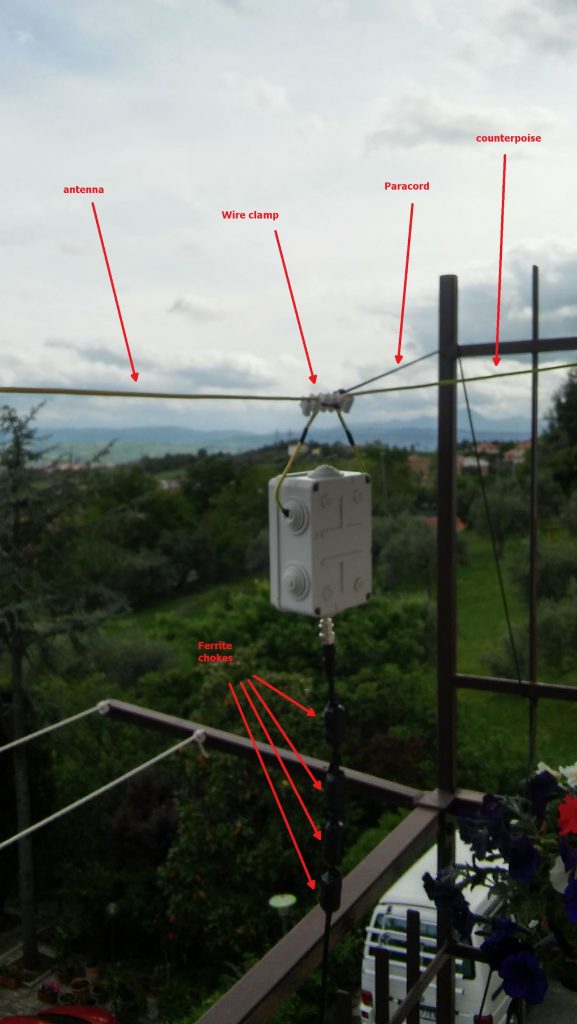
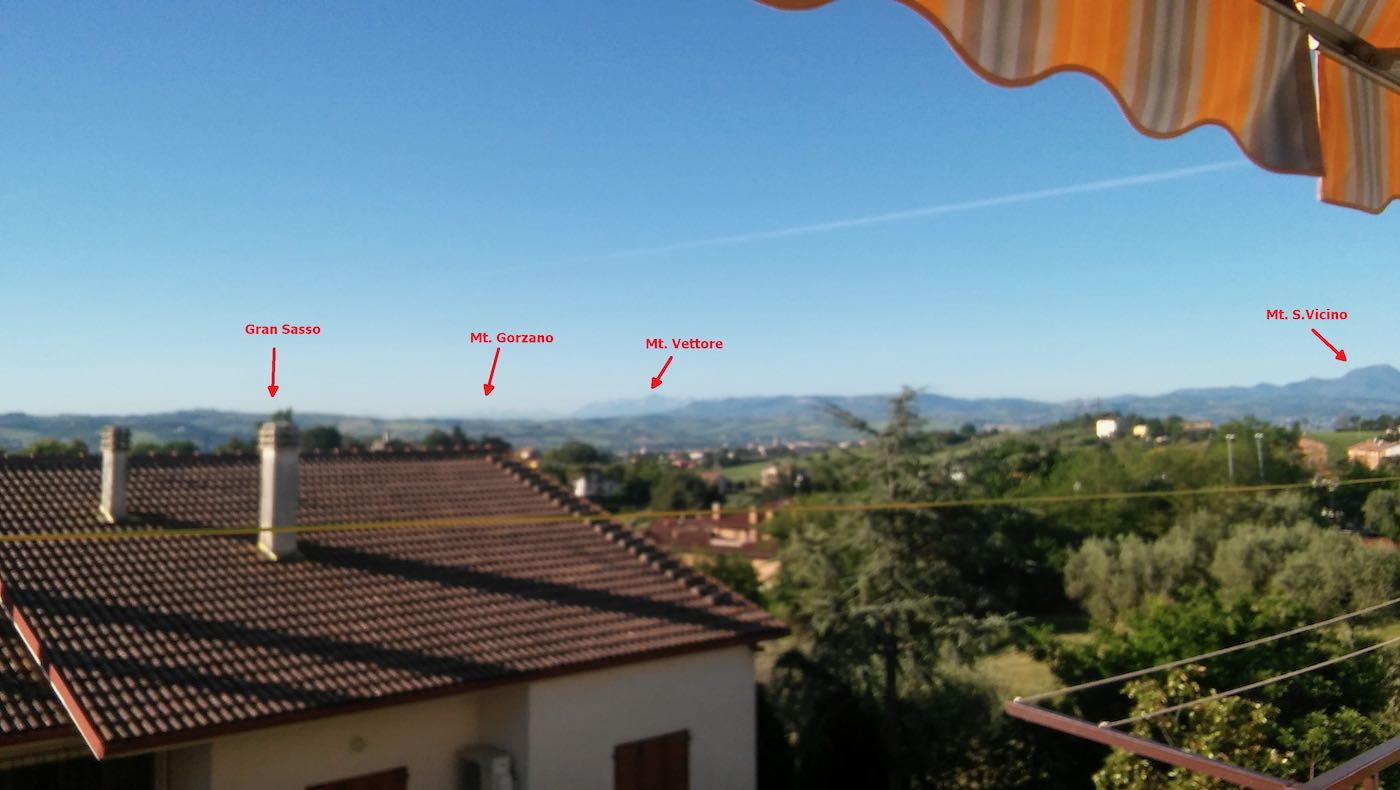
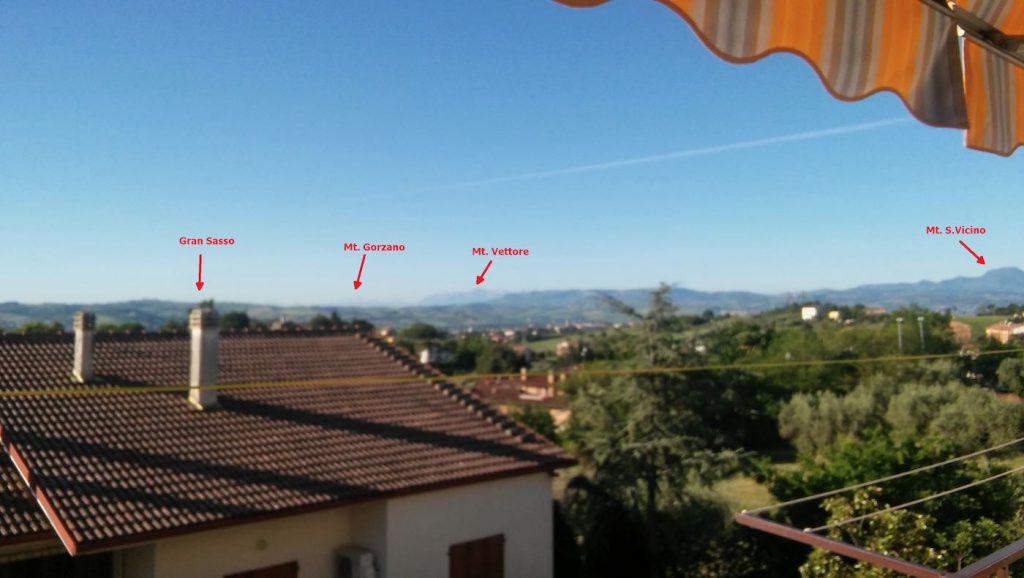
Notice that to avoid putting strain on the balun wires, I used a wire clamp I had in my junkbox–the clamp is then tied to the paracord using a nylon tier and the paracord holds the assembly and keeps the antenna wire in position. The ferrite chokes aren’t properly seated, and I’m planning to remove and re-place them, but for the moment they’re okay. The balcony faces to south/south-west so the antenna has a free horizon of about 270 degrees ranging from the Adriatic coast to the Appennines (Mt. S.Vicino can be seen behind the paracord)–not bad. Here’s another pic showing the horizon to West, just to give you an idea:
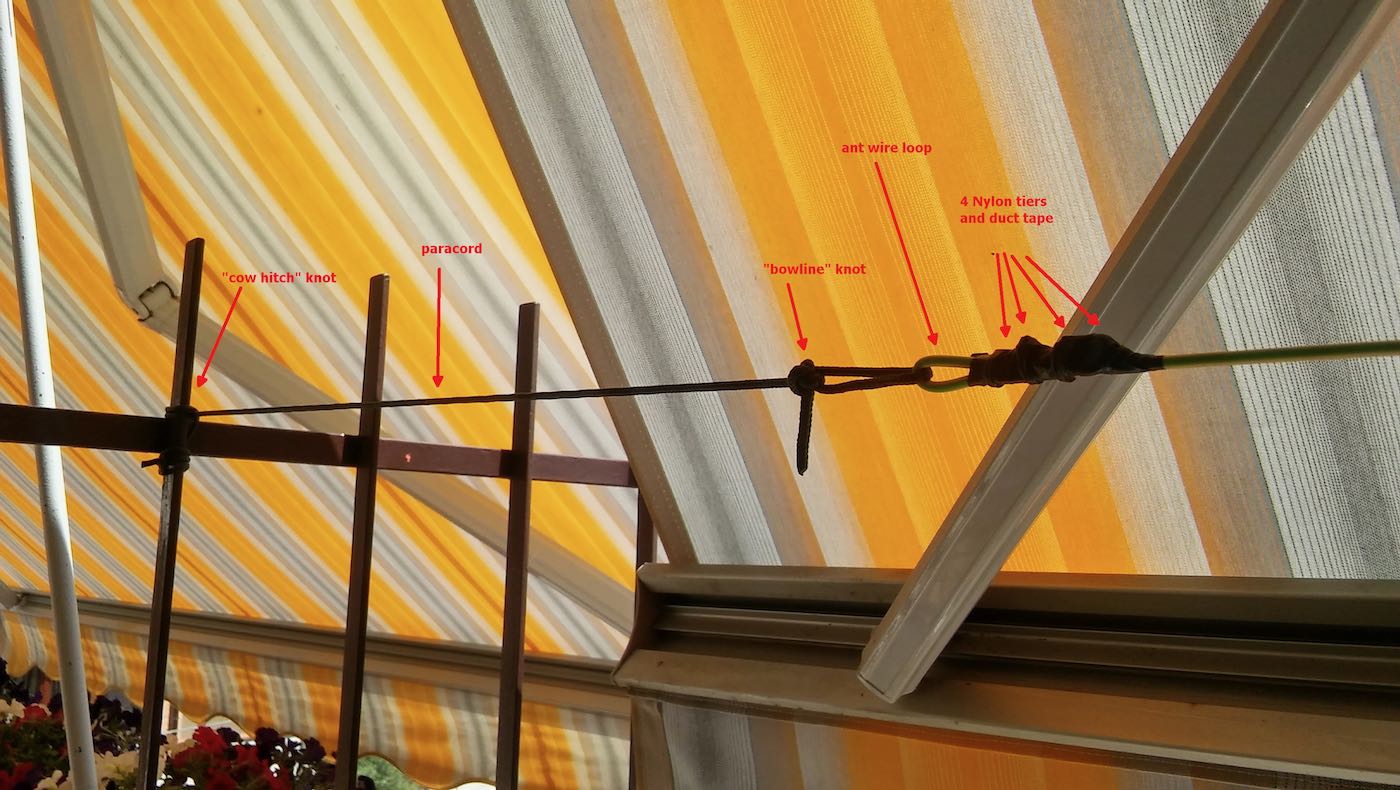
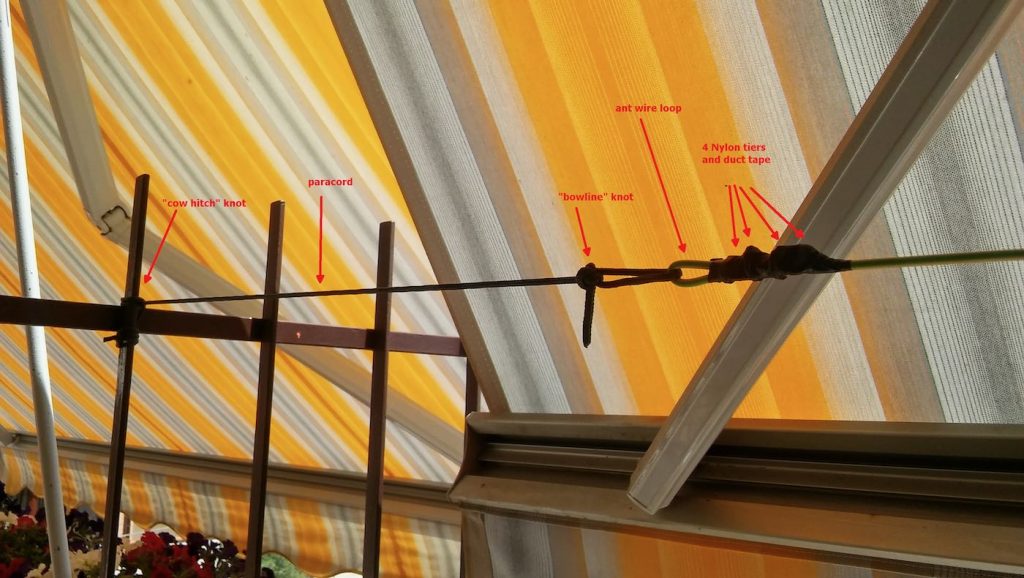
Getting back to the antenna installation, the other end of the antenna wire is tied to the opposite side of the balcony as shown below (let aside the tent/awning, I raise them when using the SDR, also, the bowline knot isn’t correct, I’ll need to tie that again):
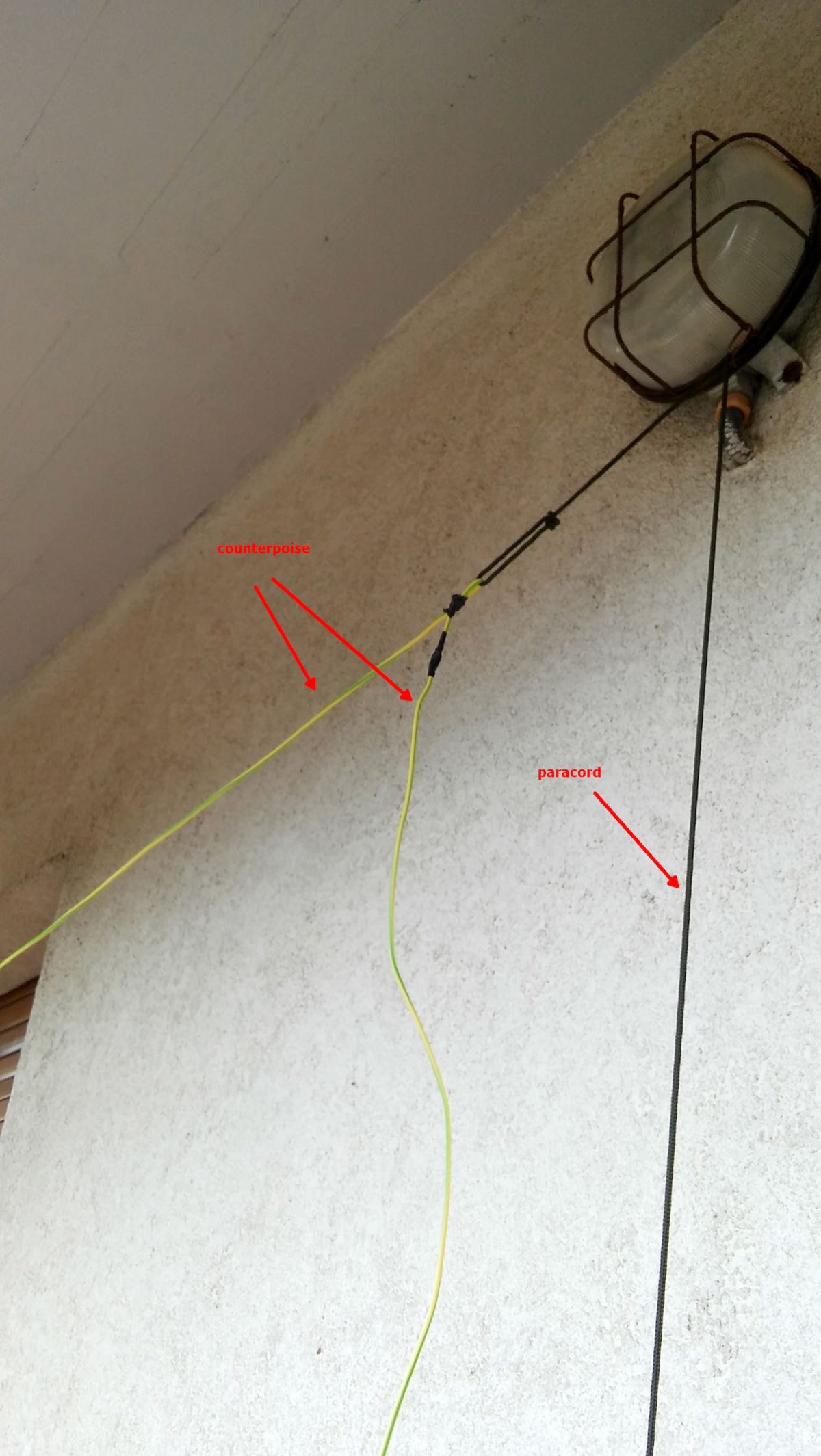
The counterpoise instead is supported by a lamp I’ve on the terrace, here’s it’s setup:
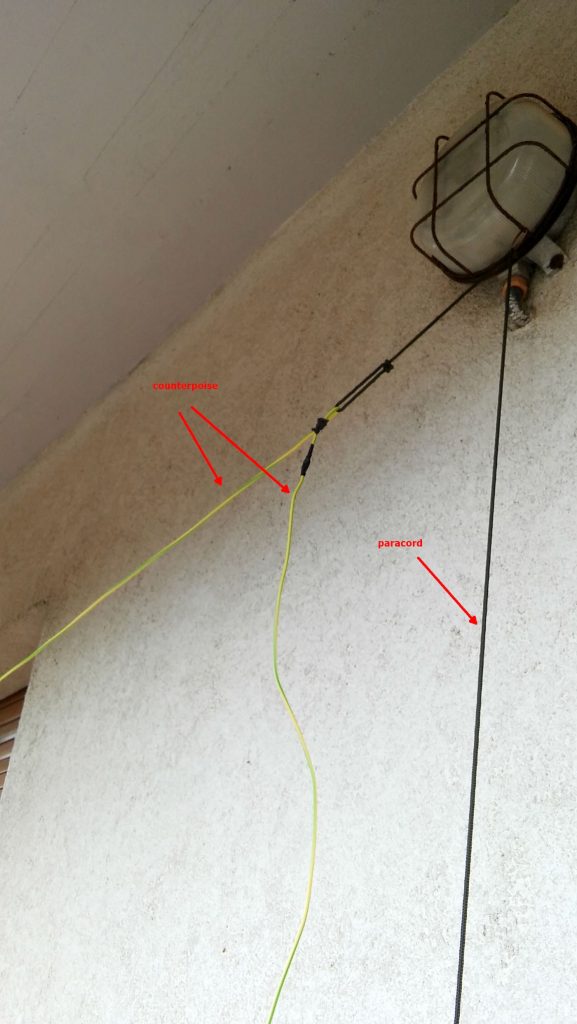
The “paracord” goes down to a plastic bottle filled with a water/chlorine mixture which serves to keep it in place. The remainder of the wire is just hanging down for about 1.5 meters (the counterpoise is shorter than the antenna wire, it’s about 2/3 of its length).
Ok, time to put the antenna and SDR to test, so I brought the coax inside home, connected the other SMA to BNC adapter to the SDR and connected the coax going to the antenna. Note that 15 meters of coax is enough for me, but if one wants a length of up to 25 mt, it won’t be a problem.
I already installed the SDR software, in my case since the unit identifies itself as an “SDR1” I downloaded the SDRPlay “SDRuno” software https://sdrplay.com/windl2.php and since I was at it I also downloaded the PDF manual https://www.sdrplay.com/downloads/ and the “CookBook” http://www.nn4f.com/SDRuno-cookbook.pdf and I heartly recommend reading and digesting them before starting the whole thing (while you wait for all the stuff to be delivered). An important note is that you MUST install the SDRuno software BEFORE connecting the SDR since that way, the SDRuno setup will install the proper drivers and you won’t have issues.
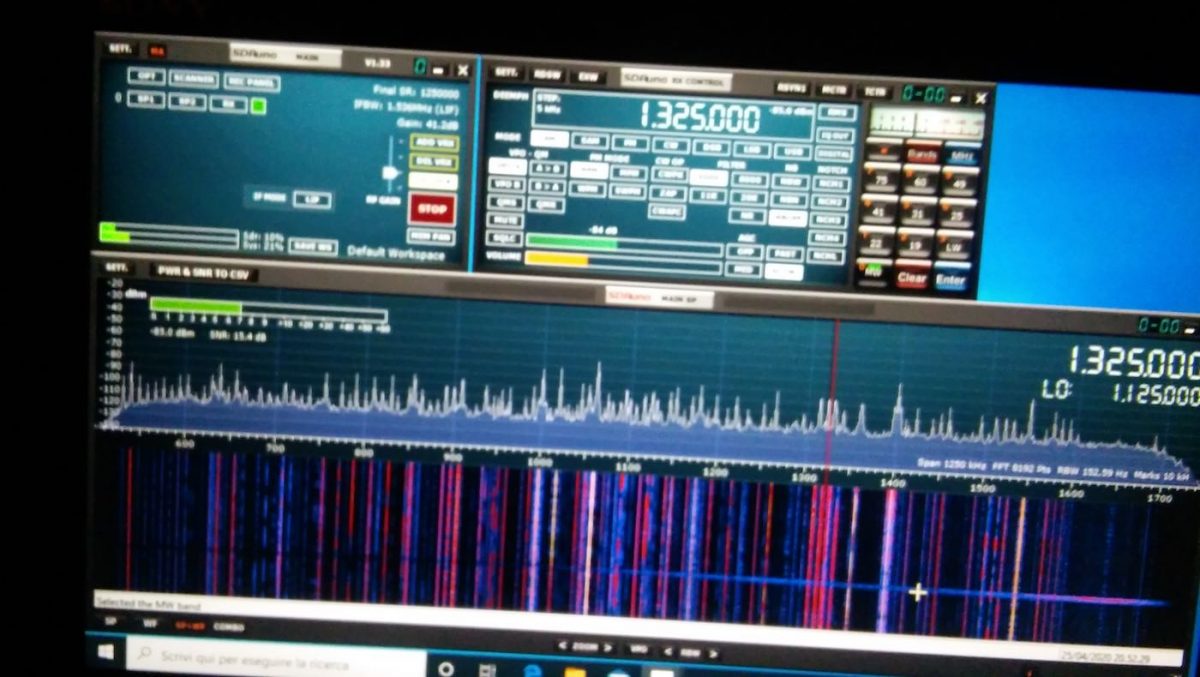
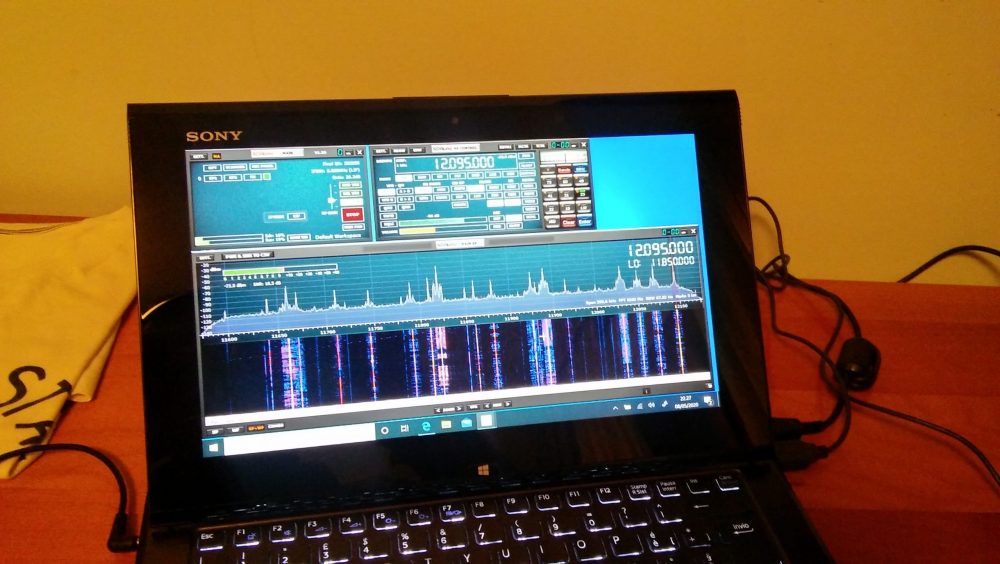
Anyhow, I connected the coax to the SDR and then it was time to fire up the whole thing and give it a spin; so I powered up the laptop (technically, a “transformable” laptop/tablet), started SDRuno, opened the “RX control” and “Main Spectrum” windows and then clicked the “play” button, clicked the “broadcast” band, and the “MW” one and got this:
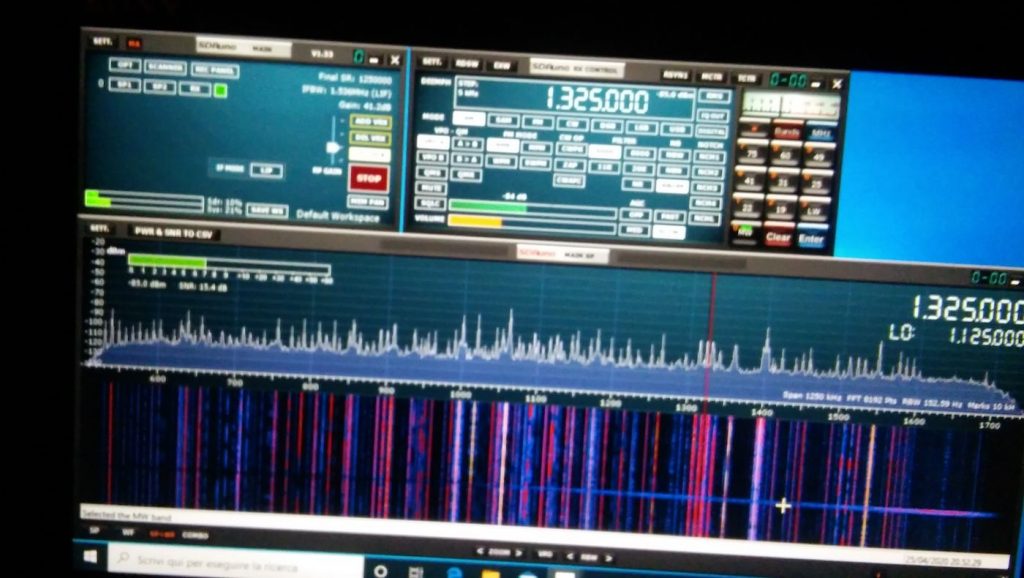
Not exceptional maybe, but not bad, either; in particular if one considers that it’s from a quite short piece of wire which isn’t exactly placed in an ideal position.
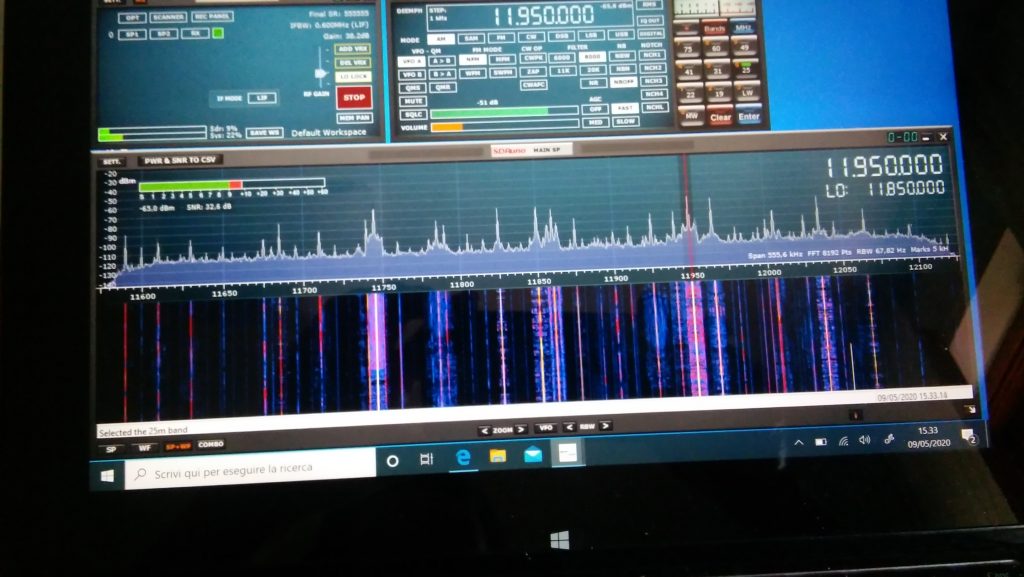
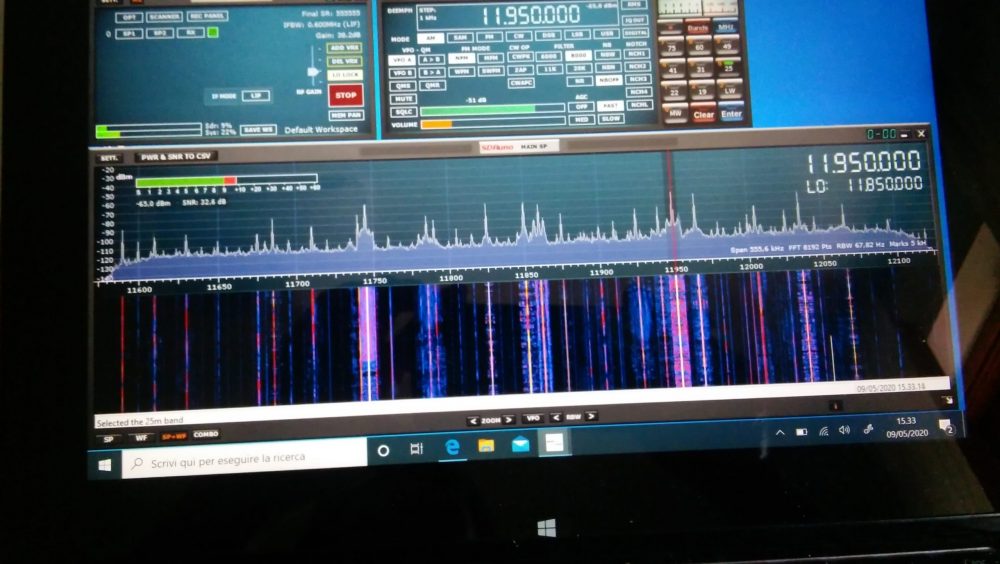
So I went on and explored the bands a bit. On ham bands the SDR picked up signals from the whole mediterranean basin (Cyprus, Lebanon, Spain and then some) and from north too (Russia, Germany, Denmark); then depending on time, I was able to clearly receive broadcasts from China, South America, Africa and more ham QSOs from a lot of places.
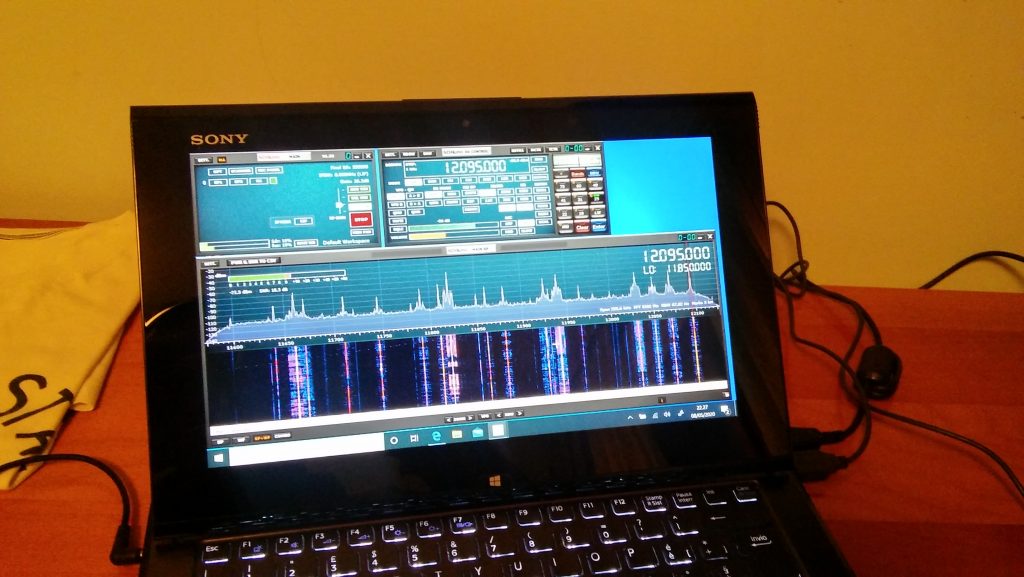
I must admit I didn’ record the callsigns or stations identifiers (“guilty” your honor–!) but I was more focused on testing the SDR and antenna than running a “DX session” at any rate. On the BCB bands I picked up WWV, BBC, VoA, China Radio International, Radio Free Asia, Radio Romania and a bunch of others from Middle East, Asia, Africa and South America. While on the ham bands, I was able to pick up some quite interesting QSOs and then… well, I went hunting for higher frequencies signals!
I got Police, Ambulances, Air control…so even if that “piece of wire” isn’t optimized for VHF/UHF it seems to be working decently there too. By the way, when changing bands you may (and probably will) need to adjust the gain control, but that will be almost the only thing needed to pull in signals
At the end of the day, I can say that I’m quite pleased with the performance offered by this simple and cheap setup. For less than 150 euros you have everything you need, not just the SDR.
Sure, the setup may be improved, but then again you’ll have all of the basic parts, so you won’t need too much. For example, if you live in a really noisy environment, it would be a good idea to use a loop antenna. You would only need a “cross shaped” support (PVC pipes or wood will do). You could quickly put together the SRL (Small Receiving Loop) designed by Matt Roberts (KK5JY) http://www.kk5jy.net/rx-loop/ the balun will be the SAME (yes, no need to wind whatsoever!) so building it will just be a matter of assembling a cross shaped support for the wire (which we already have because it’s the same used for the wire antenna) and you’ll have it. While I already tried the SRL, I didn’t build one to test with this SDR, but I’ll probably do that as soon as SWMBO will start complaining about those “wires on the balcony.”
Also, at the beginning I wrote “more later” when writing about the telescopic whip included with the SDR. Here’s the idea–it requires soldering, so if you don’t want that, skip this: remove the adhesive sheet on the bottom of the antenna base to expose the bottom cap and then remove (extract) the bottom cap. You’ll see a magnetic ring and a “bell shaped” piece of metal (the “ground” for the whip). In the middle of the “bell” there will be the antenna connector which is soldered to the coax wire with a nut holding the connector (and the “bell”) in place. De-solder the coax, unscrew the antenna connector and extract it, at that point you’ll have the telescopic whip and its connector, now you may use them to build the active “whip” antenna described here:
http://www.techlib.com/electronics/antennas.html#Improved%20Active%20Antenna
Notice that it is NOT the “usual” active whip–the circuitry and idea behind it is totally different–yet it works fine and will serve you from VLF (not kidding) up to around 100MHz. It might be a good companion for the SDR. It won’t be as quiet as the loop, yet it may be a valid “all rounder.”
To conclude, I believe that the setup described above is something anyone can afford. You don’t need to be an engineer or to have special knowledge or abilities–it’s just a matter of putting together some bits and pieces.
Obviously, this setup doesn’t require a large space and offers good performance across the bands. Plus it’s so easy to improve since the 12bit SDR is a good starting point
All the best everyone and STAY HOME, STAY SAFE !
Thank you so much, Grayhat!
I love the fact that you invested (however modestly) in a proper antenna setup to better serve you rather than relying on the basic whip antenna that comes with the SDR. You’re right: too often, we invest a receiver, yet invest no money or time into building an appropriate antenna. The antenna is the most important component in a proper radio setup and those included telescoping whip antennas simply don’t perform well on the HF bands.
Based on our correspondence, I know you had fun piecing together this little system using a simple bill of materials and items you had on hand during the Covid-19 quarantine. Thank you for sharing it here with your SWLing Post community!