Category Archives: Radios

Ken points out where Melson series derived design

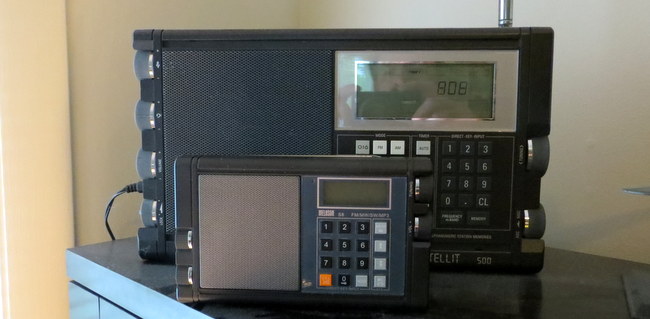
Melson and Grundig Satellit 500

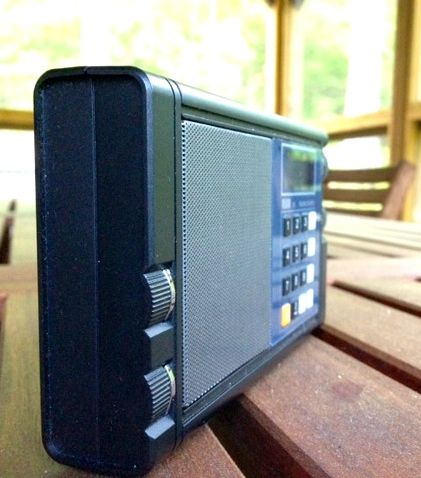
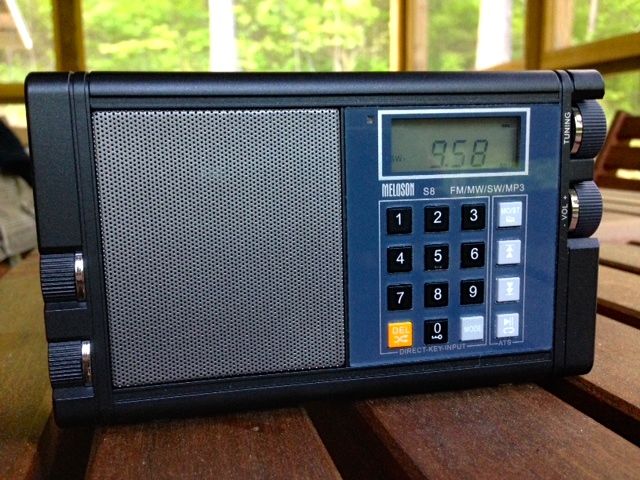
The knobs on the left side of the Melson M7 and S8 are fake.

SWLing Post reader, Ken, commented that the “faux” knobs on the Melson S8 were derived from the Grundig Satellit 500.

Ken has taken a photo of the two radios together (above).

Note that the knobs on the left side of the Melson S8 are fake (right).

Read the Melson S8 review, posted yesterday, by clicking here.

A review of the Melson S8 shortwave radio

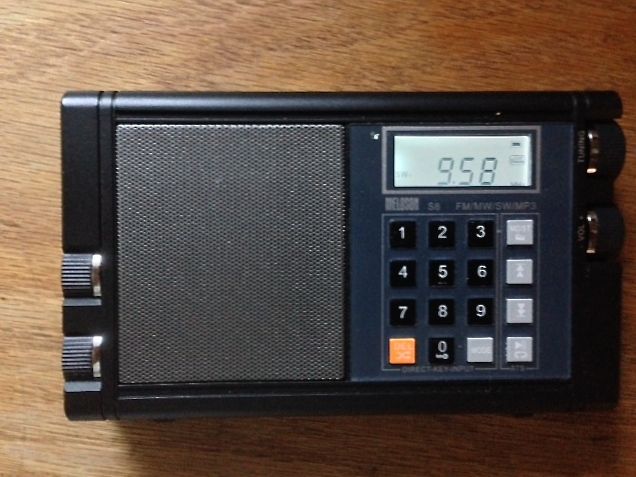
Melson-S8-v1The radio manufacturer, Melson, caught my attention a couple of years ago when it released the Melson M7–an AM/FM radio with a built-in MicroSD MP3 player. It wasn’t that an AM/FM/MP3 combo radio was that unique or novel, rather, what impressed me most was that the M7 delivered unexpectedly robust audio from its built-in speaker. I purchased an M7 last year and found that the little portable could easily fill the average-sized room with clear, rich audio, a truly superlative feature.

Other than its audio, however, the radio was fairly standard. My Melson M7 had good AM (medium wave) and FM sensitivity–well, at least on par with most other DSP portables in its price range. While the built-in MP3 player was basic, it was simple to use and functional. I loaded it with a MicroSD card filled with music and recordings, and put it to use as a mini-juke box of sorts. I didn’t expect more from that radio, or from its line.

Introducing the Melson S8

Melson-S8-1

The Melson S8 sports the same “faux knobs” of the Melson M7

But when I discovered that the newest portable in the Melson line, the Melson S8, could receive shortwave radio, I ordered one immediately. This time, I didn’t have the radio in mind for personal use; I hoped it might serve our non-profit, Ears To Our World. At ETOW, we take information-delivery devices into parts of the world that currently lack access to the Internet. Shortwave radio is our usual medium, and most recently, we’ve put into service pre-recorded content loaded onto MicroSD cards–a simple way to give school children months of educational and musical programming. I had hoped the S8 might just support this need.

Overview

The Melson S8 resembles its sibling, the Melson M7, in every respect–down to the quirky “faux knobs” on the left side of the radio. Overall, the chassis feels sturdy and the buttons have a tactile response, with enough resistance to keep them from becoming accidentally pressed when, for example, the radio is packed in a suitcase. For shortwave and FM listening, the built-in antenna is rather short but sturdy.

Fortunately, the S8 also sports that amazing speaker found in the M7–a speaker that uses an acoustic chamber to achieve excellent audio. Since the S8 also has an AUX-in jack, it can be plugged into a laptop’s headphone jack, reinventing the S8 as an amplified portable speaker.

Melson-S8-v4

The S8 has a small digital display with backlighting that turns on or off depending upon the lighting level. For example, if it’s outside in the sun, the photosensor will turn off the blue backlighting.

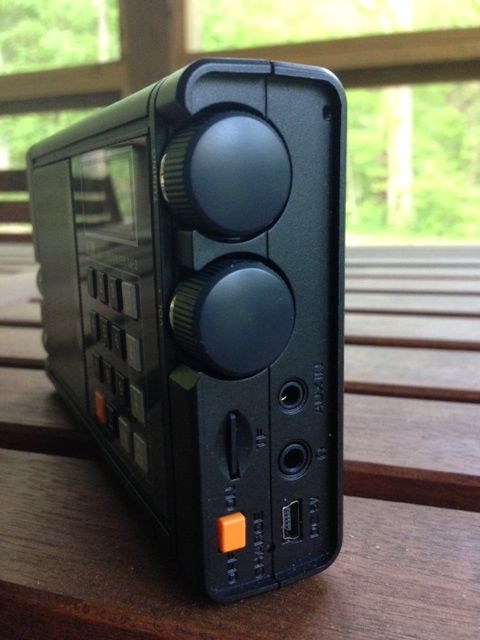
The controls are on the right side of the radio: the tuning knob, volume control, power button, MicroSD card slot, DC power input (mini USB), headphone jack, and AUX-in.

Both the tuning and volume knobs work smoothly, but don’t feel quite as sturdy as I would like. I’m not sure how well they would hold up to years of daily use. When turning the tuning knob, the action is not seamless; you’ll detect slight incremental “bumps” or pauses that coincide with the receiver’s tuning steps on any given band. The volume control, however, is smooth, much as one would expect of a traditional analog radio.

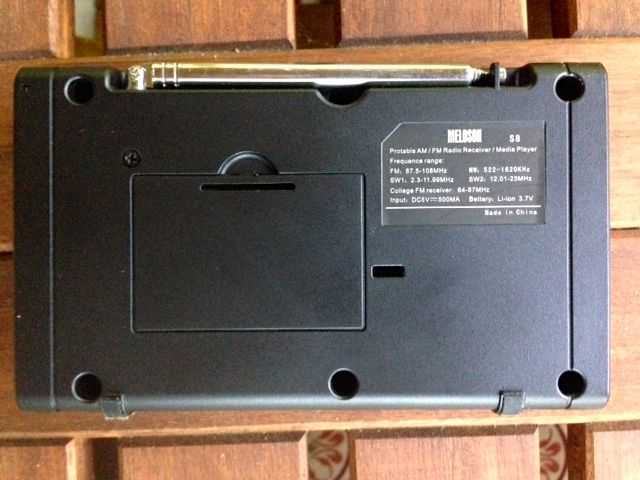
The S8 utilizes the new slim rechargeable battery pack found in some Degen and Grundig models. While I’m not a great fan of these battery packs, they do seem to perform reasonably well and allow for a thinner radio.

Performance

Melson-S8-v2When you first power up the Melson S8, if you have a MicroSD card inserted, it defaults to the MP3 playback mode and will begin playing the first MP3 on your card. You must press the light grey MODE button to cycle through the bands. The order is as follows: MP3 -> FM -> AM/MW -> SW1 -> SW2. I find this a bit annoying, since I’m primarily interested in the shortwave bands, thus must cycle through all the other modes before arriving at my selection. When powering up, I do wish Melson permitted the radio to default to the last mode used, a standard practice among portables.

Like the Melson M7, the Melson S8 has good AM (medium wave) and excellent FM sensitivity. If these are the two bands you listen to most, then you will be pleased with the excellent audio the S8 will deliver via its built-in speaker.

On shortwave, however, I’m disappointed by this radio. Most of the DSP radios I’ve tested have reasonable shortwave sensitivity and selectivity; I had hoped for the same from the S8. Unfortunately, the S8 generates internal noise that pollutes shortwave listening. While the noise is present on most bands, I find that it’s most pronounced on the popular 31 meter band.

There is the possibility that this noise might be specific to my particular unit. I spoke with a friend who didn’t notice the noise on his S8, but he lives in an area with a lot of RFI, which may have obscured the unit noise. So while I recognize that this might be a defect in my radio, I’m not interested enough in the S8 to order another for comparison. However, I would be curious if any SWLing Post readers have noticed this, and welcome your observations.

So that you’ll understand what I’m talking about with regards to the noise floor of the S8 (or at least my unit), below I include two audio clips of my Melson S8 and Tecsun PL-380, respectively, tuned to Radio Australia:

The Tecsun PL-380 on 9,580 kHz:

The Melson S8 on 9,580 kHz:

Note that the static crashes you hear in the recording are not due to performance shortcomings of either radio, but due to regional storms on the date of my recordings.

Summary

I took the following review notes of the Melson S8 from the moment I first turned it on…

Pros

  • To prevent the unit from accidently being turned on, the S8 has a traditional key lock and one must press and hold the power button to power up or shut down
  • ATS Auto tuning
  • AUX in
  • Good AM/FM performance
  • Standard mini USB port for charging

Cons

  • Noise (chirp) every ten seconds in MP3 mode via headphones
  • Telescoping antenna swivel a little too loose
  • MP3 fast-forward imprecise–upon stopping, it jumps ahead ?3 minutes on long recordings
  • Pronounced muting between frequencies while tuning
  • Tuning speed slow, cumbersome, not adaptive; 5 kHz steps only on shortwave
  • Internally-generated noise throughout the shortwave bands, noticeable on all but blowtorch signals
  • Non-standard MHz display on shortwave bands
  • Controls often have sloppy responses; e.g., one fast-forward button press in MP3 mode can yield two skips forward. Tuning knob can have a similar response
  • Back stand is a separate piece of plastic that can be easily lost
  • Even with light use, one of the rubber feet on my S8 has begun separating from the body (may be repairable with adhesive?)

I’m sure you’ll note the number of cons in this list. As a result, I could not recommend purchasing the Melson S8, especially if you’re seeking a good shortwave receiver. There are many other radios in the same price range which offer excellent shortwave reception. I would suggest the Tecsun PL-380 or Tecsun PL-310ET, instead.

The tilt stand is removable (and I appear to have lost mine)

The tilt stand is removable (and I appear to have lost mine)

If, however, you’re looking for a portable AM/FM radio with a built-in MP3 player, you may be pleased with the S8. And as I suggested, I’ve also found the S8 useful in a pinch as a laptop speaker.

But if you already have a Melson M7, do keep it. It’s a good radio, and functions well for what it does. I feel like the Melson S8 is an “upgrade” that its engineers never actually tested. If they had, they would certainly hear the high noise floor on the S8 and realize that this radio can only detect the strongest of stations.

I purchased my Melson S8 on Amazon, where the Melson M7 is also sold.

Looking forward to the 2014 Dayton Hamvention and FDIM

Each year, I attend the Dayton Hamvention and much of the QRP conference, Four Days in May.  This year, I’ll be working our Ears To Our World table again, along with other volunteers, at booth 411 in the Ball Arena (BA411). Please stop by and introduce yourself!

What I love about the Hamvention (besides the massive outdoor flea market) is that it is a one-stop-shop for innovations appearing in our radio world.

Here are a few of the companies I’ll be following at the Hamvention this year:

Ten-Tec

Ten-Tec-AlphaTen-Tec announced yesterday that it will merge with Alpha Amplifiers under the flag of RF Concepts. I plan to stop by Ten-Tec’s booth Friday and learn more about the merger. Personally, I believe the merger with Alpha Amplifiers is a good move. Both of these companies are known for great customer service and quality US-based design and manufacturing.

I know Ten-Tec is introducing a new open-source product to their line, the Patriot, because I’ve been beta testing one (check QRPer.com for details later this week).

Icom

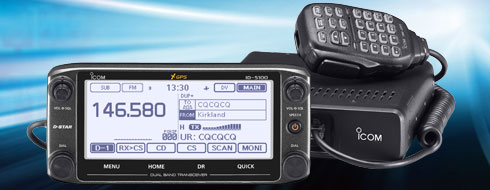
Icom-ID-5100Icom will showcase their new ID-5100 D-star, dual band, mobile with built-in GPS. While I’m more of an HF guy, this radio does intrigue me. You see, for almost one year now, I’ve been very pleased with my Icom ID-51A, dual-band, D-Star handie talkie (HT).

I find D-Star to be a very flexible digital mode and I’m amazed with how many interesting mom-and-pop companies have produced products for the D-Star mode. I’m surprised neither Yaesu nor Kenwood has adopted the D-Star standard (it’s not proprietary to Icom–indeed, read about the CS7000 below).

The new ID-5100 is a mobile version of my ID-51a. What I love about this radio is that it can store repeater frequencies and dynamically load them based on your geographic location. Perhaps my largest gripe with mobile VHF/UHF rigs is their inability to adapt to the repeater “landscape” when you travel. The ID-5100 may change this and push other manufacturers in the same direction.

Connect Systems

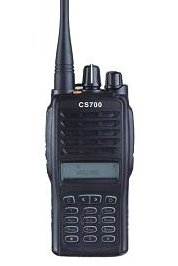
CS700_WEBIn less than a year, Connect Systems has become a household name among ham radio enthusiasts who love VHF/UHF and digital modes.

This Connect Systems is developing an HT–the CS7000–which will be the first non-Icom radio to have the D-Star digital mode. Whatsmore, in addition to D-Star, the CS7000 will also pack DMR.

I don’t think Connect Systems will have a working prototype at the Hamvention (I could be wrong), but there is a possibility that they will be taking early orders.

Elad

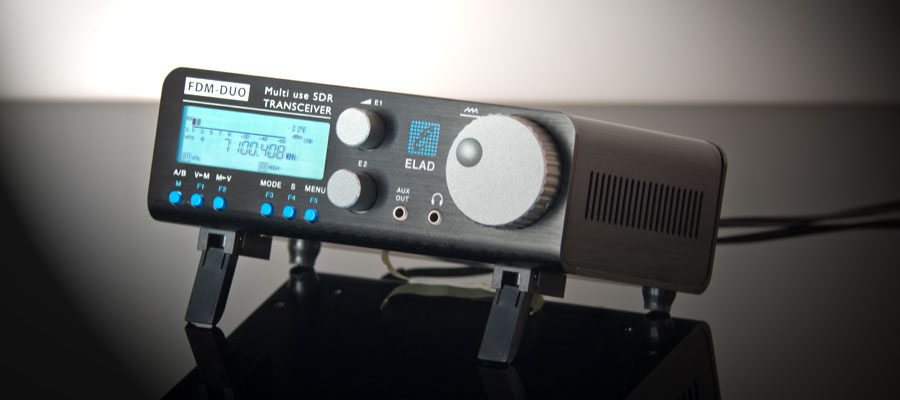
FDM-DUO-openingI’ve been intrigued by the Elad line of Software Defined Recievers. This year, they will attend the Dayton Hamvention. I look forward to checking out the new FDM-DUO tabletop SDR. I plan to review some of the Elad product line in the near future.

Palstar

Last year, Palstar showcased a prototype QRP transceiver with touch screen interface. To my knowledge, this would be Palstar’s first transceiver (though they’re well known for antenna tuners and their shortwave radio receiver, the R30A).

Last year, I was told that the new Palstar transceiver would be available this year and would retail between $1,600 – 2,000 US (a rather steep price for a transceiver with 20 watts output). One of the transceiver’s designers assured me that the receiver would “be worth the price.”

Bonito

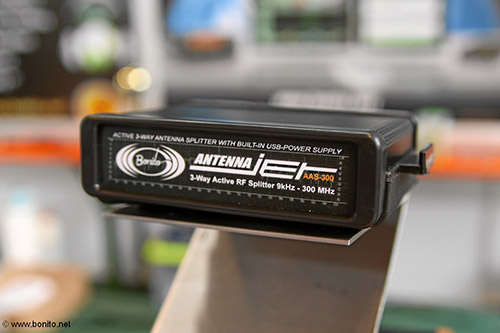
antennajet_front_hamradio2013I’ll stop by Bonito’s booth to check out their new AntennaJet ASM300.  I’m curious how it works and what the Hamvention price will be.

Though pricing is a little steep, I might bring one home as I often would like to share one antenna with two receivers simultaneously.

Elecraft

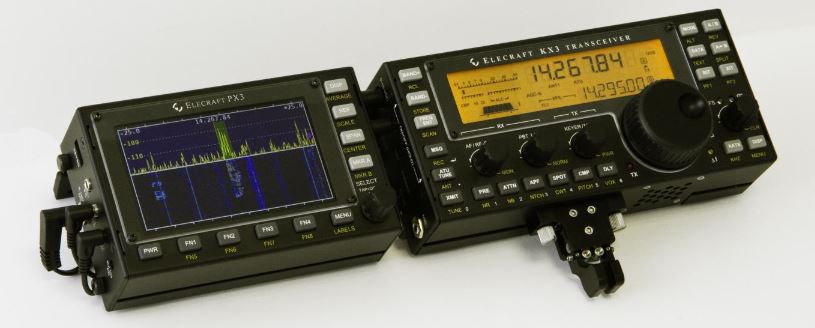
PX3The only new product I know of from Elecraft is the PX3 Panadapter for their Kx3 transceiver. Reviews of the larger P3 Panadapter for the Elecraft K3 are excellent, so I imagine this will be a great product. I hope to check out the PX3 at the Elecraft booth–I believe they’ll have a prototype on display.

SDRs

For the past three years, the market for software defined radios has been growing rapidly. I’ll be on the lookout for anything new–especially improvements on current 3rd generation SDRs.

Did I miss something?

Please comment if there’s something you’d like me to check out at the Hamvention–I’ll try to include it!

Again, if you’re attending the Hamvention, please stop by and introduce yourself at our booth: 411 in the Ball Arena (BA411).

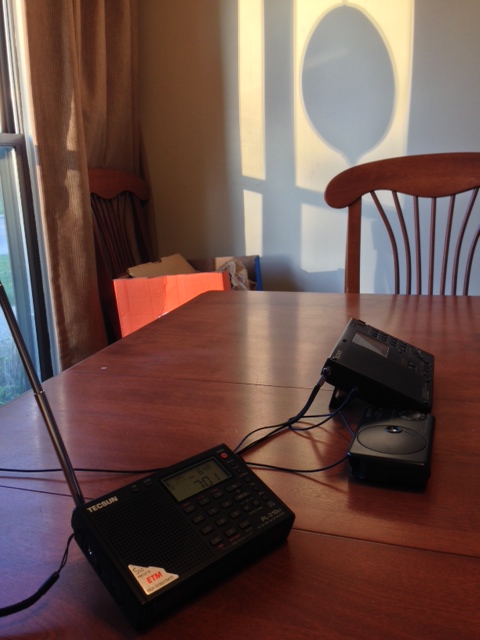
Eric remembers SWLing while deployed in Abu Dhabi

In an email last week, my good friend Eric McFadden (WD8RIF), mentioned the shortwave radio set-up he used while deployed in Abu Dhabi, United Arab Emirates back in the early 1990’s. I asked Eric for permission to post his email notes–not only did he agree, but he also found photos he took at the time.

Eric notes:

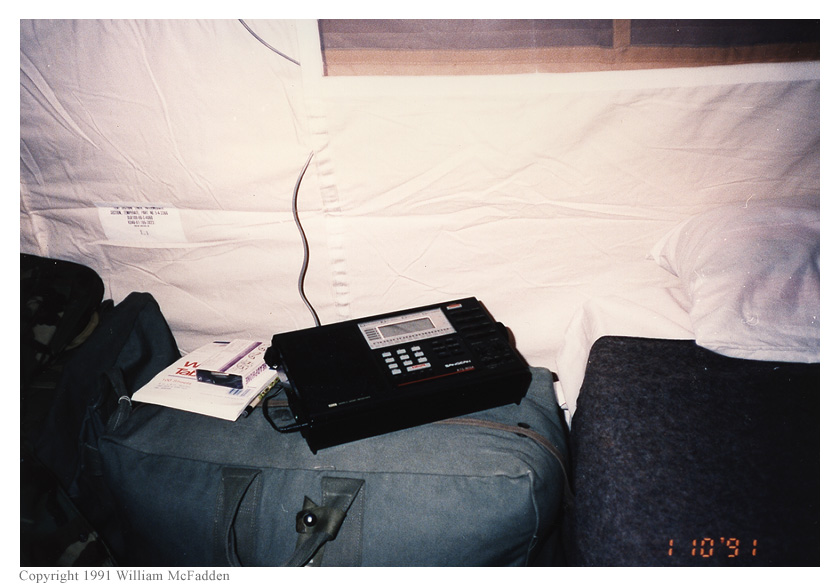
Desert_Storm_SW_Abu_Dhabi_UAE_01[F]or the Desert Shield/Storm, aka the First Gulf War, I took my Sangean ATS-803A with a doublet fashioned from two Radio Shack audio cables. The doublet was an audio cable with an RCA on one end and lugs on the other; I split the conductors all the way down to the RCA connector and it was almost the right length for a proper 31m dipole.

Desert_Storm_SW_Abu_Dhabi_UAE_02

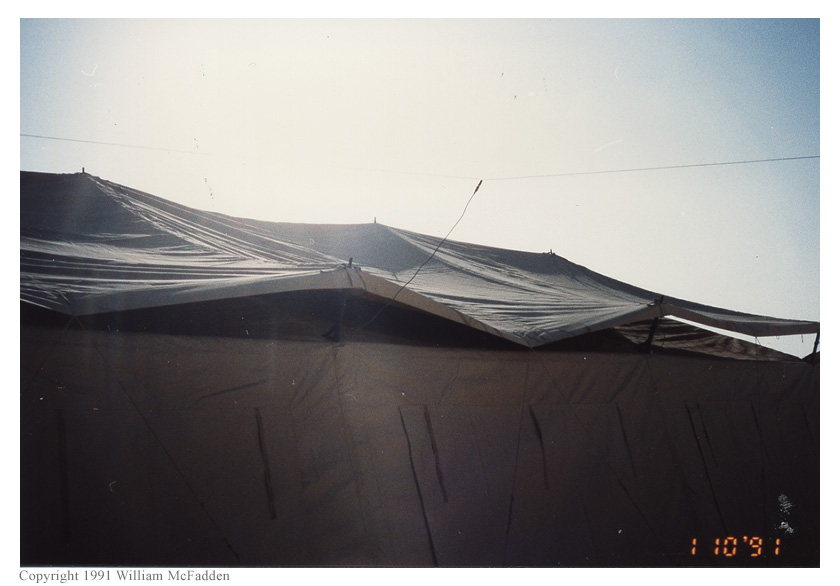
The feedline was an audio extension (+/- 25′) with a male RCA on one end and a female on the other end. The ‘803A had a proper RCA antenna connector instead of a silly phone connector. I hung the doublet between the peaks of two of our 10-man tents, the front of our tent and the back of our neighbors’. When the UAE winds ultimately broke the doublet at the RCA connector, I stripped the ends and made a random-length end-fed wire out of it.

Desert_Storm_SW_Abu_Dhabi_UAE_03

Our tents had AC-power (and A/C cooling and heat-pump heat) and I’m pretty sure I powered the ‘803A from the “mains” instead of stuffing D-cells into the radio. D-cells were available in the little BX on the base, of course.

The three photos [above] are of my installation in our tent-city at Al Dhafra Airbase near Abu Dhabi, United Arab Emirates. I did deploy my 31m dipole here. These photos were from before the dipole broke and was replaced by an end-fed wire build from the pieces of the broken dipole.

[This photo] was from inside our "hooch" on the Lockheed Compound near Jeddah, Saudi Arabia.

[This photo] was from inside our “hooch” on the Lockheed Compound near Jeddah, Saudi Arabia. (Click to enlarge)

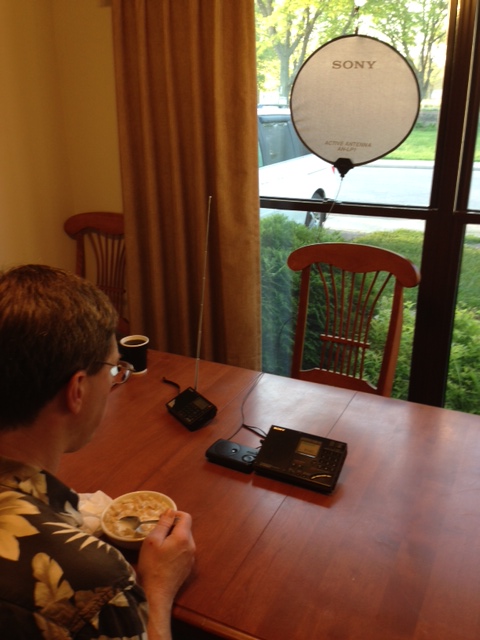
That ATS-803A was a great receiver. It’s only real flaw was its size and weight. The size, of course, allowed for a really fine speaker. I traded the ‘803A in at UAR when I bought the ‘7600G and the little active [AN-LP1 loop] antenna when we thought we were to be deployed to Kosovo[.]

Here’s text from my journal I wrote shortly after returning stateside:

“I found many interesting and exotic stations on my shortwave radio, a Sangean ATS-803A and a simple dipole antenna, but as the war progressed,
I settled on the BBC for their award-winning news coverage.”


Many thanks, Eric! I’m happy to hear such a good report of the Sangean ATS-803A–there are still many 803A’s on the used market (click here to search eBay).

Indeed, I just realized that while you were deployed in the UAE, I used the Radio Shack branded version of the ATS-803A: the Radio Shack DX-440 while studying French and living in Grenoble, France. The DX-440 delivered my daily dose of the Voice of America (the only English language news I allowed myself to listen to at the time). Since the VOA broadcast often coincided with meal time at the Université Stendhal cafeteria, I left my voice-activated Micro Cassette recorder in front of the DX-440 which was, in turn, set to turn on one minute prior to the VOA broadcast. It was an amazingly reliable arrangement. (Hard to believe that was over 20 years ago!)

Come to think of it, I’ll have to dig up those micro cassettes and see if I still happen to have one with a recorded broadcast.

Mehmet Burk reviews the Degen DE660 and DE1126

Degen-DE660SWLing Post reader, Mehmet Burk, has apprised me of reviews he has published of the Degen DE660 and DE1126.

Until reading Mehmet’s review, I was not aware of the Degen DE660 (FM/Blutooth/MP3 player). He states the DE660, will fill a room or vehicle with outstanding sound quality.”

The DE660 could be an inexpensive alternative to the ubiquitous Bluetooth speaker–one that also sports FM.

Mehmet also gives the DE1126 good marks.

Click here to read the DE660/DE1126 reviews on Mehmet’s website, ReliefAnalysis.com.

Portables, SDRs, dongles, kits, and a spy radio: our virtual radio challenge responses

TristanDaCuna-001

Two weeks ago, I posted a virtual challenge for SWLing Post readers:  I asked you to imagine you were placed on a one-year research assignment on one of the world’s most remote inhabited islands, namely, Tristan Da Cunha, in the South Atlantic.

Your goal was to assemble the best shortwave listening set-up possible for your virtual budget of $200 US. You were tasked to track down a radio kit that would keep you in touch with the world, and potentially afford you some very unique DX. [If you haven’t read the full virtual radio challenge, including all of the limitations you might face, I encourage you to check out this post before continuing.]

Your Reader Responses

And, wow, what great responses–!  First, I want to thank all who participated in this challenge. No two responses were identical.  Some truly surprised me…I must say, I sincerely hope you enjoyed this exercise as much as I enjoyed reading what you’ve sent to the SWLing Post!  

Below you will find ten responses from readers, representing remarkable diversity in radio set-ups. Note that my comments follow; they are italicized and in bold.

Now, with no further ado…I welcome you to radio DX on Tristan de Cunha!


from Frank Holden

TecsunPL-660First up, Frank Holden, who submitted his entry at 3:00 AM–prior to leaving on a 6:40 AM flight. Obviously, travel was on this Post reader’s mind.

Frank writes:

Based on both my own experience and recent swling.com research I would choose a:

(Photo courtesy of http://www.perite.com/)

Squidpole Antenna (Photo courtesy of http://www.perite.com/)

Total is $210 Australian, so you will get change out of $200 US.

Some notes:

  • Feed antenna up inside the Squidpole and tape at the top…. The rubber ‘bobble’ is removeable.
  • Maybe run a short length of coax from radio to base of Squidpole.
  • Make sure the Squidpole is well stayed. My experience in VP8land and Tierra del Fuego is that the constant flexing in high winds will lead to squid pole failure. Mine were secured to the taffrail on my boat… i.e. at the base and 50cm up from base…. Failed at the 50 cm point. I have also had a 5 metre high quality (marine grade) alloy whip fail in the same manner.
  • Utilise rest of baggage allowance with warm clothes, rum (power outages… for use during), etc.

Thanks, Frank! I love the idea of the Squidpole as it can give you a little height when trees are absent. I have used a similar telescoping pole for Ham Radio QRP operations: a Jackite pole. I’ve broken the tip section twice already due to my own clumsiness–fortunately, the tip can be purchased separately. As you suggest, I bet the winds on Tristan Da Cunha would give the Squidpole a run for its money!


from AB3RU

The Ham It Up v1.2 - NooElec RF Upconverter  converts your RTL-SDR dongle into an HF receiver.

The Ham It Up v1.2 – NooElec RF Upconverter converts your RTL-SDR dongle into an HF receiver.

AB3RU writes:

I propose using my current setup, since a laptop is a freebie here. I use the following in my setup:

1) RTL-SDR dongle for the laptop ($15)
2) Ham it up upconverter ($40)
3) AlphaDelta SWL sloper, MFJ 1020B (eBay, got ‘em for $102)

That’s $157. That leaves $43 for a 25? length of coax and two MCX adapters. Coax run is $15 (at $0.39/ft for RG-8X.) I forgot how much the adapters were, but less than the $28 left over after buying the coax run.

Downside? I have no pole to support this, and houses on the island are only one story structures. I’ll have to attach the high end of the sloper to the peak of the home where I’m staying, and I’m sure that height is less than the 25? recommended by AlphaDelta. In addition, I’ll have to plant a stake at the lower end of the sloper to keep that end the recommended 8? above ground. I also made no provision for extra power if a power outage exceeded the amount of juice in my laptop battery.

If push came to shove, I would drop the MFJ 1020B for an extra $50 to buy supports or an extra battery.

Thanks, AB3RU! I’m willing to bet that you might find something on the island to support one end of your sloping antenna. It might be a challenge to meet the 25′ recommended height, as you stated. Still, this is an innovative and quite portable option!


from Tudor

Sony-ICF-SW7600GR“Tudor” comments:

Here are my choices:

  • A 50-100m wire to be used as an antenna for SW and MW. I imagine I’ll be able to catch a few MW stations from South America or Africa. As for choosing a radio…
  • I’ll need a good radio which allows using an external antenna not only for SW (all of them do) but also for MW (few of them do). I think there is only one radio which fits this requirement within the budget: the Sony ICF-SW7600GR, available on Amazon.com at prices around $140. My other choice would be a Sangean ATS-909X which works very well with external antennas, but it’s more expensive.
  • I’ll also need two packs of 4 AA rechargeable batteries and a charger.

Thanks, Tudor! I believe your choice of the Sony ICF-SW7600GR is a very good one, as the Sony is a solid performer. It would be a challenge to find a new Sangean ATS-909X within your $200 budget–you would need to track down a used one, most likely. With the PL-660 in tow, you would then have a full $60 to purchase batteries, charger, and your antenna wire. Very workable!


from KK6AYC

KK6AYC suggests using the MFJ Model MFJ-8100:

MFJ-Model-MFJ-8100

http://www.mfjenterprises.com/Product.php?productid=MFJ-8100W

It is through hole soldered so replacing parts is easy. Bring a bag of spare parts and a couple batteries. Get two headphones so that you and a friend can listen at the same time.

Thanks, KK6AYC! At $110 US, you would certainly have enough budget for spare parts, batteries, and antenna wire. While a regen receiver may not be for everyone, these do provide excellent sensitivity once you pass this rig’s learning curve for tuning. If the winds blow your external antenna around, you might have to ride that regen control! Great alternative to the typical portable–!


from John Treager

Next, John Treager, who writes:

Neat thought experiment! I’ve recently got back into SW listening after years away. I’ve been hitting your sites for two or three months and your weak station comparison really grabbed my attention but this one has lit the fire again.

[…]I’m a contract engineer who lives away from my primary residence most of the time so this challenge kind of strikes a chord. And, as I’m getting back into SWL, you’ve given me a reason to research (something engineers love to do!).

TecsunPL-660-SilverBased on the weak station article and discussion, I like what I’ve seen in the Tecsun PL-660 (although I don’t own it yet). […]Found in silver on eBay for $100.99 from kaito-electronics-inc. Seriously, what’s the fascination with black? Black is $20 more…

If I’m renting a room with a family on the island, headphones are a must. I’m cheap and traveling light so let’s go with Sony MDRZX100 headphones. I’ve used them for quite a while and like them. I find them comfortable for at least a couple of hours. Currently $15.09 on Amazon.

I enjoy the challenge of simplicity so, as far as an antenna goes, I would choose a simple long wire. Either a reel or one I build, $10-15. I get as much enjoyment from fussing with antennas as I do from turning knobs and dials. If my simple wire antenna doesn’t work when I get on location, then investigating and tinkering with antenna design and construction will fill the hours!

wrth-2014By the rules of the challenge, power is available but somewhat unreliable it sounds like. To meet that, I’m going with rechargeable batteries and enough to last for a while. AmazonBasics AA NiMH Rechargeable batteries (16 pack, 2000 mAh). Not the newest version, but should suffice for one year and 16 batteries should be enough for extended periods of no power. And, this may be a bit of a cheat, but I use AA batteries for everything, so I already have a charger!
Next, some sort of reference. I usually use either my laptop or a phone/tablet for frequencies/times from various sources, but given that there is no internet access in the residence and power may be occasionally spotty, let’s go with the World Radio/TV Handbook as a backup (I do miss Passport to World Band Radio!). I found WRTH on eBay (new, 2014 edition) for $27.24.

I assume I will have notebooks and pens for other reasons, so not included in the total.

So, all told…

Total: $182.67

With the remaining difference, I may get a Kaito KA321, which I have found to be a great deal of fun. […]Being a budget DXer, and given the performance of this little radio, I would almost have to have one along. I would love to see what it did in the South Atlantic!

Thanks, John! That should be enough AA batteries to keep you going well over a week with no power. Packing a WRTH makes a lot of sense. Via the island’s library Internet–however variable–you could download WRTH updates, as well.


from London Shortwave

The Global AT-2000 (Photo: RadioPics.com)

The Global AT-2000 (Photo: RadioPics.com)

London Shortwave sent his suggestion in by tweet–a simple, proven combo: 

Thanks, London Shortwave!  While the Global AT-2000 is a little difficult to find these days, London Shortwave has had excellent success with this antenna coupler. There should be enough room in his budget for rechargeable batteries, as well.  


from Princehifi

“Princehifi” comments:

If a laptop was coming along, I would have to use an SDR.

AFEDRI_SDR-USB-HS_640

I would get the Afedri SDR USB-only model [see AFEDRI SDR-USB-HS above] for $159 (board only, I’d have to mount it in a sardine can). I would then use the remaining $41 for a cheap used antenna tuner and a random wire for an antenna. I think this kit would make for an excellent listening post.

Backup power would be a concern with the outages, so I am contemplating a 6-volt battery backup power system to power my Phillips 4-port USB hub (6 volt DC in requirement). From there the USB-hub will power/charge a Dell Venue 8 Pro tablet (the laptop), the Afedri SDR and maybe a USB-powered speaker? Would have to test out this backup power scheme before boarding the boat!

I think I could do all of the above for $250 including the backup power system. Although it would likely push $300 when wires, cables etc are all in (does not include the tablet/laptop).

Thanks, Princehifi! So you’re a little over the $200 budget with all of the accessories, but if you already have a laptop and tablet, I think you could tweak your set-up to meet the budget goal. I did not realize that there was a USB only version of the Afedri SDR–I might have to get one of those myself!


from Rob

TecsunPL-660-SilverRob comments:

Here’s my list. Where can’t get it locally and I don’t have a firm shipping cost, I’ve estimated it as an additional 20%. Stuff I can get locally (Radio Shack, etc.) I haven’t added any shipping or sales tax.

  • Tecsun PL660 (eBay/Anon Co): $85 + $16 shipping = $101
  • 100′ roll of 22 gauge stranded copper wire (Amazon): $9.41 + 20% = $11 (good long random wire)
  • 25′ RG58 (Universal Radio price $0.25/ft): $6 + 20% = $7 (use the coax to get wire antenna out and away from the house; wrap it on an old jar (free!) to make an ugly balun to keep household noise from creeping up the outside of the shield)
  • 1/8″ phono plugs for antenna port (Radio Shack): $3.50
  • Koss Earbuds (Radio Shack): $5 (these really cut down on battery drain and make for a better house guest)
  • Eneloop charger & 4xAA batt combo (Battery Junction): $16 + 20% = $19.20 (the 660 comes with one set of AA’s, this gives another and an away-from-radio charger to cut down on noise)

TecsunAN200OK, that totals to $147 for the basics. Now I want to add two more things:

(That’s right, a spare radio. Because middle of nowhere.)

Grand total: $192

Now if I’m allowed to scrounge in the parts bin for stuff like 22 gauge antenna wire, RG58, and earbuds, there might be enough left over for a SECOND spare radio and 4 more Eneloops!

Thanks, Rob–you have a plan, indeed! Well thought through! I, too, would be very curious what sort of medium wave DX I could hear in the South Atlantic, especially since you know there would be no local blow-torch stations around. I have the Grundig version of the Tecsun AN200 and find it an essential antenna for portable MW DXing.


from Michael C. Fortner

ECSS-PL-660Michael C. Fortner’s list includes:

Radio: Tecsun PL-600 (I have one and am comfortable with it’s operation) – $43.35

Antenna: 500′ spool red 18 gauge wire (you can’t have too much wire in case of wind damage, animals, people, etc.) – $29.07

2 two packs of 1/8 mono phone jacks (again, backups are good) – $4.49 x 2 = $8.98

AmazonBasicsBatteriesBox-001Batteries: 16 AA NiMH batteries – $25.86

Charger: Solar battery charger (backup to mains power that charges batteries in radio): $19.99

Headphones: Koss KSC-75 headphones x2 (good dynamic range for the price and I have two pair that I use): $14.82 x 2 = $29.64

Grand total: $156.89 (all qualify for free shipping)

I’d guess I would save the rest for repair costs in case the radio acts up. Of course, I’d take the one I already have as a spare. When in remote locations, backups are essential so I probably bought more than most people think I need. And as far as the battery charger, rapid chargers are bad for most NiMH batteries so I went with a slower charger. And don’t forget that the Tecsun can charge the batteries in the radio when not in use.

Thanks, Michael! You are erring on the side of having extra batteries and more than enough wire for antennas; there’s no way you’ll run out in your one-year stay. On Tristan, I know that locals often trade supplies: those extra batteries may turn into an antenna support!    


from Kenny B

 OLYMPUS DIGITAL CAMERAKenny B writes:

I love your site, I’m there everyday and almost forgot to enter so here it is:

1. Kaito 1102, I have had good luck with it and it has ssb, second choice would be a Tecsun PL-380, I really love this radio and it’s a great little dxing machine but no ssb.
The Kaito is 64.95 on Amazon, free shipping.

The Sundance Solar DIY battery charger

The Sundance Solar DIY battery charger

2. A Sundance Solar- build it yourself battery charger for AA and AAAs: $40.00 plus 9.99 shipping

3. Scotts Electronics 384pf air variable capacitor, $13.95 plus $4.95 shipping, this if for my shortwave magnetic loop I will build, I’m pretty sure I can procure the wood for crossbeams or something to make a loop can be had on the island.

4. 6ft RG-58, Wal-Mart, $4.95

5. 50ft speaker wire, Home Depot, split it gives me 100ft, can also be used to make a dipole or longwire, $9.99

6. Sanyo Eneloop rechargeable batteriess, AA, 3rd generation, 2000mah, 8 pack $26.40, Amazon, free shipping

7. Travelproducts.com, 1600 watt voltage converter, 19.99, free shipping

8. Radio Shack 1/8th inch miniplug for end of coax, $4.00

Wow! Thanks, Kenny B! Other than the KA1102, your complete kit is DIY–I like it! You could build the battery charger and antenna prior to leaving. 


from Anil

Anil writes:

1. Receiver: Wandel & Goltermann FE-8 Spy Radio Receiver (US$ 120 at a Hamfest)

Wandel_And_Goltermann_FE-8

Wandel & Goltermann FE-8 Spy Radio Receiver from the cold war (mine was manufactured in 1963. I bought it at a Hamfest in Sweden a month ago for the equivalent of US$ 120.[…]

For ruggedness there is nothing else like it. It is completely sealed and constructed from a single piece of die-cast machined aluminium and stainless steel. Just the thing for wet and rainy Atlantic islands! Covers 2.5 – 24 MHz and only needs 6 Volts at 8mA. A pack of twelve AAs will fit in my pocket and last at least a year with about three hours of listening every day. No adapter, no charger. The razor sharp 3.1 kHz Collins Mechanical Filter is not ideal for music but hard to beat for general news and SSB utility listening. Like the famous Collins R390 it uses a mechanical “digital” dial accurate to 1 kHz which also glows in the dark. […]It is smaller that a Tecsun 660 though it weighs a lot more. More about this radio here http://www.cryptomuseum.com/spy/sp15/fe8.htm

2. Antenna & Earth (US$ 15 in any electrical store)

Random length PVC insulated wires with a banana plugs- total 50 meters. The radio has a hi-impedance input and is sensitive enough to do a great job with just 20 m of wire. The rest is spare.

3. Headphones (US$ 25 on eBay)

Lightweight Telex Aviation Headset with 1500 Ohms impedance can be worn for long periods with no fatigue. The audio response is tailored for voice.

WandelAndGoltermann-FE-8-Front

4. The latest  WRTH Handbook (US$ 30 online)

I’m all set for the trip now with $10 to spend on a supply of chewing gum. I know that this radio setup can easily deal with whatever is thrown at it… the question is if I can!

Thanks, Anil!  Wow…I never saw that spy radio coming! It does look like an ideal radio for prolonged use and for pretty much any environmental conditions. I hope you realize that I will be bugging you (okay, pun intended!) to provide us with a few broadcast recordings from the FE-8. It’s certainly got my interest piqued!


Now, that was fun! Thank you all…

I know this sort of challenge may not appeal to everyone, but I really enjoy it. This sort of exercise forces you (though safely) outside the comfort-zone of a home radio set-up. Your responses are truly innovative. I only wish the Post could actually send our participants to Tristan de Cunha to try their set-ups out first-hand! I, for one, would love to come along…

Thanks, again, for your participation! If your response wasn’t included above, or I didn’t respond to you directly, please let me know: it’s possible I skipped over yours by mistake as there were quite a few responses to collate, and my email is managed by a rather discriminating SPAM filter.

Meanwhile, if you think of an alternative set-up–or would like to add your own to this post–please comment below!

Frugal SWLing: Investing little, but getting a lot out of your radio

This article originally appeared in the April 2014 issue of The Spectrum Monitor Magazine.


RadioDialLet’s face it: SWLers and amateur radio operators are some of the most frugal hobbyists out there.  But the good news is that radio is a hobby that favors the frugal.  There are many practical and time-tested ways to make radio listening fun and effective–such as improving your shortwave radio reception–that are absolutely free, or that cost very little.

And how do I know this?  Among the frugal, I’m the most frugal SWLer I know! Yet there’s a method to my frugal madness:  because I simply can’t afford to waste hard-earned radio money on gadgets and accessories that are ineffective, I count my pennies in order to make quality purchases with longevity in mind.  Meanwhile, I track down ways to keep my hobby cost-effective.

I’ve gathered here some of my favorite frugal tips and quality purchase suggestions here. So, without further delay, let’s start SWLing–and saving money.

1. Check your shack/home for RFI. Cost: Free

Checking your shack for RFI is vitally important, a procedure every radio listener or operator should undertake.

The truth is, very few of us regularly experience ideal conditions for HF or AM radio listening. Devices like plasma TVs, laptop power supplies, and the ubiquitous AC adapter inject distracting noise into our otherwise peaceful environs, disrupting our hobby. This noise is known as RFI (Radio Frequency Interference).

These "Wall Wart" type adapters can create a lot of RFI

These “wall wart” type adapters can create a lot of RFI

A number of times, I’ve received a message from one of my readers on the SWLing Post claiming that their new shortwave radio can “only” hear strong, blowtorch stations. My simple advice? Put batteries in your radio, turn it on to an unoccupied frequency in your favorite shortwave meter band, go to your circuit breaker box, and turn off everything in your house. (Warning: Do warn your housemates beforehand, to avoid any loud protestation! And do reset your clocks and check your refrigerator/freezer after this test.)

Did the noise level on your radio decrease? If the decrease coincided with the power cut, then one or more electronic devices in your house are generating RFI. RFI often sounds like static–very loud static–and is often so wide in bandwidth that it can cover several megahertz. RFI can overwhelm your portable radio and basically “deafen” it to anything but the loudest stations that break through the elevated noise floor.

Next comes the process of elimination: systematically turn on circuit breakers until you hear the noise return. If you’re fortunate enough to have accurately-labeled circuit breakers, you will at least know what area in your house holds the infamous disruptive device. Here’s a short list of the usual RFI culprits:

  • the ubiquitous AC adapter (aka, “wall wart”)
  • laptop power supplies
  • flat screen TVs: especially Plasma TVs
  • heating devices like electric blankets
  • external hard drives
  • lamp dimmers
  • touch lamps

Good luck tracking it down!  Chasing RFI can be complex.  Check out this list of RFI resources on the ARRL website for methods and ideas to cope with RFI.

2. Take your radio outside. Cost: Free

ParkListeningIf you live in a condo, high-rise, or high-density neighborhood, my first suggestion may be of little use to you. In this case, your neighbor(s) may be causing RFI; turning off your own power may have little to no effect.  Fortunately, there’s an easy–albeit modestly inconvenient–way to deal with neighborhood RFI. Leave the neighborhood! No, not permanently; just for a fun afternoon outing (with radio, of course).

If you live in a city, grab your radio, and head for a park or other area with wide open space and no buildings. Listeners who live in urban areas frequently enjoy radio listening via headphones on a park bench; some even have a favorite bench for their fair-weather pastime.

The benefits in this case are two-fold: firstly, you’re removing yourself from the vicinity of RFI, but secondly–and the icing on the cake–is that you’re taking your radio, and its antenna, outside.  Antennas always function better outside. Walls and even windows attenuate HF signals.  Plus, outdoor settings nearly always equal fun.

Want some inspiration? Check out how this SWL plays radio in central London.

By the way, if you have no local parks to which you can escape, consider taking your radio in the car and driving to a national park. Better yet, combine camping and SWLing.  I like to do this, although I don’t have an RFI problem where I currently live.

3. Make a simple wire antenna. Cost: Free (or, at most, $10-15)

Most shortwave portables radios on the market today have a telescopic whip antenna that will suffice for casual listening. But often you can increase the antenna gain by simply adding more length in the form of a simple thin wire. Keep in mind that many radios actually ship with a clip-on antenna wire. Check your original box and make sure you haven’t overlooked it, as it’s fairly easy to do.

An alligator clip offers serious bang-for buck--especially if you already have the parts lying around

An alligator clip offers serious bang-for buck–especially if you already have the parts lying around

If you didn’t receive a factory-supplied clip-on antenna, no worries!  They’re a breeze to make and quite cheap: indeed, if you have a junk box of electronics parts like so many hobbyists I know, you may already have what you need. Simply obtain a 20 foot length of jacketed (insulated) wire–gauge is not important, just something thin enough that you can easily roll up to transport. Next, strip ¼ inch of insulation off the end of the wire. Solder and/or crimp an alligator clip to the end of the wire, making sure you have a solid, stable connection.

Now, stretch out this wire and attach it to your antenna.  You will most likely find that this improves antenna gain. The effectiveness of the wire varies with the receiver. When I’ve made clip antennas in the past, I’ve simply made them longer than I thought I might need, then later cut it off at the optimum length based upon signal strength.

Two caveats:

  1. If you live in an RFI-heavy environment, adding a wire antenna at home may only increase your noise level (after all, it will make the radio better at “hearing” the noise).
  2. Some receivers are susceptible to overloading and electrostatic discharge (the Tecsun PL-600, Grundig G5 and G3 come to mind). To be on the safe side, do not attach any wire to your portable that is in excess of twenty feet in length.  Twenty feet should be more than sufficient length to increase antenna gain without any negative repercussions.

4. Use batteries––preferably rechargeable ones. Cost: $5- $20

Not all rechargeable batteries are created equally. Lean toward name brand, higher quality cells. Dollar store batteries lack longevity.

Not all rechargeable batteries are created equally. Lean toward name brand, higher quality cells. Dollar store batteries lack longevity.

This is one suggestion that may require a modest investment, but will pay off in more ways than one. I honestly can’t think of the last time that I listened to a portable radio while it was plugged into mains/grid power via an AC adapter. Since at least 2007, I have been powering my portables exclusively with good-quality rechargeable batteries.

Why rechargeables–? First and foremost, with rare exception, shortwave radio manufactures give little thought to the AC adapters they include with a portable shortwave radio; they’re simply an accessory that is expected, so they deliver. Indeed, the AC adapter that came with my Tecsun PL-880 (Tecsun’s latest flagship portable) came with an AC adaptor that does a great job charging the internal batteries, but injects copious amounts of RFI in the process. Running the radio off of batteries solves the problem instantly.

Many radio manufacturers now include rechargeable batteries with the purchase of a radio. Some of these batteries are AA cells, others are slim packs resembling cell phone batteries. Consider purchasing an extra battery if you’re worried yours might die away while you’re listening to your favorite program; a quick switch, and you scarcely miss a beat. If your portable comes with rechargeable batteries, most likely the radio even has a built-in charge control circuit.

I should add that I’m a fan of the traditional AA battery, even though they’re bigger than other battery types. After all, they’re nearly always accessible.  If a radio takes AA batteries, I never use the radio’s built-in recharger, instead I prefer a MAHA brand battery charger, as they condition and give a longer life to the rechargeable cells.

Sure, buying rechargeable batteries and, potentially, a good battery charger require an initial outlay of money, but the rewards are a quieter receiver and a more earth-friendly approach than heavy-duty or alkaline batteries can deliver.

5. Listen with headphones or earphones.  Cost: $0 – $100

Sony MDREX10LP in-ear headphones are inexpensive and effective.

Sony MDREX10LP in-ear headphones are inexpensive and effective.

Why headphones? Ask any serious DXers (amateur radio or SWL) and they’ll tell you headphones are an indispensable tool. While armchair listening is great with your radio’s built-in speaker, headphones give you better sound isolation, and your radio’s audio is equally balanced. Digging a weak station out of the ether is easier with headphones.

Almost every portable you buy today will come with a complimentary set of earphones. Quality varies amongst these, but in my experience, the headphones included tend to be of the lowest quality; for shortwave listening, these may suffice.

Though AM and shortwave radio is not considered a “high-fidelity” medium, thus not requiring a wide frequency response, I still prefer listening with quality earphones/headphones. As long as your headphones have a decent frequency response–I usually aim for 8 – 22,000 Hz–you’ll be pleased.  And do make sure your headphones or earphones are comfortable to wear for extended periods of time.

Yamaha CM500's are a worthwhile investment if you're an amateur radio operator.

Yamaha CM500’s are a worthwhile investment if you’re an amateur radio operator.

One of my favorite pair of in-ear earphones for SWLing are the popular Sony MDREX10LP series. They’re comfortable, responsive, isolate noise, and are available from a number of retailers for about $10 USD per pair.

For over-ear headphones, I like the Panasonic RP-HTF600. They’re large, comfortable, and deliver amazing fidelity for about $30 USD.

If you also happen to be an amateur radio operator, the Yamaha CM500 headphones have a built-in boom mic that works amazingly well.  At $50 USD, they are a steal. When I received mine, I opened the package, plugged the headphone and mic jacks into my Elecraft KX3, and I was on the air with them in seconds.

6. Learn to use use Exalted Carrier Reception (ECR/ECSS). Cost: Free

ECSS-PL-660“Exalted Carrier Reception” (ECR) a.k.a. Exalted Carrier Single-Sideband (ECSS) is just a fancy way of saying that an AM broadcast carrier is tuned in while in single-sideband mode. This is most useful when you’re trying to listen to weak broadcasters.

This (ECR) is, in a sense, the frugal listener’s version of synchronous detection. Why does it work?  As my knowledgeable ham buddy Mike (K8RAT) explains: ”You’re removing any selective fading problems by filtering away one of the sidebands, and injecting a carrier of steady amplitude which eliminates the ‘tearing’ heard when a broadcast carrier is varying in amplitude.”  Got that?

Even if you don’t understand it exactly, here’s how to use ECR:  Simply find a strong AM station on your radio.  Next, turn on the BFO or SSB mode on your radio. As you adjust the tuning knob, you’ll hear an audible whine, the pitch of which will change with every increment of tuning. “Zero-beating” the carrier follows next–this is simply tuning in the signal until that whine is gone, and the AM station can be heard as clearly as if the radio were in AM mode.

The fidelity of ECR/ECSS is typically not as good as AM–mainly because SSB filters are usually narrower than AM filters–but it does lower the noise floor, increase the stability of the received signal, and make this signal “pop out” a bit more.

But don’t take my word for it–let your ears be your guide! In this recording, I tune in a low-power station on my receiver in standard AM mode, but at 15 seconds into the recording, I switch to the upper-sideband (SSB) mode, zero-beat the frequency, then open up the SSB filter a little wider.  Then, just before I end the recording, I switch to lower-sideband–something you can do if there is interference in the upper-sideband, for example:

It’s amazing how much background noise ECR removes.

If you’re lucky enough to have a tabletop radio, chances are it has an SSB mode (although there are some very rare exceptions). Less than a third of portables on the market, however, have SSB. Here is a list of the most popular portables with SSB that are, or have recently been, in production.

7. Use a web receiver.  Cost: Free

If you live in an area with frustrating RFI, but want to listen to the shortwave bands from home, try an online web-based receiver. Sure, it’s not quite like tuning a radio at your fingertips, but it’s the next best thing, and also a handy tool for checking propagation or verifying your own signal (if you’re an amateur radio operator).

My two favorites site are:

  • GlobalTunersGlobal Tuners which has a number of remotely-controlled radio receivers all over the world. You must register before you can participate, but registration is free. Global Tuners even has a free Android app that permits remote receiver control via your smart phone or tablet.
  • utlogo4bThe University of Twente Wide-band WebSDR is an amazing resource. Not only can you control this receiver, but so, too, can a few dozen other web guests––all at the same time! I’ve used U Twente’s receiver on a number of occasions to listen to European pirates. Cost? Again, it’s free.
  • The KiwiSDR network has become the largest network of web SDRs since we first published this post. You can literally travel the world via the KiwiSDR network! Click here to view KiwiSDR stations on a map, and here to view them in a searchable list.

8. Finally, practice listening. (Cost: Just some time)

SP600Dial3My final bit of “free” advice sounds a little philosophical, but rest assured, it isn’t.

I’ve always likened radio listening to another of my interests, astronomy–an entirely different hobby that, unless you’re a radio astronomer, relies on an entirely different sense.

Why the comparison?  I’ve known some talented astronomers that, with just a basic pair of binoculars, can see much more in the night sky than I ever could. Are their eyes better than mine? Not necessarily. Their eyes are just experienced in the field of stargazing; they know what to look for, and most importantly, what to appreciate. Their brains decipher the images of bright or faint stars, subtle variations in color or shape, and focus on what they consider important. In short, this is not an ability you can pick up overnight; it takes patience, experience–and true passion.

Radio listening is, in that sense, much the same. Though I’m by no means a good example, I do wish I could go back to the days of my youth with the ability to listen that I have developed over the decades. There must have been so many jewels of stations hidden in the ether that I completely skipped over…My ability to, for example, pick out the ID of a faint station, to tune accurately and quickly, and to cope with adjacent noise, have all been honed since then, a result of time spent just listening.

My good friend Vlado (N3CZ) is a case in point: he is one of the most capable ham radio DXers I know. His extraordinary ability to pull intelligible conversations and CW (Morse code) out of the static, even in crowded radio conditions, is simply astounding. Vlado’s main transceiver is nearly two decades old, and by no means a benchmark technically. If you ask Vlad if he uses filters and digital signal processing, he will wisely tell you, in his Macedonian accent: “Your best filter is between your ears.”

The same goes for SWLing. I have spent enough time listening to shortwave and weak DX that I can now pull conversations out of the noise that my (non-radio) friends can barely detect. I’m convinced this is healthy exercise for the old grey matter.

David Goren, good friend and the highly-creative radio producer behind Shortwaveology.net, describes how shortwave listening enhanced his career:

“When I first discovered shortwave, I’d strain my ears through the static and all the layers of jumbled up sounds trying to hear as far around the world as I could. Years of this kind of intensive listening tuned my ears in such a way that allows a laser-like focus on the sonic details when working in the production studio making radio stories.”

Indeed, I’ve heard and can certainly appreciate the results of his remarkable “laser-like” listening ability; check out Shortwaveology.net for your own experience of David’s talented ears. You’ll be glad you did.

No doubt you enjoy listening already; my contention is that it has more benefits for your brain than Sudoku puzzles, and iis even more fun. Plus, did I mention that it’s free? You don’t need to pay a subscription to listen to the radio. There’s no real trick to this: it just takes time…interest…and a pair of ears.

Happy listening!