Category Archives: Shortwave Radio

Guest Post: Wellbrook 1530LNPro vs ALA1530S+ Imperium Loop Antennas

Many thanks to SWLing Post contributor and noted DXer, Guy Atkins, for the following guest post:

Two-Wellbrook-Loops-001

Wellbrook 1530LNPro vs ALA1530S+ Imperium Loop Antennas

-Guy Atkins

This past weekend I found some interesting results from medium wave DXing with both models of Wellbrook Imperium loop antennas at the “fabled” Rockworks cliffs near Manzanita, Oregon USA. This location has become popular the last few years with Oregon, Washington, and British Columbia DXers due to the signal enhancement at this narrow strip of land approx. 450 feet above the Pacific ocean. The main benefit seems to be splatter reduction of “pest” stations due to the signal blockage of the rock walls blasted into the cliffs for the coastal highway 101. However, a boost of signals around local sunrise is also beneficial, and is a common occurrence near salt water beaches.

Here is a Google Maps Street View of this beautiful “wide spot in the road” along the cliffs.

Ultralight-Cliff

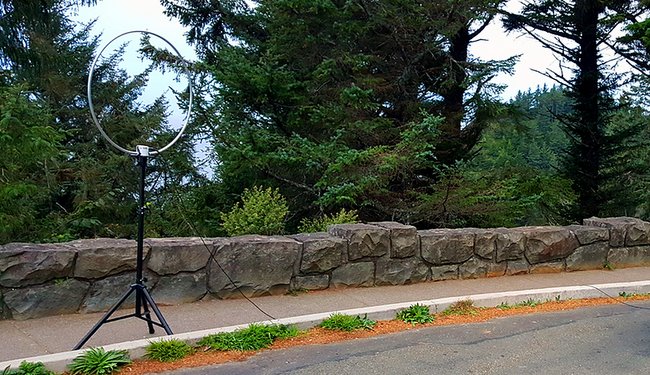
Because of the limited space along this scenic coastal highway, all antennas used for DXing need to be both compact and temporary. Wellbrook loops supported on pro-audio speaker stands are a great way to go, and can easily be set up in the pre-dawn darkness.

Comparison
Both Wellbrook loop antennas mounted on "pro-audio" tripod stands right at the cliff edge at Rockworks Cliffs. (Photo: Guy Atkins)

Both Wellbrook loop antennas mounted on “pro-audio” tripod stands right at the cliff edge at Rockworks Cliffs. (Photo: Guy Atkins)

This is a comparison file of weak signal reception with the two models of Wellbrook Communications “Imperium” series loop antennas: the ALA1530LN “Pro” Imperium and the ALA1530S+ Imperium.

Both models of compact, 1-meter dia. active loops are excellent for reception from longwave & medium wave upwards. However, the ALA1530LN “Pro” excels at LW & MW with its low overall noise level and 9dB higher gain, engineered by Wellbrook for improved signal-to-noise ratio (S/N) of up to 10 dB. S/N on the HF bands is reportedly better also.

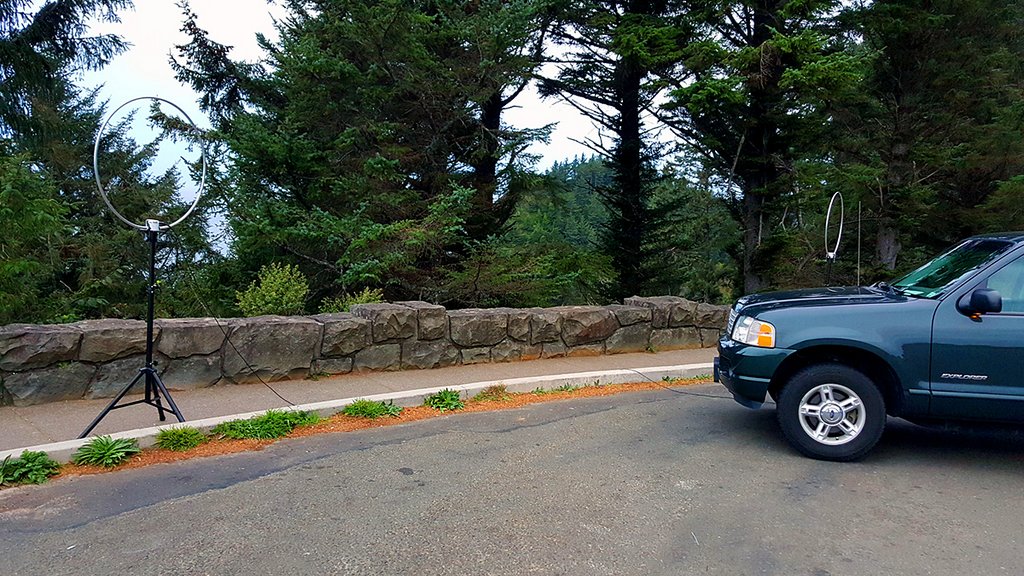
My laptop running HDSDR software in my SUV; the receiver is an Elad FDM-S2. (Photo: Guy Atkins)

My laptop running HDSDR software in my SUV; the receiver is an Elad FDM-S2. (Photo: Guy Atkins)

On the weekend of October 24th, 2015 I was DXing at the “Rockworks” cliffs on the Oregon coast near Manzanita, OR. Both of these Imperium series antennas were in use and I was recording the medium wave band with an Elad FDM-S2 SDR receiver. Both antennas were fed with identical 25 ft. lengths of RG-58 coaxial cable.

The demonstration in this video begins with 10 seconds using the ALA1530LN Pro Imperium loop, alternating with 10 seconds with the ALA1530S+ Imperium loop.

The first signal tuned is aviation voice beacon “SQM” from Level Island, Alaska on 529 kHz (400 watts). The signal is weak, but audible as it rises above the noise floor. The reception improvement with the ALA1530LN Pro is evident.

Half way through the recording the frequency is switched to 1710 kHz, where an unidentified station (possibly a MW pirate) is audible playing the 1967 Zombies tune “Time of the Season”. Again, the clip starts with 10 seconds with the ALA1530LN Pro alternating with 10 seconds of the ALA1530S+ Imperium.

Each antenna is a worthy, compact loop for DXing, but for chasing the weakest signals with the best readability I think the ALA1530LN Pro shows its advantages.


Many thanks, Guy, for sharing your loop research! 

What I love about your portable SDR set-up, is that you can go to the cliff side, set up your antennas and equipment, record the spectrum on your SDR, then go back home to analyze and listen to what you captured.  It takes some of the pressure off while you’re on-site. 

This year at the Dayton Hamvention, I purchased the Pixel Technologies RF PRO-1B mag loop antenna. I used it (for the first time) at the PARI DXpedition. We were all impressed with its performance. I would love to compare it with the ALA1530LN Pro at some point in the future.

Tune in: Halloween weekend is a pirate radio playground!

Haloween-Pirate-Radio

Halloween is typically the most active day of the year for shortwave pirates…so, here are three things you’ll want to do this Halloween:

  1. Listen for pirate radio stations this weekend!  Turn on your radio anytime this weekend, but especially around twilight and tune between 6,800 – 6,990 kHz. Pirates broadcast on both AM and SSB; you’re bound to hear a few. For a comprehensive primer on pirate radio listening, check out this post.
  2. Note what pirate stations are being logged–in real time–on the HF Underground pirate radio forum. This is a very active community of pirate radio listeners; I often check the latest loggings to discover frequencies where stations have surfaced. Click here to view the HF Underground pirate radio forum. Posting to the forum requires registration and approval by the moderator (so do this in advance!).
  3. Check out Andrew Yoder’s pirate radio blog with its deceptively simple title, the Hobby Broadcasting blog. Andrew is the author of the Pirate Radio Annual and a guru on shortwave pirate radio. He’s already logged a few mid-week, pre-Halloween pirates. Bookmark his site while you’re at it!

Happy Halloween to all! 

PCJ special broadcasts to Europe and SE Asia

UPDATE: Frequency has changed.  Please read this update.

(Source: PCJ Media Press Release)

pcjOctober 29, 2015

Beginning November 14th, 2015. PCJ Radio International will offer a series of special broadcasts before the end of the year for listeners in Europe and Southeast Asia.

Time: 0900 to 1000 UTC
Frequency: 17825khz

November 14th – Say It With Music
November 21st – Call it Ukraine
November 28th – Rockin’ with Raoul
December 5th – Classics with David Monson
December 12th – Special Jazz For The Asking
December 19th – European radio during WW2 (documentary)
December 26th – Special listeners programs

Each of these special transmissions will have a special E-QSL.

Good Listening!

Guest Post: A Late Summer Visit to Howard Mills’ Radio Restoration

Many thanks to former VOA correspondent and noted DXer, Dan Robinson, for the following guest post:


DSCF7551

A Late Summer Visit to Howard Mills’ Radio Restoration

-Dan Robinson

The end of summer is a wistful time, as we begin to mourn the passage of warm days and anticipate the arrival of autumn.

For those of us in love with shortwave, even in these waning days of HF broadcasting, August brings changes in propagation that herald the approach of improved reception, thoughts of getting antennas in shape, and preparing receivers for the new DX season.

It’s also a time when Hamfests are winding down for the year — for me, it’s still great fun to attend these and see what equipment is available.

A few months ago, I and fellow Washington, DC area SWL Dave Malick took the opportunity to visit a couple of Hamfests. At one of these, in Berryville, VA, I ran across someone who over the years has become somewhat of a legend in the field of radio restoration — Howard Mills.

Howard lives in rural West Virginia, at a point about equidistant from Harper’s Ferry and Sheperdstown. That’s about an hour or so from DC and the immediate Maryland suburbs. From DC, you drive out Rt 270 to Frederick, Maryland and then up Route 15 and 340.

It’s beautiful country — on the way you pass through small towns, past farms, and in late summer, roadside stands selling huge ears of corn and about every type of vegetable, along with peaches and apples of every type and size.Rack mounted equipment

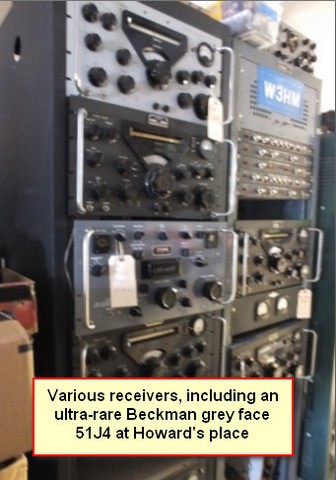
Back in the late 1990’s I first became aware of Howard Mills when I brought my Collins 51J4 to him for refurbishing.   Howard is one of the few persons remaining in this country capable of going through classic tube receivers from top to bottom.

A visit to Howard is an experience everyone should have at least once in a lifetime. Restoration activities take place in the lower/ground level of his home.

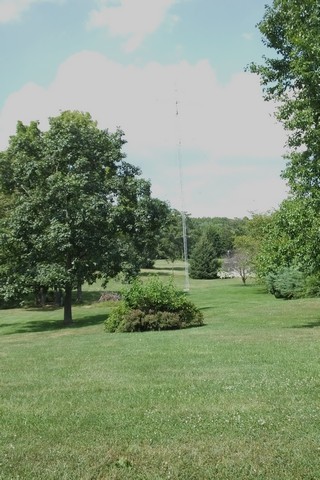
Outside there are some amazing antennas, long wires, and beams which support both his amateur radio and receiver activities.
DSCF7558Under a porch, covered in tarps, are some of his latest equipment and parts acquisitions, from thousands of tubes to some of the rarest radios and transmitter items one may ever see.
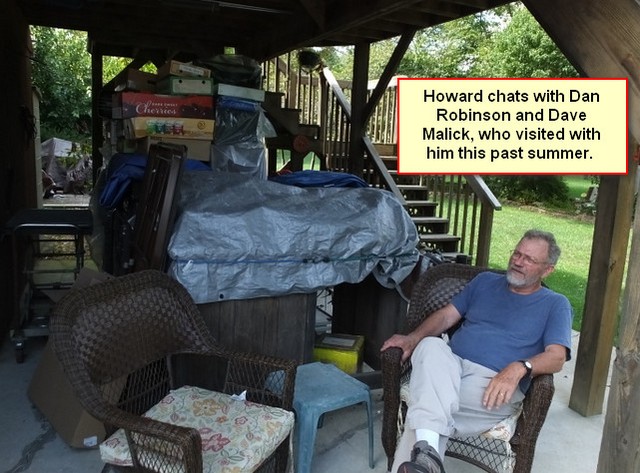
Howard at his home in WVA

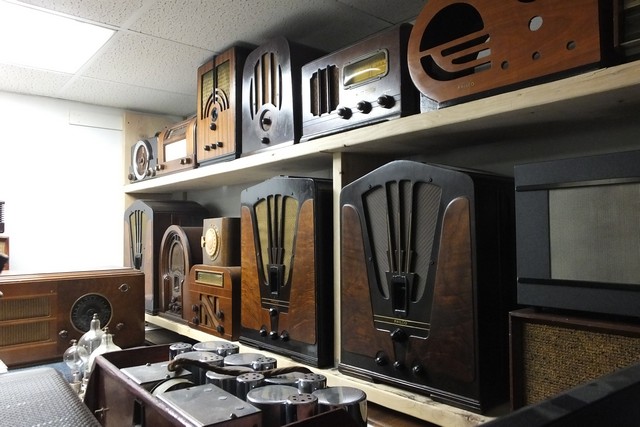
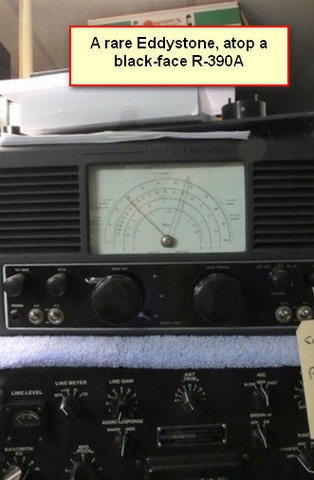
Inside, you find a wonderland of receivers. You name it, Howard has it. In racks, there are specialized Beckman 51J4s, SP-600s, AR-88s and R-390/As, Eddystones, and others. In another room, you see some of the most beautiful, and collectible and valuable, American and foreign-made radios dating back to the earliest days.

Rare Eddystone

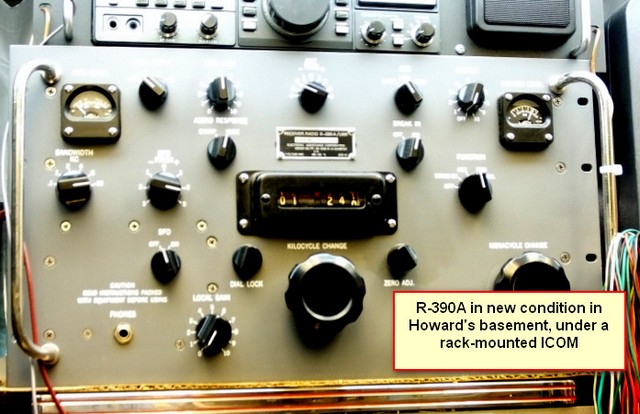
On tables in one portion of the basement of Howard’s place, you find several R-390s in various stages of refurbishment. One, he notes (probably among his “keepers” ) was found still new in its original crate (how I would love to have that one!).

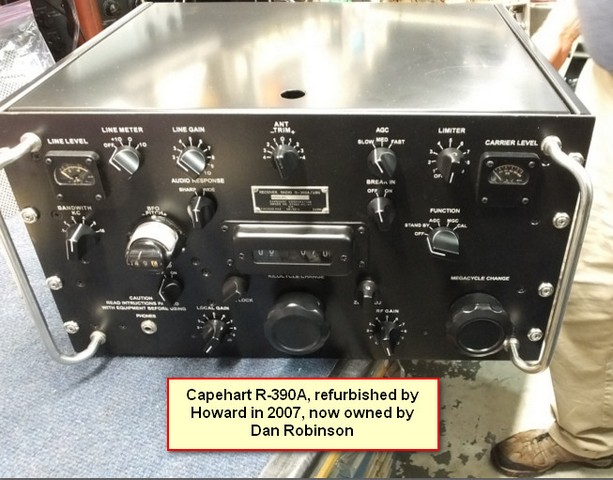
On the day Dave and I visited, the purpose was to pick up one of the most beautiful R-390s I have ever seen — a Capehart that was refurbished by Howard in 2007 and placed in a custom cabinet, complete with an easy-left-off top, similar to the HQ-180 design. This black beauty is now sitting in my shack at home.

R-390A Capehart

Howard has been at it for many decades, as I said. A conversation with him is a voyage through radio history, punctuated by references to a range of major radio manufacturers. He clearly loves what he does, though one wonders how much longer he will be at it.

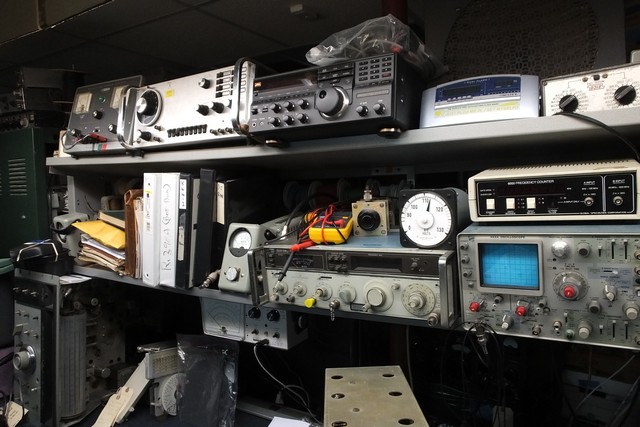
Howard emphasizes by the way that his work is in restoring TUBE radios — he doesn’t get into solid state. There are a few well-known receivers in his place — I noticed an ICOM IC-R72 and a JRC NRD-535– but most of what you see are the classics that we have all come to know and love.

DSCF7529

His primary specialty appears to be the 51J series. A link to him on the Collins site notes that his main focus is on A line equipment, J series, and 32V series, but he is certainly capable on a number of models, including as I saw, HQ-180s and AR-88s (http://www.collinsradio.org/howard-mills/)

I was able to take some photos of Howard’s operation and offer them to SWLing Post readers here. At this point, Howard remains in business. He has had customers from all over the U.S. and I assume around the globe.

For each refurbishing job, Howard provides an extensive print out of every single modification and component replacement he does, along with the results of sensitivity and calibration tests done for each set.

Please do note that Howard makes clear that basically as long as it takes him to refurbish a radio — is as long as it will take.   If you give him one of your radios, you basically agree to it being with him for several months if not longer. He does have a backlog.

R390A New

Things like sandblasting front panels for R390s (I am not certain to what extent he does this himself or out-sources this particular aspect) also takes time.   And the detail with which he approaches a breakdown of an R390/A, evidenced by the sets I saw in process, is quite extraordinary and time-consuming.

Howard gets mostly superb reviews from those who have used his services. If you look him up on the Internet, and he has time for you to visit, it’s an experience you will always remember, though it’s not that I would suggest a crowd descend on him.

Hope everyone enjoys the photos — I had intended to get this article to Tom much sooner than October. Keep in mind, of course, that though Howard is one of the last to do this kind of work, there are a few others, including Chuck Rippel in Virginia.

We are indeed lucky to have anyone still doing this work. We know they do it not just as a business, but out of a love for this wonderful old equipment.

Photo gallery

This slideshow requires JavaScript.


Many thanks, Dan, for taking us on this virtual tour of Howard Mills’ collection and workshop!

Your Capehart R-390A is absolutely gorgeous; Howard, no doubt, brought it back to mint status through loving, considerate restoration. What a great addition to your collection, Dan.

Thank you, again,  for sharing your guest post.

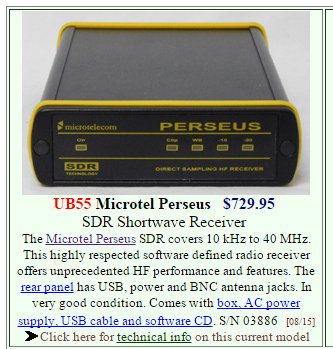
Used Microtelecom Perseus $729.95 via Universal Radio

MicrotelecomPerseus-1

I regularly check out the used equipment list at Universal Radio. While prices are not rock-bottom, the seller (Universal) is solid. Universal backs all of their used equipment with a 60 day limited warranty and their product descriptions are accurate. Fullscreen capture 10272015 65822 PM

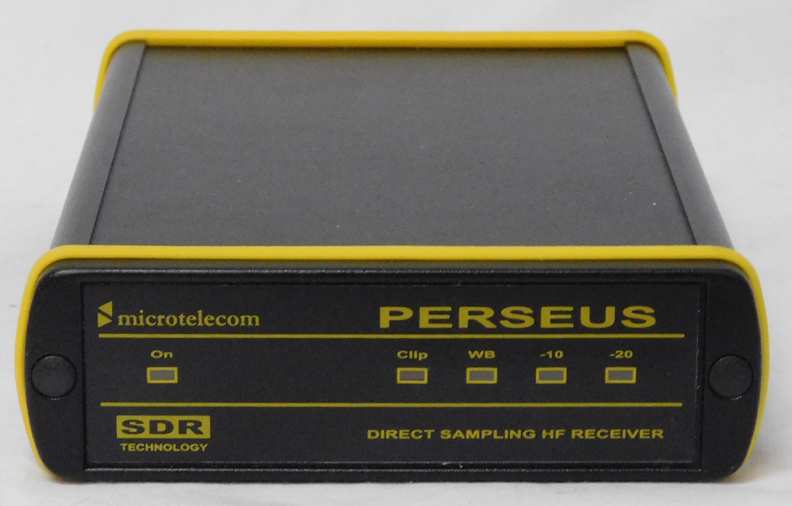
This Microtelecom Perseus (see ad above) appeared in Universal’s used index a few weeks ago.  I assumed it would be snatched up pretty quickly at $729.99 US. I’ve been tempted to purchase it, but since I have no less than five SDRs in my shack at the moment, it would certainly be in excess to my needs.

Why buy a Perseus?  Even though it’s been on the market for many years, the Perseus has an excellent receiver that is comparable to or better than many of the latest SDR offerings. While I’ve never been a huge fan of the Perseus application/software, it is unique in that it allows you to both share your receiver and control other Perseus receivers online. The included server software is relatively easy to implement as well; no doubt, this is why there are so many Perseus receivers online.

I’ve even heard rumors that Microtelecom may be introducing a new Perseus application before long (I certainly hope this is true).

If you’ve been looking for a used Perseus in good condition, I feel like the $729 price is fair from Universal Radio (new units sell for $999.95).

Occasionally, you can find the Perseus used on eBay as well (click here to search).

At the prompting of Mark Fahey, I’m planning to borrow a friend’s Perseus soon and try some of the online functionality. If I make the receiver available through the Perseus online network, I’ll post an update here on the SWLing Post.

Reminder: Share a photo of your shack or listening post for a chance to win a Grundig G2

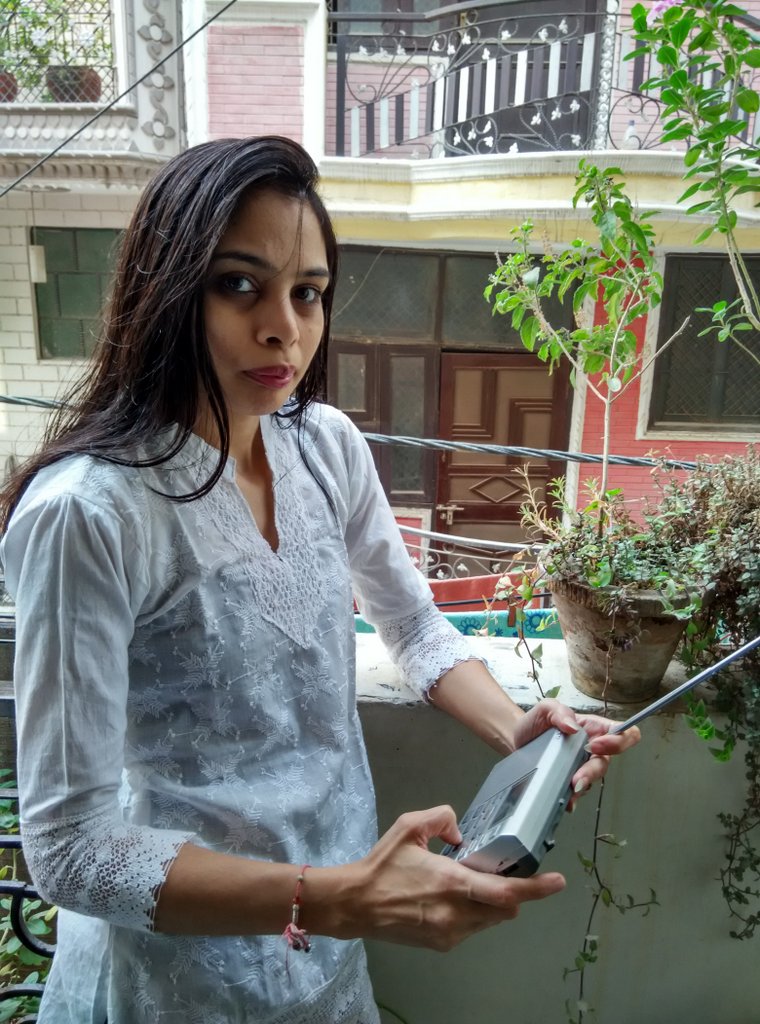
Manisha's favorite listening post is her balcony in New Dehli where she listens with her Sony portable.

Manisha’s favorite listening post is her apartment balcony in New Delhi.

The November 1st deadline for our latest Reader Challenge is approaching!

In exchange for sharing a photo of your favorite listening post or your radio shack with the SWLing Post community, you’ll be entered for a chance to win a Grundig G2 portable radio/recorder and player! The choice will be made by random selection, so everyone has an equal chance of winning.

Click here to read a full description of the contest and how you can participate!

Many thanks to our friends at Universal Radio for sponsoring this contest!

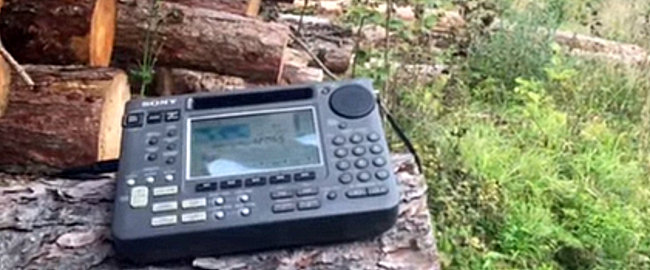
Mini DXpedition: Oxford Shortwave Log and the Sony ICF-SW55

Sony-ICF-SW55

SWLing Post reader, “Oxford Shortwave Log” recently noted the following on our Facebook page:

“Hi there, I received some very nice feedback regarding almost perfect reception of Radio Australia during a mini DX-pedition into the Oxfordshire countryside and thought I would share it.”

“I use a (now vintage I guess!) Sony ICF-SW55 and a 25 metre long-wire. There are lots more videos at on YouTube channel: Oxford Shortwave Log

Great proof that Mini DXpeditions can pay off!

Sounds like that Sony ICF-SW55 performs admirably–it is certainly a classic portable.

I remember when the ICF-SW55 was introduced in 1993-1994; back when I was doing my undergraduate studies and had no funds for it. In the 1990s, Sony’s portables almost seemed to be sent to us from the future–large informative displays, advanced memories, and incredible portable performance were the hallmarks.

On eBay, you’ll find that the ICF-SW55 still fetches a high price.

OSL: thanks for sharing the videos!