Category Archives: Shortwave Radio

Excellent current conditions, evidenced by today’s 31 meter logs

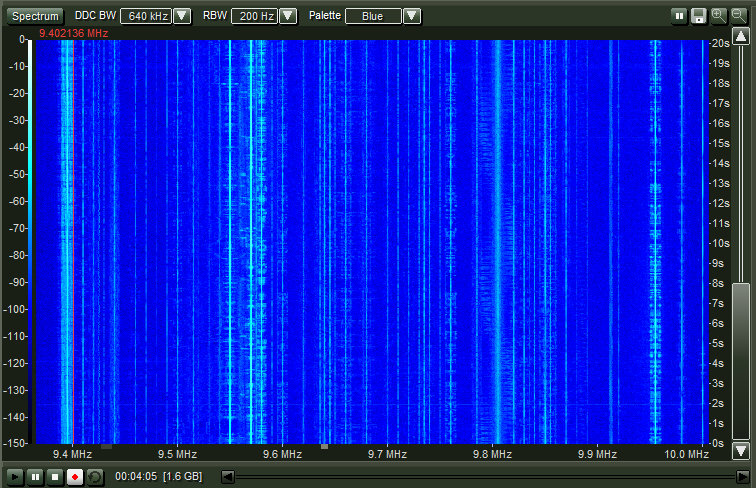
31meterband-waterfall

This morning, before heading out the door, I tuned around the 31 meter broadcast band. I’ve actually been recording 640 kHz of the 31 meter band for almost 24 hours, trying to capitalize on the fact that propagation conditions have been the best I’ve seen in several months. At some point in the future, I’ll load this recording, tune through it and remind myself what’s possible when propagation is favorable! Check out the waterfall screenshot above.

Asian stations had a strong showing on the band in eastern North America this morning.

Here are the stations I logged starting around 12:30 UTC today:

  • 9395 WRMI English
  • 9410 China National Radio 5 Chinese
  • 9420 China National Radio 13 Uyghur
  • 9430 FEBC Radio Chinese
  • 9440 China Radio International Cambodian
  • 9460 China Radio International English
  • 9470 UNID (weak)
  • 9490 Voice of America Korean
  • 9500 China National Radio 1 Chinese
  • 9515 China National Radio 2 Chinese
  • 9540 China Radio International Chinese
  • 9550 Radio Havana Cuba Spanish
  • 9570 China Radio International Cantonese
  • 9575 All India Radio Tibetan
  • 9580 Radio Australia English
  • 9600 China Radio International English
  • 9620 All India Radio Sindhi
  • 9635 Voice of Vietnam 1 Vietnamese
  • 9640 Radio Havana Cuba Spanish
  • 9645 China Radio International English
  • 9650 Radio Sonder Grense Afrikaans (with QRM)
  • 9660 Radio Taiwan International Chinese
  • 9665 KCBS Pyongyang Korean (weak)
  • 9680 Radio Taiwan International Chinese
  • 9700 Radio New Zealand International English
  • 9710 China National Radio 1 Chinese
  • 9720 Reach Beyond Australia (HCJB) Indonesian
  • 9730 China Radio International English
  • 9735 Radio Taiwan International Indonesian
  • 9740 BBC English
  • 9750 NHK World Radio Japan (?) Japanese
  • 9760 China Radio International English
  • 9785 China Radio International Laotian (?)
  • 9805 Radio Marti Spanish (w/accompanying Cuban jammer)
  • 9820 Radio Habana Cuba Spanish
  • 9830 China National Radio 1 Chinese (with RTTY QRM)
  • 9835 RTM Sarawak FM Malaysian (very weak)
  • 9840 Voice of Vietnam English
  • 9845 China National Radio 1 Chinese (weak)
  • 9855 China Radio International Chinese
  • 9870 AIR New Delhi Hindi
  • 9880 KSDA-AWR Guam Korean
  • 9920 FEBC Radio Hre
  • 9955 WRMI English
  • 9980 WWCR English
  • 10000  WWV Ft. Collins

That’s 46 signals in a space of 640 kHz–not bad!

I dare say: these excellent band conditions will not last forever.

Make time to play radio today!

Virtual Radio Challenge IV: Emergency radio and a chance to win a prepper radio package

GP5SSB-Front

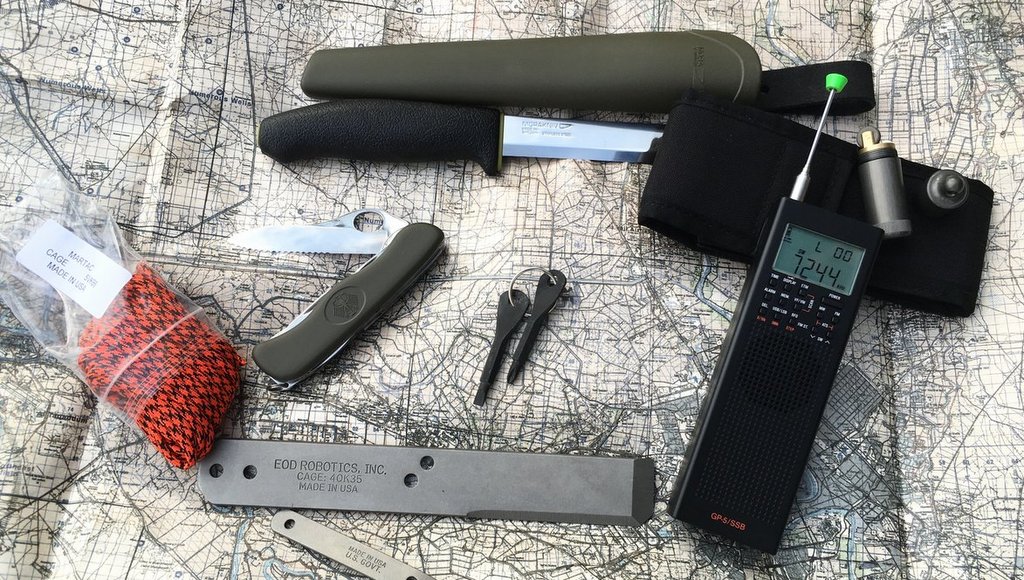
The CountyComm GP5/SSB portable SW/AM/FM radio is just one of many items in this prize package!

UPDATE: This challenge is now closed.  Click here to read about the winning entries.

The SWLing Post attracts readers and enthusiasts from all walks of life. In the past, we’ve put together Reader Challenges based on actual questions we receive from readers, usually looking for the best radio kit for a unique situation or location. Our first challenge sought gear for the most remotely inhabited island on the planet; the second, for a village in the Himalayas; and the third, for an Appalachian Trail thru-hiker.

This time we’re taking a slightly different angle, but nonetheless representative of a quite significant (and growing!) number of reader queries: What is the best radio for use in an emergency? Or, as we’re often asked,”What is the best prepper radio?”

There are many ways to answer this question based upon the scenario a reader is confronting. To help define a scenario for this challenge–perhaps the first in a few similar radio challenges–I enlisted the help of my good friend, David Cripe (NM0S). Dave, an engineer and radio/kit designer, is something of a modern day MacGyver and preparedness expert. Not to mention, a very cool guy.

Dave agreed not only to help author an emergency scenario (below), but has also agreed to judge the reader challenge responses.  Dave will select his favorite from among the best  entries.

But there’s more: CountyComm Government Products Group has generously offered a comprehensive prize package for the winning entry!

Interested? Keep reading…

The scenario
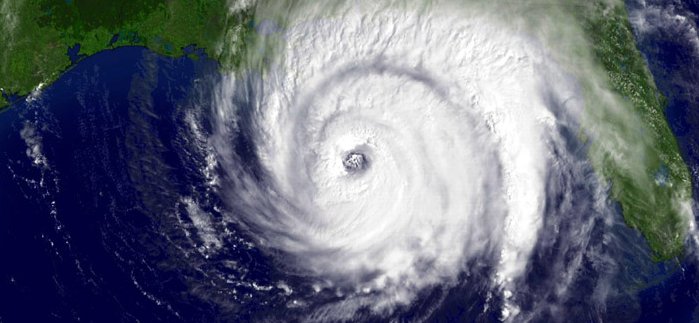
ivan-hurricaneAs is often said, stuff happens. Indeed, our modern communication infrastructure is a fragile thing. Let’s imagine that your area suddenly loses power–as well as cell phone and internet service–for an indeterminate period. Home and personal electronics remain unaffected, but must be powered off-grid (without mains power).  Moreover, you may be required to evacuate your home…perhaps even on foot.
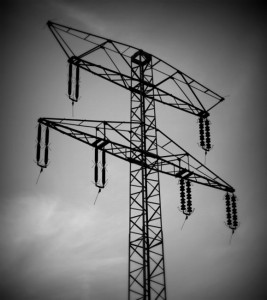
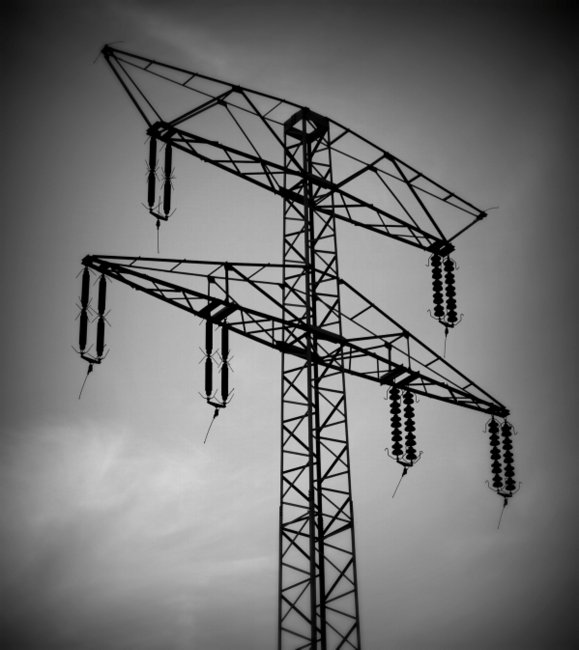
Electricity-Pylon-TowerDoes the above scenario seem far-fetched?  Actually, this is just the sort of scenario we often see occur in regions throughout the world as the result of natural disasters (and occasionally human sabotage), and it’s the scenario we’ll mentally prepare for in this exercise.

In preparation for this event, what portable radio kit would you assemble?  In particular, you’ll want to look for an optimal combination of features and portability for price, ($400 US for all your kit). And it isn’t just the radio we’re interested in, but also how you intend to use it.

Therefore, how do you intend to:

  1. obtain information about local and world events?
  2. communicate within your local region to assist emergency services?
  3. pass messages to friends and family over long distances?
  4. power your kit for an indeterminate amount of time?

Limitations

Rather than making this virtual challenge restrictive, the following limitations are designed to make the challenge more fun and create a level playing field for all participants.

  1. Once again, you’re limited to a (virtual) budget of $400 US to procure your supplies; ideally, this will include the shipping costs of all purchase(s) you make.
  2. You may select new, used, or homebrew gear, but you must base your choices on reality (i.e., actually find item(s) online and document the price and time of availability). If you “shop” eBay, for example, make sure you’re using the final purchase price, not the current or opening bid. If you do locate something used on eBayQTH.comQRZ.com, or at Universal Radio, for example, do include the link to the item (just to add to the fun). If you enter a homebrew radio, it should be based on something you’ve either built or used, and must include a photo. Of course, you can use multiple radios, but keep in mind the amount of space and weight these will consume in your evacuation or “bug-out” bag.

The prize package
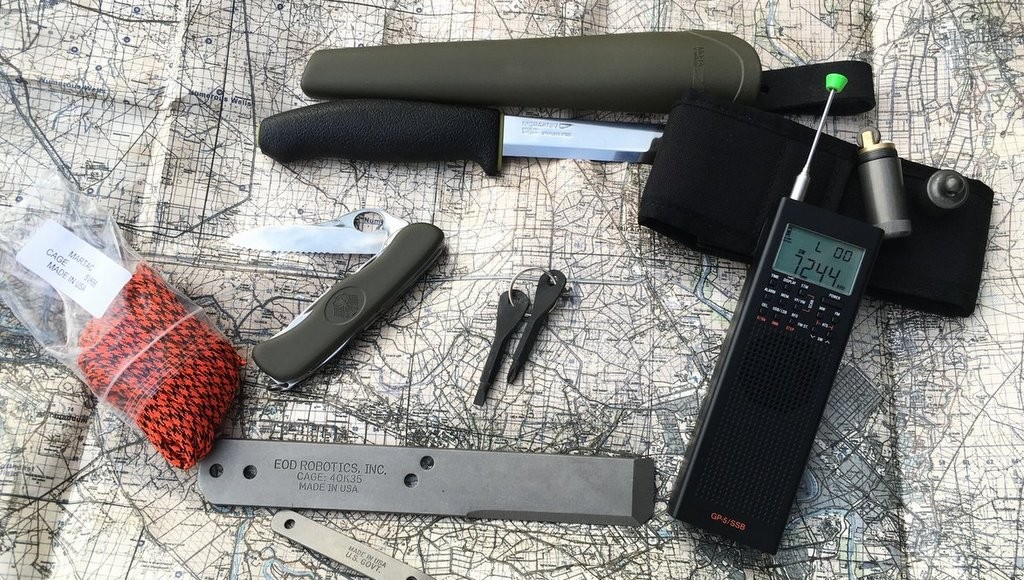
Click to enlarge

Click to enlarge

CountyComm is generously offering the selected entrant of this contest a prize package that includes the following items, useful whether there’s an emergency or not:

The total value of this kit is $209.94 US!

How to enter the challenge

This challenge will continue for one month, ending on November 21.

To enter, simply describe the kit you’ve chosen and how you would address the scenario above. Please be specific, but also as concise as you can. If you’re describing a radio or gear you already own, consider sending photos, as well.

Simply send your entry to [email protected].

Spread the word!

If you’re active in a preparedness group locally or online, please help us spread the word in your group!  Although there is a serious element to this exercise, in that it might really help you or another reader in an emergency situation, it’s intended to be fun; enjoy the challenge, and good luck!

The bands are open! Make time to listen.

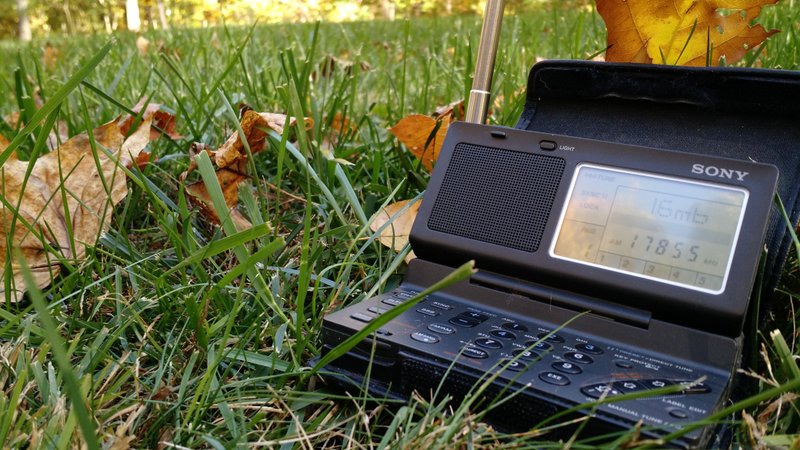
Sony-ICF-SW100-Outside-Fall

Though I’ve spent the entire day sawing and splitting firewood, I’ve been actively recording spectrum on the 31, 25, 19 and 16 meter bands with the WinRadio Excalibur, Elad FDM-S2 and the SDRplay RSP. Why? Propagation–especially on the higher bands–has been the best it’s been in several weeks.

As I discovered at the recent SWLing Post DXpedition, my shack PC can handle making multiple spectrum recordings simultaneously as long as I limit each recording to the width of a broadcast band. (I’ve never tried pushing the limit very hard.) Someday in the future–perhaps when we’re having terrible propagation–I’ll play those spectrum recordings back and tune through them as if they were live.

Radio time travel at its best.

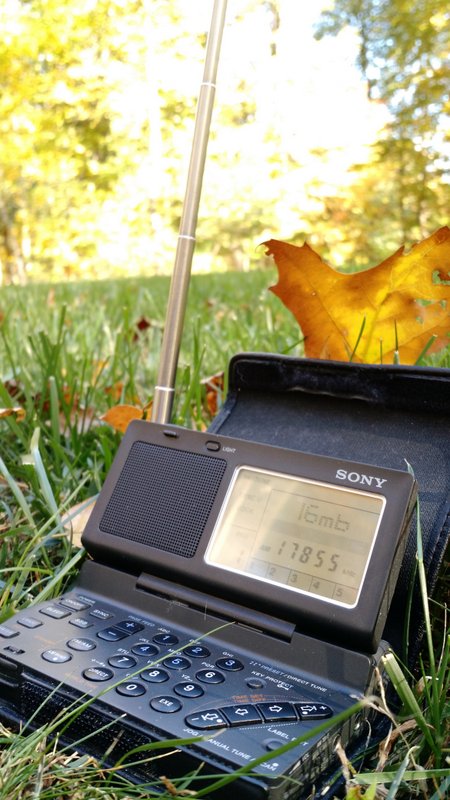
Sony-ICF-SW100-Outside-2

When I decided to throw in the towel with all of the firewood processing, I fired up the Sony ICF-SW100 (above) and tuned in a game on 17,855 kHz: Radio Exterior de España.

The REE signal was simply booming into eastern North America!

Hard to break away from the radio on days like this.

My advice? Take advantage of these conditions and make time to listen!

For me, SWLing a great excuse to relax and let me back heal after a long day of splitting wood. For some, perhaps it’s a good excuse to take the radio outdoors and away from urban interference. Whatever the excuse, don’t hesitate to fire up your radio!

There are some interesting stations on the bands this evening. Feel free to comment with some you’ve logged.

SDRplay RSP review in CQ Ham Radio Japan

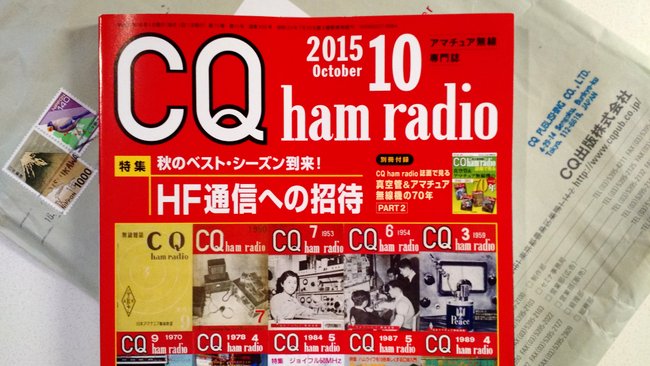
CQhamradioMag-Front

Two weeks ago, I received a mystery package in the mail: a copy of the October 2015 issue of CQ Ham Radio magazine, sent directly from the publisher in Tokyo, Japan.

Supplement magazine shipped with the October issue.

Supplement magazine shipped with the October issue.

Since I can’t speak or read Japanese, I was very confused why I would receive a copy.

Out of curiosity, last week, I opened the magazine to see what sort of articles it contained.

In short: I was very impressed. While I couldn’t read the content, of course, I was able to get an idea of the scope of this magazine–it contained numerous articles, news items, reviews and photos.

I was pleased to note a section that focused on good etiquette for amateur radio exchanges in English. After all, if you are a Japanese DXer, you will need to know enough English to log DX stations around the world as English is the staple DX language. Japanese hams are well known for their excellent on-air etiquette–ask anyone who has been on a DXpedition.

The magazine is thick, too; most of the pages are black and white news print, but there are several color/glossy sections as well. This particular issue was even mailed with a separate supplement magazine containing a history of ham radio ads throughout the years. I thoroughly enjoyed the trip down memory lane.

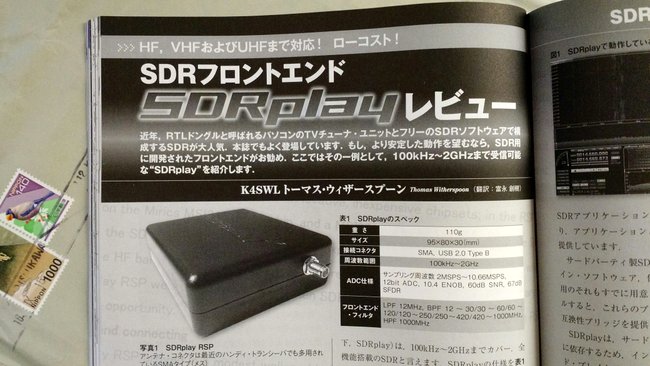
CQhamradioMag-Article

Once I landed on the page above, I quickly realized why I had been sent a courtesy copy of the magazine: my SDRplay RSP review had been translated and published. It was then I remembered granting permission to have the article translated into Japanese for a ham radio magazine. I had completely forgotten!

I’m honored my review was printed in CQ ham radio, but most of all, it has been fascinating to browse through what appears to be an excellent radio publication. I offer my gratitude to the translator who took the time to edit my article.

ITU Monitoring Programme: 2.85 to 28 MHz

Fullscreen capture 10142015 42958 PM

I’m having difficulty remembering who sent me a link to the ITU Monitoring Programme, but I am most grateful.

What is the monitoring programme? Here’s the description from the ITU website:

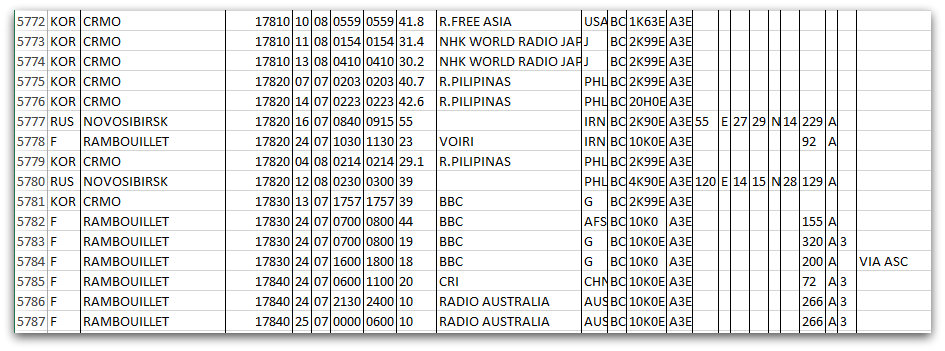
“The objective of this monitoring programme is to identify stations whose emissions in bands between 2 850 kHz and 28 000 kHz are not in conformity with the RR and to provide administrations that do not have monitoring facilities with information for frequency management purposes.

?The Bureau prepares a publication containing spectrum monitoring information in the frequency bands between 2 850 kHz and 28 000 kHz submitted by administrations in accordance with BR Circular-letter CR/159 of 9 May 2001.”

The data can be downloaded in spreadsheet format, organized by monitoring date. It’s an amazing amount of information–a decent survey of what can be found on the bands.

Click here to view the list of spreadsheets.

Tom’s 1981 off-air recording of RCI’s Shortwave Listener’s Digest hosted by Ian McFarland

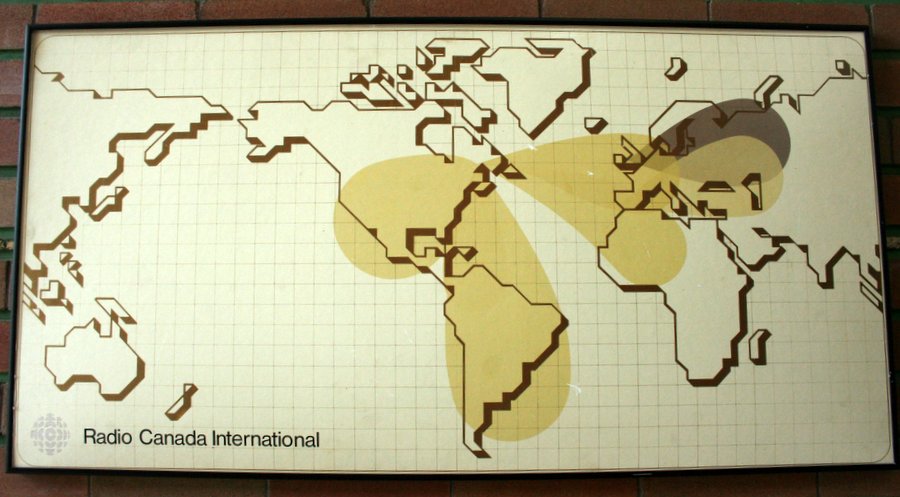
I snapped a photo of this propagation poster in RCI's Sackville, NB transmitter site only months befor ethe site was closed.

A propagation poster in the foyer of RCI’s Sackville, NB, transmitter site only months before the site was closed. (Photo: Thomas Witherspoon) 

Tom Laskowski, has been generously contributing a number of off-air shortwave radio recordings to the Shortwave Radio Audio Archive (SRAA).

Recently, he shared a series I’m sure many of you remember. Tom writes:

My first contribution of many recordings I have of Radio Canada International’s Shortwave Listener’s Digest hosted by Ian McFarland.”

“The first 12 1/2 minutes is Bonsoir Africa. The recording was made using a cheap GE portable. The audio quality isn’t great but it’s still very nostalgic listening to a program I recorded 34 years ago.”

This brings back many memories of one of my favorite shortwave programs–thank you, Tom!

The audio quality actually reminds me of one of my first analog portables, Tom! Nostalgia at its best.

Check out all Tom’s SRAA contributions by clicking here. While you’re at it, bookmark the SRAA!

C.Crane fixes CC Skywave overloading

CCrane-CC-Skywave

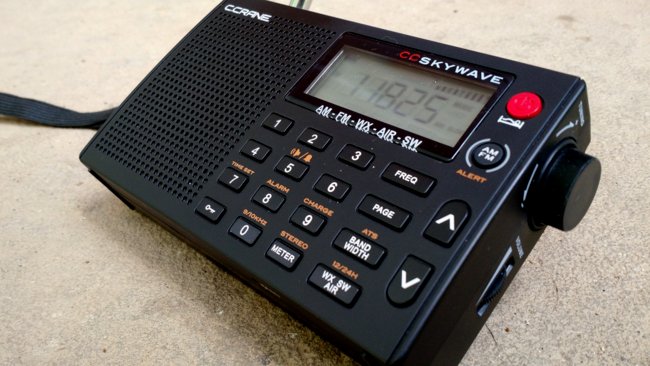
Many thanks to SWLing Post readers, Mark and Alan, who were both recently notified by C.Crane that the CC Skywave has been updated.

Mike purchased the CC Skywave early this year after reading our review. He was disappointed to find out, though, that a local radio station (in his urban location) overloaded the Skywave’s front end, causing imaging and other problems.

Mike, along with other Skywave owners, notified C.Crane about the issue and returned their units.

C.Crane passed along this feedback to their engineers, who have updated the CC Skywave accordingly.  C.Crane believes the latest production run will be immune to this sort of overloading. [Kudos to C.Crane for listening to customer feedback.]

I contacted C.Crane yesterday–they recommend ordering directly from their website to insure your unit is coming from the latest production run. It’s possible that some of their distributors could still have some of the older units in inventory for the next few weeks. At least, to be certain, you should check with the distributor directly.

To be clear, I’ve never noted the overloading issue on my Skywave, but I live in a rural area with no blowtorch stations nearby. If you live near an AM broadcaster, and are considering the CC Skywave, you should certainly purchase the updated unit.

Click here to view/purchase the CC Skywave on C.Crane’s website.

Again, many thanks to Mike and Alan for the tip!