C.Crane: CC Witness on sale, while supplies last

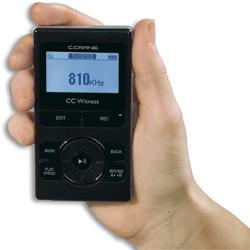
The C.Crane CC Witness

Though not a shortwave radio, the CC Witness is a very capable AM/FM radio with a built-in digital recorder.  In fact, I know of no other portable with on-board digital recording that receives such stellar reviews. As a result, many medium-wave DXers use the CC Witness while traveling, to capture the sounds of the local radio scene on the go.

For ages, the CC Witness was priced well over $200 US.  Right now, C.Crane is selling their stock of CC Witness radios for $99.95 US.

Clearly, this is an excellent bargain for anyone seeking a very small portable AM/FM radio with on-board digital recording. Note that the CC Witness will also do line-in recordings from other audio sources.

Follow this link for details.

Review: The Worldwide Listening Guide

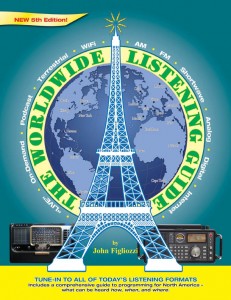
The Worldwide Listening Guide by John Figliozzi

On the SWLing Post, I write an annual review of the World Radio TV Handbook–a fantastic and comprehensive frequency guide, with a focus on broadcasters and frequencies, though it certainly lacks the programming detail–i.e. content–I so enjoyed in the late Passport To World Band Radio.

That’s where John Figliozzi’s The Worldwide Listening Guide (WWLG) comes in–in short, I think you need a copy in your shack, not to mention, next to your computer.

The Worldwide Listening Guide is like no other frequency/schedule guide you’ll find on the market. First of all, it’s instantly apparent that the author, John Figliozzi, is a DXer, since the book has a spiral bind–which permits it to lie flat when open, and allows the pages to be folded back to take up less table space. A small detail, but important for those of us who want an easily accessible reference in the shack. Figliozzi, moreover, is a noted SWLer, a long-time active member of the North American Shortwave Association, co-host of the annual NASWA Winter SWL Fest in Plymouth Meeting, PA–and did I say, a great guy?

But back to the book: perhaps what makes the WWLG so unique is its comprehensive look at “radio” listening in general, guiding the reader through the many forms radio content now takes:  live, on-demand, WiFi radio, podcasts, satellite, internet, AM/FM and, of course, shortwave radio. He explains the pros and cons of each delivery method and a little about its utility. I thought that I wouldn’t gain a lot from these beginning sections as I’m quite familiar with all of them, but was pleasantly surprised to find all sorts of interesting facts hidden within; no doubt you will, too. Figliozzi also spends a good deal of time time covering the various devices–such as WiFi radios, satellite radios, apps, shortwave radios, portables–that have become indispensable tools of the trade.

Program details like no other

My favorite part of WWLG, and the sections I turn to the most, are those covering programming and content. Figliozzi exhaustively curates more than 4,000 programs sorted by time of day, station, days of broadcast, program types, their frequencies and web addresses. He also sorts the listings by genre:  from the arts, culture and history, to music, sports and more. In fact, he has a well-thought-out list of 34 genres that have helped me locate programming I would have otherwise have never known about. For example, SWLs will find his “Media and Communications” genre listing programming from Allan Weiner Worldwide, Glenn Hauser’s World of Radio and DXers Unlimited to Click and Tech Nation. Each listing tells you exactly when you can catch the program, and where.

What’s also great is the fact that if I find a program I like, I can cross-reference its offering on shortwave–and, if I miss that, I can look up where to find it on demand, on the internet.

A program guide with longevity

I have the 5th edition of The Worldwide Listening Guide–the latest. While I like to have an annual guide, I actually believe this guide will be valid for several years. True, some programming comes and goes–as we’ve seen shortwave stations leaving this year–but, Figliozzi also actively maintains a companion website, The Worldwide Listening Guide Online, which he keeps up-to-date with the latest changes; there is even a blog with his comments and news items. He tells you when to cross out and change listings in your WWLG as programming evolves.

In short, I like the WWLG and have decided that it will become a permanent reference book in my shack, along side my trusty WRTH. There is a surprising amount of information packed into this slim, spiral-bound book. Enough to keep even the seasoned DXer happy for years.

The Worldwide Listening guide can be purchased here:

Advances in Software Defined Radios could (will) change our wireless world

(Photo Source: New Geography)

Note that I’m not speaking strictly of the HF spectrum here. But mark this:  a radio revolution is, right now, in the making. ARS Technica just last week published an article entitled, “How software-defined radio could revolutionize wireless” in which the authors argue that software defined radios (SDRs) might not only open the door to new uses for our radio spectrum–uses we can’t currently fathom!–but also open the door to unlimited free innovation.  Innovation in the form of experimental hacking, much of which could simply fall below or outside of the FCC and other spectrum governing bodies, could become the province of literally anyone who wants to give it a go.

The article takes the reader through the evolution of SDRs and introduces a company manufacturing a product that could be to the radio spectrum and wireless communications what Apple became to personal computing.

I typically quote my favorite parts of an article, but this one is so very well-written and comprehensive, you really will want to read it in its entirety.  Click here to read, “How software-defined radio could revolutionize wireless“–and let your imagination take flight.

Radio Australia’s live coverage of the London 2012 Summer Olympics

This morning, I’ve been enjoying Radio Australia’s live coverage of the London 2012 Summer Olympics.

In an era where Olympics coverage is tightly controlled by television networks (and swallowed with a generous amount of sponsorship ads) it’s a relief to know that I can hear live, uninterrupted coverage via Radio Australia on shortwave.

Here’s a recording from 9,580 kHz at 14:00 UTC today (coverage begins after the news):

Radio Australia is well known for their sports coverage. Indeed, I’ve heard their dedication to cricket, football and rugby coverage secures their listenership throughout Asia and Oceania.

I believe it. Thanks, RA!

Do you own a Quantum shortwave radio?

The Quantum FX J-114U portable analog shortwave radio features an analog radio dial, but USB/SD media playback. Who knew?

Several of you have written to me in the past few months asking about the new Quantum analog shortwave radios found on eBay. The prices for the various models are anywhere between $20-40 US.

I’ve resisted checking into these radios as they have very little technical information available and I assumed would not be worth the bother. In fact, sellers don’t even list the frequency coverage of the shortwave bands, only how many “bands” each unit has (i.e. “SW 1-7”). However, one unit (the Quantum FX J-114U) is available on Amazon, and there have been a few favorable reviews. Now I’m a bit curious.

Do you have experience listening to shortwave on one of these radios? If so, please share your comments.

I just added three of them to the Shortwave Radio Index:

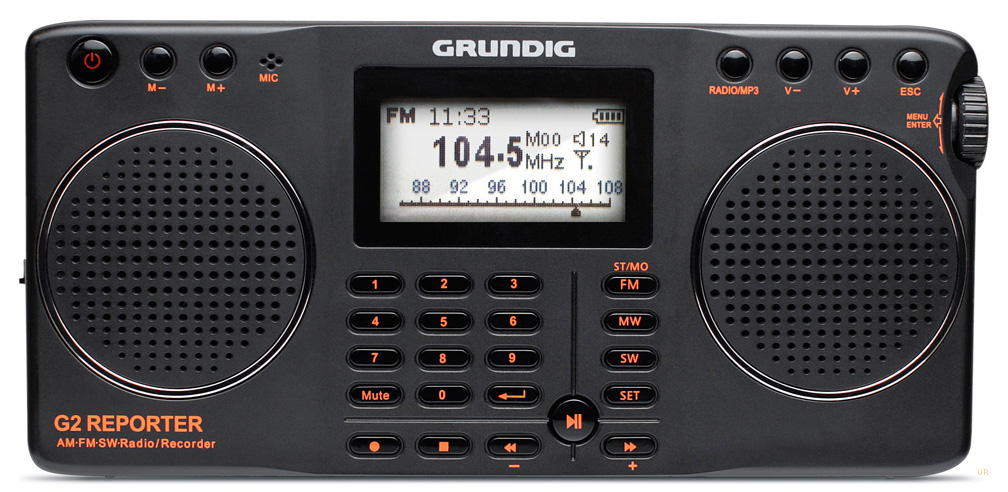
CNET reviews the Grundig G2

, with CNET, has written a review of the Grundig G2.  What’s more, he offers a fairly thorough review of the Grundig G2’s features and design.

First of all, I’m very impressed that CNET would bother reviewing a shortwave radio at all.  Typically, I look to CNET for reviews of portable hi-tech like cell phones, iPods, cameras, computers, and the like; to see them review a shortwave seems like a broad-minded effort.

However, the focus on the G2’s actual shortwave performance was glossed over, at best.  The reviewer merely writes:

If you’re most concerned with pulling in FM stations, you’ll be happy with the G2 Reporter. Even some stations that I’ve found difficult to tune with other portables came in strong. Tuning of AM and SW was good, too, but less reliable than FM.

And…that’s it. So much for the G2’s shortwave.

So, though this is not a review of the merits of the Grundig G2 as a shortwave radio, it does cover the radio’s recording features, battery, .mp3 and .wav file playback, battery, design, and similar features.  Which, at least, is a step in the right direction.

Click here to read the entire review.