Tropical Band DXing at home with Elad FDM DUO and Wellbrook ALA1530 active loop

2-jungleRecently I have spent a little more time listening out for Tropical Band stations from my shack in Oxford UK, attempting to emulate some of the very nice signals I have previously recorded out on DX’peditions. The obvious problems with this (and they are numerous) include the relatively weak signal strength of many tropical band stations, the ubiquitous blanket of QRM, resulting in generally poor SNR, lack of space for a large antenna……need I go on?! Fortunately, the Elad FDM DUO has proven to be a very senstive and selective receiver, capable of, at times, incredible SNR, coupled with almost limitless signal conditioning options and SSB, SYNC, ECSS etc. Throw the Wellbrook ALA1530 active loop into the mix (not literally!) and you have a very powerful Tropical Band receive set-up. The Wellbrook is able to null most (although not all) QRM in my shack and that really can make the difference between simply observing a carrier and actually hearing audio. Clearly one cannot expect to hear DX at home under heavy QRM as well as you might outdoors, however, the following stations were logged in the past month or so, with respectable signals, with the ALA1530 indoors:

Video links also follow below, thanks for reading/ watching.

Direct link to Oxford Shortwave Log video; Radio Logos 4810 kHz, Peru

Direct link to Oxford Shortwave Log video; Radio Cultura Ondas Manaus 4845 kHz, Brazil

Direct link to Oxford Shortwave Log video; AIR Bhopal 4810 kHz, India

Direct link to Oxford Shortwave Log video; Rádio Educação Rural 4925.2 kHz, Tefé, Brazil

Direct link to Oxford Shortwave Log video; Radio Mosoj Chaski 3310 kHz, Bolivia


Clint Gouveia is the author of this post and a regular contributor to the SWLing Post. Clint actively publishes videos of his shortwave radio excursions on his YouTube channel: Oxford Shortwave Log. Clint is based in Oxfordshire, England.
Gary’s Arvin Model 61R35 brings back memories

Many thanks to SWLing Post contributor, Gary Wise (W4EEY), who shares the following guest post:


It’s funny how much we radio folks share in common. The recent posts on Arvin radios made me smile because I have an Arvin radio too. An Arvin transistor was my very first radio, and here she is:

Arvin Transistor Radio

This is the Arvin Model 61R35 in Ice Blue (it also came in black). My parents bought it for me in roughly 1962 or 63. It was the first radio that was mine (though we did have an older Crosley tabletop in the living room of our house in Midland, Michigan that we all used). Mine had seven Germanium (!) transistors (as silicon transistors were not yet in wide production in the early 60s).

Arvin Model 61R35

And Made in America! Arvin was an Indiana company as I recall.

Arvin Transistor Radio

It used a Round 9V battery. They were hard to find even back then, and I expect impossible to find today.

Arvin transistor radio

I used to love to put my fingers on the PC board while the radio was on and listen to the buzzes and noise that I could create. Unfortunately, I think this is what killed the radio and required my folks to mail it off to the big city (Flint, Michigan) to have it repaired. No one in my “little” town could fix solid state radios back then.

Arvin Transistor Radio Repair Tag

I was fortunate not to lose this radio in my many moves throughout the years. I display in proudly in my ham shack.

Arvin Model 61R35 in leather case

Thanks for the memories!

73,

Gary
W4EEY


And thank you for sharing your memories and the great photos of your Arvin Model 61R35, Gary! What a cute little radio–I’m glad you’ve taken care of it all of these years.

Myanmar Radio, Yangon, heard in Oxford UK on 49 and 41 metres

Myanmar

Hi there, I thought some of the readers of SWLing post might be interested in my reception of Mayanmar Radio, Yangon, during a late-night DX’pedition in Oxfordshire, UK. I managed to catch them on 5985 and 7200 kHz; the latter was a personal first and perhaps further confirmation that my 200 metre longwire is contributing in a positive way to my mobile listening post. Subscribers and regular visitors to Oxford Shortwave Log on YouTube will know that I am forever trying to push the performance of my vintage portables to the limit of what’s possible, in the hope that I might hear something very exotic. it’s happened once or twice and thus worth all the effort in the small hours. Thanks for watching/ listening.

Direct link to Oxford Shortwave Log for Mayanmar Radio reception video 5985 kHz

Direct link to Oxford Shortwave Log for Mayanmar Radio reception video 7200 kHz

Clint Gouveia is the author of this post and a regular contributor to the SWLing Post. Clint actively publishes videos of his shortwave radio excursions on his YouTube channel: Oxford Shortwave Log. Clint is based in Oxfordshire, England.

 

AM Mode: Comparing the Elecraft KX2 with the LNR Precision LD-11

My new Elecraft KX2 tuned to Radio Australia this morning.

My new Elecraft KX2 tuned to Radio Australia this morning.

I’ve only had my Elecraft KX2 since Monday evening and have been so busy, I’ve only had an hour or so to tinker with this pocket transceiver. Monday evening, before putting it on the air, I updated the KX2 firmware to the latest Beta release which includes the new AM mode.

I’ve had so many questions from readers about the KX2’s AM audio already, I thought I’d do a quick comparison with the LNR Precision LD-11.

I set the LD-11 to a bandwidth of 9.6 kHz, and the KX2 to 5 kHz: their widest AM filter settings. Keep in mind, this is not an apples-to-apples comparison, but it does showcase each radio’s potential AM audio fidelity.

I tuned both rigs to the Voice of Greece last night on 9420 kHz around 00:30 UTC. VOG’s signal was strong into North America.

I made the following recordings with my Zoom H2N digital recorder, by feeding in-line audio patched from each radio’s headphone jack. I tried to balance the audio levels between the two rigs.

Here are the results:

The LNR Precision LD-11

LNR-Precision-LD-11-AM-Mode-Voice-Of-Greece

Click here to download the audio.

The Elecraft KX2

Elecraft-KX2-Voice-Of-Greece-AM-Mode

Click here to download the audio.

The Elecraft KX2 in “Delay” audio mode

Note: Some Elecraft radios have an audio effects mode which includes a “delay” function. Elecraft describes it as “a quasi-stereo effect intended to provide depth and space to the received audio.” On an AM broadcast signal, it makes it sound wider and gives it almost a stereo depth.

Elecraft-KX2-Delay-Audio-AM-Mode

Click here to download the audio.

I think the results from both radios are impressive. Since the LD-11’s bandwidth can be widened to 9.6 kHz, strong signals like this one sound pretty amazing. In truth, I actually prefer a filter width of about 8.2 kHz on strong signals, but VOG was wide enough to justify 9.6 kHz.  I believe the LD-11 would rival many dedicated tabletop receivers.

The Elecraft KX2, in normal audio mode, sounds flatter and narrower than the LD-11 of course, but still very pleasant!  In the KX2’s “delay” audio mode, the signal sounds much wider than 5 kHz, though the effect adds a little graininess to the audio. That’s okay, though–I love having the “delay” audio option in my tool bag.

Here’s what amazes me as an SWL and ham radio operator: both of these QRP transceivers offer excellent HF broadcast listening opportunities.

Please comment! Which audio sample do you prefer? Do you like the “delay” audio effect on the KX2? Keep in mind this is only one comparison and doesn’t address sensitivity or selectivity.

Galena, Alaska: Paul’s evolving listening post

Paul-Walker-Galena-Alaska-TEcsun-PL880

Many thanks to SWLing Post contributor, Paul Walker, who writes:

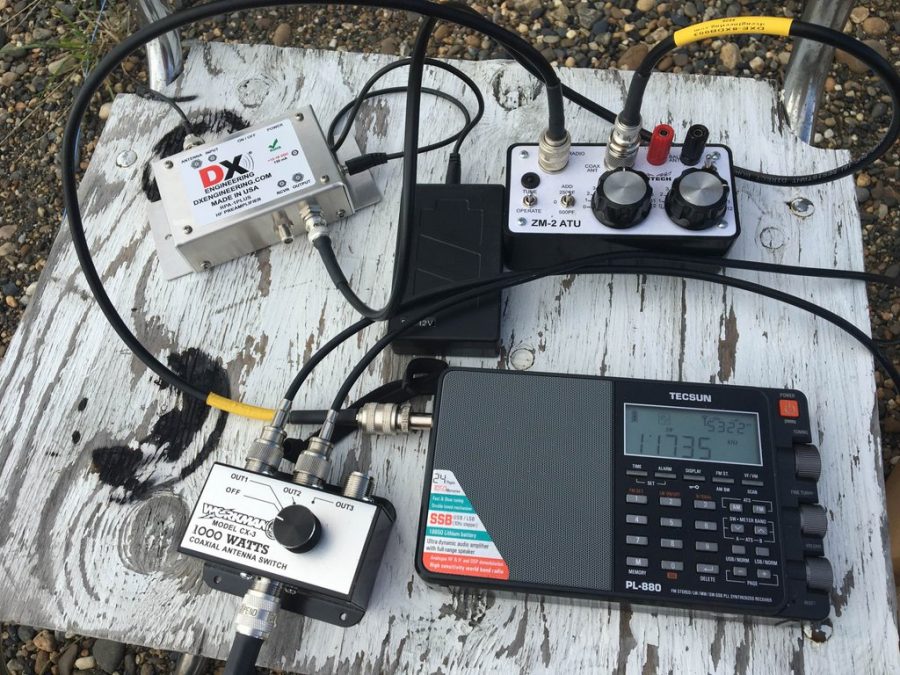
My listening post as it stands now

Time: 1600-1700 UTC
Location: Galena, Alaska (Rural central interior, halfway between
Nome & Fairbanks)
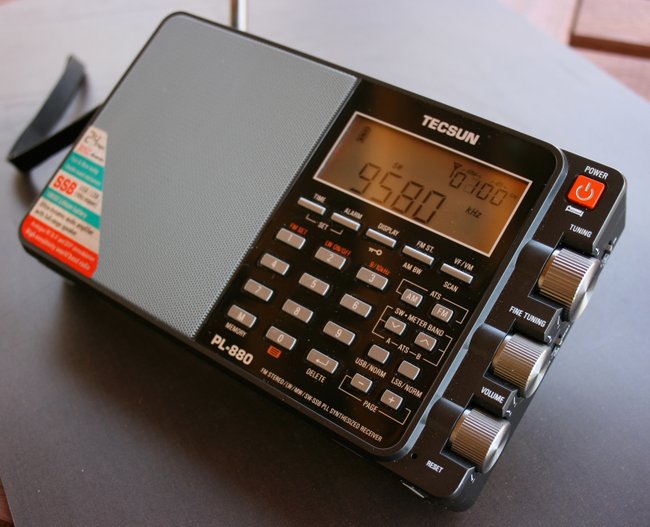
Equipment:Tecsun PL880, 225 foot long wire oriented north south and 225 foot long wire oriented east west, EmTech ZM2 Antenna Tuner, Workman Antenna Switch and DXEngineering RPA-1PLUS HF PreAmp

Paul-Walker-Galena-Alaska

Paul, I hope you’re enjoying the good weather while it’s still summer! I imagine the days and nights are getting cooler already and soon, that beautiful stretch of Yukon will be frozen.

I’m happy to see you’re employing the ZM-2 tuner; it’s an effective little antenna manual tuner and doesn’t need a power source.  Plus, if you ever get your ham radio license, you can use it in the field with QRP equipment. You’ve got a great setup there with quality components!

John takes the Elecraft KX2 on the shortwaves

ElecraftKX2

I just noticed that John (AE5X) has updated the firmware on his KX2 and made a short video of a shortwave band scan. On his blog, he notes:

Before getting my ham ticket, I was a SWL and am very happy that AM capability has been added to the KX2, making a fantastic radio even better.

[…]We have a very powerful AM broadcast station near my QTH on 740 kHz. I was not able to receive it at all with the KX2. Unlike some, I see this as beneficial – it tells me the 80m filters (the KX2 doesn’t operate on 160m) are doing what they were designed to do.[…]

Read the full post on John’s excellent blog.

Click here to view John’s video on YouTube.

Update: I’ve had my KX2 for 24 hours now! I’ve already updated the firmware and will post a couple AM audio samples soon.

The RTL-SDR V.3 dongle on shortwave: Gary details setup and reviews

Many thanks to SWLing Post contributor, Gary Wise (W4EEY), for the following review of the RTL-SDR dongle:


RTL-SDR-RTL2832U-e1471375714199

Based on your blog post on the Version 3 release of the RTL-SDR dongle I had to buy one. I ordered mine from Amazon for $25, and it came in two days. I have an earlier version of this unit that was VHF and above only. What intrigued me about the V3 was the possibility of HF reception in the Direct Sampling mode (without an up converter). So I had to try it.

I used the RTL-SDR Quick start guide at RTL-SDR.com/qsg. While I did not see any mention of Version 3, I hoped that the software that was linked would be adequate. As I am using a Windows 7 laptop, I downloaded the Zadig driver installer, along with copies of SDR# and HDSDR.

Getting the dongle going was pretty straightforward. And right away I was receiving VHF and above signals. The I/O driver defaults to Quadrature demodulation and this was what is used to receive VHF. But what about HF?

It took me awhile to figure out that you select Direct Sampling in the setup screen for the driver. In SDR# software this is found by clicking on the gear wheel icon.

eiagfcab

Under sampling mode select Direct Sampling (Q branch).

In HDSDR you select the EXTIO icon.

dbieggab

Here you select the Q Input under Direct Sampling.

Note that with both you must use the Q input.

With the telescoping antennas included with the dongle, I received very few signals (of very poor quality). But I had read that the unit can only receive HF with a substantial antenna, so I moved the laptop to my hamshack.

I use an ELAD antenna distribution amplifier for my HF receive antennas.

iejehdgi

It was easy to use a spare output from the ELAD ASA15 to drive the antenna input of the RTL-SDR V3.

Wow, what a difference!

First up was international shortwave. Here’s a shot from my Alinco General Coverage receiver on 9955 kHz this morning using my 260′ beverage antenna (pointed toward Europe). S9 on the Alinco S Meter.

habghgaa
And here’s the same signal on SDR#.

cgifieha

There was a delay in the audio coming from the PC versus from the receiver, but other than that, reception was identical. Audio quality was very good.

I then moved to the 20M Amateur Radio band. USB audio demodulation.

jibifhbj

The little dongle worked! It is not what I would call my first choice in receivers, but it will demodulate AM and SSB just fine.

I did not try it on CW as I ran out of time.

I also tried the HDSDR software, which worked equally as well (but I think I prefer SDR# for ease of use).

cafibbdh
All in all, if you have or can put up a good antenna for HF, the little $25 dongle is in, my opinion, worth trying out.

73,

Gary
W4EEY

Click here to purchase the new RTL-SDR–$24.95 shipped on Amazon.com.


Thank you, Gary, for not only giving a quick evaluation of the RTL-SDR’s HF performance, but for describing how to setup HF reception via SDR# and HDSDR.

Over the years, I’ve gotten probably hundreds of emails from readers who would like to try their hand at SDRs, but were cautious about investing. For many years, a 3rd generation SDR would set you back at least $300-400. At $25 shipped, the RTL-SDR V.3 is an SDR receiver that is accessible to anyone who can afford a fast food meal or a few cups of Starbucks coffee. My how times have changed!

Once I get a few transceiver reviews off of my table, I might do some side-by-side HF comparisons between the RTL-SDR and a few of my other SDRs. 

Thanks again, Gary!