Shortwave listening and everything radio including reviews, broadcasting, ham radio, field operation, DXing, maker kits, travel, emergency gear, events, and more
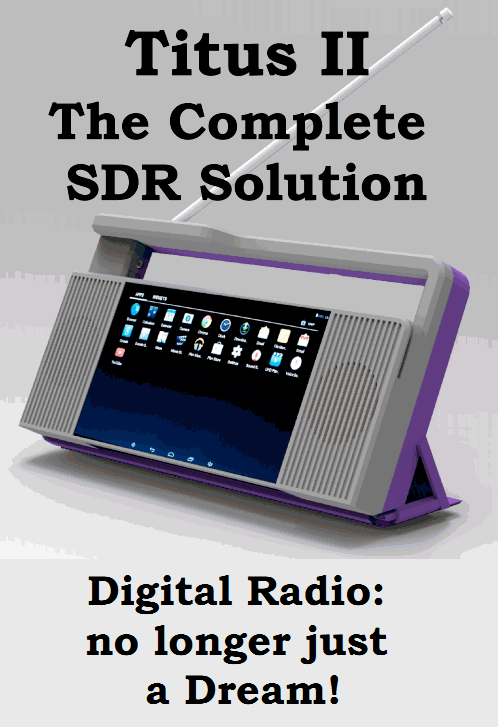
Those of you following the upcoming Titus II receiver will enjoy reading this interview with Mike of Pantronix. Here’s a short excerpt taken from DRMNA.info:
[DRMNA] Can you tell us a little about the process taken to develop the new receiver?
[Mike] We became aware of the need for a digital capable receiver by a visit from TWR representatives about three years ago. Having designed RF products and receivers in the past, it intrigued me that there were no low cost method to receive DRM. This began research into the problem. Initially we envisioned and designed what we call an ATU (Antenna Tuner Unit) that plugged into a ‘standard’ Android tablet. Unfortunately as time and testing proved, ready made tablets had varying problems from vendor to vendor, model to model. The decision was made about a year ago that we had to do our own Android ‘tablet’ and integrate the ATU into it. Hence the Titus II was developed.[…]
Many thanks to SWLing Post contributor, Vlado (N3CZ), for sharing the following story from the South African Radio League newsletter:
Broadcasters, jammers wreak havoc on amateur radio frequencies
The ARRL reports the battle in the amateur radio 7 MHz band continues between Radio Eritrea and Radio Ethiopia, which is said to be jamming the Eritrean broadcaster with broadband white noise
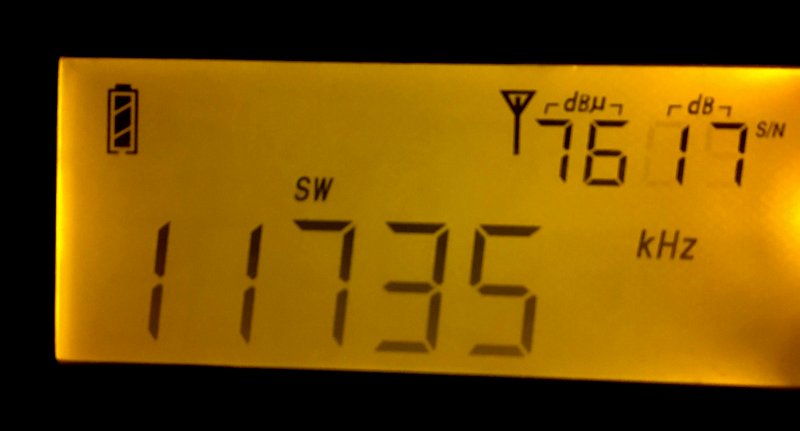
The problem for radio amateurs is that the battle is taking place in the 40 meter phone band 7,145 and 7,175 MHz with the jamming signal reported by the IARU Region 1 Monitoring System (IARUMS) to be 20 kHz wide on each channel.
The on-air conflict has been going on for years; Ethiopia constructed new transmitting sites in 2008 and is said to use two or three of them for jamming purposes. The interfering signals can be heard in North America after dark.
According to IARUMS Region 1 Coordinator Wolf Hadel, DK2OM, Radio Eritrea is airing separate programs on each frequency. He said in the IARUMS September newsletter that telecommunications regulators in Germany, Austria and Switzerland have been informed, so they could file official complaints.
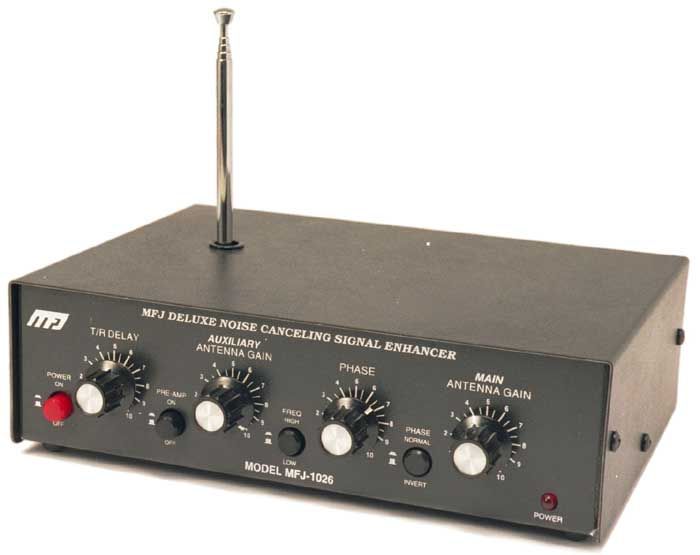
My VERY NOISY Sony CRT TV has gone to the great electronics recycling bin in the sky thank goodness. But I still have a MFJ-1026 here and need to use it when the neighborhood gets noisy. Intermittent power line noise is the main issue these days for me.
[Note that] my Monitoring Times review from April 2007 on the MFJ-1026 (and 1025 model without the preamp, but is best to have it) is still available here :
I still power it with a analog REGULATED Jameco 170245 12 volt (1 amp) ac adapter.
Last batch I purchased a few years ago were still 100% clean and analog regulation. As I have covered in the past, SOME of Jameco excellent REGULATED AC adapters have gone to using switching regulator devices inside (and these no longer clean for any radio use).
DX Engineering is about to come out with a improved version of the premium priced NCC-1, called the NCC-2. Mid late November Delivery ?? Never had our hands on one the pricey NCC-1 critters as the MFJ gets the job done for us (let alone affording it).
For the past six years or so, we’ve used Google Feedburner as an email distribution system on the SWLing Post. Feedburner is a bare-bones RSS-based system, but it’s worked quite well–allowing readers to sign up for individual Post emails or daily digests. It’s also free for both readers and for me.
However, in the past two months, I’ve received numerous comments from readers and contributors describing very flaky and unreliable behavior from Feedburner.
Truth is, even when I signed up to use Feedburner, Google had all but abandoned the project support-wise. Many bloggers feel that Google could simply pull the plug on Feedburner with little notice, so I’ve been looking into other options.
When I update SWLing Post functionality, I also upgrade functionality.
Over the past few months, I’ve been looking into alternate email distribution systems. Almost all of these are paid systems, and I’m only considering those that are reliable and have been in business for a long time. These systems typically charge based on the number of emails delivered per month and the total number of subscribers.
In the next couple of weeks, I hope to start trial subscriptions to these services and see which one I like best. I’m especially interested in a system that has better formatting than Feedburner (which, essentially, has no formatting–!). 🙂 Once I commit to a system, I’ll import all of the current subscribers into the system and you’ll have an option to adopt it as your new platform. I’ll also post a new sign-up sheet.
Please be patient as I go through this process–my schedule is jam-packed at the moment, so I’ll be exploring all of this in my spare time.
If you have any email delivery systems recommendations, please feel free to comment or contact me directly! Thank you!
In a previous guest post, SWLing Post contributor TomL, shared his “Evolving, Morphing, SW Listening Station” where he detailed the many ways he’s trying to fight heavy radio interference at his listening post. The following post is TomL’s update:
More Anti-Noise Ideas
(Continuing the hunt for better reception in a foul RFI environment)
by TomL
I have made the following changes:
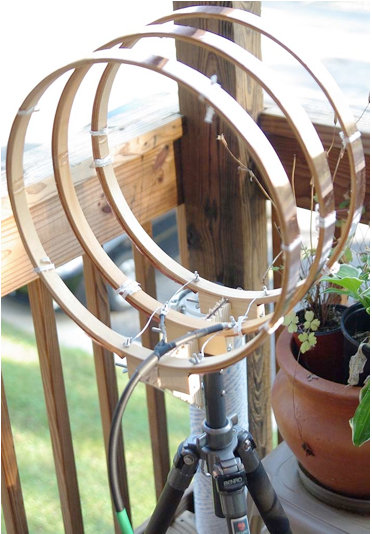
Created a prototype mini-loop based on a crossed-parallel idea from VE1ZAC (Jeff).
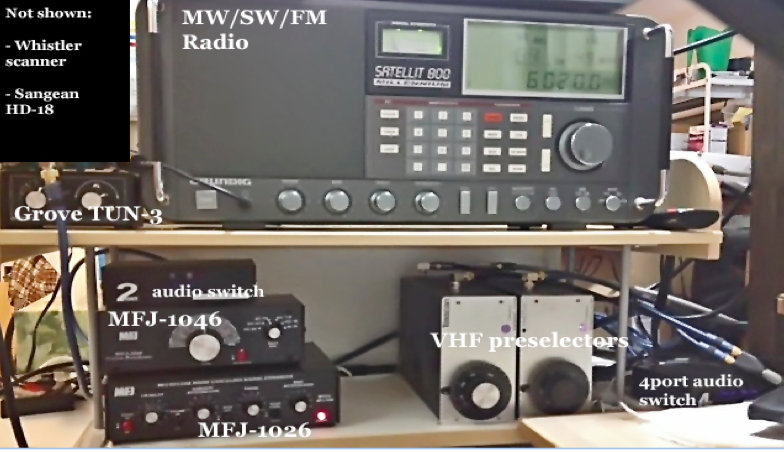
Added 2 preselectors, an old Grove TUN-3 connected to the main loop feed and an MFJ-1046 connected to the ground connection of the balun. Both feeds go into the MFJ-1026.
Added a medium wave noise canceling unit that I have not figured out how to use yet. (Quantum Phaser). The MFJ unit does not work on medium wave without modification.
Purchased from eBay a used Grundig Satellit 800, a somewhat more robust fixed-station receiver to replace my aging Sony ICF-2010.
Other non-related (not shown): Whistler digital scanner + UHF over-the-air TV + FM broadcasts + an AM/FM HD digital radio + high pass filters from MiniCircuits.com – (audio from all these sources is passed to an existing high fidelity stereo power amp and NHT Super One speakers on the computer desk for near-field monitoring). Associated antennas are also hidden on the outside deck (shhhhh!).
Large charge card balance!!
So, here are some pics for the crossed-parallel loop. VE1ZAC web site has all the references if you want to explore further or google him. Mine is purely a prototype and not finished. And should eventually be placed on a rotor (but how to keep my Nazi-like condo association from finding out?!?!?!?).
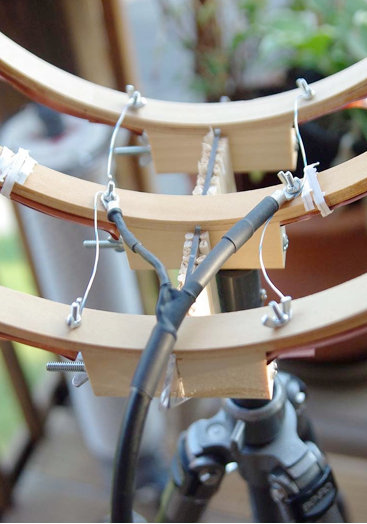
It is three 14 inch quilters hoops from Joann Stores plus some 1-inch copper strips cut from a small 2 meter roll of thin copper from eBay. Then, it is wired in parallel with silver-plated aviation wire on each side with a feed in the middle. Not an optimal placement of the feed, (should go straight down along the pipe). Will fix things up whenever I get some more time.
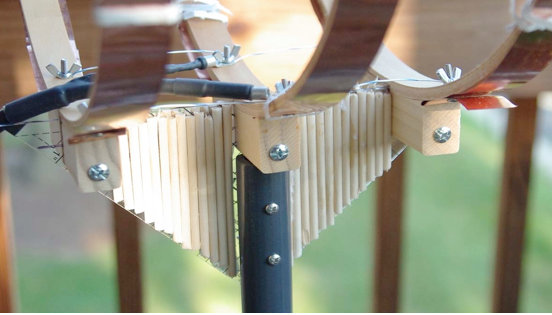
Seems to be an efficient way to prototype small loops. It is now mounted on a short ¾” inside diameter PVC pipe into a cheap plastic sand-filled deck-umbrella stand. Loops are light and somewhat flimsy, so I mounted the three loops on a plastic triangle ruler and dowel sticks glued to the sides for some extra strength. Good enough for now.
The EF-SWL balun is also in an experimental configuration. Since I read somewhere that loop antennas have a very low impedance at the feed point (like, 10 ohms or lower), I thought I might try a balun that is meant to lower the impedance and mount it backwards. I don’t have a picture of it but the SO-239 output is facing the loop and the screw terminals are facing the direction of the radio. My feeble brain thinks since it is a passive device of coils on ferrite, it should work bidirectionally for receive only applications like this. It seems to work but I have the excuse that I really don’t know what I am doing! 🙂
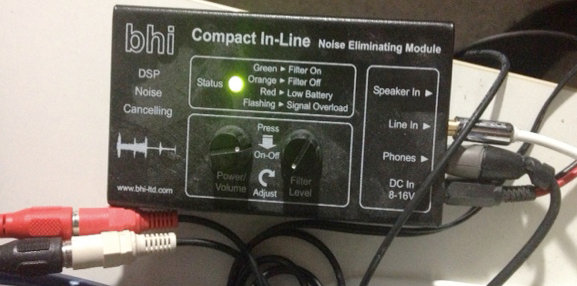
BHI unit in action.
The BHI DSP filter is useful in some circumstances but I find it fatiguing to listen to. The audio from the Sattelit 800 is so nice, I mostly like it without the DSP. The DSP narrows the bandwidth significantly, somewhere around 4 kHz or less from my hearing. I like that the Grundig has two tone controls. And it also has a stable SSB and on very strong signals with clear audio, I like to listen with SSB lower or upper sideband. But the DSP is useful at times for hash-like noisy signals; it is not quite as good on buzzing noise and I wish the Satellit 800 had a noise blanker, but that would have been a more costly purchase, like a Drake R8A.
So, in a nutshell, I have a discovery about noise here: it is all around me and ubiquitous, like the air I breathe!
I find it hard to null and also worry about peaking a station signal at the same time. However, I do have a lower noise floor with the experimental loop sitting outdoors, especially on medium wave (the Wellbrook amp + loop works great on the lower frequencies – am able to get eight different medium wave stations carrying Major League Baseball games at night – it would be nine to get WFAN for the New York Mets but the local Chicago Cubs station covers the adjacent frequency with horrible digital hash! ***Bleeping*** digital junk!).
Also, the signal level is noticeably lower using the loop. Then, add in the effect of the MFJ Noise Canceling unit, the usable signal gets even weaker.
The bottom line is, I can now finally enjoy listening to many SW broadcasts, BUT only the strongest signals. Anything else is still hopelessly lost in the noise. So, gains are limited.
On the other hand, and something else I learned by doing is that, any 1 or 2 dB signal/noise ratio improvement will help with the final audio output in the end product. Using low-noise amps, loops, noise canceler, preselectors, grounded connections, ground isolators at the input of every receiver, high quality stereo amplifier and speakers, tone controls, SSB vs. AM Sync, weird antenna configurations, etc, etc. It all helps in the end to some degree.
Tinkering is an art that involves a lot of thinking/doing iterations! And high quality parts must be used all along the chain or it could degrade the signal.
Below are some audio samples, not very well recorded, but can give some idea of the incremental improvement with each enhancement (turn up the volume). NOTE: other people may get better or worse results depending upon individual situations, type of antennas used, etc, etc.
Recording 1: R. Marti. First 10 seconds an indoor antenna with no noise reduction, second 10 seconds the outdoor loop without the MFJ-1026, the third 10 seconds with the MFJ-1026, then switched off and on to hear the difference.
Recording 2: R. Marti. MFJ -1026 is ON. Last 15 seconds is SSB, very thin sounding. Really only good for strongest signals. I liked the AM Sync better (Satellit 800 is really a Drake SW8 in disguise with a quality AM Sync). But, SSB can sound excellent with very clear voices with a steady and strong signal (The Satellit 800 does NOT have IF-shift or a BFO to fine tune an SSB reception, so the station must be exactly transmitting on the kHz mark, which most are nowadays).
Recording 3: R. Marti. MFJ-1026 is ON. Last 20 seconds you hear me switch in the two audio switches and the BHI DSP is on its lowest setting. Narrower and clearer with some reduction of background noise. I find I only like going up to about 4 on the DSP dial, after that the audio fidelity starts getting more choppy with digital artifacts that sound like dripping water. I tend to like higher fidelity. One nice thing about the BHI DSP is a faux-stereo that helps a little with voice intelligibility by helping the brain naturally filter the noise. Faux-stereo is ON even when the noise reduction circuit is manually turned off (power must be on and bandwidth still sounds narrowed).
Recording 4: R. Nacional Brazilia. First without MFJ-1026, then ON, then OFF, then ON, then with the BHI kicked for the last 20 seconds.
Recording 5: Greece. Switching the MFJ-1026 on and off every 5 seconds. In this particular case, the signal was weak and fading a lot. The MFJ OFF was also weaker than with it turned ON. That is interesting behavior, usually it is opposite. It pays to play with the settings a little. At other times, and less frequently, the MFJ unit turned OFF sometimes sounds better than with it ON and tuned for less noise. Go figure!
After all the tweaking is done, and I cannot get any more performance out of this, I will probably have to move to a nice, quiet neighborhood and setup a nice antenna farm!!
In the meantime, I do enjoy listening to the stronger stations from North America, Cuba, Brazil, Europe, and Australia with less noise than before.
73’s
TomL from NOIZEY Illinoiz
Once again, Tom, thanks for sharing your RFI elimination journey!
I love how you take on this noisy problem by experimenting and seeing it more as a challenge than an obstacle to enjoying your hobby. Great job!
Many thanks to SWLing Post reader, Bob Chandler (VE3SRE), who leaves the following reply to our WiFi Radio Primer:
I have been streaming online radio using a PC for a number of years using a really simple programme for the GNU/Linux operating system called “RadioTray“. RadioTray is a tiny programme written in Python that uses the Gstreamer “back end”.
This programme is so small, that you can turn that old 1990’s vintage Pentium II laptop that’ gathering dust in a broom closet into an internet radio. Just choose a very “lightweight” distribution of GNU/Linux.
For instance, on an old “original” Asus EeePC netbook, with a 900 MHz. Celeron processor, 512 MB RAM and a little 4 GB solid state hard drive, I installed the “Debian” distribution but used the lightweight “JWM” window manager for the GUI. JWM isn’t pretty, but it works great!
You can get “RadioTray” using the package management system of just about any GNU/Linux distribution. I know for sure it’s in the “repos” for Ubuntu, Debian, Arch and Fedora along with all of the derivatives. Unfortunately, it’s not available for Windows and MacOS. But, the GNU/Linux OS is “free as in freedom and free as in free beer” as they say!
All of your radio station “bookmarks” are stored in a simple “bookmarks.xml” file that makes it a breeze to copy your bookmarks from computer to computer. Over the years I’ve accumulated a thousand or more (I’ve lost count) internetradio stations in RadioTray.
RadioTray is capable of handling just about any streaming format.
My online “dx challenge” is finding the “real” stream URL of the station that’s often buried inside of browser based “Flash” players. But, since these days most radio stations outsource their audio streaming to one of about half a dozen streaming audio providers, once you’ve figured out the provider’s URL pattern for one station, you’ve figured them all out.
I’m able to figure out the “real” stream URL about 90% of the time. Some are easy, while some require a bit of detective work.
That also means that I don’t depend on streaming aggregators, since stream URL’s are changing all the time and sometimes it takes the aggregator a while to do an update. I can just update a station that I’m interested in myself.