Category Archives: Nostalgia

Project Amelia Earhart: work an air mobile station as it travels the world

Here’s an opportunity for both ham radio operators and SWLs to log this special event air mobile station throughout June and July. Based on WB6RQN’s flight path, almost everyone should have an opportunity to put WB6RQN in the logs!

The following excerpt has been copied from the Project Amelia Earhart website:


About Ham Radio on the Spirit

Brian Lloyd has a powerful radio system aboard the Spirit. The radio communicates on High Frequency (HF) shortwave using Single Sideband (SSB), and anyone can tune in to these transmissions who has the proper type of radio receiver. Listen for WB6RQN, that’s Brian’s Ham radio callsign. Ham radio operators around the world are invited to communicate with Brian while he is on the air in international airspace using the Ham bands. HF radio is dependent on ionospheric conditions to be heard over long distances, and it may change rapidly with the space weather or other factors.

Ham Radio Technical Information

Ham Radio Callsign: WB6RQN
Operator Name: Brian
QSL Via: eqsl.cc Electronic QSL system
HF Radio: Mobat model Micom 3, commercial HF transceiver
HF Power: Maximum power 125 Watts, 2-30 MHz
HF Antenna: Tapered Towel Rack type Belly Wire, with Automatic Tuning Unit (ATU)
HF Modes of Operation: SSB Voice or ALE
Ham Callsign Phonetics: Whisky Bravo Six Romeo Quebec November , Listen:

Click here to download.

Schedule of Possible Upcoming HF Radio Operation in 2017

31 May: Texas to Miami
01 June: Depart Miami. Embark on Round-the-World flight
02 June: Caribbean Sea area
03 June: South America area, Atlantic Ocean
05-06 June: South America, Atlantic Ocean, Brazilian Coast
07 June: Atlantic Ocean
08-09 June: Western Africa area
10 June: Eastern Africa area, Red Sea
11 June: Arabian Peninsula, Arabian Sea
12-15 June: South Asia, Bay of Bengal, Indian Ocean
16-18 June: SouthEast Asia, Adaman Sea, Indian Ocean
19-23 June: SouthEast Asia, Gulf of Thailand, Java Sea
24 June: Timor Sea area to Australia area
30 June – 4 July: Australia area, Tasman Sea, to New Zealand
14 July: New Zealand to Fiji, South Pacific Ocean
15 July: Fiji to Howland Island overflight, Pacific Ocean
16 July: Hawaii, Pacific Ocean
17-18 July: Hawaii to California, Pacific Ocean
19-21 July: California area
22-23 July: Western USA to Kansas area
24-28 July: Oshkosh Wisconsin USA for AirVenture
29 July: Oshkosh to Texas

Note: All dates and flight locations are approximate and tentative. Please see the Live Tracking Map for actual locations and flight movements.

Ham Radio Frequencies of Operation for Spirit Flights

HF Frequencies for Ham Radio SSB Voice QSOs and DX: 

  • Ham QSO activity may occur at any time while the airplane is in International airspace, USA, or some other areas.
  • Ham operation may happen while Brian is not busy with flight operations
  • There may be unexpected interruptions during a QSO
  • Please be especially courteous and patient, because his first priority is to pilot the plane.

Simplex or Split? Most of the time, WB6RQN will use simplex, listening and transmitting on the same HF frequency. But, sometimes Brian may ask calling stations to transmit “UP 5” split. When using UP 5 split, your transmit frequency must be exactly 5 kHz above WB6RQN. The plane’s HF radio is channelized, and it does not have an S-meter.

Click here for WB6RQN DX cluster spots.

Brian said, “During the actual flight I can talk on ham radio when I’m not using the HF radio to make position and status reports to Air Traffic Control. I will probably get 10 to 15 minute windows when I will be able to work ham stations on the HF bands occasionally. I have never been a contester, so my QSO rate will probably be lower than most ham operators would like.”

HF Channel Frequencies for Ham Radio ALE Activity: 

  • Activity using common Amateur Radio standard 2G-ALE Automatic Link Establishment may occur on the following scanned channels when Brian is not busy with flight operations.
  • ALE activity may occur at any time while the airplane is in International airspace, USA, or some other areas.
  • Whenever the ALE soundings of WB6RQN are heard, operators are invited to call on any one of these channels using an ALE Individual Call and link with WB6RQN.
  • When linked on an ALE Voice channel, the preferred QSO method is Upper Sideband Voice.
  • If a text is to be sent, use AMD and include the AMD text within the initial Individual Call.
  • Do not expect a wordy text reply, because there is usually no QWERTY keyboard connected to the ALE radio in the cockpit.
  • Anyone copying soundings, calling, or other types of reports is encouraged to post ALE reception logs on the HFLINK.NET website.

SWL and UTE Monitoring of HF Aero Frequencies

For SWLs (Shortwave Listeners) or UTEs (Utility Monitors), it is possible to listen to Spirit on the Air Traffic Control (ATC) HF Aeronautical frequencies with an SSB (Single Sideband) receiver. More information about listening to Spirit on HF Aero, click here.

Tour of the HF Radio System in Spirit  

For more information, click here to view the Project Amelia Earhart website.

2017 Hamvention photos: Inside Exhibits

Saturday was another long day at the 2017 Hamvention, but I did have a moment to visit most of the inside exhibit tables. The following photos were taken (in no particular order) in the main Hamvention buildings at the Greene County Fairgrounds. Again, it was especially fun meeting so many SWLing Post readers and contributors in person!

Click on the photos below to view larger images (click here to view photos of the 2017 Hamvention flea market):

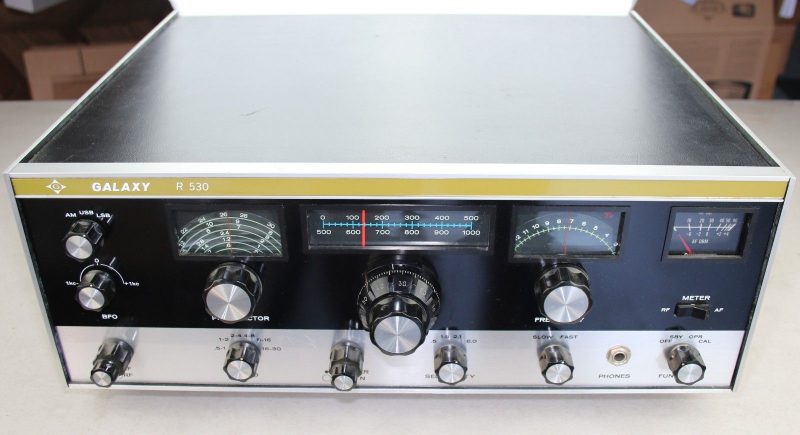
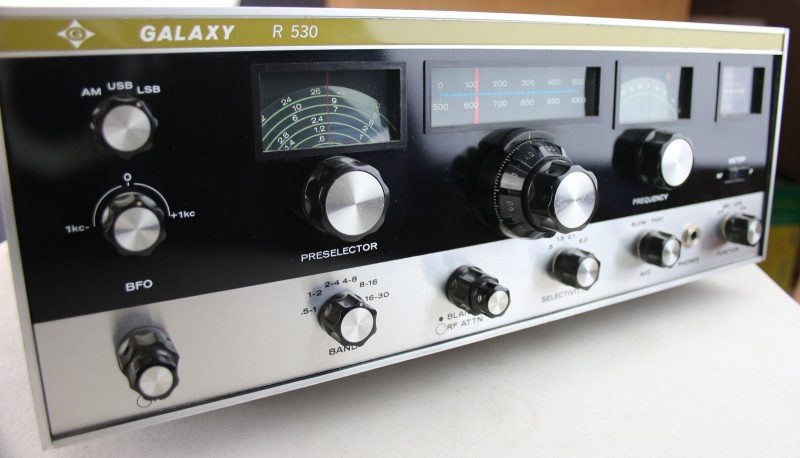
eBay Find: Dan’s thoughts on the Galaxy R-530

Many thanks to SWLing Post contributor, Dan Robinson, who recently spotted a Galaxy R-530 on eBay and notes:

Some observations on this. The R-530, and military version R-1530, were considered fairly top of the line when they were made. They’re still among the rarer radios on the used market, though not the rarest. The R-1530 is not seen often. On performance, these receivers were not on the same level as National HRO-500s, 51Js, and R-390s. This was made by Hy-Gain after all, which was not top of the heap in receiving design. However, the R-530/1530s are great looking pieces. Anyone considering these should make absolutely sure that the PLL circuit functions on all bands. Poor cosmetic condition is a tipoff that the radio had a hard life.

Click here to view on eBay.

2017 Hamvention photos: Friday Flea Market

We had a rather long day here at the 2017 Hamvention, but we had a fantastic time. It was especially fun meeting so many SWLing Post readers and contributors in person! Thank you for stopping by our booth at 6508.

Below, I’ve posted well over one hundred photos I took at the Hamvention Flea Market this morning. Click on the thumbnail to expand each photo. I’ve tried to include price tags when available! I plan to post inside exhibit photos tomorrow.

The R-902 (XE-2)/PRD: Ed’s flea market mystery radio

Many thanks to SWLing Post contributor, Edward Ganshirt, who writes:

This radio followed me home from a flea market and I am trying to find out what it’s mission was.

I think it is a surveillance radio from the Vietnam era because of it’s low serial number #7 R-902 (XE-2)/PRD.

I can’t seem to find anything on it. It tunes from 96 to 404 MHz FM AM CW is battery powered and is totally waterproof (this would be the radio to take white water rafting) .

I would like a schematic or manual for it.

Does anyone in SWL world know anything about it?

Wow! I’m afraid I would have taken that heavy metal home with me too, Edward! And it’s waterproof? What a bonus! 🙂 Actually, I imagine since it’s waterproof, the internals are likely well-preserved.

Post readers: If you can shed some light on this model R-902, please comment. If you have a service manual or schematic, I’m sure Ed would appreciate a link/copy!

Soviet Era Radio: Dennis reviews the Shoroh R-326 receiver

Many thanks to SWLing Post contributor, Dennis Kalinichenko, who shares the following review:

The Shoroh R-326 military radio

by Dennis Kalinichenko

I believe the piece of Soviet military equipment I recently bought to my collection would be interesting to all readers and contributors.

This is the R-326 “Shoroh” (“Rustle”) general coverage military tube shortwave radio receiver. These were produced decades ago, back in 1963. These portable receivers were in active military use in the Soviet Army until the early 2000s, when the R-326 was finally discontinued . Today, this set is no more a spy secret, but a great collector’s item and also a good receiver for home use.

My set cost me about $150 US, which is rather expensive for this radio. The R-326 was plentiful in the local market in 90-s, right after the fall of the Soviet Union, very cheap and popular between radio amateurs, but nowadays this radio has become more and more rare, so the price rises up.

My R-326 arrived from Khabarovsk city, the Russian Far East, where, I believe, for many years it was on duty in some of the Soviet radio intelligence and defense forces division.
The set includes the radio itself, original military 100 ohm headphones, original rectifier box for 2,5 V output, 12 meter long wire antenna on a reel, the 1,5 meter famous “Kulikov” mini-whip antenna, the isolator for placing it on top of the radio and some minor accessories.

Originally, the R-326 radio came with two batteries–1,25 V each–for field use, but mine are totally drained and need to be serviced, so I haven’t used them so far.

The radio is a light-weight, only 33 lbs, which is a real minimum for Soviet military equipment–the famous R-250 radio’s weight is up to 220 lbs–so, in comparison, this unit is really portable. You can easily put it in your car using the attached leather handle and take it with you on a weekend trip. No other military radio can be so “travel-friendly”; this is one of the reasons it was so popular in the ham radio and SWL communities.

The case is made out of steel and looks so solid you may want to use it as a nutcracker. And you can! In no way could you harm the box constructed to resist nuclear attacks. It is waterproof and sealed–so I can be confident that no previous owner has ever tried to solder something in the guts.

The radio is a super heterodyne containing 19 (!) special mini tubes and covering 6 SW bands, from 1 to 20 MHz. It works in both AM and SSB (CW) modes, having an on-board adjustable bandwidth control from 300 Hz to 6 kHz.

On the front panel, there are two scales: one is rough/coarse, and above is the precise one, a so-called photoscale, which may be adjusted to match real radio-frequency using the four screws near the sun protection visor. With this scale, you don’t actually need a digital readout. It also has a BFO control with a zero setting, adjustable AGC levels for AM and CW, and adjusting screw for matching the antenna input, as marked for 12 m long wire, 1,5 m and 4 m whip.

The radio has no built-in speaker. Instead, there are two output sockets on the front panel, for 100 ohm headphones and 600 ohm line-out.

The power consumption is very low for s tube radio, the rig needs only 1,4 A at 2.5 volts DC (including the lightscale). I use the original power transformer (transistor rectifier) and therefore switch the unit into the 220 AC outlet.

The sensitivity of the radio is extremely high and equals some modern transceivers. The selectivity is also impressive. No doubt it was really great for 1960s. But there’s negative side as well: the radio easily overloads even from the outdoor long wire antennas. The best fit is the “Kulikov” mini-whip that you can see in the photos.

When you switch on the radio, you hear noise, the level of which seems high, so you lower the volume down. Yes, the radio is sensitive and a bit noisy. But thanks to the tubes it sounds really amazing in the headphones. The SSB ham operator’s voice is warm and very clear.
The tuning is very smooth, being actually 2-speed: outer wheel is for fast tuning, inner wheel for precise tune.

It’s absolutely obvious that nowadays a simple Degen or Tecsun may be more useful than this old and heavy unit with big and tough knobs and switches. But what a pleasure sitting in front of this perfect tube radio at night, with the headphones on, turning the huge tuning wheels, looking into the moving dim scale, listening into distant voices and rustles, feeling yourself a Cold War times operator near the rig.

Isn’t this experience priceless?

Indeed the experience is priceless, Dennis! Better yet, your R-326 now has an owner that will keep it in working order and enjoy it on a regular basis. I personally believe keeping these vintage rigs on the air is one way to preserve, and experience first hand, a little of our collective radio history.

Thank you so much for sharing your review and excellent photos of the R-326!

Post readers: If, like Dennis, you have a vintage radio you would like to showcase/review here on the SWLing Post, please consider submitting your story and photos. Being a huge fan of vintage radio, I truly enjoy reading through and publishing your reviews.  I know many other readers feel the same!

Good Luck Point poles have been removed

(Source: Micromedia Publications)

BERKELEY – A few poles, a couple new osprey nets, make up the new horizon of Good Luck Point’s marshland. Once home to hundreds of telecommunication poles that made up a ship-to-shore communication system, the poles were taken down from mid-January onward as part of a United States Fish and Wildlife Service project in the Edwin B. Forsythe Refuge which officials said focused on marshland sustainability.

The project removed several hundred poles from the old AT&T field in the marsh of Good Luck Point and scheduled 100 poles from its sister site in Manahawkin.

The long-decommissioned telecommunications poles were once part of a ship-to-shore network. The pole field is located along Bayview Drive in Berkeley and Beach Avenue in Manahawkin.

Continue reading at Micromedia Publications…

We’ve been following the story of the Good Luck Point site for serval months. Click here to read previous posts.  Be sure to check out Dennis’ photos of Good Luck Point prior to WOO remnants being removed.