Shortwave listening and everything radio including reviews, broadcasting, ham radio, field operation, DXing, maker kits, travel, emergency gear, events, and more
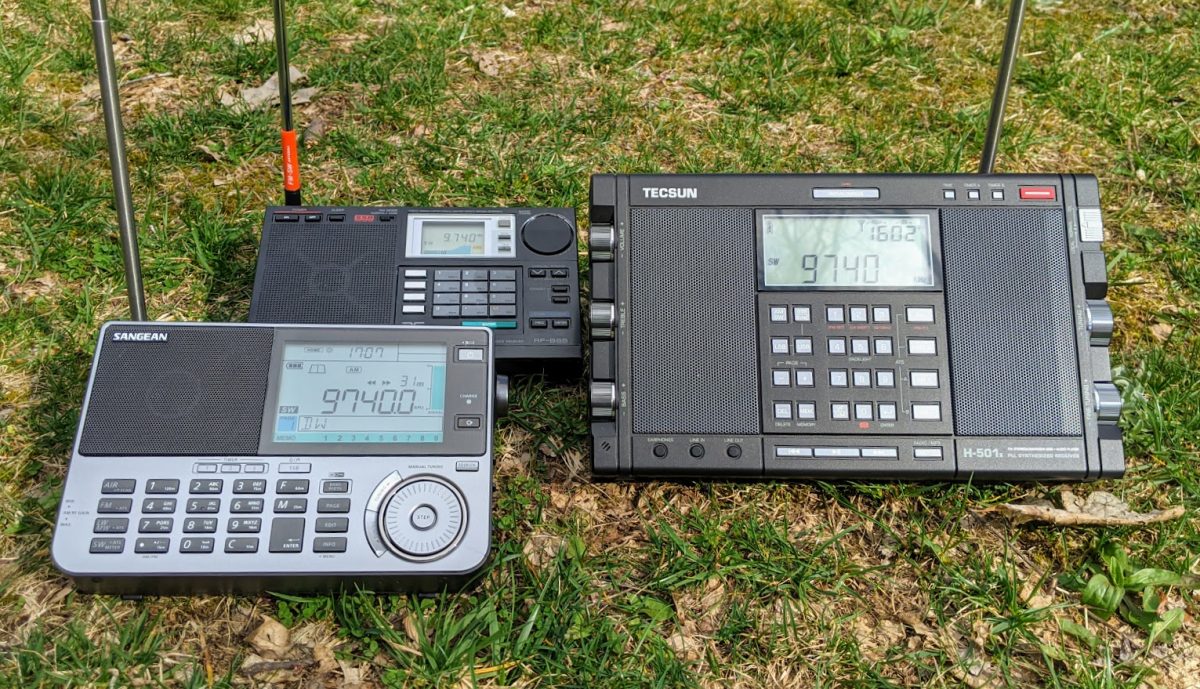
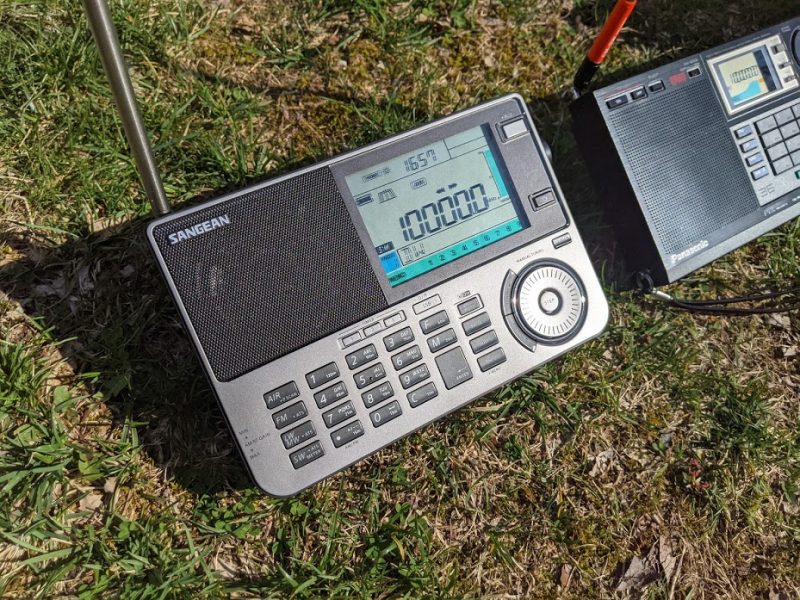
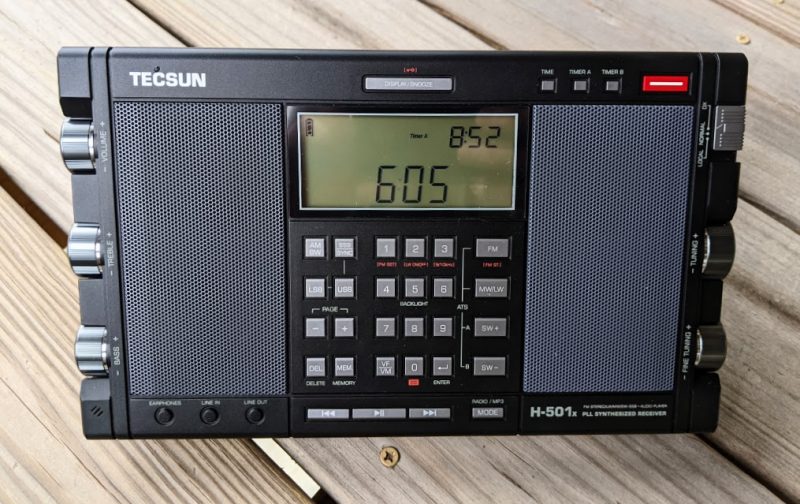
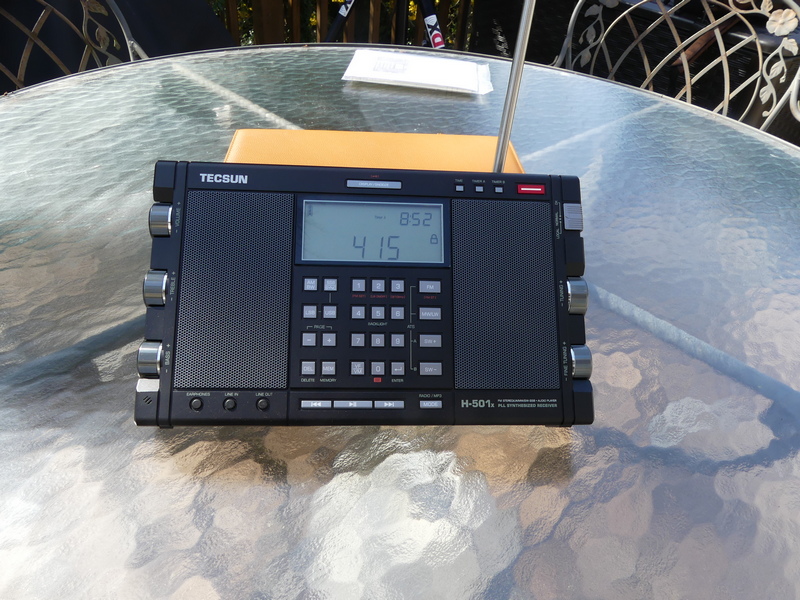
I took delivery of the Tecsun H-501x yesterday morning and the Sangean ATS-909X2 last week.
I’ve been waiting for these portable receivers for what seems like ages, and both arrive within one week of each other.
My initial impressions are positive for both radios, but I know it’s time to start some proper comparisons.
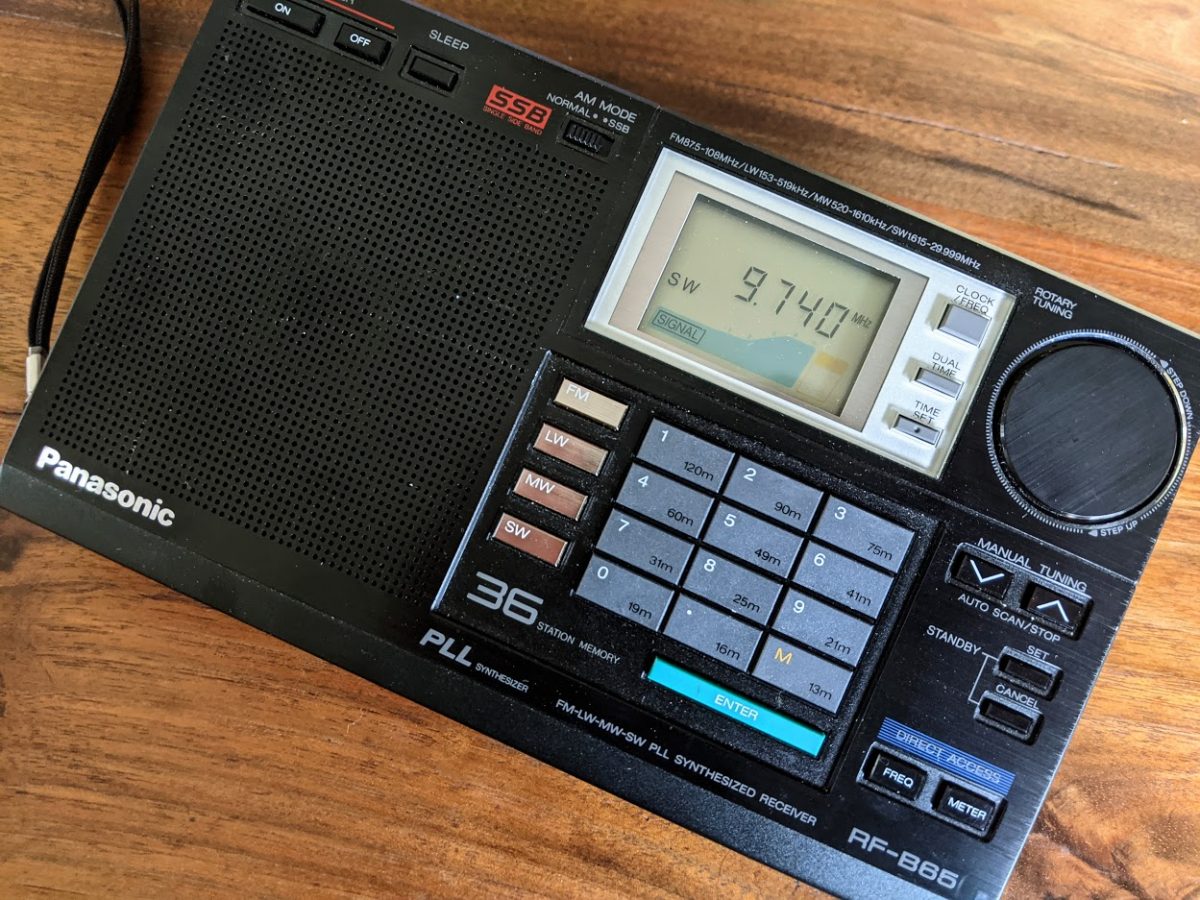
These portables are arguably the flagships of both manufacturers, so I decided to pit them against a “legacy” portable that has a reputation for eating other receivers for lunch: the Panasonic RF-B65.
“Nom nom nom…”
I fully expect the RF-B65 to emerge as the leader of this pack on shortwave in AM mode. No kidding. That’s why it’s a benchmark. If you can out-perform the RF-B65, you’re a five-star, Holy Grail portable and that’s the end of the story.
Where both the H-501 and ATS-909X2 will have an advantage is in audio fidelity. Both have excellent built-in speakers.
In addition, while the Panny RF-B65 is a great AM mode radio, it has very basic BFO controls and fine tuning for SSB. No doubt, I’ll likely pull out a different receiver for SSB comparisons.
DanH expects his ATS-909X2 back from firmware update soon and I look forward to his evaluation.
I plan to write a review of the Sangean ATS-909X2 for the June 2021 issue of The Spectrum Monitor magazine. My Tecsun H-501x review may appear in TSM as well.
I will post updates here on the SWLing Post and possibly some comparison audio/reception examples.
Tecsun H-501x availability
SWLing Post contributor, Troy Riedel, received word from Anna at Anon-Co that they hope to have their first batch of H-501x units available to ship by the end of April 2021. Pricing has not yet been firmed up.
Many thanks to SWLing Post contributor, Dan Robinson, for the following guest post and review:
The H-501: Jewel in the Tecsun Crown, With Some Attractive Features
by Dan Robinson
Since 2020, there has been one Tecsun receiver I have been most looking forward to reviewing, and that is Tecsun’s H-501.
Videos showing the pre-production and mainland China versions of the 501 started appearing online at least a year ago. There are also numerous videos showing comparisons between the H-501 and PL-990x as well as the PL-330.
What I will do here is provide an assessment of the 501 informed by my use of a H-501 just received, the other two Tecsun receivers, and my decades of experience using a wide range of portable receivers. This review is based on initial tests of a H-501x, among the first production units.
Video: Unboxing
HOMAGE TO RECEIVERS OF THE PAST
The elephant in the room with the 501 is, of course, its two large left and right speakers. This reminds one of another Tecsun DSP portable, the PL-398BT with a similar left-right speaker arrangement.
On the left of the H-501, from the top, are the Volume, Treble, and Bass knobs which like the PL-880 and 990x has obvious lineage back to the famous Grundig portables of the 1990’s – the Satellit 500 and 700. Both of those were limited to two bandwidths. Only the 700 had anything approaching usable synchronous detection.
Each of the left hand control knobs on the 501 contains a dot to indicate where you are in the Maximum/Minimum range. At the bottom of the left side is a micro-USB port for when the receiver is used as a computer speaker – quite a nice feature!
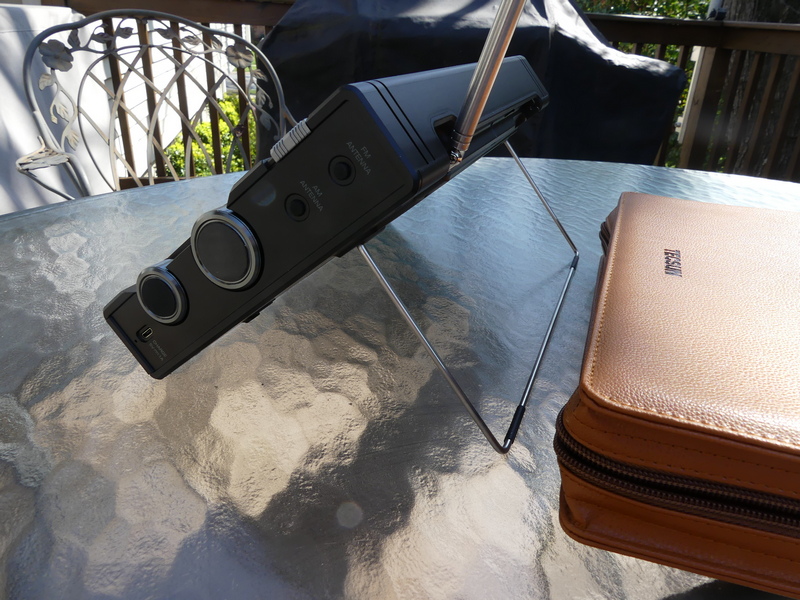
On the right side of the 501 you find ports for AM and FM antennas, each with a rubber traction cap, similar to what is found on the PL-990x. There is also a three position sensitivity sliding switch for Local, Normal, and DX modes – that’s one more than usually found.
Knobs on the right side are the Main tuning and Fine tuning, again similar to the PL-990x. At the very bottom of the right side is the 5v 1.0 amp micro-USB charging port.
ERGONOMICS
NEGATIVE: Here I discuss one of two major negatives with the 501. The tuning knobs are embedded quite far into the radio body. Each has a round piece of rubber covering on the knob end surface designed obviously to provide traction, possibly also as a protective measure.
The reality is that on the 501, more seriously on the PL-330, embedding of the knobs so far into the cabinet makes it virtually impossible to undertake rapid tuning using those knobs if you are just placing your finger on the top barrel part of the knob itself!
As you will see in photos and video accompanying this review, holding a finger against the rubber on the end of each knob, or closer to the center, to achieve more rapid tuning. But it’s kind of annoying. On the PL-990x the knobs are somewhat different – extending a bit farther out of the cabinet, but also with the rubber coverings.
So, this is a design point for Tecsun to consider. Surely, it should be possible to come up with slightly different knobs for the 501 that make it more comfortable to achieve rapid tuning. As it is, the knobs on the 501 barely extend beyond the cabinet edge, including the end and rubber cap.
The same goes for the PL-330 – which has knobs that only one half inch in depth, and extending only about 1/16 of an inch beyond the cabinet edge. Part of the attractiveness of the 330 is its compact size and I doubt Tecsun will be moving to put slightly larger knobs on that radio anytime soon. But as it is, using the main and fine tuning controls on the 330 gets you maybe 10 kHz in tuning range.
[UPDATE] I realized after further use of the 501x that Tecsun clearly intended for the rubber knob cap covers to act as traction for tuning. The problems I see: after significant use over time, those rubber covers will lose their stickiness and thus their ability to help tuning will be reduced. Also, the fine tuning knob is smaller — and even using the rubber cover on the knob for more traction, it is somewhat difficult to achieve rapid tuning in 1 kHz mode. Tecsun could help 501x owners on the issue with the tuning knobs by including spare rubber knob caps. But it’s uncertain how the existing rubber knob covers are attached to the original knobs and how easy it would be to replace them when they lose their stickiness.
H-501 IMPRESSIVE FRONT PANEL
At the top of the H-501 radio above the LCD display can be found the Display/Snooze/Lock button. On an older Tecsun radio, the PL-880, this button doubled as the calibration adjust control. On the PL-990x this triple function button is located on the top of the radio.
LCD DISPLAY
POSITIVE: One of the big positives of the 501 is the large LCD display. The number digits are absolutely huge and make it easy to read frequencies.
Thanks Tecsun! The display contains numerous bits of information about receiver operation, the signal strength meter, etc.
Below the display is the keypad, with special dual keys for 9/10 kHz mediumwave, Longwave activation, and FM range adjustment. Backlight activation is on the 5 key. At the bottom you have the VF/VM key to select between frequency tuning and memories. To the right are the FM, MW/LW, and SW + and – buttons. These put the radio into shortwave mode and as is the case with the PL-990 and other receivers, activate ATS/ETM tuning.
At the very bottom of the front panel can be found PLAY/PAUSE, RR, and FF buttons for control of SD card audio when using the microSD card, which like on the 990x is located on the bottom of the receiver. According to the manual, by the way, the microSD slot accepts cards of up to 128 GB. Included in the box is a 16 GB SanDisk Ultra card. A reset hole is also on the bottom of the radio.
Finally, at the bottom of the 501 face are rubber covered input ports for Earphones, Line In, and Line Out.
METAL TILT BAIL
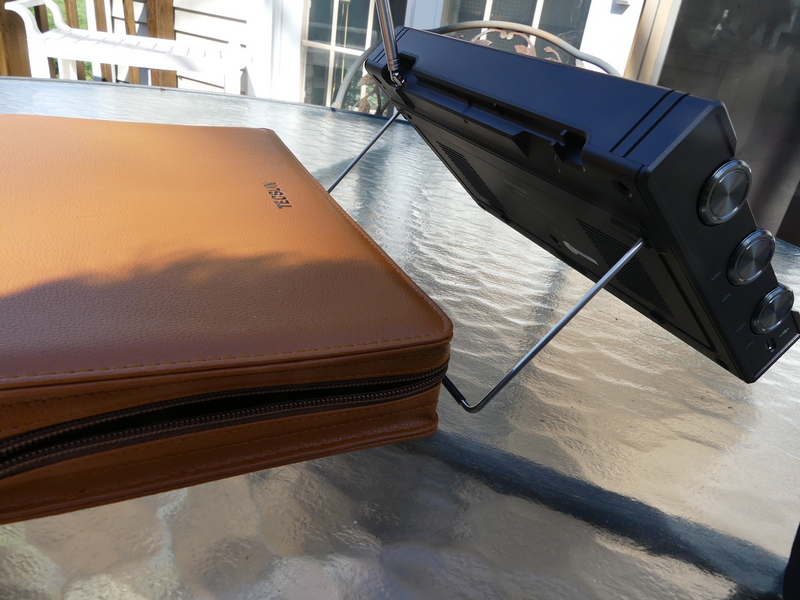
POSITIVE AND NEGATIVE: On the back of the receiver, you find the metal tilt bail which folds down and locks into two plastic tabs and can be lifted easily with a finger from an indentation in the cabinet.
This was a good design move by Tecsun, with the following observations: there are no incremental positions on the metal bail as you find on, say, a Microsoft Surface or similar tablet type PC. The only fully stable position is to have the metal bail fully extended back. That places the 501 in a great position if you’re standing or even sitting to a degree. But if you try to place the bail in any middle position you’re in danger of having the radio become unstable. Tecsun should definitely give some thought to a re-design, though the bail is better than the flimsy plastic stands found on the PL-990 and PL-880 and some older portables.
Still on the back of the radio, intelligently, Tecsun marks a screw hole which can be used to remove the telescopic antenna (marked as ANT SCREW). The other screw holes for removal of the back of the radio are also clearly marked. Thanks Tecsun!
However, one additional partial negative – there are no rubber pads on the bottom back edge of the 501x which will be contacting whatever surface the radio is sitting on while the metal bail is in use. So, if you don’t want that bottom back edge to be scratched, place the radio on something to cushion it.
BATTERY CHARGING
POSITIVE: Another interesting feature not found on other radios: Tecsun has created a dual charging system for the 501 which uses two 18650 batteries.
In viewing numerous videos, I have not seen this discussed much. Basically, this enables you to use the receiver’s internal charging capability to choose which battery you are charging. The manual states that the battery contains space for a “spare” battery. The charging indicator on the LCD display will flash while charging is underway – there does not appear to be a separate display for battery A or B. However, and this is quite a unique capability – while you are using the 501x, the switch changes which battery the radio is using.
It’s not clear to me whether the receiver while powered on is taking energy from one or both batteries simultaneously. As I note in my reviews, and this is amplified in the manual, do not expect to be able to charge a battery internally and listen to the radio at the same time because there WILL be noise.
HUGE WORLD MAP AND RADIO DIAGRAM INCLUDED
Tecsun includes a huge – and I mean HUGE – World Amateur Radio map in a plastic pouch with the manual. On the back of this is a large photo of the 501 with clear English guide points to each and every feature of the radio. In this, Tecsun is really going out of its way to make owning the 501 a special experience.
In the box (see photos) Tecsun includes 2 18650 lithium batteries, a 5 volt double USB A charging cube, a mini to mini cord, a USB charging cable, and to boot, a pair of fairly high quality wired earphones complete with spare ear tips.
PERFORMANCE
Anon-co advises that the H-501x uses a different IC than the PL-990x. No further details were available as of the time of this writing.
This is clearly a sensitive radio, as is the PL-990X. In these days of declining use of shortwave, almost any receiver is going to be able to hear “stuff” all over the bands and the 501x and 990x as well as the 330 are all quite capable in this regard.
In the video, I tune some familiar stations, including Voice of Greece and BBC
and move through the excellent bandwidth options. This is where the 501, with its large dual speakers, excels because if you’re on a strong station – Greece is a great example because of its great music programs – and you have that wider option, it’s really pleasant to listen to.
NEGATIVE: However, one has to puzzle over the decision to limit bandwidth to 6 kHz when in shortwave mode. On mediumwave (AM) you have a 9 kHz option which provides some fine listening. Perhaps Tecsun felt that there are few stations using shortwave these days that would benefit from having a significantly wider option? I would urge Tecsun to make 9 kHz available in shortwave.
SYNCHRONOUS DETECTION
NEGATIVE: I really had some hope that Tecsun would go farther toward
solving the problem of unstable/distorted SYNC mode with all of these recent radios. Unfortunately, it was not to be.
Using SYNC on these radios – though this was not the case with the PL-660 and 680 – involves a delicate dance, requiring using a combination of bandwidth filters and LSB/USB. SYNC works fairly well with some stations, but it really depends on signal level, and to an extent signal level of any station close to the frequency you are on.
There is a 1 kHz fine tune spread when using SYNC after which lock is lost. And still, lock is often lost even when you’re on center frequency and not using
fine tune in SYNC – the signal just becomes distorted. Not fun. The PL-990x has the same issues.
Now, Tecsun has definitely made progress since the horrendous implementation of SYNC on the PL-880, which wasn’t even an official feature. But it’s disappointing that given the design features in the 501, especially the wonderful dual speakers, a way has not been found to resolve this issue which obviously involves the DSP chip that is the brain of the receiver.
Video: Detailed testing of Tecsun H-501x
ANTENNA
NEGATIVE: One of the things the folks at SONY, Panasonic and some other manufacturers did so well was design radios with antennas that nested inside the radio and could be pulled up and out of the cabinet, and because of this, there was clearance from the top of the radio so the antenna can achieve vertical position. Tecsun has not done the same. Antennas on the H-501x, PL-990x, PL-330 swivel but cannot take up vertical position, and of course they are nested on the top of the radio. One would have thought that after years of producing portables, and coming to dominate the portable market, someone at Tecsun would have recognized the importance of antenna re-design. NOTE: the antenna on the 501x is sufficiently long, but on the PL-330 for example, seems to be not long enough.
BLUETOOTH
POSITIVE: Hooray for Tecsun in integrating BT capability into the 501x and 990x. This was such an obvious move and thanks to Tecsun for really hitting it out of the park. Unfortunately, we don’t get the ability to record audio from the radio on to microSD cards – that would truly have been a major step forward
CALIBRATION
The H-501 has the same re-calibration adjustment feature as is seen in the PL-909x and the PL-330. This involves going into LSB or USB mode, holding down the USB or LSB keys until a flash appears, then using the Fine Tuning knob to achieve zero beat on WWV or strong station that is known to be on frequency, then holding down USB or LSB again to have the radio re-zero itself. This is a fine feature that we have seen since the PL-880.
When I first received the H-501 it appeared that the receiver was fairly on zero beat from mediumwave up through 25 meters shortwave. Further testing revealed that re-calibration was necessary, but the degree of error from mediumwave up through 19 meters was not as significant as I have seen on the PL-990x. Re-calibrating at a mid-point of 25 meters appears to be a good mid-point choice, but inevitably, doing re-calibration on shortwave will throw the receiver off by a bit down on mediumwave.
A cautionary note: when undertaking this calibration function be sure to give the radio time to confirm it’s in calibration mode with the FLASHing LCD. Sometimes, the readout will jump a full 1 kHz above or below the frequency you’re zeroing on – if that happens use the MAIN TUNING knob to get yourself back (i.e. 9,704 to 9,705.00) and complete the zero beat operation with the FINE TUNING knob, then hold down LSB or USB to complete.
All of this may be overkill for most people – I am just among those who obsess over having receivers as exactly on zero beat as possible. That’s more difficult or impossible to achieve with older receivers that have no calibration function, such as the ICF-2010 or SW-55 without literally taking those radios apart to access internal points of adjustment. The fact that Tecsun provides this capability in these portables is something we should all be very grateful for.
CIRCUIT LOCKUP
All of the Tecsun radios have a “reset” hole to be used if the receiver is not functioning properly. I had one occasion of lockup with this sample of the H-501x. Rather than using the reset hole, I decided to remove one of the two 18650 batteries, which of course reset the receiver. I have alerted Anon-co to this issue, but it’s hard to tell whether it’s a major problem without having other H-501 units to compare to.
CARRYING CASE
POSITIVE: The H-501 that I received for review from Anon-co came with a beautiful faux leather case complete with a convenient carrying handle. My understanding is that this matches mainland China versions that have been widely seen in videos online.
Anon-co advises that the first batch of 501x to be carried by them will come in a gift box with this PU leather case, possibly to be followed at some later point by a hardcover carrying case. Indeed, a photo can be found online showing the H-501 in a hardcover carrying case similar to the cases for the PL-880 and PL-990x kits.
As of early April, Anon-co advises that while the price for 501x is not set yet, it’s expected to be somewhere in the $310 – 330 range including shipping to the U.S.
AM/MEDIUMWAVE AND FM PERFORMANCE
Not much to say here – I find FM performance on the 501x to be superb, and mediumwave reception is more than satisfactory.
CONCLUDING THOUGHTS
As I noted earlier, these days amid declining use of shortwave by remaining broadcasters, almost any DSP or older portable receivers are capable of producing excellent results for shortwave listening.
Facebook groups devoted to shortwave (they have become the new gathering place and information exchanges for those of us who still love the hobby) are
full of newcomers inquiring about which Tecsun, Degen, or other portables are best.
Often, my advice is to consider older portables that are still quite competitive, especially considering the reduction in the number of stations still on shortwave. These would include such classics as the Grundig Satellit 700/500, the SONY
ICF-2010(2001D), SONY ICF-SW77, and ICF-SW55, along with the venerable Panasonic RF-B65 and SONY ICF-SW100S in the smaller category.
What Tecsun has done with what we have to assume may be the final group of DSP receivers it produces is come up with small (PL-330), medium (PL-990x), and large (H-501) radios that combine extremely attractive features and excellent audio. The H-501x, in effect, is a Grundig Satellit 700 re-born for the 21st century and the path to it was paved by the PL-880.
Though implementation of SYNC in each of these receivers still leaves much to be desired, having this feature is enough to push prospective buyers to choose one or more of these Tecsun units over older portables.
Note that Sangean, which is now producing its ATS-909×2 (though the radio has growing pains and is having its firmware updated by Sangean) seems to have taken note of Tecsun’s dominance of the market and provided multi-bandwith capability, and an improved and enlarged LCD display on the 909×2 along with finer frequency resolution.
In a strange but perhaps understandable decision, Sangean left SYNC mode off of its new flagship receiver. Whether this had more to do with production costs or a decision that synchronous detection really brings little to the game these days, or both, along with other factors, remains a puzzle. It does appear, from early reviews, that Sangean may have improved sensitivity on the 909×2, though this too remains unconfirmed.
But again, even with the negatives I noted here about the H-501x, what Tecsun has accomplished is significant. It has given remaining potential buyers of multi-band portables three superb receiver choices. There are others in the Tecsun line such as the S-8800 and S2000, but of these only the S8800 is something I would recommend.
As I noted in a recent review of the PL-330, had we enjoyed a situation back in the golden days of shortwave in the 1960’s/1970’s/1980’s where a portable provided multiple bandwidths, advanced memory operations, and synchronous detection, DXing would have been even more of an enjoyment than it was. Certainly those Country Heard/Country Verified totals would have been higher!
The H-501x could easily be considered the crown jewel in the Tecsun group with its killer looks, large speakers, and performance equaling the PL-990x. Each of these receivers is arguably an easy choice as a “daily driver” for traveling, though where air travel and TSA issues are concerned, the PL-330 would be a better choice.
RECOMMENDATION: Of the negatives I discuss in this article, only one I would consider fairly huge, and that is the ongoing issue with synchronous detection. If the 501x, like the 990x and 330, were to have this issue resolved that would make it easy to recommend any of the three radios. As it is, the attractiveness of the 501x lies with its beautiful two speaker design. Even with the annoying SYNC issue, I would recommend the radio to anyone who understands the SYNC issue and doesn’t mind and who wants a nice, larger version of the 909x.
In a video he posted on YouTube, Fenu demonstrates reception, speaker quality (including a small issue with button vibration at high volume), and how you can connect IQ out to an SDR application like SDR#:
While the Norwegians are getting into Påskekrim (Easter Crime), the Swedish and Finnish kids are dressing up as Easter Witches and the Danes are making their Gækkebreve (Teaser Letters), we’ve created a jam-packed show for you this month with more guest spots, lots of great music and we have worked with Karl from scandipop.co.uk to bring you a song of the month!
For ease we’ve split the broadcasts into 3 versions;
• WRMI & On-Demand Version: RNEI 16 + RNEIxtra Mammas Mest Metal + Stephen’s feature + HamDRM.
• Channel 292 & Radio Onda version: RNEI 16 + HamDRM + This is an Express Music Show.
• World FM & Unique Radio version: RNEI 16 only.
RNEI #16 includes great music including:
• A new duo from Iceland who don’t want to be forgotten.
• Ku?ka’s & Four Night’s Latest.
• A great Danish song from Nana Jacobi.
• UNDER’s gorgeous chill-house remix of a famous Swedish song.
• A joik from Sweden’s Got Tallent’s winner Jon Henrik Fjällgren.
• Finland’s Heroines will be singing about their Rules.
• Scandipop.co.uk will be picking their song of the month for us to feature.
• The opening song to Mammas Mest Metal with the playlist encoded in MFSK 64 during.
A new RNEIxtra segment called Mammas Mest Metal is going to air for the first time this month on WRMI featuring a selection of Metal, Post Metal, Viking and Post-Prog Metal songs!
Afterward we’ll head over to Stephen to hear music from some sisters who sing in Welsh and Cornish, their music is beautiful!
Lastly We have a HamDRM data segment coded by Daz featuring a self rendering animation and our playlist. You can download an early alpha copy of Daz’s decoder, EasyDRF, here. Other options for HamDRM are: EasyPal & WinDRM on Windows and QSSTV &TRXAMADRM on Linux.
We are trialling some new beams this month to Asia and Africa!
Keep an eye on our announcements for extra broadcasts!
If you miss the show you can always catch up on demand and, if you prefer to only hear our music, we have Spotify Playlists of each show usually published after the first broadcast!
Radio Waves: Stories Making Waves in the World of Radio
Because I keep my ear to the waves, as well as receive many tips from others who do the same, I find myself privy to radio-related stories that might interest SWLing Post readers. To that end: Welcome to the SWLing Post’sRadio Waves, a collection of links to interesting stories making waves in the world of radio. Enjoy!
Many thanks to SWLing Post contributors Troy Riedel, Dave Zantow, NT, Wilbur Forcier, and Rob for the following tips:
Unlike today’s blank sun, the solar disk 20 years ago was peppered with sunspots, including a monster named “AR9393.” The biggest sunspot of Solar Cycle 23, AR9393 was a truly impressive sight, visible to the naked eye at sunset and crackling with X-class solar flares.
On March 29, 2001, AR9393 hurled a pair of CMEs directly toward Earth. The first one struck during the early hours of March 31, 2001. The leading edge of the shock front was dense (~150 protons/cc) and strongly magnetized — traits that give rise to powerful geomagnetic disturbances. Within hours, an extreme geomagnetic storm was underway, registering the maximum value of G5 on NOAA storm scales.
“I was fortunate to witness and photograph the event when I was just a teenager,” recalls Lukasz Gornisiewicz, who watched the show from Medicine Hat, Alberta:
In the hours that followed, Northern Lights spread as far south as Mexico. In 20 year old notes, Dr. Tony Phillips of Spaceweather.com describes “red and green auroras dancing for hours” over the Sierra Nevada mountains of California at latitude +37 degrees. Similar displays were seen in Houston, Texas; Denver Colorado; and San Diego, California.
“Here in Payson, Arizona, red curtains and green streamers were pulsating all across the sky,” wrote Dawn Schur when she submitted this picture to Spaceweather.com 20 years ago:
“We have seen some auroras here before, but this display was really special,” she wrote.
A second CME struck at ~2200 UT on March 31th. Instead of firing up the storm, however, the impact quenched it. When the CME passed Earth the interplanetary magnetic field surrounding our planet suddenly turned north — an unfavorable direction for geomagnetic activity.
Indeed, the quenching action of the second CME may have saved power grids and other technological systems from damage. The storm’s intensity (-Dst=367 nT) stopped just short of the famous March 14, 1989, event that caused the Quebec Blackout (-Dst=565 nT) and it was only a fraction of the powerful Carrington Event of 1859 (-Dst=~900 nT).
The whole episode lasted barely 24 hours, brief but intense. Visit Spaceweather.com archives for March 30, 31st and April 1, 2001, to re-live the event. Our photo gallery from 20 years ago is a must-see; almost all the pictures were taken on film! [Read more at Spaceweather.com…]
WASHINGTON (Reuters) -The U.S. Supreme Court on Thursday allowed the Federal Communication Commission to loosen local media ownership restrictions, handing a victory to broadcasters in a ruling that could facilitate industry consolidation as consumers increasingly move online.
In a 9-0 ruling authored by Justice Brett Kavanaugh, the justices overturned a lower court decision that had blocked the FCC’s repeal of some media ownership regulations in 2017 for failing to consider the effects on ownership by racial minorities and women. Critics of the industry have said further consolidation could limit media choices for consumers.
The justices acted in appeals by the FCC, companies including News Corp, Fox Corp and Sinclair Broadcast Group Inc and the National Association of Broadcasters.
The associations for other broadcast networks’ local affiliates, including ABC, NBC and CBS, backed the appeals, arguing that consolidation would help ensure the economic survival of local television amid heavy competition from internet companies that provide video content. Broadcast television stations have said they are increasingly losing advertising dollars to digital platforms.[…]
BERLIN (AP) — German authorities on Friday banned the sale and use of a New Age ‘water vitalizer’ device amid concerns that it is interfering with amateur radio signals.
The Federal Network Agency said it had received numerous reports that the device, sold by Swiss company Wassermatrix AG as a way to “activate” the body’s self-healing powers, was transmitting on the frequencies allocated for ham radio users.
The agency said owners of the 8,000-euro ($9,540) device, which has been sold more than 2,400 times in Germany, are allowed to keep but not use it.
Wassermatrix AG didn’t immediately respond to a request for comment.[…]
Canadian rock star Geddy Lee is less than thrilled with Sportsnet’s decision to cut their dedicated radio broadcast of the Toronto Blue Jays for the 2021 season.
Sportsnet won’t directly broadcast a separate radio feed and will instead simulcast their television broadcast over the airwaves for the 2021 season, becoming the first MLB team to do so. The decision was made to minimize travel and closely adhere to team, league, and government protocols related to the pandemic, Sportsnet said in a press release.
Lee, the lead singer for Rush, spoke about the importance of preserving a radio feed during an interview earlier in March.
Lee has been avid Blue Jays fan for years, throwing out the first pitch during the 2013 Blue Jays opener, and was a regular attendee at home games for decades.
It would be easy enough to spin this into “old man yells at cloud” in defence of a slightly outdated medium, but the sports media business is tough enough as it is, and the radio broadcast does indeed have charms that television simply can’t replicate, which is especially important for the visually impaired.[…]
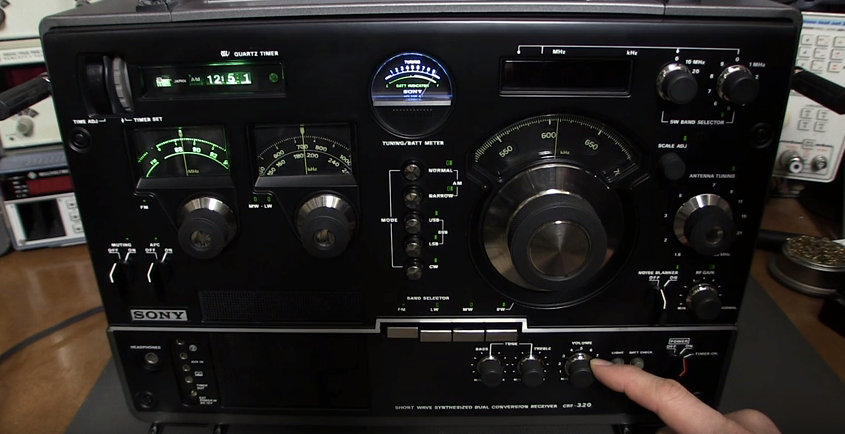
Many thanks to SWLing Post contributor, Brian, who writes with the following inquiry:
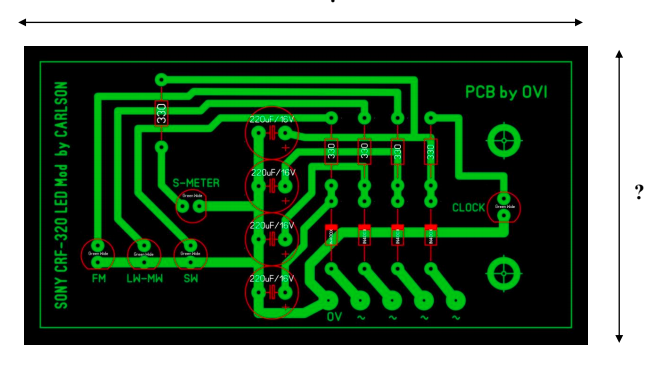
I found a pic of a printed circuit board, based on Mr. Carlson’s Sony CRF-320 panel light mod, on the Yahoo 320/330 fan page but no board dimensions or component values.
I plan to order a bunch of these so if anyone can sort out some measurements on this board or are interested in obtaining a board, please comment. I am a novice in this and am unsure of the component values. I have wired up an electric guitar, so this I anticipate will be less complicated.
Post readers: If you can help Brian with this info, please feel free to comment!
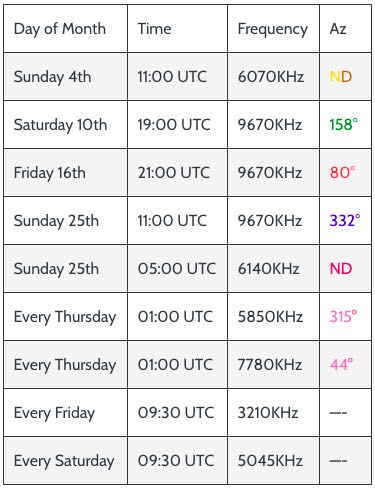
Many thanks to SWLing Post contributor, Fastradioburst23, who shares the broadcast flyer above for KSOL. Broadcast times are April 18 and 25, 2021 at 1500 UTC on 9670 kHz. Thanks for the tip!
Please support this website by adding us to your whitelist in your ad blocker. Ads are what helps us bring you premium content! Thank you!