Shortwave listening and everything radio including reviews, broadcasting, ham radio, field operation, DXing, maker kits, travel, emergency gear, events, and more
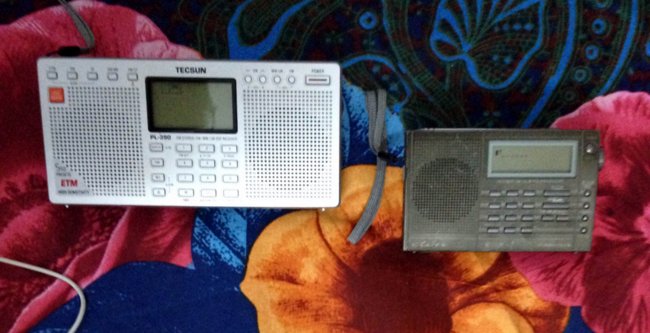
“I love these radios (see photo above). The Tecsun PL-390 stereo DSP radio with selectable band width- is able to pull in a slew of shortwave stations in quite clearly (of course a lot depended upon time of day and atmospheric conditions.) I can routinely receive signals from Asia, Australia, South America and Europe which is exciting!
And another one is my small Eton E100 Radio- The highlights of this one is that the stereo through headphones sounds great. Its Informative LCD display includes the frequency and the time while the radio is on (some other radios require a keypress to display the clock). It also features a nice amber backlight for the LCD display. Not to forget the sturdy whip antenna.”
Congratulations, Vimal–and many thanks to everyone who shared their photos.
Vimal’s entry was chosen at random from the 62 SWLs and ham radio operators who shared their shack/listening post photos. What an amazing number of entries!
I plan to take the many photos and notes we received from readers and turn them into an online photo galley. I’ll post this as soon as I’ve curated and formatted entries.
If you didn’t win this contest, fear not! We’re already plotting another simple & fun contest before the end of the year.
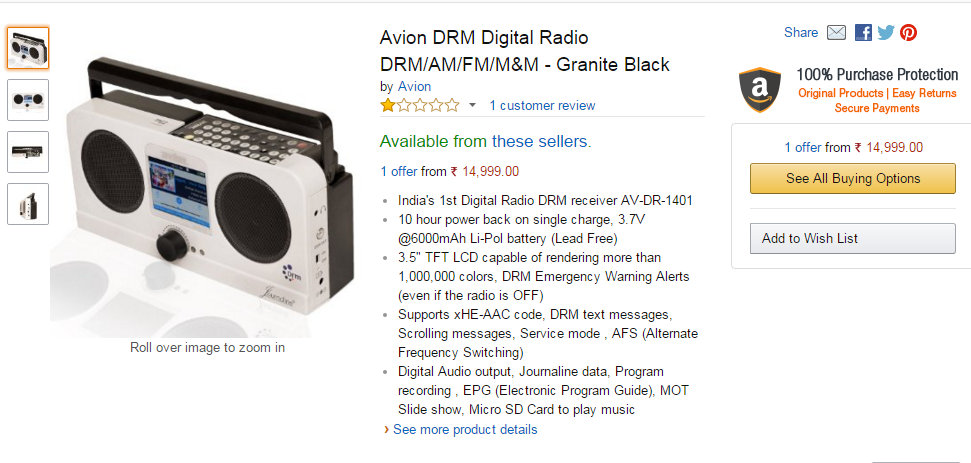
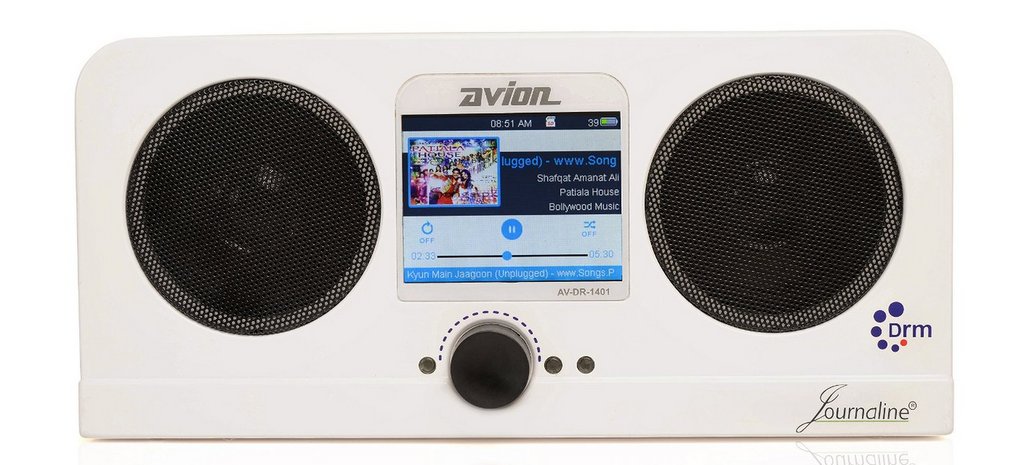
At time of posting, The Avion DRM receiver only has one review by someone who has (obviously) never used the radio. They give one star then state: “price is very high. so i hate this product.”
While I dismiss reviews like this, I must believe that this price is, indeed, high for most Indian consumers; especially when compared with alternate forms of media consumption (smart phones, analog radio, FTA satellite TV, etc.). It would be high for me, too.
I hope, at least, that the Avion performs well. I have no plans to review the Avion DRM receiver at this point simply because it’s challenging for me to find and decode DRM here in North America with my SDRs hooked up to large external antennas. Don’t get me wrong–occasionally, I do get amazing copy–but it’s typically when conditions are favorable. Listeners in Europe, Asia, and Oceana would have better results, no doubt.
Has anyone seen an objective review of the Avion DRM receiver? Please comment.
While the audio sounds identical to that of UVB-76’s on 4,625 kHz. I strongly suspect this is simply a pirate radio station relay–especially since it’s broadcasting just below the 40 meter ham radio band. Either way, it’s a great catch! Thanks for sharing, Andrea!
Many thanks to Chris Smolinski, from the HF Underground, who has crunched some numbers from North American pirate radio loggings on Halloween. The number of pirates (and his charts with times and frequencies) are most impressive and informative.
Chris posted the following on the HF Underground and has kindly allowed me to share them here as well. Chris notes:
Here are two charts showing who-was-on-when-and-where this Halloween.
Many thanks to SWLing Post contributor and noted DXer, Guy Atkins, for the following guest post:
Wellbrook 1530LNPro vs ALA1530S+ Imperium Loop Antennas
-Guy Atkins
This past weekend I found some interesting results from medium wave DXing with both models of Wellbrook Imperium loop antennas at the “fabled” Rockworks cliffs near Manzanita, Oregon USA. This location has become popular the last few years with Oregon, Washington, and British Columbia DXers due to the signal enhancement at this narrow strip of land approx. 450 feet above the Pacific ocean. The main benefit seems to be splatter reduction of “pest” stations due to the signal blockage of the rock walls blasted into the cliffs for the coastal highway 101. However, a boost of signals around local sunrise is also beneficial, and is a common occurrence near salt water beaches.
Because of the limited space along this scenic coastal highway, all antennas used for DXing need to be both compact and temporary. Wellbrook loops supported on pro-audio speaker stands are a great way to go, and can easily be set up in the pre-dawn darkness.
Comparison
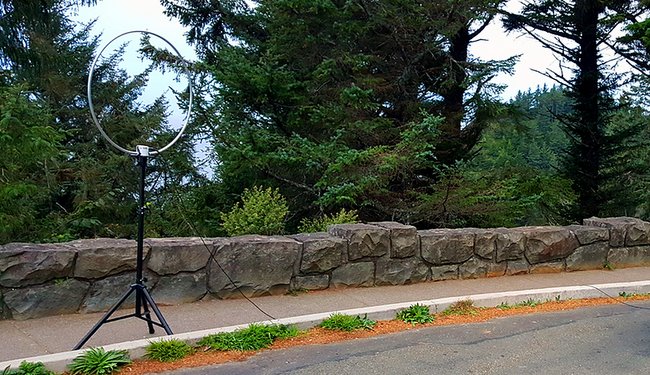
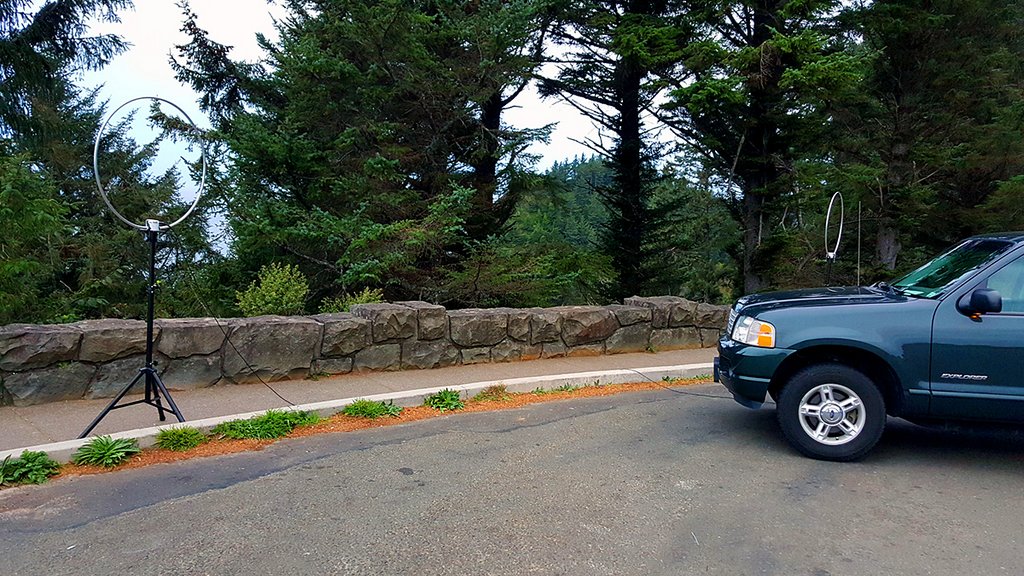
Both Wellbrook loop antennas mounted on “pro-audio” tripod stands right at the cliff edge at Rockworks Cliffs. (Photo: Guy Atkins)
This is a comparison file of weak signal reception with the two models of Wellbrook Communications “Imperium” series loop antennas: the ALA1530LN “Pro” Imperium and the ALA1530S+ Imperium.
Both models of compact, 1-meter dia. active loops are excellent for reception from longwave & medium wave upwards. However, the ALA1530LN “Pro” excels at LW & MW with its low overall noise level and 9dB higher gain, engineered by Wellbrook for improved signal-to-noise ratio (S/N) of up to 10 dB. S/N on the HF bands is reportedly better also.
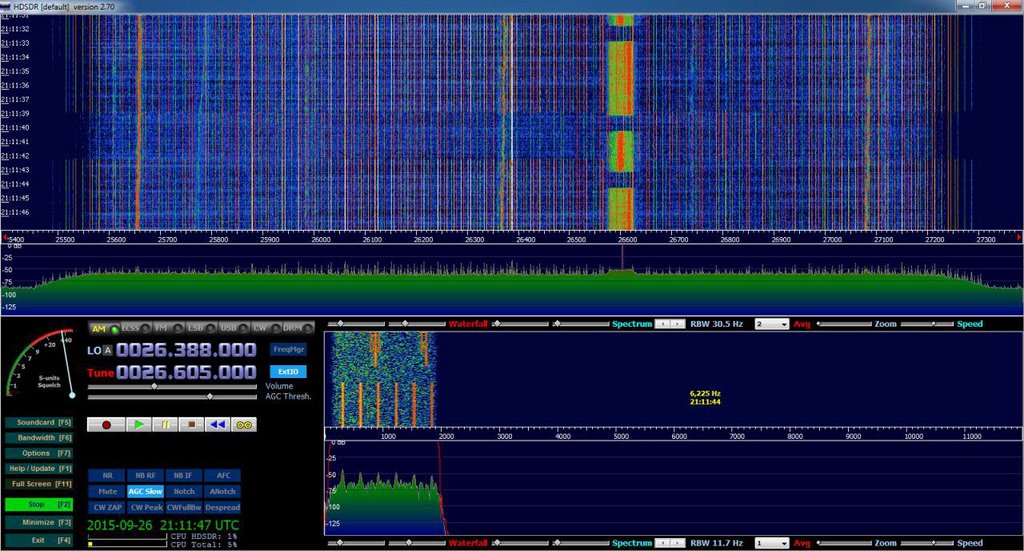
My laptop running HDSDR software in my SUV; the receiver is an Elad FDM-S2. (Photo: Guy Atkins)
On the weekend of October 24th, 2015 I was DXing at the “Rockworks” cliffs on the Oregon coast near Manzanita, OR. Both of these Imperium series antennas were in use and I was recording the medium wave band with an Elad FDM-S2 SDR receiver. Both antennas were fed with identical 25 ft. lengths of RG-58 coaxial cable.
The demonstration in this video begins with 10 seconds using the ALA1530LN Pro Imperium loop, alternating with 10 seconds with the ALA1530S+ Imperium loop.
The first signal tuned is aviation voice beacon “SQM” from Level Island, Alaska on 529 kHz (400 watts). The signal is weak, but audible as it rises above the noise floor. The reception improvement with the ALA1530LN Pro is evident.
Half way through the recording the frequency is switched to 1710 kHz, where an unidentified station (possibly a MW pirate) is audible playing the 1967 Zombies tune “Time of the Season”. Again, the clip starts with 10 seconds with the ALA1530LN Pro alternating with 10 seconds of the ALA1530S+ Imperium.
Each antenna is a worthy, compact loop for DXing, but for chasing the weakest signals with the best readability I think the ALA1530LN Pro shows its advantages.
Many thanks, Guy, for sharing your loop research!
What I love about your portable SDR set-up, is that you can go to the cliff side, set up your antennas and equipment, record the spectrum on your SDR, then go back home to analyze and listen to what you captured. It takes some of the pressure off while you’re on-site.
This year at the Dayton Hamvention, I purchased the Pixel Technologies RF PRO-1B mag loop antenna. I used it (for the first time) at the PARI DXpedition. We were all impressed with its performance. I would love to compare it with the ALA1530LN Pro at some point in the future.

 the Aliexpress web marketing person.